Frivolous
The dictionary definition of that title is “not having any serious purpose or value.” You would think that at my age I would consider carefully the books on which I am going to spend my remaining reading time, and look for those that are worthwhile, or profound, uplifting, meaningful,, maybe educational; but it seems that I instead have the occasional need to abandon all thoughts of quality of phrase, good characterization, or realistic world-building to read something that is the snack food equivalent of Cheetos or Skittles. I believe there’s no type of book more addictive than a good thriller, and even the bad ones have the power to keep your attention if the plot points are sufficiently twisty. I proved that point to myself by reading The Housemaid, by Freida McFadden, and then the sequel, The Housemaid’s Secret.


This book has been touted on the “Friends and Fiction” Facebook page I have started to follow as a slightly more upscale version of the “What Should I Read Next?” crowd. The post-ers on F&F seem to read more, more varied, and generally better fiction, but the common denominator of “Oooh, I couldn’t put it down!” still prevails, regardless of quality. Here I am, sounding like a total snob, when one of the tenets of readers’ advisory is “Never apologize for your reading taste!” (Betty Rosenburg’s first law of reading, Genreflecting, 1982), and another is “There is no such thing as an objectively ‘good’ book.” While I try hard to refrain from shaming people for their book choices, what would a review blog be without a little gentle mockery now and then? Especially when it’s directed at myself…
The Housemaid and its sequel star Millie, a down-on-her-luck ex-con who’s trying desperately to find a job that will give her somewhere to sleep besides the back seat of her Nissan. Since she went to prison in her teens and stayed there for 10 years, she has few marketable skills; while she has done her share of fast food gigs, the holy grail at the moment is a job as a live-in housekeeper. The problem is, most people run a background check on someone they plan to hire to fill that role, and once they find out Millie’s past, they politely shut the door. But finally, Millie’s luck changes: Nina Winchester, beautiful and poised on the surface but giving off a bit of a weird vibe, offers Millie a position cleaning, cooking, and occasionally nannying for her little family—husband Andrew and daughter Cecelia—and Millie jumps at the chance. She rapidly discovers some disturbing nuances in the household, but beggars can’t be choosers, so she puts up with Nina’s foibles and her spoiled brat of a daughter, all the while trying not to covet Nina’s lifestyle, not to mention her handsome, soulful, and much put-upon husband. Then things take a dark turn…Dum Dum DUUUUUMMMMM!
The narrative in this book is first-person, and pretty much at the level of “Dear Diary.” It’s hard to tell whether the characterizations are kept purposefully opaque or whether McFadden is just not a good describer. The point of view switches around for sections of the book, but the voice stays a little bit too much the same. The plot twists are arresting, but some of the events on which they are based are laugh-oud-loud ridiculous, as in sitting in your chair reading along and then shouting “Oh, C’MON!” at the text as your cat bolts off your lap in terror. The redemptive value of bits of dark humor here and there can’t be overstated. But still…there’s something that keeps you reading. I loved how one Goodreads reviewer, Dan, put it in his synopsis:
This book is not as clever as it thinks it is. You probably won’t want to put it down. But you may be asking yourself what the hell you just read.
DAN, GOODREADS REVIEWER
As for the sequel, it is exponentially less believable than the first. And yet, I finished it and went looking on Goodreads to see when book #3 in this series will be published (June 2024). Let’s face it: Even Cheetos and Skittles can be addictive.

Psycho Thriller
Yes, “psycho” is an abbreviation for psychological thriller, but also…well, there are characters in this book that might qualify for the title without the abbreviation.
The Fake Wife was not my favorite Sharon J. Bolton thriller, but at this point Bolton is almost an automatic read for me. The book is certainly full of twists and turns, some expected and some definitely not. It’s complex and intriguing, but you really have to pay attention to know what’s happening at any given moment. There are multiple flashbacks from several characters to follow, and we get threads of the story from all directions—the victims, the perpetrators, the cops—that all weave together to gradually reveal what’s going on.
As the book opens, Olive Anderson is having dinner on her own in her hotel dining room in Hexham. A beautiful stranger walks up and seats herself at Olive’s table as if she belongs there, and then starts an elaborate game of pretense, engaging the waiter in banter and implying she is Olive’s wife. Olive is intrigued and decides to play along—it’s a lot more fun than sitting there by herself mulling over her marriage to Labour MP Michael Anderson. But as the evening goes on, the lighthearted pretense morphs into something else, and soon Michael is reporting Olive as missing and DS Lexy Thomas and traffic cop PC Garry Mizon are teaming up to try to solve what becomes an increasingly complex and bewildering situation.
This is an immersive domestic puzzle combined with a police procedural, adding more characters into the mix as the plot continues, with back stories that completely change what you were thinking at the beginning. It’s almost impossible to figure out who is telling the truth—if anyone is. The characterizations are excellent, and as for the setting, the beautiful but frigid winter scenery in the north of England provides both background and an extra sense of menace. If you like reading books that are set at the same time of year and in the same climate you are currently inhabiting, this is definitely a winter tale!
I’m kind of hoping Bolton decides to bring back the odd police couple in another book—their relationship provides both depth and humor in a story that is otherwise kind of dark. But if you enjoy dark (and confusing and exciting and suspenseful), this book might be a good one for your reading list.
Writer of the dark
I have been a longtime fan of Sharon J. Bolton‘s books, variously characterized as mystery, suspense, or thriller. I defined the difference between those in a previous post; let me recap here:
First of all, neither a suspense novel nor a thriller is about solving a crime, they are about stopping a killer or a crime. So they are not necessarily a whodunit as is a mystery; we may know who the villain is from page one.
In a thriller, the protagonist is in danger from the outset, and action is a required element. Pacing is the key ingredient. In suspense, danger is more important than action, and the protagonist becomes aware of danger only gradually. Setting and mood are key. There must be terror, confusion, upset, and conflict.
A thriller has to start off with a bang, and have a clearly defined hero and villain, because the thriller is all about the push and pull between the two. By contrast, the only real requirement of a suspense story is that it build, and that it keep the reader on edge with a series of reveals or surprises until the final one. Suspense can be present in any genre; a suspense novel is simply one where the reader is uncertain about the outcome. It’s not so much about what is happening as what may happen. It’s about anticipation.

Bolton is a nuanced writer, with examples of all of these in her repertoire, sometimes putting the characteristics of all three into one volume. I would call Daisy in Chains a psychological thriller, and perhaps The Craftsman as well, while Dead Woman Walking would probably fall more into the suspense line. And then there is her ongoing mystery series, featuring Detective Constable Lacey Flint, from which I just read #5, The Dark. I am always thrilled when a new book in this series is published, because they are so involving, so ingenious, and so suspenseful—they leave me breathless. This one was no exception.
Lacey is, first of all, such an intriguing character. She comes out of nowhere, makes a name for herself by exhibiting “derring do,” aka extreme recklessness in solving cases for the London police by any means necessary (including dangerous undercover work), and then takes a baffling sidestep from advancement up the ladder to instead become part of the Marine Policing Unit, working on the Thames river. She’s aloof, almost secretive, even with her best friends and occasional love interests, and as the series progresses you learn that her secrets are not garden variety and she has a good reason (several, actually) for maintaining her solo status; but at the same time, you wish for her that she could let it all go and simply be happy! In short, it’s hard not to get involved with her life story.

Then there are the mysteries, and this latest is a doozy. It relates to what’s been happening in the world during the past few years as women’s rights have begun to be rescinded and certain men scheme to steal even more freedoms in their attempt to turn the world back to when they ran things without dispute and the women stayed home and had babies. In The Dark, there is an underground movement lurking on the dark web that is stirring up the “incels”—men who are involuntarily celibate and therefore harbor a deep dislike of the women who deny them—as well as any other guy who has felt overlooked in favor of a woman, for whatever reason. They target women who (they claim) have benefitted from affirmative action, those who they perceive as having favored the rights of women over men, and pretty much all women who choose more successful, more attractive men (or other women) over them.
And they aren’t just talking—they are inciting men to violence, staging actions such as harassment of women walking alone on the street after 10 p.m., intensive catfishing on dating sites, and the like. The women are both terrified and outraged, and the police are using every traditional and cyber tool at their disposal to figure out who are the ringleaders. And Lacey is, of course, smack dab in the middle of all of it, having been in the right place at the right time to foil their opening act, when a baby is stolen from its carriage and tossed into the Thames on a pool float and Lacey is in the area in her kayak to pull off an audacious rescue.
The scariest part of the story is when one of the incel leaders figures out that he has a past connection with Lacey, and she suddenly becomes the focus of everything he hates in women. All of the regulars from previous books—Dana, Helen, Victoria, Mark Joesbury—are present, along with some new characters from Joesbury’s team, plus Emma Boston, a reporter who plays a pivotal role. The book is as dark as its title, and scarily believable, given recent activities by the religion-obsessed right wing active in many countries today.
The suspense throughout is riveting, and I will confess I lost some sleep sitting up to read this. It’s been a while since Bolton wrote a Lacey Flint, and I was so glad she was back. Bolton has a new book (not in this series) coming out on November 9th, and I already have a pre-order destined for my Kindle the minute it’s 12:01 a.m. on that date! If you’re not familiar with Bolton’s books and you crave more thrillers and mysteries, start reading!
Endings
Does the ending of a book alter your perception of the entire story? This is what I’m pondering, a few minutes after turning the last page of The Moonlight Child, by Karen McQuestion. The book had a compelling premise and an engaging presentation, but the climax and aftermath of the story was too casually told for what had gone before. And that was the crux of the problem, I think—the author ceased showing us and instead starting telling, and the whole story suddenly lost its mojo.

Sharon Lemke is recently retired and reveling in the ability to call all her time her own. She had thought that she would be at loose ends and perhaps immerse herself in volunteer work, but instead she is simply enjoying each day. One night she stays up late to watch a lunar eclipse, and from an upstairs bedroom window she observes something that puzzles her. In the house behind hers, a little girl, perhaps five years old, is standing on a step-stool doing dishes while the lady of the house apparently berates her. First of all, why is a child of that age performing household chores at midnight? and second of all, Sharon knows a little bit about these neighbors, the Flemings, enough to know that they have one son, Jacob, who is 17. So who is the little girl?
Soon after this incident, Sharon’s daughter, Amy, an attorney, calls her to ask a rather large favor: She is a mentor for a teenager, Niki, a former foster child who at 18 has just aged out of the system. Niki hasn’t been able to find an appropriate place to live, and Amy wonders if Sharon would consider letting Niki stay with her for a while. Sharon somewhat reluctantly agrees, but after Niki arrives the two form a bond much like grandparent and grandchild, and both are pleased to go on with the situation.
Niki’s bedroom overlooks the Fleming family’s back yard, and after she, too, notices some odd occurrences surrounding the anonymous little girl who apparently lives with them, she and Sharon decide to call social services. But the wheels of bureaucracy turn slowly; the two become impatient and decide to do a little detective work on their own, to find out who this child is, and what relation she bears to the family. This sets some dramatic events in motion.
I really enjoyed about 85 percent of this book. The characters were interesting and memorable, their interactions dynamic, and the story moved along at an exciting pace, with numerous small surprises to keep things interesting. The psychological aspect of the antagonist—the sociopath, Suzette Fleming, whose selfish needs drive the story and motivate the actions of every member of the Fleming household—was fascinating to observe, and the differences between her perception of the world versus what other people were actually thinking were quite entertaining.
But…then a few things happened that turned me against it. First of all, although Sharon Lemke is initially set up as an important protagonist, she all of a sudden takes a back seat during the crucial action of the book, which was disappointing. I felt like the author decided to relegate her permanently to “grandma” status, rather than allowing her to keep her agency.
Second, the crucial scenes in the resolution of the child Mia’s situation were in some ways excitingly written, but we suddenly lost touch with the thoughts and emotions of Suzette, who was the driving force of all the internal action throughout, and the rest of the book becomes simply a series of narrated events without the context of her delusion. The whole ending resolved itself with comparative ease, but in the process it became truncated, leaving the reader (or, at least, this reader) feeling dissatisfied even though everything had been wrapped up.
So, my question: Does the ending ruin the rest? Not entirely, but sufficiently to change my opinion of this book from an enthusiastic five to a somewhat tepid three. All I could think, for the last 15 percent, was, Damn! and it was going so well!
Books about/with books, writers
I picked up a bargain e-book last week, a “relationship fiction” novel by author Susan Mallery. I hadn’t read Mallery before, but she’s quite popular, apparently. Most of her books seem to edge over the line into romance, but some are more story- or character-driven. She has quite a few short series and some stand-alones, one of which I chose from the BookBub E-book Deals that arrive in my inbox each day, because I was drawn in by the title: Boardwalk Bookshop. I am a sucker for any book that includes bookstores, libraries, readers, and writers in its title or content, so it was inevitable.
Although supposedly about a bookshop, the store in question is actually one large space divided up into three separate retail establishments (bookstore, bakery, and gift shop) shared by three women who wanted shops on the beachfront but neither needed the larger space nor could afford the price tag on their own. Despite not knowing one another, they impulsively team up to lease the place, installing their three enterprises side by side, each operating independently with their own employees and cash registers but benefitting greatly from the cross traffic of the other two businesses.
Mikki, the gift store owner, is a recently divorced 39-year-old who has two almost-grown children and a comfortable co-parenting arrangement with her ex-husband. Although they have been apart for three years, Mikki has not really moved on; right after the divorce she went on three separate but equally disastrous dates with various partners and gave up. A planned solo trip to Europe has suddenly awakened her to the fact that she could live another 40 or 50 years and doesn’t want to do so alone, but she’s not sure she has it in her to put herself forward again as a single, datable woman, with all the trial-and-error that involves.
Ashley, the baker, is swoonily in love with her live-in boyfriend Seth, who seems like the perfect man and mate except for one large flaw that, when it manifests, throws Ashley for a loop and has her doubting him, herself, and what will ultimately become of their relationship.
Bree, the book purveyor, raised by indifferent, self-involved author parents, met a man equally as brilliant as they were but who seemed to promise what they never gave her—love and a sense of belonging. Instead, he betrayed her rather spectacularly and then died, leaving her a young widow whose walls don’t come down for anyone—even Ashley’s persistently interested brother, Harding (who is also a writer).
The three women, initially bonded over their joint enterprise, slowly become friends and weigh in on each other’s options for romance, personal growth, and more. There is a dynamic, well-fleshed-out cast of secondary characters to interact with them, and the Los Angeles seaside setting is well utilized.
I liked this book, with some reservations: I thought both the narrative and the language could have been more nuanced. I found each of the women in turn to be dithery about her choices and actions. The three kept circling around to the same indecisiveness again and again, and while this may be how real life goes, in a novel it became repetitive and a little irritating. But the growth and change ultimately exhibited by each of them, while uneven, did move along to satisfying conclusions for all, and I mostly enjoyed the reading experience. I could be persuaded to try some other Mallery titles, probably when I am looking for a light, fast read as a palate cleanser between more serious novels.
The second book-oriented story I read this week was The Woman in the Library, by Sulari Gentill, and it was a cat of a different color! I don’t remember where I came across this—it might have been on the readers’ Facebook group—but I’m so glad I picked it up, although others were not so happy with it. This is one of those books that (on Goodreads) either gets a five-star exclamation of “Yes!” from its reader, or a one-star “too weird for me.” I fell into the former group, with a few reservations—but mostly I was enthralled.
This book is the ultimate in meta, and the jump between reality and fiction is what kept me reading. The real-life set-up is that an Australian author of mysteries, Hannah Tigone, is writing a novel set in Boston, but she can’t travel from Sydney to do any on-site research due to Covid quarantine restrictions. Enter email pen pal Leo Johnson. Leo is initially introduced as an author trying to get his book published and reaching out to Ms. Tigone, a writer he admires, for suggestions or, preferably, actual assistance with finding an agent. But then Leo moves on to suggest that since he lives in Boston, he can easily assist with on-the-ground research, acting as a beta reader to give her information about locations and also vetting her language, since American slang differs markedly from Australian and it’s easy to slip up (calling a sweater a jumper, for instance) if you’re not paying attention.
After Leo’s initial email, the book moves into Hannah’s writing of her mystery. Her protagonist is Australian Winifred “Freddie” Kincaid, working on her own novel, living in Boston courtesy of the Marriott Scholarship, a writer’s grant that comes with a brownstone in Carrington Square. In the opening, Freddie has gone to the Boston Public Library for the day, planning to work on her book in its famous Reading Room, but is distracted by the three other people sitting at her table. She idly jots down notes on each of them as possible characters—she calls them Handsome Man, Heroic Chin, and Freud Girl—but then all four, along with the rest of the library users, are startled by a terrified scream coming from somewhere nearby. The library is locked down while security searches for the woman who cried out, and the four begin to chat about their immediate circumstance and a little about themselves; when they are released, they decide to go together to get something to eat, and this is the beginning of a four-way friendship.

It becomes harder as you go on to remember that Freddie is not the true protagonist, nor are these others real people—all are a part of Hannah’s story—but at the end of each chapter, the reader is yanked back to that reality by Leo’s comments on the last chapter Hannah has sent to him. Leo becomes increasingly invested in the contents of Hannah’s book, and…but that would be telling, and I have revealed enough. There are two stories here (or are there three?) and their juxtaposition and relation to one another kept me reading to finish this book in 48 hours.
The reservations I mentioned: The pacing wavers here and there, and sometimes the characters are a little flat—not well enough fleshed out. Also, insta-love rears its weary head. But these things didn’t bother me because they are, after all, part of a first draft of a manuscript! Remembering that as you go along makes everything completely believable, because Hannah still has the opportunity to come back and fix or change any of the details.
Hoping you pick this one up and are as delighted by it as I was, rather than falling into the group who considered it “weird.” The truth is, it IS weird and that’s what I liked!
A dark one
I just finished Jar of Hearts, by Jennifer Hillier, and it definitely lives up to that quote I used two books back about Hillier imagining the worst and then writing about it. Lest you should be taking the title seriously, based on that information, let me reassure you that there is not a jar filled with literal hearts—they are the cinnamon red-hot variety. But if you are a person, like the main character Georgina (nicknamed Geo), who associates tastes or smells with particular events from life and is thus permanently put off from ever enjoying them again, you will probably not be eating red-hot cinnamon candies any time soon. I will say up front that this book is not for the sensitive or squeamish. It is gritty, explicit, and dark. I have a fairly strong stomach when it comes to reading this kind of story and still found it challenging. So now that I have given you the “trigger warning”…
Jar of Hearts is ultimately about three friends: Angela Wong, the popular girl—cheerleader, guy magnet, gorgeous and charismatic; Geo Shaw, the otherwise engaging one whose light is slightly dimmed by keeping company with her best friend, Angela; and Kaiser Brody, who follows in Geo’s wake like a smitten puppy dog. This is who they were in high school; but when this story begins, Angela is 14 years dead, Geo is the star witness (and accused accessory), and Kaiser is the arresting officer of Calvin James, serial killer, Geo’s former boyfriend and the one being tried for Angela’s murder.
This is a book about friendship, obsession, jealousy, and death—but all the assumptions are out the window from the first page. No one is innocent among the interconnected friends and lovers whose actions doom one another to various fates, and although at least two of them would like events from the past to remain buried forever, the others will actively or passively guarantee that’s not going to happen.

The story’s pacing is designed to keep you looking for answers throughout its five parts, with clearly defined jumps from past to present and back again, and new elements to the story that have you second-guessing absolutely everything you know about everyone involved. It explores the question of nature vs. nurture, and highlights the theory of the deficiency of the underdeveloped teenage brain and the psychology behind ideas about compartmentalization and deflection. It is chilling, involving, and more than a little messed up. In other words, Jennifer Hillier delivers again.
It’s thriller time
I’m not usually an avid reader of thrillers, but after my extremely positive reaction to Jennifer Hillier’s Little Secrets, I wanted to see if she (and I) could repeat the experience, so I checked out Things We Do In the Dark. And although I didn’t love it quite as much (I liked the set-up and characters in Little Secrets better), it turned out to be a similarly riveting read with some fascinating characters, unexpected twists, and a great ending.
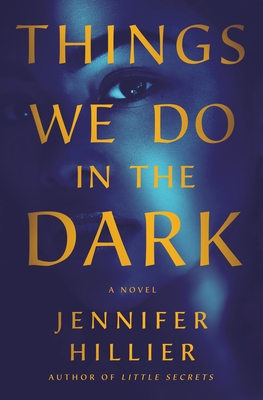
Things look bad for Paris Peralta. She’s been married to a wealthy, successful man more than 30 years her senior for just a few short years, and now he’s dead and she’s been accused of his murder. But as horrifying as this is to Paris (especially since she didn’t do it), it’s not the worst eventuality she is anticipating as a result of all the publicity surrounding Jimmy’s death. Paris has a past full of secrets she doesn’t want exposed, and there is one specific person who knows who she was and what she did. Paris thought she was safe from Ruby Reyes, who was serving a life sentence for committing a murder of her own, 25 years ago, but now Ruby is unexpectedly out of prison early and is all too ready to exploit her knowledge about Paris’s past to get what she wants. And she may not be the only person from back then who is a threat to Paris—having your picture on the cover of every magazine in town when you’re trying to maintain a low profile can be hazardous!
The minute I finished this, I went to the online library to put a hold on the e-book for Hillier’s Jar of Hearts. She has a new fan.
Secrets and twists
It’s been a really long time since I was so riveted by a story that I made a conscious decision to stay up at night until I had finished it. I started Jennifer Hillier’s Little Secrets two days ago, and at bedtime tonight I was at 71 percent (Kindle). At 79 percent and 1:30 a.m., when I probably would have turned out the light on a normal reading night, I got back out of bed, made myself a snack (dinner was a long time back at 6:30 p.m.!), sat down in my chair and kept going. Luckily for me, as happens with Kindle books, the publisher had included a bunch of stuff at the end, including book club questions, author notes, and a preview for her next book, so I only had to read to 90 percent instead of 100. But I would cheerfully have gone that extra 10 percent, after the turns this book took in Part Three.

The book opens with that nightmare of all parents holding their child’s hand in a crowded place—for just one second, struggling to juggle packages and her cell phone, Marin let go of four-year-old Sebastian’s hand in Pike’s Peak Market in Seattle at the height of the Christmas rush. For a few seconds more, she felt him pressed up against her side and then, as she pulled her attention away from her phone and looked around, he was just gone. As is the initial expectation with any mom with a lost kid, she thinks the crowd will open and he’ll be standing there, turning in place, looking for her and panicking a little, and she can sweep him up and reassure him. But he’s not.
Six weeks later, the FBI tells Marin and her husband, Derek, that they have followed every lead and have turned up absolutely nothing new since day one, and that although the case will, of course, remain open, they will now turn their focus to the cases of other missing children. Marin’s response is to attempt suicide. Once she recovers some balance, she decides she will hire a private investigator to keep going with the case; Derek feels it’s a vain effort, so she allows him to believe she has let the P.I. go after a month, but instead she keeps Victoria on the job and, while seeking out some tenuous leads, one of Victoria’s employees spots Derek with a young art student with whom he is apparently having an affair.
Roused from her stupor of despair by a surprisingly strong flash of rage, Marin realizes that she has lost her son, but she’s not going to lose her husband, too; this girl is an enemy with a face, and Marin decides she’s going to fix this problem and keep intact what’s left of her family.
Jennifer Hillier’s author blurb on Goodreads says, “Jennifer Hillier imagines the worst about people and then writes about it.” Boy, does she ever! I kept thinking I was one step ahead and had figured something out, only to be shocked into a delighted exclamation as each secret revealed itself and led to five more. Nine times out of ten, I am disappointed by the latest book lauded for psychological suspense, but this one was definitely an exception. I’m hoping now that her other five books are also exceptional, because I’m headed right for the digital library for Kindle reservations (at 2:30 a.m.)!
Mysteries need another name
I have been off the radar for a while because, when I bought the Sydney Rye mysteries, I bought them in an e-book omnibus of eight books, and I have spent the past two weeks reading all of them, which did a big favor to my Goodreads challenge for the year but didn’t do much for this blog!

They are specifically titled the Sydney Rye Mysteries (by Emily Kimelman), but after the first one, I have to disagree with that genre specification. Although in book #1 there is a dead guy whose killer must be discovered, and this puzzle leads to others within that volume, the subsequent books are not what I would characterize as mysteries. There aren’t specific crimes to solve, although there is a high level of criminality throughout; the books are much more like thrillers or suspense.
The events of the first book have awakened in Joy Humbolt, now rechristened Sydney Rye, a passion for justice, and her first step towards that, in book #2, is to go along with Detective Mulberry’s plan for her, which is to work with a Tai Chi and weapons master whose parallel expertise is teaching dogs to be fighting partners; Sydney and her dog Blue train with Merl and his dobermans, and turn into a couple of badasses practically unrecognizable to the friends and family of Joy Humbolt.
Subsequent to this training, Sydney basically looks around for injustices (or they arrive on her doorstep), from white slavery to organ harvesting, and goes after the people responsible, sometimes on her own but mostly aided by various people from her past, including Mulberry, her sometime romantic partner and computer hacker Dan, the aforementioned Merl, several imprisoned and abused women she rescued who decided they wanted to pass on the favor, and various well-met strangers along the way. And while there is a specific issue, bad guy or guys, and challenging task in each book, none of them could be characterized as mysteries. There are occasionally bigwigs behind the little guys who have to be discovered and ferreted out, but if you are wondering how to characterize these books, they have a greater resemblance to the Jack Reacher (Lee Child) franchise, for example, than to any traditional murder mystery series.
If you like that kind of thing, however, with a legendary protagonist and a lot of exciting action with a positive conclusion for the downtrodden, then by all means broach the Sydney Rye books…just don’t think of them as mysteries!
By the way, the eight volumes aren’t the end of this series—numbers nine through 15 currently exist, and who knows (besides Emily Kimelman) if there will be more?
Genre confused
I am a big fan of Peter Heller’s work. I have read all of his novels and haven’t disliked a one of them, although I do have favorites. So I was delighted to discover that he has a “new” book out (almost a year old, now).

The Guide has the trademark lyrical descriptions of nature that one expects from Heller. The theme is fly-fishing, and although I don’t fish and am not a fan of early morning activities, his narrative of the terrain was so lovely that it calmed my breathing as I read it, making me long for wide open spaces with the sound of flowing water in the background and the dawn vista of a still pool with mayflies rising and rings spreading outwards as the sun heats the surface and the fish rise to feed.
Although this book can certainly be read as a stand-alone, it is, in fact, a sequel to Heller’s book The River, in that the protagonist is Jack, a few years on from that tragic adventure. Although it enhanced the experience to know the back story referenced periodically throughout this book, it wasn’t such a direct continuation that anyone would feel the need to go back and review the previous story in order to feel caught up. It’s made plain that Jack has been damaged by an event in his past, and that he sees this term of employment as a guide at one of the most exclusive fishing resorts in the country as an escape from his everyday life, in which he suffers from silence and too much free time.
Jack is taken on by the Kingfisher Lodge, on a pristine stretch of protected waters near the town of Crested Butte, Colorado, to replace a guide who left abruptly. The resort caters to the über-wealthy and the camera-shy celebrity, and provides an all-encompassing interlude of comfortable quarters, gourmet dining, camaraderie, and sport. His first assigned client is Allison K., a woman Jack vaguely recognizes as a hugely famous country western singer (he’s not really into music). She also turns out to be gifted at and dedicated to fly fishing, and the two share what’s described as an almost spiritual out-of-body state as they roam up and down the river, casting their lures.
But there’s something weird going on in this paradise, and soon Jack is nervous and on the defensive as minor violations of some resort rules result in some out-of-proportion reactions and repercussions. He and Allison begin first to speculate and then to research what they’ve been told, as anomalies crop up and their status becomes ever more perilous.
Although I enjoyed this book over all, there seemed to be a profound disconnect between the scene setting and the behind-the-scene activities. Heller’s other books certainly contain elements of mystery and suspense, but for some reason this one didn’t feel organic. For one thing, the “nature documentary” aspect of the book dominates for about 80 percent of the book, with only small hints and incidents thrown in here and there to increase the reader’s feelings of disquiet, and then all of a sudden, in the last 20 percent, it becomes all about the alter ego mystery of the story. Nature buffs will enjoy the setting and melodic language about fishing, while thrill seekers will get their payoff with the bizarre back story, but the genre blending that took place here needed a few more spins of the Kitchenaid to work properly. I was still fairly happy with the book, however, until I reached the last few pages. There are few things I dislike more than a book that shows the entire story, only to punt at the end by “telling what happened” after the significant events occur, instead of taking the reader directly through them, and that’s sort of what happened here.

Primarily as a result of that ending, I would have to recommend Heller’s other books over this one, although the prevailing narrative was the verbal equivalent of the glorious imagery experienced in the 1992 film A River Runs Through It; if you are susceptible to words that so graphically paint a picture, you will enjoy this book no matter what.
 The Book Adept