Expectations
One thing you have to do as a reader, if you are not to be eternally disgruntled with life, is to try not to have outsize expectations of authors. That’s tough sometimes, particularly if an author has never disappointed you with a single one of her books until the one you are reading right now, which you cannot believe came from the same person’s formerly fertile brain. Sometimes it’s not a matter of your icon having written a bad book, simply that she has written one that doesn’t resonate with you, or is directed to a different age group than you expected, or was written earlier in her career before she developed the amazing story-telling abilities that hooked you later on.
There are several authors I have run across who have surprised me in this way: One of them is Elizabeth George, whose masterful mysteries featuring the unlikely detective team of Thomas Lynley, son of the peerage, and Barbara Havers, woman of the people, cause me much excitement whenever they emerge. When I found out she was also trying her hand at young adult books, I was excited to see what she would produce, particularly because, as a teen librarian, I was always looking for a gifted “new” author to pitch to my YA book clubs. I read the first one the minute it hit the library shelf, and was both amazed and dismayed; where was the intricate plotting of her adult mysteries? This pseudo-paranormal mish-mash couldn’t be a product of the same sharp, incisive wit! I’m told that they did improve as she wrote more of them, but I never found out, I stopped at number one. I am still a dedicated fan of Lynley/Havers, and steadfastly ignore the rest.

Author V. E. Schwab
Another author where the contrast isn’t so wide but nonetheless exists is V. E. (Victoria) Schwab. Her book Vicious is among my top 10 favorite books of all time, and I tout her Shades of Magic series to all and sundry, from 12-year-olds to the elderly. But her two series for young adults—The Archived and Monsters of Verity—left me feeling not exactly disappointed but certainly underwhelmed. I did enjoy the first of her Cassidy Blake books (City of Ghosts) for slightly younger readers, and I am looking forward to reading her new, long-awaited The Invisible Life of Addie LaRue, which Schwab has spent 10 years bringing forth and of which she says, “I’ve put my heart and soul, my teeth and blood and bones into this one.” I’m really hoping that it falls into the “I want a copy so I can reread it multiple times” category and not into the “I’m wishing I had read something else this weekend” pile.
 Anyway…that’s a long preface to say that I have experienced something similar this week with the book I chose. A few years back I read Code Name Verity, by Elizabeth Wein, an historical fiction novel of World War II, set in Nazi-occupied France, with an American and a British protagonist, both women, one a pilot and the other a spy. To say the book captured my imagination as thoroughly as one of its protagonists is held hostage by the Germans is an understatement. I read it straight through in one sitting, and wept profusely several times, the first occasion on which a book has caused tears since I was a teenager. The story, and the specific way it was recounted, simply bowled me over, and I actually couldn’t read anything else for a couple of days while I thought about and recovered from the book.
I remember, when I read it, thinking, “I do not understand why this has been marketed and sold as a YA book. Will some teens love this book? Definitely. Is it a teen book? Not in the least.” I followed up by telling blog readers, “I find myself sad that [CNV] has been marginalized in any way from finding its full audience, because this book deserves to be widely read. Adults out there, recommend this to your teens, and then read it yourselves, and give it to your mother and your friends and to strangers on the bus.”
As you can imagine, this set up high expectations for all the rest of Wein’s oeuvre, and when I saw one of them for a discounted price from bookoutlet.com, I snapped it up and prepared to be wowed.
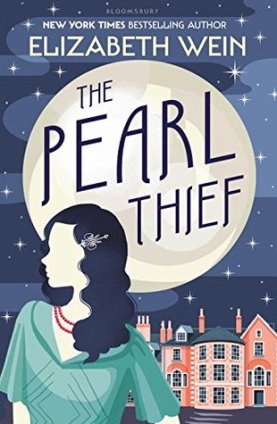 The book is The Pearl Thief, and it is as different as night and day or, to be specifically British about it, as chalk and cheese, to her previous work, even though its protagonist is one of the women from CNV, at age 15. And it is definitely written for a younger teenage audience. Before you expect me to pan it, let me say that it was a completely enjoyable read. But I was unconsciously expecting a level of drama and pathos, based on Code Name Verity, that simply didn’t manifest in this story.
If I hadn’t had specific expectations of this author, I still think I would have been intrigued by the book and its subject matter. It takes place in Scotland in 1938, and drops in at the end of an era for one family whose “perfect little Scottish estate, with a ruined castle and a baronial manor, nestled in woodland just where the River Fearn meets the River Tay” will no longer belong to the family, now that the death of Julia Beaufort-Stuart’s grandfather has triggered a reckoning. Lord Streathfern did all he could to save the house and the land for his heirs, but the combination of a lingering illness and a downturn in the economy made it necessary to sell up to a boys’ school, and the family are now inhabiting a small section of the house while the school administrators oversee the renovations and conversions necessary to turn it into the institution it will become. This will be Julie’s last summer on her grandfather’s land, with her brothers, her mother and grandmother, and the few servants left, and then they will move back to their own Craig Castle near Aberdeen, taking her widowed grandmother with them.
By broad contrast with Julie’s sheltered and privileged upbringing, the other vital characters in this story are the two teenagers, Ellen and Euan, in a family of Travelers who have spent seasons on Streathfern land time out of mind, helping harvest “tatties,” beating the bushes and collecting the downed birds during shooting holidays and, in between, collecting tin from the townsfolk and weaving baskets from the withies in the marshy land near the river. This land was ceded to them by right for the past 300 years in exchange for a small fortune in river pearls (which play a vital role in the story), but now the changing fortunes of the laird will mean change for them all.
As the story begins, Julie has just arrived home for the summer three days before she is expected. When no one is around up at the house, she changes out of her traveling outfit into a T-shirt and an old kilt and goes out hiking around the estate, reacquainting herself with her favorite haunts. One moment she is lying on the bank of the river with one arm immersed, tickling for trout in the deep, cold water, and the next she is awaking in a hospital ward with a splitting headache from a lump on her head, being treated with disrespect and disdain as the “tinker” girl they believe her to be. She discovers that she was found, unconscious, on a path in the woods, and brought into the hospital by two of the Travelers; once her mistaken identity is resolved, her mother is called, and she returns home, feeling battered and wondering about how it all happened.
It soon becomes clear that the thump on her head was no accident, and that it is probably directly related to a missing employee of the estate, who disappeared on the same day she landed in the hospital. Along with the two travelers, Euan and Ellen, she seeks out the reason why anyone would have sought to hurt her or the missing man and, in the process, must stand up for her Traveller friends as local bias against them starts framing Euan up for murder.
This book is a delightful combination of murder mystery, coming of age story, and a serious depiction of prejudice, as exhibited by many of the “regular” people towards the Travelers they hold in suspicion and distrust for their alternate lifestyle. Although it wasn’t quite what I expected in terms of drama and emotional engagement, it surprised me (in a good way) with its exposition of the themes Wein did choose to explore. I think adults could enjoy the book, but it is definitely written with teens in mind, and is one of those books one could recommend that promotes empathy to its young readers. The book would be appropriate for anyone 12 and up, although probably a lower age of 14 would find it more relateable.
This review is also to say, placing expectations on your favorite authors and holding them to some rigid ideal may make you miss out on books they wrote that are different but nonetheless effective and providing of considerable enjoyment.
ADDENDUM: Today (according to a post on Facebook) is National Book Lovers Day. I’m not making a special post like for the cats, because EVERY day is book lovers’ day here @TheBookAdept!
Internat’l Cat Day
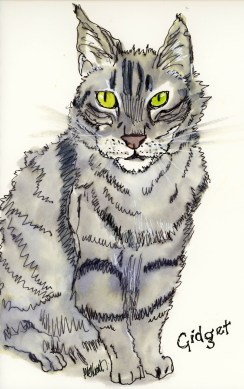 I woke up this morning and checked the calendar to discover that it’s International Cat Day! I must commemorate that, or Gidget and the spirits of all my house cats who have gone before will haunt me. Here, therefore is an eclectic and by no means complete list of some books that feature felines as protagonists and companions. The array of adult books seem to fall into one of two camps: The cats who solve mysteries with their human counterparts, and the cats of science fiction, who are sentient to various degrees. The children’s books celebrate cats in all ways possible from the realistic to the bizarre. These are in no particular order, except possibly by the age of the humans to which they may appeal. If you wish to find hundreds more books about cats, look here, under “lists” in Goodreads.
ADULT BOOKS
The Cat Who… mysteries, by Lilian Jackson Braun, in which a reporter and his cat solve mysteries. First book: The Cat Who Could Read Backwards.
The Mrs. Murphy mysteries, by Rita Mae Brown & Sneaky Pie Brown, in which Mrs. Murphy and her human companion solve mysteries. First book: Wish You Were Here.
The Joe Grey mysteries, by Shirley Rousseau Murphy, in which there are talking cats and also a human who discovers an ability to morph into a cat. First book: Cat on the Edge.
Catfantastic: Nine Lives and Fifteen Tales, by Andre Norton, editor, in which sci fi and fantasy writers tell tall tales about furry felines. (Short stories.)

The Dalai Lama’s Cat, by David Michie, in which the Tibetan Buddhist leader’s cat offers insights on happiness and meaning.
The Chanur novels, by C. J. Cherryh, in which a leonine species—the Chanur—take in a human refugee and by so doing threaten the interspecies Compact. First book: The Pride of Chanur.
The Cinder Spires books, by Jim Butcher, in which there are also cat clans and some naval airship action. First book: The Aeronaut’s Windlass.
The Cult of the Cat books, by Zoe Kalo, in which Trinity is left with a dead grandmother and a thousand grieving cats. A sort of Egyptian urban fantasy. First book: Daughter of the Sun.
Old Possum’s Book of Practical Cats, by T. S. Eliot, in which the author describes cats each by their distinct personality. (Poetry.) Someone should set this to music…
FOR CHILDREN:
Millions of Cats, by Wanda Gág, in which a lonely old couple acquires companions. This is known as the original picture book for children.
The Cat in the Hat, by Dr. Seuss, in which Sally and her brother receive a visit from a madcap cat.
 Socks, by Beverly Cleary, in which the cat has to learn to share his family with their new baby.
The Warriors books, by Erin Hunter, in which a house cat discovers clans of cats living in the wild in the forest…. First book: Into the Wild.
Varjak Paw books, by S. F. Said & Dave McKean (illustrator), in which a cat goes Outside and overcomes challenges.
The Wildings books, by Nilanjana Roy, in which a small band of cats lives in the alleys and ruins of Nizamuddin, an old neighborhood in Delhi, India.
The Feline Wizards series, by Diane Duane, in which feline wizards time travel to avert disasters. First book: The Book of Night with Moon.
The Cat Pack books, by Phyllis Reynolds Naylor, in which brothers Marco and Polo go adventuring. First book: The Grand Escape.
The Black Cat Chronicles, by Aileen Pettigrew, in which there are cats, zombies, and magic. First book: Soul Thief.
Stray, by A. N. Wilson, in which a cat without a home tells his own rather bleak story.
Tales of the Barque Cats, by Anne McCaffrey, in which cats are essential members of the crews of space vessels…until an epidemic threatens their extinction.
The Incredible Journey, by Sheila Burnford, in which a bull terrier named Bodger, a Labrador retriever called Luath, and Tao, a Siamese cat, travel 300 miles through the Canadian wilderness to reunite with their people.
Robin McKinley
As I have mentioned before on this blog, I am a huge fan of fantasy writer Robin McKinley. I reviewed my two favorite books of hers, The Hero and the Crown and The Blue Sword, here. I think she has inventive ideas, compelling characters, and amazing world-building. A friend and I recently discussed, however, how unpredictable she can be—we have loved some of her books, hated others, and been bored to catatonia by at least one of them. Shadows, one of her lesser-known books, is one that I like.
 But how to describe this book? In a weird way, it’s a dystopia, because something happened a couple of generations back that changed the world and put a bunch of scary bureaucrats in charge of it. But it’s also a fantasy, because it’s all about magic and its banning from the world of science, and how it leaks and creeps back in again.
Maggie and her mom and little brother lost their dad/husband awhile back (car accident), and it’s been tough going. But now her mom has found someone new to love, and although Maggie would like to be glad for her, Val creeps her out on so many levels that she just can’t deal. There’s his wardrobe, and his weird accent, and his fairly unattractive exterior, but that’s the least of it: Val has too many shadows, which seem to loom and dart and rise up higher and create a stranger outline behind him on the wall than anybody’s shadow should, and Maggie is apparently the only one who can see them. I found it a little unbelievable how long she managed to ignore them and avoid him, rather than just coming out and asking, but on the other hand, if you put this behavior in the context of people in “science world” being jumpy about anything that smacks of magic, it made sense. And that’s where you have to “suspend disbelief” and be willing to go with it because you love McKinley.
As I said, in Newworld, where Maggie lives, there are regulations in place designed to keep people away from magic and magic away from people. In fact, there is a whole bureaucracy set up to defend against “cohesion breaks,” or cobeys, which are apparently alternate worlds or magical worlds (?) trying to push their way through to this one (or suck people out of it). It’s a crime to own magical artifacts, or to practice magic, or to BE magical, and this is a big source of Maggie’s worry about Val (who emigrated from Oldworld, where they still practice magic), because now that he’s living in their house, he puts them all at risk, even though he’s shown no obvious signs (other than the shadows) of risky behavior. Maggie’s family has a history of magic-wielders, but supposedly that gene was surgically removed from everyone awhile back—or was it?
Things I loved about this book: all the characters—her mom, her friends, Jill and Taks, her love interest, Casimir, the animals (she has a dog and also works at a shelter), the evolution of the plot. Things that frustrated me: Well, because it was McKinley I was willing to go with it, but the world-building is weird—incomplete and random, with lots of assumptions, confusing lingo, truncated history, tantalizing and infuriating hints that you could know more if only she would tell you! You are set down in the middle of a work in progress that you have to figure out as you go along, and I didn’t feel like I had completely understood it even by the end of the book—but I didn’t care all that much, because I was enjoying myself and the story.
The book ended satisfactorily, but it was more like the end of a chapter in this alternate history than the end of a world; it definitely left itself open for a sequel, but whether there will ever be one is anybody’s guess, since McKinley mostly doesn’t do sequels. I hope so, because I grew fond of these characters.
So–would I recommend it? Yes. But judging from the ratings on Goodreads, which range from one star to five, you definitely have to be a certain sort of reader to like it.
I’m tagging this with the YA Fiction category because it reads as if it could have been written specifically for teens; but as with most fantasy out there, if you are a fantasy reader you don’t discriminate between teen and adult fantasy, it’s all just fantasy!
Guns and diversity
 While scrolling through the Los Angeles Public Library’s e-book offerings, I came across a young adult novel that had been hyped to me, and it was available so I checked it out and started reading. The book is This Is Where It Ends, by Marieke Nijkamp, and I was curious to see how it would explore the incendiary subject of school shootings.
One of the reasons that several people encouraged me to read this book is that it is written by a “We Need Diverse Books” member, and has two female lesbian protagonists (and one is also Latina), a prominent character who is Middle Eastern, and so on. But what I found was that this was more of a problem than an advantage, because the author gave their credentials as if she were cherry-picking specific examples of ethnicity and sexual identification to appear in her novel for the sake of that alone. I guess what I’m saying is, not only did their diversity make no significant difference to who they were in the context of the story, but it seemed to further accentuate “otherness.” She stereotyped them.
The basic plot of the book is that a boy, Tyler, who dropped out of school the year before, is scheduled to come back and try again, but instead, while the first student body assembly of the year is taking place in the auditorium with only a handful of students and a couple of teachers missing, he locks all the doors from the outside, enters through a stage door, and begins shooting people.
The story is told from four points of view, two of them in the auditorium and two of them outside trying to figure out what is happening and hoping to help their siblings and classmates to escape. There are also some other viewpoints represented via a few students’ texts to one another and one boy’s entries on his blog.
The narrative jumps back and forth between flashbacks and the present moment. The protagonists are all related in some way to the shooter—one is his sister, one is his ex-girlfriend, one is his sister’s girlfriend, and the last is that girlfriend’s brother. All have a history with Tyler, and each of these, as recounted, gives perspective on their interactions with him. You do gain some knowledge in this way about what may be some of Tyler’s issues, but because there is never any internal, first-person view given by Tyler, most of that is left unexplored, and this becomes a huge flaw. Tyler is largely painted as an evil guy, and since he isn’t allowed to speak for himself, we never find out the nuanced details that brought him to this place. I’m not an apologist—I realize that not every kid who is abused or friendless or bullied turns into a murderer. But this book had the opportunity to explore that, and instead Tyler is a smiling, vindictive, one-dimensional jerk with a gun. And the protagonists, despite the sharing of their back stories, are also one-dimensional to the point where the two female characters’ narratives sound so similar it’s easy to get confused about who is speaking.
The book initially confused me as to its power, because it is written on a breathless timetable in which minutes are literally counted down (one chapter being the action taking place between 10:00 and 10:06 a.m., etc.), and that gives the book a pace and a tension that builds on initial foreboding to boost the reader onto an emotional high. The countdown and the jumps between narrators keep you enthralled as you wait to see what’s happening inside the auditorium while you’re outside, and what’s happening outside when you’re inside. It took arriving at the end of the book and feeling strangely let down (and also emotionally manipulated) to make me realize that although the pacing pushed me to the end, once I got there I was devoid of answers, or even of much content. The book is so thoroughly focused on the events of 54 minutes that it fails to provide sufficient context to explain them.
The charitable interpretation of this book would be that the author was well intentioned but simply overwhelmed by the scope of the issue and therefore told it as best she could but without diving below the surface. This problem was accentuated by the time frame she set herself in the plot—I feel like the need to keep the tension at a certain pitch precluded her flashbacks from going into sufficient detail to satisfy. The less charitable would be that this topical subject was sensationalized for the sake of book sales.
 My recommendation would be that you read Jennifer Brown’s Hate List instead, a book that is successful at breaking down the barriers between victim and villain in its shooter, at explaining the survivor’s guilt of the people who knew him best, and in showcasing the dark thoughts that everyone has but most never act upon.
Ninth House
I have been anticipating reading Ninth House, by Leigh Bardugo, for several reasons: Although I didn’t care for her Grisha series because it was so full of angsty teenage indecision, I absolutely loved the duology Six of Crows and Crooked Kingdom, particularly the latter. I felt like Bardugo had stepped up her style and discernment by a lot in the second series, and also, I can’t resist a “gang of thieves” story.
 I’m really not sure why Ninth House has been identified as an adult, rather than a teen, book. Admittedly, it’s far too gory and explicit for younger teens, but I could definitely see some of my former book club members from the 10th-12th grade club enjoying this. After all, the philosophy in writing for children or teens is that they always want to read “up,” which is to say, they want to read about a protagonist who is a year or two older than they are. As a freshman at Yale, the Ninth House protagonist, Alex Stern, is just the right age to appeal to seniors in high school. I imagine many parents of said older teens would still quibble with me, because they feel their children should be protected from such graphic fare; and there is a part of me that thinks everyone should be protected from it! But as you learn from reading a lot of books, sometimes you need that stuff to make a point, to expose a wrong-doing, to create empathy in your reader. (Plus, of course, for dramatic effect in your adventure story.) There were certainly plenty of opportunities for that here!
Within the first few pages of this book, I seriously considered putting it down without finishing it. There is a scene early on in which a group of students from one of the magical “houses” at Yale performs a “prognostication” by reading the innards of a man who is still alive (although sedated), with his stomach cut open and pinned back; when they’re done, they stitch him up and send him off to hospital without another thought for his well-being. Also present at the ritual were a group of “Grays,” ghosts who gave off a really frightening vibe. The entire scene turned my stomach, and since I hadn’t as yet invested much into either the story, the scene, or the protagonist (and didn’t really want to encounter more of this), I thought about stopping. But surely all my friends—both personal and Goodreads-type—who were bowled over by this book couldn’t be wrong? So I kept reading.
Ultimately, I was glad I did. Although it took a long time to understand what was happening and also to bond with the main character, I eventually came to appreciate both the bizarre behind-the scenes action and the dogged, flawed, yet honorable Alex, who didn’t give up no matter what.
“Could she grasp the ugly truth of it all?
That magic wasn’t something
gilded and benign, just another
commodity that only
some people could afford?”
Some things I liked about the book:
It gives this Ivy League school an ulterior motive for existing that is both completely creepy and also believable. The concept of a university elite is nothing new, but the idea that they became that way by the practice of necromancy, portal magic, splanchomancy (the reading of entrails), therianthropy (basically, shape-shifting), glamours, and the like is certainly novel!
The funniest part of this is at the end of the book, in an appendix, where the author describes the eight occult houses, reveals in what talent or magic each is invested, and then names graduates (from the real world) who have benefited by being members of the houses during their careers at Yale.
This is not just an amusing commentary, however, on how these students one-upped their futures by participating in magical solutions on the sly. As highlighted in the quote above, Alex comes to realize that magic, while theoretically accessible to whoever was trained or born to practice it, was in reality a tool of the rich and privileged that was sought after at the expense of the poor and defenseless. This is a huge theme of the book, and this is why the reader is able to bear with all the dark scenes, because they are so illustrative of our own contemporary world where billionaires are tripling their wealth during the pandemic while so-called “essential” workers are flogged back to their minimum-wage jobs, despite the danger, by the threat of unemployment. I don’t know if she intended it, but Bardugo here reveals the true “deep state” of influence, bought and traded favors, and a deep disregard for anyone who gets in the way.
Up against this mostly impenetrable and nearly unbeatable system of advancement is Galaxy “Alex” Stern, an underdog heroine if there ever was one. She is recruited (and given a full ride to Yale) to be a member of a secret society, Lethe, whose officers are trained to monitor the other eight houses for stepping over the line, and to report and penalize them when they do. Alex wants to use her special abilities for good, but quickly realizes that her job is mostly for show, and that there will be few consequences for any of these offenders, because to bring their activities out into the light would mean embarrassment for alumni, for administrators, and for Yale itself as an institution. What the people who recruited her don’t realize, however, is that first, Alex has abilities about which they (and at first she) are unaware, and that second, Alex has been conditioned by life as an almost constant victim to fight for herself and for other victims no matter how hard the going.
At its heart, Ninth House is a giant (and cleverly structured) mystery. There is a contemporary murder, there are disappearances of vital personnel, there is a string of dead girls from the past that may tie in, and Alex, despite discouragement from both her mentors and her opponents, is determined to solve it in order to bring justice for the have-nots that she sees as her equals.
But the book is not single-minded. There are also themes of friendship and (nonromantic) love, and a lot of social commentary. There is the gradual evolution, also, of the book’s characters as they confront issues and reflect upon their responses. One early-on thought from Alex that I loved was when she was pondering how easily things change from “normal” to not:
“You started sleeping until noon, skipped one class, one day of school, lost one job, then another, forgot the way that normal people did things. You lost the language of ordinary life.”
There were also, in amongst some fairly gruesome scenes that (if you are squeamish, you should be aware) include drug abuse, coercion, murder, rape, and the like, some inside jokes about college that I enjoyed, including some funny dormitory moments among roommates. One library-oriented joke, as noted by my Goodreads friend Lucky Little Cat, was, “I especially liked the special-collections library where occult search requests result in the delivery of either an avalanche of barely relevant books or one lonely pamphlet.’ Anybody who has been to college has encountered this result, with absolutely no occult assistance whatsoever!
Be aware that some readers have accused Bardugo of racism (because of a few comments on Alex’s Mexican origins), and of blatant sexism and misogyny in her portrayal of the rape scenes in the book (because they are pictured from the observer’s point of view rather than that of the victim’s). You will have to decide for yourself how you feel about these accusations.
Bottom line, apart from a rather confusing and disjointed few pages at the beginning, I found this to be a clever, nuanced read about white privilege (as symbolized by magic!) and the lengths to which people will go to cling to it. It also has both a protagonist and a secondary character that, while the book has a satisfactory ending, you are longing to follow into the sequel, which will hopefully be produced quickly.
One last title
When I dialed up Los Angeles Public Library’s catalog and looked at their e-book selection for Brigid Kemmerer, I found one more book that wasn’t included in either the Elementals, the contemporary fiction, or the Cursebreakers. It was a stand-alone and it was available, so I downloaded it.
 Thicker Than Water is an anomaly, in that it starts out like a contemporary, turns into a murder mystery, and then makes a shift into the weird.
Thomas Bellweather is in trouble, with pretty much no one to whom he can turn. A few weeks ago, he and his mom moved to the town of Garretts Mill so that his mom could make a happy second marriage with her boyfriend, Stan. But two weeks after the wedding his mother has been murdered, and he’s left alone with his brand-new step-dad in a town full of strangers…many of whom believe that he was the killer. There’s not enough proof to lock him up, but there’s plenty to make every cop in town suspect him. Three of those cops, brothers, have a little sister named Charlotte who seems to be the only person interested in finding out the truth and, at least tentatively, extending a hand of friendship to him. But every time the two of them try to get together to work things out, mishaps turn into drama, and Thomas is deeper in trouble. Then, while looking through boxes of his mother’s things in the garage, Thomas makes a strange discovery about her past that turns everything he knows upside down. What, if anything, does this have to do with what’s happening today?
This book was immediately both frustrating and gripping. All the people in town who dedicate themselves to keeping Thomas and Charlotte apart, thereby delaying the vital information they need to discover to keep Thomas out of jail, was crazy-making, as was Charlotte’s alternating stance between trust and fear of Thomas. But what was weird to me was the pacing. The fact that the two protagonists are constantly being separated meant that the story line dragged behind where it “should” have been for a large part of the book, but then…
Since I was reading the book on my Kindle, I paid attention to the “percentage” of book finished. When something super significant happened, I glanced to the bottom of the screen and saw that the book was already at 81 percent, but this book was billed as a stand-alone. Hmmm, I thought: For me to get what I need from this story, we shouldn’t be at more than 65 percent at this point! (the voice of experience speaking) And sure enough, although everything was sufficiently revealed to solve the initial mystery, I was left with so many questions!
I can’t detail them here, because it would completely ruin the book for anyone reading this review, but I will say that I think Brigid Kemmerer owes us a sequel. These characters deserve more closure, and more exposure! The twist at the end needs further exploration and explanation! C’mon, what do you say?
Historical fic for middle school
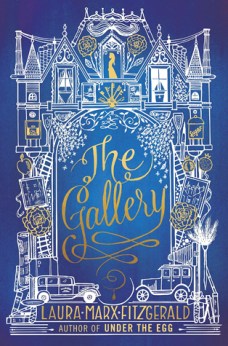 The Gallery, by Laura Marx Fitzgerald, was a sweet, if slight, middle-grade book with some historical context that was fun to read about. It is billed as an art “mystery” taking place in the Roaring ’20s, although there wasn’t a lot about it that was too mysterious.
I liked the spunky protagonist, the 12-year-old kitchen maid Martha, and I enjoyed exploring her relationship with her mother, the housekeeper for the wealthy Sewells of New York City, as well as her interactions with the other staff, the family members, and various odd characters with whom she comes into contact. But I felt like the book would have been vastly better if there had been more of a connection between Martha and Rose Sewell herself, the mysterious “madwoman” sequestered in the attic about whom the book was supposedly written!
The 1920s setting was fun (Prohibition, extravagance, cool clothes), and I enjoyed learning more about the Irish working classes and the rich titans of industry, but the main reason for which I picked up the book—details of Rose’s art gallery, which is, let’s face it, in the TITLE—was a disappointment.
We got a few descriptions of a small percentage of all the supposedly amazing paintings from Rose’s collection that were squirreled away in her attic, a little Greek and Roman mythology thrown in to explain those images, one quick and unsatisfactory trek through the Met, and that was it. I felt like the central ploy—to “save” Rose (and her inheritance) and get her out of the attic—wasn’t explored nearly enough, and the ending was abrupt and somewhat disconnected from the rest of the story.
Also, I will echo another reviewer on Goodreads who deplored that this author actually gives away THE central plot point of Jane Eyre in a middle school book, thus spoiling the future reading of a classic! No, no, no!
This book had the feel and the potential of such entertaining historical fiction as Rhys Bowen’s Molly Murphy mysteries, but turned out to be hit or miss—pleasant, mildly entertaining, and mostly forgettable. Nice cover design…
More Kemmerer!
After completing and thoroughly enjoying Brigid Kemmerer’s Call It What You Want earlier this week, I was positively compelled to read two of her other contemporary realistic teen fiction novels: Letters to the Lost, and More Than We Can Tell. Previous to 2015, Kemmerer was apparently known for her “Elementals” series about four brothers with paranormal powers, but when I read the descriptions, I wasn’t enticed to read one. I can’t say the same for her contemporary realistic novels, which I have practically inhaled one after another without stopping, becoming incensed when my Kindle ran out of juice at 2:30 in the morning about 40 pages from the end of the last one!
These books remind me of a few other authors—Dessen, Caletti, Rowell—because their books also contain that ideal combination of relationship and life events that propels the story. Even though there are elements of romance to each book, the primary motivation is understanding, empathy, and relationship. Although I have seen some young reviewers on Goodreads remark on the swoon-worthiness of various protagonists (as do some of the other characters!), most recognize that they are not reading these books for the romance but for the real-life transformations that occur as a result of the connections made by the people in Kemmerer’s books.
 Letters to the Lost is, as one might assume from its title, an epistolary tale. While working his community service gig at the local cemetery by clearing up the debris left by its visitors and then mowing the plots, Declan Murphy finds a letter left by one of the headstones. When he picks it up and reads it, he feels a surprising affinity with the feelings expressed by its author and, in an impulsive moment, he pulls a pencil out of his pocket, appends the words “Me, too” to the end of it, and lays it back on the grave, never dreaming that the original writer would come back to find his alteration of her letter.
Juliet Young, who has been heartbroken for four months since the death of her photojournalist mother in a hit-and-run, is outraged when she sees that someone has dared to appropriate her grief, and writes another, indignant letter addressing not her mom but the encroaching P.S. person. This is the beginning of both a correspondence and a friendship that grows faster than either could have dreamed, as they each feel free in their anonymity to express some of their deepest feelings and fears.
The truth is, Declan and Juliet are not complete strangers to one another; but the public personnas they wear at school have blinded each other and almost everyone else to who they are or have the potential to be. It takes some extraordinary events to bring them out of hiding, for one another and with all the other people in their lives with whom they need to clear the air.
 In More Than We Can Tell, one of the significant sidekicks from Letters to the Lost gets his own tale, which is a more than satisfying happenstance for those who loved the first book. He was an intriguing and important character in the first story, but although we gleaned bits and pieces of his history, there was so much more to tell. As in Letters, and also in the book I read earlier, Rev Fletcher gets a counterpart, Emma Blue, to help him reveal his story while dealing with the fallout from her own, and together the two are able to transition some difficult events with all the ambivalent feelings they stir up.
Rev has loving adoptive parents who took him in 10 years ago at age seven, and adopted him a few years later. He has for the most part put the effects of his troubled early childhood aside, but when he turns 18 and receives a letter from the father who abused him both mentally and physically, it sends him into a tailspin from which he is having a hard time recovering.
Emma has parents who love her, but her mother is hypercritical of Emma’s choice to follow in her father’s footsteps as a creator of video games. To escape the bickering between them, Emma focuses all her time and attention on the perfecting of a computer game she has created from scratch. But when an intrusive and insistent “troll” begins harassing her online, she is reluctant to reveal this problem to a mother who will order her to stop or a father who will be disappointed in her less-than-perfect design security.
Rev and Emma meet, and each serves as an outlet for the other’s private fears. But then issues arise that cause a lack of trust, and it’s not clear whether the budding relationship will survive them.
These books, while sounding formulaic (the alternating points of view, the pairing of two protagonists, the problems they must overcome) are in all honesty totally immersive, nuanced, and redemptive in tone. I can’t imagine a teenager who couldn’t relate to at least one, if not all, of these characters, and the “lessons” that are being taught are not heavy-handed. Some of the messages—that you can ask for what you want instead of passively waiting to be given it; that unkindness should always be resisted on your own behalf and that of others; that talking to people will mostly relieve all kinds of unfortunate misunderstandings; and that a moment is just a moment and a day is just a day, always making room for a different choice or change—are beautifully illustrated by these stories.
I do plan to read the sequel to the Beauty and the Beast fairy tale retelling Kemmerer has written, and I still maintain hers is one of the better and more original one of these out there, but I think her true strength lies in writing about real teenagers in the throes of their confusing, sometimes difficult lives.
I also have great admiration for her, in that she has written at least a dozen books between the years of 2012 and 2020, while simultaneously being married and having four sons!
Contemporary YA
While scrolling through books on bookoutlet.com in the search of a few more to round out my $35 minimum, I came across Call It What You Want, by Brigid Kemmerer. The name sounded familiar to me, so I looked her up on Goodreads and realized that she was the one who wrote the fairy tale retelling of Beauty and the Beast that I liked so much, so although it didn’t appear to be fantasy, I decided to try this one, which seems to have been written (or at least published) between that book and its sequel, A Heart So Fierce and Broken, which I also own but have not yet read.
 Having read both books, I can see that Kemmerer has created for herself something of a formula, although in this case that’s a good thing. One of the ways that her fairy tale book worked was to tell it from two perspectives—those of the enchanted prince and the commoner girl—and this book echoes that by also giving us two protagonists with story lines that intersect.
The male protagonist, Rob, is a victim of circumstance, although many of his peers think he is more than that. Rob’s father, Rob Sr., a financial advisor, was a mini Bernie Madoff who ran a Ponzi scheme on his clients that lost them all their money. To add insult to injury, when he was turned in Rob’s father tried and failed to commit suicide, and survived in a vegetative state, needing constant care from his now destitute wife and son. Rob had been working as an intern in his father’s company when all this transpired, and despite his protestations of ignorance, his classmates and their parents who were injured by his father’s actions refuse to believe that he wasn’t “in the know,” causing him to become a pariah at his high school. He’s basically putting his head down and trying to survive for the rest of his senior year until he can get out of town.
The female protagonist, Maegan, has her own issues: Despite being an honors student with high grades, Maegan questions her abilities and makes an impulsive decision to cheat during her SAT test. She is caught, resulting in 100 other kids’ tests being invalidated and discarded. So Maegan has her share of abuse to survive, and is likewise walking around school in a solitary bubble. Fun fact: Maegan’s dad is the cop who arrested Rob’s dad.
The two share a calculus class, and when their teacher pairs everyone up for a class project, Rob and Maegan are the two conspicuously left standing, ending up together. Neither of them is happy about this and both consider asking the teacher to change the assignments, but with the prospect of having to be third wheels on teams who don’t want them, they resign themselves and tentatively try for a way to work together.
Kemmerer does a brilliant job of first investing you in their situations and then illustrating how these two closed-off teens are gradually able to open up to one another and seek sustenance in an unlikely friendship. Prior to Rob’s family’s “fall,” he was one of the privileged, über-popular lacrosse stars, while Maegan’s family is from much humbler blue-collar origins, although Rob and Maegan’s sister, Samantha, share a love of lacrosse that bridges an initial gap. The sub-plots in the book, involving Rob’s former best friend, Connor, who is determined to constantly remind everyone of Rob’s supposed culpability, Rob’s new and unexpected friend, Owen, with whom Rob conceives of a “Robin Hood” plan to assist the have-nots, and Maegan’s sister Samantha’s secret pregnancy, further enliven the story.
The book explores such themes as right and wrong (doing right for the wrong reasons and wrong for the right ones), trust, responsibility, mistakes, and transparency, but does so in such a way that the reader never feels imposed upon by those themes. Kemmerer presents black and white and every shade of gray as they appear to all participants and makes the reader as eager as the characters to resolve the issues, find justice, and give the misunderstood some relief. There is romance, but it’s far from the dreaded insta-love; this is realistic young adult fiction at its best. If you are a teen who enjoys contemporary fiction, this is a writer who will give you what you want.
I have already lined up Kemmerer’s other two contemporary novels on my Kindle.
Spooky YA
When placing a recent book order, I decided to catch up with some YA books that have been out for a few years, some so I could move further into the series, others just because I felt they were books I should have read in order to maintain “street cred” as an expert in young adult literature for my class at UCLA. One such book was City of Ghosts, by V. E. (Victoria) Schwab.
I was initially taken aback as I began to read, because all of Victoria’s other YA books are targeted more towards high school students, and
I had expected the same here. City of Ghosts is definitely a middle school offering—in fact, if a kid is a precocious reader, I think this could reach down into the upper levels of grade school—5th grade
for sure. But once I realized what I was reading, I settled in to enjoy this story.
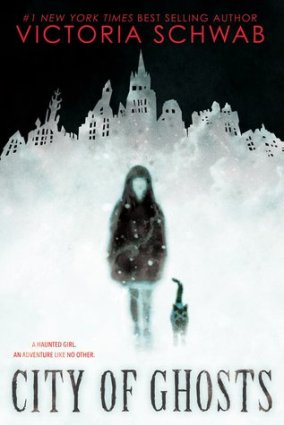 Cassidy Blake died by falling into a river. She was saved from permanent death, however, by a ghost named Jacob, who snapped her out of it and in the process became somehow attached to her. Now he is her faithful invisible sidekick in her world, and because of her NDE (near-death experience), she is a regular guest in his world, which she has nicknamed “the Veil,” because when she enters the world of ghosts, it’s like pulling back a curtain and stepping through a window.
Cassie’s parents are ghost-hunters, of a sort. Nothing so crass as the people on TV who stumble around in dark houses trying to film ghosts as proof they exist—her father is an historian, while her mother enjoys the story aspect and is enthralled by old folk tales of ghosts and specters. Now, however, the two have been invited to host a TV show about the world’s most haunted places. The first filming site is the ancient city of Edinburgh, Scotland, which teems with restless phantoms. Cassie has no idea what she will confront in a city so steeped in haunted history.
The descriptive language, particularly Cassidy’s sensations inside and outside of “the Veil,” lent a lot to the power of the story. I had a bit of a hard time believing that while her parents were “inspecters,” they didn’t believe in Cassidy’s sidekick, or see that there was something going on with her. I know her dad was fixated on the historical and didn’t endorse the supernatural aspect, but it seems like her mother, so involved with the legends, could have been a little more receptive—or perceptive. Maybe that changes in the next books in the series?
The introduction of the ghost hunter Lara and the mysterious Findley added a lot to the story, as did Cassie’s encounters with both personal and historical aspects of “ghosthood.” The “villain” was a convincing choice as an avatar from several cultures, and yielded a satisfyingly scary climax to the story.
Some of the material here is familiar from other writers and other series, particularly the concept of the near-death experience providing a heightened sensitivity to ghosts, and the idea of people sending ghosts trapped in the “in-between” to their final rest by releasing them from their rote repetition of a particular moment in their life/death. The first concept is dealt with in greater depth in Maureen Johnson’s three high school paranormal mysteries, Shades of London, in which a girl first discovers her own ability to see ghosts, and then finds out that there is a coterie of secret ghost-fighting police, called the Shades, who want her to join up with them. The second is covered in the delightful five-book Lockwood & Co. series by Jonathan Stroud, set in an alternate universe where “the Problem” (ghosts everywhere) is out of control, and only children are able to see and fight them. Schwab’s account is by no means derivative—I only mention these other series because they could be a natural progression as the younger middle schoolers who enjoy City of Ghosts want older fare.
Since Schwab has written three series for older teens (The Archived, Monsters of Verity, and The Near Witch), you might think I would refer young people to those; but honestly, I didn’t enjoy any of them beyond a point. This is odd, because her adult books (the Shades of Magic series, and the Vicious books) are among my all-time favorites—to the point that I have re-read all of them several times. My experience with teenagers from my librarian days is that they feel likewise—they are tepid about her YA books, but madly enthusiastic about the ones she has written with adults in mind. And especially with the Shades of Magic books, she has provided for the attraction of that audience by creating two protagonists young enough to appeal to teens while complex enough to attract adults.
I find it so odd when one writer writes for two audiences with such different results, but I have encountered it numerous times. I love the adult mysteries of Elizabeth George, but practically panned her young adult paranormal series. It’s also interesting when someone writes under two names, and you read both of them as separate authors, come to completely different judgments about their work, and then discover that they are the same person, as happened to me with mystery writer Barbara Vine, who is also Ruth Rendell. While I like Rendell’s books, I find them a little dry, a little cold, and sometimes frankly off-putting, whereas Vine’s books are much more to my taste—softer, more intimate, less clinical.
If you are a young adult, you should certainly not take my word for it that Victoria Schwab’s YA books won’t be to your liking. There are so many YA books that I have loved while teens said “take it or leave it,” and so many others that I couldn’t stand but about which teens gush over how good they are. But I can tell you that my recommendations of her adult books have met with universal approval, and I look forward to the new one arriving this year in October—The Invisible Life of Addie LaRue. That is one book for which I will put in an advance order.
There is currently another Cassidy Blake book to be read (Tunnel of Bones), shiveringly set this time in the catacombs of Paris, and a third book in the series is due out in 2021.
 The Book Adept