A World of Curiosities
I was late to the party reading Louise Penny’s most recent in her Chief Inspector Armand Gamache series—they reliably drop in the fall of each year (although this one, coming out in November, was later than the usual August or September denouement), and I have just gotten to it in April, five months later. But I am happy to say it was worth the wait, and harks back, in more ways than one, to the best books of the series.
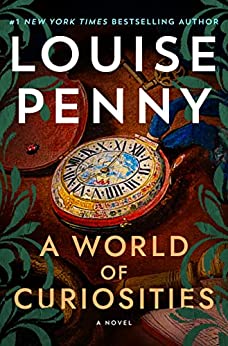
I always enjoy the books in which Penny explores origin stories for her characters, and A World of Curiosities went back to the original meeting and co-opting of Inspector Jean-Guy de Beauvoir into Gamache’s work circle and later, inevitably, into the family. And the case over which they met plays a central role in the current mystery, so that we are simultaneously intrigued by the past case and put into a major state of anticipation over the current one. This is a great ploy for keeping readers enthralled with the story line. It becomes even more engaging with the inclusion of Amelia Choquet, one of my favorite characters.
The creation of the siblings, Sam and Fiona, children of a murdered woman who managed to tragically damage them before she died, gives an entrée into the eternal question of nature vs. nurture, and also messes with the reader’s faith in the instincts of the detectives. Gamache cannot help but feel a frisson of fear and dread each time he encounters Sam, while Beauvoir believes he is completely off base and is being naive by trusting Fiona. When the two become a part of a bigger case, something Gamache believed to be shelved for good along with its perpetrator, John Fleming, lodged in the Special Handling Unit (SHU) of Montreal’s most notorious prison, the tension just keeps ratcheting higher. I loved this quote from one Goodreads reviewer:
“Despite the ravioli and eclairs,
this is no cozy mystery.”
I was also pleased that something lacking in the last book seemed much more present in this one: the Three Pines community. In the last story, interactions amongst the villagers seemed both subdued and incidental, while in this one the presence and significance of the residents came roaring back, with new connections being made and new characters introduced.
I like to scan the star ratings of books on Goodreads to see what other readers thought; I am somewhat puzzled by those for this book, since it was either the absolute favorite with five stars or the most disappointing with one or two! My vote is for the upper end of the spectrum, and I hope Penny will continue to tap into the richness of her characters’ back stories for future tales.
Manufactured mystery
I tried out a new mystery writer, D. D. Black, on the recommendation of someone on “What Should I Read Next?” and I’m feeling a little conflicted about whether to continue after the first two books. On the one hand, I liked the setting a lot (a small town on one of the many islands and peninsulas off Puget Sound, near Seattle), and I also liked the main character, Thomas Austin. He’s a former NYPD detective who, after a personal tragedy, retired on his pension to the Pacific Northwest and bought a combination mini-mart, café, and bait shop to keep him marginally occupied (not a lot of traffic). He’s smart and interesting and intuitive, and a little dark. I also liked the secondary characters, including Anna, a reporter/blogger destined to become a love interest in a future novel if Thomas can get out of his own way, and the three officers from the local police force—Ridley, Lucy, and Jimmy. I also like Austin’s corgi, Run.
What I didn’t particularly care for was the mysteries themselves. I know I have maintained in previous blog posts that mystery lovers read as much for the characters as they do for the mysteries, and that although the plots fade into one another, interest in the character’s ongoing storyline is what keeps the readers coming back. But the caveat to that is, the mysteries have to be at least marginally believable and present some sort of cohesive story arc to provide the background for a favorite detective, and…these didn’t, in my opinion.
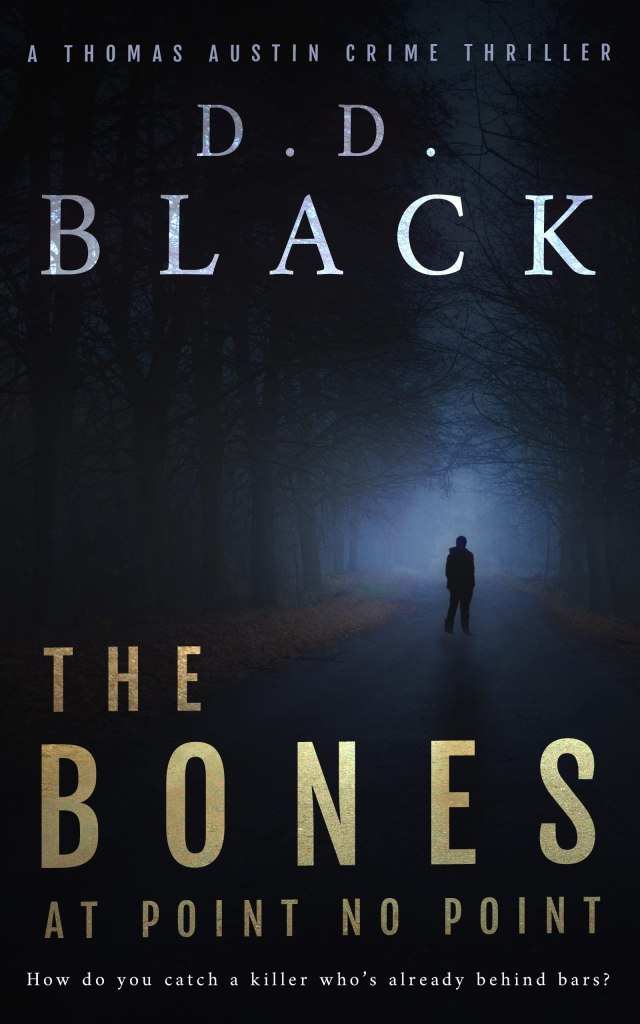
The debut volume, The Bones at Point No Point, did a nice job of introducing all the characters, and then harked back to a case in which Thomas Austin was the lead detective when he was in New York City. It seems there is now a copycat killer on the loose, but the details are so eerily similar that it has him (and everyone else) wondering if he locked up the wrong woman or, at least, missed that she had a partner. This sounds plausible as a bare-bones description, but the likelihood of any of it was highly suspect. Also, for his first novel D. D. Black chose to portray a particularly gruesome murder scenario, in shocking detail, and I didn’t want to read about it, especially because he described it several times in scenes from the past and circumstances in the present.
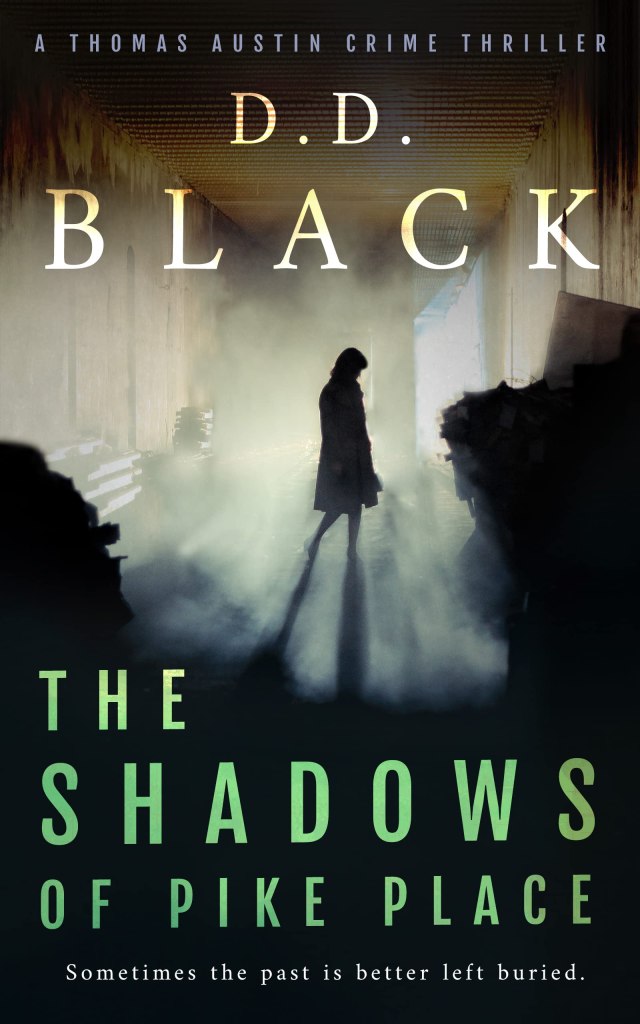
I thought about stopping with the first, but then read the description for the second, The Shadows of Pike Place, and was intrigued. This was more of a “locked-room” mystery, in that the protagonist was murdered during an evening when she was in the company of a limited number of people, and therefore the killer had to be one of those present. Again, I enjoyed the dynamic between Austin and Anna, the introduction of the Seattle police chief, and the colorful characters Black writes as members of the murdered woman’s family; but again, the mystery took off in various weird directions and the result was dependent on so many doubtful events that I found it somewhat absurd and also anticlimactic.
These are what I call “manufactured” mysteries, in that the scenario is so out of the box that it strains credulity. In both cases, I would have much preferred a tamer mystery less dependent on extraordinary events, one that showcased its detective’s abilities rather than dropping him in the midst of chaos and expecting sense to be made of it when it wasn’t plausible in the first place.
I may come back to this series someday, just for the characters and locales, but I think I’m done with the Thomas Austin Crime Thrillers for now—they’re just too frustrating.
Zig-zag
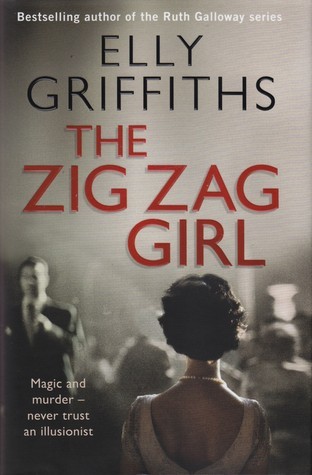
I recently discovered that Elly Griffiths, who writes the Ruth Galloway mysteries and has three volumes in a fairly recent story line starring Harbinder Kaur, has yet another series, called either The Brighton Mysteries or Stephens & Mephisto, new to me although not new. She wrote the first, The Zig Zag Girl, in 2014, and the sixth one came out in 2021, so presumably it is an ongoing effort. I was excited by the prospect of another series by this author, especially because this one is billed as more of a “cozy,” so I picked up the first when it was offered at a discount by Book Bub. I am disappointed to say that it will not be a new favorite.
The first book begins in the 1930s, moves through World War II, and ends up in a “present-day” 1950s mystery in England. The pre-war and war years are told in flashback as background for what is happening “now.” During the war there was a group of recruits called the Magic Men (mostly made up of magicians by trade) who were deployed undercover to Norway to deceive and distract the Germans by building decoy camps, tanks, and aircraft carriers to make the enemy think there was a base of operations about which they should worry. In the present day, one of those people—Edgar Stephens—has gone on to become a police detective; a person associated with the war group has been brutally murdered, and Stephens is assigned to the case. It’s an odd one, employing a magical trick called the Zig Zag Girl, in which the magician’s assistant is apparently sliced into three parts, only to emerge whole at the end of the trick. (In the case of the murder, she has actually been dismembered.)
After a second person, also associated with the undercover war effort, turns up dead, Stephens and his friend Max Mephisto, a magician who still headlines in variety shows around Brighton where the murders have taken place, conclude that not only are the murders related, but that the other members of the group (including themselves) may be in danger. An effort is made to track them down and warn them, simultaneously checking to see if it could be one of them committing the murders.
The premise and the historical time period appealed to me, but there were so many flaws in this initial book that I doubt I will continue on to read another. The historical aspect is sketchy, and the timeline of the war itself doesn’t correspond to reality; the Norway campaign was in 1940, and in the book the group’s efforts there last only two years and a few months before the war ends, leaving out three years of World War II!
The police procedural elements of the book were likewise hard to believe: These are gruesome and high-profile murders (each based on a magic trick, so they were bound to have the media all over them, not to mention capturing the public’s imagination), yet the only people investigating them are one policeman, his assistant at the station, and his magician friend? It’s just too casual—even in the 1950s, there would have been some sort of investigative team. Most of the activities that, in a regular police procedural, would be featured and discussed (for instance, forensics) were merely dropped into narrative between the sole policeman and his civilian buddy, so that they seemed incidental rather than central to the case. Despite its being a murder mystery, there was more attention paid to the lifestyle of the traveling magician than there was to the murders!
Other than the two protagonists, the characters were thinly developed; perhaps the intent was to have you figure them out for yourself, but they just weren’t that interestingly presented, and some members of the Magic Men (even central ones) remained cardboard cutouts to the end. There wasn’t much scene-setting in terms of details about the era. The witness observations were repetitive and clumsy, and although the descriptions frustrated both the detective and the supposedly canny magician, I figured out “whodunnit” from them pretty early on in the book, and from there I was just reading to get to the big reveal.
If this book were a debut novel by a novice writer I might have been a bit more forgiving; but this is a skilled storyteller who has published 29 books and counting. My advice: Stick with Ruth Galloway, or try one of her Harbinder Kaur books. Perhaps the rest of the Brighton Mysteries are better than the initial one, but I don’t intend to investigate. There wasn’t enough zig-zag in this one to draw me further in.
Re-wilding
Scottish-American conservationist John Muir, the “Father of the National Parks,” once wrote that
“…when we try to pick out anything by itself, we find it hitched to everything else.”
John Muir
This quote was specifically called into use when considering the failing ecosystem of Yellowstone National Park, where the purposeful removal of wolves, Yellowstone’s top predator, meant that the elk population overgrazed the plants and trees, leading to the demise of songbirds, beavers, and cold-water fish. Wolves were the missing link in the equation that would keep Yellowstone healthy and, 28 years after they were reintroduced (in 1995), the ripple effect is considered one of the most successful rewilding efforts ever undertaken. The culling of the elk herds by the 80+ wolves now living in Yellowstone benefitted ravens, eagles, magpies, coyotes, and bears. Wolves’ preying on coyotes increased the populations of rabbits and mice, providing a wider food source for hawks, weasels, foxes, and badgers. Muir’s quote was certainly prescient.
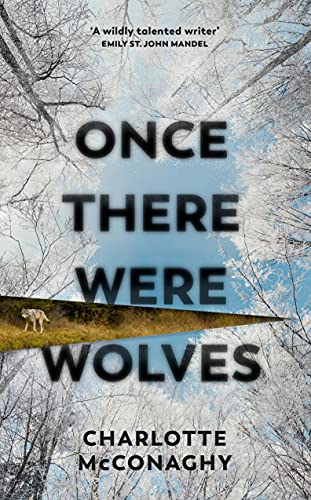
Charlotte McConaghy’s novel Once There Were Wolves posits a similar experiment to bring wolves back to the forests and Highlands of Scotland to rebalance biodiversity, depicting the difficulties inherent in convincing the resident human population (primarily sheep farmers) of the benefits to be had, and protecting the wolves against the farmers’ and ranchers’ conviction that humans and wolves can’t
co-exist on the land.
The protagonist is lead biologist Inti Flynn, a passionate young woman whose unusual upbringing by her father—living a subsistence life deep in the forests of Canada—has shaped both her beliefs and her career. She arrives in Scotland accompanied by her twin, Aggie, who is deeply damaged, mostly silent and passive, and spends all her time sequestered in their cabin. Inti has an extraordinary affinity for the wolves, heightened by an actual neurological condition called mirror-touch synesthesia:
“My brain re-creates the sensory experiences of living creatures, of all people and even sometimes animals; if I see it I feel it, and for just a moment I am them, we are one and their pain or pleasure is my own. It can seem like magic, but really it’s not so far removed from how other brains behave: the physiological response to witnessing someone’s pain is a cringe, a recoil, a wince. We are hardwired for empathy.”
Inti Flynn, Once There Were Wolves, by Charlotte McConaghy
The book is part literary fiction, part mystery, and engrossing in its narrative. Although the rewilding program is officially sanctioned by the government, there is massive resistance by the locals, some of whom are aggressive with their threats to kill wolves who set foot on “their” land. Inti struggles between her desire to protect her wolves and her need to engage with the locals as something other than a know-it-all outsider. She is assisted in making the human connections by the sheriff, local-boy Duncan MacTavish, but he remains something of an enigma throughout the story, and his passivity when it comes to enforcing Inti’s cause frustrates her. Then a local farmer goes missing, and speculation inevitably turns to assumptions about wolf culpability.
The best parts of the book are Inti’s detailed observations about the wolves—how they relate to one another and to their surroundings, and their habits, travels, and behaviors as they integrate into this foreign environment. The reader is transported to the hillside blind where Inti watches a new batch of pups scramble and play just outside the mouth of their den while the adults warily sniff the air, cognizant of the human close by, and the welfare of the small packs dispersed around the town becomes personal as each wolf becomes familiar.
Less effective, for me, was the rest of the narrative, especially that surrounding the sheriff, Duncan, and Inti’s sister, Aggie. I felt like we were too far into the story before we understood what happened to destroy Aggie’s confidence and turn her into the near-catatonic figure she now presents. Likewise, Duncan runs hot and cold, both with Inti and also with his commitment to doing his job (although his devotion to the individuals in his community is touching), and I was frustrated by the incitement to waffle over whether he was a good guy or a bad one. But McConaghy knows how to keep the action flowing throughout the narrative, and the mystery remains intriguing up to its final solution. Readers should be aware that this book presents scenes including violence and abuse, although much of that action takes place “off screen,” or is implied but not graphically described. But the few graphic depictions are powerful and potentially disturbing.
I enjoy a story with some meat on its bones—focusing on a particular iteration of a wider philosophy. As happens with my reading choices from time to time, there was a serendipity of theme between this book and The Crow Trap, by Ann Cleeves, which also detailed a biodiversity study in a rural area, but whereas I found that book almost completely lacking in appeal, Once There Were Wolves delivers all kinds of intellectual and empathetic content. Despite the few caveats above, I would definitely recommend this book to anyone interested in both a gripping story and a thorough education about how the biological world works.
For more information about the Yellowstone rewilding project:
https://www.muchbetteradventures.com/magazine/yellowstone-wolves-rewilding-1995-history-books/
Short stories
I get offered daily e-book bargains—freebies, or super-cheap prices—by BookBub, and sometimes I take them. I have learned, however, to first look up each one on Goodreads to see its average star rating and read some reviews; sometimes they are a bargain simply because they will never make it any other way. Also, BookBub has a habit of offering #3 in a series, with the hope, no doubt, that you will acquire it, realize there are two books before it, and buy them at full price. Nope. That’s what the library is for.
Anyway, some recent freebies were short stories by prominent authors and, while in general I dislike the very idea of short stories, being offered something for free by the likes of Margaret Atwood and Alice Hoffman definitely made me pause…and then say yes! So I acquired and read The Bookstore Sisters, by Alice Hoffman, and My Evil Mother, by Margaret Atwood.
I read these stories solely because of who wrote them. I have never understood the motivation behind writing short stories: Why go to all the trouble of selecting a venue and creating complex characters, only to write 34 pages about them and stop? I would think it would be as unsatisfying for the writer as for the reader!

I checked some reviews after finishing The Bookstore Sisters, and had to agree with someone else on Goodreads who summarized it as “Good, if a little twee.” Although I gave it four stars for the writing and characters, I was disappointed in this effort by Hoffman, because it is essentially a shorthand version of every “relationship” book written by lesser writers in the past five years: Two sisters, estranged—one remains at the “homestead” while the other goes off to, of course, NYC, and “forgets” her past. The homebody runs into crisis, the stray returns home to help, a breakthrough is made, the family income is saved, a love is rekindled, and…scene. Meh.

I had more initial hope that My Evil Mother, by Margaret Atwood, would rise to the level of the few short stories I ever really appreciated, chief among them those by that mistress of the unsettling tale, Daphne du Maurier. (I do love her compilation called Don’t Look Now.) While told in the voice of the daughter, the story showcases Mom, who is giving a perfect performance as a 1950s housewife, attired in pin-striped shirtwaist dresses protected by flowered aprons, delivering the occasional tuna casserole to a sick neighbor, while hiding her true self. The reality is that the daughter never knows whether, when Mom takes out her mortar and pestle to grind something up, it will be the garlic and parsley she needs to mix into her meat loaf, or something concocted from the plants in her off-limits herb garden in the back yard and sold to a weeping woman who visits their kitchen after dark. (Coincidence: Shades of Alice Hoffman here, with the aunts providing contraband love spells for the ungrateful townsfolk in Practical Magic.)
There are funny bits, as the mother tries to convince the daughter that her gym teacher is an ancient nemesis who may work a spell with the daughter’s hair if she isn’t assiduous about collecting it from her hairbrush and burning it. Or that the mother has turned the girl’s absent father into the oversize garden gnome who stands on their front step. But ultimately, there’s not much of a story here, only “stories,” anecdotes about a girl growing up with a peculiar, eccentric mother and coming to certain realizations, once grown, that help her deal with her own surly teenage daughter.
Ultimately, My Evil Mother had a certain novelty and a lot of imagination (I loved the mother’s voice), but it wasn’t a satisfactory experience. All you get with a story like this is a skim off the surface of these people’s lives, when you want their full depth and presence—the entire bowl of pudding. I think I won’t spend time on them again, even if they are written by authors I love and admire.
Metaphor
If I had to define the central theme of the book Black Cake, by Charmaine Wilkerson, it would probably be summed up by this quote:
“But the fact was, when you lived a life, under any name, that life became entwined with others. You left a trail of potential consequences. You were never just you, and you owed it to the people you cared about to remember that.”
ELEANOR BENNETT
The cake in the title, made with blended fruits soaked in liquor and with burnt sugar added to produce its distinctive black color, is a symbol of family, tradition, a thread of familiarity that stretches back to connect all the disparate parts down through generations. It’s also a metaphor for the complexities of culture, in which such issues as colonization, slavery, immigration, assimilation, and social, racial, and political borders figure into every aspect of life—or a recipe.
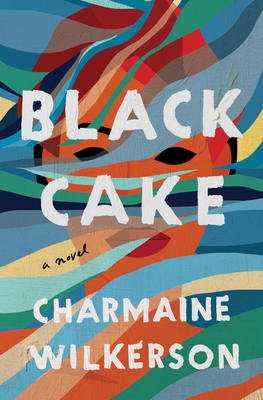
This book is a kind of revelatory fiction; the story is told completely in third person, but from multiple voices and points of view, and a new bit of the story is revealed as another person takes up the narrative and adds his or her perspective. Situations are fleshed out by hearing about them from different voices and seeing them through different eyes, and each narrator has a reaction to share. Although Eleanor Bennett, the matriarch of this family, is the pivotal character, the story is moved forward by noting the effects all the secrets of her life have had on the members of her family, most specifically her children, and also by revealing the major impact that both significant and tertiary characters in her past have had on hers and everyone else’s future.
Although I had some difficulties with the book, the most persistent probably being that Wilkerson stuffed it as full of social issues as her black cake bulges with fruit, I appreciated it as a whole. I couldn’t wait, when I reached the end of a chapter, to turn the page and see what the next one would contain, and I was seldom disappointed. Murder, desperate acts, rebirths, aliases, grand secrets, it’s all there in Black Cake. The story is about decisions made that can never be taken back, about necessary sacrifice and stubborn persistence. It’s a powerful picture of what it means to be a survivor, and to preserve a sense of racial and cultural identity throughout. The thing I liked most about it was that the narrative evolved as a true storyteller would reveal it, carrying you along with her into an evocative past. Give it a taste and see if it’s to your liking.
The essence of a genre
As I discuss in my genre lecture in my readers’ advisory class at UCLA, crime fiction accounts for as much as a third of the fiction published in English worldwide. If you regard that statistic you must conclude that there are many for whom the reading of mysteries is an attractive or even compelling way to occupy their leisure time.
A basic definition of mystery fiction is “any work of fiction in which a crime or the threat of a crime is central to the theme or plot.” But there is so much beyond that basic definition—at the very least, Who are the characters? What is the situation? and Who will figure it out? Think about all the elements that can be components: the red herring, the false clues, the inside job; the amateur vs. the professional detective, the reconstruction of the scene and circumstances, the procedural details of discovering the means, motive, and opportunity—the list goes on. There is also, amongst mystery readers, a certain vicarious authority or presence indulged in by their choice of protagonist. In other words, since most mysteries are part of a series, you as the reader are going to be spending a lot of time with that protagonist, i.e., the detective or person acting as such. That protagonist is
going to become far more important to you than any individual plot or story.
If you ask a mystery reader to describe Harry Bosch, the main character in Michael Connelly’s long-running series set in Los Angeles, they can give you a complete catalogue of what he looks like, how old he is, where he lives, how many times he’s been married and to whom, his relationship with his daughter, how many times he has been hired and then fired by the LAPD, in what other capacities he has performed as a detective, and even his war record in Vietnam; but if you ask that same reader the plot of one of the 24 Harry Bosch novels, that person may say “they all run together after a while.” It seems that everything about a series protagonist is recalled as a unit, with little or no memory of which specific texts revealed these details.
That’s not to say that plot isn’t vitally important to the experience; by reading a mystery, you are participating in the process of going from the unknown (the whodunnit) to the known, and following many indicators to get to the resolution, and mystery readers are notoriously unforgiving of a poorly laid-out plot. But characterization, of both the protagonist and the other participants, is key to a successful mystery.

I say all this as a lead-in to discussion of the book I just read, the first of a fairly long (10 books) and apparently successful body of work by a well-respected author whose other, more recent writing (Shetland Islands) I have recently enjoyed. It was because of those books that I decided to sample Ann Cleeves’s more well-known series about Detective Inspector Vera Stanhope, beginning in 1999 with The Crow Trap.
Having finished the book, I am utterly baffled about why, once having read this first one, anyone would bother to continue onward with the rest. Perhaps, if I had first seen the television show Vera, based on the series and starring the wonderful Brenda Blethyn, I might barrel on through, convinced that things could only get better. But if it were left to The Crow Trap to convince me, it simply wouldn’t happen.
To me, this book violated so many of the criteria we mystery readers have come to expect from our genre: A compelling story, an interesting if not charismatic lead, an engaging mystery. Instead, there is a vaguely presented low-key conflict in a country town, about which even the principal players don’t seem passionate, and a detective who isn’t introduced (beyond a cameo appearance where she is mistaken for someone else) until about the 45-percent mark in a book that is about 150 pages too long. There are multiple murders of people that everyone, including the principals, seems hard-pressed to care about. The main characters are not well defined or described, and each of their personalities border on irritating to downright unlikeable. The detective herself is repellent in a way that would, for me, be hard to recover from in subsequent volumes, because I disliked her so much—both her manners and her methods. There is little order or logic to the investigation, and the resolution is so completely underplayed that I had a hard time understanding that yes, indeed, it was this person for these reasons, and the story is over.
This book received a preponderance of four-star ratings on Goodreads, while I struggled between the flat three-star “I liked it” score and the more accurate (but still maybe too enthusiastic) “it was okay” of two stars. I won’t descend to one star, giving Cleeves credit for at least creating an initial interesting scenario, but beyond that I would say, Read her Shetland books instead, or, hey, watch the TV series guilt-free.
Plausibility
Do romance novels have to have a plausible premise?
I ask this because so many don’t, in my experience. Every once in a while I go outside my preferred reader zone and assay one of the genres for which I have little affinity (these would be romance, horror, westerns, and pretty much all nonfiction!), because as a readers’ advisor I need to keep up with what’s current and have some titles ready to suggest, no matter what my personal preferences. So, after finishing the mammoth undertaking that was Demon Copperhead (see previous post), I decided to go for something light and frivolous.

My chosen book was When A Scot Ties the Knot, by Tessa Dare, a part of the “Castles Ever After” trilogy (which isn’t a series but rather a rough grouping of similar stories). I actually looked up a different book on Goodreads, but one reviewer said that in her opinion that one was a rip-off of this novel, and cited Dare’s book as the better read, so I believed her and switched. Ironically, all through this book I kept thinking, Ripoff? Yeah, of Outlander. The Scot in question spent the whole book calling the object of his affection “Mo chridhe,” which is a Jamie-ism if ever I heard one. No, I know Jamie Fraser was not the first to use that expression, but you have to admit that has become a signature phrase for him, along with “Mo nighean donn.” Also, the whole forced marriage thing…whoops!
On to the implausible plot: Madeline Gracechurch is shy. In fact, her introversion goes far beyond that—she suffers panic attacks in crowds. So when her family plans to send her to London for the Season, where she has to mingle with hundreds of people at balls and actually talk to men with a view of marrying one, she panics. She makes up a suitor that she supposedly met while in Brighton on vacay, but not just any suitor: He’s Scottish, he’s a Captain in the army, and he’s away at war. So obviously she has no need to go to London, because once the war is over, her Captain MacKenzie will come for her.
This begins a years-long deception in which Maddie writes letters to Captain MacKenzie and sends them off to the front…and receives letters from him in return, because after all, it would be a bit suspicious if he didn’t write back! There is no explanation of how she manages to arrange for the return letters, especially in someone else’s handwriting other than her own, but this is just the first (although admittedly most egregious) of implausibilities. The next is a much bigger surprise: Captain MacKenzie, the remainder of his men in tow, shows up at her castle in Scotland (she inherited it from her godfather), letters in hand, and informs her that they will be wed forthwith so that his men will have a place to live, their lands having disappeared while they were away fighting for the Brits, and if she won’t marry him, he will expose her deception.
So…how did Logan MacKenzie receive the missives Maddie expected to end up in the dead-letter box? Well, apparently the British mail system within the armed forces is just that good! (Anyone surprised by that?) Even though he wasn’t a Captain but a lowly private when she first began her correspondence with him at the age of 16, the letters somehow found their way to him and yes, actually inspired him to work hard enough over the subsequent years to make the rank of Captain a reality.
All those letters, though, that Maddie received in return—not a one of them was from him. He collected all of hers…but never had the impulse to write back and say, Um, who exactly are you, why are you writing to me, what the hell, young lady? Nope. But he saved all of hers with the plan to confront her and demand her hand in marriage on his return.
Then, however, she makes him mad: She kills him off! Well, it had to come sooner or later, because what would happen should he never show up to claim his bride? So she pretends to have received news of his demise, wears mourning for a year or two, and blithely goes about creating a career for herself as a naturalist’s illustrator, drawing pictures of plants and bugs for prominent researchers and publishers.
Then the big surprise, in a blue and green kilt, shows up on her doorstep.
I suppose that romance is a genre in which you are expected to willingly suspend disbelief in a major way, but there was so much potential for holes in this one that I laughed out loud several times as this farce unfolded. It’s not a bad book, and she’s not a bad writer, especially as regards the steamy scenes when they are working up to consummating their hand-fasting. But Maddie’s subsequent frantic search for the letters—Logan’s tool of blackmail—and Logan’s maintenance of his mad-on because she killed him off became increasingly ridiculous, since it was patently obvious that she had fallen for all of his many charms, and he for hers, pretty early on. The book was basically an exercise in drawing out the anticipation for sex between the two.
One funny note that falls under reader serendipity: After I finished this silly story, I picked up a rather dark and convoluted mystery by Ann Cleeves, only to discover that its protagonist was also a naturalist’s illustrator. How weird is that?
A classic based on a classic

I feel like I need some kind of reward for having finished, just as the author deserves an award for having written! I enthusiastically and optimistically started Demon Copperhead, by Barbara Kingsolver, two days after Christmas, thinking it would be my first read of 2023, but my count is now up to 11 books, and I just finished it. I took two breaks, one motivated by wanting to be able to read on my Kindle in the dark of night in my bed (I bought the hardcover of Demon Copperhead, knowing that I’d want to keep it on my shelf), and the other by realizing that the depressing nature of the story was having such a profound effect on my mood that I needed to read something else for a while! But I was determined to finish, and the wink-out of my Kindle battery mid-sentence day before yesterday sent me, finally, back to the last 13 percent of this tangible book.
It’s not that I didn’t want to read it—it’s an amazing story of a quirky, irrepressible, sad, endearing red-headed boy who nobody wants, and it’s also both a literary masterpiece and a stern indictment of America’s marginalization of the disadvantaged. For all those reasons, it is worth my time and yours. But lordy, is it depressing! Damon Fields (the protagonist’s real name) is a logical (though still incredibly unlucky) product of his surroundings, growing up in the foster care system after his junkie mother leaves him an orphan in a single-wide at a young age. But he is not an anomaly—there are plenty of unfortunates in the culture of Southern Appalachia who contribute to the dour mood. One of the most powerful understandings comes towards the end of the book, when Tommy, one of Demon’s former foster brothers, crafts a philosophy of America that pits the “land” people against the “money” people, and the land people—those who hunt and fish, farm tobacco, and share what they have with their family and anyone else in need, operating outside the monetary system—always lose.
I am somewhat ashamed to say that I have never read David Copperfield, the book on which Kingsolver based this one, although I have a fairly good knowledge of its contents and am in awe of how she translated Dickens’s “impassioned critique of institutional poverty and its damaging effects on children in his society” (Kingsolver, Acknowledgments) into this stunning story of the opioid crisis in Appalachia. But unlike the Jodi Picoult novel about which I blogged last, this book is not preaching about the social crisis but instead is determined to tell the story via the victims and survivors of it in a straightforward, completely realistic manner that guts the reader who is invested in them. Every person in this book (and there are dozens) is vivid, individual, and completely memorable. Even though I broke it up into multiple reading sessions over the course of more than a month, I never once had to think, Um, who is this character again? and backtrack, because every single one of them stood out as a person. I can’t think of a much better compliment you could give to a writer, and Kingsolver deserves it.
But it is the character of Demon who dominates—and sometimes overwhelms. His circumstances are beyond tragic, horrifying when you think of a child having to endure what he does, and yet he is a source of continual hope. It’s not that he’s a falsely optimistic Pollyanna of a character, it’s that he has somehow assimilated a work/life ethic that causes him to put his head down and push through every challenge in his desire to live. And even when he fails—and he does that just as spectacularly—he somehow never gives up on himself. As he loses family, friends, mentors, homes, abilities, he manages to continue focusing on what he does have and what he can use, and keeps hauling himself back to his feet.
One reviewer on Goodreads repeated a quote from a Washington Post book review that said,
“Demon is a voice for the ages—akin to Huck Finn or Holden Caulfield—only even more resilient.”
I couldn’t agree more. Another said “This is a book about love and the need for love, the search for love,” and that, too, is true. And the language, both brutal and brilliant—Kingsolver’s way with words is beyond skillful. I won’t say much more about the book, I’ll leave it to you to discover. But it deserves all the accolades.
A certain kind of story
I discovered Jodi Picoult’s books back when I was on the cusp of 40, with her book Mercy (I think). I may have read one of the ones before that, but the descriptions on Goodreads don’t spark any memories. But I have read so many books over the years that sometimes I come to an old one thinking it is new, only to vaguely recognize the story as I get further into it, so I’m not sure. Anyway, after that I made a habit of picking up her books until somewhere around My Sister’s Keeper, in 2004, and after that I lost interest and quit reading them.
It wasn’t because she wasn’t a good writer, and in fact I enjoyed the story in My Sister’s Keeper; but her books increasingly reminded me of my least favorite young adult novels—those the library profession calls “problem novels.” Somehow, even though her characters remained fairly compelling, her books began to seem to me like those preachy tomes written for teens that turned out to be about a condition, or a social concern, rather than a person; as Michael Cart says in his history of teen fiction,
“The problem novel stems from the writer’s social conscience. It gave the frisson of reading about darkness from the comfort of a clean, well lit room.”
Young Adult Literature: From Romance to Realism, p. 35
Rather than telling realistic stories about the teens who experienced certain aspects of life, the books focused on such subjects as drug abuse, abortion, unwed motherhood, and so on, using a formula that approached the feeling of an old-fashioned morality play. Problem novels sought to illustrate the perils inherent in poor life choices, and every time I opened a Picoult novel, it was with the unspoken question: What is the problem/flavor of the month in this one? They became repetitive and increasingly uninteresting to me (although a certain segment of readers continued to eagerly devour every word).
There were a few things that enticed me to once more read a Picoult bestseller: One of the characters is a bee-keeper, which profession has always fascinated me; Picoult co-wrote it with someone rather unexpected, about whom I wanted to know more; and the “What Should I Read Next?” crowd on Facebook pretty much raved unequivocally about Mad Honey, Picoult’s latest hit with Jennifer Finney Boylan.

There were parts of this book that I liked very much. The bee-keeping was, as anticipated, as enthralling as always. The back stories and characters of the two moms were compelling, as was the head-rush of a romance between the two teens, Asher and Lily. The authors wrote both their main and subsidiary characters with conviction and believability. But there was a fatal flaw within the story that really bothered me.
The basic outline is this: Olivia McAfee took her six-year-old son Asher and ran from an abusive husband back to the New Hampshire town where she grew up, inheriting her father’s bee-keeping operation. Asher is now in high school, a star of the hockey team, a good student, and a kind son and friend, having grown up in Olivia’s sole custody.
Ava Campanello fled with her daughter, Lily, from her own marital trials and more, and her employment options with the park service landed her in the same town in New Hampshire just in time for Lily’s senior year, hoping for a fresh start for the both of them.
Asher and Lily are almost immediately drawn to one another, and begin an intense relationship that lasts about four months before Lily ends up dead, having fallen down the stairs in her own home, and Asher is the one who finds her and is discovered weeping and clutching her body—but not calling for an ambulance. After a brief investigation, the police come for Asher and he is charged with first-degree murder.
Thus far, the whole plot worked for me, even the crazy timeline about which some complain, which jumped from before to after “the event” in almost every chapter, and also switched narrators/viewpoints—Olivia to Lily. Then we get to the trial. Olivia’s brother, Jordan, is, serendipitously, a rather famous defense attorney, and immediately comes to the rescue, agreeing to represent Asher pro bono. We go through all the details of a murder case—expert witnesses, character witnesses, the prosecution’s efforts to make the defendant look as guilty as possible by characterizing him as a violent, impulsive liar with both motive and opportunity. Then we get to the defense and Jordan completely falls down on the job.
The question that is never, ever asked by anyone—Asher, his lawyer, his mother or, apparently, the police—is the one that would have been central to the defense in any halfway well written murder mystery. Can you guess what it is? In his Dismas Hardy legal thriller series, author John Lescroart characterizes it as the “SODDIT” defense: Some Other Dude Did It. In Mad Honey, Asher adamantly maintains his innocence: When he walked in the (slightly ajar) front door, Lily was lying at the foot of the stairs, her head bleeding. His uncle/lawyer and his mother believe him, despite his mother’s secret fears that genetics have won out and he is violent like his gas-lighter of a father. The prosecution is insisting that he did do it, based almost solely on circumstantial evidence—some DNA, some texts, a scandal in his past that brands him as a liar. But not one person who believed he didn’t do it (including Asher himself!) spoke up to say, If Asher didn’t kill her, then who did?
Jordan should have been all over that—questioning the police and detectives to see whether they had considered any alternate person and scenario, having his investigator look into others who might have been suspicious, checking neighbors and traffic cams to determine whether anyone else visited the house that day, but…crickets. No mention of an alternative theory of who the murderer could be. That’s pretty much when the story lost me, and should have been when Asher, fighting for the rest of his life, or his mother, with her greater adult wisdom, sat up and said Jordan! WTF?
It didn’t totally ruin the rest for me—I still liked the characters (particularly Lily), the story, and the twists, small and large, and might recommend it based on those things. (And you should know that, despite all the surface details cataloged in this review, I have kept all the big secrets of the book.) But that one omission, paired with the way the book ends, made me realize that perhaps my initial conclusion—that Picoult is too focused on the social concerns she wants to highlight to truly immerse herself in the meat of the story—was not off base. I won’t say I’ll never read another from the Picoult oeuvre, but it will take something extraordinary to convince me.


 The Book Adept