Interludes
As I have previously mentioned here, sometimes I take a break between what I would consider more “significant” works (or at least the works of writers unknown to me) to read something lighthearted, whether that is a book written with juveniles as its audience, or a “bit of fluff” characterized by chick lit or Regency romance. This past week or so, I did both, with some surprising results.

The first book I picked up was The Extraordinaries, by T. J. Klune. Given that Vicious, by V. E. Schwab, is one of my favorite books ever, I had high expectations for a book in which ordinary people have the potential to become extraordinary, and the extraordinaries have complicated relationships with their ordinary contemporaries (and with one another). What can I say? First, I have to face that there is no comparing any book with the brilliance that is Vicious. It stands alone (well, except for its sequels). Second, I read Klune’s The House in the Cerulean Sea first, absolutely fell in love with that, and then read this. Who could not be a little disappointed?
The Extraordinaries is exactly as billed: A YA novel about a kid with ADHD who wants to be a superhero or, alternatively, wants to be beloved of a superhero. It’s cute, it’s inclusive, it’s frank and matter-of-fact about sexuality, it has some great characters, and teens will love it. Me? Not as much. I see its worth and its value without being able to immerse myself in its story. Also, I feel like the (ultra-serious) post-er who decried the glorification of the police (always the good guys, regardless of bad behavior) in this had a point. Not to the extent he carried it, but still…yeah. But for kids who like comics and graphic novels, this is a next step, and a fun one. I had planned to read the sequel, Flash Fire, but after the first couple of chapters I put it aside. It’s not that it’s not good, it’s just not for me. But like I said, teens (especially lgbtq etc. teens) will be enthused. (I do, however, look forward to the sequel to Cerulean Sea with unabated hope.)
I decided instead to move on to my reliable go-to author for light relief, the inimitable Georgette Heyer, writer of the quintessential Regency romance. But I ended up being surprised by a book that was not quite like most others she has written. A Civil Contract is surprisingly serious in tone compared to her light, frothy stories of witty, clever people, and owes much to Jane Austen’s book Sense and Sensibility.

It has a common theme of star-crossed lovers who may or may not prevail, and who probably appreciate the person with whom they end up more than the one they initially desired. But in this case there is no blinding realization that they have come to love that person, but rather a quiet acceptance that the relationship they have created will in the long run suit better, regardless of their feelings.
Adam Deveril, Viscount Lynton, an officer in the Peninsular War, is called home upon his father’s demise to discover that his family’s fortune has been decimated by his happy-go-lucky, completely improvident parent, and that he is on the verge of ruin. He has a mother and two sisters to support, and the youngest is not yet “out” (presented to society); without a dowry or indeed any basic support, her fate at least will be grim if he can’t figure out their financial situation in a hurry.
Before he left for the war, Adam had an understanding with Julia Oversley, for whom he has conceived what he believes to be a lasting passion, and which is returned by the beautiful Julia. But he knows that her father is not so unworldly as to agree to a marriage between his daughter and a man who can’t support her. While he is steeling himself to sell significant parts of the family’s estate, including the country seat, Julia’s father approaches him with the idea that he make a marriage of convenience with the daughter of a fabulously wealthy but admittedly vulgar merchant, Jonathan Chawleigh, to whom Mr. Oversley owes a favor. In exchange for his daughter Jenny achieving the social status that comes with marriage into an aristocratic family, Chawleigh will pay the myriad bills accrued to the estate and buy back all of Adam’s mortgages on the country home. Jenny, a school friend of Julia’s, goes into the marriage knowing that Adam still loves Julia. And the rest of the book details the emotions still held by the two parties in the doomed love match, as well as the new wife’s adaptation to being married to a man who not only doesn’t love her, but holds her father in revulsion, despite his own resolve, for being who he is and wielding power over Adam’s every decision.
This book, rather than a recounting of the making of a marriage, is an exploration of what constitutes a successful one once the deed is done. It incorporates the many sacrifices one has to make by tolerating the baggage of relatives and friends that come with a partner; it reveals the necessity of kindness, tolerance, patience and, above all, a sense of humor. It showcases, in fact, that the significant parts of married life are the ordinary, everyday events rather than the moments of exaltation or grand passion.
Julia Oversley is the Marianne Dashwood of the story—beautiful, impulsive, sensitive, willful, and somewhat selfish—while Jenny is Elinor—practical, somewhat shy and retiring, and more concerned for the feelings of others (specifically Adam’s) than for her own. Jenny’s father, Jonathan Chawleigh, is somewhat reminiscent of Sir John Middleton, in that he speaks his mind in an embarrassing manner without thought for what he is saying or how it will affect his listeners. But he goes far beyond that character in both coarseness and good-heartedness, and steals the show whenever he appears on the page.
There was rather too much historical narrative for my taste regarding the various engagements between Napoleon Bonaparte and the Duke of Wellington, but it’s well written and definitely pivotal to the plot. This is one of the few books of Heyer’s that has a quiet, satisfying ending rather than an “Ahah!” moment, but it doesn’t suffer for that. While it was an unexpected read in the midst of Heyer’s others, I still both enjoyed and appreciated it.
The Madness of Crowds
If it’s August, it must be time for the annual Inspector Gamache mystery by Louise Penny. It’s amazing to me that she can keep turning one out every year, no matter what. A few times I feel like the series has suffered, but mostly they are intricately plotted, with intelligent dialogue, in-depth philosophy, and compelling characters. This one was no exception, although there were a few moments while reading it that I wanted to say, Where is your editor in all of this?
The setting is once again the village of Three Pines, south of Montreal, Quebec (the previous book in the series occurred while the Gamaches and Beauvoirs were on a visit to Paris), and it is post-covid. I’m sure that when Penny wrote it, she anticipated a legitimate post-covid world in which everyone was going about their normal lives again instead of one plagued by variants that threaten to keep us in masks and in isolation for yet another season (or year). But at the heart of her plot is a moral issue that has sprung to life partially as a result of the medical shortages and triage of the worst days of the epidemic, and it’s dark.

Never assay a Penny mystery expecting it to be an ordinary police procedural. She incorporates not only philosophy and politics, but also art and poetry, and while the police work is meticulous, the feelings and intuitions of the officers involved (with Gamache at their head) are always as essential as are the bare facts of the case. One of the things I enjoy about Penny is that she inserts real poems and quotes and books into her fictional works; the title of this one is based on a book by Charles Mackay, called Extraordinary Popular Delusions and the Madness of Crowds. She immediately made me want to seek it out.
This book uses its characters and story to explore such social issues as disinformation and propaganda, xenophobia, and eugenics. I feel like her pivotal character, Professor Abigail Robinson, is consciously modeled on some of the charismatic but wildly morally skewed characters who have appeared as players in the recent American story, in the way that she divides the culture in two over the validity of her theories with the sheer strength of personality and certitude.
One Goodreads reviewer opines that this novel is “the most allegorical of Louise Penny’s work. The actual murder is incidental to the plot, serving only as a springboard to examine morality on both personal and societal levels.” I’m not sure I would go that far; but there is occasionally an arms-length feel to the crime they are supposed to be solving, as opposed to the debate they are constantly having.
Gamache is asked to provide security at a lecture being given by a professor of statistics. Given the presumably dry content of a speech on statistical analysis and the fact that it’s taking place at an obscure university auditorium in between Christmas and New Year’s Day, Gamache is puzzled as to why anyone would approach the Chief Inspector of the Sûreté du Québec to oversee this task; but then he does a little research on the likely content of the professor’s speech and immediately musters a far bigger response than anyone would expect at what should be an incidental, poorly attended event. More people show up than the venue can accommodate, and Gamache has a volatile and angry crowd on his hands as the professor steps up to speak.
One thing that bothered me about this book is how long it takes to reveal the specific contents of the professor’s government-solicited (but later repudiated) report on which her call for action is based. Another was how long it took to get to the actual murder, using some “foreplay” crime to keep the reader going until we arrive. And a third was the resolution of the mystery: There were multiple individuals who could have been the culprit, and none of them stands out for long, as facts are discovered that exonerate each one, only to raise more doubts about the others and then circle back around again. It felt like Gamache, Beauvoir, and Lacoste spent an aeon going over basically similar theories for why each person was or could be the murderer, and they all made sense! This is one of the few of her books that didn’t have that “Ahah!” moment in it when the unexpected solution arises and proves to be the truth. I think this is probably because Penny wanted the social commentary, rather than the murder, to be the star of the show…but it made the actual mystery a long, drawn-out process.
With all this caveating (is that a word?), I was still thoroughly engaged by and absorbed in the story. We are reunited with familiar villagers, get to know others who haven’t been prominent before, and are also introduced to a variety of strangers, each of whom brings their own twist to the plot. The physical details are, as usual, spot-on for a winter interlude in coldest Canada, and made me want to drink hot chocolate even in 100-degree Los Angeles! (I sometimes wish that her annual pub-date was in February, so I could be in accord with her characters as they snuggle up with comfort food and beverages around the fire.) And the moral dilemma around which the entire plot is wrapped is likewise riveting, albeit deeply disturbing.
I made a comment in my review of A Better Man (two books back) about a stylistic shift I saw taking place in Penny’s writing structure and, while I noticed that it mostly disappeared again in All the Devils Are Here, it’s back in this book. She does this short-phrase, incomplete-sentence thing that can occasionally work as a device to emphasize something, but is less pleasing when it constantly occurs. Perhaps she (or her editor) will see this comment, here or elsewhere and, taking it to heart, go back to the more fluid literary construct of yore. But even with that, I still give the book four stars out of five.
Jane in person
I am a sucker for time travel stories—although I really hate it when they are poorly conceived and/or realized. Likewise, I am a huge Jane Austen fan, but have learned to be wary of embracing the countless Austen spinoffs and glorified fan fiction spawned by authors who don’t have the chops to write anything close to canon. (I don’t know which is worse—the juxtaposition of Pride and Prejudice with zombies, or the creation of an Austen theme park in which young women can act out their Regency-born fantasies.) So imagine my delight when I discovered a book that sends a couple of intrepid explorers back to 1815 to see if they can retrieve additional Austen materials and bring them up to the present day to delight literary scholars everywhere?
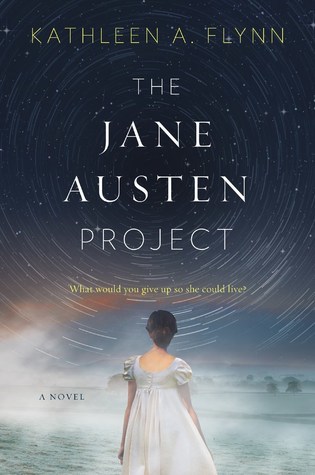
In The Jane Austen Project, by Kathleen A. Flynn, Rachel and Liam are sent from their rather sterile and unsatisfying present—they live in a world that has experienced “the Die-off” (no more trees), and eat food created by 3-D printers—back to 1815 England. They have been immersed in history for months, properly clothed (albeit with only one outfit apiece), and furnished with what will be an inordinate amount of money for the time period (although it’s mostly counterfeit), and the opening to the past has dropped them in a field near a town called Leatherhead. Most important to their mission, they have been cautioned that they must interact as little as possible so as not to effect change while trying to achieve their mission, which paradoxically will require a particularly close acquaintance with their subject! They are cast as the Ravenwoods, brother and sister, recently arrived in London from Jamaica after having manumitted their slaves on the coffee plantation and sold up to make the move. This back story ensures that they have a ready explanation for small awkwardnesses in local custom, as well as their lack of acquaintance with anyone who could expose them as impostors.
Their mission is to cultivate sufficient intimacy with Jane Austen and her family so as to gain access to letters she wrote to her sister Cassandra, as well as to an unpublished manuscript that was previously thought to be incomplete—only three chapters exist in their time—but, it has been learned through the recent discovery of a letter from Jane Austen to a friend, was rather held back from publication because Jane thought it too revealing of her own personal family situation.
Apart from staying in character, which is particularly difficult for Rachel, since she is an independent single woman and a medical doctor in the present day, the challenges are enormous. They have about a year to become established enough in London to curry an acquaintance with Henry Austen, Jane’s brother, and then to win an introduction by him to his reclusive sister, whose books are not even published under her own name. It would be hard for Jane to imagine the extent of her fame and the reverence for her work held by scholars and commoners alike, a couple of centuries hence; almost as hard as it is for Rachel and Liam to restrain their enthusiasm and wonder at being a part of her close circle.
All sorts of things go awry, as they are wont to do in time travel adventures, given the necessity for lying through your teeth, sticking to appropriate behavior for the times, and knowing your specific place in society—whether it’s how familiar to be with your kitchen staff, or how much flirting you can venture without compromising your reputation. There are many surprising turns in this book, and with a year to accomplish their mission, the author was able to space them out nicely and make everything feel logical and/or inevitable.
I really enjoyed reading this and, unlike some books where you wish an editor had stepped in to cut a couple of hundred pages, I could have asked for more. There was adequate detail about everything, but absolutely no excess. I would have liked to know more about Liam, in particular, before the adventure began (the book is told from Rachel’s viewpoint), and also welcome would have been just a little bit more detail about the specifics of daily life in both past and future, and some explanation of why particular interactions turned so awkward. But over all, I have to applaud the author for pulling this story off so well—it had enough history, enough romance, enough intrigue, and never went overboard. If you have enjoyed the Outlander books, or Connie Willis’s multiple forays into time travel, I venture to say you will also get a huge kick out of The Jane Austen Project.

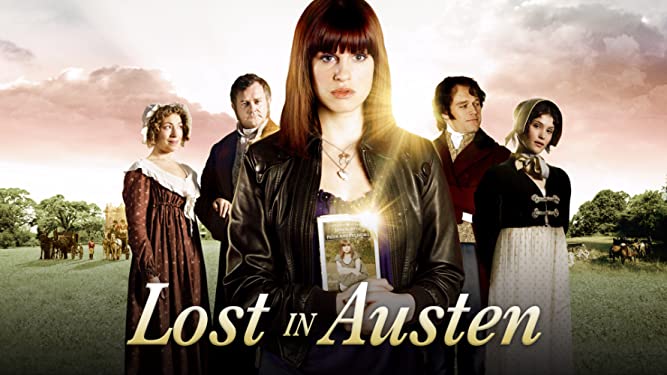
(One exception that I have to confess as a guilty pleasure in this oeuvre is Lost in Austen, a four-part British miniseries in which a P&P fan opens a hitherto unknown door from her bathroom into the Bennet household, trading places with Elizabeth, who steps into the present day, whereupon the door disappears and each is stuck in the other’s life. It’s hilariously well done. Jane Austen is spinning in her grave. Check it out.)
Coming of age w/dogs
I somehow never picked up The Story of Edgar Sawtelle, by David Wroblewski, back in 2008 when it was published and getting all the buzz. I had started my first job in my new career as a youth services librarian, and was far too exhausted ordering books for the library and trying to get current on children’s literature to read much of anything for my own pleasure. I was buying some remaindered books from bookoutlet.com recently and saw that it was available, so I included a copy in my order and started reading without knowing anything about it.

It reminded me, with its gorgeous prose, descriptive scene-setting, and intriguing characters, of a few other books I have lately read—This Tender Land, by William Kent Krueger; The Extraordinary Life of Sam Hell, by Robert Dugoni; and Where the Crawdads Sing, by Delia Owens. Like those books, it has a young protagonist with a challenging facet to his character, and is both a coming-of-age saga and a snapshot of the times and locale in which its events take place.
In This Tender Land, the boys are orphans being raised in a reservation institution during the depths of the Depression; in Sam Hell, the protagonist is born with red eyes, an odd genetic marker that is a target for bullies; in Crawdads, Kya grows up in isolation in the North Carolina marshes after being deserted by her family, and is regarded with suspicion by the rural community surrounding her. Edgar Sawtelle is more fortunate than these others, in that he has two loving parents and a meaningful life working on his family’s farm in northern Wisconsin, breeding and training dogs for sale. But Edgar has his challenge, too: He was born mute. He hears, but is unable to speak, scream, or make any kind of verbal noise. He is fortunate to meet a woman early in life who teaches him and his parents to sign, and he and his mother go on to make up their own peculiar gestures for all the dog-related trainings, which he does silently with his hands while she verbalizes.
When Edgar is a teenager, his uncle Claude comes back into their lives (he has been in prison), and as soon as he is on the scene, things begin to change. Edgar’s father and his uncle quarrel almost constantly, his father’s native caution coming up against his uncle’s rash impulsiveness. It begins to seem like they are all doomed to live in a constant state of turmoil. Then Edgar’s father dies unexpectedly, leaving he and his mother to carry on the ambitious and taxing breeding and training program with the family’s dogs, and Claude begins to insert himself into the business as his mother, bereft and grieving, reaches out for help. When Edgar has an astounding realization about Claude’s character and actions, he lashes out with tragic consequences and flees into the woods with three of the dogs from “his” litter. But he can’t stay away forever, and is ultimately forced to face the consequences of his flight.
The book has been called a riveting family saga and a compulsively readable modern classic, and I couldn’t disagree with either of those descriptions. Edgar is an immediately sympathetic character, beset by frustration and grief and unable to make himself understood. The story is so moving, in both its triumphs and tragedies. There are those who quibble that the details of the dog breeding and training involve way too much description and attention, just as some readers disliked the lengthy descriptions of nature in Crawdads and asserted in each case that these were flaws of a first-time writer; but I actually enjoyed learning about this trade, and also specifically how it was undertaken by a boy who was mute and couldn’t call out his commands. Others decry the hint of magical realism and/or the anthropomorphism involved in having a few chapters told from a dog’s point of view. But for me, the characters of both the humans and the dogs come to life on the page and are so distinct and compelling that it’s hard to leave them behind when the book is over.
I honestly don’t know what to say, however, about the resolution of the book. I kept expecting, despite all the portents, for it to be a heart-warming boy-and-his-dog story, and up through about 75 percent of it I hung onto that; but the last 25 percent devastated me. After it was over, I went back to Goodreads and discovered that the author had patterned the book on Shakespeare’s Hamlet. It might have been good knowing that, going in! I can’t say that I wouldn’t have read it anyway; but perhaps I wouldn’t have invested so heavily in my belief that there would be a redemptive, if not precisely happy, ending.
I have probably said too much for either proper readers’ advisory or a book review; but it’s hard to get over the emotion that was provoked by this book. It’s beautiful, evocative, and tragic. I would still say to read it, but hold a tiny part of yourself in reserve from wholly committing to the characters.
Tangier melodrama
I just finished reading Tangerine, a novel of suspense by Christine Mangan, a first-time author, and I am struggling to put into words what I found compelling and also how the book ultimately failed in its task (for me, at least).

There was a lot of chatter in the blurbs about this being the next iteration of The Talented Mr. Ripley, by Patricia Highsmith, with Lucy understudying the role of Tom Ripley. But I think it is this central issue that caused the book, although somewhat engrossing, not to work for me. Ripley did all the things that he did because he was a sociopath. He presented, as did Lucy, as charmingly naive; but underneath it all, there was no empathy. He saw something he wanted, he saw what he would have to do to get it, he pondered the ways to achieve it, and then he took them on, however reprehensible and with whatever consequences. But in Tangerine, Lucy’s motivation is not so clear.
Lucy is obsessed with Alice—in love, she would probably say—and Alice, of higher caste and income than Lucy, has foolishly created a dream future for Lucy by carelessly promising that, after they graduate from Bennington, they will go together to Paris, possibly to stay, or perhaps traveling on to Spain and beyond. Lucy, in her obsession, takes this casual remark as a promise, one that she slowly comes to realize that Alice will fail to fulfill, once Alice becomes involved with other people and essentially abandons their one-on-one relationship. It is this failure of a dream that causes Lucy to become the ruthless driving force who alters Alice’s life; and it is only at that point in the book that she begins to resemble Mr. Ripley in her conscienceless manipulations.
That evolution somehow didn’t ring true for me. I see the similarities—Tom + Dickie with Marge as the outsider, and Lucy + Alice with Tom (and John) as the problem third wheel—but for some reason, it just didn’t feel the same. Perhaps one flaw that caused the disconnect is that Alice is such a wishy-washy character with so much baggage that she doesn’t act as a sufficient foil to show Lucy’s true colors. Everything seems to be lovely; then there are a couple of red flags that Alice confronts with confusion because she’s so unsure of her own mental state that she halfway believes she imagines them; and then everything goes to hell. As one writer on Goodreads said of the two, they are “ghosts of far more fascinating characters found in a Daphne du Maurier or Shirley Jackson novel.” I tend to agree!
The author drew such a line between strong, decided Lucy and weak-willed Alice that at one point in this story I actually believed we were going to be subjected to a dissociative identity disorder type of thing, where Alice and Lucy turned out to be (two sides of) the same person. While I’m thankful that didn’t happen, if the author had the moxie to try to pull that off I would have given her respect. By contrast, the evolution of the two characters in the actual story just didn’t gel for me. The setting of Tangier, where the relationship reconnects and continues to the end, was a potent one, and some of the subsidiary characters, notably Youssef and, to a lesser extent, Aunt Maude, are compelling, but the central struggle seemed too diffuse—too much took place in the confines of each character’s mind and out of the other’s tangible presence for there to be true drama. There were great moments, scenes, but they didn’t connect enough to give me the story arc. Also, the author frustratingly introduces mysterious characters who show up at the door, deliver veiled threats, and never appear again. There’s nothing I dislike more than a red herring that flops around and doesn’t actually swim anywhere.
The most interesting part of the book, honestly, is its setting, which is telegraphed by the title. Tangier is portrayed vividly and tangibly, with description but also from the gut reactions of the characters themselves to its peculiar atmosphere. There is much made of the fact that some people, arriving in a place, instinctively recognize it as “home,” while others quickly realize that, no matter their inclination, the place will never be a good fit for them. I enjoyed all this scene-setting immensely, with its contrast between the hot, dry, dusty streets with the sun beating down that cause Lucy to revel, and Alice’s wistful memories of rolling hills of green, and winter by the fire at Bennington that contrast so forcefully with her present surroundings. Tangier, a bit lawless, innately spontaneous, a little dangerous, definitely furthers the ruthless actions taken within its confines. But a gripping setting is not enough to carry the action.
I can’t honestly pan this book; it’s fairly exciting in parts, and kept me reading to find out what happened. But if you have never read any of Highsmith’s Ripley books, I’d definitely give preference to those.
More Barclay
It turns out that my last read by this author, No Time for Goodbye, has a sequel, called No Safe House. So I decided to read that too, but while I was waiting on a copy from the library, I picked up his book Never Look Away. I think this one is my favorite so far, in terms of the drawn-out suspense.
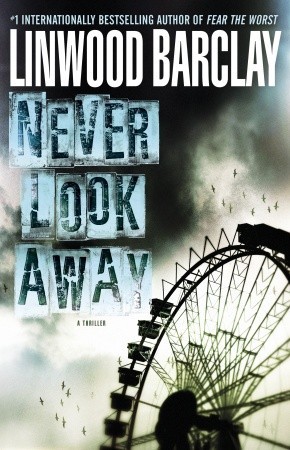
It actually answered questions that came up when I read his more recently published Promise Falls series. It’s the back story of one of the protagonists from that series—David Harwood, the newspaper reporter. There are comments made in that series about the tragic events involving his wife that took place the last time he lived in Promise Falls, and this book tells that story.
David and Jan Harwood have been married about six years, and have a darling four-year-old boy, Ethan. But lately Jan seems to be struggling with depression. She isn’t able to articulate what’s wrong, so David encourages her to see the family doctor for a talk, and hopes for the best. They make plans for a little getaway one Saturday, taking their son Ethan to a new amusement park that has just opened. But shortly after they arrive, Jan takes her eyes off Ethan’s stroller for just a couple of minutes, and when she turns back, he’s gone. The parents split up to search the park and finally, when they have almost given up, David spots Ethan’s stroller, with a suspicious-looking man running away from it. He’s relieved to find Ethan unharmed—the kid apparently slept through the entire abduction!—and calls Jan’s cell to let her know everything is okay. David waits with Ethan just inside the park for Jan to meet up with them, but after standing there for a really long time, David starts to wonder—has he found Ethan only to lose his wife?
In the days that follow, David’s work life impinges upon his personal situation in such a way that the police start to look at him with suspicion in the matter of Jan’s disappearance and continuing absence. It’s up to David to figure out how he could have gotten his signals so crossed up and what, exactly, has happened to Jan…and why.
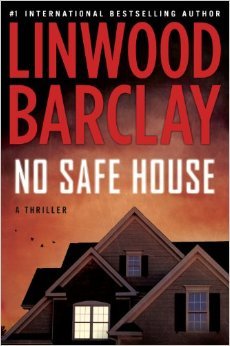
No Safe House takes us back to Cynthia (Bigge) Archer, whose family disappeared without a trace one night when she was a teenager. This book takes place six years after the end of No Time for Goodbye; Cynthia’s daughter Grace is now 14 years old, and is responding with typical teenage contrariness to Cynthia’s admittedly somewhat paranoid attempts to keep a tight hold on her schedule. After a particularly fraught interchange, Cynthia moves out of the house and into a sublet apartment to take a break from family life, leaving husband Terry, who’s a little less tightly wound, in charge of Grace. Grace takes advantage by telling her dad she’s going to the movies with a girlfriend and will get a ride home from the friend’s mom afterwards, but instead going out with Stuart, a former student of her father’s who is a couple of years older and exemplifies trouble on two feet. Later that night, there’s a panicky call from Grace to her dad: “I think I might have…done something.” And this sets off events that bring the family back in contact with the lawless Vince, who helped them out during their drama six years ago and suffered for it, and Vince’s stepdaughter Jane, who proves to be a tower of strength for Grace. Things escalate, as is typical of Barclay stories, and stay pretty exciting and perilous throughout. I enjoyed this follow-up even more than I did the first book.
I’m going to take a break now from mysteries to embrace some other genres, but I’m sure I’ll be back with Mr. Barclay someday soon.
Promise Falls
On the recommendation of my friend Patrice, who also enjoys mysteries, I checked out a few books by Linwood Barclay, whose writing I had yet to explore. It just so happened that a fairly recent trilogy by him was available through the library (e-books), so I first read Broken Promise, Far From True, and The Twenty-Three.
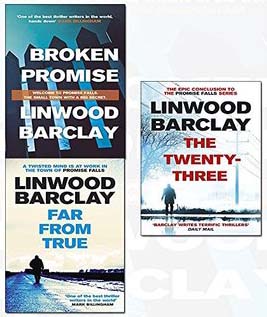
The structure of this trilogy seemed to me like an anomaly among mystery writers: Although many write series featuring the same detectives, most of the books in those series are self-contained; that is, a mystery is opened at the beginning of each book and solved by the end of that same volume. But this trilogy carried several complex situations over from book to book, so that small parts were solved in books one and two, but it took until book three to reach final resolution on all sides.
Additionally, instead of just one detective protagonist (or a team), these books feature three protagonists, each with a different profession and a separate agenda, although all of them are ultimately interested in solving the complex situation taking place in Promise Falls, an upstate New York town seemingly plagued by bad luck.
We are introduced to the town in Broken Promise by David Harwood, a “native son” who decides to move back from Boston and a decent (though stressful) career as a reporter, after the passing of his wife. He applies for and gets a job at the local newspaper, only to have the paper fold within a week of his returning home, and he and his son Ethan are stuck living with his parents until he can figure out some other way to support them. Then his cousin Marla, who suffered a recent devastating loss when her child was stillborn, turns up with a baby that is not her own. She claims the child was left with her by an “angel” who exhorted her to care for it; but when the child’s mother turns up murdered, all eyes are on the somewhat unstable Marla as the culprit. David puts aside his own concerns to focus on finding out the truth, but other strange events in town muddy the waters even further.
The second book, Far From True, features Cal Weaver, a private investigator who, subsequent to a major tragic event that takes several peoples’ lives, is hired by one of the deceased victims’ daughters to look into a break-in at his house. Cal discovers far more about a number of supposedly upstanding town citizens than he ever wanted to know; but how are their activities related to the break-in, and are they also connected somehow to the murders the local police are still trying to solve?
The third book’s narrative, The Twenty-Three, is primarily driven by Detective Barry Duckworth, the lead officer on almost every criminal case in Promise Falls. Right now he is feeling out of his depth, torn in five different directions, between the murders he has yet to solve, the new and ominous events that are piling up around the significant number 23, and the latest disaster that is sending a good portion of the town’s citizenry to the emergency room—and some to the morgue.
Although each of the books begins with a particular narrator and may feature more details about that person and his efforts, all three of the protagonists appear in each of the other books as well, and it’s a bouncing timeline that jumps from one crime scene to another, from one character to another (and not just the protagonists), from one interview to another, as the three pursue their separate agendas but also come into contact with one another—sometimes for an amicable exchange of information, other times as opponents or even suspects.
I enjoyed these books in a different way than with regular mysteries, since the cases took three books to solve; the pace is more leisurely and allows you to get to know the characters better (and also for the author to add characters without too much confusion as to who they are). At first I did have to pay close attention to the different story lines between David and Cal, because they are about the same age and share some of the same concerns and characteristics (intelligent, curious, fit, interested in some of the women with whom they interact); Barry Duckworth was much easier to keep separate, since he was the only policeman involved (initially), as well as being a decade (or two) older than the others, married, and described in different terms (a big gut owed to an irresistible sweet tooth, a sweaty suit and tie rather than casual dress, etc.). I liked having all the different perspectives from which to draw conclusions, and I also appreciated Barclay’s introduction of other colorful characters from the community, particularly the former (and hoping to be future) mayor, a genial sociopath who mucks up the works for all of the crime-solvers in his attempts to be both relevant and constantly in the public eye.
In the end, it was a lot to wrap up, even for a trilogy! Serial murders, sex scandals, opportunistic former mayors, a series of what amounted to terrorist attacks on the people of Promise Falls…and basically only two detectives and a couple of well-meaning amateurs working full-time on all of it. In the hands of a less skillful author this would have become a confusing mashup, but I feel like Barclay handles the multiple trains of thought well and keeps everything focused in the general direction he wants things to go. I saw one of the guilty parties coming, but only because our attention was so firmly directed towards someone else; but I was blindsided by the other one. A good conclusion, although Duckworth’s final situation left something to be desired—by him! Still, he knows he has cake in his future…

After completing the trilogy I decided to read a few more of Barclay’s books, which are for the most part stand-alone. One, Too Close to Home, harks back to a specific event in the history of a minor character from the later trilogy; Derek Cutter (father of cousin Marla’s baby in the trilogy) was just 17 when the family next door were all brutally murdered while he hid in their basement. Barry Duckworth has his eye on Derek as his prime suspect, and Derek’s father, Jim, has to do some quick work to figure out who else besides his son could have done the deed and, almost as important, why? Soon Jim has a potential culprit in his sights, but Jim’s wife, Ellen, thinks Jim is taking this opportunity to exact revenge on a former rival. Getting to the truth proves more complex than anyone expects.
The other, No Time for Goodbye, has a fascinating premise: One morning when she is 14 years old, Cynthia Bigge wakes up to discover that her entire family is missing from the house—her mother, father, and brother Trevor. The cars are both gone, and she initially assumes that they have left for work, school, or errands before she came downstairs. When they don’t return, however, the suspicion by the authorities is that they have left—and left her behind. There’s no note; no clothes or possessions are missing; there are no circumstances that overtly indicate a violent end; it’s completely baffling. Twenty-five years later, Cynthia and her husband and daughter are dealing with the trauma afresh, after Cynthia goes on one of those television documentary shows that tries to solve cold cases. Weird things start happening: A car lurks in the neighborhood and seems to follow Cynthia when she walks Grace to school; an anonymous phone call hints that the mystery should be abandoned; a strange artifact from the past appears inside the house. Cynthia’s husband, Terry, is trying his best to be supportive, but can’t help wondering if it’s all a figment of Cynthia’s anxious imagination—or worse, that she’s the source of all of it. Cynthia, determined to solve the mystery, hires a private investigator, and his actions soon send things out of control.
I really enjoyed both of these books. The writing is engaging and entertaining, the plotting is smart and convoluted without being confusing, and the outcomes are nearly always unexpected. I would probably label his books thrillers rather than straight mystery, although there is an element of detecting going on throughout. But the pacing and the level of suspense (and the ultimate revelations) definitely qualify as thriller material. I’m happy I’ve been introduced to Linwood Barclay and will look forward to reading more.
Crossover nuances
I was trying to decide what genre would next receive attention for possible summer reading recommendations, as August winds down. Some people who are turned off by traditional fantasy (quests, medieval societies, talking animals, etc.) are hooked by what some designate as urban fantasy—a story that takes place in a contemporary setting with “normal” people, but eventually fantastical creatures or events invade that space and change it or them. I started pondering, then, what crossovers there are with urban fantasy—so often, paranormal creatures are the fantasy part of urban fantasy, so I looked to my paranormal list to see what fit and what didn’t within that broader category. It also crossed my mind that works of magical realism could, in some cases, twin as urban fantasy. So this will be a mashup of all of those, which, while technically being separate genres, share the characteristic of something “wyrd” intruding on everyday life. (It is obviously not comprehensive, since that would take a post five times as long. But hopefully it is a representative offering.)
The first urban fantasist who comes to mind when thinking about that genre (at least for me) is Charles de Lint, a writer who sets all of his stories in the fictional Canadian city of Newford. People refer to his work not only as urban fantasy but as magical realism and mythic fiction but, whatever you call it, it’s compelling. He has written at least two dozen books that are consciously numbered Newford #1-21 etc., but many of his nondesignated works also take place in and around that city and its anomalies, as well as several collections of short stories featuring characters from various novel-length works.

I have enjoyed reading most of his books, but my two favorites are Memory and Dream, and Trader. Memory and Dream takes place mostly in flashback: It begins with the story of an artist, Isabelle Copley, who has retreated from the city to an island where she isolates herself and paints only abstract works; but in her youth, she was a vital part of the art scene in and around Newford, and studied with a master painter who abused her but also taught her a method of painting that could (at least theoretically) bring the subjects of her portraits to life. Trader is about a musician and craftsman (he makes musical instruments, mainly guitars) who is going through a bad patch in which he has no joy in life and no appreciation of his situation. Across town, there is another man who is going through an actual (rather than psychological) life crisis generated by his own bad behavior—he’s a gambler and a cheat, and has just been evicted from his home with only the clothes on his back. He has come into possession of an Inuit artifact and, as he goes to sleep that night, he clutches it in his hand and wishes hard for his life to get better, just as the other man is wishing the same. In the morning, everything has changed for both of them.

While de Lint’s books are filled with both events and characters who are out of place in their everyday environment, his are based on myth and legend (mostly from the Original Peoples), with archetypes such as Coyote and Crow (as well as more whimsical made-up characters) making appearances. But the next writer who springs to mind—Seanan McGuire—has much more crossover with the paranormal genre than with magical realism, because her unorthodox characters are mostly scary supernatural creatures—were-people, sentient snakes, monsters that cause those bumps in the night. The protagonist and her family call them cryptids. The early books take place in New York City, where Verity Price (a cryptozoologist) is working in a bar while trying to become a competitive ballroom dancer. But she keeps getting drawn into conflicts between the native cryptids, both advocating for and fighting on their behalf for their right to life against the monster-hunting society called the Covenant of St. George, whose members are dedicated to wiping out the monsters one and all, regardless if they are talking mice or dragons in the subway system.
In addition to these InCryptid stories, McGuire writes another urban fantasy-ish series called Rosemary and Rue, around the protagonist October Daye, a half-human, half-faerie changeling who keeps getting burned by both sides of her heritage. It is set in San Francisco, and is about the remains of the fae (faeries) who exist in the cracks of that city and keep intruding on its existence, sometimes in nefarious ways. Although McGuire has a lot of fans for this series, I found it wordy and tedious compared to the witty, light-hearted tone and fast pacing of the Incryptid books.

Finally, McGuire has a new series about which I have raved in reviews on this blog: the Wayward Children books. They are compact little gems of literary writing based around the fascinating premise that some of the children who disappear every year into the back of the wardrobe or under the faeries’ mound on the heath or down the rabbit hole have been kicked out of their alternate worlds back to this real one, and their sole desire in life is to return to whatever world they discovered when they walked through that mirror. Eleanor West runs a Home for Wayward Children that takes in these unhappy souls; their parents believe that West is attempting to re-acclimate them to their mundane life in this world, but Eleanor’s secret goal is to aid them in finding their way back to the magical lands they long for.

A couple other well-known urban fantasy writers are Jim Butcher, who writes the engaging Dresden Files, about wizard Harry Dresden, who consults with the Chicago P.D. whenever a crime seems a little “out of this world” to be solved by a mundane police force; and Charlaine Harris, who has written full-on paranormal (vampires as a part of everyday life in the Sookie Stackhouse books) and also has been more restrained (as in the wonderful Harper Connelly series, about a woman who was struck by lightning and can, as a result, stand on someone’s grave and tell you how they died). Harris has recently extended her imaginative worlds into both alternate history and dystopian fiction with her Gunnie Rose series, which is also urban fantasy with the inclusion of wizardry by Russian and British practitioners.
There is some debate about whether Melissa Albert‘s books The Hazel Wood and The Night Country should be included in the urban fantasy category, since they are predominantly new fairy tales. But the fact that the protagonist and her mother live in the real world while her grandmother, who wrote a cult classic book of dark fairy tales, has thus created the Hinterland, a parallel land into which the protagonist ultimately travels, makes this duology a candidate for both.
It is difficult—and sometimes arbitrary—to differentiate between urban fantasy and paranormal as two different categories, and after thinking it through, I have decided for myself that the paranormal books only qualify as urban fantasy if the urban setting and mindset predominate. In other words, the scene is first and primarily set in the real world, and the fantasy intrudes upon it to the surprise of the characters living in that setting.

One young adult duology that I adore that qualifies in both categories is Lish McBride‘s Hold Me Closer, Necromancer, and its sequel, Necromancing the Stone. While both books are filled with all sorts of paranormal critters, the first book starts out in a commonplace setting and with an all-too-characteristic protagonist. Sam lives in Seattle, still at home with his single mother despite having graduated high school. He’s not exactly a loser, but he lacks focus and ambition; rather than going to college, he has chosen to continue working in the fast food joint where he and his friends have a light-hearted routine of playing “potato hockey” in the back parking lot during slow periods. But when a potato flies out of control and smashes the headlight on a brand-new Mercedes, Sam comes to the attention of Douglas, a scary dude who turns out to be the neighborhood necromancer and reveals to Sam that he, too, has this “gift.” Douglas is threatened by the presence of what he sees as a rival for his territory, and gives Sam an ultimatum; but Sam, baffled by this amazing discovery, feels helpless to know what to do. Fortunately, his mother, his uncle, and even some of his friends have abilities that can help him out of his dilemma.
Another young adult author who specializes in the urban fantasy/paranormal mashup is Maggie Stiefvater. Some, like her Wolves of Mercy Falls books, fall more heavily on the supernatural side, with setting being instrumental (the necessity of a cold climate) but not primary, while others, such as her Dreamer books, feel a lot more like urban fantasy. The Raven Cycle, four books set in the small town of Henrietta, Virginia, straddle the line between urban fantasy and legend. All are intriguing and beautifully written.

Then we come to the crossover with magical realism. Urban fantasy and magical realism have the connection that there are uncanny things happening within a mundane setting; but in magical realism, the setting is often not as important, and this is seen by some as the dividing line. Who could argue, though, that it wasn’t crucial for the book Chocolat, by Joanne Harris, to be set in the straight-laced French village of Lansquenet, with its narrow-minded mayor and contentious residents? Or that the events in Practical Magic, by Alice Hoffman, would have had the same impact had they not taken place in the Massachusetts town where the Owens women had been renowned for more than 200 years as witches? Or that the events of Once Upon A River, by Diane Setterfield, would have differed significantly had they not been centered on an ancient inn on the banks of the river Thames? Looking through my list on Goodreads of the 50+ books of magical realism I have read, these are three that stand out for their significant settings, while the others could most of them have happened anywhere, as long as it was within this ordinary world and featured extraordinary events or characters. But you can see that there are commonalities that can be significant.
The bottom line for me is that all of these permutations contain the wonderful premise that there are things taking place around us in our everyday lives that, could we only look up at the right moment and see them happen, would change everything in a heartbeat. I love this premise and, therefore, the books that promote it, be they classified as magical realism, paranormal fiction, or urban fantasy. I hope you will find a book or two from this blog post that appeal to you in the same way they have to me.
Illustration
In the category of “Better late than never…”
I had a lesson this week in my year-long portrait-painting class that took as its inspiration Picasso’s harlequins. It was a complicated, lengthy, and convoluted lesson and I almost didn’t do it…and then I got an idea. I decided, instead of painting the boy and girl harlequins like the teacher did, that I would illustrate Robin Hobb’s fabulous Farseer books by making a painting of one of the main characters, the Fool, an albino court jester who (in the early books) sits at the feet of King Shrewd, dressed in black and white motley and playing with a rat-head marotte. So I did, and here it is!
The teacher who taught this lesson is a big proponent of collage, and I found some fun and symbolic stuff for this one. In addition to using tissue paper to good purpose for the ermine of the King’s cloak, I found a dragon, which figures significantly in later books; a Queen of Hearts card, which I interpreted as Queen Kettricken, my favorite female character (well, she was until Bee arrived); and a tiny jester, who is gesturing up towards my Fool from the corner.
Perhaps this will intrigue more readers to look into Robin Hobb’s three trilogies about the Farseers!
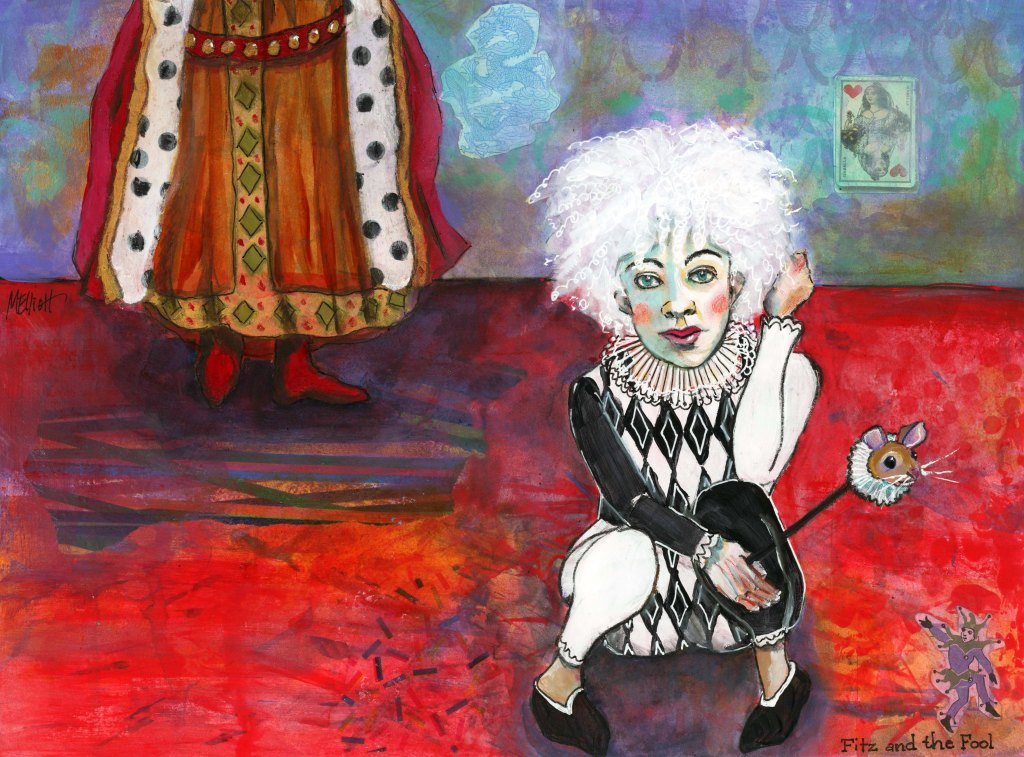
Robin Hobb wrote the Farseer Trilogy, the Tawny Man trilogy, and the Fitz and the Fool trilogy. There are also other books set in the same universe, about the Liveships and their Traders, the Rain Wilds, and the Elderlings.
Light relief
Sometimes, when you have been reading serious stuff—whether it’s stark realism, a western set in a dystopian world, or an intense (and long) immersive fantasy, you just need to indulge in some junk food. Lighter fare. In other words, chick lit. And if it has paranormal overtones, so much the better!
I have noticed a trend, also, that requires I seek out this kind of fiction occasionally: When I am painting intensely, I want light reading, and when I am reading something heavy, I don’t paint anything too challenging. So I guess what I am discovering is that balance is important, even in cross-disciplines? (Now, if could only find something to read that would make me want to do housework compulsively for about a week…)
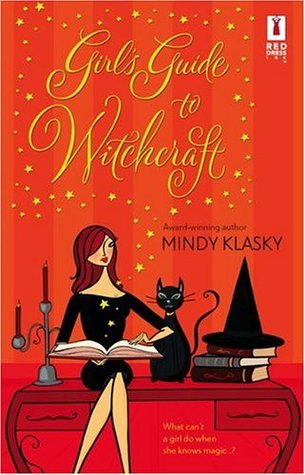
I started on this chick-fest with Girl’s Guide to Witchcraft, by Mindy Klasky. I don’t recall precisely how I came across the book, but once I had read the description, I was a goner: The main character, Jane Madison, is a librarian (ahem), and when her library experiences funding difficulties, her boss breaks the news that she is about to suffer a 25 percent cut in pay; BUT, to compensate, she will be allowed to move into an empty cottage on the library grounds (it’s an historical library in Washington D.C., surrounded by extensive gardens) and live there rent free. Jane can’t really afford to turn down this offer; plus, the cottage is within walking distance of work, so she will save gas as well as rent. She and her best friend Melissa (yes, I know, but I am determined to be JANE) spend a weekend cleaning out the place, except for the cellar. A while later, Jane decides to see what’s down there, only to discover an extensive book collection (as well as other artifacts) placed there under ward by a famous witch. Guess what happens next?
When I was in my early 30s I worked in Hollywood as a movie title designer. The office was about a 30- to 45-minute drive from my house in typical Los Angeles traffic, with the result that I spent all daylight hours either driving or at work. The typography studio was in a primarily industrial neighborhood with no restaurants close by, so I mostly brought my lunch. But if I ate it at my desk, I would inevitably get 10 minutes max before someone needed me for something, and there went my lunch hour, so I went looking for somewhere else to enjoy my sandwich and chips. There were no parks close by, but there was a cemetery, backed up against the Paramount lot, and it was beautiful, with a lake, lots of mausoleums and sculptures, and benches strategically situated in the shade of large spreading trees. After eating, sometimes I would go gravestone browsing to see what famous or infamous people I could turn up (not literally). Along one wall of the cemetery there was what appeared to be a stone cottage, built right into the wall. It was most likely a garden shed where tools were kept, but it looked like someplace a reclusive witch (or an indigent typesetter?) would live, however macabre that sounds. So when I read the part of Klasky’s first book about the cottage in the library gardens, I was immediately hooked.
Needless to say, I had to finish out the trilogy, which details Jane’s journey as she comes into her witchy powers, works an accidental love spell that apparently connects with everyone from the library janitor to her own warder, and alienates the head witch of the Washington Coven. There is also a lot of “girl” time with friend Melissa, who is the local baker of delectable pastries and cupcakes and is always up for a Friday night of muddling mint leaves from Jane’s garden to make a pitcher of mojitos over which they can discuss their love lives.
Then I discovered that there were two more books, in which Jane starts her own (highly irregular) school for witches and has to fend off magical rivals and the beasts they send to deter her, so of course I had to proceed. There was also a 3.5 crossover novella that introduced me to a new character, Sarah, clerk of court for the District of Columbia Night Court (the secret after-hours Capitol court for paranormals). Sarah is (of course) a sphinx, charged with the protection of vampires (who knew they needed it?); she contacts Jane for assistance with a library of vampire lore in disarray and I (of course) was lured down this side pathway to read Sarah’s own trilogy, which involves her coming into her own as a sphinx and trying to decide whether to pursue romance with the very nice and compulsively tidy Chris, a reporter for a local newspaper (or is he?), or the darkly dangerous but infinitely appealing James, her vampire boss, head of security for the Night Court.
Finally, when I thought I had come to the end, I discovered one last volume, called The Library, the Witch, and the Warder, which circles back around to tell the Jane Madison story from the viewpoint of her warder, David Montrose. But I swear, THIS is the last Mindy Klasky book that will capture me with its lure of magic, romance, drama, comedy, cupcakes and mojitos.
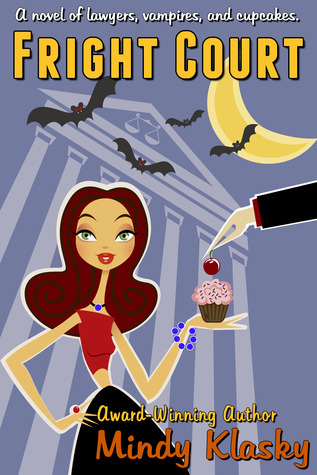
The books are (in order):
(Jane Madison)
Girl’s Guide to Witchcraft
Sorcery and the Single Girl
Magic and the Modern Girl
Capitol Magic
Single Witch’s Survival Guide
Joy of Witchcraft
(Sarah Anderson)
Fright Court
Law and Murder
High Stakes Trial
(David Montrose)
The Library, the Witch, and the Warder
She has also written some vampire books that take place in a Washington, D.C. hospital, and some books with an actress, a magic lamp and a genie, but I am not going there. At least, not today.

 The Book Adept