
Louise Penny
 I was emailing with a former co-worker from the library the other day. She shares my love of a good mystery, and we were doing the usual “Have you read…” conversation, wherein I discovered that she had not yet read any of Louise Penny’s series set in the mythical Three Pines, somewhere in the snowdrifts below Montréal, Canada, and starring the inimitable Armand Gamache, Chief Inspector of the Sûreté du Québec.
I immediately encouraged her to drop everything and start reading with the first book, Still Life, and then…I paused. I love this series almost unreservedly, and yet it is not a series that you can recommend to just anyone. It has quirks.
The first quirk is that the development of the characters is far more instrumental to the reader’s love of this series than are the individual mysteries/murders/cases pursued in each volume. With a few standout exceptions, I have released from my memory the specifics of the cases, and yet I retain every detail about the inhabitants of Three Pines and the officers of the Sûreté who make recurring appearances or simply loom as brooding, somewhat intangible threats over Gamache’s future.
The second quirk is that the mysteries themselves are weird. Victims are shot by arrows, electrocuted in the middle of a village fair, die of fright in the midst of a séance. Penny seems determined to come up with deaths so out of the ordinary that the reader must struggle a bit with “the willing suspension of disbelief” in order to continue with the book or the series.
The third quirk is more a matter of degree or intensity than it is anything unusual, and that is the level of psychological and personal involvement one develops with the character of Armand Gamache with each subsequent book. I phrased that last sentence purposefully, because the character of the man is what draws me to these books and keeps me reading. He is the hero you could wish for as the head of any police department, and yet because of his high standards and philosophical rigor, his expectations are hard to meet, and in fact many of the officers of the Sûreté not only don’t try to meet them, but purposely flout them. Those within his magic circle realize that he is as deeply flawed as they are, and that his flaws are what drew them to him as a mentor and eventually as a friend. But even those who claim friendship have never plumbed the depths of Armand Gamache, and this is what makes him forever fascinating.
 I began this intending to give a review of the latest book, Kingdom of the Blind, number 14 in the series. It is true to form, in that the initial mystery is puzzling and offbeat—Gamache, Three Pines bookstore owner Myrna, and Benedict, a young builder unknown to either of them, have been summoned by a notary to discover that they have been designated liquidators (executors) of a will, but for a woman none of the three has ever met. Becoming somewhat reluctantly involved with this duty ends up leading them to a murder, and to the puzzling facts of the will itself, which bequeaths possessions not actually owned by the deceased. Running alongside this new conundrum is the leftover entanglements from the last book, in which a powerful new drug was released onto the black market, partially as a result of controversial actions by Superintendent Gamache, with the consequence that he has been suspended from his position at the Sûreté, temporarily replaced by his close associate and son-in-law, Jean-Guy de Beauvoir.
A few commenters on Goodreads expressed the feeling that the familiar characters in Three Pines are becoming redundant, and that Penny should start fresh with a new project. Although I can’t agree with this, I do think that this was not one of the 40 percent of standout books in the series. I wasn’t a big fan of the story line with the will and the historical puzzle contained within it; but I did breathlessly follow the events in this book that played out the contentious actions from the last, and watched with intrigue Gamache’s desperate attempts to remedy his daring ploy that put a dangerous drug on the streets. And an exceedingly surprising plot twist at the end may do something significant for those readers bored with the inhabitants of Three Pines….
In her afterword to this book, Penny confessed that she thought she had already written the last Armand Gamache book, and had expected to confess as much and default on her commitment of another to her publisher. Penny’s beloved husband, Michael, passed away in 2017, and she had believed that his embodiment of Gamache and his constant participation in all aspects of her writing life would keep her from going further once he was gone. But one morning, she woke up with an opening sentence in her head, and realized that, far from being unable to go on, the continuation of this series kept her husband’s integrity, courage, and good humor present in her life and in her writing.
I ended up reiterating my recommendation to my friend about the series, with the caveat that the mysteries are weird and not always satisfying, but that it is the community in which you live while you read them that will keep drawing you back. I plan to check in with her after she’s read a few, and see if she has invested in them as I have. The series is about kindness, humor, wit, love, and affection. The fact that it’s sometimes also a window into despair and inhumanity simply points up the contrasts.

Procedurals
I recently caught up with the Bill Slider mysteries by Cynthia Harrod-Eagles; I had inadvertently read numbers 20 and 21 in the series without having read 18 and 19, so I bought them for my Kindle and settled down for a rainy day’s read.
 The first book, One Under, has a chilling plot. The opening scene is of a middle-aged man inexplicably throwing himself under a tube train at Shepherd’s Bush station, an obvious suicide. Soon after, a report comes in of a hit-and-run incident that has killed a teenage girl in a country lane far away from where she lives on the White City estate.
Normally, Bill Slider and his homicide team wouldn’t concern themselves with either of these sad but obvious deaths; but during a slack period, they are assigned to double-check that the hit-and-run was just that, and Bill Slider’s discovery that it might not be leads to all the rest.
First, he finds a case of another teenager who was found in the river but who didn’t drown; and then, as his team pursues small bits of information about these two girls, strange linkages begin to appear between them and some extremely unlikely people. Slider ultimately discovers a scene of widespread corruption amongst the upper level of British government, including the police department, and finds himself both out of his depth and persona non grata as he doggedly pursues the evidence.
Contrary to her usual practice of one mystery to one volume, Old Bones begins a new mystery while still dealing with the dangling strings of the old one. A young couple moves into a new house and, doing some renovations, discovers a skeleton buried at the bottom of the garden. The medical examiner determines that it must have been there for at least two decades; Slider’s boss, Detective Superintendent Porson, leaps upon this opportunity to keep Slider and his team simultaneously occupied and out of trouble. After all, it’s a very cold case; the likelihood of them even solving it is negligible, and the passions surrounding a missing person from that long ago are probably spent. But he reckons without the single-minded persistence of his best but most exasperating DCI.
 I don’t know exactly why I find police procedurals such as these so appealing. Perhaps it is because, of all kinds of mystery or crime fiction, the police procedural is the most realistic. After all, when a murder occurs in real life, it is most likely that the police, rather than your local personal trainer or some other amateur sleuth, will be the ones to respond to the call and attempt to solve the crime.
I also enjoy the variations present when you have a team of criminal investigators, rather than one lone guy, cooperating to find the killer. A good procedural may include uniformed cops, police detectives, medical examiners, forensics experts, psychologists, sketch artists, and so on. It’s an ensemble piece, and although certain protagonists will necessarily take the lead as the more developed and therefore more interesting people, the methodology of detection is based on real police work. I enjoy the gradual ferreting out of each tiny detail that, added to a big pile of other tiny details, mounts up into irrefutable evidence.
Part of it, of course, is admiration for the character and ethics shown by the lead detective, Bill Slider. Harrod-Eagles has created a complex man with a complicated back story, and these personal details give humanity and depth not just to him but to all her characters to a lesser degree. I love the “team” the way Harrod-Eagles has written and continues to write them. And speaking of the writing, it’s clever, literate, and deliberate. Last but not least, DS Porson’s nonsensical malapropisms make me laugh out loud at least a few times per book, and I have a feeling that if I had a more comprehensive understanding of British humor, that would increase significantly.
 The first book in this series is Orchestrated Death, in which the set-up for the series gives the reader a satisfying amount of detail into the back story of this obscure policeman; I have read all 21 subsequent volumes, and can only think of one that wasn’t quite up to the standard of the rest. It’s a consistent and immersive collection.
Book Power
BOOKS FEED AND CURE AND
CHORTLE AND COLLIDE
In all this willful world
of thud and thump and thunder
man’s relevance to books
continues to declare.
Books are meat and medicine
and flame and flight and flower,
steel, stitch, and cloud and clout,
and drumbeats in the air.
—Gwendolyn Brooks
Pastiche
The definition of “pastiche” is “an artistic work in a style that imitates that of another work, artist, or period.” I am not accusing B. A. Shapiro of ripping off another author; rather, I am praising her skill in presenting the fictional story of an art forgery within the confines of an actual historical event.
Being a Sunday painter who has had occasion to try copying the art of another artist in the course of a school assignment, I have always been in awe of the art of the forger. While not an admirable profession—since you’re deliberately trying to fool people into paying millions for a Van Gogh that you created in your kitchen—it is nonetheless an accomplished profession, given the extreme difficult of getting each color and brushstroke so close to identical that the imitation is undetectable by experts from the great art collections of the world.
 Given this interest, I eagerly chose The Art Forger, a novel by B. A. Shapiro, as a representative work of mainstream fiction, so I could join my readers’ advisory students in their reading assignment this week. My favorite quote from amongst the reviews is from Amazon’s editors’ picks:
“The most absorbing story every written about watching paint dry.”
A summary of the story:
Accomplished painter Claire Roth was previously involved in an art-related scandal that has made her name mud and sidelined her career. To support herself while she continues to paint in obscurity, she has signed on with Reproductions.com, a company that produces high quality reproductions of masterpieces for sale. After extensive training in all the anomalies of “reproduction,” she is their specialist on the works of Edgar Degas.
The story is set in Boston for an important reason: In 1990, there was a legendary art heist in which 13 master works were stolen from Boston’s Isabella Stewart Gardner Museum, never to be seen again. Soon after the story opens, Boston’s most prominent gallery owner brings a Degas that went missing in the heist (not disclosing the details of how or from whom he has acquired it) to Roth, and asks her to make a copy of it for him. The trade-off is that she will receive a one-woman show of her own paintings at his gallery. Claire is engaged and challenged, and can’t resist the temptation, but as she begins this arduous task, she makes some interesting discoveries about the painting’s provenance and origins that lead her to investigate the personal life of art collector Isabella Gardner and her possible relationship with the artist, Edgar Degas, as well as pointing her towards some contemporary scandals.

I appreciated the multiple levels of this novel: mystery, art, and moral dilemma. It’s always fun to put yourselves in the shoes of the protagonist and say to yourself, What would I do if presented with this Faustian bargain? Claire is at once ambivalent and determined, and the stages she goes through are enlightening to observe, as she struggles with whether it is acceptable to do something wrong for all the right reasons. The art world itself is equally exposed as Claire questions whether her art is popular because it is good, or because she is notorious and people are buying it as a result of the “famous factor” and not because they love it. Ultimately, the book is about ambition and obsession, in work and in love. The historical element gives it an extra fillip of verisimilitude, and the revelation at the end is unexpected. A truly engrossing and engaging read.
Fantasy’s best
I hereby nominate Laini Taylor as best fantasy writer of the year. I was going to say for best young adult fantasy, but there is no need to make that distinction: Muse of Nightmares, the sequel to last year’s Strange the Dreamer, is the quintessential fantasy that everyone else wishes he or she had written, and everyone who loves high fantasy will want to read.
When Strange the Dreamer came out in 2017 and I read it, I declared it my best book of 2017, saying this was the book I had been waiting for Taylor to write. If you would like to read the entire review, go here to the young adult blog of Burbank Public Library, for which I lately wrote and edited. The essence of that book was Lazlo Strange, the foundling librarian’s assistant with his head full of stories, and he continues near the center of this book, but his tale is expanded to embrace all those—humans, gods, and monsters—he has encountered along his way, across the great desert Elmuthaleth to the city now known as Weep, cowering in the shadow of a giant metal seraph with nightmares at its heart.
 Muse of Nightmares picks up almost exactly where Strange the Dreamer left off, although it begins by introducing two new characters (one of whom we will discover that we already knew), and it proceeds to both fulfill and exponentially advance my opinion of Laini Taylor’s skills—as a lyrical and expressive writer, as a masterful storyteller, as an imaginative genius. Lush language carries you into the hearts of her characters, where you discover complexities of emotion and conflicts of conscience not often found in any story, particularly in a genre that follows specific tropes and often fails to deviate much from them. This is truly sophisticated fiction, dealing with large issues, and yet it also manages to be a blue whale of a good story, with so much content, so many conflicts and twists, and such gripping love for and between its characters that you simply can’t conceive of it ending!
It does, as all stories must, but the author is charitable to both her characters and her readers by putting out there the possibility that somewhere, between worlds, we may encounter Lazlo and Sarai, Minya, Feral and Ruby (the “gods”) and Thyon, Calixte, Tzara, Suheyla, and Ruza (the “humans”) yet again.
Do yourself a favor: Read these books.

“Alex” on fiction
 Margaret A. Edwards (nicknamed Alex by her friends) is considered the very first teen librarian, and her purview was the Enoch Pratt Free Library in Baltimore for about 30 years, beginning in 1932. In her time, she trained innumerable young adult librarians by making them read 200 novels and report back on them to her, 10 books at a time, in preparation for talking to teens about them. She book-talked in the public schools (unheard of in the 1930s), and rented a horse and wagon to bring books to neighborhoods that didn’t make regular use of “her” library. Edwards’ love of reading, and conviction that only through literature would young adults move beyond themselves into a larger world, became the hallmark of her professional life. Here is one of my favorite quotes from her, about the value of fiction, which in her time was disputed as not nearly so important as “informational” reading:
“Certainly we get essential information from factual books, but it is experience we need most.
If we would live richly, we can expand our lives more by sailing down the Nile with Cleopatra, looking at the cherry trees with Housman, or sweating it out to triumph at long last with Moss Hart than we can by gathering all available information on Egypt, raising cherries, or writing for the theater.”
Noir
Before teaching this class, I never had to differentiate between the sub-genres of mystery to such a fine point. Yes, I knew the difference between a “cozy” and a police procedural, but the distinctions between hard-boiled and noir escaped me, and I didn’t really worry about them, since people who like one bleed over into people who like the other. But now, after reading up on it and then re-examining an example of noir, I get the difference.
Although both are dark, stark, and unsentimental, the hard-boiled mystery stars a detective, bent on solving a crime, defending the innocent and righting wrongs, while noir fiction has a different kind of protagonist—a victim, a suspect, or a perpetrator. Although both sub-genres may feature a particular villain, often in the person of an evil femme fatale, in the hard-boiled book the detective is fighting against the corruption perpetrated by the villain or the system, while in the noir, the protagonist is just trying to survive. What they have in common is inevitability.
 In Fun & Games, by Duane Swierczynski, former contractor to the Philly P.D. Charlie Hardie’s latest job is house-sitting an isolated mansion in L.A.’s Hollywood Hills. But when he arrives to start the gig (his description of the specifications of the job include making sure the house doesn’t burn down, while drinking bourbon and watching old movies on DVD), he is surprised to discover an unwanted guest hiding out in the house—a B-movie actress who says she’s being hunted by professional hitmen.
Charlie thinks she’s just high and paranoid. But he’s wrong.
The killers are real. They’ve tracked her to the house. And they’re not letting anyone out alive—including Charlie.
I decided on a re-read, since Mr. Swierczynski is going to be a guest speaker in my class at UCLA next week. This is classic noir: The protagonist, Charlie Hardie, is a self-destructive, hapless victim, caught in a situation he doesn’t understand and didn’t seek out. He just wants to be left alone, to drink and try to forget about the disaster he made of his former life. He’s relateable, but not particularly likeable. His co-victim, B-movie actress Lane Madden, is likewise set up for failure, driven by guilt but with a visceral need to survive. The “bad guy” is a femme fatale, and boy, is she conscienceless and mean! The only way in which it isn’t so noir is that Charlie is turned, willy nilly, into a hero, simply because there is no one else. I’m curious to find out whether “noir” is how Duane characterizes his own book. I also now want to read the two sequels, Hell & Gone, and Point & Shoot!
Mysteries, favorites
This coming Monday will be the fourth class out of 10 of the Readers’ Advisory course I am teaching for the Graduate School of Education and Information Studies (GSE&IS) at UCLA. To translate that last, I’m teaching the course for graduate students getting their masters in library information studies, to become librarians, and I’m teaching them how to match up readers and books, which sounds simple but isn’t.
We have spent the past three classes talking about the mysteries of readers: how they read, why they read, and what kind of readers they are; and then we have discussed two powerful methods to connect these readers with “their” books. The first is the readers’ advisory interview, which ascertains what books readers have enjoyed and specifically why they have enjoyed them, and attempts then to find other books that will please their reading tastes, based on “appeal factors.” The second is the art of book-talking, which is to find an array of books that might appeal to a particular audience and talk about them as a storyteller would, so persuasively that the listeners’ first question when one is done is to ask “But what happens next?” and be moved to read the book to find out.
In this fourth class, we will be proceeding into an in-depth study of individual genres of popular reading. We’ll be examining one genre each week, and this week is mystery. I have asked my students to read one or more book each week, selecting from the genre we intend to discuss so that they will have read at least one representative example before we break down that genre for discussion. I decided, this week, that I would join them by reading a mystery in preparation for class on Monday, and perhaps discuss it here, and so I have done; I have actually indulged myself in two.
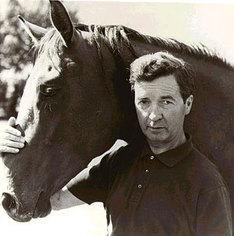
 I didn’t feel like making a second trek to the library this week, so I cast about within my own collection for something to read, and decided to indulge nostalgia by re-reading a couple of Dick Francis novels. Both I and my father were horse lovers and mystery readers. Dad always said he’d like to move to Montana and have a horse ranch (although if you knew my mother, you knew that would never happen), and I was a typical horse-mad pre-teen who had to deal with a particularly horrible birthday one year when my grandfather, a Central Valley farmer equipped with fondness but little sense, bought me an unbroken yearling stallion at auction as my gift and then had to return it when my parents, who lived with me in SoCal suburbia, flatly refused to let me accept him. (It took me a while to forgive them.) Dad and I greatly enjoyed all of Dick Francis’s books; in fact, over the course of many birthdays and Father’s Days and Christmases, I managed to gift Dad with the entire collection, start to finish, some as tattered old paperbacks and others as pristine first editions. He read them over and over again, as do I; and it was that fact that made me pick them up this week.
Often, someone who is gifted in one career will be significantly less so in another; but Dick Francis seems to have had an impressive career as a “jump jockey” (a steeplechase rider), his ultimate achievements becoming champion jockey in the National Hunt 1953-54 season, and then jockey to Elizabeth the Queen Mother’s stable. Then, after his retirement at age 36 (a typical age for jockeys to cease practicing this dangerous and exceedingly taxing pursuit), he became a journalist and began writing horse-racing novels, becoming an explosive success as a mystery writer of sport-related books. He wrote one book a year thereafter, from 1962 to 2010, the year he died. On many of the early books, he collaborated with his wife, Mary Margaret Brenchley, who did quite extensive research surrounding the plots (including teaching herself photography and how to fly a plane), and after Mary’s death in 2000, his son Felix collaborated with him on his last four.
 I am giving all this background information because I am attempting to puzzle out exactly why these books retain their appeal through several re-reads for so many people. Although I am definitely a reader who re-reads favorites, there are few authors—Georgette Heyer, Margaret Whalen Turner, and Dick Francis—whose works hold up for me again and again, even when either vaguely or completely familiar. But these same authors must hold a similar appeal for others, since they are among those considered worthy of a re-release of their novels, with new covers, in trade paperback form.
The interesting thing I find about Francis’s books is that, while they are all solidly oriented in the world of horse racing, not all, or even most, of his protagonists are jockeys. He has done an extraordinary job of exploring with his characters not just every facet of horse racing life by casting jockeys, trainers, breeders, and owners as his protagonists, but also by bringing in other only tangentially related careers, such as an air taxi service pilot, ferrying horsey people to distant races; an artist who paints portraits of winning jockeys and horses; a Jockey Club investigator; an adventure book writer; a wine merchant; a banker; a jewel merchant; and more. But all of them preserve that tie to the sport that allows Francis to include the sure-fire fast-paced scene of the breathless progression of man and horse over daunting jumps and along the flat to victory at the tapes.
Francis could definitely be characterized as a “formula” writer; while he seldom repeated the same protagonist (he wrote four books starring Sid Halley and the two I just re-read featuring Kit Fielding, out of more than 40), all of his protagonists were similar: Men between 28 and 40, with a certain kind of smart, intrepid, ethical, persistent personality combined with a light-hearted charm; a love interest usually between 19 and 28, often becoming important to the protagonist within first or second meeting; and a situation that has to be figured out, confronted and overcome, usually featuring one or more villains intent on having their own way at everyone else’s expense. But although they are formula, Francis writes them as complete individuals, with personal quirks that make them stand-out characters, and most of his plot lines are clever, convoluted, and engaging.
 The two books I read this week were Break In and Bolt, a duo starring the same protagonist, jump jockey Kit Fielding. What makes Kit so interesting is his associations: First of all, he is the end product of a long line of Fielding horse trainers, with a twin sister, Holly, who is married to the last scion of a competing family of horse trainers named Allardeck who, up until this marriage, were bitter enemies of his family. And while the youngest members—Kit, Holly, and her husband, Bobby—have mostly resolved their feud, other members of the family are still hotly opposed to any association between the two clans, who have been undercutting one another for multiple generations. The second thing that makes Kit’s life interesting is that he is chief jockey to a European princess-in-exile, Princess Casilia de Brescou, and this connection forms a considerable amount of the plot of both books.
In the first, Break In, someone is targeting Bobby and Holly’s horse training business, to the point where they may lose it if they don’t find out who and why. Malicious bits of gossip about them have been published in the local paper, and someone has taken the trouble to circle the gossip in red and hand deliver it to all the merchants to whom they owe money and to all their owners who have horses in their training lot. Kit comes to the rescue and begins to believe after a while that his sister and her husband are suffering the unfortunate fallout of a plot that is actually aimed at discrediting Bobby’s father, Maynard Allardeck. Once this theory occurs to him and he goes looking, all sorts of skeletons fall out of closets, and Maynard, who maintains the vicious attitude of “death to all Fieldings” as a loyal Allardeck should, proves to be a formidable opponent. But he is not the only villain involved…
The love interest in this book is the Princess Casilia’s husband’s niece, Danielle de Brescou, an American working in London as a programmer at a major news outlet. Kit meets her when she comes to the races with her aunt, and although there aren’t immediate sparks, there is definitely interest on both sides that may progress as the book unfolds.
 In Bolt, the focus is more on Roland and Casilia de Brescou. Henri Navarre, the son of Roland’s long-time business partner in France, petitions Roland to sign papers that will allow their company to manufacture plastic guns. Roland, former royalty and an old-fashioned aristocrat, is horrified at the idea of having his family name associated with weapons manufacture, and refuses. Navarre, who is a brash, greedy bully determined to have his way, proceeds to threaten everyone in Roland’s household. Roland is elderly, frail, and disabled, so Princess Casilia reaches out to Kit for support. Roland’s obnoxious sister, Beatrix, who wishes Roland to sign so that she can live yet more comfortably from the family fortune than she already does on her quarterly allowance from Roland, comes to stay with the family and acts as a rat, giving away vital details about where and when everyone will be, and Navarre carries out his threats to the point where Kit and others in the family must unite to figure out how to outwit Navarre and get rid of the threat. The book is punctuated by Kit’s exciting rides in various races on the princess’s horses, and the saga of the continuing up-and-down relationship between Kit and Danielle, which is being influenced by the presence of the suave, mature and cultured Prince Litsi, a nephew of Casilia’s. And the menacing form of Maynard Allardeck still hovers in the background, intending to do Kit harm…
 I feel like one of the charms of Francis’s books is their “old-fashioned” standard of upright ethical behavior. The profession of horse-racing itself is fraught with opportunities for cheating, from drugging horses to bribing jockeys or trainers to fixing things somehow at the bookies’. But Francis, while taking all that into account, pictures his protagonists as people with a genuine, innocent relationship to the center of the sport—the horses—and a pure love for their job that keeps them going despite bad weather, bad luck, and injury. When he describes the union of horse and rider up on the Downs while the horses are being exercised or schooled, there’s an idyllic quality to the whole scene that pulls in the reader, as does his narration of the exciting points of each race in which the protagonist rides. Further, the main characters possess a dedication to logic and justice that is satisfying in its resolution against the badly behaved villains of each book. And although some of the early love interests were misogynistic in their details, as he continued to write, the women in his books made progress and became individuals in their own right, which you can’t say for some writers of mystery series. The dialogue is clear and simple, touched with humor, and the plots are in many cases labyrinthine and clever. Being myself horse mad, I can’t say for sure that someone who had no affinity for horses would enjoy these books the way that I have. But Dick Francis certainly had the aptitude to make you care what happens to his characters, and that, I feel, is the one thing that makes these books so re-readable.
Saints and Miracles
 When I first finished reading All the Crooked Saints, by Maggie Stiefvater, I was eager to put my thoughts about it down on paper. But when I actually sat down to write, I realized that I couldn’t figure out what I thought of this book. Part of me thought “It was amazing…” but on reflection, I didn’t know if I liked it. Let me try to make more sense.
I am a pragmatic person who isn’t really into saints, miracles, or allegorical tales about same, so I wasn’t sure I even wanted to read this book. I have intensely disliked such books as Paolo Coehlo’s The Alchemist and Dan Millman’s Way of the Peaceful Warrior, and wondered, based on some reviews, if that was where Maggie was going. (I also presumed VOYA magazine was way over the top in comparing it to Gabriel Garcia-Marquez, and I have read a few dissents about appropriation of other people’s culture that I took somewhat seriously when approaching this book.)
But…I have always enjoyed good magical realism (Alice Hoffman and Anna-Marie McLemore come to mind), and I presumed that Maggie Stiefvater, with all her speculation about Welsh kings and making something out of nothing, would possibly do a good job at this. Also, I was intrigued by an essay she wrote on her Facebook page talking about the extreme difficulty with which she birthed this book, given that she was suffering from a severe, initially undiagnosed autoimmune disease. So I picked it up.
At first, the sheer number of incidences of magical realism overwhelmed the story for me. It was too much, too fast, and way too facile, and I felt like I wanted to quit reading. But gradually, I was intrigued enough by some of the characters that I wanted to know what happened to them, so I kept going. I didn’t find it an easy book to read, perhaps because my skepticism of the outcome was high, so it took me a lot longer than I expected this slight volume to last. (Although it is 323 pages long, the type is set generously with about 1.5 line spacing—leading, if you want the technical word—between lines. So if it were single-spaced, it would probably have been about 200 pages.)
Ultimately, I was beguiled by this book, for several reasons. The first was the language and the way Stiefvater sets about exploring the miraculous within the mundane through the agency of her characters. I actually copied a couple of quotes from the book, after they had forced me to read them three or four times, savoring them more with each reading.
“The problem with ideas is that they never come all at once. They emerge like prairie dogs. An edge of ear, or the tip of a nose, and sometimes even the whole head. But if you look straight at an idea too fast, it can vanish back into the ground before you’re even sure of what you’ve seen. Instead, you have to sneak up on it slowly, looking out of the corner of your eye, and then and only then you might glance up to get a clear look.”
The second was the epiphanies experienced—or made—by both the Soria family and the pilgrims who seek them out. They seemed simultaneously true to life and completely allegorical, which I believe was the author’s intent, although perhaps she was more fixated on storytelling than I believed when I first finished reading. Certainly it turns out to be a gripping story, but so permeated by meaning it almost overflows.
I also loved the folklorish use she makes of the natural world—the owls in particular, but also the overwhelming atmosphere of the desert, the black roses desired so persistently by Francisco, the rain and butterflies that follow Marisita—and their parallels to emotion.
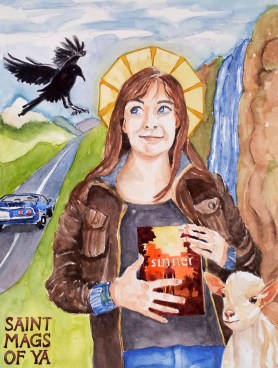 After I read this book, but before I wrote this, I went on Goodreads and looked up a couple of the books mentioned in my second paragraph—the ones people think of as a combination of allegorical revelation and self-help. In a comment about The Alchemist, one reader said, “This is either a beautifully written and fable-like illustration of simple and universal truths, or a load of crap.” One could probably react in the same way to All the Crooked Saints—but ultimately, I don’t believe either of those summations. It’s a story. If you read it first just as story and then come to appreciate the other mysterious and lyrical elements hidden within, I believe it deserves the encomiums it has received from reviewers. Readers of Barbara Kingsolver might also enjoy this.
One warning: It’s not like anything else Stiefvater has written, so if you go into it expecting that it will be, you will be disappointed. Also, I would in no way categorize this as young adult fiction. Some teens may read and appreciate it; but it is not specifically written for that market, even if that was the author’s intent (which I find hard to believe). It’s just the next story to come out of the complex being who is Maggie Stiefvater.

 The Book Adept