What are you reading?
Post your book, and let’s chat!
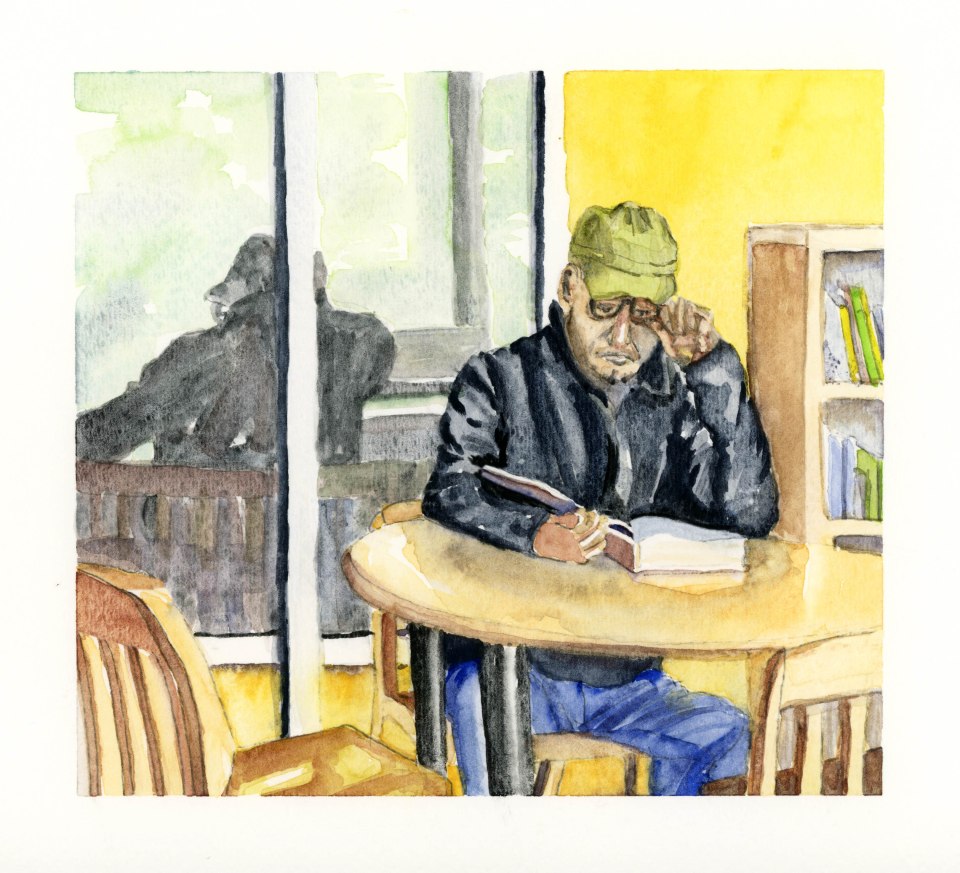
“Kirsti reads a magazine” from my “people reading” series.

Graphic dilemma
In the library masters program at UCLA, certain classes are only offered once every two years, because there are so many paths these days for a librarian to take that equal time must be given to covering all those avenues. One of these is my class on Young Adult Literature, which I last taught in the winter of 2017 and am going to be teaching during this upcoming spring quarter, beginning two weeks from now.
Since the last time I taught it was my first, I have been going back over my syllabus, assignments, and lectures to tweak them in ways suggested by the feedback I received from my students, and to update them, since much YA literature has been written in the interim!
Although I have read widely in teen lit for the past 12 years, the one area in which I am weak is graphic novels. Being an artist myself, one would think that I would enjoy this format more than most; but on the contrary, I find them difficult to follow. Even though I am a visual creator, apparently I am not a visual learner, and the effort to go from frame to frame seeking out the text and trying to understand the continuity of the story is daunting. (I honestly don’t know how the kids and teens read manga, which is also much of it read right to left!)
When I realized that I needed to choose some new graphic novels, both fiction and nonfiction, as the required reading for that week’s lecture, therefore, I turned to three of my students from last time who were enthusiastic about the format and asked their advice. Helen, Christina, and Alex were generous with their recommendations, and I proceeded to order about half a dozen for my Kindle and chose several afternoons to page through them in a search for good examples for my class.
Last time out, one of the GNs we read was the classic Smile, by Raina Telgemaier. I wanted something similar in terms of age level, which is middle school, and also a book that was autobiographical and “coming of age” oriented, so the first book I read was Real Friends, by Shannon Hale.
 It’s a fairly simple story, and it’s probably nearly everyone’s story, depending upon your point of view. It’s easy, when you’re in kindergarten or first grade, to make a friend: You turn to your left or your right, you focus on the person sitting there, you ask “Will you be my friend?” and they are. This was the case with Shannon and her friend Adrienne. It’s harder, having been best and only friends together for a couple of grades, to confront the concept of popularity and to realize that while you are perhaps the one-loyal-bff-forever type, your friend would prefer to run with a crowd, a crowd that is happy to leave you behind because you don’t quite fit. The combination of the judgment made by the group and the betrayal by your friend, whose reluctance to go against the group outweighs her loyalty to you, is heart-breaking.
While there is much to appreciate about this memoir, including the myriad ways Shannon finds to cope and hold her own against bullying and her own OCD, the conclusion I came to after having read this was that it was well done…and reminded me way too much of my own grade school experience! The issue with reading books like this is that the level of angst, while probably completely true to life for that child in that moment, is a little much to read about after you have passed through it. (However, Susie Benveniste, if you are out there somewhere, read this book! I was Shannon, you were Adrienne, and Lori was the evil Jenny in our scenario.) The illustrations are adorable, and seem directed towards the younger end of this age group.
The next book I read was recommended by Christina as one that addressed similar themes: Roller Girl, by Victoria Jamieson.
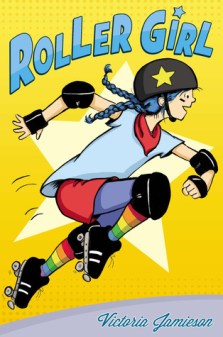 In this story, there are also best friends (Astrid and Nicole) who have done everything together for years. Their twosome has been a little more long-lasting than that of Shannon and Adrienne, but they have reached a place (the summer before middle school) where their interests have diverged, and for the first time they are not in agreement. Nicole is a ballet girl, and is beginning to gravitate towards others who share her interests (in dance and also regarding boys), while Astrid has become fascinated by the prospect of skating with the local roller derby team, after seeing them play. Although Astrid’s skating skills are definitely lacking, she is so enthusiastic about this idea that she wants to sign both of them up for the summer for roller derby camp. She’s devastated when Nicole chooses, instead, to go to ballet camp, but grits her teeth and pursues roller derby alone. The rest of the book is her personal journey, including meeting new friends who are quite unlike her and her previous circle, and painfully gaining a new skill.
This was a really cute story, both verbally and visually. The illustrations were a little more adult and modern, and with more energy and pizzazz than those in Real Friends. It had just enough about changing friendships, growing pains, and growing apart to be entertaining, without quite so much self-obsessed angst; and all the roller derby details were great fun. I ended up agreeing with Christina that this might appeal to a wider range of readers.
 The third book I read was also memoir, but nonfiction this time: March, Book One (of three), by John Lewis. March begins in 2009, when Lewis is a prominent Senator, and then flashes back to his beginnings on the farm and in small towns as he began his lifelong struggle for civil rights and human rights. This first volume looks at his youth in rural Alabama, his first meeting with Martin Luther King, Jr., the beginning of the Nashville Student Movement, and their nonviolent protests at lunch counter sit-ins across the South. It poignantly references the 1950s comic book Martin Luther King and the Montgomery Story as an influence on Lewis, whose own comics now enliven that history.
It was a powerful, emotional read, and the stark black-, white-, and gray-toned images were an excellent choice to convey the importance and the emotions of the theme. I will go on to read the other two volumes with pleasure.
Although I have a few more graphic novels to read, Roller Girl and March are both definitely going to be part of the curriculum for my class.
Serendipity
I always find it interesting how one has a thought about something and suddenly that subject is popping up everywhere in life. This happens to me frequently with books: I will decide to read a book about Paris, for instance, and three more will come to me, purely by chance, after I’ve finished the first. This time, the theme was the Romany, otherwise known as travelers or, in less politically correct nomenclature, gypsies.
 First, I bought a Kindle book as one of my “daily dollar deals,” called The Snow Gypsy, by Lindsay Jayne Ashford. I have always liked stories about Travelers, ever since reading Rumer Godden’s book The Diddakoi as a child, and following it up with Meridon, the last book in Philippa Gregory’s Wideacre trilogy as an adult. I didn’t read this one right away, though; my friend Bix had mentioned the other two books in the Chocolat series by Joanne Harris, and I decided to catch up with those first. But those introduced me to the itinerant boat people, including Vianne’s love interest, Roux, who seem to be some variation on Romany or pavees, as the Irish travelers call themselves, except that they travel by river boat rather than by horse and wagon. The French townsfolk of Lansquenet unflatteringly designate them “river rats.”
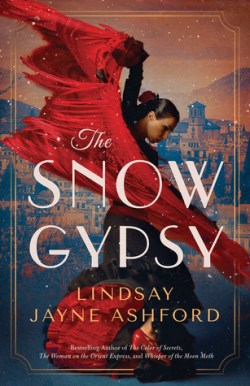 After finishing the three-book series, I went back and read The Snow Gypsy on my Kindle. Rose Daniel is an English veterinarian who specializes in alternative medicine for animals; in other words, she is an herbalist in her practice. Rose’s brother disappeared in 1938 in the mountains of southern Spain, fighting alongside gypsy insurgents during the Spanish Civil War. Rose knows that he had a love interest (or possibly a wife) in one of the villages near their base, and decides, in 1946, to drop everything and go there to see if she can find any trace of what happened to him. (She has, of course, an irrational hope that she will actually locate him, and/or possibly the woman and child.) She is on a collision course with Lola Aragon, whose entire family was murdered by the fascists eight years ago in one of those same villages while she was herding goats up on the mountain, and who rescued a baby girl from her dead mother’s arms when she descended and found the slain villagers. Rose connects with Lola, an aspiring flamenco dancer, hoping to get her help finding some trace of her brother and his family.
I enjoyed this story quite a bit, though it had its flaws. The parts I liked best were the details about flamenco (tantalizingly few, as it turned out), the herbalist knowledge Rose exhibits and learns throughout the book, the scene-setting in the mountain villages of Spain, and the lingering atmosphere of the Spanish Civil War that casts its shadow over all the characters. The coincidences were a few too many, and at least one of the relationships was hard to buy. I wished (in light of the title) that there had been a bit more detail about the Travelers—the few pictures that were given were evocative but not elaborate. Some of the details of the book that seemed superfluous became more understandable when I learned from the afterword that it’s based on the true story of a woman herbalist, so I reserved one of her autobiographies at the library and am waiting for its delivery.
 In the meantime, my memory was jogged about another Traveler-related book that I read a few years back, and will mention here: The Outside Boy, by Jeanine Cummins. It’s poetic, beguiling, and different; a coming-of-age story, but within the subculture of the Irish Pavee—gypsies, tinkers, whatever name they are called by outsiders—circa 1950s rural Ireland. And within the already arresting picture of this nomadic people is the intimate story of Christy, who is at the brink of many unexpected discoveries about his family’s past and his own. I had planned, when I read it, to suggest this as a selection for my 10-12 Book Club—it was a real charmer, poignant and inspirational but also a good tale. Alas, I couldn’t get copies of the book in sufficient quantities at the time to make it work for the club.
That was my Romany serendipity; the following week, everything was about bees. Stay tuned…
Magical realism
The terms “magical” and “realism” seem antithetical, don’t they? If there’s magic involved, isn’t it fantasy? How can it be realism if there are magical elements in the story?

The literary movement of magical realism began with Latin American authors, and it has often been used by them as a genre of political subversion. The fantastic and magical elements of the story are presented as normal aspects of everyday life, thus putting the standard structure of reality into question; this allowed authors such as Gabriel García Márquez and Isabel Allende to question the political regimes of their day without being instantly labeled as dissidents. Essentially, magical realism allowed these authors to show or even suggest an alternative to an accepted or established political reality.
As it diversified from the Latin American authors, the genre has taken on additional qualities, adding surrealism, with its irrational juxtapositions and combinations, and fabulism, incorporating fables and myths into a contemporary setting. Unlike fantasy or science fiction, which set up worlds separate from our own, authors of magical realism simply introduce into our world some slight distortion that forces the reader to question what is real and opens up additional avenues for our minds to ponder. It can be quirky and fanciful or fraught with significance, but the specific characteristic that makes it magical realism is the author’s refusal to define which elements are real and which are fantastical. It is for the reader to decide.
Some original classics would be One Hundred Years of Solitude, and Love in the Time of Cholera, by Gabriel García Márquez; Like Water for Chocolate, by Laura Esquivel; and The House of the Spirits and Eva Luna, by Isabel Allende. Other more contemporary examples include Life of Pi, by Yann Martel; Kafka on the Shore, by Haruki Murakami; most titles by Alice Hoffman; The Strange and Beautiful Sorrows of Ava Lavender, by Leslye Walton; and you could also include such offbeat books as Mr. Penumbra’s 24-Hour Bookstore and Sourdough, by Robin Sloan.
Here’s the thing about recommending books containing magical realism: You have to be sure that your readers understand what it is and welcome its inclusion in the story, because they will either be delighted by it or they will be massively irritated. I am a person who has always enjoyed magical realism, and even I have a tolerance point beyond which I say to the author, “You’ve gone too far!” My breaking point, and it may be this way for others, is when the author begins to “fix” parts of the story as it unfolds by simply making things magical, instead of addressing the situation as it demands. When it is used as a crutch instead of as a delightful element or purposeful metaphor, that’s when magical realism can get out of hand.
All this has led up to my current reading, which is the trilogy about a French chocolate-maker who lets the wind dictate her destination in life.
 Chocolat, by Joanne Harris, is a quintessential example of magical realism. It is especially potent because of the contrasts between the rural, parochial, cautious inhabitants of Lansquenet-sur-Tannes versus the mother and daughter who are swept into town with not only an ability but almost a mandate to upend everything traditional and narrow about the townspeople and insert some charm and whimsicality into their environs by opening a chocolate shop.
I had seen the movie version of this book several times, and so I felt I could dispense with reading it and move directly to the sequel, but it turned out I was wrong—the book has essential similarities, but also some crucial differences. So I actually ended up reading this trilogy in 2-1-3 order, which skewed my viewpoint of the books somewhat.
The first book is a nearly unalloyed delight. Using the device of injecting this footloose, free-spirited, pagan, magical woman into the humdrum life of a traditional French Catholic town allows the author to examine issues of tolerance and acceptance, religion, relationships, happiness, and even death in a serious but lighthearted manner. The touches of magic only serve to highlight these issues and keep the book from becoming too intense (and the constant talk of chocolate will have you noshing with one hand while you hold the book with the other).
 The sequel, The Girl with No Shadow, on the other hand, was a puzzle to me. It’s four years later, and it’s clear that Vianne is fearful about something, though it’s hard to tell what or why. She and Anouk have assumed new names, their spirits have dwindled, and I couldn’t figure out how we got from the mostly upbeat Vianne at the end of the first book to the weirdly passive, unhappy, and self-deluding widow living in Paris at the beginning of the second. I became impatient at times with the levels of apprehension and timidity exhibited by Yanne, the name under which she now masquerades. She has developed a panicky need to be “normal,” supposedly for the sake of her daughters, that has left her open to the machinations of the malevolent trickster, Zozie, who shows up and essentially tries to steal Vianne’s life (and elder daughter) out from under her.
The story examines the debilitating effects of fear and the dangers to which it can expose us if we let it rule our lives. It also examines the sometimes desperate choices we make to obtain the things we need.
Even though she introduces some wonderful elements into the story, I so disliked the character of Zozie that it was hard to read about her triumphs and the way she insinuated herself into the lives all around Vianne. Ultimately I liked the book, but felt that it was a vehicle, a second designed to get you to the third—a long episode, if you will, to transition Vianne out of her fearfulness and back to embracing life.
I also felt that in this book, the author crossed that fine line from magical realism into manipulation. There was too much solving of problems with the flick of a finger or the drawing of a symbol, combined with an inadequate explanation of what magic was being sourced to do so.
I’m going to leave the discussion of the third book, Peaches for Father Francis, to a subsequent post, because it weirdly melded with a new young adult novel I picked up a couple of weeks later, and I want to put the two together. For now, suffice it to say that the third book documents a return to Lansquenet and also to the original spirit and intentions of Vianne.
Out of commission
My computer hard drive failed on Thursday, so instead of posting yesterday, I hauled it to the repair shop, where they can hopefully retrieve my precious data and then install a new robust drive. Meanwhile, I am continuing to read and note my thoughts (longhand! haven’t done that in a few decades), and once the computer is back and I transcribe, new reviews will appear. (I am currently typing two-fingered on my Kindle, which is not ideal.) Since I am gearing up for my Young Adult Literature class at UCLA in April, you can expect some great brand new YA reviews. Stay tuned…
What are you reading?
As a regular feature here on the blog, I’d like to furnish an image of someone reading, and ask you what books you are enjoying. Please leave a comment and tell me what you’re reading this week!
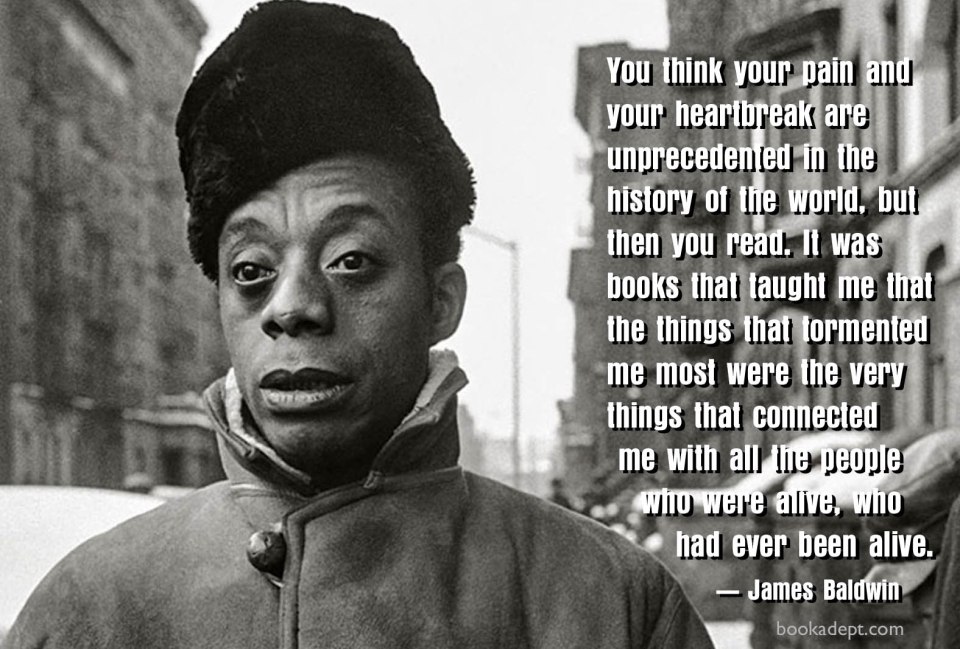
Hear, hear!
“A survey of the Baltimore-Washington metropolitan libraries showed that half the patrons of the public library had come to it simply for a good book to read. Yet patrons who come to the library are seldom accosted by a librarian who has thought enough of books to read very many of them, or if [s]he has read extensively, cares enough to recommend books to others searching for good reading. The library profession hopes to improve its image and seems to feel this can be done by proof of efficiency. Those students who enter the library profession because they love books and wish to work with people soon discover they are being trained for technical services, and become bored and disillusioned. If we continue to confine ourselves to administering collections, to making information and materials available, to answering questions but remaining unconcerned for the individual, then we should be honest enough to admit we are technicians, cease insisting on professional status, disown the bastard YA, and catch up with our work! I say that when the time comes that library schools train readers’ advisors as well as technicians; when administrators make the promotion of reading as important as the informational services; when staff members render creative professional service to individuals; then we shall not have to worry about our image.”
—Margaret A. Edwards
The Fair Garden and the Swarm of Beasts, 1969
 The Book Adept