Day for cats
A friend’s post on Facebook reminded me that today is International Cat Day, which I dare not let go by unremarked, lest Gidget do some big-time scolding (at which she is quite proficient!). So here are some titles guaranteed to appeal to readers of various types who are also cat lovers.

MISCELLANEOUS STUFF YOU WON’T WANT TO MISS
The Dalai Lama’s Cat, by David Michie, in which the Tibetan Buddhist leader’s cat offers insights on happiness and meaning.
The Rabbi’s Cat, by Joann Sfar, a graphic novel about a cat who eats the family parrot, gains the ability to speak, and demands a Bar Mitzvah, by a celebrated French comic artist.
James Herriot’s Cat Stories, by, you guessed it, James Herriot! Celebrating his feline friends…
On Cats, by Charles Bukowski, the irreverent and profane poet whose primary subjects of women and booze also apparently expand to include his take on cats.
The Travelling Cat Chronicles, by Hiro Arikawa, in which Nana the cat and her person, Satoru, go on a road trip, for what purpose Nana isn’t quite sure. Be prepared to cry.
The Cat Who Went to Paris, by Peter Gethers, the story of how a Scottish Fold kitten named Norton turned a curmudgeonly cat hater into a compassionate human.
A Street Cat Named Bob: How One Man and His Cat Found Hope on the Streets, by James Bowen. It’s all there in the very long title.
I Could Pee On This, and Other Poems by Cats, by Francesco Marciuliano. From the singular minds of housecats.
Old Possum’s Book of Practical Cats, by T. S. Eliot, in which the author describes cats each by their distinct personality.
The Tribe of Tiger: Cats and Their Culture, by Elizabeth Marshall Thomas, a naturalist and anthropologist who explores the worlds of lions, tigers, pumas, and housecats.

MYSTERIES
The Cat Who… mysteries, by Lilian Jackson Braun, in which a reporter and his cat solve mysteries. First book: The Cat Who Could Read Backwards.
The Mrs. Murphy mysteries, by Rita Mae Brown & Sneaky Pie Brown, in which Mrs. Murphy and her human companion solve mysteries. First book: Wish You Were Here.
The Joe Grey mysteries, by Shirley Rousseau Murphy, in which there are talking cats and also a human who discovers an ability to morph into a cat. First book: Cat on the Edge.
SCIENCE FICTION/HORROR
Catfantastic: Nine Lives and Fifteen Tales, by Andre Norton, editor, in which sci fi and fantasy writers tell tall tales about furry felines. (Short stories.)
The Chanur novels, by C. J. Cherryh, in which a leonine species—the Chanur—take in a human refugee and by so doing threaten the interspecies Compact. First book: The Pride of Chanur.
The Cinder Spires books, by Jim Butcher, in which there are also cat clans and some naval airship action. First book: The Aeronaut’s Windlass.
The Cult of the Cat books, by Zoe Kalo, in which Trinity is left with a dead grandmother and a thousand grieving cats. A sort of Egyptian urban fantasy. First book: Daughter of the Sun.
Pet Sematary, by Stephen King. I always have trouble with the spelling of this one, seeing as how it’s spelled “cemetery.” Hm. But if you like to be scared by revenants, this one’s for you.
FOR SMALL, MEDIUM, AND LARGE CHILDREN:
Millions of Cats, by Wanda Gág, in which a lonely old couple acquires companions. This is known as the original picture book for children.
The Owl and the Pussycat, by Edward Lear. A classic.
Time Cat, by Lloyd Alexander. He can talk, he can time travel…what’s not to like? By the wonderful author of The Prydain Chronicles.
The Fur Person, by May Sarton. Yes, that May Sarton. A charming tale about a Cat About Town who decides to become a Fur Person instead. It could be read as either a children’s book or a novelty book for adults.
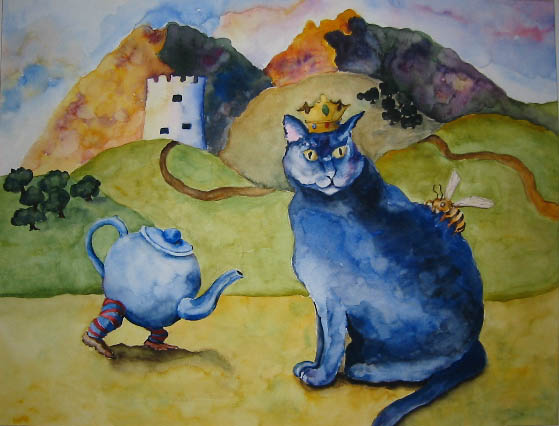
The Warriors books, by Erin Hunter, in which a house cat discovers clans of cats living in the wild in the forest…. First book: Into the Wild.
The Wildings books, by Nilanjana Roy, in which a small band of cats lives in the alleys and ruins of Nizamuddin, an old neighborhood in Delhi, India.
The Feline Wizards series, by Diane Duane, in which feline wizards time travel to avert disasters. First book: The Book of Night with Moon.
Tales of the Barque Cats, by Anne McCaffrey, in which cats are essential members of the crews of space vessels…until an epidemic threatens their extinction.

For many, many more books with or about cats, hit up this gargantuan list on Goodreads of Great Cat Books (1,511).
Graphic dilemma
In the library masters program at UCLA, certain classes are only offered once every two years, because there are so many paths these days for a librarian to take that equal time must be given to covering all those avenues. One of these is my class on Young Adult Literature, which I last taught in the winter of 2017 and am going to be teaching during this upcoming spring quarter, beginning two weeks from now.
Since the last time I taught it was my first, I have been going back over my syllabus, assignments, and lectures to tweak them in ways suggested by the feedback I received from my students, and to update them, since much YA literature has been written in the interim!
Although I have read widely in teen lit for the past 12 years, the one area in which I am weak is graphic novels. Being an artist myself, one would think that I would enjoy this format more than most; but on the contrary, I find them difficult to follow. Even though I am a visual creator, apparently I am not a visual learner, and the effort to go from frame to frame seeking out the text and trying to understand the continuity of the story is daunting. (I honestly don’t know how the kids and teens read manga, which is also much of it read right to left!)
When I realized that I needed to choose some new graphic novels, both fiction and nonfiction, as the required reading for that week’s lecture, therefore, I turned to three of my students from last time who were enthusiastic about the format and asked their advice. Helen, Christina, and Alex were generous with their recommendations, and I proceeded to order about half a dozen for my Kindle and chose several afternoons to page through them in a search for good examples for my class.
Last time out, one of the GNs we read was the classic Smile, by Raina Telgemaier. I wanted something similar in terms of age level, which is middle school, and also a book that was autobiographical and “coming of age” oriented, so the first book I read was Real Friends, by Shannon Hale.
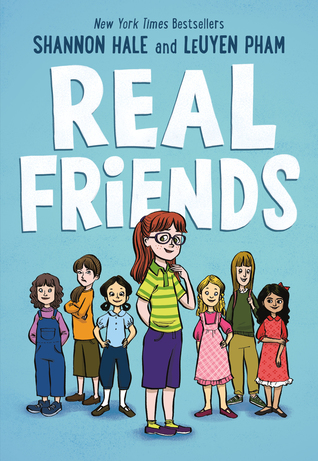 It’s a fairly simple story, and it’s probably nearly everyone’s story, depending upon your point of view. It’s easy, when you’re in kindergarten or first grade, to make a friend: You turn to your left or your right, you focus on the person sitting there, you ask “Will you be my friend?” and they are. This was the case with Shannon and her friend Adrienne. It’s harder, having been best and only friends together for a couple of grades, to confront the concept of popularity and to realize that while you are perhaps the one-loyal-bff-forever type, your friend would prefer to run with a crowd, a crowd that is happy to leave you behind because you don’t quite fit. The combination of the judgment made by the group and the betrayal by your friend, whose reluctance to go against the group outweighs her loyalty to you, is heart-breaking.
While there is much to appreciate about this memoir, including the myriad ways Shannon finds to cope and hold her own against bullying and her own OCD, the conclusion I came to after having read this was that it was well done…and reminded me way too much of my own grade school experience! The issue with reading books like this is that the level of angst, while probably completely true to life for that child in that moment, is a little much to read about after you have passed through it. (However, Susie Benveniste, if you are out there somewhere, read this book! I was Shannon, you were Adrienne, and Lori was the evil Jenny in our scenario.) The illustrations are adorable, and seem directed towards the younger end of this age group.
The next book I read was recommended by Christina as one that addressed similar themes: Roller Girl, by Victoria Jamieson.
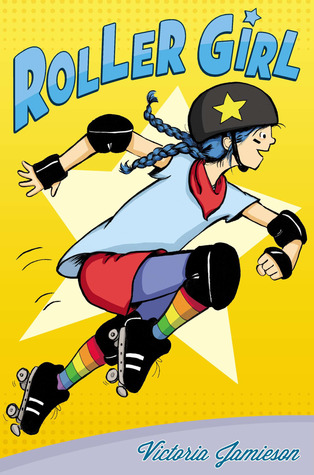 In this story, there are also best friends (Astrid and Nicole) who have done everything together for years. Their twosome has been a little more long-lasting than that of Shannon and Adrienne, but they have reached a place (the summer before middle school) where their interests have diverged, and for the first time they are not in agreement. Nicole is a ballet girl, and is beginning to gravitate towards others who share her interests (in dance and also regarding boys), while Astrid has become fascinated by the prospect of skating with the local roller derby team, after seeing them play. Although Astrid’s skating skills are definitely lacking, she is so enthusiastic about this idea that she wants to sign both of them up for the summer for roller derby camp. She’s devastated when Nicole chooses, instead, to go to ballet camp, but grits her teeth and pursues roller derby alone. The rest of the book is her personal journey, including meeting new friends who are quite unlike her and her previous circle, and painfully gaining a new skill.
This was a really cute story, both verbally and visually. The illustrations were a little more adult and modern, and with more energy and pizzazz than those in Real Friends. It had just enough about changing friendships, growing pains, and growing apart to be entertaining, without quite so much self-obsessed angst; and all the roller derby details were great fun. I ended up agreeing with Christina that this might appeal to a wider range of readers.
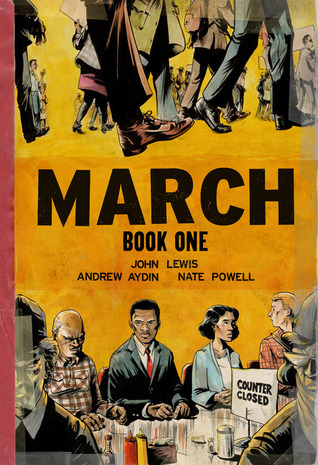 The third book I read was also memoir, but nonfiction this time: March, Book One (of three), by John Lewis. March begins in 2009, when Lewis is a prominent Senator, and then flashes back to his beginnings on the farm and in small towns as he began his lifelong struggle for civil rights and human rights. This first volume looks at his youth in rural Alabama, his first meeting with Martin Luther King, Jr., the beginning of the Nashville Student Movement, and their nonviolent protests at lunch counter sit-ins across the South. It poignantly references the 1950s comic book Martin Luther King and the Montgomery Story as an influence on Lewis, whose own comics now enliven that history.
It was a powerful, emotional read, and the stark black-, white-, and gray-toned images were an excellent choice to convey the importance and the emotions of the theme. I will go on to read the other two volumes with pleasure.
Although I have a few more graphic novels to read, Roller Girl and March are both definitely going to be part of the curriculum for my class.
 The Book Adept