Scary season
It’s Decorative Gourd season, and I should be coming up with a great list of scary reads to share with you. But…I’m going to be exceedingly lazy here and post a link to last year’s book recommendations for the spookily inclined. I am not a horror reader and, although I do like a good ghost story, I haven’t read any new ones this past year except for Wyrd Sisters and Mort, by Terry Pratchett and, while they do have a resident ghost or two (not to mention Death) as characters, they aren’t exactly fright-inducing! So if you haven’t read any of last years’s selection, try one, and if you have, you could always suggest one to me! Be convincing about its merits and I might post it!
Go HERE to find them.
Spooky reads for October
There are a lot of requests on Facebook reading pages for haunted tomes to make their month more enjoyable (and more chilling). So I decided to comb through my “horror” and “paranormal” categories on Goodreads to see if I could find some good reads to recommend. I am not much of a horror aficionado, so those are in short supply, but I do like a good ghost story. Here’s a list of a few I have enjoyed, both new and classic, with some young adult stuff thrown in because it is also entertaining for we grownups.
The Haunting of Hill House, and We Have Always Lived in the Castle, by Shirley Jackson. Very different vibes in these two, but I can say that they are both truly creepy. Don’t judge the first by its movie(s), it’s so much more nuanced and weird than anything Hollywood managed to put onscreen.
Starling House, by Alix E. Harrow. Southern gothic horror. Here is my review.
Vampire books by Anne Rice (the first two are the best). Classic paranormal. I also liked Sunshine, by Robin McKinley, a completely different take. And if you like sex and diners with your vamps, there is, of course, the “Sookie Stackhouse” series by Charlaine Harris.
The Harper Connelly books, also by Charlaine Harris, recently reread and commented on by me here. You could also try the “Midnight, Texas” series, though they are not my faves apart from my love for their protagonist.
The Graveminder, by Melissa Marr. “Sleep well, and stay where I put you!”
The Library of the Dead, by T. L. Huchu. Ghosts with a Zimbabwean twist. I reviewed this one too.
A Certain Slant of Light, by Laura Whitcomb. A dreamy, unusual ghost story. There is a sequel I haven’t read, called Under the Light.
Hold Me Closer, Necromancer, by Lish McBride, a somewhat comedic take on a modern necromancer and his paranormal pals. Big fun. There is a sequel called Necromancing the Stone.
The “Visions” series by Lisa McMann.
Also, please enjoy the following excellent ghostly tales, which I reviewed here for a previous Hallowe’en post:
Meet Me at the River, by Nina de Gramont
The “Lockwood & Co.” series, by Jonathan Stroud.
The “Shades of London” series, by Maureen Johnson.
…and a few more.

Third time continues the charm
I just finished Alix Harrow’s third full-length novel, Starling House, and was nearly as taken with it as I was by her other two (The Once and Future Witches, and The Ten Thousand Doors of January). That’s saying something—if you read my reviews, you will know how blown away I was by every aspect of those two amazing stories.

This one is perhaps not as original an idea as either of the other two; instead, it takes some trope stuff and makes it fresh and interesting. It’s a combination of a Southern Gothic fantasy/horror hybrid and a coming-of-age story, and has a lot of levels.
In some ways it is a commentary on the bigotry and trauma one encounters as an outsider in a small town, particularly a small “company” town in the deep South. This one is Eden, Kentucky, and the town’s reason for existence is the working of the coal mines owned by the Gravely family. The town and its residents are either singularly unlucky or the story of a curse is true, because a sadder and less hospitable place could scarcely be conceived. The supposed origin of the curse is tied up with the history of E. Starling, a 19th-century children’s book author who was married to one of the three original Gravely brothers, wrote a story about a creepy place called Underland, built a mansion for herself after her husband’s death, and ultimately disappeared. Starling House has since been host to a number of owners, all of whom show up just when the previous owner dies or leaves, but such is its unsavory reputation that the people of the town cross the road rather than walk on the sidewalk near its gates.
The book revolves around Opal, a young woman who has never caught a single break. Her mother died in a car crash when she was a child, and she and her younger brother Jasper have continued to live in the motel room where they landed shortly before her death. Opal works a minimum wage job at the local hardware store, trying to save enough money to get her brother, a smart young man with debilitating asthma made worse by the miasma that hangs over the industrial town, into a private high school far from the environs of Eden; but there’s scant hope of that until she gets a job as a cleaner for Arthur Starling. She’s heard all the rumors about both the house and its owner, but she’d do almost anything to get Jasper the chance he deserves in life, so she begins the task of bringing this house full of dust and cobwebs (and other, more sinister things) back to life. But the feeling of sentience she gets from the house and the weird vibes coming off of Arthur, who seems alternatively tortured, coldly aloof, and strangely sympathetic, are getting under her skin, and she’s wondering where it’s all going to end…
You could scarcely find a less likable protagonist than Opal, but she somehow endeared herself to me. Maybe it’s because every small victory she has is so hard-earned that it’s almost not worth it, and you can feel the palpable intensity of her longing for things to change and her simultaneous hopeless conviction that they never will.
The best thing about this book for me was the language. Admittedly, it’s sometimes over the top or overly descriptive, but there are moments that struck me so forcefully that I marked them in my notes on my Kindle. Alix Harrow knows how, with one phrase, to invoke a memory or even an entire phase of life, as with this one, where she is describing some symbols incised into the wood of a door:
The carved symbols are still very slightly luminescent, like glowsticks the day after a sleepover.
I read that one sentence and jumped back to a moment in childhood: We were in someone’s yard at dusk, at the end of a birthday barbecue. We all cracked glowsticks that had been passed out by the birthday girl’s mother, manically waving the neon tubes and dancing around, lighting up the dark. By the next day, most of the chemical inside the sticks had finished its reaction and was subsiding, but there was still a dim glow to them if you turned out the lights in a windowless room.
The biggest flaw in the story for me is the revelation that Opal is 27 years old. Her character, while honestly and intricately drawn, seems more typical of a teenager—16, 17, maybe 18 tops—than of a young woman approaching her late 20s. Honestly, this book works better as a young adult novel, both in its characterizations and in the way the story is couched in a particular kind of gritty magical realism. But since I am a big fan of good young adult literature (note the emphasis on good), that’s fine with me. I simply decided to forget Opal’s age and read it as it reads. There are other problems—unresolved plot points, underutilized characters, unexplained mysteries—but ultimately it all worked for me, with its beautiful prose, interesting characters, and slow-burn sense of menace.
Scalzi saves the day
So…I have a couple of rules that I rarely break here. One is that I don’t utterly pan a book, but rather try to say something nice even if it wasn’t a book I enjoyed, and if I can’t do that, I simply ignore it. The other is not to review books that I haven’t finished, because I spent so many years as a librarian having to argue with self-righteous people who wanted to get books pulled and banned from the library shelves simply on hearsay when they hadn’t personally read the book for themselves. But…sometimes I succumb to temptation. And I’m not trying to persuade anyone not to read a book, I’m just saying why I quit after five chapters.

After a lot of positive hype in two Facebook book groups, I decided to read Go As A River, by Shelley Read, as my first book of the year. The description was intriguing—a combination of historical small-town fiction and coming-of-age novel—and people had praised it for its literary language. Within a few chapters of beginning it, not only was my interest flagging, but I was becoming actively irritated; when I finally decided to quit reading, I skimmed some reviews on Goodreads (fives down to twos) and decided that this time I would leave one, even though I had categorized this book as “Changed my mind.” Here is that review:
I’m wondering why no one is focused at all on the thing that has stopped me reading Go As A River after five chapters?
The people who disliked the book mainly say it’s because of the too minimal dialogue and too florid description, or the theme of unrelenting heartbreak, or their lack of interest in nature or motherhood. And many who disliked the book still cite the writing as beautiful and lyrical. Not one seems to have been bothered by the thing I dislike the most in storytelling, which is foreshadowing. I don’t know if it continues throughout the book, but the first few chapters are rife with text dedicated to phrases (or sentences or paragraphs) of “if only she had known,” or “she was to learn this lesson from him one day, but not just yet” or “she came to wish that he had left town that day instead” or some such. It completely steals both the momentum and the element of delightful surprise that comes from reading a story from start to finish without all the ominous “da da da DUM” of foreknowledge.
Also, the so-called beautiful writing is so over the top! Just to use one example: The main character, Victoria, mentions that her uncle-in-law went away to fight in World War II just a few short months after he married her aunt. Then she seemingly cuts away to describe an event that took place in her town, in which a man stalls out his roadster on the railroad tracks and the car is hit and destroyed by the train. She mentions that it grew into an elaborate tale about the supposedly gruesome details of the death of the driver (decapitated, splatted on the windshield of the train engine, etc), despite the fact that he had actually jumped clear of the car before the train hit. But this detail has absolutely nothing to do with how the author is using this simile, because after going on for three full paragraphs about it, she then says that what that train did to that car (i.e., mangled it beyond recognition) was what World War II did to Victoria’s Uncle Og, changing him from a young, enthusiastic, engaging, funny guy into a bitter, mean, spiteful slob in a wheelchair who delights in provoking discord. And she keeps doing this kind of thing, but as far as I can tell it’s just an exercise in “look at me,” because few of these passages materially advance the narrative, or give any significant perspective to either the main thread or any side story. She could have just said “the war didn’t treat my uncle kindly” and his nastiness and lack of mobility would have revealed what she meant. My ultimate reaction to the part of this book that I did read is total exasperation. No thank you.

After this inauspicious beginning to my reading year, I was about to begin searching my TBRs for something else when Los Angeles Public Library let me know that a book on my holds list had become available—Starter Villain, by John Scalzi, a completely different genre of book, without either baggage or literary pretensions—so I checked it out to my Kindle and began to read. I’m so glad that this book popped up when it did, because it completely saved my mood and provided a delightfully fresh interlude.
Scalzi seems to write two kinds of books, the first being the fairly straightforward story of something-or-other happening in space and/or on other planets—colonization, exploitation, war, murder mysteries with a technological twist—the kind of thing that Heinlein wrote about, but considerably updated. These would be his Old Man’s War series, his Interdependency trilogy, the Locked In books. The second category is when he takes some premise based in more outlandish science fiction—environmentally challenged dinosaurs on an alternate-dimension Earth, aliens on a religious quest, sentient fuzzy monkey-like beings threatened by a planetary takeover—and goes to town with all the wry and unexpected humor he’s been storing up while writing the serious stuff. While I have enjoyed all his books, I think these are my favorites; The Android’s Dream is one of the funniest books I have ever read, in any genre. Starter Villain joins the ranks of this second group of books and, despite its fairly short length, gives full value to those looking for a clever, twisty, funny read.
Charlie had a career as a journalist, but when everything went digital he lost that gig, along with the majority of other newspaper writers on the planet. Around that same time, his dad got sick, so rather than find a new job, Charlie elected to do some substitute teaching to fill in the financial holes while living with his dad and caring for him. But after his dad died, he felt both stalled and trapped, and hasn’t really made a move since. He’s still living in his dad’s house, but he shares the inheritance with three half-siblings, all of whom want him to move out and sell up, and the subbing doesn’t really pay the bills.
His new dream is to buy the town’s most popular pub—both the business and the building it’s in are recently up for sale, and he’s trying to think of a way to finagle it, but the bank looks askance at a divorced part-time substitute teacher whose meager liquidity is dependent on three uncooperative siblings. Then his Uncle Jake dies, and he is distracted from his life plans when his uncle’s right-hand assistant shows up at his house with a request from his uncle to conduct the funeral. Despite the fact that Charlie’s father and uncle were estranged from the time Charlie was five years old, he feels some obligation, as Jake’s only remaining next of kin…not to mention that Jake was an extremely wealthy man and there may be something in it for Charlie.
Becoming involved with his uncle’s estate, however, also means he has come to the extremely unwelcome attention of the other wealthiest men in the world—rich, soulless, and very curious about what will happen if and when Charlie inherits. But Jake has left Charlie some unexpected advantages to help him with his new profession as a “starter” villain, and he finds himself carried along in his uncle’s wake, trying to make sense of what is happening and what will happen next if he fulfills his destiny as heir apparent.
This is one of Scalzi’s most entertaining ventures. Charlie is a wonderful character—innocent, sincere, and somewhat bumbling, but not unintelligent; and although part of him is reluctant to become ensnared in Jake’s labyrinthine business dealings, he is nonetheless fascinated by some of their more outlandish results. The supporting characters are intriguing, the villains are, well, villainous, and it doesn’t hurt that genetic engineering has provided some unlikely spies who are on Charlie’s side—at least for now. It has a decidedly contemporary vibe, what with its themes of income inequality, workers’ rights, animal liberation, unions, nepotism, and corruption in capitalism. It’s also whimsical, silly, irreverent, and occasionally laugh-out-loud funny. Grab this one with gusto. [Warning to those who care: Lots of strong language, and a fair bit of over-the-top violence.]

Dystopian YA

The Grace Year, by Kim Liggett, has been variously compared to The Handmaid’s Tale, The Hunger Games, and Lord of the Flies, by reviewers and readers alike. I can see some parallels: The subjugation of women, with their fixed roles and color-coded hair ribbons, by men who use fear and ignorance to stifle female individuality; pitting the young girls against one another in a contest for supremacy; the artificially created isolation while waiting to see who survives. But this book is both more and less than any of those—more frightening in its depiction of the virulence that comes out when these girls are made to understand (or led to believe) that they will thrive only at the expense of other girls; yet less intense in the sense that the threats they encounter are many of them manufactured, some existing only in their minds. Certainly the relentless bullying of one group by another, and the ganging up of the many on the one, are true to form for all the books.
The story: Garner County is ruled by a strict form of religion, mostly unspecified although pseudo-Christian in some aspects. But there is a magical component that feels like it was introduced directly from the Salem Witch trials: Young girls are believed to have an uncanny set of powers that gradually come to fruition following puberty, and the girls are sent away to live together in isolation in a guarded compound for an entire year when they turn 16, supposedly so they can dissipate their magic into “the wild” and return to the County ready for marriage and motherhood. Their society is ruled by a council of men, and punishment for the flouting of rules includes banishment, stoning, hanging, and death by fire, further perpetuating the Salem reference. It’s baffling that most of the girls will compete so hotly to be a part of such a society, but if you know nothing else and are all too aware of the alternatives (banishment includes prostitution on the outskirts of the county, for instance, and that’s one of the less fatal destinies), it makes more sense.
Tierney James has other plans for herself. She has no desire to wed just to be controlled by man and motherhood, and has calculated that her best bet is to become a field worker, so she can be outdoors and remain as free of constraint as possible. But her hopes are shattered when she is given a veil, the symbol of being claimed by a man as soon as she returns from her “grace year.” This news is likewise unwelcome to other girls in her year who thought they were much more likely to claim one, so Tiffany is set up from the beginning of the year as a victim for bullies and malcontents. Tiffany is, because of her former tomboy ways, better prepared than most to survive in the wilderness to which they are all conveyed, and she soon realizes that the threat to her happiness—and safety, and survival—isn’t the wilderness, the woodland creatures, the poachers, or the guards, it’s the other girls. But she is unprepared for the mad intensity with which she is pursued…
They can call it magic.
THE GRACE YEAR
I can call it madness.
But one thing is certain:
There is no grace here.”
The narrative by Tierney is atmospheric and consuming. The fears of the girls are stoked up to exploding point by the little knowledge they are given, coupled with their dismay upon seeing other groups of girls, greatly decimated in number and also in health and looks, returning to the County from their own grace years. The dread and anticipation are palpable, and the greatest horror is the way the women and girls all act against one another, fueled by misogynistic feelings of insecurity and doubt about their futures. Tierney does her best to combat these knee-jerk reactions and pull some of the girls out of the mob mentality, but her success is sporadic and limited. I don’t want to tell too much about the plot or the individual events or relationships, because it’s something that should be experienced first-hand by the reader, but there are many unexpected twists, especially in the last third of the book, that will keep you guessing to the end.
This book is terrifying enough to qualify as a horror read as well as a dystopian one. (Who decided that a pink cover was appropriate?!) I can’t say it’s exactly enjoyable, because it’s so brutal; but it’s definitely a book you won’t forget, and one that deals in a graphic manner with more subtle currents in society that should be addressed, from stereotypical roles to religion gone awry. I particularly liked that the resolution of the book wasn’t neat and tied up with a bow, but left some room for both despair and hope.
This book came out in 2019, yet seems to be on everyone’s radar now, for some reason. Maybe it’s the delaying effect of the pandemic, or perhaps readers were subconsciously influenced by the attacks on our democracy and personal freedoms to read about this oppressive, unpleasant society as a warning. For whatever reason, you might want to pick it up while enthusiasm is running high.
Missing the mark
I read two books this week about which I was kind of excited, both of which didn’t pay off in the way I was hoping they would.

The first was The Final Girl Support Group, by Grady Hendrix. I hadn’t read anything by Hendrix, but people rave, so since I’m not much of a horror reader but am trying to keep up with some new books in that genre that I could recommend, I decided to try this one, which didn’t sound as terrifying as some.
The premise was interesting: In slasher movies, the “final girl” is the one who’s left standing at the end, after having fought back and defeated the killer, cutting short his terrifying rampage. This book purported to explore what happens to real-life final girls after the trauma is ended. The answer is, the trauma never ends. There may be an actual threat offered by a surviving villain (one who, for instance, has gone to jail rather than dying, and could therefore escape or be released) or from a crazed fan; or the ongoing villain could simply be the PTSD that lingers long after the events are history.
This book focuses on six “final girls” (women) and their therapist, who have met for more than a decade to try to exorcise their demons, and the action in the book is triggered by one of the women going missing, followed by other events that indicate someone knows who they are and is stalking them, one by one. The premise goes on to promise that the “girls” will stick together and have each other’s backs.
I’m not going to waste a lot of time on this review. I struggled to find a description for the book: It was supposed to be horror…but the emotion of fright was never once evoked. The scenes were so disjointed and the red herring got passed to so many different people that in the end, I just didn’t care that much. Add to that a bunch of intensely unlikeable characters and a somewhat boring narrative and all I can say is, interesting idea, poorly executed, don’t bother.
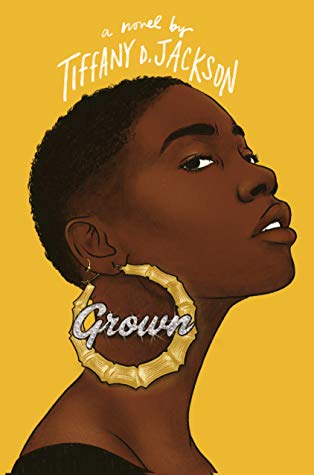
The second was the book Grown, by Tiffany D. Jackson. I had selected this book for my Young Adult Literature class in the mystery category without having read it, because it was a book that included diverse characters, written by a credible (and award-winning) author of color.
The blurb on Goodreads said: “Author Tiffany D. Jackson delivers another ripped-from-the-headlines mystery that exposes horrific secrets hiding behind the limelight and embraces the power of a young woman’s voice. When legendary R&B artist Korey Fields spots Enchanted Jones at an audition, her dreams of being a famous singer take flight. Until Enchanted wakes up with blood on her hands and zero memory of the previous night. Who killed Korey Fields? Before there was a dead body, Enchanted’s dreams had turned into a nightmare. Because behind Korey’s charm and star power was a controlling dark side. Now he’s dead, the police are at the door, and all signs point to Enchanted.”
First of all, whose idea was it—the publishers, the author’s?—to try to position this book as a murder mystery? That is specifically what the blurb on Goodreads promises: It makes it sound like the book is all about “Who killed Korey Fields?” In that blurb, Enchanted (the main character) almost serves as a set-up rather than as the whole point of the story. But (spoiler alert) the murder doesn’t happen until you are almost 80 percent through the book, and is, compared to the rest, a minor plot point. The author specifically says in her author’s note at the end, “This book is about the abuse of power. It’s about the pattern of excusing grown men for their behavior while faulting young girls for their missteps. It’s about the blatant criticism of girls who were victims of manipulation…. About the individuals who were meant to protect and serve never believing victims in their moments of bravery.” So why not position the story directly? Why promote what amounts to deceit? I am honestly surprised that more reviewers aren’t calling this out.
The book is a vivid and sometimes horrifying depiction of a teenage victim of “Me Too,” who is stalked, groomed, essentially held captive, and abused by a 28-year-old celebrity. Korey Fields prefers young girls, and uses his celebrity as a music star to draw them in by promising them assistance with their singing careers. Enchanted Jones has an amazing voice and dreams of stardom, and she is captured by the twin allures of that and the personal attention Korey begins to lavish on her. She ends up leaving school and her family behind at age 17 to go on tour with Korey, supposedly protected by a guardian (who is in Korey’s employ and is possibly one of his former victims), only to encounter the crazy, jealous behavior and punitive actions of an exploitative sociopath who must be the center of attention no matter what.
I can see all the reasons why so many people embraced this book and gave it high marks. It deals with issues that need to be shouted about—loudly. And its focus is about and from within the Black community, where these issues are even more perilous. But there were so many problems with it that I couldn’t give it the credit I wish it fully deserved.
I feel like the author punted in some ways. She starts out with a clear idea of where she wants to go, but then doesn’t follow through in areas that matter, and that’s too bad, because there was real potential. The story gets confusing when her characters don’t know, act, and do as the real people in this situation would. There’s way too much random here.
Some specifics:
The main character was all over the place. I can see her initial star-struck reaction when this man shows interest in her and supposedly wants to promote her career, but honestly, her ongoing level of naiveté, given her background and family dynamic, was flat-out ridiculous. Don’t get me wrong: I do believe that a teen girl could get herself into this situation—but not this teen girl, the way she is initially written. And the mistakes that she makes in attempting to defend herself, after the murder occurs…anyone who had ever watched five episodes of any police procedural TV show would understand such concepts as chain of evidence and illegal search and find another way to make sure that somebody paid attention to the things that would exonerate her.
And looking at that family dynamic: There are certainly hordes of teens out there with parents who aren’t paying attention and/or just don’t care, but that’s not how these parents were set up. Sure, their life was pictured as busy and full of worries (primarily financial), and they placed a lot of reliance on their eldest to help out and babysit the rest of their children, but this is painted as a household in which everyone acts responsibly, and even if their daughter insisted she leave school and go on tour with a male musician who is 11 years older than she is, there’s no way that these parents were going to allow that. These parents, the way they were drawn (and the father’s lay-off and financial woes are not sufficient distractions) would have been all up in her business to find out how she got to know him that well in the first place, and stuff would have come out that would have waved all kinds of red flags on the way to the big one, which is, Are we really letting our daughter, who we care enough about to send to an expensive private school and harangue about her homework and college prospects, be a dropout and go away with this man? No. Sorry. I just didn’t buy it. And if you are saying Yeah, but the girl was determined—again, not this girl. She wasn’t described as someone with the self-confidence, bull-headedness, or fortitude to demand and get her way, or to leave without permission. On the contrary, she is nervous, unsure of herself, all of the characteristics that would lead to the initial situation of his being able to groom her, but would not promote the action she then takes. It just happens, somehow, and that’s one of so many things that just happen, without enough back story to create believability.
There were a lot of things to appreciate about this book, but there were so many small details that jangled that the cumulative effect was an atmosphere of disbelief for the reader (or at least this reader), which is the complete opposite of what the author was trying to achieve with her thesis of “please believe the victims.” I admire her desire to write about girls being sexually coerced and exploited by adults who know better, and to focus specifically on black girls, who continue to be the most disregarded, but the way she went about it was simply inadequate. There were elements that rang true, but just as many that made me say “Oh, c’mon!” more times than I should have during a narrative such as this. I give her respect for her attempt, and her storytelling kept me reading to the end despite all the missteps…but it could have been so much more powerful.
(I do love the cover…)
Altering the past
It’s been many years since I read a Stephen King book; not because I haven’t liked some of them, but for a combination of reasons including a dislike of most horror and a prevailing impulse to call his editor and tell him to automatically edit out 300 pages from everything King writes. There was a time, in my youth, when I gravitated towards gigantic tomes—the longer the better!—and managed to immerse myself until the deed was done. I find these days that I am a bit more impatient, and it takes some really good writing, story-telling, and character/world building to keep my attention.

But…as I have mentioned before, I am a sucker for time travel. Also, for all children of the ’60s, the biggest conundrum was and remains the assassination of President John F. Kennedy, that new, young, charismatic leader whose death was variously chalked up to Lone Gunman Lee Oswald or a mysterious shooter from the grassy knoll, and attributed to J. Edgar Hoover, Lyndon Johnson (impatient to succeed), or the CIA for some reason having to do with Cuba. Put those elements together, and it was inevitable that I would get around to reading 11-22-63 by Stephen King.
The idea of going back in time to kill Hitler or witness the birth of Jesus or whatever has always been out there; but most time travel writers find some unbeatable reason why it can’t be done—like simply stating, “If something happened, then it happened.” otherwise known as the Novikov self-consistency principle. Even if you allow for the possibility of paradox, the problem with changing something in the past is, of course, that it has the potential to alter all future outcomes, so even if it were possible, people might hesitate to do it—unless there was a really good reason. This is the idea upon which King’s book is built—that if JFK hadn’t died, everything would have turned out differently—presumably better (for instance, no war in Vietnam)—and that’s a really good reason to go back and thwart the assassination.
The method of time travel in this book is vague. It’s not even loosely based in science or invention—there’s no time machine, no De Lorean or Tardis, no black hole in space, it’s more like a version of Narnia, reached via a portal at the back of a wardrobe or, in this case, the pantry of a local diner. And it leads to only one place and time, a small town in Maine in 1958. It is from this place and time that Jake Epping, aka George Amberson departs 2011 and takes up residence in the ’50s, making a living as a substitute teacher while he scopes out Oswald, his associates, his various addresses, and his ultimate destination—Dallas, the Texas School Book Depository, and November 22nd, 1963, when JFK drives through town in an open car to meet his fate.
In the process of taking on this quest, “George” will also meet and change the lives of a bunch of other people, and fall for the love of “his” life, small-town school librarian Sadie Dunhill, thereby endlessly complicating what was already nigh impossible to achieve.
All the potential for a roller-coaster ride of a story is built right in, and King provides a lot of exciting moments…and a lot of sitting and waiting. Since the only entry point to the past is 1958, and returning to 2011 means the time on the “other side” resets to 1958, Jake has no other choice but to take on an identity that will allow him to live in the past for five years while waiting for the right moment to take out Lee Harvey Oswald. Even though there is research involved, and even though we are provided with such distractions as a rescue mission for an unrelated family and Jake’s romance with the beautiful but ungainly Sadie, it’s about 700 pages of waiting before we get to the ultimate climax, which then goes by quickly and with much less explanation than this reader would have liked.
Also, you have to keep in mind that even though this is presented as an alternate history, Stephen King is, when all is said and done, a horror writer. He can’t resist adding in sinister bits involving characters or even whole towns that give him the willies; he makes the hero the target of various ill-intentioned people or groups, leading to a fair amount of violence and uncertainty; and history itself is cast as the “monster” of the tale. Jake comments (more than 60 times, as another Goodreads reviewer helpfully provided) on the immutability of the past and its obduracy, and this irrevocable tendency manifests as a series of catastrophes that intervene between Jake and his goal. No, it’s not a clown, but it’s still creepy.
The part I found most disap-pointing is the many oppor-tunities King misses to comment on the time and place as it was; instead, he does a virtual whitewash. Despite some of the threatening characters, questionable neighborhoods, and ominous events, the 1950s are primarily presented as a place where the “real” food tastes so much better (butter, root beer, deep-fried lobster), people in the ideal small town are trusting (leaving their doors unlocked and greeting one another as they walk down the street), and the automobiles are an aficionado’s dream (tailfins). He mentions the ever-present smoking of cigarettes and the bad smells of unregulated industry and diesel-belching transport, yet fails to find them particularly offensive; he gives (and then repeats) exactly one example of the separate-and-unequal state of bathrooms for whites vs. “colored people” but neglects to further notice or comment upon any inequities he sees, whether they be race-related or examples of rampant sexism. I think I could have forgiven this aspect of the book more easily had it been a fast-paced thriller; but there are at least (the aforementioned) 300-400 pages where we wander from New Orleans to Dallas to Fort Worth and back again, pondering what little is known about Oswald, attempting to observe he and his family and his associates, and waiting, waiting, waiting. Some of that waiting could have been more profitably spent.
Ultimately, I did enjoy more than half of this flash to the past…but for all the reasons cited above, I could have loved it better.
Ambivalence and vampires
After not quite embracing the witch book, I thought I’d give some vampires a shot, as my last read of October. But the one I picked…well, let’s just say it’s not what anyone would expect from a story about the undead.

Matt Haig’s The Radleys features a middle-class family living a somewhat suffocating existence in a small, declining village in North Yorkshire. Helen and Peter used to travel in the fast lane in London, but decided, once they married, to move to suburbia to raise their children, Rowan and Clara, who at this point are both in high school. Helen seems like your classic up-tight suburban mom, while Peter is showing signs of mid-life crisis in his yearning after his neighbor, Lorna. Rowan is painfully shy, has a nearly constant headache, suffers from various skin rashes, and is bullied relentlessly by the jocks at his school; Clara is trying to save the planet by going vegan, but nothing she eats seems to agree with her poor stomach, and she gives a convincing imitation of someone suffering from bulimia.
Despite her poor health, however, Clara still has the spirit of the rebellious teenager buried deep within her, and manages, in a moment of inattention from her father, to get permission to go to a party. This proves to be the pivotal event of the story: A drunken lout attacks her and tries to rape her, and she bites him on the hand with which he is covering her mouth. Suddenly, Clara is no longer feeling weak and sickly, and manages to fight back very effectively…because the one thing their parents neglected to tell Rowan and Clara is that they have made the choice for the family to live as “abstainers,” but what they are denying is vampirism! When Peter calls upon his brother, Will, an unregenerate blood drinker, to come sort out the tricky situation with Clara, their secret, restrained lifestyle is upended and new choices have to be made.
Well, first of all, I was somewhat disappointed because I picked out this book based on the name—I thought maybe someone had written the back story for the character of Boo Radley in To Kill A Mockingbird! (You have to admit that it would make sense for the pale and reclusive Boo to turn out to be a vamp!) No such luck. Maybe someone will write it someday, however, after this book in which the name “Radley” is revealed to be that of an old vampire family of natural-borns.
The premise of the book—that vampires could choose to be “vegetarian”—echoes the choices of the Cullens in the Twilight saga—no eating the neighbors, utter secrecy, etc. But in those books everybody gets to choose, while in this one Rowan and Clara are miserable because unaware of and without access to their true natures. Also, although everyone in the family (except the martyr Clara) eats a lot of meat, it doesn’t seem to be an option to drink animal blood, which I found peculiar.
The truth is, this isn’t so much a book about vampires as it is about bourgeois values: The well-behaved Brits are fighting their baser instincts in order to lead an upstanding existence by engaging in a lot of typical repression. What it is they are repressing is supposed to make it more interesting, but I felt like that in some ways they were just too stereotypical to make it work. The middle-aged malaise about sex with one’s long-term partner, the yearning over the forbidden neighbor (or wicked brother-in-law!), the hasty steps taken to keep what’s really going on a deep dark secret—even from their children—doesn’t explore much new ground. I was thrilled when Clara finally bursts her restraints, but that had to be covered up like everything else.
The various temptations that present themselves once the truth comes out result in both triumphs and tragedies for the conflicted Radleys, and there is an eventual resolution…but by the time it happened I had become wearied by all the dithering. The writing is both descriptive and clever, and there are some dark moments and some redemptive ones that appeal, but ultimately it felt like just another story about child abuse, with parents deciding for their children who they are to be without ever consulting them. That may sound like a harsh conclusion to draw, but when you find yourself applauding as the dainty teen protagonist takes large chunks out of the school bully, well…there’s just something not quite right about that!
Mostly ghostly
I promised ghostly goodies in honor of Hallowe’en, so let’s review some titles that will have you thinking of the mysterious barrier between this world and the next, and what happens when that barrier falters!
First off is a series that was written for middle school teens but that delights everyone who reads it: The Lockwood & Co. series by Jonathan Stroud. The first book is called The Screaming Staircase, and it lays out the scenario that prevails in the other four books:
For more than 50 years, England has been overrun by ghosts. They linger, they float around, they make horrifying noises, they haunt specific places and, in some cases, they reach out to touch the living, which “ghost-touch” is nearly always fatal. The most frightening aspect of this wholesale haunting is that while adults can experience some of the effects, they can’t actually see the ghosts and therefore can’t protect themselves. So a bevy of teens and children (who CAN seen them) are recruited and armed with silver chains, salt, lavender, swords, and holy water and sent out in teams to lay the souls to rest by measures merciful or stern.

Psychic Investigation Agencies, mostly run by adults, are in charge of these teams of teens; but one young man decides that the adults who can’t even see the threat shouldn’t be in charge of his fate, and starts his own agency, run by and employing only teenagers. Anthony Lockwood, George Cubbins, and Lucy Carlyle do their best to prove they can fight ghosts with the best of the prestigious and powerful organizations against which they are competing for business, but a series of hapless incidents puts their fate in question. Then they get the chance to spend the night in one of the most haunted houses in England…
I’m baffled as to why the reviewers insist that this series is “for a younger audience.” In fact, the recommendation for 4th through 7th grades is wholly inappropriate—the 4th-graders would be too frightened! I would say 6th grade and up…and up. I found the mysteries engaging, the haunted scenarios truly frightening, and the world-building completely believable. I think anyone would like these. The other books are: The Whispering Skull (pictured above), The Hollow Boy, The Creeping Shadow, and The Empty Grave. (Another bonus: The series is complete! No waiting around for sequels.)
Now for another book that is also YA, but doesn’t seem so in the reading: A Certain Slant of Light, by Laura Whitcomb. Helen and James are two spirits who are haunted by a few hazy, incomplete memories of their pasts (when they were alive), and need to remember who they are and how they died, and figure out why they are in this strange limbo between life and death. Helen, who is 130 years past her due date, has discovered that when you are “light,” in order to keep from plunging into some kind of horrific afterlife you need to cling closely to a human host. Her latest is an English teacher, Mr. Brown, and it is in his class that she encounters James, the first person who has been able to see her since she died. There’s a reason for that: James is also “light,” but has found an ingenious way to live again.

I don’t want to give away much more than that, but if you are thinking this sounds like a Stephenie Meyer plot, think again: It’s far more than a sappy teen romance. FIrst of all, Whitcomb’s writing is witty and sophisticated, and the story itself is surprisingly complex, exploring such themes as human existence, forgiveness, and the emotions of love, grief, and responsibility. The personas are carefully crafted to relate to their relative time periods, Helen’s formal speech contrasting beautifully with James’s more contemporary lingo. Whitcomb is also a master at describing the sensations the characters feel as they experience certain things for the first time. I found the story arc deeply satisfying when I read the book, and only recently discovered that there is a second book, called Under the Light. I was surprised, since a sequel didn’t seem necessary, but the description reveals that it’s more of a companion novel, telling the stories of two other deeply invested characters, and I intend to grab it just as soon as I reread this one so that I remember all the necessary details!
Note; Whitcomb has another book that sounds like it would be spooky, called The Fetch. My recommendation is, don’t bother. It’s more about the Russian Revolution than anything else.

Another young adult series that offers up some spooky situations is the Shades of London series, by Maureen Johnson. In the first book, The Name of the Star, Louisiana teen Rory Deveaux has arrived in London to start boarding school just as a series of murders directly mimicking the crime scenes of the notorious Jack the Ripper are taking place. Despite a number of potential witnesses, it seems that Rory is the only one who spotted the man responsible for these heinous crimes, for a surprising reason that puts Rory in imminent danger. In the other two books—The Madness Underneath, and The Shadow Cabinet—we move beyond the Ripper story to discover that there’s a lot more happening on the ghostly front in London than anyone without Rory’s extraordinary perspective would suspect.
Note: There was supposed to be a fourth book, but six years passed and the author seems to have moved on permanently. It’s not really necessary to continue—the story arc was satisfyingly contained within these three. People wished for new adventures for various characters, but there is no cliffhanger, the story ends.
Finally, let me mention a few stand-alone titles that provide a satisfying shiver for your backbone:
Try Graveminder, by Melissa Marr. Although she is primarily a teen author, this book was billed as her first for adults; but I think both teens and adults would enjoy it.
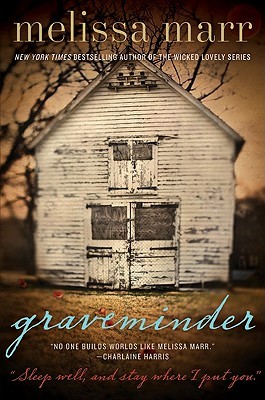
The story centers on the town of Claysville, home to Rebekkah Barlow and her grandmother, Maylene, and also a place where the worlds of the living and the dead are dangerously connected. Minding the dead has been Maylene’s career and, once she dies, Bek must return to her hometown and, in collaboration with the mysterious Undertaker, Byron, make sure that the dead don’t rise. The tagline of the book is “Sleep well, and stay where I put you.” Deliciously creepy!
Break My Heart 1,000 Times, by Daniel Waters: A suspenseful thriller in which a “Big Event” has happened in the nearby metropolis, and all the resulting dead are lingering instead of moving on. Veronica and her friend Kirk have recently noted that not only are the ghosts not moving on, but they seem to be gaining in power. But when the two decide to investigate, they draw the sinister attention of one of Veronica’s high school teachers, who has an agenda that may include Veronica’s demise…
Meet Me at the River, by Nina de Gramont, is told from two viewpoints, that of Tressa, trying to cope with the death of her boyfriend, and that of Luke, the boy who is dead but can’t leave. I don’t want to say too much about it, because I so much enjoyed discovering the facts of the story in exactly the way the author wanted, which was not immediately, not all in a paragraph of explanation, but gradually, through the interchanges, the thoughts, the scenes. I will say that this book is much more than a sad paranormal love story—it’s as deep and intense as the river in its title. I found myself humming while I was reading, and finally figured out that I was remembering the hymn “Shall We Gather At the River?”, a song they sang at funerals in my childhood, a song laden with images of crossing over, being with loved ones. So much of this book was about death, but so much about life, too.
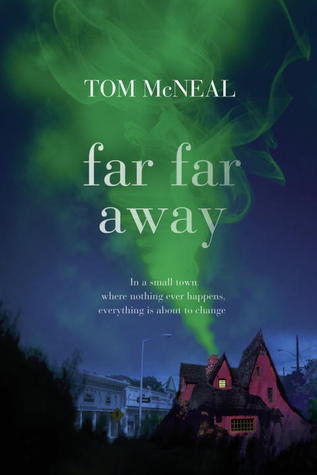
Far Far Away, by Tom McNeal: Jeremy can hear voices. Or, specifically, one voice, that of the ghost of Jacob Grimm, one half of the infamous writing duo, The Brothers Grimm. He made the mistake of admitting this once during childhood, and has been treated with doubt and suspicion by all the others in his village ever since. Jacob watches over Jeremy, protecting him from an unknown dark evil whispered about in the space between this world and the next. But when Ginger Boultinghouse takes an interest in Jeremy (and his unique abilities), a grim chain of events is set in motion. And as anyone familiar with the Grimm Brothers knows, not all fairy tales have happy endings…
For this list, I pretty much stuck to ghosts and steered clear of all the other beings that go bump in the night, but I’m going to mention one simply because it’s so much fun: Fang Girl, by Helen Keeble. Xanthe Jane Greene, a true fangirl of the fanged, wakes up one night in a coffin. Given her fantasies you’d think she’d be pleased, but no: What girl wants to preserve in eternal life such 15-year-old afflictions as acne and a puberty-born tendency to extreme clumsiness? Not to mention missing out on all the teen milestones, like getting a driver’s license and going to prom. So what does she do, upon emerging from her grave? What any 15-year-old from a loving environment would do—she goes home to her parents and little brother. Vampire lore has been done to death, but in this clever and winning parody Helen Keeble finds new territory, and it’s the perfect mix of paranormal with comedy. Don’t miss it.
I hope you will find something from this list to make your Hallowe’en reading sufficiently scary. Let me know what you think!

Ghosts for Hallowe’en
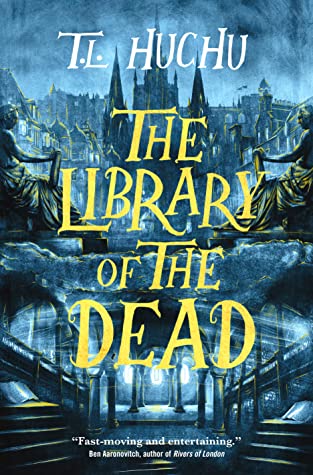
Now that we’re coming up on October, someone on “What Should I Read Next?” (Facebook page) just asked for good ghost stories or scary books for their teenager and, although I have a few favorites (more about those in a later post), I think that niche has been underfilled with good works. But T. L. Huchu is helping to change that, with his new book (published this summer), The Library of the Dead, listed as “Edinburgh Nights #1.”
The book’s protagonist is a fierce, brash, in-your-face 14-year-old girl with green dreadlocks named Ropa, a part-Zimbabwean, part-Scots “ghostalker”—I’m not sure whether this was Huchu’s (unattractive) way of spelling ghost-talker, or whether he purposely left it hazy as to whether she is a talker or a stalker!—who carries messages between the living and the dead in a vaguely post-apocalytpic Edinburgh. She, her little sister, and her beloved Gran live in an immobile caravan (trailer) parked on someone else’s land, and while Gran pays for her medicines with her knitting, Ropa haunts the streets looking for ethereal customers whose relatives will pony up a fee for a message from the dead, in order to pay the landlord for their parking space and buy their food and coal for heating. She draws on her Zimbabwean heritage by using an mbira, an ancient African musical instrument, as an aide to better communicate with the spirits, whose messages can be “tuned” into coherence by music.
Jomo, a friend of hers since childhood, has recently begun a job about which he is being extra secretive, but Ropa knows how to play to his ego, and she is soon being ushered (surreptitiously) by him into a library that operates as a secret society, available only to those with an interest in and talent for the occult. Although Ropa dropped out of school in order to support herself and her family, she is a lifelong reader and is thrilled with the opportunities offered by the library, once she gets past the daunting gatekeepers. Some of what she learns comes in handy when Ropa finds out from some ghosts on her turf that (live) children are being kidnapped and exploited in weird ways, and decides to track them down and return them to their families.
I was immediately drawn into this book—the narrative voice is fantastic. Ropa uses street lingo like a hansom cab driver from a Regency novel, but also throws in a lot of teen slang (presumably Scottish), so that while she is completely understandable, her turns of phrase are quite entertaining. The scene-setting is likewise amazing: History has taken the heart out of Edinburgh, and while there are only slanting references to wars and conflicts that leveled buildings and changed the financial dynamic of the city, a clear picture emerges that seems like London after the Blitz, if London had also suffered from climate change! It’s clearly a victory of some other country (England?) over the Scots, since everyone greets one another with the call-and-exchange of “God save the King!” and “Long may he reign!” with a nervous look over their shoulders to make sure people observe that they are following protocol. It’s little details like this that make the book so immersive and such fun.
The book is populated by quirky, fully fleshed-out side characters, both sinister and benign, and draws on Ropa’s two cultures—Zimbabwean and Scots—to make things even more interesting. There are truly scary scenes and also a lot of sarcasm and humor, and I predict a big hit with teens from about 13 up, although this is one of those young adult books that speaks to a wider audience. If you are an adult and enjoy a good ghost story, by all means recommend this to the teens in your circle, and then go read it yourself!
I’ll review an array of Hallowe’en-appropriate books for teens (and others) as soon as the month turns to October…
 The Book Adept