Re-reads
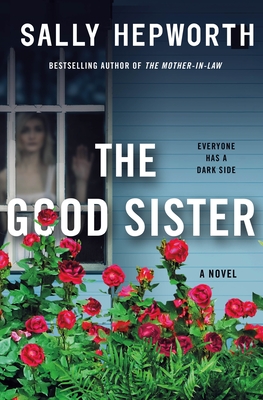
I got frustrated by the length of time I was having to wait for new library books and decided to do some rereading this week, since older books are easily obtainable. I chose the first book, The Good Sister by Sally Hepworth, because I had just reread Eleanor Oliphant and their protagonists share some things in common.
Although I remembered the story pretty well, there are always things that you don’t pick up on the first time through. One of the ones I enjoyed this time was protagonist Fern’s description of her mode of dress. She starts out by saying she is a librarian, and at 28 years old she is much younger than the average librarian (apparently the average is 45!). She comments that many librarians tend to be stodgy dressers, but Fern likes to express herself, so her typical outfit is a rainbow T-shirt topping a long, swirly skirt in some bright color (that day’s was sunshine yellow) with a pair of rainbow- and glitter-covered “trainers” (Brit for sneakers or tennis shoes) to match. She tops off all of this by putting her long strawberry blonde hair into two braids and then rolling them up above each ear for a Princess Leia look-alike effect, although she asserts that she is not copying that style; it is merely a handy way to keep her hair out of her face while working.
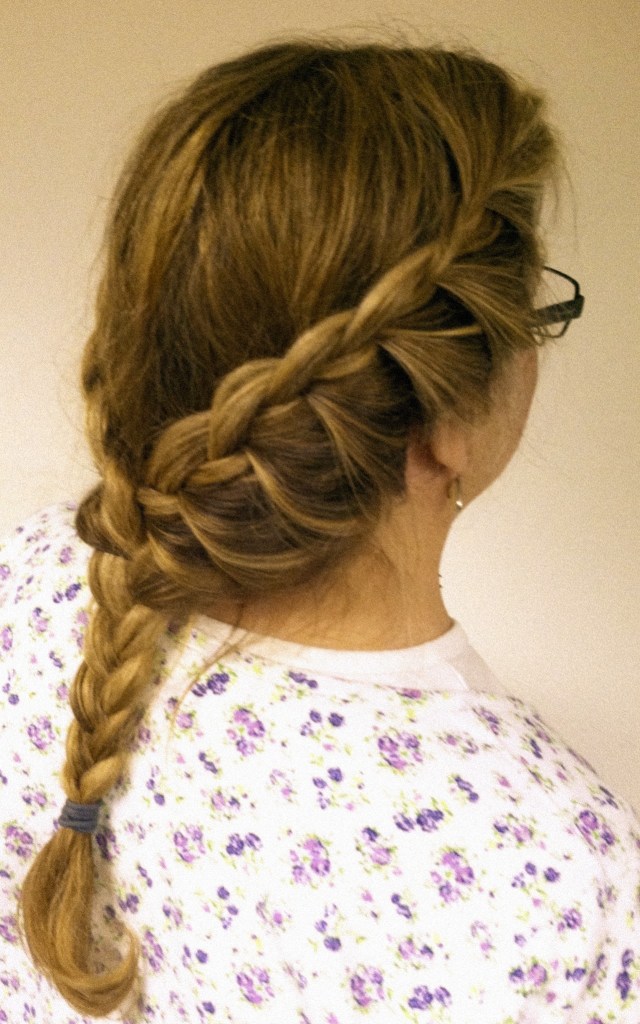
As a person who went to library school at 48, I was definitely up in that core demographic, but I did share some characteristics with Fern. I liked wearing colorful, full, knee-length skirts (flowered, striped) with matching solid-color leggings, black boots, and a T-shirt or sweater on top, depending on the season, and although I never did the Princess Leia ‘do, I did wholeheartedly embrace braiding during my 11-year career as a teen librarian.
I enjoyed this book as much this time around—it definitely held up. The characters are either delightfully quirky or deliciously sinister, and the action and narrative are nicely balanced to hold your interest. If you would like to read my initial full review, you can find it here.
The second book I picked up was one I hadn’t read since 2015 when it first came out, and I didn’t remember a lot about the story. It’s The Reversal, by Michael Connelly, and it was the book where he shook things up in several ways: Mickey Haller (the Lincoln Lawyer) crosses the aisle to become a prosecutor for one case; he partners up with his (first) ex-wife, Maggie McPherson, an assistant district attorney for Los Angeles; and instead of his usual investigator, he hires his half-brother, LAPD detective Harry Bosch, to help put a child-killer behind bars for the second time.
I looked forward to reading it again because I liked that all my favorite characters were in one place. But in the end, I didn’t find this to be one of his better stories. I did enjoy having Haller, Bosch, and McPherson all working together on a case that Mickey was prosecuting, but there was a bit too much courtroom (without enough drama). The man they are prosecuting has spent 24 years in jail for the crime and everyone is still convinced he is guilty. But some new DNA evidence proves compelling enough for the courts to grant him a retrial, and in the meantime he’s out in the world while the trio tries to find enough evidence to put him back in prison.
I felt like not enough happened “in the field” in this book, and I also didn’t enjoy the guy in the role of defense attorney; he was whiny and not sufficiently developed in comparison to his opponents. There is also a huge foreshadowing element with the murderer that never comes to fruition, which was both disappointing and annoying, and the ending is both rushed and anticlimactic, after a big build-up. I actually dropped my rating on this one from four stars to three after rereading it. I’m still a loyal Connelly fan, but in certain books he seems off his game, and this was one for me.
Two of my “new” (to me) books just came in and got transferred to my Kindle, so there will be fresher reviews coming soon.
We All Live Here
I just finished JoJo Moyes‘s latest, We All Live Here, published just under a year ago. In looking at the list of her books that I have read, most have received four or five stars from me; but there’s always one…and this seems to be it.
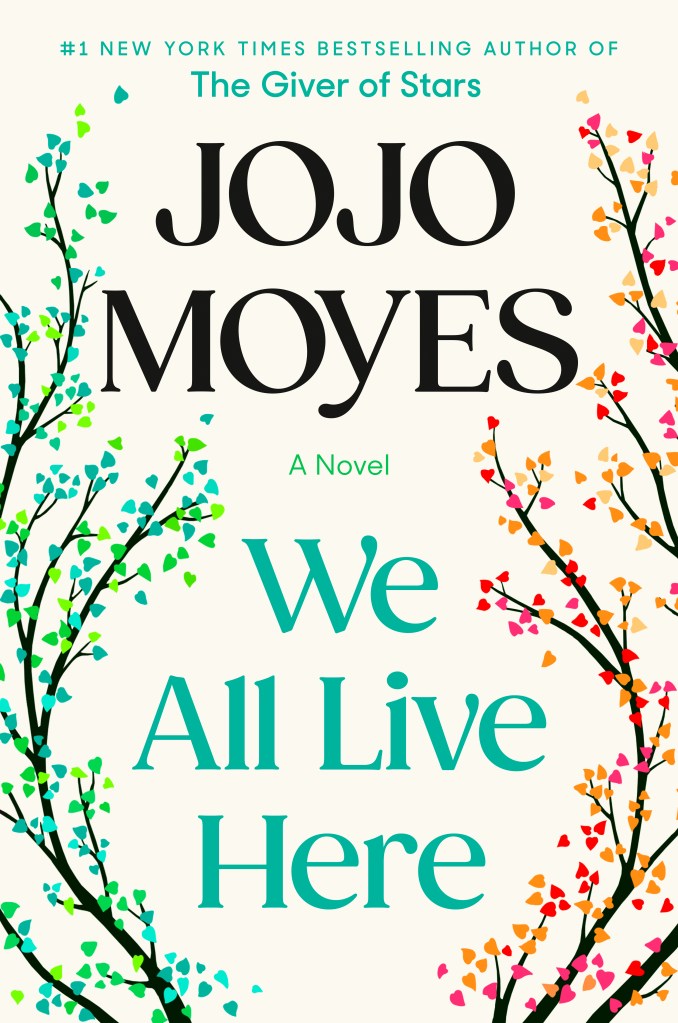
I thought, after reading the blurb, that I would relate to this protagonist. After all, both of us were left by our husbands, ostensibly to take a time out to consider the relationship but in actuality to hook up with someone younger and more fit. I didn’t have the burden of raising two children (we didn’t have any), and neither of my parents moved in with me (although my mother did insist that I should move home, back into my childhood room, after my seven-year marriage was over!), but still…empathy, right? (BTW, I did not move back in with my parents!)
Unfortunately, this book reads more like those ubiquitous “AITA” (Am I the A$$hole?) videos on Facebook, where someone tells a story in which someone behaves badly and then wants validation about whether or not they are the, er, bad guy. In the context of the book, I decided, fairly early in the story, that Lila the protagonist was the a$$hole, despite the fact that yes, she had a lot to endure: A philandering husband who left her to raise her two daughters while he started a new family with a new model; a stepfather who was recently widowed (Lila’s mother died) and seemed to have moved in with Lila and her daughters without invitation; and an absent father she hadn’t seen since she was a teenager, who showed up on the doorstep expecting to inhabit the spare room and weasel his way into the hearts of his granddaughters.
It would seem to be easy to have sympathy, at least, for someone so beleaguered, and yet Lila makes it so difficult. She is self-centered, self-pitying, and whiny, and she dwells inside her own story with total disregard for those around her for a good part of the book. The final self-realization epiphany comes so late that I just didn’t care. Also, there was one incidental detail in the story that drove me mad until it was solved, and there was no resolution until the last 40 pages of the book.
Even though I have enjoyed some of her books much more than others, I never thought I’d read one and simply say “Don’t bother.” Who knows—maybe your reaction to Lila etc. will be materially different from mine. But don’t say I didn’t warn you.
I’m fine

That’s everyone’s socially acceptable response when someone asks “How are you?”, right? But how often is it actually true?
My initial reaction to the first third of Eleanor Oliphant is Completely Fine, by Gail Honeyman (despite some clues in the opening pages that would have led me elsewhere had I been paying sufficient attention), was that it reminded me of The Rosie Project, by Graeme Simsion. Socially awkward protagonist with no friends, wedded to routine, on whom a random suggestion acts as a catalyst to start changing things up, check. Protagonist meets someone completely outside their wheelhouse and makes an unexpected connection, check. But that’s not quite how this book ended up going. The two books share a sense of humor, and their protagonists share the quality of being literal and inept at human relations as they attempt to navigate their way through life. But the reasons behind their similar states are different, as are the resolutions.
There are lots of books out there (fiction and nonfiction) about various kinds of mental health issues. Not many of them, however, address the situation of loneliness as either a cause or an outcome. Eleanor believes that she is completely self-sufficient—after all, her physical needs are being met, and in all her years in the foster care system she didn’t get a chance to indulge any emotional needs, or even recognize that she had any. But when she has two chance encounters that change her focus, these events and the people connected with them worm their way into her formerly solitary existence and begin to show her that she had very little idea what a full life could be like.
Eleanor is, in many ways, profoundly broken, and her metamorphosis depends on courage that she wouldn’t have found without making some human connections, but it is not a romantic book, for which I was grateful. This is a book about Eleanor, and Gail Honeyman doesn’t fall into the trap of leading her out of her unhappiness by making her fall in love—in fact, quite the contrary. Her story is told in a tender, sweet, and humorous way that isn’t manipulative and never descends into mawkishness, that pulls both Eleanor and the reader out of melancholy into hopefulness. I was impressed that this was the author’s debut novel: The language, the characters, and the world in which she places them are smart and engaging, and she writes with confidence.
I have encountered only a few books that, the minute I turned the last page, I wanted to go back and re-read to see what I missed or to re-experience the emotions brought forth by the story. This was one of them.
Note: This was a re-read for me—I originally read this in 2018 and had the impulse to revisit it. The above was my review from 2018. Nothing materially changed from the reread, except that I found the book, if anything, more emotionally moving. If you enjoyed this book as I did, you might also like to read The Good Sister, by Sally Hepworth.
Saving the library
My next book on the library holds list was The Last Chance Library, by Freya Sampson, and I’m happy to report that I am now two for two (two good reads in a row) for 2026.

This was Sampson’s debut novel, and it might be my favorite. I hate to be predictable, but I do love a book about books. I don’t, however, always love books about libraries and librarians, for the simple reason that the authors don’t do their research to understand what role is filled by degreed librarians as opposed to assistants, circulation staff, shelvers, etc. But Freya Sampson is among the few who get it absolutely right. She acknowledges the need for a degree in order to be a librarian, she describes the duties of her main character, June, a library assistant, perfectly and consistently, and no one ever calls June “the librarian.” She hasn’t had the requisite schooling to be acknowledged as a librarian, and the lines in this book are always clear. That may sound elitist to those who are not librarians, but as someone who worked hard for two years to get my masters degree in order to be one, it’s so demoralizing when anyone who has a job at the library is assumed to possess the same abilities. It would be like going to your lawyer’s office and believing that everyone working there must be a lawyer, or that the people who staff the reception desk at your doctor’s office are qualified to diagnose.
Anyway…with that out of the way, let me say that this was a delightful book, although not as lighthearted as some of hers. Sampson has a gift for characterization that makes the plot situations believable and engrossing. You like (or dislike) these people, you get to know them pretty thoroughly, and you therefore invest in their circumstances. Despite the fact that the characters may fall into standard categories—curmudgeonly old lady, nosy neighbor, old friend turned love interest, etc.—Sampson fleshes them out so that you don’t mind the use of a common trope.
In this case, the protagonist, June, has been a library assistant at a rundown stand-alone library in a small town since she started there part-time as a teenager. She is now 28 years old, and seems frozen in place; her mother, who was the librarian for most of June’s life, died of cancer eight years ago, and since then June’s life has turned into a predictable round of work, frozen lasagna or takeout, and reading. She gave up all thought of college when her mother got sick, staying home to nurse her, and now she lives in the house in which she grew up, and has changed nothing since her mother passed. She has no friends and relies on library patrons for any form of human contact, but retreats into her silent solitude whenever she isn’t shelving books or helping seniors log into their email accounts on the library computers. In a word, she’s stuck.
She is also almost debilitatingly shy, so nothing seems likely to change—until outside circumstances interrupt her cycle. The local council has signified that they will be considering closing up to six libraries in her town, Chalcot, and five other adjacent townships, due to budget cuts, and replacing them with a once-a-week visit from a bookmobile. The regular patrons of the library are immediately up in arms and ready to do whatever is necessary to save their library, but June is told by her boss that as an employee she is forbidden from participating in any of these activities. June unhappily acquiesces, but a chance comment from someone new in her life causes her to think of ways she can subvert this order and help keep her beloved library open.
There is a nice incipient romance in this book but, as with Sampson’s other books, it isn’t the dominating theme; that is more nuanced, and brings insight to various aspects of the human condition and the best ways in which we interact when important issues are on the line. I really enjoyed this and read it in two days. Sampson’s books couldn’t be considered “literature,” but they are certainly good stories that provoke both feelings and reactions. I will continue to read them.
My Year in Books 2025
I managed to read quite a few more books this year than last (95 to 2024’s 66), but I don’t know that I realized much advantage from doing so, beyond just clocking the reading time. My stats, according to Goodreads, were:
95 books
28,425 pages read
Average book length: 346 pages (longest book 908 pages!)

Although I discovered some enjoyable reads, there wasn’t one single book that truly bowled me over or made me immediately check out another book by that author or settle in to read a lengthy series. And most of the books I did like were the lightweight ones that I ended up reading as a sort of relief between the tougher titles. Here’s a list:
The Lost Ticket, by Freya Sampson
The Busybody Book Club, also by Freya Sampson
Vera Wong’s Guide to Snooping (On a Dead Man),
by Jesse Q. Sutanto
Finlay Donovan Digs Her Own Grave, by Elle Cosimano
My favorite science fiction book was The Road to Roswell, by Connie Willis.
My new discovery in YA fantasy, with an intriguing Egyptian-like setting, was His Face is the Sun, by Michelle Jabes Corpora. I look forward to the sequel(s).
I read a few books that were award-winners, or by well-known literary authors, or touted by other readers as amazing reads, but found most of them problematic in some way, and therefore didn’t feel wholeheartedly pleased to have read them. They were:
James, by Percival Everett
The Seven Husbands of Evelyn Hugo, by Taylor Jenkins Reid
Horse, by Geraldine Brooks
The Mare, by Mary Gaitskill
Horse Heaven, by Jane Smiley
Three Days in June, by Anne Tyler
Gentlemen and Players, by Joanne Harris
These have all been reviewed on this blog, so do a search for the title or the author if you want the specifics. None of them received a thumbs-down, but none of them lit up my imagination either.
The most disappointing part of the reading year was the letdown I felt each time I finished the next book in a bestselling series I had previously enjoyed. I read two books by Michael Connelly—The Waiting, and Nightshade—and had a “meh” reaction to both. The Grey Wolf, by Louise Penny, didn’t deliver the characteristic Gamache love, and was filled with tangents and extraneous story lines. Perhaps the least successful (for me, at least) was The Hallmarked Man, by “Robert Gabraith,” aka J. K. Rowling, which was so endlessly convoluted that I felt the need to reread it—but so long, wordy, and unsatisfying that I didn’t! I’m really hoping these authors rally in the new year, but it’s more of a “fingers crossed” than an actual expectation.
Honestly, my best and most sustained reading took place when I got fed up enough to revisit beloved books from decades past by such authors as Rumer Godden, Georgette Heyer, and Charlaine Harris.
Today I am starting on 2026, two days ahead of schedule! Onward, readers!
Last book of the year

My last book of the year was The Secret Christmas Library, by Jenny Colgan, and I almost didn’t read it. I usually love discovering a new Colgan book, especially the ones that take place up in the wilds of Scotland (which this did), but then I found out it was a sequel to last year’s novella The Christmas Book Hunt, which wasn’t one of my favorites because of the exceedingly obnoxious male lead and, sure enough, that character was equally distasteful in this one.
Fortunately, he wasn’t the only guy on the scene for Mirren, the female lead in both, to moon over, but it took about 85 percent of the story to get to the romance. The setting and atmosphere saved it for me, since it took place in a remote rundown castle on a loch, with its own train stop and maze, and had a resident poverty-stricken laird in search of a rare book hidden somewhere in the “pile.”
The major bone I had to pick with this one was the lack of editing and proofreading. I came across at least five misspellings and/or misuses of words, and it was also apparent that neither the author nor the editor had gone back and perused the work for repetition; on the very first page there was a sentence repeated verbatim twice, just two paragraphs apart, and about 30 pages later she used the word “immaculate” to describe three separate things, again all on one page. The overall impression was that this was dashed off to satisfy the holiday market.
Colgan has written many Christmas books (most as sequels to various series), and any of those is preferable.
Serendipity
I am wary of books that are described as “heartwarming.” I likewise shy away from anything that has been labeled “meet cute.” But there are occasionally stories about fortuitous occurrences that actually are genuinely charming, and The Lost Ticket, by Freya Sampson, is one of those.

Libby arrives in London from Surrey and gets on the 88 bus on the way to her sister’s house feeling as if she no longer recognizes herself or her life. Her eight-year relationship, her job, and her home have just been jerked out from under her by her “bored” boyfriend, and it’s a sign of how bad things have gotten that she is choosing to go stay with the officious Rebecca in London. But the elderly man next to her on the bus won’t let her sit in miserable silence; Frank instead tells her the story of how he met a girl on this same bus, the 88, back in 1962, with hair just the same beautiful shade of red as Libby’s. They made a date to meet up at the National Gallery, but Frank lost the bus ticket on which the girl had written her telephone number, and never found her again. She made such an impression that for almost 60 years he has continued to ride the 88 line hoping to run into her; in addition to feeling like there was a spark between them, he wants to thank her for saying something to him that changed the entire trajectory of his life.
Libby, sad and at loose ends, is inspired to help Frank find the woman he has sought in vain. She teams up with others in Frank’s life to try everything from online searches to running advertisements and posting flyers, looking for #girlonthe88bus. But Frank has growing dementia, and his daughter wants to put him into a care facility, so time is running out.
The events that spread out from this simple encounter of strangers on a bus illustrate how serendipity can be a blessing in lives that had previously felt fixed and inevitable.
I immediately identified with the characters. I enjoyed the setting. I admired how the book discussed relevant social topics rather than just being “aw, how sweet.” I particularly liked the element of found family, that what we don’t get from our biological relatives can be had by embracing empathetic strangers and turning them into our people. There’s really not much more to note about this lovely book, except to say that it was a real pick-me-up when I needed one, and was not nearly as predictable as I thought it would be when I began reading.
Public, secret lives

I finally got around to reading The Seven Husbands of Evelyn Hugo, by Taylor Jenkins Reid. Although she has written some other well-received books (Daisy Jones and The Six, Carrie Soto Is Back), this was the first of hers I have read. I’m always a bit skeptical about reading “popular” books, because I have been let down so many times by the promise created by all the hoopla, but I have to say that this one actually surpassed my expectations.
For those who have managed to avoid the book clubbers’ raves and have remained oblivious to this book, the basic outline is this: Evelyn Hugo is a Hollywood icon in her late 70s—retired, wealthy, and reclusive—who made it out of Hell’s Kitchen in the 1950s as a teenager and did whatever it took to become a Hollywood film star. Some of that meant entering into marriages for a variety of purposes that included true love, lust, ambition, politics, and money. Her relationships helped to shape both her career and her legend, but the men she married weren’t all of them the most important people to figure in her life—there is a story behind all the stories, and this is what Evelyn, now alone for many years, is ready to reveal while she still can.
She selects as her biographer a young journalist, Monique Grant, for reasons that are somewhat but not wholly connected to Monique’s writing abilities (and that’s another story) and gives her exclusive access. They spend days and nights together as Evelyn unpacks her entire glamorous and scandalous life—all the turning points, decisions, triumphs, and tragedies—until she finally reveals something that sets Monique back on her heels.
I’m not going to say much more about the story, because it’s one of those that you need to experience for yourself as you go along, rather than having it wrapped up in a couple of summarizing paragraphs. I will say that Jenkins’s writing style and the creation of the character and story of Evelyn are so evocative that you feel like you’re in the room with her as she tells it, as well as accompanying her to every movie set, red carpet, shop, motel, mansion, beach, or city street. It’s an enthralling look at Old Hollywood with its studio contracts and glitzy movie stars. The narrative creates a rich tapestry woven of ambition, betrayal, love, and a search for identity and authenticity. It’s full of historical detail and paints a colorful picture of the woman, her companions, and their backdrops.
My one caveat is that I would have liked to know just a little bit more about Monique Grant. Although we do get her basic story line, her character is so eclipsed by that of Evelyn that you tend to forget she’s in the room until Evelyn says “let’s stop there for today” and someone else’s hand reaches out to turn off the recording device.
Aside from that, I was captured and fascinated by this book and character from beginning to end, with no detail feeling extraneous. That’s a rarity, in my experience.
Busybodies
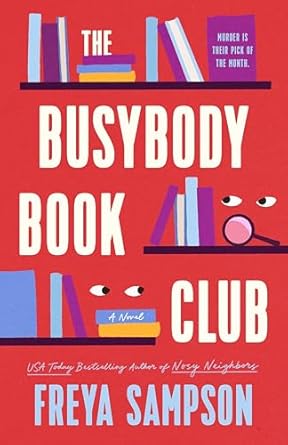
The Busybody Book Club is my first experience of the novels of Freya Sampson, and I think I will need to read at least one more just to verify what other reviewers on Goodreads had to say about them. Some loved this book, others said it was her least successful; if the latter is true, then I look forward to reading one/some of the others, because I found this a charming story with much to enjoy.
Nova Davies has recently moved to Cornwall to start a new life with her fiancé, Craig, and has found a job at the St. Tredock Community Center. She is attempting to revive a previously popular book club run by her predecessor, but so far it’s an uphill task. There are to date only five members including herself, and two of the five are distressingly silent, while the other two are all too outspoken. Arthur wants to read romances, because he is tasked at home with reading aloud to his wife, Esi, who has lost her sight and much of her mobility, and that’s what she likes. But Phyllis (accompanied by her smelly old bulldog, Craddock) insists that romances are rubbish and the club should focus on mystery, preferably the works of her favorite, Agatha Christie. She prefers Miss Marple (quietly brilliant) to Hercule Poirot (too pretentious), but is adamant about genre. Because they take turns suggesting each month’s read, however, opinions are also solicited from painfully shy teenager Ash, who is a science fiction fan, and from their new member, Michael, who is largely inarticulate and, of course, from Nina, who tries hard to keep selections eclectic and discussions moving despite Phyllis’s loud and frequent exclamations, interruptions, and wholesale scoffing.
On the night of their meeting, the only people left in the club are Nova and the four other members. At some point during the lively discussion of Where the Crawdads Sing, someone enters the center’s office and steals the petty cash box, which happens to contain ten thousand pounds allocated for a new roof. This isn’t discovered until the next morning, when the police are called by director Sandy to interview the book club members; everyone immediately focuses on the odd behavior of Michael, who received a text on his phone halfway through the meeting, looked distraught, and ran out of the room. He never returned to the meeting, and is instantly suspect; but Nova is also under scrutiny because it was her job to lock the office, thereby preventing the opportunity for the theft.
Losing that money is a disaster for the center and may actually precipitate its closing. The club members are immediately up in arms, Phyllis most of all, and are determined to figure out the puzzles of who could have stolen the money and for what purpose, and what has happened to the mysterious Michael. Theories abound, suspects are scrutinized, and meanwhile the relationships between the members change and grow based on their collaboration. Some things turn out exactly as you would expect while others are a total surprise, and the fun of the book is figuring out where you (and the characters) got it right.
This is a sort of hybrid; it’s a cozy mystery, but it’s also a story about people and their relationships with one another, their secrets, their memories, their hopes. And it’s a book about books, and who among us can resist that? I loved that the members ranged so widely in age, interests, and taste in books, and that there was “book chat” throughout. There are so many elements to this story—from coming of age to confidence issues to loneliness and grief—that kept the narrative lively and interesting. It’s not a “significant” book, but it is a well crafted and witty one that provided great entertainment and made me want to know what happens to the characters after. What more could you ask for, on a solitary rainy afternoon?
Memorable
I just finished Say You’ll Remember Me, by Abby Jimenez, and it seems that I am among the few who enjoyed it more than some of her other popular titles. I think I did because it was a simple story with mostly believable obstacles that came from real-world issues and not from elaborate mind games on the part of its protagonists.
The problem I frequently have with these contemporary relationship novels is that they require so much suspension of disbelief. Every trope comes with its moment where you think “Oh, c’mon, nobody would be that obtuse!” So often there are massive misunderstandings that keep couples apart, but the story relies on the reader accepting that, despite being in a relationship, these people never talk to one another, that they make blanket assumptions they don’t check out, then refuse to believe credible evidence, etc., and after a while I become impatient that I’m reading a book whose whole premise depends on two people not initiating one simple conversation.

This one was refreshingly different. It did have its flaws—but for the most part it felt believable to me.
Samantha has been living in Minnesota, having been drawn there for her work. She finds and decides to adopt a kitten, and takes it to a veterinarian who gives her advice she absolutely does not want to take. She is incensed by his attitude, which feels defeatist, and decides to prove him wrong, but when she actually pulls it off, she is surprised to discover that he readily admits he was mistaken and apologizes. Then Dr. Xavier Rush asks her out. Since his revised attitude comes along with Greek god-like good looks and a particular intensity that appeals to Sam, she decides to accept. They have one absolutely perfect date, and then everything blows up. Samantha had learned that her mother’s early-onset Alzheimers is advancing at a rapid rate and realized that she needs to be spending time with her and helping her family with her mom’s care, and she is scheduled to move back home to California the very next day.
That’s the real-world conflict that keeps them apart: geography and bad timing. They resolve to forget what might have been if they could have continued seeing one another…but neither Sam nor Xavier seems able to move past their undeniable connection.
The problem is, neither can change their circumstances to make a move. Xavier just opened his veterinary clinic a couple of years previous and is in debt for the start-up in an amount greater than he could get for selling it. And he can’t just hire someone to work there and run it in his absence, because he can’t afford to pay them—he’s been living on the leftovers after the loan payments are made, but no one else would do that. He’s stuck in Minnesota until circumstances change, but that could take a decade. And Samantha can’t and won’t shirk her responsibilities and cut her ties just to be with him.
But having a long-distance relationship with the burdens under which each of them is operating is nearly impossible, and although they give it a try, the thought that this situation might last for years is so daunting that neither of them is happy.
What happens when the person you have realized is “the one” for you can’t be in your life for more than a weekend every three months?
There were some features of the story that were less believable than others, and it does bog down in the middle when the angsty stuff becomes somewhat repetitive, but the attention to the details of Xavier’s back story, Samantha’s relationship with her family, and their undeniable chemistry when together keep it going. If you’re looking for a less formulaic relationship story, try this one.
 The Book Adept