The Horse Dancer
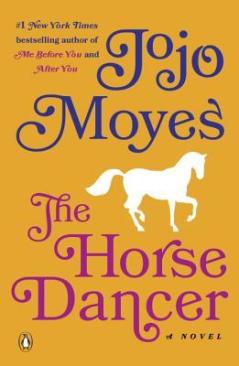 I decided on a re-read this week, and picked one of JoJo Moyes’s lesser known books, The Horse Dancer. I enjoyed it enough the second time around to want to revisit (for my newer readers) the review I wrote in 2019 when I first read it.
There are three intertwined stories in this book—one in the past, the other two present-day. The first involves Natasha and her soon-to-be-ex-husband Mac. Natasha is an up-and-coming attorney in the area of child protective services, and channels all her repressed feelings about the end of her marriage into her work and her tentative new relationship with a shiny partner at her firm. Mac is a freelance photographer, and appears to be fairly happy-go-lucky and irresponsible next to the upright and uptight Natasha, but seems to have major regrets about the end of the relationship. The two are in the process of sorting out their mutual possessions and financial issues on the way to divorce when their paths cross with Sarah.
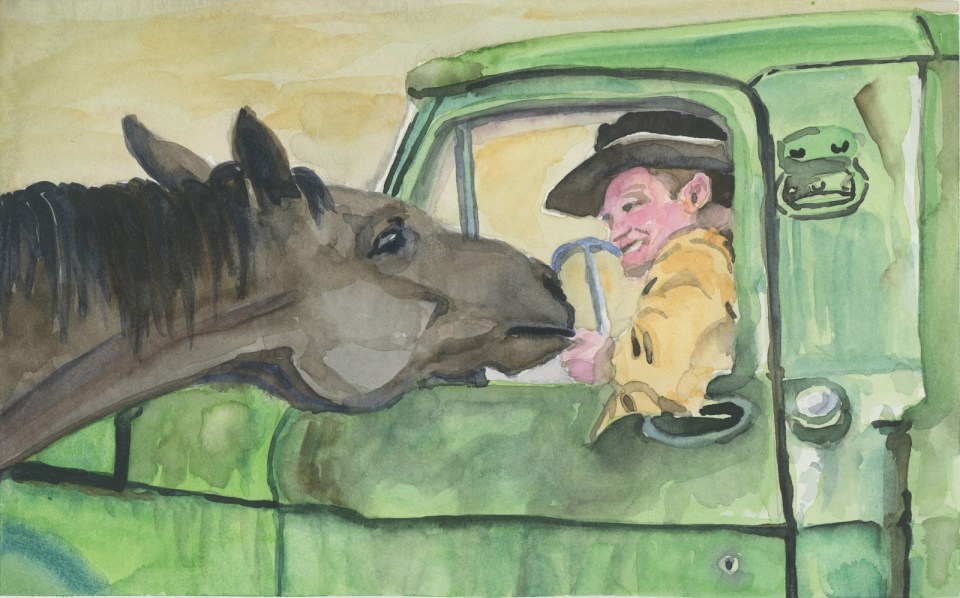
Sarah is a 14-year-old girl who has two major loves in her life: her beloved grandfather, Henri, with whom she lives, and her horse, “Boo.” Her grandfather was, in his youth, a professional rider for the prestigious Cadre Noir, a French dressage academy, but he gave it all up to come to England to marry Florence, the love of his life, recently lost to cancer. Sarah’s dream is to follow in her grandfather’s footsteps and ride with Le Cadre Noir in Saumur, France. Meanwhile, she and her grandfather train the horse in the shadow of an old railway siding in the seedy part of London, where they stable the horse with Henri’s friend, Cowboy Joe. When something terrible happens to Henri, Sarah discovers the fragility of her situation as a child with too many adult responsibilities, and tries her best to deal alone with all the potentially terrible outcomes.
I found this book tremendously moving in several areas. The relationship between Sarah and her horse brought back memories of being that age and wanting that special partnership so badly. (My grandfather, an impulsive bidder at auctions, actually gave me a horse for my birthday when I was 12—an unbroken two-year-old palomino
stallion—and my parents, dismayed by the thought of dealing with the housing, feeding, and exercising of him from the comfort of our suburban lifestyle, made him take it back. I can hardly remember ever feeling more heartbroken.) The scenes that depict the tie between Sarah and Boo are so viscerally and immediately written as to be impossible to resist.
The interplay between Mac and Natasha was painful and confusing, and there were parts I flat-out had trouble believing, but ultimately the idea of the walls we build to protect ourselves that do us more damage than those we built them against resonated with me. The picture Moyes paints of a teen girl who depends on her grandfather and no one else, and of what happens to her when she is thrown on her own resources and believes she must cope all alone, is poignant, real, and frightening. The back story of the grandfather’s youthful experiences in Le Cadre Noir gave the book additional legs. All in all it was a satisfying and touching, albeit somewhat dark, read.
This is a book that is written for adults, but it explores the adult-child (or adult-teen) relationship from both sides, given that it shows both Natasha’s and Sarah’s views of the proper way to deal with the situation in which they find themselves; and I think that there are teens who would appreciate and even benefit from reading this book. Natasha has to transform her view of Sarah as a frustratingly opaque, surly compulsive liar and see that she is a child adrift in an adult’s world who is convinced she has to be as strong and resourceful as an adult; while Sarah has to get past her view of Natasha as a controlling authority figure and see that she is doing her best to be helpful even though Sarah is keeping the bulk of her life secret from everyone. The thing Moyes gets right is that final push through misunderstanding that is essential to a true and lasting love, whether it be between a couple, a parent and child, friends, or a girl and her horse.
Wish fulfillment
A lot of popular fiction these days seems to fall into a category I would call “wish fulfillment”—that is, books where nice things happen and people end up happier by the end. I just read two of those, and while I enjoyed both of them, they left me feeling a little…flat? It’s not that I don’t like a happy ending, but when it telegraphs itself throughout the book, one has to wonder: Did I really need to read this book?

The first was People We Meet on Vacation, by Emily Henry, author of the popular Beach Read, which I covered in a previous post. The title is a little misleading, because the person Poppy “meets” on vacation every year is her best friend Alex; the two shared a car ride home from college and have gotten together every summer for the subsequent 10 years to go on a vacation. (Poppy has engineered her career so as to become a travel writer, which makes the vacations much easier to navigate financially!) This yearly trip persists despite all complications, including moves to Chicago and then to New York for Poppy, job changes, other (dating) relationships for both—no matter what, Poppy and Alex have their trip.
The relationship is described by Poppy as 95 percent friend-zone and 5 percent what if? and this is probably a situation to which it is easy to relate for most people. I’ll bet if you think back, there was always that one person about whom you wondered, What if I acted on my impulse to change this relationship? but never quite dared. This premise, with inner waffling by Poppy to which we are privy, and some outer signs from Alex, to whose mind we are not welcomed until much later in the book, is what makes the whole thing work.
Like Beach Read, the main strength of this story is the witty banter between its two protagonists. Sometimes the back-and-forth from past to present trips with the accompanying descriptions both external and internal get a little wearying; but with the always tantalizing possibility that this trip is the one during which things will shift or change, the motivation to keep reading is pretty strong.
No spoilers, but it’s a feel-good book so you can probably guess what happens. In fact, the book’s cover blurb touts it as “a sparkling new novel that will leave you with the warm, hazy afterglow usually reserved for the best vacations.” Not exactly a cliff-hanger. So if you are going to read this book, you have to do so for the journey, not the destination, so to speak, which is kind of funny when referring to a book about travel.
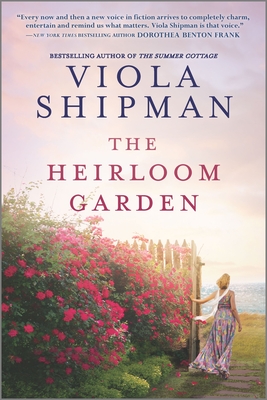
The second book I read was The Heirloom Garden, by Viola Shipman and, while this book had more depth and less wit to it than Emily Henry’s books, it was still within that realm of predictability that made the inevitable ending simultaneously satisfying and anti-climactic. It’s about Iris Maynard, an old woman alone, who lost her entire family early in life and walled herself off, both figuratively and literally, from all but the minimum human contact. She is a botanist who lives behind a tall fence enclosing a beautiful garden that she has both preserved and extended from her mother’s and grandmother’s initial efforts. She grew up in the house where she lives, while her grandmother’s old house sits next door, and this one she rents out.
I’ll bet you can almost write the story in your mind from these beginning details—I could and did. A young couple with a daughter move into the rental house. The daughter, Lily, is the same age as Iris’s Mary was when she died; the husband is suffering from PTSD from his time in Iraq, while Iris’s husband never returned from World War II. The child is irrepressible and worms her way into Iris’s life and affections; the wife, Abby, is an engineer whose career has, like Iris’s, been fraught with misogyny; and the husband and Iris share agoraphobia and a lack of the will to live. Everybody’s issues and natures work upon everybody else’s, with the inevitable outcomes.
I’m not saying this book isn’t well written—it is—or that the situations aren’t powerful and poignant—they are—but…they are also so predictable. The highlight of this book is all the abundant detail about horticulture, and the “relevance” factor of dealing with PTSD. But again, the journey (touching moments and interesting information) has to become more important than the destination, because that is a foregone conclusion. You can say that you don’t know what will happen—will Iris come out of her shell? Will Casey come back into the world?—but really, you do. So I guess the point of books like this is the feel-goods you get as you read them.
There is, of course, a story arc to every tale, whether it has a happy ending or not, but for some reason the predictability of contemporary fiction like this is rubbing me the wrong way right now and I’m wanting more. Maybe it’s time to go back to science fiction…
Aging, dying, living

The Brilliant Life of Eudora Honeysett (released as Eudora Honeysett is Quite Well, Thank You in the U.K.—a better title, in my opinion) is supposed to be a feel-good read. I chose it because someone on the “What should I read next?” Facebook page compared the writing of Annie Lyons to that of Linda Holmes, author of Evvie Drake Starts Over, which I liked quite a bit. I somehow got it into my head that one person had written both books, but learned my mistake after reading it, then looking up “other books by Annie Lyons” and then “Evvie Drake” on Goodreads.
I scrolled through Goodreads reviews checking to see if anyone at all had hated this book, and found only one “did not finish” (DNF) in two pages of reviews—that person called it A Man Called Ove rip-off. Otherwise, universal fours and fives out of five stars.
I have to say that it was an engaging narrative, with interesting, well-developed characters who made me care, and an alternating timeline that clearly explained how we had gotten to where we were at the opening page. Where Eudora was…
Eudora Honeysett is 85 years old. She is (that dreaded word) a spinster, and lived with her mother, Beatrice, for most of her life, caring for Beatrice until she died—after a series of incidents and illnesses—all by herself in a hospital bed. This experience shone a light for Eudora on exactly how she didn’t want to end up; so, since she is alone in life, without friends, siblings, or other relatives, and the effects of the aches and pains and obstacles of old age are beginning to become burdensome rather than just annoying, she decides that she will take steps to ensure she gets to go out on her own terms. She contacts a clinic in Switzerland that will give appropriately vetted patients “a good death” at the time of their choosing, and makes every effort to get them to see that they don’t need to doubt her motives or mindset—she is not depressed, she is simply done.
I am eighty-five years old. I am old and tired and alone. I have nothing I want to do and no one I want to see.
EUDORA HONEYSETT, protagonist
I don’t want to end up dribbling in an old-people’s home, wearing adult nappies in front of a shouting television. I want to leave this
world with dignity and respect.
Now, can you help me out?
I think I have to vet my books more thoroughly and quit reading this kind. I had an almost identical, visceral reaction to Dan Mooney’s The Great Unexpected, which is much the same theme, although Eudora remained mostly in control of her environment while Mooney’s protagonist, Joel, was already stuck in the nightmare of the nursing home Eudora dreads.
This book, like that one, posits that the infirm elderly can still find something to live for, if they open themselves up to life. In Joel’s case it was rebelling against his environment and reconnecting with his family; in Eudora’s, it is the acquisition, despite herself, of two new friends: Rose, the relentlessly inquisitive but also consistently kind 10-year-old girl who moves in next door and decides to adopt Eudora as her new best friend; and Stanley, an elderly widower who rescues Eudora when she faints and falls on the sidewalk in their neighborhood while out for her morning walk. Eudora tries hard to resist their interest in her, since she is determined to carry out her plan, but neither of them (especially Rose) will take no for an answer and, despite her best efforts, she finds herself caught up in their lives and drawn into a world with which she has been largely unfamiliar in the course of her life of disappointments and hardship. She discovers that people can be kind, that connections can feel welcome rather than burdensome or obligating, and that love is to be treasured, not avoided for fear of being injured.
The book was, I must admit, heart-warming, charming, and all the other accolades bestowed upon it. But my frame of mind while reading it somewhat poisoned the well for me, and I looked ahead, as with Mooney’s book, and wondered about my own fate. I have always possessed what they call “rude health”—I have had no operations (save a tonsillectomy at age 13), take one medication, and am never ill. I assumed, up until this year, that I could continue to rely on my robust constitution until I departed life in my 80s or 90s or, who knew, achieved the century mark like several of my immediate ancestors have done. But a recent health problem with a discouraging diagnosis has resulted in a major loss of mobility and suddenly, at age 66, I am wondering if an independent life will remain sustainable, or if I will end up trapped and alone as Eudora dreads and Joel experiences.
I think it’s time for some bibliotherapy: Georgette Heyer, Dick Francis, some good escapist science fiction? Four stars from me for Eudora, but I don’t really want to talk about it any more!
It may end with this
After reading Verity, by Colleen Hoover, I wasn’t sure I wanted to read any of her other books; although there were certain aspects of that book that were enjoyable, parts of it also decidedly put me off a further experience. But, as with that book, so many people in the Facebook group “What should I read next?” lauded It Ends With Us that I decided it deserved a look-in.
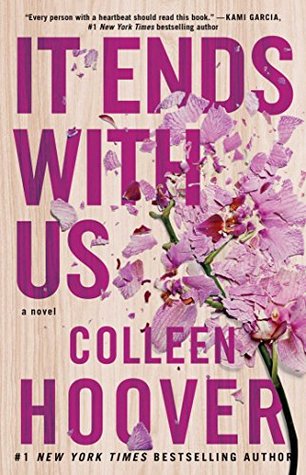
It took me three tries to get past the first 30 pages. Ordinarily I would give up after two, but a unique set of circumstances made me go there again: I was reading the third book in the turbulent and engrossing Nevernight series by Jay Kristoff on a night when my insomnia seemed like a last-all-night kind of thing, and my Kindle tragically ran out of juice; the only other book sitting on my night table was It Ends With Us, and it was so cold that night that I didn’t want to get out of bed to rummage around for something else to read! So I picked it back up and pushed through my initial reaction, which was that these characters—Ryle, and Lily Bloom, for godssakes—were so disingenuous, so superficial and coy, so self-consciously meet-cute that I simply couldn’t deal with the cheesiness.
I honestly didn’t become interested in anyone until the flashback part of the book, when Lily harks back to her teenage years by reviewing her journal entries about meeting and getting to know Atlas (the names in this book are truly ridiculous), the homeless boy hiding out in the vacant house behind hers. At that point, a spark of interest was fanned to a modest flame, so I kept going.
The book turned out to be a revelation of sorts; what seemed like it was going to be a somewhat frothy romance took a dark turn into interesting territory, as Lily confronts her past and has to question whether she will allow herself to be doomed to repeat it. I won’t say more than that, but the book shifted all in a moment from something that didn’t interest me much to a compelling story whose ending I really needed to know.
I can’t honestly say whether this will lead me to read any more Colleen Hoover books, though. The makeup of this one was initially so contradictory that the effort involved to get to the “good parts” required a denial of what I usually value in a story. The second half of the book proved to me that this author can deliver something compelling and genuine; but it evolved from such a ridiculously idealistic and unlikely set-up that it almost spoiled the rest. I ended up being mostly glad I read it, but also feeling manipulated and a little resentful. That doesn’t seem to be a recipe for becoming a fan.
Old age, friendship, rebellion
I didn’t know what I was getting into when I picked up The Great Unexpected, by Dan Mooney. It was billed as “charming” and “poignant,” and compared to such books as A Man Called Ove, The Storied Life of A. J. Fikry, and books by Mitch Alblom. There were definitely some of the same elements present; but it was also both depressing, and depressingly real, and I wasn’t in the greatest space to read about someone’s sad last years.

Joel Monroe, 76, is counting down his days in a nursing home. After independent life got to be a bit too much, he and his wife, Lucey, moved into the home together and, as long as he had her, everything was okay. But she quietly expired one morning while waiting for her cup of tea, and since then Joel’s experience has begun a downward spiral into thoughts of suicide. His entire life as a younger man had been centered on his work and his relationship, and he has no hobbies or pastimes to occupy him. He is plagued by the sense that no one at the home—nurses, aides—and no one in his family—his daughter, Eva, and grandchildren Lily and Chris—sees him as a vital human being who has earned respect for his long, productive life. He resents being treated like a child, from being required to passively take his medications to being refused access to the world outside the gates of Hilltop Nursing Home “for his own protection.” Everyone involved wishes Joel would just settle quietly into his role as elderly dependent, do as he’s told, and not make waves, but Joel feels angry, out of control, stifled, and grief-stricken.
After his roommate who followed Lucey also dies, Joel is made to share his room with Frank Adams, stage name de Selby, a former soap opera actor. Frank is genial, outgoing, quick-witted, and perceptive—everything that Joel is not—and he rapidly gets under Joel’s skin and provokes him into confiding his thoughts of suicide. Rather than acting shocked and horrified, Frank agrees with Joel that he should be allowed to exit his life if and when he pleases, even offering to help him plan his grand gesture, and this solidarity cements a preliminary friendship between the two. But although he is ever the listening ear for Joel, Frank has issues of his own with which he has never dealt, and soon the friendship grows in both directions. Frank encourages Joel to take back some of his dignity by exhibiting some “bad” behavior, source of much of the charming bits of this story.
On the up side, this book is much more than the sentimental, sweet story of yet another curmudgeon won over by life. It’s sincere, lovely, and touching, and tells a wonderful tale of friendship that acknowledges and supports. On the down side, if you are a person of a certain age, as I am, with the eventual prospect of being unable to care for yourself sufficiently to live alone, this is a slightly scary guidebook to what that experience could hold.
We all know that our society doesn’t treat the elderly well; once they exhibit the least infirmity, they are ignored, discounted, and shunted aside. We have all had the experience of visiting a nursing home and walking its halls lined with old people dressed in pajamas and robes sitting forlornly in their wheelchairs, of “rec rooms” featuring TV talk shows and board games to fend off boredom, with that indefinable commingled scent of piss, Lysol, and whatever is cooking for dinner. And we have also seen how the young and fit begin to talk down to the elderly and infirm as if they were irresponsible children or even beloved pets. Although Dan Mooney is never preachy in his approach, he paints a pretty clear picture of the emotions of an elderly man with few resources who doesn’t know how to fight against this encroaching, patronizing lifestyle.
Yes, I’m being just a tiny bit dramatic here; but I identified with Joel a lot more closely than was comfortable, and thought for the first time about what could be in my future if I don’t manage to fend off physical infirmity or mental laxness. So while I would recommend this book as both a worthwhile and an entertaining read, be aware that it may push some buttons for those of a certain age. On the other hand, if you are a young person reading it and are so motivated to take another look at your aging relatives as individuals of worth instead of as problems or burdens and to consider what they are due in their maturity, then all to the good!
Children for sale
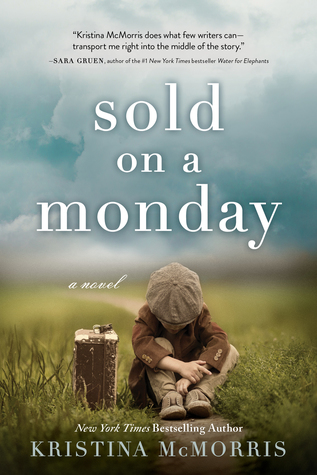
The book Sold on a Monday, by Kristina McMorris, starts with a picture: Reporter Ellis Reed is killing time along a country road while his overheated Model T cools down, by snapping photos. He has just attended a rural quilt show, where he has documented the display for a newspaper story, and he has a few frames left on his roll of film. He approaches a farmhouse and sees two young boys sitting on the porch. They are both red-headed, both blue-eyed, both dressed in nothing but overalls, and he remarks to himself that they look like the same child at different ages. But after he takes the picture, he sees something in the background that he didn’t note at first: A hand-lettered sign that says “2 children for sale.” Even though he is inured to the sight of heartbreaking poverty in this post-crash year of 1931 in America, he is horrified. He has heard tales of people farming out their children to relatives or dropping their kids off at orphanages and churches because they can no longer feed and clothe them; but the concept of a parent selling their own children to keep themselves afloat? That was a darker scenario.
His picture of the two boys was personal—not meant for publication—but when he leaves all the photos from his shoot to dry in the newspaper darkroom, Lillian Palmer, enigmatic young secretary to the publisher, sees the picture in question and shows it to her boss. The photo thus becomes an instrument in the advancement of Ellis’s career as a newspaperman, but the simple action of publishing the photo has devastating consequences.
This book was a page-turner. I liked the parallel development from Ellis’s and Lillian’s points of view; I also liked that, except for the prologue and epilogue, the story was told in third person, even though it was alternating viewpoints. It made it personal enough yet not too internal, if that makes sense. The storytelling was nuanced—the author knew when to set things up and when to reveal them, and was also good at end-of-chapter cliffhangers.
This is, in essence, an historical novel, in that it documents a particular time that was heavily influenced by events of the day; but it’s not one of those books that either pretentiously or self-consciously proclaims itself as an historical document. The small details of dress, morés and mannerisms, social class and financial status are seamlessly woven into the scene-setting and characterizations, making it simply a good story told within a particular context.
I read it with a certain degree of horror that poverty could so decimate the conscience and devastate the family construct, but also knowing that similar acts no doubt go on to this day, swept under the rug by the possibly more timely intervention of social services—still not an ideal solution, but at least evidence of a more robust social contract than was present in 1931. This book was the perfect marriage of thought piece and suspenseful tale, and I thoroughly enjoyed it.
The closest I can come to a read-alike would probably be This Tender Land, by William Kent Kreuger; if you enjoyed that, definitely try this one.
As usual, I have something to say about the cover: The scenario in the book is two children for sale, so why in the world would the publisher choose to portray only one in the cover photo? I throw up my hands.
Two by Hepworth
One of the few benefits of not sleeping much is that you end up reading a lot! So I got through The Mother’s Promise, by Sally Hepworth, in less than 24 hours (my library loan was about to run out), and I’m happy to say that it restored my faith in her. I loved her book The Good Sister but disliked and was puzzled (and bored) by The Mother-in-Law. This one took me back to an excellently researched and well told story about interesting and dynamic characters. I then went on to read The Family Next Door, and was similarly pleased by that experience, although it was a bit different again.
The Mother’s Promise was a sort of psychological exploration of what happens to people who don’t have a social network—and by that I don’t mean Facebook friends or Instagram buddies, I mean an extended family of relatives, or a close group of friends on whom they can call when disaster strikes. Alice is a single mother of one daughter, Zoe. Zoe’s father is not in the picture—in fact, Alice refuses to either disclose his identity or give away any information about him. It’s always been just Alice and Zoe—there are no grandparents, no siblings on whom Alice can rely, and no close friends. Part of this isolation is because Zoe, 15, suffers from crippling social anxiety and being her parent, her advocate, and her protector has been a full-time job for Alice on top of her means of making a living. Although they have sometimes struggled, up until now they have managed to make it work on their own. But Alice has just received some disturbing news from her doctor that will immediately and significantly affect their lifestyle and, on top of worrying about her own health, Alice has to wonder: How will Zoe, who melts down at the least sign of a challenge, cope with this?
Alice ends up throwing herself on the mercy of two strangers—a nurse and a social worker—in her desperation to find some stability for her daughter. But the results are mixed, and bring up long-buried issues in all their lives that must be confronted alongside Alice’s emergency situation.
One thing I particularly liked about this book was the portrayal of Zoe—the examination of her problem and the creative ways in which she tries, despite her fears, to address it. This part of the book felt particularly real and valid to me, and provided a somewhat hopeful coming-of-age vibe to an otherwise rather grim story line.
The Family Next Door, while also exploring family dynamics, has quite a different personality from either The Good Sister or The Mother’s Promise, but was likewise an enjoyable read. Of the four books of Hepworth’s I have read, the style and narrative of this one reminded me most of a Liane Moriarty book. Part of that is that it is centered in a small community and involves multiple families, with partnerships and parenting all under scrutiny, somewhat similar to Moriarty’s Big Little Lies.
The story takes place on a suburban street called Pleasant Court, with the obvious implications. Three families in the neighborhood know each other, but only from a distance, where everything seems perfect. They know their neighbors by their professions, by their number of children, by who is driving carpool—all the surface details that you gather when you live on the same street—but up to now, meaningful interactions have been rare. Then, Isabelle Heatherington moves to Pleasant Court, and her very presence stirs something up for each of these families, even though it’s not necessarily her intention to do so. Isabelle is single and childless, and shows an inordinate amount of interest in Fran, Essie, and Ange and their children and, in turn, the three moms become somewhat obsessed with Isabelle in various ways. Information begins to be exchanged, alliances are formed and dissolved, secrets are revealed, and marriages are perhaps in jeopardy, or at least in question. And then…things take an unexpected turn.
This is a mostly fascinating look behind the scenes of three suburban marriages and what happens when closely held secrets and ideas begin to erode those partnerships. When Isabelle moved to the neighborhood I halfway expected this to turn into the relationship cliché of husband(s) straying with the new woman, but the real reason for Isabelle’s presence is much more interesting and surprising. I said “mostly fascinating” because there are points at which the story bogs down as we get a little too much day-to-day detail about what characters are thinking and perceiving about their spouses, their children, their mothers, their friends…perhaps some of it was unnecessary. But it certainly does set things up for some entertaining scenes!
I enjoyed both of these books and would read another by Hepworth; but I’d like to somehow be able to ensure it was like the three I enjoyed and not similar to the one I did not! I guess I will have to switch from the reviewer to the petitioner and ask for recommendations for myself.
My year of reading: 2021
It’s New Year’s Day! Time to look back at all the books I read in the past 365 days, and reveal which were my favorites, which were the best books I read this year, and whether those are one and the same. Goodreads conveniently kept track of statistics related to my reading goals, so before I get specific, here are some of mine:
This year I read 132 books, which consisted of 50,676 pages.

The shortest was a Linwood Barclay novella of 81 pages, while the longest was one of the Robin Hobb Farseer fantasies at 914 pages. My average book length was 383 pages.
The most popular book I (re)read was Liane’ Moriarty’s Big Little Lies, shelved by almost 1.5 million people!
And now, here are some categories that highlight the year’s journey, from my memories of 2021 reads:
Most excited about:
Return of the Thief, the conclusion to the Queen’s Thief series by Megan Whalen Turner, finally arrived, which gave me the perfect opportunity to enjoy re-reading this series for what, the fifth time? She published the first book, The Thief, in 1996! If you are looking for a nontypical fantasy immersion to start off your year of reading, pick up The Thief and savor the story through The Queen of Attolia, The King of Attolia, A Conspiracy of Kings, Thick as Thieves, and Return. It’s one of those series that gets exponentially better as it goes along.
Best discoveries (in any genre):
ROBIN HOBB. I got lost for a month or more in three of her Farseer high fantasy trilogies, and still have two more on my TBR list, which I hope to get to early in the year.
DERVLA McTIERNAN: A wonderful new mystery series writer with books set in Ireland
Best science fiction discoveries:
A Boy and His Dog at the End of the World, by C. A. Fletcher
A Psalm for the Wild-built, by Becky Chambers (first in a series still to come)
Both of these would fit best into the dystopian category.
New time travel:
The Jane Austen Project, and The Dream Daughter, both from unlikely authors…
New fantasy I loved:
The House in the Cerulean Sea, by T. J. Klune
The Art Mages of Lure series, by Jordan Rivet (Curse Painter is the first book)
Most memorable read:
All the Ugly and Wonderful Things, by Brynn Greenwood
Most affecting mainstream fiction with an historical backdrop:
This Tender Land and Ordinary Grace, by William Kent Kreuger
Continuing fan of:
Melina Marchetta for The Place on Dalhousie
On board with the rest of the crowd:
Author Sally Hepworth, with The Good Sister being at the top of the list.

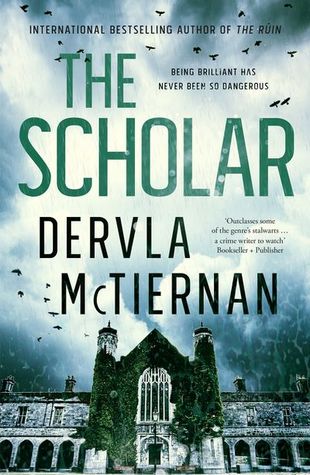
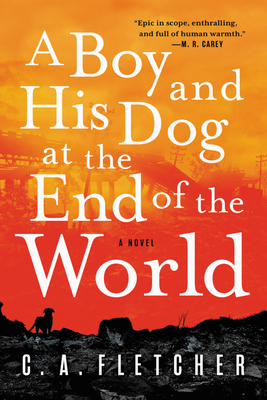


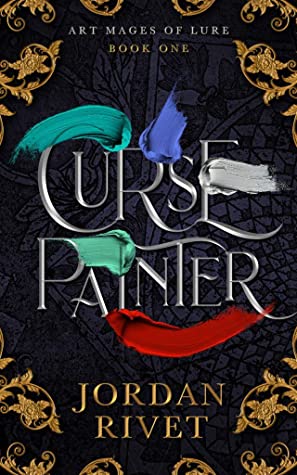


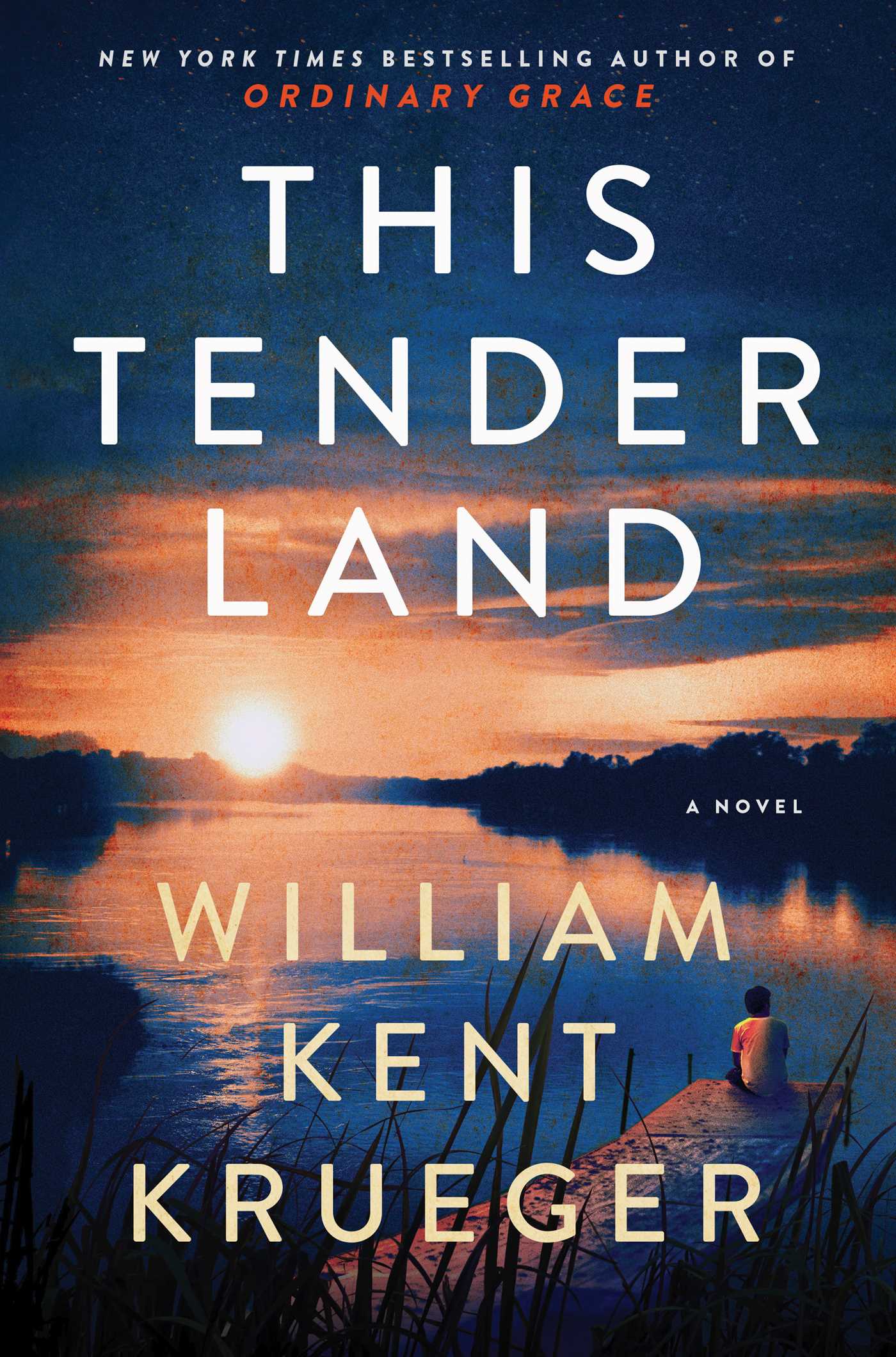
And that about covers the highlights of my year in reading! I have written/published reviews of most of the books I mentioned here, so if anything piques your interest, go to the search box (“Search this site” at the top right under my logo and description), put in a title or an author, and find out why I called out these favorite books.
The Venice Sketchbook
Between my inclination to read almost any book that’s about an artist and my steadfast desire to visit Venice someday, I could hardly resist a book with this title. I have read books by Rhys Bowen before (mostly from her Molly Murphy mysteries) and found them pleasant and entertaining without being particularly compelling; this one, while not written to a formula as is the mystery series, had a little more going for it, but its content didn’t quite meet its potential.
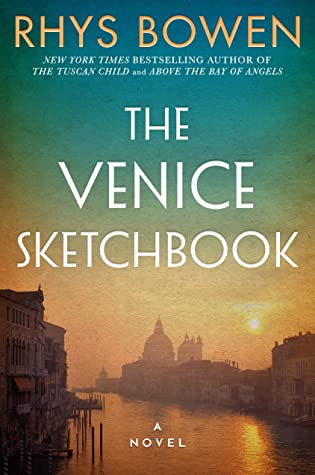
This is historical fiction, which is Ms. Bowen’s specialty, but the historical context suffered a bit by her putting the personal stories first and not sufficiently researching some of her background material, which surprised me. And while she tries to set a vibrant scene in Venice, some of her prose felt like generic descriptions from not very original guidebooks.
Part of the problem with the scene-setting may be that both of her characters are so melancholy most of the time that anything they describe carries a pall of personal gloom with it. The story is told from two perspectives—Juliet’s primarily from the war years (1938-45), and Caroline’s from 2001. Juliet Browning was an aspiring artist who attended art school for one year in her youth and then had to drop out and get a job to support the family when her father lost everything on the Stock Exchange in 1928. The story revolves around three separate trips that Juliet makes to Venice: One, when she is just out of school, a cultural pilgrimage chaperoned by her Aunt Hortensia; one, 10 years later, when she is chaperone herself to a group of girls from the school at which she is the art mistress; and a third a year after that, when she is granted a bursary through her school to spend a year in Venice studying at the Art Academie.
In the contemporary story, Caroline Grant is struggling to accept the end of her marriage when she receives an unexpected bequest. Her beloved great-aunt Lettie (Juliet) dies and leaves her a sketchbook, three keys, and a few final words that include a prompt to go to Venice. Caroline’s son is in New York City with his father, too traumatized (according to his dad, anyway) to fly back to England after the events of 9/11; Caroline decides to take her mind off her troubles by making a pilgrimage to Venice to scatter Juliet’s ashes in the city she loved. She also hopes to find out exactly what happened to Juliet there more than 60 years ago. Until Lettie passed away, Caroline assumed that she had been the same stolid, pleasant spinster her whole life, but perhaps there is a past there.
The plot line hinges on romance: On her first trip to Venice, Juliet meets Leonardo da Rossi, the attractive and charismatic son of one of the ruling families of Venice, and they have a “moment” that is repeated on her second visit. But Leo is destined to marry to suit his family’s business interests, and by the time Juliet returns in 1939, he has been married for some time to Bianca.
Connections that Caroline makes once in Venice lead (somewhat too fortuitously) to her own encounter with a descendent of Leo’s, and with some assistance from and discussion with him, Caroline begins to put together a timeline and a story of her aunt’s days in Venice. A lot of the revelations about Juliet come from a diary that she kept and Caroline discovers, although gaps in it lead to some confusion and false leads until additional clues are acquired. It’s all rather serendipitous.
As I said at the beginning, although this is supposedly a romance about an artist and a beautiful city that steals her heart, the melancholy nature of both the personal and global stories bogs it down. Juliet is first frustrated by the truncated nature of her visit to Venice with her strict aunt; then she is wistful as she conducts her young art school charges around the city, because they don’t seem to appreciate what she would have given anything to experience in their places; and when she finally arrives to stay for a year, living there and studying art, although she does make some friends and have some positive experiences, she is self-conscious about being so much older than the other art students, and she is depressed by the fact that Leo da Rossi is off limits.
Overlaid on Juliet’s story is, of course, the progress of World War II as it relates to Italy and specifically to Venice, and it begins as a constant menace that fails over and over to turn into something concrete, a hovering cloud that never actually rains (so the narrative seems like it contains a lot of false alarms); and then when things finally change for the worse, the story is so relentlessly focused on how it is affecting Juliet and her immediate circle that it’s hard to get an idea of the actual historical facts. I won’t go so far as to say it’s clichéd, but it’s a bit one-dimensional and shallow.
Meanwhile, Caroline is bitter that her husband has left her (after she has supported his career at the expense of hers) to hook up with a famous musician and make good with his fashion designs. She reluctantly agrees to joint custody with Josh of their son, Teddy, six, who stays with her in England during the school year and goes to his father in New York City for the summer and winter holidays. She complains a fair bit about all of it, but doesn’t take any action (like getting a lawyer), and then the outside world intrudes as the planes crash into the World Trade Center, separating her from her son for an extended period. Her impulse is to fly to New York as soon as that becomes possible and take Teddy back, but instead she embarks on this quest to Venice, with all of this hanging over her head.
It’s not all depression and despair—there are fun and funny moments here and there, and some genuine feelings are expressed—but it’s not a happy story, not a traditional romance with a HEA, but also not an achievement for historical fiction. I think that if the background events had been more compellingly and immediately presented, it would have been a better book. I’m not panning it, but it wasn’t a five-star read for me; maybe a three.
GUP
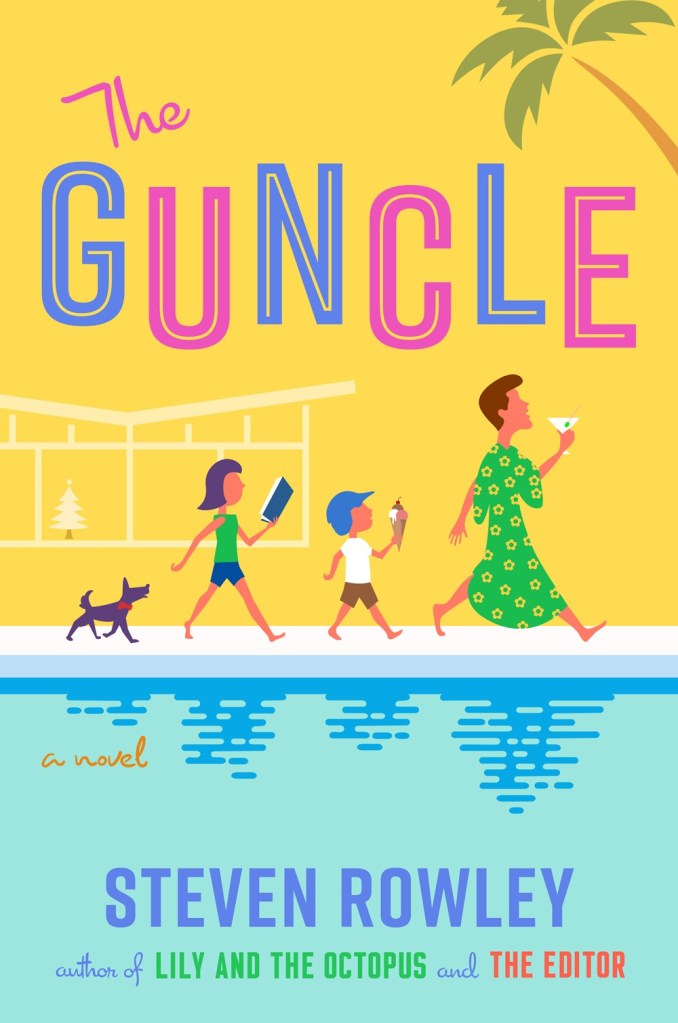
I almost took a pass on The Guncle, by Steven Rowley, after the first 30-some pages. Rowley started out writing Patrick as such a gay cliché (not to mention that he’s an actor, with all that implies), that I couldn’t see a possibility of liking, yet alone identifying with, him as protagonist.
Lest you think this is because I am a “mature” hetero white woman, let me set you straight (pun intended): I worked for more than four years as a typesetter at The Advocate, the national gay and lesbian newsmagazine, during the 1980s at the height of the AIDS crisis. Believe me when I say that I have met and, in some cases, befriended for life, every gay cliché in the book.
I couldn’t quite see what Rowley was trying to do. He invented Patrick as superficial, pretentious, cynical, and almost completely self-involved; and then put him in charge of a six-year-old boy and his nine-year-old sister and let him play out all those annoying attributes in condescendingly coy conversations with the kids, who are already in shock from the death of their mother and the retreat of their pill-popping dad into rehab, leaving them with Gay Uncle Patrick (GUP) in a strange, otherworldly place (Palm Springs in summer). (They normally live in Connecticut.)
But once Patrick gives up a certain percentage of his showboating and settles into a daily routine parenting Grant and Maisie and seeing them through the beginning stages of their grief, the story shifts. Patrick had suffered a loss of his own several years previous, when his lover, Joe, died in a car crash and, in the process of trying to be authentic and present for the children, he realizes simultaneously what they need now and what he has needed all along—to talk, to feel, to be in the moment no matter how painful, and to come to terms with life as it is now, on the other side of this cataclysmic event that has deprived them all of someone so vital.
The other advantage that kept me reading was that Rowley knew just how to write these two children. He got the fears, the naïveté, the bravado, the scorn, and all the other emotions and personality traits of children at these ages down pat, and the conversations they have with Patrick and with one another are the meat of the book, containing humor, pathos, practicality, banality, and wisdom.
The tone of the book was mostly light, but there were passages and events that packed some punch. It was also nice to see the effect serving in loco parentis had on Patrick’s long-term self and goals, provoking a willingness to assume more responsibility for his life and theirs. By the end of the book I had mostly forgiven Patrick his self-conscious snobbery and fallen for his undeniable charm, and I wanted to pack up the two kids and take them home with me. There were also some nice interludes between Patrick and one of his neighbors, as well as meaningful interactions with his two siblings (his sister, Grace, and his brother, Greg, father to the kids) that raised the tone.
This kind of book is one of the reasons that I object to the term “women’s fiction” and have rechristened it, at least in my own classification system, as “relationship fiction.” This is a prime example of that kind of novel that celebrates the relationships among families, friends, and significant others, and it is neither written by nor primarily read by women. I would say, if you have the same initial reaction that I did, give it another 30 or 40 pages and see if it doesn’t begin to draw you in and give you the experience for which you were hoping when you picked it up.
(Can I just say that the cover is perfection?)
 The Book Adept