Subversive, epic
This week when my Kindle ran out of juice and I wanted something to read before bed, I impulsively picked up a book I have read several times before (although it inexplicably remained uncatalogued on Goodreads): The Terrorists of Irustan, by Louise Marley. I have mentioned it at least twice before on this blog, but after reading it for, I think, the fourth time, I wanted to give it a space of its own, because I think it’s that important.
This book is hard to classify. It is science fiction, set as it is on a planet distant from Earth, colonized for the purposes of mining a precious material (rhodium) that is sold back to the industries on the parent planet; it is also powerfully dystopian; and it is definitely a feminist manifesto.

Lest any of those put you off from reading it, it is also a grippingly told story with powerful scene-setting and characters you won’t easily forget. If none of those themes sounds appealing to you, read it for the story!
The book takes place in the future on a planet that was settled by humans long ago, but the society on Irustan is ruled by the Second Book of the Prophet, and mirrors (and expands upon) the claustrophobic (especially for women) religions of middle eastern countries today. Everything is governed according to this restrictive religion, and as long as the rhodium keeps coming, Earth’s Port Authority on the planet refuses to intervene.
On Irustan, the men dominate every aspect of the culture, while the women remain virtually invisible: They do not appear outside the home without being wrapped head to foot in veils, and may not communicate directly with any man save their husband and the servants of their household, nor be seen by them. They may not own property, drive, or use a wave-phone. Their husbands have complete control over their destinies and those of their children. The highlight of their lives is “Doma Day,” once a week when the husbands all go to the temple and the wives and children are allowed to gather at the homes of their close friends to socialize, trade gossip, and share a meal.
The main character is Zahra IbSada, one of the women on the planet with a tiny portion of independence. In this world of male dominance, there is a strong taboo against even the acknowledgment by men of illness or infirmity, so any kind of medical treatment has to fall to a small group of women (fewer than 100 for the entire population of the planet) who are trained as “medicants.” They are a somewhat poor excuse for doctors, because their training is severely restricted, but they are aided by amazing medical technology from Earth, where machines have been developed that can diagnose illness and provide remedies directly into the bloodstream. The medicants are instructed in the use of these machines and most go no farther in their development as doctors.
Zahra is one such medicant, with better training than most due to the woman with whom she apprenticed, and also because of her own insatiable appetite for medical knowledge. The medicants treat the colonists injured in the rhodium mines, dosing them regularly with a drug therapy that prevents them from contracting a deadly prion disease from inhaling the dust, and also minister to any others who are sick or injured. This gives them an extraordinary knowledge of the private lives of those on their clinic list, and ultimately provokes Zahra to make a controversial personal decision in the course of her duties that will have unexpectedly wide ramifications.
Zahra is aided in this course of action by a Port Authority employee, a longshoreman who is in charge of delivering the medical supplies shipped from Earth to the various women’s clinics. Jing-Li comes from the ghettos of Hong Kong and used a job working for Port Authority as a way to leave Earth without having to go to college or obtain a career that would qualify a person for interplanetary travel, an option that was unavailable to someone from Jing-Li’s social class. The collaboration between the two is slight but powerful, and their fates end up being intertwined as Zahra seeks a way to change the oppressive social structures of her world.
Somewhere in The Handmaid’s Tale, Margaret Atwood comments about how extremist Eastern religions are not that different from extremist Western religions; The Terrorists of Irustan is Louise Marley’s example of a faux Middle Eastern counterpart to Atwood’s book, and I believe should be read with the same attention given to that classic. (And yes, it would make an amazing series as well!)
Interdependency
The empire in John Scalzi’s series by that name takes interdependence to new heights (pardon the pun, it’s set in space). As Wil Wheaton, narrator of the audiobooks, comments, “The Collapsing Empire [first book in the trilogy] works as a wonderful SF tale…but it also has important allegory, metaphor, and commentary on some things that are going on right now, for readers who are open to that sort of thing. For those who aren’t, it doesn’t beat you over the head with it, which is a neat trick.”
The few planets and many human habitats of various construction that are flung across the universe are connected by something called the Flow, which confounds natural physics by providing a river-like network between all the settlements. To use it for travel, spaceships must have a field that creates a “bubble” around them, whereupon they can onramp into the Flow, which carries their ship until they pop out at their destination, days, weeks, or sometimes months later—it’s somewhat predictable, but not reliably so.
The Interdependency has a top-down, static structure of emperox (the non-gendered term for their emperor), noble houses, trade houses, and everybody else. To keep all these widely spaced settlements together and avoid interstellar war, both necessities and luxuries have been assigned to or co-opted by the “houses,” which have monopolies on certain goods and services, for which the other houses trade and bargain, to the extreme that there are built-in fail-safes to ensure no one impinges on the monopolies. For instance, if a particular kind of fruit is sold, one would imagine that the seeds from that fruit could be collected by the buyer and grown elsewhere, thus disrupting the monopoly; but in anticipation of this, the produce has been designed so that the seeds go sterile after a short period of time, preventing anyone else from benefitting. (Don’t ask me how, just go with it.) The monopolies are jealously guarded, and there is a certain amount of jockeying for dominance amongst the nobles, but the empire’s structure is mostly stable, and lends itself to centralized control.
This has all worked for millions of years, barring an occasional assassination of an emperox, or a change in fortune for one of the houses. But all of that is about to change, for the simple and terrifying reason that the Flow has become erratic and, in fact, is about to fail in spectacular fashion, according to one lone physicist on the planet End, the furthest planet in the universe from the Hub, the center of the empire. When it collapses, most of the human habitats will be isolated within their systems and, without the cooperative network of supplies and services set up and supplied by the Interdependency through the Flow, they will fail to support their populations in fairly short order, presenting a stark fate of death by starvation or faltering life support systems.
Compounding this, the emperox who commissioned the physicist to research and report on the Flow has just died and, contrary to his plans and those of one of the other predominant noble houses, his illegitimate daughter, Cardenia Wu, has succeeded to the throne. She is naive, inexperienced, and not a particularly willing heir; but when the physicist sends his son, Marce, from End to the Hub to report the problem with the Flow to the emperox, Cardenia realizes she must rise to the challenge of saving as many as possible of the billions of people dependent on her empire. The noble and trade houses, of course, have other ideas, including eliminating Cardenia and putting one of their own clever but venal people in her place, and saving themselves (and their money, goods, and dominance) first, while leaving the commoners to their fates.
This is the rather long set-up and partial story of The Collapsing Empire, The Consuming Fire, and The Last Emperox.


This has been deemed a “space opera” by many reviewers and readers; I tend to think of space operas as the wild west played out in space, with smuggling, chases, and shoot-em-ups being more prevalent than, say, the thoughtful dissection of an empire into its component parts and the contemplation of what will happen to it, should no one take responsibility. The books definitely have some aspects of space opera, as there is a lot of adventure, multiple coups and assassinations (both attempted and achieved), and various exploding ships (due to both battles and sabotage). But along with all that are some amazing characterizations of both heroic and nefarious figures, along with some truly labyrinthine plotting, so the trilogy is a pleasure to read for both adventure-seekers and philosopher-anthropologists. Along with the clever, sometimes laugh-out-loud triumphs of one character over another, there is also much to consider from both an intellectual and practical viewpoint, with parallels, as Wheaton noted, to many aspects of our own culture’s functionality and possible future.
Scalzi has pulled off a coup, himself, by managing to marry the level of detail contained within his Old Man’s War series with the humor and humanity of his more lighthearted works (such as my favorite, The Android’s Dream). The dialogue is witty, the descriptions are engaging, the world-building is thorough, and the group of main characters who tell the story—the Flow physicist, the new emperox, the trade representative of a major family, and the wannabe traitor—are quirky, endearing, and profane. (If crass language bothers you, this is not the series for you!) I thoroughly enjoyed this three-part story, and couldn’t wait to see what happened.
Intricate plotting
My next book came recommended from the Facebook readers’ group (What Should I Read Next?), but I was careful not to find out too much about it before I read it. As it turns out, it wouldn’t have made too much difference (unless somebody really wanted to ruin it with spoilers), because We Begin at the End, by Chris Whitaker, is such a complex story that it would be hard to encompass everything contained within its pages in a simple book-talk.
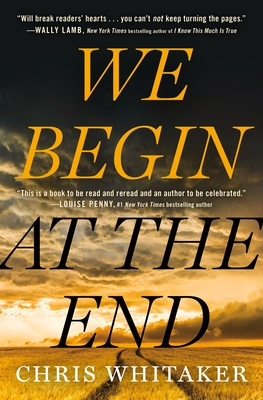
Everyone in this book, and I mean everyone, has some sort of agenda, major or minor—some are obvious, some are hidden, some seem obvious but are quite the opposite—and following them all occasionally proved challenging but also definitely worthwhile. And along with these agendas go many secrets, a lot of misunderstanding, massive amounts of lying, and some catastrophic assumptions.
There are many ways in which one could characterize this book: It is a murder mystery, it is a coming-of-age story, it is the saga of multiple people caught up despite themselves in various forms of tragedy they are mostly unable to avert. Let me see if I can outline the basic story in some sort of coherent form…
There’s a guy called Walk (last name Walker), who grew up in the small coastal California town of Cape Haven of which he is now, at 40-something, chief of police. There’s another guy named Vincent King, who was Walk’s best friend until the age of 15 when he went to prison, partly sent there by Walk’s testimony. Star Radley is a friend of Walk’s and was also Vincent’s girlfriend before he went away, and she has two children, Duchess, 13, and Robin, five, but can’t (or won’t) disclose the names of their fathers. She’s a chronic alcoholic and drug abuser, with the result that Duchess, a necessarily tough girl with a perpetually bad attitude (picture a young Ruth Langmore from Ozark), is raising Robin and keeping an eye on her mother in an atmosphere of poverty and uncertainty. Walk tries to keep tabs on Star and the kids and help them out however he can, but Star seems determined to self-destruct.
The catalyst for the story is that Vincent is finally getting out of prison, after 30 years away, which precipitates all kinds of events, both expected and unexpected. There is a further panoply of significant secondary characters, mostly connected to Star and the kids but peripherally to others, including a couple of weird neighbors, an estranged grandfather living in Montana, a boyfriend with criminal connections, and a lawyer and former girlfriend of Walk’s; and then there are the tertiary characters—friends, social workers, helpful strangers—who enter and leave the story as needed. It’s a complex cast to juggle, but it’s masterfully done, and Whitaker manages to preserve the reader’s assumptions throughout the book, right up to the revelations of the unexpected conclusion. And what he does even better than keeping track of his plot is make you care about the fate of everyone involved.
This is a heartbreaking and frustrating story on so many levels—history repeats itself, love is mostly unavailing, and revenge and retribution are dealt out with a heavy and sometimes arbitrary hand. But it also speaks to the search for absolution and redemption, and the sacrifices people are willing to make for the people who are family, whether blood-related or not.
I won’t say much more than this, because the experience of reading it is so engrossing that I wouldn’t want to take away from that for anyone who chooses to do so. I was trying to think of other books that might be comparable to the complexity and drama of this one, and couldn’t. Stylistically, it’s a story about real people in a particular context; the closest I could come is This Tender Land, by William Kent Kreuger, but I liked this so much better (and I liked that one a lot). It also put me in mind of a little gem of a book called She Rides Shotgun, by Jordan Harper, a much shorter and simpler story but with a protagonist who reminded me a lot of Duchess Day Radley, self-styled outlaw.
Don’t miss this one.
Ambivalence…
After having rated TJ Klune’s book The House in the Cerulean Sea as one of my favorite discoveries last year, I was greatly anticipating reading this year’s Under the Whispering Door. I ended up mostly enjoying it, but it was a bit of a struggle to do so.

Although they have different themes, the books do share certain characteristics: an initially unlikeable protagonist (although I mostly felt sorry for Linus in Cerulean, while Wallace in Door was simply an asshole); a quirky gang of main and secondary characters to surround him and serve as foils for his transformation; equally fanciful world-building; and a gay romance. I was intrigued by the subject matter—death and transition—and couldn’t wait to see how this creative author would deal with it. Unfortunately, I had to wait…and wait…and wait some more.
I almost put this book down a couple of times during the first 60 percent of it, simply because nothing much happened. Don’t get me wrong—there are events taking place, they simply don’t appreciably move the plot along, and also can’t compete with the constant, repetitive introspection of the exceedingly annoying protagonist, who protests, whines, and throws tantrums as each of them transpires.
Wallace, a successful and rather egomaniacal big-city attorney, has a blackout moment in his office, and when he wakes up, he’s at a funeral, which turns out to be his own. There are distressingly few people in attendance, none of them kindly disposed towards him, and it’s almost with relief that he notices one well-dressed and intriguing person he’s never met. Mei turns out to be his Reaper, the person who has been sent to retrieve him, now that he’s dead, and to convey him to the Ferryman to make his transition to whatever’s next. This turns out to be Hugo, owner of a tea shop on the outskirts of a small, out-of-the-way town whose inhabitants enthusiastically line up for his and Mei’s croissants and scones, oblivious to the presence of both resident and guest ghosts on the premises.The living quarters are upstairs from the shop and, on the fourth floor, there is a mysterious door in the ceiling that leads, well, somewhere else.
Wallace, however, isn’t yet willing to admit that he’s dead and it’s all over, let alone passively float through that door. He’s angry, he’s resistant, he’s all the many stages of Elisabeth Kubler-Ross, and he’s going to fight with anyone who tries to pressure him into something for which he isn’t ready.
This is a book about what it means to be alive and how to come to terms with death. I appreciated the marked lack of religious symbology and the unique ways in which Klune imagines that all this happens, but was less a fan of the repetitive mantras surrounding the subject matter. There were definitely both ahah! and touching moments throughout the story, and I did invest fairly heavily in most of the characters by book’s end, but there were some things that didn’t feel organic (the romance wasn’t there and then it was, and it was hard at times to understand why) and others that felt extraneous. I ended up enjoying it quite a bit, but the irritation level at pushing through all of the preliminaries that seemed to last way too long brought the pleasure quotient down a bit.
My ultimate verdict would be to read it, but go into it knowing it’s a slow burn of a read and you will have to persist to find gratification.
Indigenous mystery

The Firekeeper’s Daughter, by Angeline Boulley, was mentioned by one of my students in my Young Adult Literature class this past quarter as a book both by and about an indigenous voice from the Ojibwe tribe. It caught my attention because I have read several books set within the same locale (Sault St. Marie, in Michigan’s upper peninsula) and culture (Anishinaabe), though none that made that culture a central feature of the plot, and none written by a person from within the Ojibwe tribe, so I was particularly interested.
The first part of the book does a wonderful job of immersing the reader in the protagonist’s current life and giving the background necessary to set the scene and understand the issues. Daunis Fontaine is the product of a daughter from a wealthy white family who falls for a charismatic Objibwe hockey player, but her origins are something of a scandal, since her mother’s family forbade the relationship and her father ended up with someone from his tribe, who made a rather calculated play for him and also got pregnant, with the result that Daunis has a half-brother, Levi, who is almost her same age. Her mother courageously insisted, after Daunis was born, that she not be kept by her white family from her Ojibwe roots, so Daunis has grown up a part of both cultures, although she identifies more closely as one of the Anishinaabe, embracing native values both religious and secular.
The author also effectively embeds her story in the racism and atrocities historically visited on the tribes, as well as being immensely informative about such topics as traditional medicine, rituals and ceremonies, tribal elders and councils, contemporary politics, and the sense of family and community that characterize this culture; and she (mostly) manages to do so without being too didactic.
She uses the vehicle of a new boy at school, a recruit for the hockey team who needs to be introduced to all the nuances of life in the “Soo,” and has Daunis’s half-brother Levi, captain of the team, designate Daunis as Jamie Johnson’s “ambassador” who will tell him what he needs to know. The text is thus salted with indigenous words, concepts, and teachings that are explained by Daunis from within that context.
All of this makes the book sound more like an educational piece of nonfiction than a complex and multilayered mystery, but the wealth of scene-setting detail actually makes the puzzle to which Daunis is addressing herself much more plausible and compelling.
Daunis was supposed to be on her way up to Ann Arbor to start her college career at the University of Michigan, but two personal tragedies—the death by overdose of her beloved Uncle David, and her maternal grandmother’s debilitating stroke—keep her at home, with a plan to enroll instead in the local community college so as to be there to support her rather fragile mother through these twin losses. One person who is thrilled that she’s staying is her best friend, Lily, who will now be attending college with her.
They say tragedies always come in threes, and as a devastating event shocks Daunis into realizing that there is something dark destroying her native community from within, it is revealed to her that there are also outside interests attempting to solve the dual mysteries of addiction and suspicious deaths that are plaguing the people of Sugar Island; she makes the pivotal decision to get involved with ferreting out that solution.
The story is tense and suspenseful, with a protagonist facing many complications—perhaps too many. There is so much going on within this plot and surrounding this one person: Daunis’s biracial identity, her sick grandmother and dead uncle and father, her best friend’s meth-addicted boyfriend, her inexplicably ended hockey career, her new boyfriend’s secrets…it’s a lot. I do think the author does a good job of keeping all the balls in the air, but perhaps it would have been a better story with a few of these details ironed out of it. Because Daunis (and the author) has so much to juggle, some parts of the book become repetitive as the reader is reminded several times of the various elements in play. This is a first-time author with a slight tendency to over-explain, with the result that there are a few jarring moments in the book when Daunis suddenly seems to channel a third-person voice that is commenting on the action from an omniscient place outside the story line. A little more editorial notice should have been paid.
Having said all that, it truly is a riveting and emotionally realistic read, with a wealth of detail about the Anishinaabe peoples that you won’t stumble across in many places, and I applaud the author for managing to write a gripping tale while including such a rich, in-depth setting for it. This is definitely a book to add to your YA reading list.
In case it wasn’t made plain by my description of the story, there are many gritty, explicit events in this book that may prove overwhelming for the sensitive, so keep that in mind when recommending it—it’s definitely for older teen readers, not the middle school crowd.
Mary Jane
For those of you who grew up, as I did, in the ’60s and ’70s, no, this isn’t a book about marijuana. But that recreational herb does figure into this book, in more ways than as a code name it shares with the protagonist.
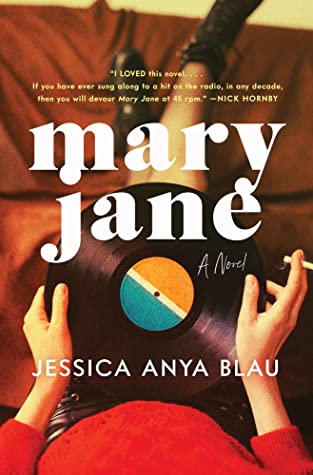
Mary Jane, by Jessica Anya Blau, is one of the most charming coming-of-age stories I have read in decades. It’s not a book with a driving plot, it’s more a slice-of-life story about a particular kind of girl from a specific era and community; but the trans-formation she experiences over the course of one summer of baby-sitting is such a pleasure to witness.
Mary Jane is 14 years old, and the epitome of a sheltered, white, upper-middle-class girl, raised by two correct but cold parents in a respectable lifestyle that includes all the necessities and some of the luxuries of life but lacks passion, humor, and spontaneity. Mary Jane’s daily life consists of an unbending routine in which her lawyer father goes out to work and comes home expecting dinner at six and a quiet atmosphere in which to read his paper and enjoy his drink, while her mother stays home, cleans obsessively, gardens fanatically, adheres to a weekly menu that Mary Jane is required to help prepare, and rigidly polices Mary Jane’s behavior, schoolwork, clothing, and contacts. Aside from a weekly outing after church to lunch at the (all-white) country club to which they belong, there is little deviation from schedule. Mary Jane is a quiet, well-behaved girl with few friends, who finds solace in music (although that is mostly limited to the show tunes her mother enjoys and the religious music she sings in church choir) and reading.
But this summer, the Cone family up the street has asked if Mary Jane will babysit their daughter, five-year-old Izzy, all day every day. They plan to have guests staying with them, and need someone to be a nanny for their daughter while they are busy entertaining. Impressed with this request from Dr. and Mrs. Cone, who seem respectable and well-to-do, Mary Jane’s parents allow her to say yes. Little do they know what awaits Mary Jane behind the doors and windows of a house that seems much like theirs.
Dr. Cone is a Jewish psychiatrist who works from his home office with clients who suffer from addiction. His project for the summer is to be a full-time counselor and presence to rock star Jimmy, a recovering heroin addict, and Jimmy and his glamorous actress wife Sheba will be living with the Cones to facilitate this. Given their celebrity status, their presence in the household is a secret that Mary Jane must keep. Since she has been sheltered from all contact with rock and roll, Jimmy isn’t so familiar to her, but Sheba has been a weekly highlight on TV, for which she hosts a variety show.
Life at the Cones’ house is nothing like anything Mary Jane has ever experienced. Although their daughter, Izzy, is a well-adjusted, loving child, Mary Jane is initially shocked to learn how neglectfully she is treated: There is no meal-planning and they all seem to subsist on junk food and takeout; Izzy wears what she wants, goes to bed when she wants, and bathes irregularly, while her mom avoids the housework in favor of hanging out with Sheba. Mary Jane is gradually integrated into the household as its most necessary member, as she takes over the marketing, meal-planning and cooking, establishes regular bath- and bedtimes for Izzy, and begins to organize the chaos in every room of the house. A quiet, tidy child, Mary Jane is happy to provide these services for the family, especially in return for experiencing a bohemian lifestyle the like of which she never imagined.
Gradually, Jimmy and Sheba introduce her to all the music she’s been missing, while the doctor and his wife show her what a relationship between two loving spouses who adore their child (even though they neglect her sometimes) can be. It’s a household where there is regular hugging, kissing, and verbal expressions of affection, all like water to a parched plant for Mary Jane. In order to keep enjoying this foreign but welcoming lifestyle, however, Mary Jane must begin, for the first time in her life, to tell lies to her parents, from the big one denying the presence of Jimmy and Sheba to little ones that keep her at the Cone house for longer hours every day. As things around her get ever more out of control with the passing weeks of summer, Mary Jane dreads a reckoning.
The character development in this book is delightful, with the naive but realistic Mary Jane as its charming centerpiece. The author knows how to write people—Mary Jane sounds 14, Izzy reads as five years old, and the adults are all individuals with unique yet believable personality quirks. Likewise, the setting of the 1970s is fleshed out accurately, from the pervasive musical theme to the avocado green kitchen appliances and the exclusion of Jews and people of color from the country club. Mary Jane’s father includes President Gerald Ford in his nightly grace before dinner, and the actress, Sheba, is reminiscent of no one so much as Cher in her glory days.
This book is a wonderful exploration of class, race, lifestyle, and gender stereotypes from the era. But it’s also fast-paced (sometimes), often funny or poignant, and a brilliantly rendered view of the transformation of one girl’s life as she witnesses and experiences new things. Some readers complain that nothing much happens, and on a purely event-based level that’s true; but so much happens in the evolution of the individual characters and their relationships with one another! The publishers are trying to hype it as something akin to Almost Famous, but honestly, it reminded me more of Betty Smith’s classic, A Tree Grows in Brooklyn. It’s definitely worth the read.
Missing the mark
I read two books this week about which I was kind of excited, both of which didn’t pay off in the way I was hoping they would.

The first was The Final Girl Support Group, by Grady Hendrix. I hadn’t read anything by Hendrix, but people rave, so since I’m not much of a horror reader but am trying to keep up with some new books in that genre that I could recommend, I decided to try this one, which didn’t sound as terrifying as some.
The premise was interesting: In slasher movies, the “final girl” is the one who’s left standing at the end, after having fought back and defeated the killer, cutting short his terrifying rampage. This book purported to explore what happens to real-life final girls after the trauma is ended. The answer is, the trauma never ends. There may be an actual threat offered by a surviving villain (one who, for instance, has gone to jail rather than dying, and could therefore escape or be released) or from a crazed fan; or the ongoing villain could simply be the PTSD that lingers long after the events are history.
This book focuses on six “final girls” (women) and their therapist, who have met for more than a decade to try to exorcise their demons, and the action in the book is triggered by one of the women going missing, followed by other events that indicate someone knows who they are and is stalking them, one by one. The premise goes on to promise that the “girls” will stick together and have each other’s backs.
I’m not going to waste a lot of time on this review. I struggled to find a description for the book: It was supposed to be horror…but the emotion of fright was never once evoked. The scenes were so disjointed and the red herring got passed to so many different people that in the end, I just didn’t care that much. Add to that a bunch of intensely unlikeable characters and a somewhat boring narrative and all I can say is, interesting idea, poorly executed, don’t bother.
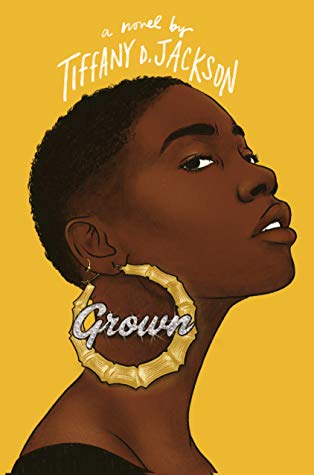
The second was the book Grown, by Tiffany D. Jackson. I had selected this book for my Young Adult Literature class in the mystery category without having read it, because it was a book that included diverse characters, written by a credible (and award-winning) author of color.
The blurb on Goodreads said: “Author Tiffany D. Jackson delivers another ripped-from-the-headlines mystery that exposes horrific secrets hiding behind the limelight and embraces the power of a young woman’s voice. When legendary R&B artist Korey Fields spots Enchanted Jones at an audition, her dreams of being a famous singer take flight. Until Enchanted wakes up with blood on her hands and zero memory of the previous night. Who killed Korey Fields? Before there was a dead body, Enchanted’s dreams had turned into a nightmare. Because behind Korey’s charm and star power was a controlling dark side. Now he’s dead, the police are at the door, and all signs point to Enchanted.”
First of all, whose idea was it—the publishers, the author’s?—to try to position this book as a murder mystery? That is specifically what the blurb on Goodreads promises: It makes it sound like the book is all about “Who killed Korey Fields?” In that blurb, Enchanted (the main character) almost serves as a set-up rather than as the whole point of the story. But (spoiler alert) the murder doesn’t happen until you are almost 80 percent through the book, and is, compared to the rest, a minor plot point. The author specifically says in her author’s note at the end, “This book is about the abuse of power. It’s about the pattern of excusing grown men for their behavior while faulting young girls for their missteps. It’s about the blatant criticism of girls who were victims of manipulation…. About the individuals who were meant to protect and serve never believing victims in their moments of bravery.” So why not position the story directly? Why promote what amounts to deceit? I am honestly surprised that more reviewers aren’t calling this out.
The book is a vivid and sometimes horrifying depiction of a teenage victim of “Me Too,” who is stalked, groomed, essentially held captive, and abused by a 28-year-old celebrity. Korey Fields prefers young girls, and uses his celebrity as a music star to draw them in by promising them assistance with their singing careers. Enchanted Jones has an amazing voice and dreams of stardom, and she is captured by the twin allures of that and the personal attention Korey begins to lavish on her. She ends up leaving school and her family behind at age 17 to go on tour with Korey, supposedly protected by a guardian (who is in Korey’s employ and is possibly one of his former victims), only to encounter the crazy, jealous behavior and punitive actions of an exploitative sociopath who must be the center of attention no matter what.
I can see all the reasons why so many people embraced this book and gave it high marks. It deals with issues that need to be shouted about—loudly. And its focus is about and from within the Black community, where these issues are even more perilous. But there were so many problems with it that I couldn’t give it the credit I wish it fully deserved.
I feel like the author punted in some ways. She starts out with a clear idea of where she wants to go, but then doesn’t follow through in areas that matter, and that’s too bad, because there was real potential. The story gets confusing when her characters don’t know, act, and do as the real people in this situation would. There’s way too much random here.
Some specifics:
The main character was all over the place. I can see her initial star-struck reaction when this man shows interest in her and supposedly wants to promote her career, but honestly, her ongoing level of naiveté, given her background and family dynamic, was flat-out ridiculous. Don’t get me wrong: I do believe that a teen girl could get herself into this situation—but not this teen girl, the way she is initially written. And the mistakes that she makes in attempting to defend herself, after the murder occurs…anyone who had ever watched five episodes of any police procedural TV show would understand such concepts as chain of evidence and illegal search and find another way to make sure that somebody paid attention to the things that would exonerate her.
And looking at that family dynamic: There are certainly hordes of teens out there with parents who aren’t paying attention and/or just don’t care, but that’s not how these parents were set up. Sure, their life was pictured as busy and full of worries (primarily financial), and they placed a lot of reliance on their eldest to help out and babysit the rest of their children, but this is painted as a household in which everyone acts responsibly, and even if their daughter insisted she leave school and go on tour with a male musician who is 11 years older than she is, there’s no way that these parents were going to allow that. These parents, the way they were drawn (and the father’s lay-off and financial woes are not sufficient distractions) would have been all up in her business to find out how she got to know him that well in the first place, and stuff would have come out that would have waved all kinds of red flags on the way to the big one, which is, Are we really letting our daughter, who we care enough about to send to an expensive private school and harangue about her homework and college prospects, be a dropout and go away with this man? No. Sorry. I just didn’t buy it. And if you are saying Yeah, but the girl was determined—again, not this girl. She wasn’t described as someone with the self-confidence, bull-headedness, or fortitude to demand and get her way, or to leave without permission. On the contrary, she is nervous, unsure of herself, all of the characteristics that would lead to the initial situation of his being able to groom her, but would not promote the action she then takes. It just happens, somehow, and that’s one of so many things that just happen, without enough back story to create believability.
There were a lot of things to appreciate about this book, but there were so many small details that jangled that the cumulative effect was an atmosphere of disbelief for the reader (or at least this reader), which is the complete opposite of what the author was trying to achieve with her thesis of “please believe the victims.” I admire her desire to write about girls being sexually coerced and exploited by adults who know better, and to focus specifically on black girls, who continue to be the most disregarded, but the way she went about it was simply inadequate. There were elements that rang true, but just as many that made me say “Oh, c’mon!” more times than I should have during a narrative such as this. I give her respect for her attempt, and her storytelling kept me reading to the end despite all the missteps…but it could have been so much more powerful.
(I do love the cover…)
Romance and more…
My friend Judi commented that when she was at a loss for something to read or wanted to experience the comfort of a familiar story, she returned to the four-part Chesapeake Bay Saga by Nora Roberts. I had never read anything by Nora Roberts, but she is a prolific author and her books are ubiquitous, so I decided to check out this mini-series.
These books fall into what I would call the “relationship fiction” category, in that there is romance present that is a big feature of the story, but there is also some kind of content that reflects a family dynamic beyond just the true-love part. Roberts’s vehicle for these four novels was clever, in that she created a family of four “boys” who were turned into brothers by the charity of one couple who saved them from difficult beginnings, and then she wrote each book by focusing on the perspective and relationship of one of them.
Each of the boys, previously in an untenable situation, was discovered (in various ways) by Ray and Stella Quinn and adopted away from their pasts to be raised in a supportive and kind environment. As adults, the eldest three—Cameron, Ethan, and Phillip—have gone their own way, Cameron to a glamorous lifestyle mostly located in Europe, where he races fast boats and fast cars and lives on the prize money; and Phillip to a big-city career as an advertising executive with a generous income and an enviable lifestyle. Only Ethan has remained at home (although now in a house of his own) in the small fishing village of St. Christopher on the Chesapeake Bay, trapping crab for a living but investing time and hope into a boat-building business. Then, the acquisition by Ray of 10-year-old Seth, a fourth brother to join their family, is quickly eclipsed by the unexpected and tragic death of their father, who makes the brothers promise, before he dies, to rally around and raise Seth the way he, Ray, would have, given the chance. Although there are various levels of grudging reluctance to give up their chosen lifestyles to return home to take up this challenge, the three are all conscious of just what Ray and Stella (deceased some years before) did for them, and are resolved to honor their father’s memory and wishes by doing the same for young Seth.

The first, Sea Swept, is the story of Cameron, who was discovered as a runaway and car thief when he tried to boost Ray’s car at a young age; after realizing that his motivation was to get away from an abusive alcoholic father who beat him, Ray and Stella Quinn took him in. Now he has made a deathbed promise to his adoptive father to assist in the upbringing of new boy Seth, whose mother beat and neglected him, and Cameron is determined to bring the suspicious and untrusting Seth out of his shell and into the family the way Ray did for him. But an unexpected opponent is Anna, Seth’s social worker, who is playing by the rules of the child welfare system by assessing Seth’s living situation and determining whether it would be more appropriate to either place him in the foster system or reunite him with his real family. Despite his determination not to let this happen to Seth, whose psychological scars he recognizes as akin to his own, Cam is unbearably attracted to the spirited and determined Anna, as is she to him, and their involvement complicates an already fraught situation.
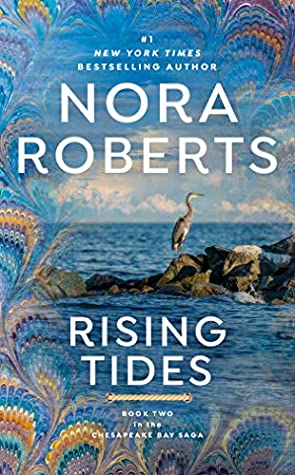
The second, Rising Tides, follows the story of Ethan, the quiet, reflective brother who has made a life for himself as a waterman on the Chesapeake Bay. Ethan’s mother, a drug addict, gave Ethan an unspeakable childhood that, despite his subsequent rescue by the Quinns, has made him determined never to marry or have children of his own, for fear of passing on some random evil gene. Local woman Grace, who despite her former marriage and the birth of her daughter has always cherished an unrequited love for Ethan, is determined not to let this be Ethan’s final word. Their romance plays out against the background of the campaign to keep Seth. In addition, the necessity for all the brothers to move back home in order to create a proper foster environment is the catalyst needed to involve Cam and Phillip in Ethan’s plans for a family boat-building business.
The third, Inner Harbor, is Phillip’s journey. Phillip is perhaps the most successful in terms of career, and also has separated himself the most thoroughly from his small-town origins. But after the Quinns gave him a life (almost literally—he was a gang member who was shot in a drive-by and was saved from death by Stella, the emergency-room doctor, before being adopted), he certainly can’t bring himself to turn down the opportunity for Seth to benefit from the same experience. Somewhat at loose ends after his move from his big-city lifestyle back to the tiny fishing village of his upbringing, Phillip notices Sybill, an intriguing writer who is making the town of St. Christopher the subject of her next book about the psychology of human interaction. But what he doesn’t know is that Sybill has a secret relationship to Seth that threatens everything the Quinns have tried to do for the boy.

The last book in the quartet, Chesapeake Blue, explores Seth’s own story in adulthood. Since it would reveal much about the way things went when Seth was 10, I won’t comment too much on this one, except to say that it, too, contains a romantic relationship, and the quartet is concluded with a happily ever after for many of its subjects.
There is much to like about this series. Yes, it contains multiple clichés or tropes—the macho, muscular, and ruggedly handsome brothers and their uniformly gorgeous love interests, the sex that is always incandescent for all parties involved, the meet-cute aspect of some of the relationships—but the thing that saves it is the back stories of the brothers and their sincere (and tender) determination to help a troubled 10-year-old boy the way that they themselves were aided by their adoptive parents. The thread that holds the book together is the development and transformation of the boy Seth and the creation of a welcoming family dynamic by all the other characters. The characters are nicely defined and feel, for the most part, like real people who express genuine emotions, and the small-town vibe is painted fairly realistically, with the charming offset by gossip and insularity. Wrapping it up as Roberts did with the story of Seth as an adult, showing the vulnerable cracks that remain in anyone who has survived a background such as those of these brothers, was the perfect way to end the story.
Although I don’t know that I would continue reading Nora Roberts as a favorite author (I am not a tropes and clichés fan, unless it’s Georgette Heyer!), I definitely enjoyed this foray into her genre and style.
It may end with this
After reading Verity, by Colleen Hoover, I wasn’t sure I wanted to read any of her other books; although there were certain aspects of that book that were enjoyable, parts of it also decidedly put me off a further experience. But, as with that book, so many people in the Facebook group “What should I read next?” lauded It Ends With Us that I decided it deserved a look-in.
It took me three tries to get past the first 30 pages. Ordinarily I would give up after two, but a unique set of circumstances made me go there again: I was reading the third book in the turbulent and engrossing Nevernight series by Jay Kristoff on a night when my insomnia seemed like a last-all-night kind of thing, and my Kindle tragically ran out of juice; the only other book sitting on my night table was It Ends With Us, and it was so cold that night that I didn’t want to get out of bed to rummage around for something else to read! So I picked it back up and pushed through my initial reaction, which was that these characters—Ryle, and Lily Bloom, for godssakes—were so disingenuous, so superficial and coy, so self-consciously meet-cute that I simply couldn’t deal with the cheesiness.
I honestly didn’t become interested in anyone until the flashback part of the book, when Lily harks back to her teenage years by reviewing her journal entries about meeting and getting to know Atlas (the names in this book are truly ridiculous), the homeless boy hiding out in the vacant house behind hers. At that point, a spark of interest was fanned to a modest flame, so I kept going.
The book turned out to be a revelation of sorts; what seemed like it was going to be a somewhat frothy romance took a dark turn into interesting territory, as Lily confronts her past and has to question whether she will allow herself to be doomed to repeat it. I won’t say more than that, but the book shifted all in a moment from something that didn’t interest me much to a compelling story whose ending I really needed to know.
I can’t honestly say whether this will lead me to read any more Colleen Hoover books, though. The makeup of this one was initially so contradictory that the effort involved to get to the “good parts” required a denial of what I usually value in a story. The second half of the book proved to me that this author can deliver something compelling and genuine; but it evolved from such a ridiculously idealistic and unlikely set-up that it almost spoiled the rest. I ended up being mostly glad I read it, but also feeling manipulated and a little resentful. That doesn’t seem to be a recipe for becoming a fan.
Children for sale
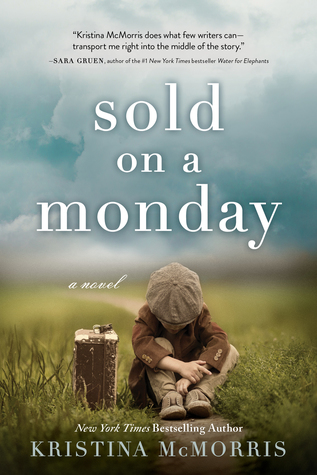
The book Sold on a Monday, by Kristina McMorris, starts with a picture: Reporter Ellis Reed is killing time along a country road while his overheated Model T cools down, by snapping photos. He has just attended a rural quilt show, where he has documented the display for a newspaper story, and he has a few frames left on his roll of film. He approaches a farmhouse and sees two young boys sitting on the porch. They are both red-headed, both blue-eyed, both dressed in nothing but overalls, and he remarks to himself that they look like the same child at different ages. But after he takes the picture, he sees something in the background that he didn’t note at first: A hand-lettered sign that says “2 children for sale.” Even though he is inured to the sight of heartbreaking poverty in this post-crash year of 1931 in America, he is horrified. He has heard tales of people farming out their children to relatives or dropping their kids off at orphanages and churches because they can no longer feed and clothe them; but the concept of a parent selling their own children to keep themselves afloat? That was a darker scenario.
His picture of the two boys was personal—not meant for publication—but when he leaves all the photos from his shoot to dry in the newspaper darkroom, Lillian Palmer, enigmatic young secretary to the publisher, sees the picture in question and shows it to her boss. The photo thus becomes an instrument in the advancement of Ellis’s career as a newspaperman, but the simple action of publishing the photo has devastating consequences.
This book was a page-turner. I liked the parallel development from Ellis’s and Lillian’s points of view; I also liked that, except for the prologue and epilogue, the story was told in third person, even though it was alternating viewpoints. It made it personal enough yet not too internal, if that makes sense. The storytelling was nuanced—the author knew when to set things up and when to reveal them, and was also good at end-of-chapter cliffhangers.
This is, in essence, an historical novel, in that it documents a particular time that was heavily influenced by events of the day; but it’s not one of those books that either pretentiously or self-consciously proclaims itself as an historical document. The small details of dress, morés and mannerisms, social class and financial status are seamlessly woven into the scene-setting and characterizations, making it simply a good story told within a particular context.
I read it with a certain degree of horror that poverty could so decimate the conscience and devastate the family construct, but also knowing that similar acts no doubt go on to this day, swept under the rug by the possibly more timely intervention of social services—still not an ideal solution, but at least evidence of a more robust social contract than was present in 1931. This book was the perfect marriage of thought piece and suspenseful tale, and I thoroughly enjoyed it.
The closest I can come to a read-alike would probably be This Tender Land, by William Kent Kreuger; if you enjoyed that, definitely try this one.
As usual, I have something to say about the cover: The scenario in the book is two children for sale, so why in the world would the publisher choose to portray only one in the cover photo? I throw up my hands.
 The Book Adept