Silence is golden

I picked up The Silent Patient, by Alex Michaelides, on the basis of a bunch of enthusiastic reviews by people on two Facebook reading group pages, and after finishing it, I have to ask…WHY?
I’m not going to use up a lot of space on this one. You may decide to read it anyway, and be as enamored of it as the many who gave it five stars on Goodreads. But here are my thoughts:
The main character is a psychotherapist, but his actions in this book lack any credibility, and in fact may well do a disservice to those who are considering therapy. It’s not the character himself (although I found him to be an unsympathetic one practically from the first page), it’s the lack of knowledge exhibited by the author concerning mental health diagnoses, treatments, and medications. Yes, it’s fiction, and in some instances I would say, Read it for the plot, the suspense, the twists, and don’t pay too much attention to minor inaccuracies; but this book goes too far. The drugs he mentions don’t act as he says they do. The treatment methods are slipshod and would never be tolerated by any facility for whom a licensed psychotherapist would work. The procedures in the supposedly locked and secure facility are laughable. The personal interactions between doctors and patients, doctors and doctors, spouses, and strangers on the street are not believable.
Aside from that, the characters are wooden, the plot is all over the place—including half a dozen unnecessary sub-plots that are nothing but blatant red herrings to distract you from what the other hand is doing—and there’s a fair bit of misogyny exhibited by most of the male characters, and uniformly negative portrayals of the female ones.
My headline for this review may be misleading: You could have taken it to imply that this book with “silent” in the title is golden, i.e., I’m recommending it. You would be wrong. While it may have turned out to be golden in terms of profits, my sole piece of advice would be to take it off your TBR list and breathe a sigh of relief that I saved you from wasting valuable leisure reading time.
Frivolous
The dictionary definition of that title is “not having any serious purpose or value.” You would think that at my age I would consider carefully the books on which I am going to spend my remaining reading time, and look for those that are worthwhile, or profound, uplifting, meaningful,, maybe educational; but it seems that I instead have the occasional need to abandon all thoughts of quality of phrase, good characterization, or realistic world-building to read something that is the snack food equivalent of Cheetos or Skittles. I believe there’s no type of book more addictive than a good thriller, and even the bad ones have the power to keep your attention if the plot points are sufficiently twisty. I proved that point to myself by reading The Housemaid, by Freida McFadden, and then the sequel, The Housemaid’s Secret.


This book has been touted on the “Friends and Fiction” Facebook page I have started to follow as a slightly more upscale version of the “What Should I Read Next?” crowd. The post-ers on F&F seem to read more, more varied, and generally better fiction, but the common denominator of “Oooh, I couldn’t put it down!” still prevails, regardless of quality. Here I am, sounding like a total snob, when one of the tenets of readers’ advisory is “Never apologize for your reading taste!” (Betty Rosenburg’s first law of reading, Genreflecting, 1982), and another is “There is no such thing as an objectively ‘good’ book.” While I try hard to refrain from shaming people for their book choices, what would a review blog be without a little gentle mockery now and then? Especially when it’s directed at myself…
The Housemaid and its sequel star Millie, a down-on-her-luck ex-con who’s trying desperately to find a job that will give her somewhere to sleep besides the back seat of her Nissan. Since she went to prison in her teens and stayed there for 10 years, she has few marketable skills; while she has done her share of fast food gigs, the holy grail at the moment is a job as a live-in housekeeper. The problem is, most people run a background check on someone they plan to hire to fill that role, and once they find out Millie’s past, they politely shut the door. But finally, Millie’s luck changes: Nina Winchester, beautiful and poised on the surface but giving off a bit of a weird vibe, offers Millie a position cleaning, cooking, and occasionally nannying for her little family—husband Andrew and daughter Cecelia—and Millie jumps at the chance. She rapidly discovers some disturbing nuances in the household, but beggars can’t be choosers, so she puts up with Nina’s foibles and her spoiled brat of a daughter, all the while trying not to covet Nina’s lifestyle, not to mention her handsome, soulful, and much put-upon husband. Then things take a dark turn…Dum Dum DUUUUUMMMMM!
The narrative in this book is first-person, and pretty much at the level of “Dear Diary.” It’s hard to tell whether the characterizations are kept purposefully opaque or whether McFadden is just not a good describer. The point of view switches around for sections of the book, but the voice stays a little bit too much the same. The plot twists are arresting, but some of the events on which they are based are laugh-oud-loud ridiculous, as in sitting in your chair reading along and then shouting “Oh, C’MON!” at the text as your cat bolts off your lap in terror. The redemptive value of bits of dark humor here and there can’t be overstated. But still…there’s something that keeps you reading. I loved how one Goodreads reviewer, Dan, put it in his synopsis:
This book is not as clever as it thinks it is. You probably won’t want to put it down. But you may be asking yourself what the hell you just read.
DAN, GOODREADS REVIEWER
As for the sequel, it is exponentially less believable than the first. And yet, I finished it and went looking on Goodreads to see when book #3 in this series will be published (June 2024). Let’s face it: Even Cheetos and Skittles can be addictive.

Psycho Thriller
Yes, “psycho” is an abbreviation for psychological thriller, but also…well, there are characters in this book that might qualify for the title without the abbreviation.
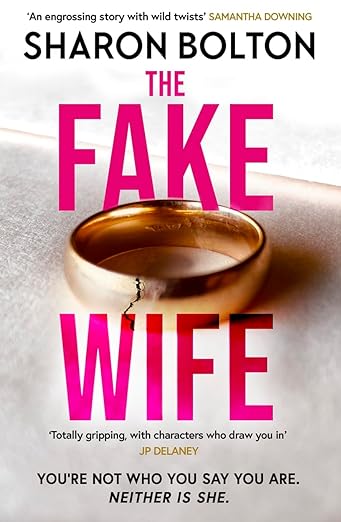
The Fake Wife was not my favorite Sharon J. Bolton thriller, but at this point Bolton is almost an automatic read for me. The book is certainly full of twists and turns, some expected and some definitely not. It’s complex and intriguing, but you really have to pay attention to know what’s happening at any given moment. There are multiple flashbacks from several characters to follow, and we get threads of the story from all directions—the victims, the perpetrators, the cops—that all weave together to gradually reveal what’s going on.
As the book opens, Olive Anderson is having dinner on her own in her hotel dining room in Hexham. A beautiful stranger walks up and seats herself at Olive’s table as if she belongs there, and then starts an elaborate game of pretense, engaging the waiter in banter and implying she is Olive’s wife. Olive is intrigued and decides to play along—it’s a lot more fun than sitting there by herself mulling over her marriage to Labour MP Michael Anderson. But as the evening goes on, the lighthearted pretense morphs into something else, and soon Michael is reporting Olive as missing and DS Lexy Thomas and traffic cop PC Garry Mizon are teaming up to try to solve what becomes an increasingly complex and bewildering situation.
This is an immersive domestic puzzle combined with a police procedural, adding more characters into the mix as the plot continues, with back stories that completely change what you were thinking at the beginning. It’s almost impossible to figure out who is telling the truth—if anyone is. The characterizations are excellent, and as for the setting, the beautiful but frigid winter scenery in the north of England provides both background and an extra sense of menace. If you like reading books that are set at the same time of year and in the same climate you are currently inhabiting, this is definitely a winter tale!
I’m kind of hoping Bolton decides to bring back the odd police couple in another book—their relationship provides both depth and humor in a story that is otherwise kind of dark. But if you enjoy dark (and confusing and exciting and suspenseful), this book might be a good one for your reading list.
Writer of the dark
I have been a longtime fan of Sharon J. Bolton‘s books, variously characterized as mystery, suspense, or thriller. I defined the difference between those in a previous post; let me recap here:
First of all, neither a suspense novel nor a thriller is about solving a crime, they are about stopping a killer or a crime. So they are not necessarily a whodunit as is a mystery; we may know who the villain is from page one.
In a thriller, the protagonist is in danger from the outset, and action is a required element. Pacing is the key ingredient. In suspense, danger is more important than action, and the protagonist becomes aware of danger only gradually. Setting and mood are key. There must be terror, confusion, upset, and conflict.
A thriller has to start off with a bang, and have a clearly defined hero and villain, because the thriller is all about the push and pull between the two. By contrast, the only real requirement of a suspense story is that it build, and that it keep the reader on edge with a series of reveals or surprises until the final one. Suspense can be present in any genre; a suspense novel is simply one where the reader is uncertain about the outcome. It’s not so much about what is happening as what may happen. It’s about anticipation.

Bolton is a nuanced writer, with examples of all of these in her repertoire, sometimes putting the characteristics of all three into one volume. I would call Daisy in Chains a psychological thriller, and perhaps The Craftsman as well, while Dead Woman Walking would probably fall more into the suspense line. And then there is her ongoing mystery series, featuring Detective Constable Lacey Flint, from which I just read #5, The Dark. I am always thrilled when a new book in this series is published, because they are so involving, so ingenious, and so suspenseful—they leave me breathless. This one was no exception.
Lacey is, first of all, such an intriguing character. She comes out of nowhere, makes a name for herself by exhibiting “derring do,” aka extreme recklessness in solving cases for the London police by any means necessary (including dangerous undercover work), and then takes a baffling sidestep from advancement up the ladder to instead become part of the Marine Policing Unit, working on the Thames river. She’s aloof, almost secretive, even with her best friends and occasional love interests, and as the series progresses you learn that her secrets are not garden variety and she has a good reason (several, actually) for maintaining her solo status; but at the same time, you wish for her that she could let it all go and simply be happy! In short, it’s hard not to get involved with her life story.

Then there are the mysteries, and this latest is a doozy. It relates to what’s been happening in the world during the past few years as women’s rights have begun to be rescinded and certain men scheme to steal even more freedoms in their attempt to turn the world back to when they ran things without dispute and the women stayed home and had babies. In The Dark, there is an underground movement lurking on the dark web that is stirring up the “incels”—men who are involuntarily celibate and therefore harbor a deep dislike of the women who deny them—as well as any other guy who has felt overlooked in favor of a woman, for whatever reason. They target women who (they claim) have benefitted from affirmative action, those who they perceive as having favored the rights of women over men, and pretty much all women who choose more successful, more attractive men (or other women) over them.
And they aren’t just talking—they are inciting men to violence, staging actions such as harassment of women walking alone on the street after 10 p.m., intensive catfishing on dating sites, and the like. The women are both terrified and outraged, and the police are using every traditional and cyber tool at their disposal to figure out who are the ringleaders. And Lacey is, of course, smack dab in the middle of all of it, having been in the right place at the right time to foil their opening act, when a baby is stolen from its carriage and tossed into the Thames on a pool float and Lacey is in the area in her kayak to pull off an audacious rescue.
The scariest part of the story is when one of the incel leaders figures out that he has a past connection with Lacey, and she suddenly becomes the focus of everything he hates in women. All of the regulars from previous books—Dana, Helen, Victoria, Mark Joesbury—are present, along with some new characters from Joesbury’s team, plus Emma Boston, a reporter who plays a pivotal role. The book is as dark as its title, and scarily believable, given recent activities by the religion-obsessed right wing active in many countries today.
The suspense throughout is riveting, and I will confess I lost some sleep sitting up to read this. It’s been a while since Bolton wrote a Lacey Flint, and I was so glad she was back. Bolton has a new book (not in this series) coming out on November 9th, and I already have a pre-order destined for my Kindle the minute it’s 12:01 a.m. on that date! If you’re not familiar with Bolton’s books and you crave more thrillers and mysteries, start reading!
Re-invested!
I just finished #7 in the Cormoran Strike/Robin Ellacott series by J. K. Rowling, and my complaints from the previous book are all forgotten in the sheer pleasure of reading this one. The Running Grave (named for a line from a Dylan Thomas poem that I find quite frankly incomprehensible) is likewise long, clocking in at 960 pages, although that still makes it 400+ pages shorter than #6; and the lack of those 400 pages may be one thing that improves this book to no end. But what caught me up in it was the subject matter (the culture and operation of a religious cult) and the resulting changes in the protagonists from their pursuit of this case.
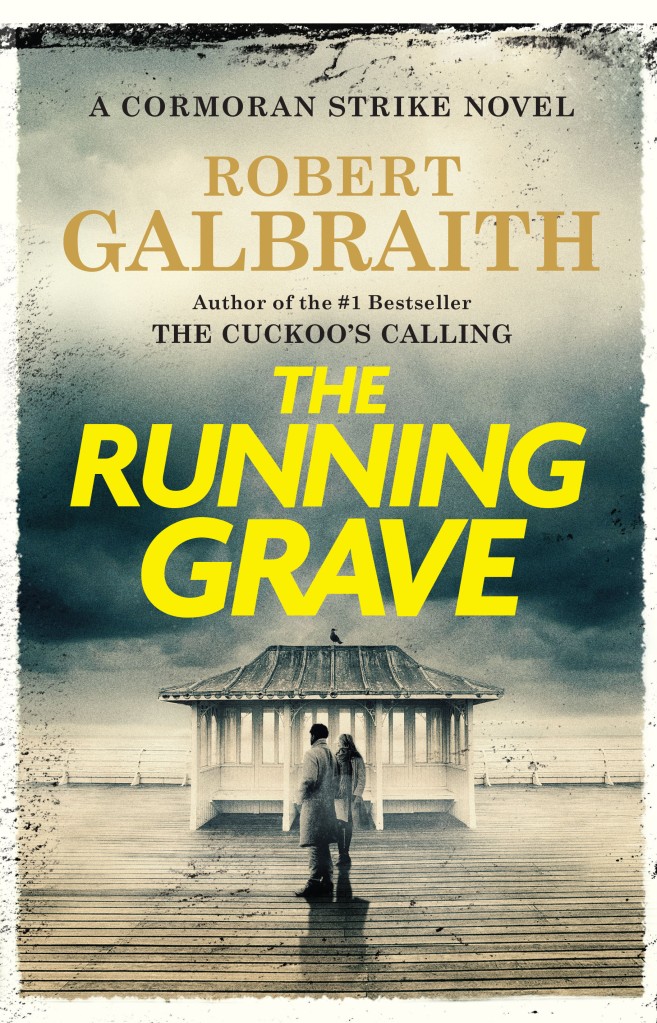
Rowling was so clever in the staging and pacing of this story: Cormoran and Robin are hired by a frantic father to try to extricate his son, Will, from the Universal Humanitarian Church, on the surface a seemingly innocuous organization focused on a general sense of spirituality in service of creating a better world. But after hearing the father’s concerns about how they have prevented all contact between his son and anyone outside the bounds of the cult and then reading up on such rumors as unexplained deaths, compulsory sex, and severe punishments for the slightest infractions, Robin decides to infiltrate the cult. Strike is reluctant to let her be the one, but he is too well known himself to be able to create and maintain an alias, so Robin attends a public meeting of the church designed to recruit new members, and allows herself to be absorbed into their midst and transported to their “farm” in Norfolk for an undetermined length of time, her goal being to contact Will Edensor and see if he is amenable to leaving with her.
This is the genius of the book, creating the world of the cult members living at the farm for Robin to inhabit while keeping Cormoran outside following up on all their other cases, essentially unaware of what’s happening with Robin. They have a tenuous connection: She sneaks out of her dormitory every Thursday night and leaves him a note detailing her week’s experience, putting it in a hollow plastic rock situated in a blind spot near the fence to the outside world; but this weekly check-in is her only fall-back position to get out of what is turning into a seriously sticky situation. Being Robin, she is determined to stay until she achieves results, no matter how precarious things become; and being Cormoran, he is constantly worrying whether he needs to storm the front gate and pull her out of there for her own good. The back-and-forth detailing of the mundane running of the agency (and some rather amusing case work for Cormoran and the gang) with the surreal situation at the farm kept me turning pages every night long after I should have turned out my light and sought sleep.
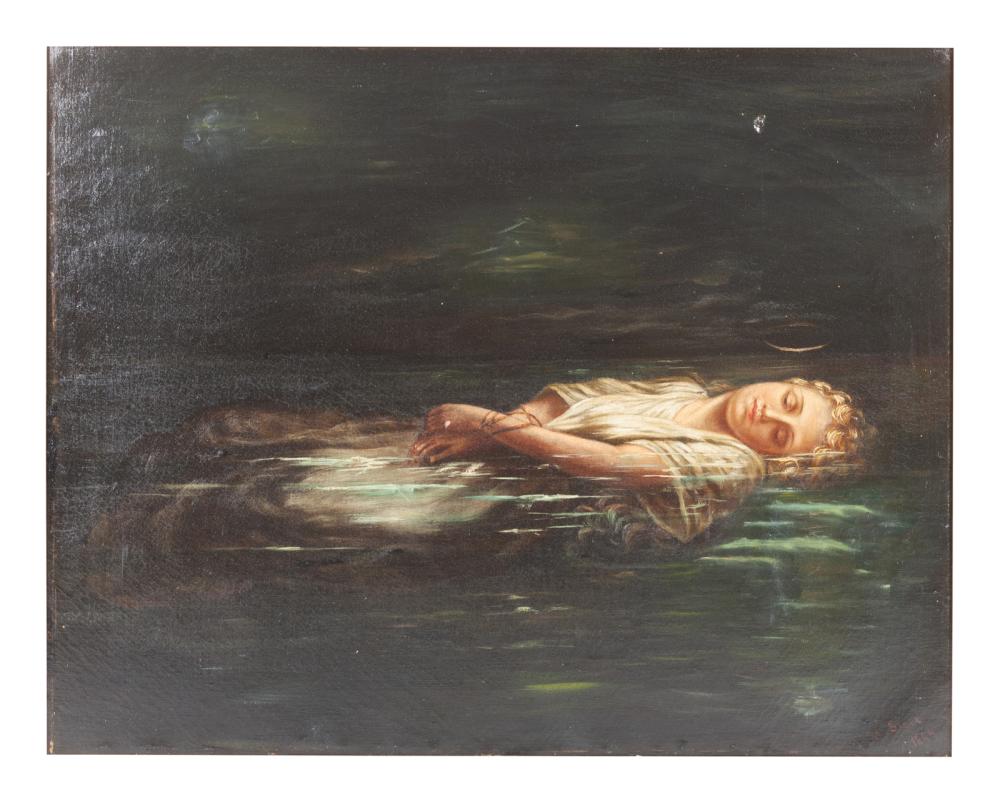
(female saint in water, painter unknown, 1894)
There is also, of course, the ongoing situation between these two business partners who treat each other like best friends while dating other people because they’re afraid of ruining what they have professionally and are also both a bit cowardly about stating their feelings in the absence of certain knowledge about the reaction that revelation would receive. Robin is currently seeing Detective Inspector Ryan Murphy, while Cormoran uses typical bad judgment in his effort to find sex with no ties by getting involved with someone wholly inappropriate and potentially damaging to his (and the agency’s) reputation. But the longer Robin is sequestered in the cult, the more clear Cormoran becomes about what he really wants, and although nothing definitive happens in the relationship arena for most of the book, it’s not the frustrating experience we have endured for far too long, because we can feel something coming, and the cliff-hanger at the end of this one doesn’t disappoint.
What I am telling you is, if your loyalty has floundered in the face of weird plots on the mystery side and stalled emotions in the romantic sub-plot, I think based on this book that Rowling has hit the tipping point and things are going to get increasingly interesting in future tomes. Read The Running Grave and see if you agree!

Misspers
Quite by chance, I ended up reading two books in a row about missing persons. The first was Force of Nature, by Jane Harper, one of her Aaron Falk series, and the second was Liane Moriarty’s latest, Apples Never Fall. I didn’t plan it that way (maybe the library did?), but it made for some fun comparing the two as regards suspense, the form of the narrative, and so on. I enjoy the works of both authors, so it wasn’t really a quality comparison, although they brought different things to the table despite their common theme. They are also both set in Australia, another coincidence? Synchronicity strikes again.
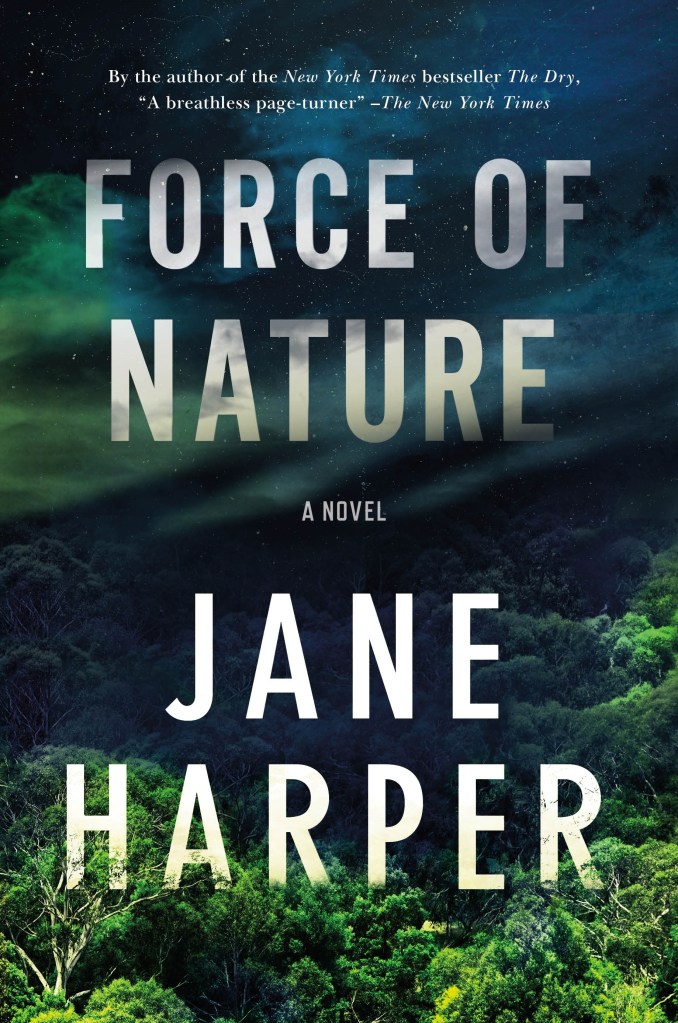
In the first, a company that is secretly being examined by Aaron Falk and his partner for financial crimes sends 10 of its personnel—five men, five women—on a retreat into the wilderness of the Australian bush that is intended as a character-building and bonding exercise. The groups are divided by gender, the men taking one route, the women another. They pack in enough supplies for the first day, and the rest of their food and fuel is stashed for them at two way-stations, each of which they are supposed to reach within a day’s hike. The men successfully complete their retreat and emerge at the expected time, but the women are significantly delayed and, when they do turn up, are exhausted, starving, slightly hysterical, and missing one of their number, Alice Russell. Vague and conflicting accounts are given by the four remaining women and, as the rangers and regular police set up for a comprehensive search of the Giralang range, Federal Police investigator Falk tries to puzzle out whether the missing woman could possibly have met with foul play due to her clandestine connection with his investigation.
I enjoyed the personalities that Harper created—they were both original and yet clichéd in the best manner, in that you could see reflected in them all the characteristics, positive and negative, of the people you yourself might have worked with in a corporate setting—the bully, the ambitious but obsequious assistant, the entitled boss, the low-level couldn’t-care-less data entry clerk, and so on. I also really liked the chemistry and interplay between Aaron Falk and his partner, Carmen. And, as in her novel The Dry, the scene-setting is excellent; you soon feel overwhelmed by the claustrophobic closeness of the trees and the sense that perhaps something is watching from beyond the light of your fire. The book did take a long time to get where it was going, but the jumps from present to past and between multiple narrators/points of view keep it interesting and vibrant. I will continue with this series.

Moriarty’s book is a much more conventional misspers narrative, in that she’s a retired businesswoman and mom from the suburbs. The story opens with a cinematic shot of a deserted bicycle by the side of the road, with a flat front tire and a bunch of apples spilling out of its basket. Then someone comes along and steals the bike, and we realize that a key piece of evidence has just gone missing in a way that guarantees misdirection.
Stan and Joy Delaney, married for 50 years and also partners in a tennis coaching enterprise, have just sold their business and retired, and it’s not going so well. Their four grown children are largely oblivious to this, although certain incidents let them know the marriage is no longer as amicable as they would hope. Then Joy sends the kids a garbled text saying she’s going “off-grid” for a while, and disappears, but Stan doesn’t know anything about where she’s gone or for how long, and has scratches on his face that look like they were inflicted in a struggle. As Joy remains missing day after day with no word and the police seem ever more inclined to look at Stan as their prime suspect in his wife’s disappearance, their children try to come to terms with what they will do if their mother remains missing and if, indeed, their father is the one responsible.
The story is told from a “now” viewpoint and also via a series of flashbacks that cover the past six months or so. Complicating the narrative is the appearance, six months previous, of a stranger—the elfin and bedraggled Savannah—on Stan and Joy’s doorstep, asking for temporary shelter from her abusive boyfriend. The couple welcome her in, but soon her extended stay coupled with her lack of a substantial back story has the Delaney children worried that their kind and gullible parents are being taken in by a grifter.
Moriarty is, as always, a master at creating and developing her characters, and by the end of this you feel like you know each of the Delaneys well enough to predict their actions in any situation. Less predictable is the enigmatic Savannah, and Stan is likewise tough because he holds everything inside and presents a gruff and seemingly uninterested façade to everyone. Although the book probably could have been a bit shorter and still succeeded, I did like the jumping around, as in Harper’s book, from time period to time period and to all the variety of narrators. The one weird thing about the book was its ending, which I should characterize as endings, plural. I read a chapter and the final sentence seemed to put a period on both the scene and the book; then I turned the page to find another chapter, which also seemed conclusive; and this went on for about five more chapters! When the end finally came, it was almost surprising, because Moriarty had dragged it in so many different directions. I found it kind of irritating, but since it also imparted a bunch of information we wouldn’t otherwise have had, I ultimately couldn’t find fault with it, though I feel like it might have been more effective to reveal it all as more a part of the story instead of as a series of addendums, which is how it read. Still, I liked the book a lot, and don’t understand why so many of her readers found it disappointing compared to some of her others. No, it’s not Big Little Lies—but it’s not Nine Perfect Strangers (which I found both weird and unsuccessful) either!
Endings
Does the ending of a book alter your perception of the entire story? This is what I’m pondering, a few minutes after turning the last page of The Moonlight Child, by Karen McQuestion. The book had a compelling premise and an engaging presentation, but the climax and aftermath of the story was too casually told for what had gone before. And that was the crux of the problem, I think—the author ceased showing us and instead starting telling, and the whole story suddenly lost its mojo.

Sharon Lemke is recently retired and reveling in the ability to call all her time her own. She had thought that she would be at loose ends and perhaps immerse herself in volunteer work, but instead she is simply enjoying each day. One night she stays up late to watch a lunar eclipse, and from an upstairs bedroom window she observes something that puzzles her. In the house behind hers, a little girl, perhaps five years old, is standing on a step-stool doing dishes while the lady of the house apparently berates her. First of all, why is a child of that age performing household chores at midnight? and second of all, Sharon knows a little bit about these neighbors, the Flemings, enough to know that they have one son, Jacob, who is 17. So who is the little girl?
Soon after this incident, Sharon’s daughter, Amy, an attorney, calls her to ask a rather large favor: She is a mentor for a teenager, Niki, a former foster child who at 18 has just aged out of the system. Niki hasn’t been able to find an appropriate place to live, and Amy wonders if Sharon would consider letting Niki stay with her for a while. Sharon somewhat reluctantly agrees, but after Niki arrives the two form a bond much like grandparent and grandchild, and both are pleased to go on with the situation.
Niki’s bedroom overlooks the Fleming family’s back yard, and after she, too, notices some odd occurrences surrounding the anonymous little girl who apparently lives with them, she and Sharon decide to call social services. But the wheels of bureaucracy turn slowly; the two become impatient and decide to do a little detective work on their own, to find out who this child is, and what relation she bears to the family. This sets some dramatic events in motion.
I really enjoyed about 85 percent of this book. The characters were interesting and memorable, their interactions dynamic, and the story moved along at an exciting pace, with numerous small surprises to keep things interesting. The psychological aspect of the antagonist—the sociopath, Suzette Fleming, whose selfish needs drive the story and motivate the actions of every member of the Fleming household—was fascinating to observe, and the differences between her perception of the world versus what other people were actually thinking were quite entertaining.
But…then a few things happened that turned me against it. First of all, although Sharon Lemke is initially set up as an important protagonist, she all of a sudden takes a back seat during the crucial action of the book, which was disappointing. I felt like the author decided to relegate her permanently to “grandma” status, rather than allowing her to keep her agency.
Second, the crucial scenes in the resolution of the child Mia’s situation were in some ways excitingly written, but we suddenly lost touch with the thoughts and emotions of Suzette, who was the driving force of all the internal action throughout, and the rest of the book becomes simply a series of narrated events without the context of her delusion. The whole ending resolved itself with comparative ease, but in the process it became truncated, leaving the reader (or, at least, this reader) feeling dissatisfied even though everything had been wrapped up.
So, my question: Does the ending ruin the rest? Not entirely, but sufficiently to change my opinion of this book from an enthusiastic five to a somewhat tepid three. All I could think, for the last 15 percent, was, Damn! and it was going so well!
A certain kind of story
I discovered Jodi Picoult’s books back when I was on the cusp of 40, with her book Mercy (I think). I may have read one of the ones before that, but the descriptions on Goodreads don’t spark any memories. But I have read so many books over the years that sometimes I come to an old one thinking it is new, only to vaguely recognize the story as I get further into it, so I’m not sure. Anyway, after that I made a habit of picking up her books until somewhere around My Sister’s Keeper, in 2004, and after that I lost interest and quit reading them.
It wasn’t because she wasn’t a good writer, and in fact I enjoyed the story in My Sister’s Keeper; but her books increasingly reminded me of my least favorite young adult novels—those the library profession calls “problem novels.” Somehow, even though her characters remained fairly compelling, her books began to seem to me like those preachy tomes written for teens that turned out to be about a condition, or a social concern, rather than a person; as Michael Cart says in his history of teen fiction,
“The problem novel stems from the writer’s social conscience. It gave the frisson of reading about darkness from the comfort of a clean, well lit room.”
Young Adult Literature: From Romance to Realism, p. 35
Rather than telling realistic stories about the teens who experienced certain aspects of life, the books focused on such subjects as drug abuse, abortion, unwed motherhood, and so on, using a formula that approached the feeling of an old-fashioned morality play. Problem novels sought to illustrate the perils inherent in poor life choices, and every time I opened a Picoult novel, it was with the unspoken question: What is the problem/flavor of the month in this one? They became repetitive and increasingly uninteresting to me (although a certain segment of readers continued to eagerly devour every word).
There were a few things that enticed me to once more read a Picoult bestseller: One of the characters is a bee-keeper, which profession has always fascinated me; Picoult co-wrote it with someone rather unexpected, about whom I wanted to know more; and the “What Should I Read Next?” crowd on Facebook pretty much raved unequivocally about Mad Honey, Picoult’s latest hit with Jennifer Finney Boylan.

There were parts of this book that I liked very much. The bee-keeping was, as anticipated, as enthralling as always. The back stories and characters of the two moms were compelling, as was the head-rush of a romance between the two teens, Asher and Lily. The authors wrote both their main and subsidiary characters with conviction and believability. But there was a fatal flaw within the story that really bothered me.
The basic outline is this: Olivia McAfee took her six-year-old son Asher and ran from an abusive husband back to the New Hampshire town where she grew up, inheriting her father’s bee-keeping operation. Asher is now in high school, a star of the hockey team, a good student, and a kind son and friend, having grown up in Olivia’s sole custody.
Ava Campanello fled with her daughter, Lily, from her own marital trials and more, and her employment options with the park service landed her in the same town in New Hampshire just in time for Lily’s senior year, hoping for a fresh start for the both of them.
Asher and Lily are almost immediately drawn to one another, and begin an intense relationship that lasts about four months before Lily ends up dead, having fallen down the stairs in her own home, and Asher is the one who finds her and is discovered weeping and clutching her body—but not calling for an ambulance. After a brief investigation, the police come for Asher and he is charged with first-degree murder.
Thus far, the whole plot worked for me, even the crazy timeline about which some complain, which jumped from before to after “the event” in almost every chapter, and also switched narrators/viewpoints—Olivia to Lily. Then we get to the trial. Olivia’s brother, Jordan, is, serendipitously, a rather famous defense attorney, and immediately comes to the rescue, agreeing to represent Asher pro bono. We go through all the details of a murder case—expert witnesses, character witnesses, the prosecution’s efforts to make the defendant look as guilty as possible by characterizing him as a violent, impulsive liar with both motive and opportunity. Then we get to the defense and Jordan completely falls down on the job.
The question that is never, ever asked by anyone—Asher, his lawyer, his mother or, apparently, the police—is the one that would have been central to the defense in any halfway well written murder mystery. Can you guess what it is? In his Dismas Hardy legal thriller series, author John Lescroart characterizes it as the “SODDIT” defense: Some Other Dude Did It. In Mad Honey, Asher adamantly maintains his innocence: When he walked in the (slightly ajar) front door, Lily was lying at the foot of the stairs, her head bleeding. His uncle/lawyer and his mother believe him, despite his mother’s secret fears that genetics have won out and he is violent like his gas-lighter of a father. The prosecution is insisting that he did do it, based almost solely on circumstantial evidence—some DNA, some texts, a scandal in his past that brands him as a liar. But not one person who believed he didn’t do it (including Asher himself!) spoke up to say, If Asher didn’t kill her, then who did?
Jordan should have been all over that—questioning the police and detectives to see whether they had considered any alternate person and scenario, having his investigator look into others who might have been suspicious, checking neighbors and traffic cams to determine whether anyone else visited the house that day, but…crickets. No mention of an alternative theory of who the murderer could be. That’s pretty much when the story lost me, and should have been when Asher, fighting for the rest of his life, or his mother, with her greater adult wisdom, sat up and said Jordan! WTF?
It didn’t totally ruin the rest for me—I still liked the characters (particularly Lily), the story, and the twists, small and large, and might recommend it based on those things. (And you should know that, despite all the surface details cataloged in this review, I have kept all the big secrets of the book.) But that one omission, paired with the way the book ends, made me realize that perhaps my initial conclusion—that Picoult is too focused on the social concerns she wants to highlight to truly immerse herself in the meat of the story—was not off base. I won’t say I’ll never read another from the Picoult oeuvre, but it will take something extraordinary to convince me.

Unreliable narrator(s)
Typically, a third-person narrative offers (at best) a picture of objective reality, or at least a world-view that is easily identified as biased in a particular way. But a first-person narrator has no obligation to offer the facts of a recognizable history—that person is free to substitute his or her own perceptions and interpretations, given without third-party corroboration to demonstrate them as accurate. Personal bias is included in those perceptions, but is not recognized by the narrator, who treats his own view as if it is “the truth,” and the reader must then decide whether to believe it.
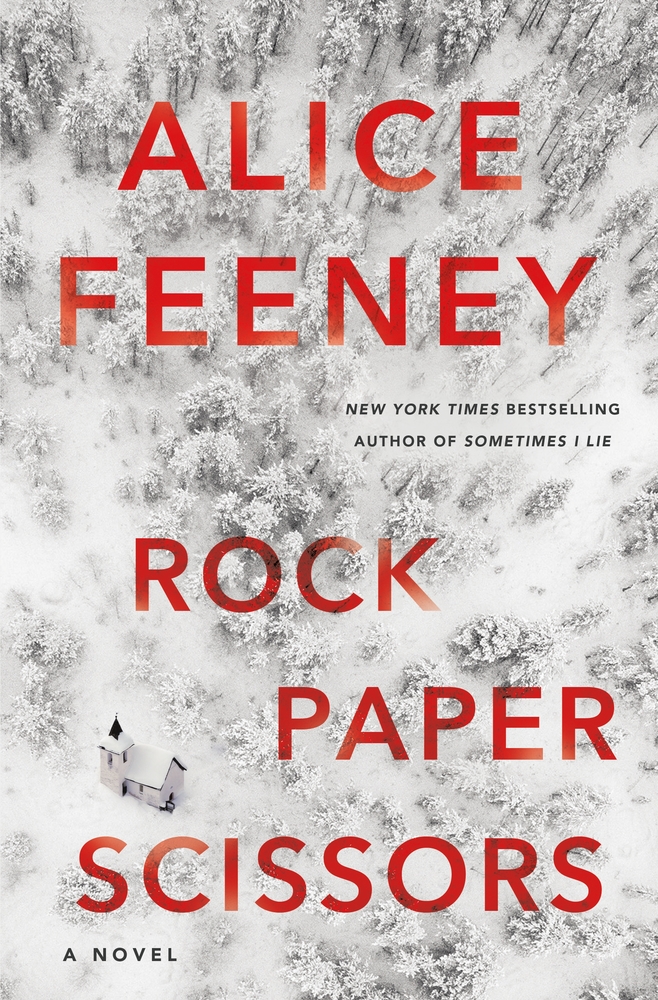
In Alice Feeney’s book Rock Paper Scissors, we have three personal narratives—those of Adam and Amelia Wright, a married couple who are (supposedly at least) both attempting to put their floundering marriage right with the help of a weekend “away,” and also that of a third person who comes along later in the story. The narrative jumps back and forth between Adam and Amelia for the first half or so of the book before broadening to include this third person, and we are serially treated to each character’s view of “the facts” about the other person, the relationship, and their individual and shared back history.
This is a nice set-up for what is supposed to be a rather dark tale of suspense. In a good suspense novel, the protagonists become aware of danger only gradually, with a subtle build influenced by the setting and mood, and with conflict present in every scene. The characters must start out in a state of slight uneasiness that builds to confusion, upset, and perhaps terror. And a good suspense book, of course, builds in a series of reveals or surprises up until the final one, keeping the reader uncertain about the outcome. The whole thing is about what may happen, about anticipation.
The tricky balance to this kind of book—and where Rock Paper Scissors lost me—is the reader’s identification with one or more of the narrators. In a suspense novel, the narrators are by definition unreliable, because that’s how the story arrives at its twists. But just because they are unreliable, does it follow that they must also be unlikeable? Adam Wright is a pompous, self-involved screenwriter with little regard for anything outside the boundaries of his ambition. Amelia Wright, apart from her work at the Battersea Dog Shelter, is equally narcissistic, expecting more from Adam than he is willing or able to give and therefore living in a constant state of disappointment with her life and her marriage. The idea that a weekend alone together in picturesque Scotland, in a converted chapel on the shores of a loch, could fix what’s wrong with these two is laughable. But that’s the scene when the story opens, as the two drive Amelia’s ancient car through a blinding snowstorm trying to reach their destination before they run out of gas or the snow strands them miles from civilization.
From the first page, each is cataloging the negligence, insensitivity, and mean little tricks of the other. By the end of the first couple of chapters I already heartily disliked the both of them, and almost put the book down at the point where they reach their destination, because it seemed like things would just continue to disintegrate. Curiosity about the back story that landed them here kept me going, but I should have listened to my first intuition and stopped reading.
It wasn’t just that Adam and Amelia were so dislikeable; the writing, too, and the pacing of the story were subtly off. The situation at their weekend retreat is purposely amped up to the point where I kept saying “Oh, c’mon!” at regular intervals. There were too many hints from both sides that each knew something that would fatefully impact the other, but the portents seemed too extreme and too abrupt to happen during a weekend in the country; also, the revelations didn’t unfold until so late in the book that I honestly think the author forgot she had inserted some of them, because they just never jelled, provoking an anticlimactic feeling about the entire story. And while the big twists were definitely momentous, given to whom they were happening, I just didn’t care.
Also, I thought the epilogue was idiotic.
I always struggle with whether to write a negative review, especially when it is a book that has been enjoyed and acclaimed by many. This one receives a preponderance of four stars on Goodreads, probably due to the fact that the “twists” are powerful. But the writing was clunky and full of clichés, the pacing alternated between maddeningly slow and overly dramatic for about 50 percent of the book, and the characters seemed flat and boring to me. The worst part was the many ominous hints that never panned out.
So the question for you is, when you are reading a psychological novel of suspense, is it more important to you that the writing, characters, and plot be of a certain quality, or that the author is able to pull off one or more true surprises? I obviously came down on the side of the former, but perhaps most people who are reading suspense appreciate the latter enough to be forgiving about the rest? I am personally feeling a bit disgruntled with Alice Feeney at the moment, because I wish I hadn’t invested the time and attention on her story.
And finally, I just want to say that everyone knows how to win or lose at rock-paper-scissors, so the idea of using it as a decider with someone you know so well that you can predict their response is, well, dumb.
Over the top is okay!
The latest installment of Elle Cosimano’s Finlay Donovan series dropped on January 31st, and I started reading it a few days later when I discovered it on my Kindle (I had prepaid for the e-book dump and then forgotten all about it).
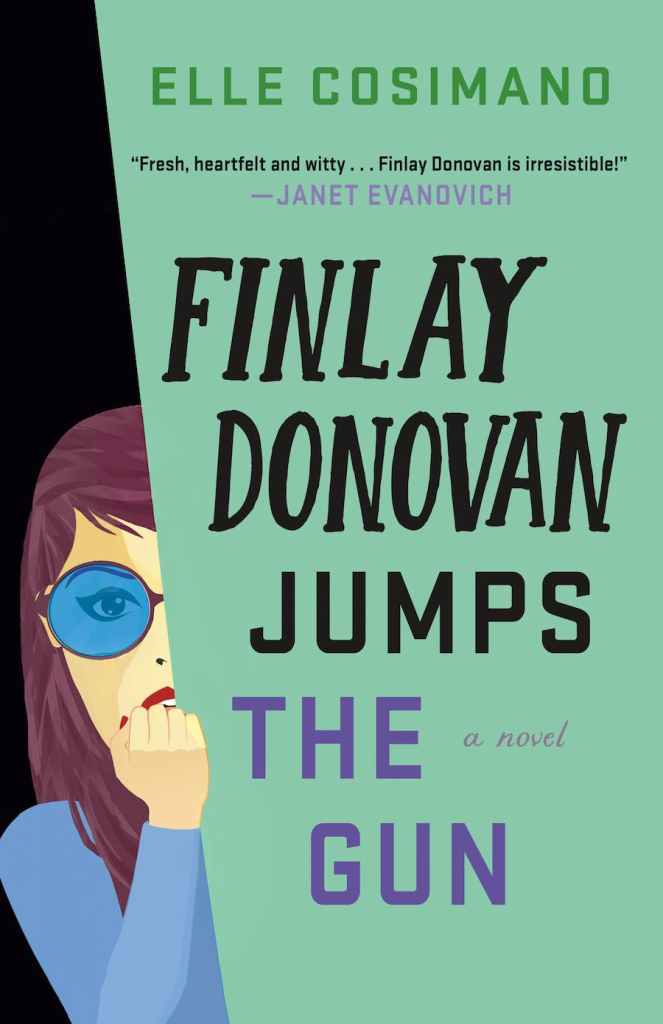
Finlay Donovan Jumps the Gun carries on fairly precisely where the last book left off: Finlay and her sidekick, nanny/ accountant Vero, are indebted to Feliks Zhirov (the local Russian mob boss) for saving them from an embarrassing and dangerous situation, and he (of course) wants something in return. There’s a person called “EasyClean” who is operating online as a paid assassin; Feliks wants to know this person’s identity, and believes that Finlay can deliver that to him. Being impatient (as mob bosses often are, don’t you know), he gives her a two-week deadline, which doesn’t make her one-week time limit with her agent for the final manuscript of her latest novel any easier to achieve, especially since the contents of the book are so close to the circumstances of her personal life that she has run head-on into writer’s block trying to resolve them.
Meanwhile, Vero has a deadline of her own—she’s delinquent on a gambling debt with a loan shark out of Atlantic City, and his enforcers are hot on her heels. What’s the solution? Finlay and Vero decide it’s to enroll in a one-week civilian police academy training. After all, they have come to believe that EasyClean may actually be a cop, so where better to figure it all out than from in amongst ’em? And where else could they be sure that pesky flunkies for the mob won’t be able to touch them? Finlay hands over the kids to Steven for a week, and the two move into the police academy dormitory to see what they can see. And, since it’s Finlay Donovan, chaos immediately ensues. Did I mention that Finlay’s crush, Detective Nick, is running the thing? and that both of his slightly suspicious partners and Finlay’s police officer sister are in attendance? And that the supposedly well-guarded barriers to the facility turn out to be as porous as swiss cheese when it comes to characters, suspicious or otherwise, making their way to the window of Finlay’s room?
In short, this is yet another frenetic flourish of Cosimano’s pen in pursuit of the author/single mom/accidental hit woman, and carries the franchise along nicely. I had been under the impression, for some reason, that this series would be a trilogy, but that’s not the case—this one ended on yet another cliff hanger, ensuring there are more books to come. (If all of this description has intrigued you, read the series in order from the beginning or you will be lost.)
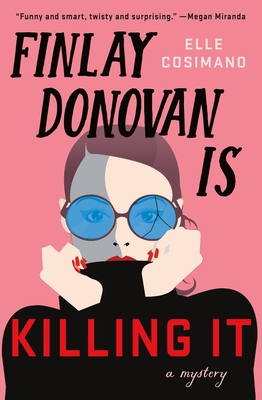
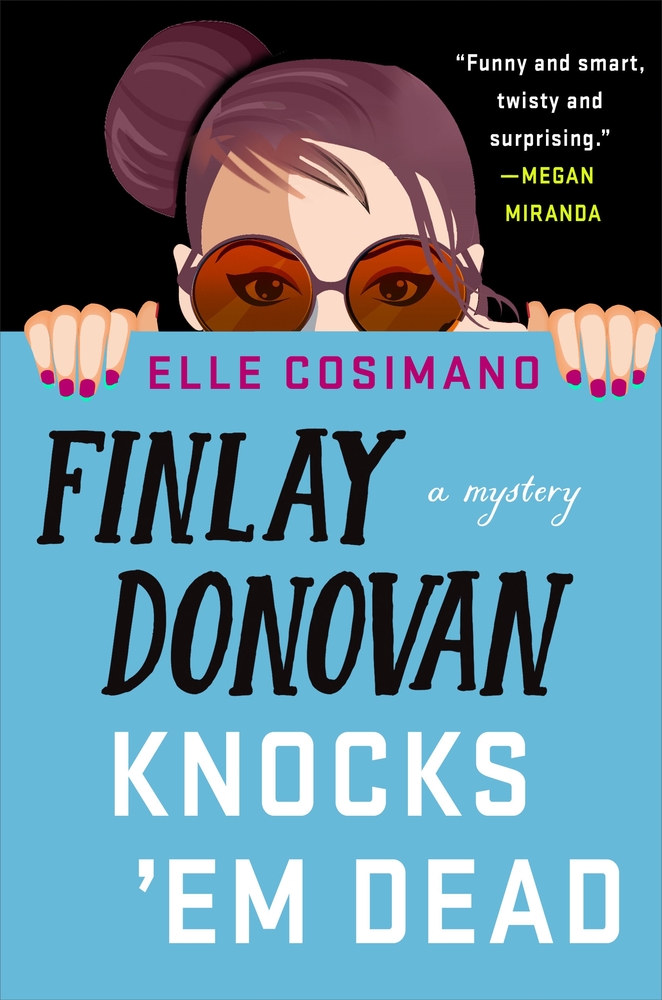
I’m a little torn on my rating for this book. I gave the first one five stars, and the second one got four; I’m tending towards four stars on this one as well. Although it had moments that were totally brilliant (the opening scene with toddler Zach comes to mind), it also had some repetitive stuff (the continued misunderstandings about poor Javi); and the restriction of the scene-setting to the police academy means we miss out on some of the fun interactions with unsuspecting civilians that were so important to the first two books. But I did enjoy the thought processes behind figuring out EasyClean, and Cosimano is an expert at writing the hapless, accidental escalation into total mayhem that feels like Lucy Ricardo has landed in the middle of a murder mystery! I will definitely look forward to the next installment in Finlay’s overwrought journey, particularly the resolution of so many relationships: Will she finally put Steven firmly in his place? Will they ever get Vero out of debt and able to show her face again? Will Finlay be able to have a relationship with Nick without revealing all her (mostly inadvertent) criminal activities? Will Georgia find a girlfriend? Will Zach complete potty training? For these and many other crucial details, we once again await you, Elle Cosimano!
 The Book Adept