Glacial thrills
No matter where she takes you or what unlikely scenario into which she drops you, Sharon Bolton never disappoints. I first discovered her when I picked up one of her stand-alone novels from the new books shelf at the library a few years ago, and I haven’t missed one since. I equally enjoyed her four-book (and two-novella) series starring Detective Inspector Lacey Flint.
I recently received a notice from Goodreads that Bolton had published a new novel, but when I went to check out the e-book from the library, it was a three-week wait. Undeterred, I put it on hold and decided, while I waited, to reread the Lacey Flint foursome plus novellas. I managed to read books one and two and the first novella, but received book four while waiting for book three and didn’t want to go out of order, so I read something else. Then The Split, her new one, became available, so I enthusiastically jumped over to that.
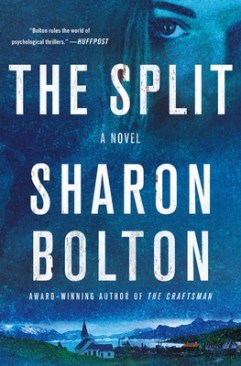 The story begins with Dr. Felicity Lloyd, a glaciologist (yes, there is such a thing) who has been living in Antarctica on the remote island of South Georgia for the past nine months. She is part of a research team there to study flow and the draining of lake waters as the precursor to the breakup or “calving” of glaciers. Although this research is the dream job of her career, Felicity has an additional reason for retreating to this forbidding landscape: Her ex-husband, Freddie, who abused her terribly while they were together, has written to tell her that he is out of prison and wants to see her. Although Felicity feels fairly secure at her post at the end of the world, cruise ships do arrive from time to time, and she watches their manifests scrupulously. When the Storm Queen faxes over a list of passengers with Freddie Lloyd’s name on page five, Felicity knows she has to take drastic action to escape him. She packs up and heads for a deserted mining town on the other side of the island. Freddie follows, but is foiled in his attempt to get to Felicity by a woman named Bamber, who confronts him, gun in hand…
At this point, we are transported back 10 months to Cambridge, England, where Felicity lives and works at the University, and where she has just received the offer to go to South Georgia. Only one impediment stands in the way of accepting the job: She has recently been attacked, but has no memory of who hurt her or why, and the University has mandated that she see a therapist. Unless she can convince the therapist to sign off on her good health, she will lose this amazing opportunity, which is also the perfect hiding place from her past. Dr. Joe Grant, her therapist, realizes she is trying to manipulate his diagnosis, and the better he gets to know her, the more troubling her problems become. Dr. Grant is, himself, recovering from the loss of a woman with whom he was working as part of his pro bono community service, while his mother, Delilah, a police officer, is pursuing the killer of two homeless women.
During the next six weeks red herrings abound, and ultimately you don’t know who to suspect of what, and why. Bolton does her usual good job of keeping her reader breathless with anticipation at each turn in the road, and provides the unexpected at every one. Fast-paced, well written, and exciting, this is a twisty thriller made even better by its vivid descriptions of its unusual landscapes and the careful delineation of each character. Sharon Bolton, as I discovered when I read her last published book—Dead Woman Walking—can get you to believe practically anything, no matter how unlikely, and The Split reinforces that assessment.
Journalism & crime
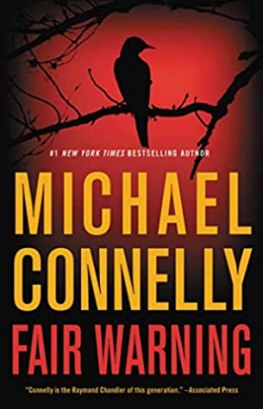 On May 26th, a surprise arrived via my Kindle. I had completely forgotten that I had pre-purchased Michael Connelly’s new novel, Fair Warning, to be delivered as soon as it was published, and suddenly there it was! I had another book mid-read, so I have just finished it.
Connelly leaves the world of Harry Bosch to hark back to gonzo journalist Jack McEvoy, the protagonist of two of his former books, The Poet and The Scarecrow. Although I read both of those books when they came out (I have to date read 34 of Connelly’s books!), it’s been such a long time that I toyed with the idea of revisiting them first before proceeding with the new one, but chose to forge ahead. Although there were a few references to the previous cases in this one, it essentially read like a stand-alone for those who hadn’t read them, so that was fine.
As well as being the title of the book, Fair Warning is the name of a non-profit consumer protection news website run by Myron Levin (which actually exists in real life). Jack is a reporter for this website, which feels like something of a come-down from his former hard-hitting crime beat for the L.A. Times (and his authorship of two best-selling books), but he is quick to point out that consumer reporting is a vital service to the public, especially in this age of accelerating scientific discovery, and that many major papers (the L.A. Times and others) pick up and run with his stories. Maybe he protests too much?
The beginning of this story, however, isn’t professional, it’s personal: Two homicide detectives show up at McEvoy’s door with the news that Tina Portrero, a woman with whom he had a fun, slightly drunken one-night stand (a year previous) has been brutally murdered, and he is a suspect. Jack cooperates to the extent that he provides a DNA sample in order to eliminate himself from their list of “people of interest”; but then, because of a curious mind and an eye for the anomalous detail, McEvoy gets ahead of the detectives on this crime and a bunch of related ones.
The method of the murder (which I won’t mention here) is so dramatic and so extreme that McEvoy researches it, and discovers that this method appears in widespread cases; then he notices that the murderer may have been using personal data shared by the victims themselves in a particular way, to select and hunt his targets.
At this point, McEvoy has ceased to think of himself as an accused murderer and started to see the potential for a really big story that involves solving the murders of a bunch of women, zeroing in on a serial killer, and even calling the government to account for lax practices in data protection. So he decides to reach out to his former lover, Rachel Walling, whose FBI profiling career he burned the last time they collaborated, to see if she can pull some strings for him.
Instead, Rachel jumps into the middle of his quest, perhaps to curry favor with and return to the FBI fold, helping Jack’s information stream but also setting up all kinds of conflicts of interest.
A big part of the story here is the moral quandaries in which the various characters find themselves. McEvoy does want to identify the killer and facilitate his capture; but he also wants to break his story, which means he can’t hand over all his information to the police until he “gets the scoop.” He and Rachel Walling have a chemistry between them that didn’t disappear with their falling-out years ago, so there is a motivation to perhaps rekindle that. In addition, Walling has been pursuing a necessary but boring job since she left the FBI, so the prospect of handing them a serial killer ignites her with the ambition to prove them wrong for firing her. A colleague of Jack’s at the website, who is added to the story by his editor, wants to make a name for herself without treading on Jack’s toes too much to do so; and Jack realizes that although he is the better researcher, she is the better writer, so he reluctantly acquiesces in her involvement but then keeps throwing her under the bus. And of course the police want to be the first, last, and final arbiters of what happens with this case, story scoop be damned. It makes for an interesting level of tension throughout the story.
Connelly has pulled off a gripping, fast-paced tale whose interest level is enhanced by having a reporter, rather than a detective, at the helm. Some of the true-to-life details of data collection and (the lack of) government regulation are chilling, and he also fills in the reader on some aspects of operating on the dark web, as well as providing the usual details of his Los Angeles setting that are fun for those of us who live here and recognize them. I enjoyed this book, and it was a nice change from the Bosch litany.
And no, I have no idea why there is a black bird (a crow? a raven?) on the cover.
Ninth House
I have been anticipating reading Ninth House, by Leigh Bardugo, for several reasons: Although I didn’t care for her Grisha series because it was so full of angsty teenage indecision, I absolutely loved the duology Six of Crows and Crooked Kingdom, particularly the latter. I felt like Bardugo had stepped up her style and discernment by a lot in the second series, and also, I can’t resist a “gang of thieves” story.
 I’m really not sure why Ninth House has been identified as an adult, rather than a teen, book. Admittedly, it’s far too gory and explicit for younger teens, but I could definitely see some of my former book club members from the 10th-12th grade club enjoying this. After all, the philosophy in writing for children or teens is that they always want to read “up,” which is to say, they want to read about a protagonist who is a year or two older than they are. As a freshman at Yale, the Ninth House protagonist, Alex Stern, is just the right age to appeal to seniors in high school. I imagine many parents of said older teens would still quibble with me, because they feel their children should be protected from such graphic fare; and there is a part of me that thinks everyone should be protected from it! But as you learn from reading a lot of books, sometimes you need that stuff to make a point, to expose a wrong-doing, to create empathy in your reader. (Plus, of course, for dramatic effect in your adventure story.) There were certainly plenty of opportunities for that here!
Within the first few pages of this book, I seriously considered putting it down without finishing it. There is a scene early on in which a group of students from one of the magical “houses” at Yale performs a “prognostication” by reading the innards of a man who is still alive (although sedated), with his stomach cut open and pinned back; when they’re done, they stitch him up and send him off to hospital without another thought for his well-being. Also present at the ritual were a group of “Grays,” ghosts who gave off a really frightening vibe. The entire scene turned my stomach, and since I hadn’t as yet invested much into either the story, the scene, or the protagonist (and didn’t really want to encounter more of this), I thought about stopping. But surely all my friends—both personal and Goodreads-type—who were bowled over by this book couldn’t be wrong? So I kept reading.
Ultimately, I was glad I did. Although it took a long time to understand what was happening and also to bond with the main character, I eventually came to appreciate both the bizarre behind-the scenes action and the dogged, flawed, yet honorable Alex, who didn’t give up no matter what.
“Could she grasp the ugly truth of it all?
That magic wasn’t something
gilded and benign, just another
commodity that only
some people could afford?”
Some things I liked about the book:
It gives this Ivy League school an ulterior motive for existing that is both completely creepy and also believable. The concept of a university elite is nothing new, but the idea that they became that way by the practice of necromancy, portal magic, splanchomancy (the reading of entrails), therianthropy (basically, shape-shifting), glamours, and the like is certainly novel!
The funniest part of this is at the end of the book, in an appendix, where the author describes the eight occult houses, reveals in what talent or magic each is invested, and then names graduates (from the real world) who have benefited by being members of the houses during their careers at Yale.
This is not just an amusing commentary, however, on how these students one-upped their futures by participating in magical solutions on the sly. As highlighted in the quote above, Alex comes to realize that magic, while theoretically accessible to whoever was trained or born to practice it, was in reality a tool of the rich and privileged that was sought after at the expense of the poor and defenseless. This is a huge theme of the book, and this is why the reader is able to bear with all the dark scenes, because they are so illustrative of our own contemporary world where billionaires are tripling their wealth during the pandemic while so-called “essential” workers are flogged back to their minimum-wage jobs, despite the danger, by the threat of unemployment. I don’t know if she intended it, but Bardugo here reveals the true “deep state” of influence, bought and traded favors, and a deep disregard for anyone who gets in the way.
Up against this mostly impenetrable and nearly unbeatable system of advancement is Galaxy “Alex” Stern, an underdog heroine if there ever was one. She is recruited (and given a full ride to Yale) to be a member of a secret society, Lethe, whose officers are trained to monitor the other eight houses for stepping over the line, and to report and penalize them when they do. Alex wants to use her special abilities for good, but quickly realizes that her job is mostly for show, and that there will be few consequences for any of these offenders, because to bring their activities out into the light would mean embarrassment for alumni, for administrators, and for Yale itself as an institution. What the people who recruited her don’t realize, however, is that first, Alex has abilities about which they (and at first she) are unaware, and that second, Alex has been conditioned by life as an almost constant victim to fight for herself and for other victims no matter how hard the going.
At its heart, Ninth House is a giant (and cleverly structured) mystery. There is a contemporary murder, there are disappearances of vital personnel, there is a string of dead girls from the past that may tie in, and Alex, despite discouragement from both her mentors and her opponents, is determined to solve it in order to bring justice for the have-nots that she sees as her equals.
But the book is not single-minded. There are also themes of friendship and (nonromantic) love, and a lot of social commentary. There is the gradual evolution, also, of the book’s characters as they confront issues and reflect upon their responses. One early-on thought from Alex that I loved was when she was pondering how easily things change from “normal” to not:
“You started sleeping until noon, skipped one class, one day of school, lost one job, then another, forgot the way that normal people did things. You lost the language of ordinary life.”
There were also, in amongst some fairly gruesome scenes that (if you are squeamish, you should be aware) include drug abuse, coercion, murder, rape, and the like, some inside jokes about college that I enjoyed, including some funny dormitory moments among roommates. One library-oriented joke, as noted by my Goodreads friend Lucky Little Cat, was, “I especially liked the special-collections library where occult search requests result in the delivery of either an avalanche of barely relevant books or one lonely pamphlet.’ Anybody who has been to college has encountered this result, with absolutely no occult assistance whatsoever!
Be aware that some readers have accused Bardugo of racism (because of a few comments on Alex’s Mexican origins), and of blatant sexism and misogyny in her portrayal of the rape scenes in the book (because they are pictured from the observer’s point of view rather than that of the victim’s). You will have to decide for yourself how you feel about these accusations.
Bottom line, apart from a rather confusing and disjointed few pages at the beginning, I found this to be a clever, nuanced read about white privilege (as symbolized by magic!) and the lengths to which people will go to cling to it. It also has both a protagonist and a secondary character that, while the book has a satisfactory ending, you are longing to follow into the sequel, which will hopefully be produced quickly.
Unreliable
The book I read this week is a fairly classic example of a story told by an unreliable narrator. It is also written in epistolary form, which is to say in the form of a letter to another person. You might also view this book as an example of Victorian Gothic, although it takes place in 2017, because of the setting and some of the events.
A narrator always serves as a filter for her story, and if that story is told in first person, then the only person’s viewpoint we are able to discover is that of the storyteller. As readers, we generally believe that the narrator is truthful and is providing, as far as she is able, an accurate view of the story. But an unreliable narrator is one whose version of the story the reader comes to realize cannot be trusted; there is a point in the narration at which the reader discovers there are lies involved, a hidden agenda is revealed, or the nature of the narrator is discovered to be criminal, crazy, naive, pathological, or any other aberration that would call the person’s views into question. Motivations are revealed that cast doubt on the narrator’s veracity, and the reader has to decide whether the narrator is being willfully deceptive, or is just deceiving herself.
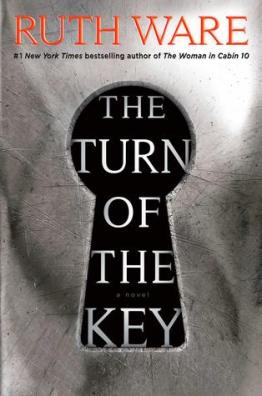 Whatever the case, it takes a certain level of skill to write an unreliable narrator that readers will continue to follow even when they have discovered this deceptive nature. The protagonist in The Turn of the Key, by Ruth Ware, is one such character.
The book opens with a set of incomplete letters, each addressed to a solicitor, a Mr. Wrexham—impassioned pleas for him to listen to her story, to believe her, and to defend her. Rowan Caine is a nanny sitting in jail awaiting trial for the murder of one of her charges. She already has an attorney, but believes (with some justification) that he is one of the reasons she is behind bars, and is looking for someone who will hear her out instead of dismissing the (admittedly odd) details of her story as irrelevant. Eventually she manages to push through all her false starts and put the events down on paper for Mr. Wrexham.
It proves to be a disturbing and convoluted explanation, with multiple reveals as we discover that Rowan is not who she pretended to be, on at least two separate levels. It also furnishes plenty of questions about the motivations of the other characters, but once you realize that she has lied about some significant events, you are provided with many reasons to doubt her experiences.
The story’s gothic elements arise from the setting, which is an old Victorian mansion set in the wilds of Scotland that has been bought and massively but jarringly remodeled by a husband-and-wife team of architects. The front half of the house maintains its pristine Victorian façade and ornate interior, while the rear has been demolished and replaced with an über-modern structure of cement and glass that provides a jarring disconnect when moving from one part of the mansion to another. And it also turns out that when the mansion was stripped and refinished, certain secrets of its architecture remained unknown to the builders, while other aspects of the house are almost too well known through its surveillance app that provides a view and a microphone to almost every room.

The couple in question, Bill and Sandra Elincourt, have four children—a teenager, an eight-year-old, a five-year-old, and a toddler. They have gone through four nannies within the past year, and are looking for someone qualified, reliable, and without a surfeit of imagination or superstition to take responsibility while they are pursuing their busy careers. Enter Rowan Caine, beguiled by the generous salary, the beautiful house, and the apparently well-behaved children. But when the Elincourts take off for a few weeks of conventions and client meetings, things begin to disintegrate, starting with the behavior of the children and ending with a series of strange events that may or may not be related to the remote controls installed in the house.
This is a suspenseful story, with vivid description and a gripping, slightly ominous feel throughout. The story builds to its conclusion, which is both cryptic and satisfying. The only thing I am pondering is whether I loved or hated the ending. It’s plausible, it explains much, but the result it implies is vague enough that I had to read it a couple of times to decide what I thought and whether I believed it.
For readers who are looking for a thrill, who enjoy a tale with twists, and who embrace the ploy of an unreliable narrator, The Turn of the Key will satisfy.
Tangents
When is an author building appropriate back story for his characters, and when is he just going off on random tangents?
I thought about this question a lot while reading Since We Fell, by Dennis Lehane. Some of his books have been among my favorites, particularly Mystic River and Gone Baby Gone, so I was pleased to discover there was a stand-alone I hadn’t yet read.
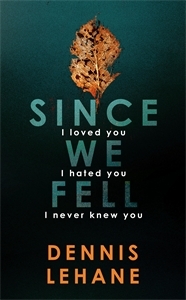 The first half of the book—maybe more than half—is dedicated to a meandering examination of the life and internal workings of Rachel Childs. Her beginnings are typical for smart and broken children—a difficult mother, an absent father, a lot of pressure to be perfect but on someone else’s terms. Most of this part of the book focuses on Rachel’s obsessive and ongoing quest to find out her father’s identity. Her mother refuses to tell her, and then dies; she tries hiring a private detective but the pickings are so slim that even he refuses to charge her for what little he can discover; and every clue seemingly leads to a dead end.
The book maintained my interest throughout this quest, but only because it said interesting things about Rachel herself. Then it takes a segué into career and family, as she develops her abilities as an on-air news reporter and, under the tuition of her new husband Sebastian, a producer and mentor, becomes known for reporting on dangerous situations in marginalized societies. This career leads to a crisis that triggers anxiety attacks and agoraphobia.
At this point Brian Delacroix, the private detective she hired to look into her father’s identity, comes back into her life. She realizes there was always a spark between them and begins to explore a relationship, and at that point I thought, Was the entire first half of the book only a build-up to get us to this pairing?
After this transition, the book’s purpose turns yet again, and becomes a Hitchcockian thriller with a secret. The first half of the book doesn’t telegraph this in any way, so the subsequent events are quite disconcerting, particularly when Rachel rather abruptly goes from a passive to an active player and turns into someone you’re not sure you believe was “in there” all this time. So if you can suspend disbelief enough to see the entire book as a character study of Rachel, then it works as a whole. If you are unable to do so, it falls apart into separate, interesting, but not necessarily well integrated parts that seem like they belong in at least two different books.
I always enjoy Lehane’s writing style—he reminds me of some of the classic mystery/thriller writers I read when younger, such as Patricia Highsmith and Ruth Rendell. But while this book held my attention throughout, I couldn’t recommend it unreservedly to people looking for one of Lehane’s trademark psychological thrillers. There was both too much and too little to sustain a specific mood, and I focused more on the transitions than on the tale.
Empathy
This book made me cry three separate times, and I don’t do that. Ever.
The book is Just Life, by Neil Abramson, and is one of half a dozen that I bought recently from bookoutlet.com, which sells remaindered books for between $2.49 and $7.00, paperbacks and hardcovers alike, music to the ears of someone who reads as much as I do. The only downside to these prices (which, let’s face it, is also an upside) is that shipping is high unless you order $35 worth of merchandise, in which case it’s free. So when I notice a book or two that I want and they have, I scroll through the rest of what is on offer and pick up enough to get that free shipping. Just Life came in one of those mixed bags. I’d never heard of either it or its author, but the story sounded good.
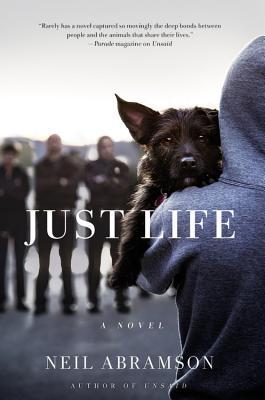 It starts out like a dystopian suspense novel: It’s told in third person, but from the points of view of four major characters, one of whom is a veterinarian and proprietor of a no-kill animal shelter, in the Riverside borough of New York City, that is being zoned out of existence. Adding to her desperate attempts to save her shelter or find somewhere for her dogs to go is an additional disaster: There is some sort of virus, appearing only in that neighborhood, that is making children sick. One has just died, more are severely ill, and the virus, which was initially blamed on pigeons, is now felt to be the responsibility of dogs with rabies in Central Park.
Samantha, the vet, and anyone as familiar as she is with infectious viruses (her estranged father is a researcher) is frankly skeptical that this could be the cause, but she knows from experience how fear can work on the human mind, and worries that panic and ignorance will mandate a “QCK,” an acronym for quarantine-cull-kill.
The other major characters in the book—a city policeman (formerly a K9 cop) assigned by choice to this neighborhood, a homeless, damaged teenager with a special affinity for dogs, and an elderly Catholic priest suffering the onset of Alzheimer’s—personify the double entendre indicated by the title of the book: They are all attempting to live a just life, and part of that mandate is a concern for all creatures, not just for humans.
The other meaning of the title becomes clear as the back story reveals that there are no viruses in animals to which humans are ultimately resistant, and vice versa—that we are all “just life,” and equally susceptible. But local politicians and bureaucrats, including the governor (who is running for president and wants to act the hero) and the Centers for Disease Control (CDC) refuse to admit that proposition could be true, and the protagonists must mount a defense in a war against dogs.
In his afterword, Abramson writes about how he hoped to show the eternal battle between fear and compassion, and how achieving compassion in the face of fear is a daily struggle. The story line in Just Life emphasizes this battle and highlights the difference between those who love all life and those who prioritize humans. In the process it is suspenseful, moving, and eye-opening.
At one point in the book, someone asks Sam what she would do if someone came for her dogs. She remembered that in veterinary school one of her professors had made her class memorize a quote from William Ralph Inge:
“We have enslaved the rest of the animal creation, and have treated our distant cousins in fur and feathers so badly that beyond doubt, if they were able to formulate a religion, they would depict the Devil in human form.”
Anyone who is a dog person knows that the most badly treated of them will nonetheless forgive a human who shows them a little kindness. This book, for me, posed the question, What if we could all be so empathetic?
It was also a fast-paced, gripping story with both people and causes worthy of embracing, and an exciting ending that has you afraid to turn the final pages.
News re: my dog
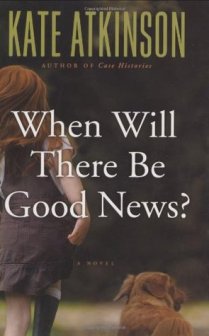 At the center of When Will There Be Good News, Kate Atkinson’s third Jackson Brodie novel, is a new character, Reggie. I enjoyed this book mainly because I so adored her. She is 16 (sweartogod), looks 12, acts 36, and is an old soul and a compassionate but completely pragmatic one. Best teenager in fiction for a while now.
While I found the multiple story lines of Dr. Joanna Hunter, whose family members were all inexplicably knifed to death in the middle of a field one day when she was a child, Joanna’s husband’s questionable business practices, Chief Inspector Louise Monroe’s domestic violence case, and the almost incidental appearance of Jackson Brodie (who is in-country for personal reasons and yet by a twist of fate ends up plumped down in the middle of all of these mysteries) all to be interesting, it isn’t until they get connected by Reggie that things really get going, even though she, like Brodie, is involved almost despite herself. The brief period when Louise, Jackson, and Reggie are all in the same room at the same time is my favorite scene in the book.
These books of Atkinson’s are so…perverse! Not in a sexual way, let me hasten to add, but in the sense that they are “contrary to the accepted or expected standard or practice.” You can’t actually call them mystery novels. I mean, there ARE mysteries, and many of them do get solved, but they are practically beside the point. The books are character studies, and there are few who are able to delineate a character as well as Kate Atkinson.
While I find these books frustrating in the way they meander off the beaten path and into prolonged ponderings about this or that (not to mention all the stream-of-consciousness literary references that keep popping up in Brodie’s dragonfly mind), the stories are always resurrected by the strength of the characters themselves.
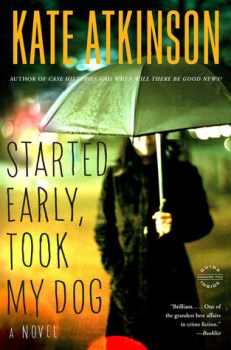 Because of that trait, I think I may have liked Started Early, Took My Dog the best so far of the Jackson Brodie books, although Jackson’s role in it is mostly ridiculous! The central mystery is set in Northern Yorkshire, where Jackson is trying to track down the birth parents of a client who was adopted in England at age two and then taken to New Zealand to grow up. But when Jackson discovers someone he thinks might have been the birth mother, a murder case from 1975 causes all kinds of people to come out of the woodwork to prevent the truth about police corruption and misbehavior from coming out.
The title of the book turns out to be a double entendre, since taking a dog away from his abusive master (literally beating the guy up after he takes out his ill temper on his dog by berating it and kicking it in the ribs) is one of Jackson’s more rational moments in the book.
In addition to the dog-napping (I always thought that should be nabbing, not napping), there is child-napping, and they are both accomplished by former police officers! Tracy Waterhouse, just retired from the force, working part-time as a mall security guard, and supposedly resigned to or even content with her single, childless existence, sees a prostitute dragging her small child through the shopping center while screaming at her, and snaps. She has money in her pocket intended for the Polish bloke remodeling her kitchen, but instead hands it off to Kelly Cross in exchange for her youngest child. Suddenly, Tracy has stepped from one side of the law to the other.
But IS Courtney the daughter of Kelly Cross? Tracy wonders. At first she thinks she’s simply being paranoid, but then she realizes that there are all sorts of people trying to “get in touch” who may have been sent to take Courtney back. Meanwhile, Jackson is, weirdly, encountering the same folks who are after Tracy, none of whom have either his quest or his best interests at heart.
Throw in other seemingly random characters whose histories and futures are tangled up somehow with these two, and things get truly confusing. It’s no wonder that the one piece of dialogue our Mr. Brodie repeats throughout the book is “I don’t understand.” It paints a pretty ineffectual picture of him as a private investigator, but certain leads to some interesting situations.
I liked this best mostly because of the characters of Tracy and Courtney. Tracy is large, awkward, stalwart, and ultimately heroic, while Courtney delights as only a truly quirky small child can. Between the two of them, they carry the story.

“Dragon,” courtesy of KJ Allison
As with the other Jackson Brodie books, the point is less about the mysteries and more about human themes of loneliness, grief, and dysfunction. Practically every character (except the determinedly upbeat Judith) is damaged and in need of love and/or salvation. Even the minor characters—Tracy’s colleague Barry, the aging actress Tilly—bring pathos to the story. And yet there is also humor, especially in the way Jackson’s role seems that of a character in a French farce, doomed to make his entrance from stage left just as his quarry (or his explanation) is departing from stage right.
I really hope that Atkinson plans to reveal the answers to some major cliffhangers left dangling off the edge at the end of this one: Who is Courtney, really? What was Jackson up to before he took on this case? Who is the murderer of a rather significant character? And I’m still waiting for the other shoe to drop with Louise, three books later. C’mon, Kate, resolution!
Novel Christmas
For those who appreciate a lengthier read, I have attempted to round up some novels with Christmas themes or settings and, in doing so, not make you doubt my good taste!
 For ’tis true, ’tis true that a plethora of Christmas tales exist, but whether you want to read any of them is the question. I have, therefore, found a few I would consider a bit more literary, and a bunch that are connected to some genre series, since much may be forgiven your favorite authors when they sell out, er, decide to delight you with a Christmas-related chapter.
First off, consider two short, sparkling comedies set at Christmas-time by Nancy Mitford, the writer later known for Love in a Cold Climate. Christmas Pudding and Pigeon Pie are Oscar Wilde-ish “great house” stories with a cast of ridiculous upper-crust characters rivaled only by those depicted by E. F. Benson and P. G. Wodehouse.
Next, there’s Wishin’ and Hopin’, a Christmas story by Wally Lamb, which focuses on a feisty parochial school boy named Felix Funicello—a distant cousin of the iconic Annette.
In a similar humorous vein, check out comedian Dave Barry’s The Shepherd, the Angel, and Walter the Christmas Miracle Dog. Or, on a more sympathetic note, Frank McCourt’s Angela and the Baby Jesus, relating the story of when his mother Angela was six years old and felt sorry for the Baby Jesus, out in the cold in the Christmas crib at St. Joseph’s Church….
The Christmas Train, by David Baldacci, is not a book I have read, but it sounds like a perfect storm of circumstances guaranteed to be entertaining, landing a former journalist on a train over the Christmas holidays with his current girlfriend, his former love, and a sneak thief, all headed towards an avalanche in the midst of an historic blizzard.
Skipping Christmas, by John Grisham, follows the fate of Luther and Nora Krank, who decide that, just this once, they will forego the tree-trimming, the annual Christmas Eve bash, and the fruitcakes in favor of a Caribbean cruise.
 One of my personal favorites to re-read this time of year is Winter Solstice, by Rosamunde Pilcher. It is sentimental without being mawkish, and brings together an unusual cast of characters in an interesting situation bound to produce results.
Now we enter the realm of franchise genre fare with a nod to Christmas:
The Christmas Scorpion is a Jack Reacher story (e-book only) by Lee Child, in which Jack’s intention to spend the holidays in warm temperatures surrounded by the palm trees of California somehow lands him instead in the midst of a blizzard facing a threat from the world’s deadliest assassin.
There are many in the mystery category, from Agatha Christie to Murder Club to baked goods-filled cozies:
In Hercule Poirot’s Christmas, by Agatha Christie, a curmudgeonly father turns up dead after telling all four of his sons, home for Christmas, that he is cutting off their allowances and changing his will. Poirot suspends his own festivities to solve the murder.
James Patterson has a couple of entries: The 19th Christmas, a Women’s Murder Club book, and Merry Christmas, Alex Cross, starring his popular detective trying to make it back alive for the most sacred of family days.
Charlaine Harris’s unconventional pseudo-cozy series about housekeeper and body builder Lily Bard features Shakespeare’s Christmas, in which Lily solves a four-year-old kidnapping case while at home for her sister’s Christmas wedding.
In a similar manner (though with quite different affect!), Rhys Bowen’s Irish lass Molly Murphy attends an elegant house party at a mansion on the Hudson in The Ghost of Christmas Past, and tries to fathom the reappearance of a girl who disappeared 10 years ago.
 Anne Perry, known for her historical fiction featuring the Pitts (Charlotte and Thomas) and the rather darker William Monk, has written 16 Victorian Christmas mysteries to date, the latest being A Christmas Revelation (2018).
Cozy mystery writer and baker Joanne Fluke has written at least four full-length books plus some short stories enticingly evoking Christmas cake, sugar cookies, plum pudding, candy canes, and gingerbread cookies, all with the word “Murder” appended.
And Ellen Byron continues her hijinks in Bayou country with Maggie Crozat in A Cajun Christmas Killing, complete with recipes.
In the Western genre, you can find A Colorado Christmas, by William W. and J. A. Johnstone, in which one family’s Christmas gathering turns into a gunslinging fight for survival, and A Lawman’s Christmas, by Linda Lael Miller, a combination of love story and western set in 1900s Blue River, Texas.
One writer of whom I am fond, in the “relationship fiction” category, is Jenny Colgan, and she has made the most of her Christmas opportunities. The only problem with them is, each and every one is a sequel to one of her other books, so without reading the first, you will be somewhat lost inside the Christmas special. She has written four “Christmas at” or “Christmas on” books to date, set in the previously detailed locales of Rosie Hopkins’ Sweetshop, the Cupcake Café, the Island, and the Little Beach Street Bakery. But if you want some enjoyable, lighthearted fare a step beyond a simple romance, you may want to read the first books and come back for the Christmas ones.
In straightforward and utterly enjoyable chick lit, we have Christmas Shopaholic, by Sophie Kinsella, an ode to shopping with a Christmas theme for her popular heroine, Becky Bloomwood Brandon.
 And then we hit the high tower of paperbacks that is the romance genre. I’m not even going to try to name all the books written within the environs of romance series, I’ll just give you a list of authors, and if you see a familiar one, go look her up on Goodreads with the word “Christmas” appended to her name:
Mary Kay Andrews, Jennifer Chiaverini, Janet Dailey, Johanna Lindsey, Debbie Macomber, Fern Michaels, Linda Lael Miller, Phyllis Reynolds Naylor, Nancy Thayer, Sherryl Woods…and so on. There are PAGES of titles.
Finally, if you are a nonfiction kinda person, I’m tagging on a couple for you, too:
In I’m Dreaming of a Black Christmas, comedian Lewis Black says humbug to everything that makes Christmas memorable, in his own engaging, curmudgeonly style.
In their quest to provide mathematical proof for the existence of Santa, the authors of The Indisputable Existence of Santa Claus: The Mathematics of Christmas, by Dr. Hannah Fry and Dr. Thomas Oléron Evans painstakingly analyze every activity, from wrapping presents to cooking a turkey to setting up a mathematically perfect Secret Santa. Lighthearted and diverting, with Christmassy diagrams, sketches and graphs, Markov chains, and matrices.
If you can’t find something to read and enjoy from THIS list, I wish you a slightly exasperated Joyous Yule, and hope to find you something non-holiday-related to read in the New Year! —The Book Adept

Cold cases
I was a little wary when starting to read Case Histories, by Kate Atkinson, because I read her book Life after Life and, while I admired it, didn’t enjoy it much. But I think, in Jackson Brodie, she has found an anchor around which she can wrap the chain of her storytelling to keep it stable.
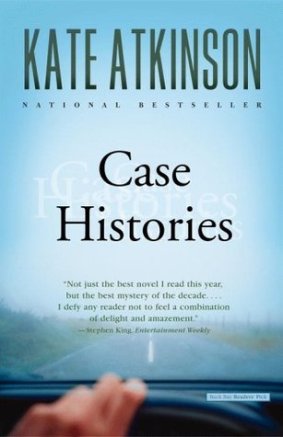 I will admit that it took me a while to get into this book and to understand what was going on; Brodie is a private investigator who has been invited for various reasons by family members or interested parties to look at three cold cases, the latest one already 10 years past, the oldest more than 30. Because Atkinson presents the case histories one at a time at the beginning of the book before ever mentioning Brodie’s name, profession, or involvement, the book initially seems disconnected by its three narratives, save for the fact that some crime has been committed in each. But having the case histories narrated by the people involved, rather than exclusively through the eyes of Brodie, makes the stories that much more powerful, and also allows us to encounter them as if we were standing in Brodie’s shadow, listening in and trying to make connections in the same moment he is.
I liked Jackson Brodie’s character, and the slow reveal of what his life is like and what kind of person he is. I also enjoyed the many and varied characters who took the lead in each of the histories, although I did have to scroll backwards on my Kindle a couple of times to remind myself of exactly who they were or how they were involved. Each of the mysteries consisted of equal parts frustration and intrigue, just enough so to keep me reading. But I don’t mind some complexity in a plot, if it serves the plot, which this absolutely did.
I have placed a hold on the next Jackson Brodie book at the library.
READERS’ ADVISORY NOTES: I think this book (and perhaps the rest, we shall see) would appeal to readers of such mystery icons as Ruth Rendell, Barbara Vine, and Patricia Highsmith. Perhaps also Tana French? Those writers produce dark, devious, complex mysteries in sophisticated language, and Atkinson nearly rivals them. And if you are a reader who enjoys Atkinson’s books but haven’t ventured back into the annals of these other writers, by all means do so!
The Man
Twice in two weeks I was able to read the latest in a mystery series I have followed from the beginning. What a treat!
Robert Crais has been writing the saga of Hawaiian shirt-wearing Private Investigator Elvis Cole and his sidekick, the inimitable Joe Pike of granite mien and special (forces) skills, for 18 books now, occasionally interspersing them with a stand-alone thriller here and there. Although I have mostly preferred the stand-alones to the series, I never miss any of Crais’s books, because he tells a good story and because I like that they are set in Los Angeles.
 There’s no denying that this series, like any other long-running one based on the same people in the same city, has had its ups and downs. There have been books I couldn’t put down for 48 hours straight, and others I could barely make it through. I liked A Dangerous Man for the very reason that a few other people cited for disliking it—it was straightforward. There have been a few of these that got so complex and brought in so many extraneous people and details that it spoiled the lead, which for me is always the partnership between Elvis Cole and Joe Pike, and how they have developed such synchronicity.
The initial encounter in this one was, as I said, simple—nobody calling the office with a long and complex tale to be sorted. Joe Pike goes to the bank, and Isabelle (Izzy) Roland is the teller who waits on him. Her boss asks her to take an early lunch, so she leaves the bank only minutes after Joe, who is still on the street by his car. A couple of guys in an SUV pull over next to her on the curb; one gets out and engages her in conversation, and before she knows it, she’s being forced into the car and abducted. Joe spots the look of panic on her face, and does what Joe does—he follows, he outwits, and he rescues, wreaking a little havoc on the kidnappers in the process and then turning them over to the police.
From this point on, it does grow a little more complicated, because the power behind the kidnappers redoubles efforts to get hold of Isabelle. When she calls Joe in a panic because SUVs have been trolling her street and then disappears, Joe appoints himself her bodyguard and avenging angel, but at this point also decides it’s time to pull in both John Chen (medical examiner) to run some fingerprints, and friend Elvis to use his P.I. contacts and figure out why these people are so determined to get control of a 22-year-old bank teller with an old car, a falling-down house, and no apparent reason to be of interest to anyone in particular.
It’s a believable story, well told, and holds your interest start to finish. The question I was left with was, is “the dangerous man” of the title the person who is relentless in his pursuit of Izzy? or is it Pike himself? In a showdown, I know who I would pick.
READERS’ ADVISORY NOTES: This is a series you could suggest to a mystery lover who is a fan of Michael Connelly, the other guy who writes a series (Bosch) based in Los Angeles. Although Harry Bosch is a policeman and Elvis and Joe are private/independent, they share the characteristics of being mavericks who take direction from no one and who are relentlessly determined in pursuing their objectives. Because of the locale, the scene-setting is quite similar, and I have always wished the two authors would get their characters (neighbors in the Hollywood Hills) to meet up and collaborate! Also, either series might appeal to people who like noir fiction, as all of these detectives tend to be involved with the darker elements of their trade, and sometimes the books feel like an offshoot of 1940s Hollywood, a lá Walter Mosley or Duane Swierczynski.
 The Book Adept