The new French
The Searcher is a departure for Tana French; and yet it possesses all the attributes that make me want to read her books—a leisurely pace with plenty of detail, a compelling protagonist, a mystery to be solved, ethical questions to ponder…just not in the context or, should I say, formula of
her others. She already left the self-created fold of the Dublin Murder Squad with her last, The Witch Elm, and was chastised for that by many readers; in this book, too, she has ignored many of her reliable “go-to”s, and yet it still reads like
one of hers.
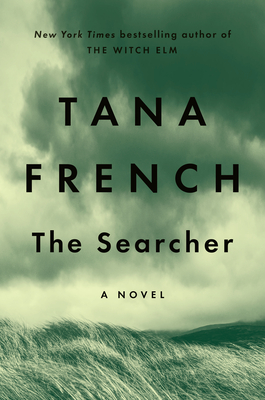
I personally enjoyed this book more than I did The Witch Elm, simply because I found that book needlessly convoluted and complex, and with essentially unlikable characters. This one is, by contrast, rather simple in plot and, though furnished with some moral quandaries, still much more straightforward than almost anything else she has written.
Her other books are all told from a first-person perspective; this is the first in which we get to observe her protagonist from the distance of third person. It is still an intimate portrait, in that Cal’s thoughts and processes are revealed for us through both his shared thoughts and his actions, but it’s a little more observational, less self-involved. Cal is also the first protagonist who isn’t Irish, with the result that we get to see life in Ireland from an outsider’s perspective, without the peculiar insights of a native but with great attention to aspects not previously examined. (Her American voice is relatively flawless, and contrasts nicely with those of the Emerald Isle.) In her other books, the protagonist is strongly tied to whatever mystery there is to be solved; in this case, the mystery revolves almost completely around others, with Cal as a rather helpless observer in some instances.
Cal Hooper is 48 years old, retired after a 25-year career as a police officer in Chicago. His daughter is grown, graduated, and in both a career and a relationship; his wife has divorced him, and although he can see individual reasons why she might do so, he can’t quite put together the big picture, and is floundering a bit without her. The divorce, in combination with some troubling realizations about his identity as a policeman in a time when that role is being reviled for racism and corruption, threw Cal’s sense of self out of whack sufficiently that he decided to leave the force and make a big change. He has bought a run-down property in rural Ireland, a house that hasn’t been occupied for perhaps decades, and has moved there with the intention of putting his energies into fixing it up and creating for himself a quiet life away from the stress of the big city. His daily routine will consist of removing wallpaper, pondering how to make friends with the rooks inhabiting the oak tree in his front yard, making a trip to the local general store for a gossip with its proprietor, or getting a drink in the bar with the fellas.
“One of the things that had caught his attention, when he first started looking into Ireland, was the lack of dangers: no handguns, no snakes, no bears or coyotes, no black widows, not even a mosquito. Cal feels like he’s spent most of his life dealing with feral creatures, one way or another, and he liked the thought of passing his retirement without having to take any of them into account. It seemed to him that Irish people were likely to be at ease with the world in ways they didn’t even notice.”
Cal is making notable progress on this plan when the back of his neck starts to itch in the way it did back in his police days; he feels observed. After a period of wondering if someone has it in for the outsider in their midst, he manages to identify his stalker as a young teenager, Trey Reddy, and after some wariness on the kid’s part, finds out that Trey has sought Cal out because his older brother is missing and neither his mother nor the police seem to care that something may have happened to Brendan. Trey wants Cal to look for Brendan, but Cal realizes he is handicapped by the lack of everything to which he would have had access as a police officer in Chicago: files, databases, records, and material assistance from other officers on the job. But the kid tugs at his feelings for all those who slip through the cracks of the system, and there is also a residual excitement at the thought of being back in the investigation game, so Cal decides to help him.
This simple agreement shifts everything in Cal’s fragile idyll. His sleepy retreat, the small village of Ardnakelty where nothing ever happens and everyone has, so far, been “hail fellow well met,” becomes a slightly sinister place where Cal can’t tell if people are looking out for him with their warnings or subtly herding him towards his own destruction. Resistance to his efforts to help Trey discover Brendan’s fate makes him wary but doesn’t deter him, and from this point in Cal’s story things begin to head towards a showdown.
The thing about this book is, it’s not really a crime thriller. It’s more of a literary novel by a writer who chooses to use a mystery as a vehicle to study a character, a community, a locale. It’s atmospheric, well written, and well plotted, but if you go into it expecting French’s usual, you will be disappointed. If you approach it with an open mind, however, you will be gratified by a story that is subtle, lovely, and special.
The Thief Returns
I’m going to start by saying
I don’t really know how to write a review of this book, because I am so predisposed to love it. I discovered the Queen’s Thief series, by Megan Whalen Turner, about 12 years ago when I became a teen librarian and found it in the library’s young adult book collection, and have been raving about it ever since.
Just to clear up what I think of as grievous misperceptions, I’m first going to say that this is not a young adult series. That is not to say that young adults—or even younger children, if they are bright, perceptive readers—would not appreciate it; but this is not a series that was designed specifically to appeal to the YA market like such others as Sarah J. Maas’s A Court of Thorns and Roses (ACOTAR), to which it has superficially and mistakenly been compared by publishers desperate to sell books. The Queen’s Thief books are both expertly and lyrically written to appeal to absolutely anyone who loves fantasy (and, probably, if you could get them to read it, to those who don’t). It is brilliantly crafted (which I will discuss further below) and in no way deserves to be dismissed as suitable only for a certain demographic.
In fact, I feel like the initial publisher did the series a grave disservice by packaging and selling it to children. The first two covers of The Thief, put out respectively by Greenwillow and Puffin, were designed with a Percy Jackson vibe to appeal to 4th-graders, and it’s a miracle anyone else ever discovered it.
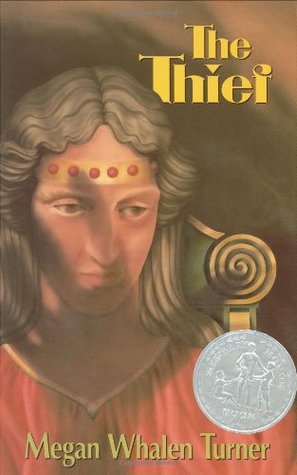


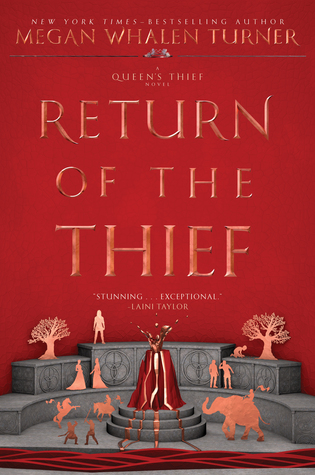
Fortunately, by the third release Greenwillow got it right, and the next three books came out with similarly engaging, nicely illustrated covers that would appeal to both teens and adults. Unfortunately, the long hiatus (seven years) between books four and five meant a re-design and a re-release in hardcover, with completely new art, so the only way for people who are obsessive about their series being all the same size with the same cover art is to buy the entire six-volume set over again. (I probably won’t do that, considering that I prefer the original covers, but it is a little annoying.)

The second thing I’d like to clear up is that the aforementioned desperate publishers keep insisting in their blurbs that the books in this series are stand-alone. They are not. If you do not read them all, and read them in order, you will be utterly and completely lost as to what is happening, to whom, and why. What the publishers don’t understand is that this is actually a huge advantage, because the books are so compelling that I daresay a large percentage of those who begin with The Thief are guaranteed to continue. And the true advantage of that, in my opinion, is that the books become exponentially better with each one, up through book #4. (I am not saying that to disparage books five and six in any way, but the story shifts at book five to a somewhat unrelated segue of a tale, and comes together again in book six to conclude things properly.)

Each of the books has a different narrator, which serves two purposes: One, it gives the reader a more well-rounded and broader perspective of the tale as a whole, seen as it is through multiple viewpoints with differing roles and agendas; and two, it keeps the story fresh and interesting. And those narrators are by no means limited to the primary protagonists; book #3 (The King of Attolia) is narrated by a hitherto unknown soldier; book #4 (A Conspiracy of Kings) by a character who, though vital, was only superficially explored in book #1; book #5 (Thick as Thieves) by a slave of the Mede empire; and book #6 (Return of the Thief) by the mute, disabled son of one of Eugenides’s greatest enemies. Who but Megan Whalen Turner would have the nerve, or the brilliance, to pull that off?
How to describe this series? Especially without giving away the cleverness, the hidden agendas, the STORY….

In the simplest of terms, this is the tale of three kingdoms—Attolia, Eddis, and Sounis—and their rulers, which exist a bit uneasily side by side on the Little/Lesser Peninsula, and what happens to and within each/all when they are threatened by the mighty Mede empire with annexation. It has a vaguely Greek or Eastern flavor, particularly as regards its gods and traditions, which is a nice shift from a more usual swords-and-sorcery Medieval-type theme. There are political machinations and plots, love, heartbreak, and courage. There are relationships so complex they take the entire series of six books to understand. There are occasional interventions by the gods, betrayals by those seemingly beyond reproach, and personal relationships between the mighty and the small that endear both to the reader. There are wars, including battles both literal and emotional for the soul of the countries, those of its rulers, and to win over some of its lowliest subjects. Dare I say it has everything?

It took Megan Whalen Turner 24 years to write the entire thing. The books are not, however, gargantuan collections of names and facts and histories akin to a Game of Thrones with its over-the-top, kitchen-sink 700+-page tomes. Instead, each book is a perfect jewel of between 300-400 pages that tells everything it should to further the story, but nothing more and nothing less. It took her an average of four years (one took six, one seven, and one three) to write each one and, I have no doubt (having read the series multiple times) that she considered each and every word, sentence, thought, feeling, and event carefully before adding it.
They say that the test of a good book or series lies in the ability to reread it and have something new revealed with each experience; I have read the first four books either three or four times apiece, and book #5 twice, the second time as a bridge to the end volume. For me, however, rereading isn’t just about picking up things I missed the first time, it’s the joy of reconnecting with something that touched me profoundly—a reunion with the world in all its details, with the subtleties portrayed by its characters, with the humor, the emotion, the realness of it.
That end volume brings us full circle to the quandary that was set up near the beginning and then proceeds to solve it, not without cost but with perfect satisfaction. This doesn’t mean that it is an easy glide down to the conclusion, however; this part of the tale is as full of surprising plot twists as is the first, and the reader is beguiled anew by all of its actors, especially the unfathomable, mercurial, and yet completely engaging Eugenides. And while it is bittersweet to reach the end, I have no doubt that I will return to this story and these characters at least a few more times to relive the entire experience.
Have I convinced you to read it?
For BHM
While my belief is that black history is history and should be taught as such, calling it out for a month a year at least gets some attention, since our school curriculum is still not what it should be. Likewise, calling out some black authors, and some non-black authors who have written effectively about black history and culture, is always a good idea, but the prompt is helpful to remind one. So…
Science fiction is one genre that can definitely usher you through time. Octavia Butler‘s Kindred, which some say is the first science fiction written by an African American woman, is a combination of memoir and time travel that transports 26-year-old Dana from 1976 California to antebellum Maryland, where she arrives just in time to save a white boy from drowning, then jumps back just before the shotgun staring her in the face can go off. Like Henry in The Time Traveler’s Wife, Dana’s jumps are inadvertent, but they serve a purpose in her life history. Butler manages to provide both a conversation about serious issues—slavery, human rights, and racial prejudice—and an exciting and complex story about human nature, love, and loss.
For a glimpse into the future instead of the past, try Parable of the Sower, set in that familiar dystopia known as Los Angeles in the year 2025 (not so far off!), and following the fortunes of Lauren Olamina, an 18-year-old pioneer of a new philosophy known as Earthseed. Parable of the Talents is the sequel.
Since Butler died tragically young (in 2006, at age 58), there will be no more of her seminal works featuring female black heroines, but her contributions to the science fiction world won her both the Hugo and Nebula awards multiple times, and she was the first science fiction writer ever to win the MacArthur Foundation “Genius” Grant.
Like a little mystery with your history? Try Barbara Hambly’s mystery series that begins with A Free Man of Color. Set in New Orleans in the 1830s (right after the Louisiana Territory was acquired by America), the characters are a rich mix of French, Spanish, and American, Creole, African slave, and “free people of color.” Benjamin January (or Janvier, depending on the language you’re speaking) is one of the latter, a Paris-trained surgeon who must earn his living in New Orleans as a piano player. Between his two professions he mingles with all levels of society, and inevitably someone turns to him for his appealing mix of compassion and good sense to help them solve a dilemma, a puzzle, or even a murder. There are 18 books, so if you’re hooked by the first one, you can relish Ben January’s world for a sumptuous long time.
Another book set in the same time period and also on the subject of the gens de couleur libre is Anne Rice’s second novel, The Feast of All Saints. If you thought Rice was only about vampires, think again: She researched this while in New Orleans planning out Interview with the Vampire, and in my opinion it’s the best thing she ever wrote (and I’m a fan of the vamps, and the witches too). Rich with the history of pre-Civil War New Orleans, with truly compelling characters, it is beautifully written, poignant, and emotionally overwhelming.
Some other books to which I’d like to draw your attention, that encompass the history of the present and the recent past:
The Rock and the River (about the Black Panther movement), by Kekla Magoon
How It Went Down (an account of a shooting, from 17 different viewpoints), also by Kekla Magoon
Flygirl, by Sherri L. Smith, about a black girl pilot trying to participate in World War II
Tyrell, by Coe Booth, a young adult novel representative of all too many young black men with few alternatives. A compelling voice and an engaging story.
March, by John Lewis, a series of three graphic novels about the Civil Rights Movement, by the senator who was by the side of Martin Luther King
Please note that this is a short, random, partial list of books that in no way represent the richness of writing available out there, but simply reflects some books I read, enjoyed, and appreciated for their topic and their tone. I hope you find something to enjoy.
Significant relationships
I picked up The Marsh King’s Daughter, by Karen Dionne,
with the misconception that it would be a fantasy retelling of an obscure fairy tale. But although the author makes creative episodic use of the Hans Christian Andersen story of the same name by revealing it gradually in chapter headings, the tale told here is all too real.

Helena Pelletier is revealed as a former “wild child,” one of those who has been raised in the wilderness outside of society, under no one’s influence but that of her parents. Even that statement is misleading; her mother played no real role (except that of passive housekeeper and provider of meals). Her Anishinaabe nickname, given to her by her part Native American father, was Little Shadow, and Helena became, as she grew, a miniature version of him, learning all he was inclined to teach her—including a basic disdain for her weak and ineffective mother. Under his tutelage she learned to track, trap, hunt, gather, and survive in the combination of forest and marshland in the Upper Peninsula of Michigan where their cabin was situated.
The truth that she finally discovers at age 12 rocks her world and skews all her perceptions: Her father kidnapped her mother off the street when she was 14 years old, brought her to his cabin in the marsh, and held her prisoner. At age 16 she became pregnant and gave birth to Helena, who spent the next 12 years in ignorance and freedom, being raised by the victim and her captor.
The story is compellingly told in alternating chapters of present day and past tense. After eluding arrest for two years, Helena’s father spent 13 years in prison for his crimes. But now he has managed to escape, killing two guards and supposedly heading off into the heart of a wildlife refuge. But Helena, now in her late 20s and with a husband and two daughters of her own, knows him well enough to believe that this is misdirection to get the manhunt going in that area while her father will make his way to the land he knows best, part of which is now the site of Helena’s family home. She also believes that since no one knows him and his skills the way she does, she is the only one who can track him down.

Each revelation in the present day leads to a chapter about her life in the past, and as the book moves to its conclusion, the picture of what that was like grows deeper, broader, and more fascinating. This is a cat-and-mouse thriller full of suspense: Although we know from the outset that Helena’s father is “the bad guy,” the tension of seeing how her life plays out as she grows up and becomes self-aware enough to recognize him for who he is—a dangerous narcissist, a psychopath—gives agency to some truly compelling character development. The conflict experienced by Helena, who goes from idolizing her father to questioning his authority to the major revelation of his actions, followed by an uncomfortable and protracted adjustment to her new life in society, shows all the nuances of parent-child relationships and how they help and harm as children achieve adulthood. I’m so happy to finally have read a book this year that I can unequivocally endorse! Five stars from me.
One of the attractive parts of this story is the wealth of detail about the marshes and wetlands of the Upper Peninsula of Michigan in which it is set; but I should also note that there is a fair bit of detail about the trapping and killing of animals for food that may disturb some readers. I am a vegetarian for compassionate reasons and managed to get through it, but some of it was more graphic than I would have liked.
Impersonation
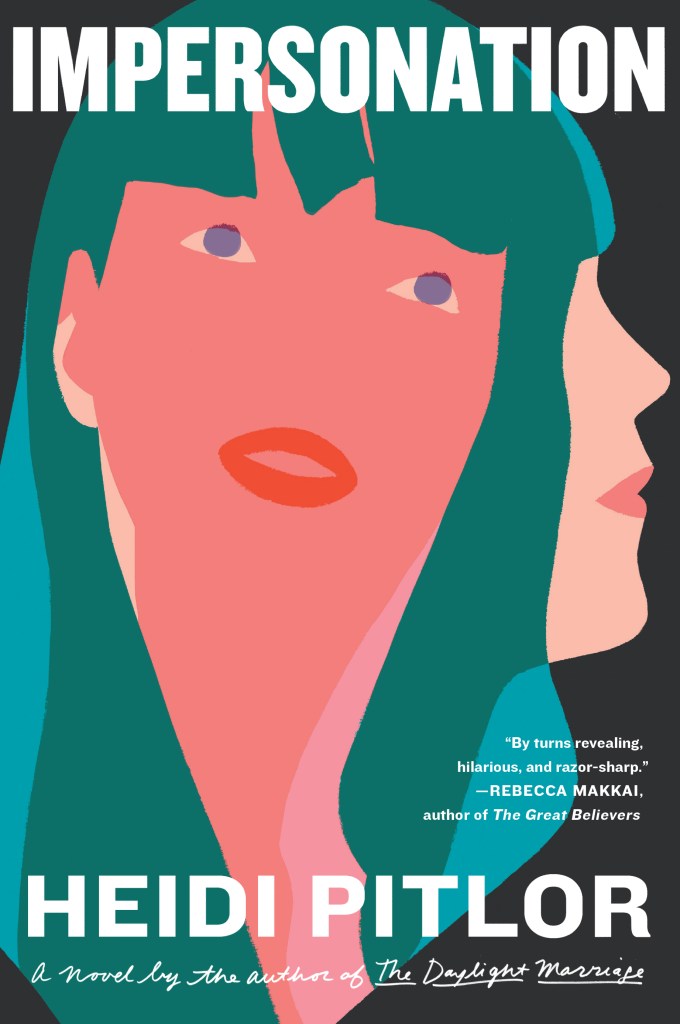
Impersonation, by Heidi Pitlor, is described as a book about a professional ghost writer, Allie Lang, who is hired to write a memoir. The subject (and supposed actual author) of the memoir is Lana Breban, a lawyer and women’s rights advocate with (it turns out, big surprise) aspirations to run for office. Her “people” have concluded that her tough image needs softening, and what could be better than a tell-all about her experiences as a feminist mother raising a son?
What this book is actually about is much less clear—in fact, it’s a bit muddy. First off, Allie, who has made a minor career working as a ghost writer for those who can’t write their own, is less memorable for her experiences in this arena and more as regards the perils of trying to live your life as a freelancer when you are a single mother. Given her status—sole support to herself and her boy, Cass—one would expect her to be tougher, feistier, more proactive about standing up for herself. This is a major disappointment of character development.
When she first gets the gig writing Lana Breban’s book, she’s excited—Lana is a sort of heroine to her—and she fantasizes about all the time they will spend together while Lana recounts her motherhood stories so Allie can craft them into a powerful narrative. The actual events, however, are far less satisfactory—Lana is too busy with the rest of her life to give Allie any time, and (oddly) refuses to divulge the details about her life as a wife or as Norman’s mother. Allie garners a few facts, but it’s like pulling teeth, and Lana basically tells Allie to do her research, put together some materials on feminism and boys, and cobble it all together with a thin strand of relevant detail.
Unfortunately, neither Allie’s editor nor her publishers are satisfied with the conscientious research approach, and Lana’s own people concur—they want the personal, not the educational. But Lana still won’t budge, and Allie is caught in the middle. This is where the book really begins to fall apart for me. Allie takes up her difficulties and reservations with both her agent and her contact at the publishing house, explains that she can’t do her job properly without more cooperation from Lana, and is basically told to get it done no matter what she has to do. They both essentially give her the brush-off. I found this part of the plot to be wholly unbelievable—surely at least one of them would be willing to take it up with Lana, or at least with her people, and give Allie some support.
The rest of the book talks unendingly about Allie’s problems—with the book and in life—but Allie never seems to figure out how to stand up for herself. Admittedly, people of Lana’s class and stature (the truth that begins to emerge is that her son has been raised by a nanny and never sees his mother) don’t understand or care about what people of Allie’s class go through when it comes to personal privations experienced in trying to make ends meet, no matter what lip service they pay. But there are so many points in the narrative at which the reader (or at least this reader) just wants to shake Allie and scream, Are you crazy? Do this! Don’t do that! SPEAK UP! When she finds herself in an unresolvable predicament, I felt like it was her just desserts.
The book explores such themes as class blindness, economic instability, how to raise empathetic sons, the MeToo movement, the distress of seeing Trump elected President, conflicts between mothers and daughters, and more. But all this “topicality” overpowers the story line and ensures a lack of connection with its main characters, who end up being both boring and unlikeable.
I have probably given too much away for a reviewer, but honestly, I kept reading waiting for a payoff that was so minor and with an ending so odd that I regretted not paying more attention to the fact that the majority of ratings on Goodreads were two or three stars. I feel like the title unintentionally gives away more about the book than was meant—it’s impersonating an important read, but really it’s just some sad people coping poorly with life. It is characterized in its publisher’s description and in author quotes as satirical, timely, insightful, and bitingly funny; of all of those, I could maybe agree with insightful. The satire, if such it was, was painful, the timeliness is contained in the context but not in the details, and I failed to find the humor.
Maybe I was just having a bad week…but I don’t think so.
The next one

Despite my desire to read something a little more substantial (after the serial disappointments of the past five books), I am to an extent ruled by my library account. When you put e-books on hold and the library notifies you that your next one is now available, it’s foolish not to take advantage of that while you can. So I just finished reading Fool Moon, the second in Jim Butcher’s urban fantasy series, The Dresden Files.
I don’t have a lot to say about it, except that I liked the second even better than the first and will definitely read more as they come my way or when I’m looking for an in-betweener. They don’t bowl me over to the extent that I want to drop everything else to read the entire series, but as an occasional “amuse bouche,” they are a delight.
Interestingly, posters on Goodreads note that A. this is one of the weaker books in the series, and B. that the series doesn’t get really good until [book 3] [book 4] [book 7]. So I guess my trajectory with Harry Dresden has nowhere to go but up!
Things I really enjoyed about this one:
Bob. He may be a plot device to keep Harry in the know, but Bob is also a delightful store of arcane (literally) knowledge, and I enjoy reading his “dissertations.” I also enjoy that he’s an old, old guy who inhabits a skull and who occasionally gets let out to “play.”
Werewolf lore. The aforementioned Bob is responsible for filling Harry in on a lot of it, but he also sources it from the various wolves’ mouths, and it’s both complex and fairly sensible as a set-up for weird trivia. There are hexenwolves, werewolves, lycanthropes, and loup-garous, each with its own set of characteristic behaviors and abilities, and the ins and outs of these aren’t just interesting info, they have a profound effect on the murders Harry (and Murphy) are trying to solve.
Things I continued to dislike: Harry is kind of a chauvinist. Murphy is kind of a dick (and I’m not using that as shorthand for detective). Their relationship and interplay is problematic, and I hope it gets substantially fixed as the series continues.
Verdict: Keep reading.
Halt!
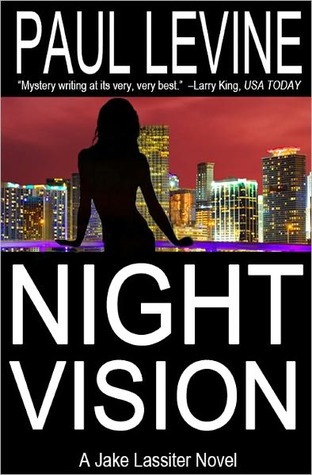
Well, I said I would try one more Jake Lassiter mystery by Paul Levine before calling a halt, and now is the time for that call. I read Night Vision, the second book in the series, and my overall reaction was that it was a hot mess. I still enjoyed the main character, although he seemed much subdued in this book compared to how he was last time, but the author’s bizarre concept of how women think and behave put me off even more in this book than in the first. I know that at least one of them was supposed to behave strangely to cue you in to the fact that she had more to do with the mystery than anyone realized, but the rest of the women in the piece were likewise unbelievable and, frankly, offensive. They were completely confused or confusing, in that they alternated between coming on to Jake like a ten-dollar hooker on a slow night and rejecting his advances with a vehemence totally unjustified by his casual flirtatious approach. And what I’m describing is the same women in subsequent scenes!
Plausibility was another problem. The appointment of Jake as some kind of investigative attorney was thin, the trip to London with the lady psychologist for a meeting with a therapy group of serial killers was completely unrealistic, and the courtroom scenes were odd.
The thing I disliked most about this book, however, was how completely repellent were most of the characters. With the exception of Charlie Riggs (whose role was much smaller in this book), no one except Jake was either likable or engaging, and the contradictory ways in which they behaved made them unbelievable as well. It worked to allow Levine to keep shifting the focus of the story from one red herring to the next, to keep the reader guessing about the ultimate resolution, but in terms of character development it was a big fat fail. They were either mean, psychotic, hysterical (as in over the top emotional, not as in funny), or simply boring. And the ultimate fate of one of the characters was too gruesome to put on paper (this from someone who likes Dexter!).
The winning personality of Jake Lassiter is just not sufficient to carry a book, and Paul Levine will have to do without me as a reader from here on out. A few reviewers commented that this was their least favorite and the least plausible of the series and to take a chance on a later book, but I think I’ll pass.
Back to urban fantasy with another dose of Harry Dresden, who arrived from the library on my Kindle with less than two weeks to be read. And then, I swear I’m going to try something literary!
Series, new to me

I tried a “new” series this week, whose first book came out in 1990. To Speak for the Dead is the first in Paul Levine’s Jake Lassiter novels and there are apparently 11 or 12 more. It was a free Kindle download a few weeks ago, so I added it and let it sit until I was between books and feeling restless for something different.
After trying and failing to read The 7.5 Deaths of Evelyn Hardcastle for book club (I may return to it later) and also striking out with three of the four books that preceded that, I was in the mood for a straightforward protagonist with a simple agenda. Jake Lassiter, attorney and former linebacker, seemed stable enough to qualify. I have been burned by courtroom dramas often enough that I tend to avoid them now in favor of more direct interactions with the case (i.e., police procedurals, detectives), but this one sounded intriguing.
I liked it pretty well. The main character is well developed and fun, with a bit of a rogue attitude but holding, at heart, a basically sound philosophy; and some of the side character “regulars” are likewise engaging (notably Granny Lassiter and the now-retired medical examiner, Dr. Charles Riggs). And there is quite a bit of leavening humor, which always helps. In this one, at least, the women were a bit one-dimensional (although I got a big kick out of Cindy, Lassiter’s receptionist), but I forgave that to a certain extent, because A. it’s the first book in the series, so we are meant to be focused on Jake Lassiter, and B. Levine wrote this in 1990, so the standards weren’t quite as high (although it would have been much more forgiveable had it been, say, the ’70s!).
There were some things that would flat-out never happen in a legal/court case, but Levine writes his Miami setting as if it is a place like no other, where rules are lax and meant to be stretched, and it’s easy to go along. The plot is a weird one, in that the man Lassiter represents, Dr. Robert Stanton, seems to be innocent of the crime of which he is accused in the civil case being tried when the book opens, but appears to be guilty of much worse as events unfold. It’s hard to be sure, though, with so much conflicting information and so many other dastardly people in the mix, and the whole book is an extended game of what John Lescroart, in his Dismas Hardy series which I have lately abandoned, calls “SODDIT,” or “Some Other Dude Did It.” But who? is the question we are meant to answer.
The book wraps up with an open-ended scene that is among the weirdest I’ve ever experienced in a so-called mystery, but it was just bizarre enough to work. I’m at least going to try the second book in the series before calling a halt.
Promising set-up
How many times have you started a book review with the words “It had a promising set-up”? You probably already know that the next word in that sentence is “but…” Yes, I’m back to suspense novels that don’t pay off. Maybe I need to switch genres for a while.
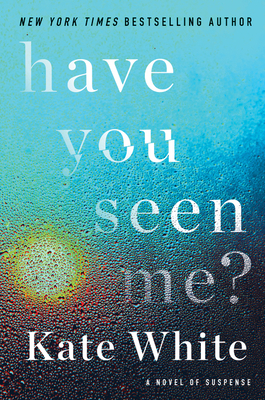
I picked up Have You Seen Me? by Kate White because the plot summary reminded me of What Alice Forgot, by Lynne Moriarty, a book I enjoyed quite a bit. In this one the protagonist, Ally, is only missing two days (not 10 years) of her life, but I love the way the writer starts it off, with her showing up to work in the morning only to realize that she hasn’t been employed by that company for five years. She faints and is sent to the hospital, and when she wakes up she gradually recalls her current life (including the husband who temporarily slipped her mind in favor of the boyfriend who ran the company where she went that morning), but can’t piece together where she has been since Monday night (it’s now Thursday morning).
Events take a logical progression as she has a psych eval, checks in with her own therapist, searches for missing belongings, calls her brother and friends to see if she has had contact with them during her blackout, and eventually decides to hire a private detective to back-trace her movements and put it all together. But this makes it sound pretty straightforward, when in fact the book meanders repetitively through Ally’s experiences to the point of shrieking boredom: Every time she discovers a new fact, she tells her husband, her brother, her best friend, her therapist, and her private investigator, and the reader “gets” to sit through all the explanations and then hear each reaction in turn (most of them both unsatisfactory and unhelpful to Ally). The author was also unnecessarily parochial about such psychological terms as “dissociative fugue state” and “rigor mortis”—I think we have all watched enough TV that it would be a miracle if we didn’t know the definitions already!
In contrast to all this excruciating detail, there are areas that are left vague (one can only assume purposefully) that should have been the absolute first places that the investigation went: Number one, her husband is acting super weird—aloof, unsympathetic, and largely unavailable. If I were Ally, the first thing I would do is rule out Hugh by either having a frank talk with him or getting perspective from people who know and are in contact with him (work colleagues, friends, etc.). Instead, she alternately obsesses or ignores. Number two, if you turned up after two blank days with bloody tissues in your pocket and it is determined that the blood isn’t yours, wouldn’t that be your primary focus before such details as where you ate lunch or who you talked to on the phone while you were “gone”? It would be mine, but that fact is brought up briefly and then ignored for the rest of the book until the ending. Number three, the way events unfold and the reasoning behind them regarding the fate of the private investigator is just outrageously bad. Number four, her supposed best friend is constantly MIA, first because she is out of town and then because she gets the flu. When Ally catches her in a lie, this should have been the lead-in to something significant, but instead it’s dropped with a ridiculous explanation. This is the case for so many characters/red herrings, both major and minor: the intern who drops hints about the ex-boyfriend, the intern’s friend who seems to know Hugh a little too well, the ex-boyfriend who hasn’t spoken to her in five years but is suddenly calling her a couple of times a day, the unaccountable feeling of unease she gets that her therapist is purposely steering her away from certain truths, her brother’s new wife’s backstabbing…any and all of these could and should have led somewhere—anywhere! I guess I just should have said “don’t get me started” instead of writing all of this!
And let’s talk about that ending without giving it away: After all the drama, the sleuthing, the surprise details, the fractured relationships, the horrifying events past and present, you’re telling me THAT is how you end this? Sure, I guess it’s possible, but plausible? Given the exceedingly awkward treatment of that whole aspect of the book, this was perhaps the least convincing (and most disappointing) conclusion.
Do I even need to type the words? Not recommended. Despite some inexplicable five-star ratings on Goodreads. Trust me.
Tech run amok
Finally—a suspenseful story that I actually enjoyed! Take Me With You, by Tara Altebrando, is a combination of science fiction and suspense…although the science fiction is so close to reality that you could drop that out of the description with some justification. When I say that the events of this book could be “near future,” I’m talking weeks or months,
not years.
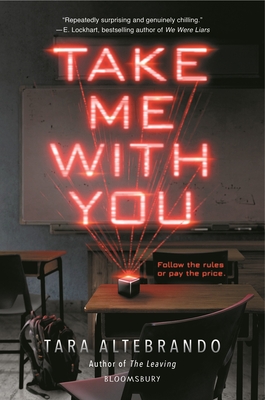
Four teenagers who attend the same school but barely know one another—Eli, Marwan, Eden, and Ilanka—are all summoned via the school’s messaging app to report to the music teacher after school about “an important matter.” When they arrive, there’s no sign of the teacher, and after waiting for a while, they think it must have been a mistake and prepare to leave. But there is a small black cube sitting on one of the desks, and as they talk it over, its sides light up with messages:
“Do not tell anyone about the device.”
“Do not leave the device unattended.”
They all agree that it’s weird, and the best thing might be to walk away, and then…
“TAKE ME WITH YOU…OR ELSE” appears on the cube, immediately followed by a fire alarm going off. As they evacuate, Eden grabs the cube and shoves it into her backpack, setting in motion a bizarre interval in all their lives as the instructions from the cube grow more arbitrary and more adamant and they all scramble to meet its demands. When one of them decides to disobey, there are scary consequences that make them all wonder how this is going to end.
The thing I think I liked the most about this book was that the characters, although invested in this mystery, were multi-dimensional (and multi-cultural, by the way) and had a lot more going on in each of their lives, so that the advent of the cube was mostly an irritant and an inconvenience (at least at first) rather than the main thing on which they were all focused. Too many YA books are mono-focused, and unless it’s very well done, it gets monotonous. But in this book, which takes on the topics of stereotyping, anxiety, grief, and racism, Eden has boy problems and family issues, Marwan and his family (and their restaurant) are experiencing xenophobia for being Egyptian, Eli is a gamer who is more comfortable in his created world than in the real one, and Ilanka is busy figuring out priorities, trying to decide whether it is more important to her to be accomplished or to be happy. So interaction with the cube either accentuates their dilemmas or brings up new ones to distract them, and becomes a part of the story rather than the whole. It also brings them together as a unit as a result of outward motivation rather than choice, which shows all of them how little they knew the people around them and how, if they paid attention, they might find previously unrecognized value in their classmates.
As for the cube itself…a fairly classic story of artificial intelligence gone wrong, but with the advantage that it’s something that could actually happen. Consider all the data collection, spying, and hacking that is already going on in the world. Then think about Alexa, already able to a degree to self-program, by learning from repeated experiences and providing what you want or need in your home or car. Now give her a little boost, so she is aware enough to become curious about human interactions and to experiment with your reality by trying out things you haven’t requested or approved, with little critical judgment about what is trivial and what is potentially catastrophic. Now you have the propelling idea.
The story, which is presented from the teens’ multiple viewpoints (mostly according to who is currently in possession of the device), is a compelling page-turner. I wanted to know what would happen to the characters, and I also wanted to know the origins and rationale behind the device and why it was presented to these four, at this time, and for what reason(s).
The whole tale definitely makes you think about the various uses of technology, and how vulnerable we are when we allow its intrusion too far into our lives. It’s time to wake up and make the hard choices about tech: whether to surrender to it, tame it and keep it on a tight leash, or banish it in the name of autonomy. This could be a great book for a group discussion in a book club. Pair this with Cory Doctorow’s For the Win to expand your ideas on this topic.


