Charmed by books
After dwelling in darkness with Sharon Bolton for a couple of days, I felt the need for lighter fare. I initially chose these three books because of their titles and covers, which revealed they were all books about books. As an avid reader, I’m always looking for more of those!
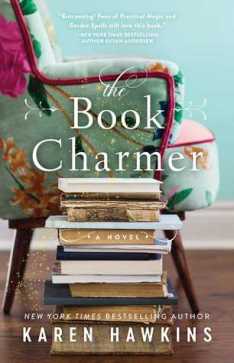 The first one I read—The Book Charmer, by Karen Hawkins—also has the element of magical realism going for it. It did, in fact, remind me of Practical Magic, by Alice Hoffman, in some of its elements, notably the two sisters who are dumped at a young age for someone else to raise, and in the fact that books actually talked (maybe out loud or maybe just in her head) to one of the residents of the small town in which the story ultimately takes place.
It was, indeed, a charming book about books, about family and friends, about small towns and the very real dangers of their dying out in the face of progress. It also dealt delicately and accurately with the issue of Alzheimer’s disease.
I would have liked more about the growing-up years of sisters Grace and Hannah, and the parallel years of Sarah Dove, lucky seventh daughter (and the book charmer) of the Dove family of the town of Dove Pond. But after an introductory chapter about each,
we jump to present day when everyone is an adult, and proceed from there. Not that the “there” wasn’t a good tale, I just wanted a bit more of the back story.
I thought the portrayal of Grace was excessively curmudgeonly, although I could understand her point of view. But she could have relented a bit sooner in instances where people were actually trying to help or befriend her, or both.
I liked this book’s gentle quirkiness, and will probably seek out the author’s subsequent stories about the same town.
 The next book I took up was
The Bookish Life of Nina Hill, by Abbi Waxman. Talk about your basic wish fulfillment!
At the beginning, given that you are a person who thinks like me, Nina has it all: A job in a cool bookstore, a lovely guest house lined with bookshelves filled with books, a companionable cat named Phil, and a busy schedule taken up mostly with book clubs and trivia contests.
Only child: check
Likes books better than people: check
Likes cats better than many people: check
Enjoys her work putting together readers with books: check
Likes her routine and doesn’t want to be dynamited out of it: check
Then, Nina discovers that the father she never knew has called her out in his will to receive some sort of legacy, thereby putting her in touch with a raft of unknown and unsuspected brothers and sisters, nieces and nephews, aunts and cousins…which is in one way kind of a dream come true for a wistful only child who has previously been an observer but not a participant in family life…and in another way kind of a nightmare for a self-sufficient, slightly anxious introvert.
Also, the team leader of one of the competing trivia teams in her league is showing definite interest in Nina…but it will never work out, because he’s not a reader. Oh well… But he IS good looking, and persistent, and maybe…no, definitely not. But…
You can guess how things play out from fairly early on in the book (obvious portents), you can see the “event horizon” clearly, but you’re so caught up in it you don’t really care. This is the ultimate feel-good book for the bookish and the romantic.
 I didn’t think I’d be a fan, initially, of The Overdue Life of Amy Byler, by Kelly Harms, because of the whole martyrish deserted mom thing. I mean, I get it, and she had a perfect right, and I’ve been there as the deserted wife, although not with the mom thing piled on top of it; I just didn’t think I’d enjoy a book about it. But I did, quite a bit!
Amy is soldiering on as a single mother after being completely abandoned by her husband and partner, John. When the children were 12 and 9, John went to Hong Kong on a business trip, and never came back. Amy had to go back to work full-time as a school librarian, and scrape absolute bottom to keep her kids in their school and put food on the table. Not only did John desert them, he didn’t pay child support or communicate with any of them for three years. Small wonder that Amy harbors major resentment.
Then John comes back—because he misses his kids and wants to make things up to all of them. They all know that’s not possible, but Amy agrees (with some counseling by her friend, Lena) to give John a week with the kids, and she takes off for New York City on a part-professional, part-personal trip. The week stretches into a summer, and Amy finds herself at loose ends (and somewhat uncomfortable with it) as all her responsibilities are picked up by someone else.
I loved that the book included attendance at a librarian convention, accompanied by a presentation by the protagonist about a concrete idea (Flexthology) on how to promote reading to reluctant teen readers through choice and anonymity. This made the character feel solid and real, and made the subsequent events (even though they were more fanciful) seem plausible and possible. Her makeover (to be featured in a magazine article) by her publisher friend, Talia, was fun (and only a little patronizing). I adored Daniel, the “hot librarian,” and rooted for him despite Amy’s #momspringa (a play on the Amish Rumspringa) dates with other guys. Part of what kept the book going was the witty banter—Harms knows how to write dialogue.
These books all three definitely fit the bill when you’ve been reading a lot of brooding thrillers or books heavy on emotion and description—while there is still poignancy, these authors keep the tone light while exploring some serious issues. They are all three great additions to my rapidly growing “canon” of books-about-books-and-readers!
Dark deeds
I am a big fan of the books of Sharon J. Bolton. A mystery-reading friend turned me on to her and (being a little obsessive in my reading methodology) I decided to start with her debut, Sacrifice, written in 2008, and work my way forward. Her protagonists are women in unusual professions and offbeat settings, and the books cross that line from mystery to thriller, almost to gothic. They are definitely dark, but also compelling enough that I have been undeterred by subject matter that might make me stop reading another writer’s book.
I like both her series, featuring Detective Constable Lacey Flint (yes, British), and her stand-alone novels, which encompass a far wider array of characters and situations, with settings from Dorset to the Scottish border to the Falkland Islands, and plots that range from mistaken identity to serial killers to something eerily reminiscent of Children of the Corn. They are uniformly well written, well plotted, and harrowing to various degrees.
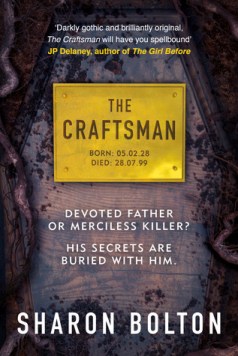 After having read her latest,
The Craftsman, I concluded that the name of the book should rather be reserved for its author. Bolton is truly a craftsman of storytelling, and her latest is even creepier than some of her former offerings, which I wasn’t sure was possible.
The central modus operandi of the killer in this one is something I wasn’t sure I could persist in reading about, it horrifies me so much. If it’s not your worst nightmare, it will be after you read this.
The character of WPC Florence Lovelady, a green but smart and enterprising 22 years old in 1969, immediately engaged me, particularly her trials with smoothing it over and dumbing it down in order to operate as a policewoman in those misogynistic times (not that things are leaps and bounds better today…). The setting—
the bleak beauty of northern England—was likewise captivating.
And the mystery was topnotch, wandering as it did from past to present and infecting the reader with certainties and doubts in almost equal measure.
In 1969, three teenagers have gone missing (one at a time, over a period of months) from the small town of Sabden. There is speculation each time one disappears that they could be runaways, out there in the world somewhere doing just fine; but after the third disappearance, the police (and particularly newbie Lovelady) are starting to think otherwise. Detailed to follow up on the claims of some children who swear they heard a voice coming from a recent grave, Florence makes a horrifying discovery that starts her on a chase that will make her career…and change her forever.
In 1999, the death of the imprisoned serial killer brings Assistant Commissioner Lovelady back to town, in company with her son, to attend the funeral. But subsequent events suggest that what she thought was buried in 1969 with the confession of Larry Glassbrook may just emerge from the grave to haunt her.
This is apparently the first of a trilogy, with the next book not due out until October of 2020. I don’t know if I can wait…
Big Little Lies
I hadn’t previously read anything by Liane Moriarty, although several librarian friends had recommended her to me, so I decided to start with Big Little Lies, since the TV series stars some of my favorite actors and I’d like to have read the book before embarking on that.
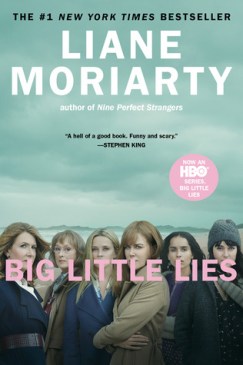 I didn’t know anything about the book, except that it’s classified by some as “women’s fiction,” a category title I have always found insulting. Joyce Saricks, readers’ advisory guru, defines women’s fiction as consisting of “books written primarily by women for women, that feature female characters, and that address the issues women face in their professional and domestic lives.” I find the descriptor “women’s fiction” to be dismissive and ghettoizing. When men were the primary writers of fiction, it was all just fiction, whether literary, mainstream, or genre-based. Why do we need to use condescending terminology that puts female writers in a “less than” category?
It is true that the three main protagonists of Big Little Lies are women with issues (some of them dark): Madeline, Celeste, and Jane. It’s also true that this is primarily a book about white privileged people whose children attend an exclusive school. But it’s ultimately a story of parents acting badly, and it features the real lives of children, teens, friends, husbands, wives, second wives, and exes. And the interplay between all these characters, primary and secondary, is smart and witty, making the book completely engaging.
It’s also suspenseful, given that the pivotal moment (which is mentioned at the beginning and then built up to in timed chapters) is a death at the annual Pirriwee Public School Trivia Night, an annual fund-raising event. You know what happens, but not to whom, nor how, nor why. There are small glimpses fed to you in the guise of gossip shared with an unknown interviewer by various secondary characters at intervals throughout the book, which lend further tension as some get it entirely wrong and others come perilously close to guessing secrets they’re not supposed to know.
I loved the way Moriarty sets up the story—the countdown to the trivia contest, the fragments of gossip and commentary, the glimpses into all the lives involved in the broader story. But I particularly loved the entire array of characters, both main and secondary. This is a quintessential example of a character-driven plot, and although its stated theme is suspense, the real content of the book lies in understanding every woman portrayed here. The character development is fresh, intuitive and nuanced, and doesn’t stop with the first few moments of set-up on their personalities, but portrays complex, flawed people with real issues. Moriarty is equally good at capturing the quirks and personalities of all the children involved, and she seasons serious interactions with moments of humor and even hilarity.
I didn’t figure out the climactic moment ahead of time, and honestly spent the second half of the book hoping passionately that she wouldn’t kill off any of the people in which I had invested so thoroughly!
I have put three more books by Moriarty on hold at the library.
Reacher
Past Tense is Jack Reacher book #23, by Lee Child. I read a bunch of the books in this series in long-running binges, and then got tired of them and went away for a while. But after reading a surfeit of quirky and thoughtful mainstream fiction and some angsty teen fantasy, this was the straightforward, somewhat creepy dose of suspense I needed in the moment.
 The Reacher books are, admittedly, pure formula, but when it’s a good formula (as with so many mystery or suspense series), it’s easy to go with it. Jack Reacher is former military police, but in a way he’s been ruined by his career. The typical nomadic existence of military life, constantly picking up sticks and moving to a new base, a new assignment, doesn’t lend itself to putting down any roots. People who retire from that either react by finding a home and never leaving it, or they remain perpetually restless. Reacher is an extreme example of the latter, roaming randomly and impulsively back and forth across the United States with no baggage but a toothbrush and no transportation but his thumb stuck out by the side of a highway. (If he gets work and makes some money, he occasionally takes a bus or train.) Because of a combination of his background training and his hardline personal ethics, no matter where his curiosity leads him, Reacher inevitably becomes embroiled in some local trouble and acts as a knight errant to help the innocent and punish the guilty.
If you’ve seen the two movies starring Tom Cruise, most faithful readers will tell you that you haven’t met Jack Reacher. There was major outrage when he was cast, since Jack is a rangy six foot five in his stocking feet, 220-250 pounds, with blond hair—scarcely a description of the tough and enigmatic but nonetheless short and dark Cruise. I always thought, if he’d been 30 years younger, that the recently deceased Rutger Hauer (the replicant from Blade Runner) would have been good casting. Ironically, when she first sold the film rights to Interview with the Vampire, Anne Rice had pictured Hauer as perfect for the role of the vampire Lestat, which role Cruise also bogarted, to his and everyone else’s eternal regret!
In this particular book, there are two parallel story lines that persist throughout and only come together near the end. Reacher’s part of the story is initially fairly benign; with autumn coming on, he is departing soon-to-be-chilly Maine with plans to take a zig-zag path that will eventually land him in California for the winter. He puts his thumb out and gets a ride that promises to take him a good ways on his first day, but then the driver’s business calls him back to town, and Reacher is stuck out in the middle of the New Hampshire woods. A road sign for Laconia, New Hampshire decides him on his next leg; he’s never been there, but recognizes the name from family stories as his father’s birthplace, and decides to explore for a day before continuing his journey.
Meanwhile, a young Canadian couple is traveling to New York City to sell something valuable and parlay that into a new life in Florida; but car trouble sends them limping down a long country lane in search of assistance. From the minute Shorty and Patty arrived at the out-of-the-way motel, their old Honda knocking and backfiring, and met the four co-owners, I knew something was up; the guys’ bouncy, friendly affect was too much like Mormon missionaries at the door to be for real. The elaborate web of lies they wove to keep Shorty and Patty from going anywhere kept amping up my nerves as I waited to see what was intended for these two, even as they rationalized and justified their way from uneasiness to optimism and back again. The whole story line was fraught with anticipation.
At first, I assumed Reacher’s part of the story was simply designed to put him in the neighborhood of the hotel when it came time for whatever terrible thing was going to happen there to require his services. But his accidental and fairly casual research into his father’s small-town origins revealed more and different facts than he expected, puts him up against a couple of tough customers, and leads to some trouble of its own.
Although some people thought both story lines were drawn out too much, I really liked the switching back and forth between them as a vehicle to build suspense. The situation with Shorty and Patty eventually blows up, and Reacher is instrumental in his familiar role as a fixer. Despite a few departures from Reacher’s usual modus operandi, I enjoyed this quite a bit—it kept me reading until my Kindle died at 1:30 a.m., and I recommenced at 7:30 after the Kindle (and I) had recharged! There’s something to be said for a recurring theme with individual characteristics enlivening each iteration!
Ash & Bramble
“What if the stories aren’t told?
What if they’re lived? What if you were forced
to live your life in the shape of a story that is
not your own, with no choice about who you are
and where you’re going?”
Ash & Bramble, by Sarah Prineas, has an intriguing premise…and buries it so deeply (the above quote is from page 265) that it’s hard not to be confused and frustrated before you arrive at a partial explanation; and after that it’s equally difficult to put up with the lack of certain details that end up detracting from the true potential of the book.
 Despite all its publicity copy, I would not
call this a true fairy tale retelling.
It’s a book with a bigger concept,
a philosophical question in which fairy tales are used as illustrations, in a way. It reminded me a little of Cornelia Funke’s Mirrorworld series (Reckless, Fearless, and The Golden Yarn), in which various remnants of fairy tales are present but in a dark and twisted setting that isn’t about that trademark feel-good happy ending they all promise (marry-the-prince trope).
People may scream “spoiler” when I explain, but honestly, I would have been somewhat happy had someone spoiled things for me a little earlier on in the book. Basically, Story has become a powerful force in the world, and wants everything its way; it has co-opted the Godmother (nothing fairy-like about her) to enforce its will on the people by making them all act out the same stories, over and over and over again. In service of this series of “passion plays,” the Godmother has enslaved countless unfortunates to labor without ceasing behind the scenes to make shoes, sew dresses, dip candles, construct props, and spin straw into gold. So between the people working their fingers to the bone as prop-makers and the ones being forced onto the stage to re-enact the same tales, pretty much everyone in this book is miserable.
Pin (a seamstress) and Shoe (a shoemaker) are trapped in the Godmother’s fortress of fairy tale props, but because Pin possesses a secret artifact (a magic thimble), they have an advantage over their zombified colleagues and are able to look outside their presumed fates and aspire to something better. Unfortunately for Pin, the Godmother has her own magic thimble, is aware of Pin’s speshulness (although not aware of the twin thimble), and Pin wakes up one day to find herself cast by the Godmother as the lead in that hoary old tale of Cinderella.
In this way, the book itself echoes the state of its characters: There is the Before (everyone’s past), and the After (in which they have been brain-wiped and re-set to participate), and there is also the Before (in the fortress) and the After (in the tale) for the reader.
I’m not going to say that I didn’t enjoy the book, because it had some wonderful aspects to it. I thought the world-building and scene-setting were good; I was enamored of a couple of the characters, intrigued by the idea of Story as a power all its own, and caught up in the action of rebellion. But when we get to the end of the book without finding out one simple thing—where the thimbles came from and what was their intended use (as opposed to the perversion of powers wielded by at least one of their wearers)—I have to admit that I gave the writer a great big “C’mon!” There were several other glaring unlikelihoods that I won’t share here but that have caused an outcry among some reviewers on Goodreads. With all of that, I wouldn’t tell you not to read Ash & Bramble, because in many ways it’s better than the bulk of the true retellings out there. But be aware that it is more a foe than a fan of fairy tale.

Parenthetically, can we talk for a minute about that cover? Ornate typography? Good. Brambles with accompanying thorns? Good. Big floaty red chiffon skirt edged with ashy gray? Good. Backless sequined slutty Las Vegas-style “bodice”? C’MON. So close.
Autism in fiction
A few years back, I read the book The Rosie Project, by Graeme Simsion. At the time, I didn’t have what you would call a significant reaction to the book; it was more along the lines of “charming, funny, and enjoyable relationship fiction.”
I did comment in my notes on Goodreads that the protagonist, Don, put me in mind of an adult version of Christopher Boone, the kid from The Curious Incident of the Dog in the Night-time by Mark Haddon—I could see him growing up to be Don: precise, literal, frustrating, yet engaging in his innocence and bewilderment about the social norms that escape him.
 Don Tillman, Australian genetics professor, is an odd duck. His lifelong difficulties with social rituals and situations have caused him to create an orderly, easily navigated life with a precise routine and little human contact. He does have a few friends, and one of them comments to him that he has many attributes that would make him a good husband. This sets Don, who has never gone on a second date, to thinking about how best he could find a partner for himself with the least amount of fuss. His conclusion is The Wife Project, a questionnaire he devises that he intends to submit widely (mostly via a dating site) to weed out the things he can’t abide and narrow his search to the perfect woman for him: no smokers, no vegetarians, no late people, no messy people…the list of what he doesn’t want far exceeds the list of what he does!
Rosie Jarman shows up at his door intending to ask for his assistance on a genetics project, but because she has been sent by his friend and mentor, Gene, Don thinks she is there in response to The Wife Project questionnaire, and asks her out. He is baffled when he discovers that she is a smoker, a drinker, perpetually tardy, and in no way his ideal woman. But when he questions Gene about her, Gene (with some suppressed mirth) says he threw her in as a “control,” and encourages Don to continue to see her. Don takes up the challenge of Rosie’s genetics project, and begins to learn that perhaps the ideal woman on paper isn’t the one for him.
Although it is obvious to other characters in the book that Don is “on the spectrum,” as it has become modish to say about degrees of autism, Don has not self-diagnosed as such. When he is asked by Gene to substitute for him at giving a lecture and the lecture turns out to be on Asperger’s Syndrome to an audience of children with Asperger’s and their parents, Gene’s wife, Claudia, a psychologist and also Don’s friend, asks him if, in preparing his notes, anything seemed familiar. Don seems baffled by her question and doesn’t arrive at the answer she is obviously implying.
A few readers’ reactions to this novel have been negative, because they felt it mocked or made fun of autistic people, but the book’s author has noted that when he wrote it, he didn’t research Asperger’s, and in fact had based Don on “people I met in physics, information technology and doing a Ph.D.” He follows up by adding, “Experts in the field assure me that Don has Asperger’s and that community says the same thing. It was not my intention to make light of Asperger’s, and the Asperger’s community…regards Don as typical but not stereotypical. He’s seen as a good role model; readers generally love him, and that’s a good thing for the image of ASD.”
Remembering how I had enjoyed this somewhat light but entertaining and thoughtful read, I was pleased to see that while I wasn’t paying attention, Simsion had written two follow-up novels, continuing Don’s and Rosie’s story, and I snagged both sequels from the library’s e-book collection as soon as I could get them.
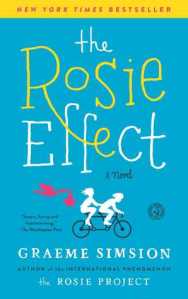 The Rosie Effect picks up fairly soon after the events of the first book; Don and Rosie are married (sorry, that’s a spoiler, but you kind of knew how it would end, right?) and living in New York City; they both have satisfying work, and everything seems to be going according to plan, which makes Don feel happy and secure. Then an unexpected pregnancy throws everyone for a loop. Don had always agreed, in the abstract, that he would enjoy having offspring, but as far as he knew, birth control was in place and nothing along those lines would happen without a lengthy discussion and negotiation. Rosie, observing their friend Sonia’s struggles to conceive, realizes she isn’t young any more in terms of optimum child-bearing years, believes it could take some time to become pregnant, and “decides” to forget to take her birth control pills, resulting in an almost immediate “success.”
Don does his best to cope with this news, but approaches it with his usual lack of emotion, choosing instead to make lists of tasks and goals that need to be accomplished before the baby is born and setting about them in typical Don fashion, which is to say he almost immediately finds himself in trouble on every front. Meanwhile Rosie, who was happy as Don’s wife, begins to question what kind of father he will be able to be for their child, and as Don seems increasingly incapable of understanding the emotional commitment she needs, Rosie withdraws. Don will have to rein in his various projects and focus instead on his relationship with his wife and child, or all his good intentions will be for nothing.
I had a little trouble with the evolution of Don’s and Rosie’s relationship as a result of the pregnancy. Don continued to be himself; but Rosie, confronted with parenthood, had an extreme reaction to everything about him that she had previously found charming (if maddening). Her reaction seemed over the top, even for someone whose instincts were telling her to place the welfare of her child over the viability of her marriage. For the first time in their interactions, you see Rosie have as little emotional understanding of Don as Don has of Rosie, and it’s unsettling. But it’s a strong story over all, and with the help of their friends they are both able to attain clarity.
 There is a considerable hiatus in years between the ending of the second book and the beginning of The Rosie Result; Don and Rosie’s son, Hudson, is now 11 years old. The family has returned to Melbourne, where both Rosie and Don are working full-time in their professions. It soon becomes clear, however, that one of them will need to suspend a busy schedule to give time and attention to their son, who is having trouble fitting in at school and needs more parenting. Coincidentally, Don does something that is typical (and without agenda) for him but which his students find offensive, and concludes that putting some distance between himself and this problem is congruent with his goal of tutoring Hudson in how to get by in a world that thinks you’re weird. Don quickly realizes that the best thing he can do for Hudson is to “outsource” some of this instruction to people with better social instincts than his, and the following year becomes a good example of a “village” raising a child.
In this third book, Simsion openly confronts the topic of autism; while its effects in Don’s life were duly noted in the first two, it is Hudson’s difficulties in school that bring the topic into focus, and Simsion uses the interactions of the Tillman/Jarman family with school administrators, teachers, and counselors, other parents and students, and their unusual group of friends to highlight various sides of the issue. He shows the prejudices that confront people who don’t fit in with perceived social norms, and specifically discusses the pitfalls that lie in allowing a child to be “diagnosed” with something that will follow them for the rest of their school career and beyond. Labeling and identity, both specifically with regard to autism but also in a wider sense, are prevalent themes, and the book directly questions people’s assumptions about autism.
There is a particularly effective scene in which Don and Rosie attend a panel discussion about autism, participated in by a mother who has taken every route—including intensive tutoring, medication, and behavior modification—to help her daughter conform to neurotypical norms, as well as an activist who maintains that autism is not a disease but an identity. Her example is that she doesn’t ‘have’ lesbianism, she is a lesbian; therefore, she doesn’t ‘have’ autism, she is autistic—it’s part of who she is, not something visited upon her that she needs to confront and conquer.
Far from turning the book into a polemic, I felt that this debate, fictionalized and exemplified by the relationships amongst the participants in the story, made it all the more compelling. It is particularly touching as Don, who is determined to make Hudson’s life better than his own by teaching him to cope with society’s expectations, comes to realize that perhaps his response isn’t the best one for Hudson, and that if Hudson can navigate his life by being himself, there may be more wiggle room in his experience than his father had assessed. While maintaining the gentle humor inherent in Don’s (and Hudson’s) misunderstandings of social norms that Simsion portrayed in the first two books, in this one the intensities of the relationships become truly heartfelt. The arc of this three-book story is completed with vastly more depth than one would expect from light, “relationship” fiction.
Regency magic?
I’m always looking at other people’s (and publications’) lists, to see if there are stand-out books on them that I somehow missed reading. On a list that was called something like “best sci fi and fantasy books you may not have discovered,” I found a few with which I was unfamiliar and ordered them. The first one I read was Sorcerer to the Crown, by Zen Cho.
Most people who reviewed it on Goodreads either lauded it or hated it for one reason: It reminded them of Jonathan Strange and Mr. Norrell, by Susanna Clarke. Some loved it because it had similar characteristics but was “half the length and twice the fun,” while others loathed it because they found it derivative and without the same careful attention to detail given to the subject by Clarke.
I have not (yet) read Susanna Clarke’s 800+ pages, so that comparison sparked no reaction for me; but when reviewers started comparing it to Georgette Heyer and Jane Austen, I went back and took a closer look.
 The story takes place in an alternate-reality London, where magic was once a powerful and primary occupation for the upper classes and every prominent family seemed to feature at least one sorcerer accompanied by his familiar. (Women are banned from practicing magic, unless it’s the hedge-witch variety of small household spells to lighten the domestic load.) But in the current day, England’s atmospheric magic is drying up. No more familiars are coming over from Fairyland, and no promising young sons are venturing there in hopes of catching the Fairy Queen’s eye.
Sir Stephen Wythe, the Sorcerer to the Crown, has recently died under mysterious circumstances; his familiar has likewise disappeared, and the man who has taken up his staff to become the new head Sorcerer is Sir Stephen’s foster son, Zacharias, an emancipated slave raised by Sir Stephen to be a thaumaturge. Zacharias, a conscientious, retiring, and painstaking person, would much rather have remained in the background, doing his research into the restoration of England’s magic; his new role throws him to the lions of extreme prejudice, with plots against his life, perilous meetings with the Fairy Court, and speeches at such frightening venues as a school of gentlewitches (he’s cautioning them against the dangers of magic for women). Then he meets Miss Prunella Gentleman, also an outcast because of her lack of good birth and the “dusky skin” that proves she is of mixed race, and Prunella’s aptitude for magic and the effrontery to practice it turn his perceptions upside down.
The book is set in Britain during the Regency period and the Napoleonic wars. Those who compare it with Heyer and Austen say it fulfills their requirements for a comedy of manners with amusing commentary also reminiscent of Wodehouse (the speech at the girls’ school being that example). I didn’t find the language or tone either of them to be reminiscent of Heyer’s lighthearted works, nor were there sufficient social interactions to spark recognition of her influence, and the romantic aspect was almost entirely lacking. I did think perhaps Austen would have enjoyed Cho’s send-up of the nobly born and pretentiously superior, commenting on their bigotry and their assumptions about “good birth” always triumphing over morals and brains.
The book did remind me of some others: Gail Carriger’s Etiquette and Espionage, because of the young-ladies-in-training aspect, as well as something about the pacing and language of the story-telling; and Jonathan Stroud’s The Amulet of Samarkand (Bartimaeus book #1), which features a similar setting of an alternate London ruled by stuffily self-regarding magicians. It’s also vaguely reminiscent of Garth Nix’s Newt’s Emerald (in fact, it looks like the same artist for the cover of that book has been employed for Cho’s sequel), which in my opinion pulls off the Heyer tie-in a bit better.
Because I read Sorcerer to the Crown before I looked at any of the reviews (including the blurbs on the back cover), I was initially quite taken aback by both the racism and the misogyny so freely expressed by Cho’s characters. The use of the term “piccaninny” on page four shocked me so much that I almost put the book down. Only the comment of Mr. Damerell, “What an edifying sight for a child—a room full of men several times his size, calling him names,” encouraged me to continue. Likewise, the discovery by Zaccharias that the gentlewitches’ school has been using a killing spell designed to drain the magic from its victims in order to keep its young ladies in line (i.e., magic-free) was a bit daunting. I had not yet put the book in context as a Regency send-up, so for me, the author’s choices were jarringly unexpected for a book written in 2015 by a woman! Once I had figured out the intended setting and atmosphere, I forgave the various liberties, but in this era of extreme care about the way the races and the sexes are portrayed, I have to confess it still left a lingering uneasiness about the book.
My final reaction was primarily that of enjoyment; but I didn’t give it the wholehearted five stars it received from many of its Goodreads fans. Perhaps, for me, Cho simply attempted too much within the context of this one volume. Perhaps I wasn’t in the proper mood to appreciate its quirks. For whatever reason, I didn’t click with it; but that isn’t to say that you wouldn’t. If you enjoyed the Finishing School or Parasol Protectorate books of Gail Carriger, you might like it a lot.
 There is also a sequel, The True Queen, released just this year, that takes the reader to Janda Baik, the country from whence one of the first book’s main and powerful female characters hails. It received similarly high ratings from those on Goodreads who enjoyed the first book.
Cross-genre delight
One thing you learn when becoming a readers’ advisor is,
you can’t be a book snob. Some people pride themselves on only reading “worthy” or “classic” or “literary” fiction. Others believe that while mainstream fiction is legitimate, anything that falls within a genre description is somehow less-than. When you read so as to address the interests of every type of reader, the fortunate outcome is that you discover there are “worthy” books—that is to say, engaging, well written, and with something to say—within every category of fiction.
I have wondered whether I should bother reviewing older books here, or whether I should just be addressing newly released works, to keep up with the ever-changing whims of contemporary readers. My conclusion so far has been that it’s all right to cover older reads, because no matter how long ago they were written, they will be new to someone.
Today, I just finished rereading Bloodhound (Beka Cooper #2), by Tamora Pierce. Pierce is much beloved by many fantasy readers, and has been incredibly prolific in the number of books and series she has written that are all set in the kingdom of Tortall. Tortall is a semi-feudal land populated by knights and ladies (and some knights who are also ladies), master craftspeople and master thieves, commoners both honest and corrupt, and the supernatural creatures who also make an appearance. The gods are definitely present (though mostly in subtle ways) in Tortall.

Rather than write one long series with a particular cast of characters, Pierce has broken down the Tortall legend into small “cycles” of three or four books each, that come at the world and its events from many different perspectives. While all these novels are immensely popular with a wide variety of people from 10-year-olds to the elderly, it does seem to me that the earlier books were specifically written to appeal to middle-school teens. Although many adults read them, there is a large percentage who do so out of nostalgia, because they read Pierce as a child and want to revisit the world of Tortall.
The first thing I like about the Beka Cooper series, therefore, is that while the books are completely teen-friendly and accessible (and are, indeed, marketed to teens), they are written from a much more adult viewpoint. While Beka, the narrator, is a young woman, she is more woman than girl, and the others with whom she interacts are likewise more mature. This is yet another in the growing list of teen fantasy series that could equally well (or perhaps more successfully) have been marketed to adult fantasy readers.
The second thing I like about the series is that it so fluidly combines medieval fantasy with mystery and police procedural, using a memoir format—basically, all my favorite genres rolled into one. The characters (and there are many) are engaging, the situations are surprisingly sophisticated (how many young adult novels expound on the effects of counterfeiting on a nation’s economy?), and the mysteries are well paced and satisfying. Beyond this, Pierce has exerted herself to provide a made-up language, reminiscent of the “thieves’ cant” you find in Regency romance novels, that give the books a particular flavor. The inclusion of this lingo also cleverly circumvents any criticisms she might get from parents who ban language and sexuality by expressing things that she couldn’t do in a teen book if she put them in contemporary English. Pierce has taken pains to spell out the differences in rank from that of the King in his palace down to the lowliest gixie picking pockets amongst the slums. There is no difference made in the characterizations between children, teens, and adults in terms of attention to detail, and while Beka remains firmly the main character, the people with whom she partners, the neighborhood from where she rose to the police force, and the “coves and mots” she encounters in the course of her work are all given a real existence. Finally, the books feature strong female heroines, a welcome departure from some fantasies.
 Terrier, the first book (released in 2006), takes us away for the first time from the lords and ladies, knights and squires of the other series and introduces Beka Cooper, an orphaned 17-year-old with some special gifts that lead her from the Lower City (the worst neighborhood) of Tortall into a career as a “Dog,” or police officer, in the Provost’s Guard. She is assigned as a trainee (“puppy”) to two veterans, Tunstall and Goodwin, and proves herself as an officer who hangs onto a case like a terrier until it’s solved.
 In Bloodhound (2009), her second year on the force is also documented in the pages of her journal, and it’s quite a ride. As a new Dog, she is matched up with four different partners who don’t work out, and she ends up instead working solo with Achoo, a scent hound she rescues from an abusive handler. She and Clary Goodwin, one of her former training partners, are then sent by the Provost General, Lord Gershom, down the river to Port Caynn, on a secret investigation to discover who is behind the spread of counterfeit silver coins that are destroying the economy. She falls in love, falls afoul of the Port Caynn Rogue (Queen of the thief caste), and earns her new nickname as she doggedly (pun intended) pursues the solution to the case.
 The third book, Mastiff (2011), is equally compelling. Three years after their mission in Port Caynn, Clary Goodwin has finally opted to promote to a (stationary) command position, and Beka is now paired with Goodwin’s former partner (and her other former training officer), Tunstall. Beka has suffered a recent tragedy—her fiancé, a fellow Dog, has been killed while pursuing slavers—and she doesn’t know how to go on, mostly because she was on the verge of breaking up with him when he died, and now she’s feeling guilty for receiving unwanted attention as the grieving almost-widow. But an assignment abruptly pulls her away from her familiar surroundings and sends her, her partners both human and canine, and a strange mage assigned to their team on a hunt the outcome of which will determine the future of the Tortallan royal family and government. As with the second book, the pacing ramps up as the Dogs get closer to their quarry, and unexpected elements throw several wicked curves into the story before it ends.
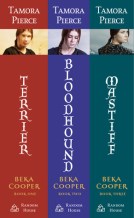 There have been two things against this series when I talked it up to others: The first was the truly abysmal cover art on the original paperbacks, which was actively ugly and made it almost impossible to “sell” these books to anyone (especially teenagers). The photographic image chosen to represent Beka was both laughable and disrespectful. The recent re-release of this series with new covers may give it a chance; if you are a librarian reading this, please consider immediately replacing your originals with the new versions!
The second is the supernatural element, which I sometimes completely leave out of my descriptions. When you say that a book is about a girl who gets messages from the recently dead by listening to pigeons, and who also gathers clues by standing in the middle of dust devils and picking up bits of conversation the dust devil has been hoarding, people look at you like you’re crazy!
This fantasy series has so many facets and is so hard to adequately describe that I don’t often find myself promoting it to anyone—but after rereading #2 on impulse this weekend, I decided to make another pitch, because these books are a worthy, intriguing, and entertaining addition to the mainstream fantasy canon.

 The Book Adept