Saving the library
My next book on the library holds list was The Last Chance Library, by Freya Sampson, and I’m happy to report that I am now two for two (two good reads in a row) for 2026.

This was Sampson’s debut novel, and it might be my favorite. I hate to be predictable, but I do love a book about books. I don’t, however, always love books about libraries and librarians, for the simple reason that the authors don’t do their research to understand what role is filled by degreed librarians as opposed to assistants, circulation staff, shelvers, etc. But Freya Sampson is among the few who get it absolutely right. She acknowledges the need for a degree in order to be a librarian, she describes the duties of her main character, June, a library assistant, perfectly and consistently, and no one ever calls June “the librarian.” She hasn’t had the requisite schooling to be acknowledged as a librarian, and the lines in this book are always clear. That may sound elitist to those who are not librarians, but as someone who worked hard for two years to get my masters degree in order to be one, it’s so demoralizing when anyone who has a job at the library is assumed to possess the same abilities. It would be like going to your lawyer’s office and believing that everyone working there must be a lawyer, or that the people who staff the reception desk at your doctor’s office are qualified to diagnose.
Anyway…with that out of the way, let me say that this was a delightful book, although not as lighthearted as some of hers. Sampson has a gift for characterization that makes the plot situations believable and engrossing. You like (or dislike) these people, you get to know them pretty thoroughly, and you therefore invest in their circumstances. Despite the fact that the characters may fall into standard categories—curmudgeonly old lady, nosy neighbor, old friend turned love interest, etc.—Sampson fleshes them out so that you don’t mind the use of a common trope.
In this case, the protagonist, June, has been a library assistant at a rundown stand-alone library in a small town since she started there part-time as a teenager. She is now 28 years old, and seems frozen in place; her mother, who was the librarian for most of June’s life, died of cancer eight years ago, and since then June’s life has turned into a predictable round of work, frozen lasagna or takeout, and reading. She gave up all thought of college when her mother got sick, staying home to nurse her, and now she lives in the house in which she grew up, and has changed nothing since her mother passed. She has no friends and relies on library patrons for any form of human contact, but retreats into her silent solitude whenever she isn’t shelving books or helping seniors log into their email accounts on the library computers. In a word, she’s stuck.
She is also almost debilitatingly shy, so nothing seems likely to change—until outside circumstances interrupt her cycle. The local council has signified that they will be considering closing up to six libraries in her town, Chalcot, and five other adjacent townships, due to budget cuts, and replacing them with a once-a-week visit from a bookmobile. The regular patrons of the library are immediately up in arms and ready to do whatever is necessary to save their library, but June is told by her boss that as an employee she is forbidden from participating in any of these activities. June unhappily acquiesces, but a chance comment from someone new in her life causes her to think of ways she can subvert this order and help keep her beloved library open.
There is a nice incipient romance in this book but, as with Sampson’s other books, it isn’t the dominating theme; that is more nuanced, and brings insight to various aspects of the human condition and the best ways in which we interact when important issues are on the line. I really enjoyed this and read it in two days. Sampson’s books couldn’t be considered “literature,” but they are certainly good stories that provoke both feelings and reactions. I will continue to read them.
My Year in Books 2025
I managed to read quite a few more books this year than last (95 to 2024’s 66), but I don’t know that I realized much advantage from doing so, beyond just clocking the reading time. My stats, according to Goodreads, were:
95 books
28,425 pages read
Average book length: 346 pages (longest book 908 pages!)
Although I discovered some enjoyable reads, there wasn’t one single book that truly bowled me over or made me immediately check out another book by that author or settle in to read a lengthy series. And most of the books I did like were the lightweight ones that I ended up reading as a sort of relief between the tougher titles. Here’s a list:
The Lost Ticket, by Freya Sampson
The Busybody Book Club, also by Freya Sampson
Vera Wong’s Guide to Snooping (On a Dead Man),
by Jesse Q. Sutanto
Finlay Donovan Digs Her Own Grave, by Elle Cosimano
My favorite science fiction book was The Road to Roswell, by Connie Willis.
My new discovery in YA fantasy, with an intriguing Egyptian-like setting, was His Face is the Sun, by Michelle Jabes Corpora. I look forward to the sequel(s).
I read a few books that were award-winners, or by well-known literary authors, or touted by other readers as amazing reads, but found most of them problematic in some way, and therefore didn’t feel wholeheartedly pleased to have read them. They were:
James, by Percival Everett
The Seven Husbands of Evelyn Hugo, by Taylor Jenkins Reid
Horse, by Geraldine Brooks
The Mare, by Mary Gaitskill
Horse Heaven, by Jane Smiley
Three Days in June, by Anne Tyler
Gentlemen and Players, by Joanne Harris
These have all been reviewed on this blog, so do a search for the title or the author if you want the specifics. None of them received a thumbs-down, but none of them lit up my imagination either.
The most disappointing part of the reading year was the letdown I felt each time I finished the next book in a bestselling series I had previously enjoyed. I read two books by Michael Connelly—The Waiting, and Nightshade—and had a “meh” reaction to both. The Grey Wolf, by Louise Penny, didn’t deliver the characteristic Gamache love, and was filled with tangents and extraneous story lines. Perhaps the least successful (for me, at least) was The Hallmarked Man, by “Robert Gabraith,” aka J. K. Rowling, which was so endlessly convoluted that I felt the need to reread it—but so long, wordy, and unsatisfying that I didn’t! I’m really hoping these authors rally in the new year, but it’s more of a “fingers crossed” than an actual expectation.
Honestly, my best and most sustained reading took place when I got fed up enough to revisit beloved books from decades past by such authors as Rumer Godden, Georgette Heyer, and Charlaine Harris.
Today I am starting on 2026, two days ahead of schedule! Onward, readers!
Last book of the year

My last book of the year was The Secret Christmas Library, by Jenny Colgan, and I almost didn’t read it. I usually love discovering a new Colgan book, especially the ones that take place up in the wilds of Scotland (which this did), but then I found out it was a sequel to last year’s novella The Christmas Book Hunt, which wasn’t one of my favorites because of the exceedingly obnoxious male lead and, sure enough, that character was equally distasteful in this one.
Fortunately, he wasn’t the only guy on the scene for Mirren, the female lead in both, to moon over, but it took about 85 percent of the story to get to the romance. The setting and atmosphere saved it for me, since it took place in a remote rundown castle on a loch, with its own train stop and maze, and had a resident poverty-stricken laird in search of a rare book hidden somewhere in the “pile.”
The major bone I had to pick with this one was the lack of editing and proofreading. I came across at least five misspellings and/or misuses of words, and it was also apparent that neither the author nor the editor had gone back and perused the work for repetition; on the very first page there was a sentence repeated verbatim twice, just two paragraphs apart, and about 30 pages later she used the word “immaculate” to describe three separate things, again all on one page. The overall impression was that this was dashed off to satisfy the holiday market.
Colgan has written many Christmas books (most as sequels to various series), and any of those is preferable.
Age and time
After 900+ pages of frustrating and confusing murder mystery, I needed a break from the serious, so I picked up two books in a row by Sophie Cousens, whose books are billed as romantic comedies. I don’t know that I would go that far, although there are comedic elements and/or moments. But I did find them enjoyable, one more than the other, although the one I liked second-best is apparently her most popular.
First I read Is She Really Going Out With Him?, mainly because I am a big fan of Joe Jackson. If you don’t get that reference, you are probably too young—Joe made his mark in the 1970s. But do go to Spotify and dial up his song by the same name—you might find a new favorite musician, who knows? If you like the song, then follow up by playing his album Night & Day.
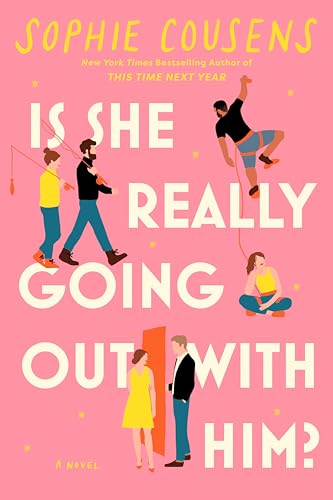
Anyway…the premise of this one is engaging, although you sort of know what will happen at the end by pretty early on. Still, it’s amusing the way the story takes you there. It’s the tale of a divorcée with two children and not much interest in (or success with) renewing the dating game. Anna is a columnist for a popular but struggling arts magazine that has just been bought by a larger company, and she’s nervous that her job is on the line; the new publisher wants material that is more social media-attuned than her traditional approach—more personal, more anecdotal, more relateable. She is doubly alarmed when she gets the idea that her office rival, Will, may be trying to poach her column.
She ultimately has a contest of sorts with him, when he proposes to the publisher that they do a dual column. Anna decides that Will will write about going out with seven women he discovers on dating apps, while Anna will give up the details of the same number of dates with men chosen by her children. Since they are young and enthusiastic (seven and 12) and not particularly discriminating in their choices, her dating pool is a weird one, but Anna gamely holds up her end of the competition. But working together with Will presents more problems than just fending off his job takeover…
Yes, it’s pretty trope-y, and yes it’s been done before, but Cousens does have a gift for character development and for comedic moments that keep this one pretty fresh. And yeah, an author who references Joe Jackson…

The second book, The Good Part, reminded me of a few other books (in a good way), foremost being What Alice Forgot, by Liane Moriarty. In that book, Alice gets conked on the head and forgets about the past decade of her life, in which significant things happened (she had kids, she got divorced), which makes it awkward and sometimes comical when she keeps trying to relate to people the way she did in the moment to which she has been returned by amnesia. The Good Part is sort of the opposite of that, because Lucy Young doesn’t forget her past, precisely, she just anticipates her future so hard that she suddenly wakes up there one morning.
Lucy is 26, a downtrodden TV production assistant who is tired of fighting for the promotion that never comes, tired of living in a dump with three inconsiderate roommates and a ceiling that leaks on her bed every time the upstairs neighbor takes a bath, and one night when she takes shelter in a news agent’s during a downpour and discovers a curious wishing machine, she puts a coin in the slot and wishes hard to be past all this and into the “good part” of her life.
Next morning she awakens with a ring on her finger that the handsome man downstairs apparently put there, and a closet full of really expensive designer shoes. But she also has two children about whom she has no memory, a high-powered job she doesn’t know how to do, and a shockingly old (40-something) face confronting her in the bathroom mirror! She has apparently been transported ahead 16 years but retains only the memories of her life up to age 26, which in her mind was last night.
Not wanting to be diagnosed as mentally ill, she tries for a while to “fake it until she makes it,” but with variable success (especially with her older child, who thinks an alien has possessed his mummy). At first she firmly believes that the mysterious machine has transported her here, and that she will wake up the next day back in her grotty apartment, but when this doesn’t happen, she also has to confront the idea that she may simply have amnesia and has conjured a crazy reason for it.
The most interesting part of the book is Lucy’s inner debate about what she really wants. She has it all—but at the cost of missing the entire experience of getting there. Her husband remembers them falling in love, the birth of their children, her climb up the professional ladder, but inside Lucy is still that single girl who has never been able to afford nice things, doesn’t know if she wants to have kids, wonders if she should ditch her career for something different…and now that she is seemingly in the middle part of her life, she has to decide whether she will settle into the wonderful achievements and relationships she doesn’t remember establishing, or try to get back to her past so she can experience them all first-hand—or possibly make different decisions? This quandary is complicated by the fact that what she ends up doing (if she is able to figure out how) may impact not just the lives but the very existence of the husband and children staring at her with so many questions in their eyes…
These books were a great way to while away a few days. I might even read more Cousens the next time I get burned out on long, serious, and complicated.
Best or worst?
It is almost unprecedented that contemporary romance writer Emily Henry would have a rating under 4.0 on Goodreads for one of her books, but Great Big Beautiful Life is scoring a 3.99. It is even more rare for people to actually write “DNF” (did not finish) and discard one of her books before finishing it but, again, that has happened here. And yet, minus a few issues, it has been my favorite of her books to date.

Perhaps that is because I almost always want more than just the meet-cute, the enemies-to-lovers, the fake relationship, or whatever trope this genre’s authors employ while trying to make the rest of the story unique by the choice of professions for the protagonists or whatever other quirks they can throw in to make it distinctive. And this book has two story lines in it, each somewhat dependent on the other, that to me made it so much more interesting than the standard fare.
Alice Scott is a reliable writer of biographical stories and celebrity puff pieces for a reputable magazine. But she dreams of getting that big break that will take her to the next level and let her write more serious work, whether it’s articles or a book. Hayden Anderson just published his biography of a celebrity who struggled to capture his legacy as Alzheimer’s stole his memories, for which Hayden won a Pulitzer Prize. And now these two writers are in competition for a story that would be a huge score—the biography of Margaret Ives, the heir to a vast family fortune and an enduring social impact.
In her youth, Margaret lived a privileged existence as a frivolous and charismatic fixture of the society pages and the tabloids; but family tragedies and scandal drove her underground, and no one has heard from or about her in decades. Alice, however, fascinated by her for both personal and professional reasons, has tracked her down to a small island off the coast of Georgia, where she is living a secluded and anonymous life, and Alice has gone to see her, to pitch the idea of working with her to write her story. She has competition, however, that she didn’t count on, and is dismayed to discover that it’s a famous writer with a Pulitzer already under his belt. Margaret, both canny about the value of her story and also deeply distrustful of journalists (and people in general), offers them each an opportunity: Stay on the island for one month, meet with her regularly (and separately) to talk about her past and also to outline how each of them thinks her story should be told, and abide by her decision at the end of the month when she picks one of them with whom to move forward.
In addition to being in competition and not wanting to reveal their strategies to the other writer, Alice and Hayden are bound by airtight non-disclosure agreements they signed for Margaret, swearing not to talk to anyone about the contents of their meetings with her, including with one another. But it’s a small island with limited places to stay, eat, walk, and shop, and it’s inevitable they will run into each other; so they have to work out a relationship that is civil while avoiding all talk of why they are actually in this place. This proves challenging for several reasons. (Yeah, you see where this is going.)

The story switches back and forth between Margaret’s first-person reminiscences of growing up rich, famous, and beleaguered by notoriety, and the present-day thoughts and feelings of Alice and Hayden as they weather this month of testing by Margaret and their burgeoning feelings for one another. This is apparently what a lot of her fans didn’t like—both the jumping back and forth between past and present, and the intrusion of another person’s life story into the middle of their romance. But I found it an effective contrast and was caught up in both stories as they evolved.
In the contemporary story, we are much more involved with Alice, while Hayden remains a mystery. The story is primarily driven by Alice’s inner thoughts and by her encounters with and reflections on Hayden, which works with their personalities—Alice’s sunny and outgoing, and Hayden’s secretive and a bit dour. But ultimately we figure out what he’s thinking and feeling too, based on his actions and responses to her, and begin to hope that things might work out between them despite all the obstacles in their path. Picture, for instance, the feelings of a person in a relationship who loses out on a dream job to the person with whom they are involved. Also, they live in different places (Alice in Atlanta and Hayden in New York) and come from and pursue completely different lifestyles. But…there is a spark. More than a spark. So one way or another they have to figure it out.
There was only one thing that didn’t work for me about this story and, while it wouldn’t normally faze me, in this context I found it both inappropriate and awkward. It was all the sex. I wouldn’t normally believe I’d ever say something like that, but in this case I found it positively jarring in the way it distracted from the story. In fact, it was more than just a distraction—I felt like it flat-out didn’t work and shouldn’t have been there.
When Alice and Hayden figure out that they have feelings for one another, they make an agreement that it would be just too much, too weird, too tragic for them to get physically involved during their audition month with Margaret, because of what will happen at the end of that month. So they promise to “be harmless to one another,” and put off a physical relationship despite the attraction between them. That all makes sense. Then they (Alice in particular) do everything they can to test that resolve and flout every rule they make for themselves. I’m sure the author thought that making them irresistible to one another would be exciting, but for me it was offputting to see that they couldn’t stick to their resolve for a month, in the interests of not hurting the other person long-term. And the way that the physical relationship was portrayed was likewise distracting to the story, in that it “just happened” at strategic intervals, almost as if an editor looked over the manuscript and said to Emily Henry, “Oh, your readers won’t put up with no sex in a romance,” and Henry responded by writing calculatedly provocative scenes, and then counted off pages and dropped one in here and there almost out of the blue. It was so inorganic!
Don’t let my irritation with this stop you from reading this book; it’s interesting, and convoluted enough with its twists and big reveals to be a compelling story. But after you have finished it, see if your reaction was the same as mine, and let me know!
Yours Truly…except…

I wanted something a little more realistic after immersing myself in the sci-fi/fantasy of Discworld, but nothing too heavy. So I picked up Abby Jiminez’s most recent contemporary romance, Yours Truly. I am always torn when I read romance, because there is a tiny portion of my brain (heart?) that wishes things could go the way they do in these books, but a larger percentage that keeps saying “C’mon!” every few chapters.
There were things to like about this book. The male protagonist, Dr. Jacob Maddox, is almost too good to be true, except for one major thing that makes the story much more realistic: He suffers from nearly paralyzing anxiety (and, although it’s not named, possibly a little OCD as well). I liked the way the author incorporated this, because we don’t see much of these very common yet hidden conditions in this kind of fiction. The female protagonist, Dr. Briana Ortiz, is a quirky, interesting person with a hair-trigger temper and a great sense of humor who is currently dealing with some serious issues: divorce, a brother who needs a kidney transplant, work stress. Again, the sensitive and stark way the author dealt with the brother’s need for a new kidney and the likelihood he wouldn’t get one was a positive element. The way the author introduces the two characters and the initial misunderstandings followed by Jacob’s unusual solution to their hostility drew me in. (I love some epistolic fiction…)
Having acknowledged those elements, I now have to say that the book was not ultimately a success in my eyes for one reason: TOO. MANY. TROPES. Yes, I did all that capitalization and punctuation on purpose, because, as I noted earlier, “C’mon!”
We have:
• Workplace competition (rivals to lovers)
• Recovering from a breakup (both of them) so, rebound!
• Fake dating (pretending they’re in a relationship when they are not…or are they?)
• Uncomfortable (but suggestive) situations caused by the above
• Realization that they are soul mates
• Miscommunication that pollutes the relationship
• LACK of communication (bordering on the ridiculous) that rips them apart
The whole thing ultimately made me so tired.
I will admit that I really liked the characters, which is probably what carried me through the rest of the sturm und drang. And there were a couple of hilarious incidents that will make this book forever memorable. (In one case it’s killing me not to drop a spoiler here.) But the completely unnecessary angst that resulted from each of the characters being too cowardly to ask a simple question of the other for fear the answer wouldn’t be what they wanted to hear was not only implausible but became unbearable as the situation was drawn out for about 85 percent of the book. And the interminable inner monologues about said miscommunication made me want to bang their heads together (or mine against a wall).
I don’t quite know what to say; it was one of those books that you liked pretty well when you finished it, and then began to pick apart as you gained the perspective of days away plus other, better books as contrast. I won’t say don’t read it; but go in knowing that it is in some ways almost a parody of its genre.
HEA with soundtrack

At some point, for some reason, I put The Happy Ever After Playlist, by Abby Jiminez, on my library holds list, and it turned up about a week ago, so I read it. It was good timing, because I was in the mood for something involving but not taxing, if that makes sense.
The culmination is sorta promised to you in the title, but there is a lot (a LOT) of angst and drama between the first page and the last to keep you on your toes. One Goodreads reviewer described this as Justin Bieber fan fiction for adults, which is a little unkind but also somewhat accurate; but there is definitely more to it.
Some of the tropes were a little much: insta-love, co-dependency, traditional role-play, unnecessarily complicated situations provoked by hasty assumptions. But there were some winning characters and situations that retrieved it from cliché and, overall, I enjoyed the read.
The female protagonist, Sloan Monroe, is a painter, which caught my interest. She is also stuck firmly in the aftermath of losing her fiancé to a motorcycle accident almost two years ago, and has gradually let go of avocation, family, friends, and all but the most necessary of functions as she allows her grief to bury her in a trench of depression and inactivity. Only her best friend, Kristen, and Kristen’s husband, Josh, refuse to allow her to be solitary; they are constant in bringing over meals, binge-watching TV shows for an evening, and making a point to phone her every day to check in.
Then coincidence (or fate) takes a hand. Sloan is out doing errands when a stray dog runs into the road, forcing her to slam on her brakes, whereupon the dog climbs up her car and drops down through her sun roof. He’s chipped, so Sloan calls the phone number listed for his owner, Jason, but there is never any answer, and after more than a week, the voice mail is full. So although she never planned on having a dog, she decides, with this lack of response from his owner, to take Tucker on, and having him around reshapes her life into a more healthy profile. Now, she has to get out of bed, get dressed, and leave the house in order to walk the dog. This one change leads to others, and soon Sloan is feeling more like herself.
Jason finally gets in touch and wants his dog back, but Sloan is suspicious; why did it take him so long? Is he really a fit pet parent? This provokes a back-and-forth of texts and phone calls revealing that Jason took a break to go walkabout in Australia for two weeks, leaving his dog with someone who turned out to be untrustworthy. As they keep calling and texting, they both realize there is something between them, some spark, and look forward to meeting. But Jason, a musician on the rise, is on the cusp of a big shift in his career, and Sloan doesn’t know whether she will be able to come second to such an all-consuming lifestyle.
I thoroughly enjoyed both this set-up and the early days of the relationship, but there were parts of the book where I wanted to lecture (or slap) one or the other of them for making things so much more difficult than they had to be. Also, the insta-love was exceedingly insta (one week in, they can’t live without each other?), and the misunderstandings between them seemed avoidable if only they would sit down for 15 minutes and have a good heart-to-heart. And finally, the dog, Tucker, needed to be more prominent throughout!
Still, it kept my attention and proved as entertaining and non-taxing as I had wished. I also really liked the musical playlist that Jiminez incorporated as chapter headings, which, if you listen to the songs as you go, enhance the mood of the book. A fun conceit.
(There is a prequel, called The Friend Zone, which is the story of Kristen and Josh.)
Part of Your World #1
I reviewed Abby Jimenez’s book Just for the Summer in February, noting that it was the third volume of a loose trilogy without a through-story; the books simply share a few characters. This week I picked up the first in that series, Part of Your World, and was immersed in another meet-cute story about a destined couple with huge obstacles to conquer.

Alexis Montgomery is the latest in a formidable dynasty of doctors who have created their own stage on which to shine; they have all (except Alexis) been world-class surgeons whose total focus is continuing this family tradition at Royaume Northwestern Hospital, to which their award-winning research and procedures have brought both fame and financing for almost 125 years. Alexis’s twin brother, Derek, is the surgeon of her generation, leaving her free to choose to be an Emergency Room doctor instead, even though this is looked down upon by her autocratic, competitive parents. But Alexis’s saving grace (to them) is that for the past almost-decade she has dated and then lived with and become engaged to the hospital’s chief surgeon, Neil, who is the doctor they had hoped she would be.
Alexis has recently identified, however, how deeply unhappy she is with Neil; she has been subjected to a systematic program of denigration and gaslighting for most of their relationship, and has finally managed to break free, using the excuse of his affair with his department’s anesthesiologist to kick him out of the house they own together. Through therapy, she is getting a solid idea of how thoroughly warped she has been by his manipulative verbal abuse and is making strides towards being emotionally healthy; but everyone else in her life—Neil and her friends and parents included—expect the two will reconcile.
Daniel Grant’s family has lived in the tiny town of Wakan, Minnesota, for as long as the Montgomerys have ruled the medical community in Minneapolis. His many-greats grandfather built a beautiful home there that Daniel, the last of the family so far, has turned into a bed and breakfast, which he operates during the tourist season when people come for the river rafting, fishing, biking, and other outdoor pursuits. The rest of the year he makes a meager living with his woodworking, building both furniture and ornamental pieces in his workshop apartment over the garage. Daniel is also the mayor of Wakan, although this isn’t so much a position of esteem as it is a combination of social director and arbitrator of petty community issues. He knows everyone and everyone knows him, and they all look out for one another in the precarious atmosphere of a town that depends on its visitors for its living.
There could hardly be two more dissimilar lifestyles or outlooks than these, but when Alexis runs her car off the road on her way home from a funeral in Iowa and Daniel shows up to tow her out of the ditch, there’s an undeniable spark that leads one of them to think there could be something here, while the other resolves that there’s no way this can be anything but a short-term fling. Alexis, 37, has the weight of the Montgomery dynasty on her shoulders and a wealthy city lifestyle to support her long hours at the hospital; Daniel, 28, drives a pick-up truck with duct-taped seats, slaves for every penny, and doesn’t own a suit. It seems impossible that either could give up their world to be with the other; there is just too much baggage and too many extenuating circumstances. But there is that connection…
I loved about 85 percent of this book, and would say it is worth reading. The caveats that make up the other 15 percent are two. One of them is the ending; it was pretty obvious what would eventually happen, but the manner in which it did seemed way too easy after all the angst put into the situation by everyone involved, making it a little anticlimactic.

The other caveat is something I would never have expected would bother me, but it did. There is, in this story, an element of magical realism. I am generally a big fan of that literary device in fiction; I have devoured most of Alice Hoffman’s books, loved Chocolat by Joanne Harris, enjoyed some YA picks by Anna-Marie McLemore, and admired (but didn’t love) the works of Isabel Allende. I like realistic stories that include fantastical elements treated as if they are wholly normal, which is a basic definition of the genre, but in this book, this element was awkwardly handled. The first allusion to the magical nature of the town of Wakan was dropped early in the book by a minor character, but nothing occurred to back that up until about three-quarters of the way through, and then it was so abrupt and unlikely that it felt less like magic and more like one of those phenomena where it’s raining and fish suddenly fall from the sky, miles from any body of water. The whole nature of magical realism is to blend it in seamlessly with the everyday so that it is delightful but doesn’t stick out like a sore thumb, and Abby Jimenez has unfortunately not mastered this writing technique. Far from adding to the story, it pulled me right out of it.
But…I’d still give it four stars out of five (mostly for the totally hot carpenter/mayor).
#Momspringa
I wanted to continue the more lighthearted mood engendered by The Road to Roswell but wasn’t wanting more science fiction, so I decided instead to look for an entry in the “relationship fiction” category. I couldn’t find an available check-out at the library, so I searched my Kindle for a reread and remembered Kelly Harms’s The Overdue Life of Amy Byler, which I read back in 2019 and enjoyed quite a lot.
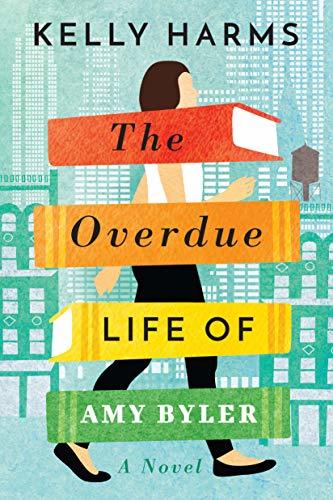
Rather than re-hashing, I will post a link to my previous review here, but will add that one of the reasons I appreciated this book (in addition to the book- and librarian-related story line and the makeover of “momjeans”) was because it dropped me into a world that, at a naive and hopeful 18, I thought might be a career choice.
At a certain age, we all look back at the possibilities we passed up, the roads we didn’t travel, and wonder what would have resulted had we made different choices; one of my fantasy life stories was to go to New York City to become a book editor or work for a high-end magazine publisher. (Sylvia Plath’s The Bell Jar had a big effect on me in high school.) Amy Byler’s friend Talia, the chic, single, city-loving editor of a fashion magazine, was the definition of my dream, and the summer Amy spends in the city housesitting her empty apartment while attending theater productions, going to museums, and discovering wonderful restaurants, sounded like a lifestyle I would have loved.
One of the few regrets I have is that I have never made it to NYC, even for a visit. I guess there’s still time left…but my dream was to conquer the boulevards by striding down them in my Reeboks on the way to the office with all the other up-and-comers, not to be a tourist taking the freight elevator to the top of the Empire State Building in my wheelchair. I guess Amy wasn’t the only one with an overdue life! I mostly don’t regret the one I have lived, but I certainly wish I had been more adventurous at key moments and thus had more on which I could look back with satisfaction. Perhaps I will stick with the fantasy fulfillment of books like this one and simply pretend to be the person living the story—isn’t that really what reading is all about?
Momfluencers
What kind of word is THAT? Ask Jesse Q. Sutanto, author of the thriller You Will Never Be Me. The book is set in the worst cliché-ridden version of Los Angeles (as a 52-year resident of this city, I beg to differ with the exaggerated depiction!), and its two main characters are social media “influencers” who are also moms touting their lifestyle—thus that ghastly splice.
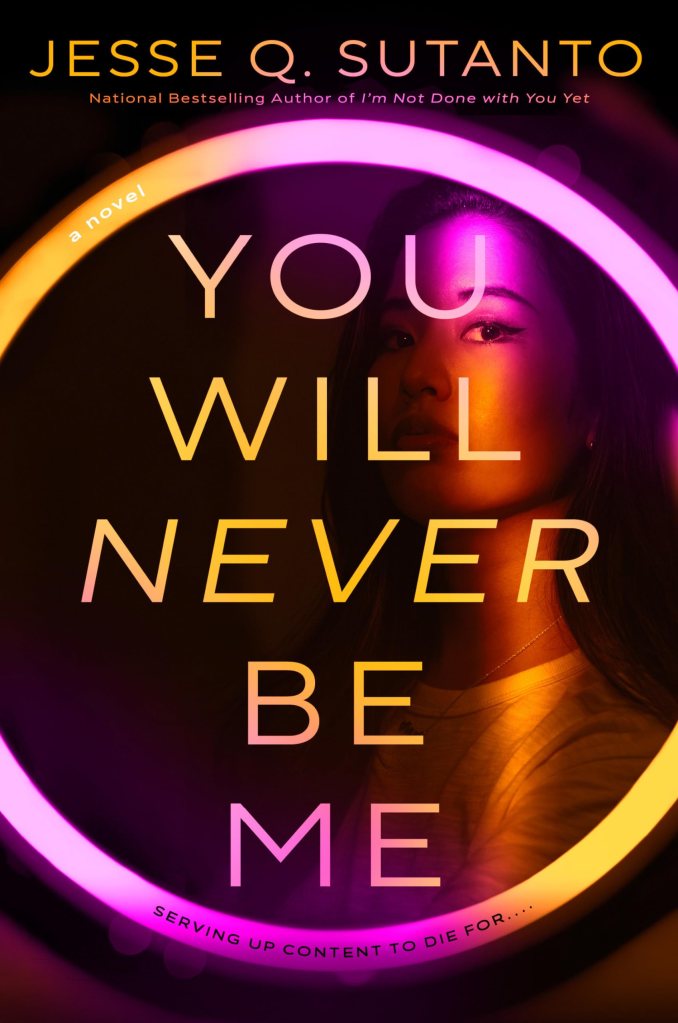
I had previously read Sutanto’s romcoms (the “Aunties” trilogy) and her delightfully silly mystery Vera Wong’s Unsolicited Advice for Murderers, so when I was looking for some lighter dark reading, I decided to try one of her thrillers. The library had this e-book on hand, and as a relative novice to Instagram with fewer followers than I would like (this is for my page featuring my portrait-painting), I thought it would be fun to read about some of the people who have made a true success out of their presence in such forums.
In some ways, it was fun; but I felt at a disadvantage with this book because, although the moms were supposedly besties in all things, the truth that they were jealous competitors who had trouble celebrating each other’s wins (particularly when one substantially overshadowed and outperformed the other) made both of them inherently unlikeable. And although I don’t mind villainous characters, I usually like it better when there is one sympathetic person in the story for whom I can cheer. You know, someone with at least one redeeming quality….
In the beginning, Meredith was the popular rising star and Aspen was the eager but slightly gauche fan. Before Meredith met Aspen, there was a friend-gap in her life; she was so busy trying to become popular to legions of online strangers that she didn’t have time to cultivate people in real life. But when she runs into Aspen at a Hollywood pretty-people party and realizes just how out of her depth she is, Meredith takes a shrewd look at Aspen’s potential and, flattered by her naive, awed admiration, decides to help her. She teaches her about hair and makeup, shows her how to make videos to entice both followers and sponsors, and gives her a leg up into Meredith’s world.
A few years later, Aspen’s star has risen exponentially, while Meredith’s influence has waned—her “brand” is a little tired, a little old. Aspen has crafted a new, polished look, married Ben, and given birth to darling twin girls Noemie and Elea; fueled by motherhood and the need to be the breadwinner in an unequal partnership (her husband is in real estate but not a player), Aspen has switched her brand to become a “momfluencer.” She films the daily routine, presenting herself and her family as living an idyllic existence—the twins always dressed in adorable matching outfits, every meal gourmet and served with panache, home decor curated to shine online. When you collect as many followers as Aspen, the deals for product placement follow, and the dollars flow in.
When Aspen gets pregnant with a third daughter, Meredith decides she has waited long enough for Mr. Perfect and chooses to become a single mother with the help of an anonymous sperm donor. While she wouldn’t go so far as to say she gave birth to baby Luca so that she, too, could go the momfluencer route, well…that’s what she has tried to do. But somehow she just can’t pull it off with the seamless brio of the successful and somewhat patronizing Aspen, who is too busy now to hang with her best friend Mer, drinking wine and gossiping as they used to do. The tables are turned; Aspen is on top, and Mer is, well, not either admiring or in awe. She resents Aspen’s success and especially her lack of willingness to share her ideas and methods the way Mer had shared with her when Aspen was the one at the bottom. Meredith discovers it’s not fun to be ditched, and finally, in frustration, she blows up at Aspen and says some unforgiveable things, and the friendship is over.
A few months later, Mer, who has been stalking Aspen (just a tiny bit, right? nothing serious) gets lucky. Little Elea leaves her iPad out on the patio where an enterprising person can appropriate it. Mer isn’t sure why she took it, but when she discovers that Aspen has created an online calendar that updates automatically onto all the family’s devices, she has access to Aspen’s social media schedule. At first she just tweaks things, causing Aspen to arrive late at a lunch date or forget to pick up the dry cleaning; but soon she is erasing meetings with sponsors and turning up in Aspen’s place to sign lucrative contracts. Meanwhile, Aspen can’t figure out what has gone awry—has the pressure of having to (appear to) be the perfect mom in front of millions caused her to lose her mind and her mojo?
Then something happens that turns the relationship on its head and sends Aspen’s and Mer’s story in a whole new direction…
It sounds like big fun, right? And some of it is. But until the twist 50 percent of the way through the book, there is a lot of snark. We don’t get to live through any of the harmonious early days of Meredith’s and Aspen’s friendship, we are instead dumped directly into the bitter rivalry felt by Meredith and the somewhat dismissive, too-busy inattention exhibited by Aspen. And neither of their lives is the shining example they present online because, let’s face it, motherhood is never that easy. Aspen and Ben have grown apart as he has become increasingly resentful of being on camera 24/7 (and having his nose rubbed in the fact that he’s not the breadwinner), while one of the twins is acting out like she’s 16 instead of seven. Mer is constantly exhausted by the unending round of nursing, changing, and being awakened by baby Luca, and upset by her inability to make more money and have the nice things Aspen has already achieved. None of the supporting characters—Ben, Mer’s sister Claire (or Clara? I could swear her name switched halfway through the book)—is a sympathetic one either. So the whole recitation becomes tiring if you are looking for some comic relief amidst all the anger and angst.
But…that twist. It makes things interesting. And there’s another one later on that takes things in an even more extreme direction. So although at 49 percent I was ready to give this book faint praise (not pan it, exactly, but not promote it either), it turned out to be a much better story than I had expected at the halfway mark. And it’s definitely eye-opening about the online popularity that people who want success must pursue. Although I wish I had the 17K followers my friend Phoebe has scored, and that I sold the bulk of my paintings the way she does, I’m certainly not going to be ruining a treasured friendship over it! (Even if I only have 879 people looking at my portraits today…) How DID she do that?
(If you’d like to follow me and save my friendship with the lovely
and talented Phoebe, you can find me at https://www.instagram.com/losangeles_melliott/.
I’m just sayin’…)
 The Book Adept