Altering the past
It’s been many years since I read a Stephen King book; not because I haven’t liked some of them, but for a combination of reasons including a dislike of most horror and a prevailing impulse to call his editor and tell him to automatically edit out 300 pages from everything King writes. There was a time, in my youth, when I gravitated towards gigantic tomes—the longer the better!—and managed to immerse myself until the deed was done. I find these days that I am a bit more impatient, and it takes some really good writing, story-telling, and character/world building to keep my attention.

But…as I have mentioned before, I am a sucker for time travel. Also, for all children of the ’60s, the biggest conundrum was and remains the assassination of President John F. Kennedy, that new, young, charismatic leader whose death was variously chalked up to Lone Gunman Lee Oswald or a mysterious shooter from the grassy knoll, and attributed to J. Edgar Hoover, Lyndon Johnson (impatient to succeed), or the CIA for some reason having to do with Cuba. Put those elements together, and it was inevitable that I would get around to reading 11-22-63 by Stephen King.
The idea of going back in time to kill Hitler or witness the birth of Jesus or whatever has always been out there; but most time travel writers find some unbeatable reason why it can’t be done—like simply stating, “If something happened, then it happened.” otherwise known as the Novikov self-consistency principle. Even if you allow for the possibility of paradox, the problem with changing something in the past is, of course, that it has the potential to alter all future outcomes, so even if it were possible, people might hesitate to do it—unless there was a really good reason. This is the idea upon which King’s book is built—that if JFK hadn’t died, everything would have turned out differently—presumably better (for instance, no war in Vietnam)—and that’s a really good reason to go back and thwart the assassination.
The method of time travel in this book is vague. It’s not even loosely based in science or invention—there’s no time machine, no De Lorean or Tardis, no black hole in space, it’s more like a version of Narnia, reached via a portal at the back of a wardrobe or, in this case, the pantry of a local diner. And it leads to only one place and time, a small town in Maine in 1958. It is from this place and time that Jake Epping, aka George Amberson departs 2011 and takes up residence in the ’50s, making a living as a substitute teacher while he scopes out Oswald, his associates, his various addresses, and his ultimate destination—Dallas, the Texas School Book Depository, and November 22nd, 1963, when JFK drives through town in an open car to meet his fate.
In the process of taking on this quest, “George” will also meet and change the lives of a bunch of other people, and fall for the love of “his” life, small-town school librarian Sadie Dunhill, thereby endlessly complicating what was already nigh impossible to achieve.
All the potential for a roller-coaster ride of a story is built right in, and King provides a lot of exciting moments…and a lot of sitting and waiting. Since the only entry point to the past is 1958, and returning to 2011 means the time on the “other side” resets to 1958, Jake has no other choice but to take on an identity that will allow him to live in the past for five years while waiting for the right moment to take out Lee Harvey Oswald. Even though there is research involved, and even though we are provided with such distractions as a rescue mission for an unrelated family and Jake’s romance with the beautiful but ungainly Sadie, it’s about 700 pages of waiting before we get to the ultimate climax, which then goes by quickly and with much less explanation than this reader would have liked.
Also, you have to keep in mind that even though this is presented as an alternate history, Stephen King is, when all is said and done, a horror writer. He can’t resist adding in sinister bits involving characters or even whole towns that give him the willies; he makes the hero the target of various ill-intentioned people or groups, leading to a fair amount of violence and uncertainty; and history itself is cast as the “monster” of the tale. Jake comments (more than 60 times, as another Goodreads reviewer helpfully provided) on the immutability of the past and its obduracy, and this irrevocable tendency manifests as a series of catastrophes that intervene between Jake and his goal. No, it’s not a clown, but it’s still creepy.

The part I found most disap-pointing is the many oppor-tunities King misses to comment on the time and place as it was; instead, he does a virtual whitewash. Despite some of the threatening characters, questionable neighborhoods, and ominous events, the 1950s are primarily presented as a place where the “real” food tastes so much better (butter, root beer, deep-fried lobster), people in the ideal small town are trusting (leaving their doors unlocked and greeting one another as they walk down the street), and the automobiles are an aficionado’s dream (tailfins). He mentions the ever-present smoking of cigarettes and the bad smells of unregulated industry and diesel-belching transport, yet fails to find them particularly offensive; he gives (and then repeats) exactly one example of the separate-and-unequal state of bathrooms for whites vs. “colored people” but neglects to further notice or comment upon any inequities he sees, whether they be race-related or examples of rampant sexism. I think I could have forgiven this aspect of the book more easily had it been a fast-paced thriller; but there are at least (the aforementioned) 300-400 pages where we wander from New Orleans to Dallas to Fort Worth and back again, pondering what little is known about Oswald, attempting to observe he and his family and his associates, and waiting, waiting, waiting. Some of that waiting could have been more profitably spent.
Ultimately, I did enjoy more than half of this flash to the past…but for all the reasons cited above, I could have loved it better.
Happy endings

I suppose it’s slightly ironic, given that my last post was an enthusiastic recommendation for half a dozen Regency romances, that I don’t normally care for books with blatantly happy endings. Given that statement, it’s even more unlikely that I would bother to pick up a book actually titled The Keeper of Happy Endings. But Barbara Davis combined several elements that lured me in, including the presence of Paris as one backdrop for the story, an artist whose dream was to open a gallery, a seamstress who created couture wedding gowns (yet another form of art), and historical elements set in World War II.
The basic set-up for the story is that it takes place partly in the present day, which in this book is 1985 Boston, and partly (in flashback) during the middle years of World War II, in German-occupied France. It brings together two women who share a similar tragedy in their lives: Soline Roussel, whose fiancé drove an ambulance for the Red Cross in France, and went missing, presumed captured and killed by the Germans; and Rory Grant, whose fiancé is kidnapped, presumably for ransom, while working in the Sudan for Doctors Without Borders.
When the story opens in 1985, Rory’s fiancé, Hux, has been gone for about six months with no word of his fate. Her life has become a waiting game, and she has dropped all pretense of continuing without him; although she is supposed to be preparing for a return to college in the fall, followed by an internship in Paris, she sits at home and reads romance novels, for the distraction and also because she hopes for her own happy ending.
In flashback, Soline Roussel is a young woman working with her mother in their bridal salon. Generations of the women of her family have created “lucky” wedding gowns: a “wish” or charm is embroidered into the dress, and so many of the brides who marry in a Roussel gown end up with good relationships and generally lucky lives that the women (and gowns) have gained a reputation for magic. But the onset of World War II and the occupation of Paris by the Germans has put an end to the business and, after her mother dies of cancer, Soline is at loose ends. She ends up volunteering at a hospital, where she meets Anson Purcell, a Yale man from Boston who drives an ambulance, and he soon becomes the love of her life. Fearful that the Germans will capture Soline and use her against him so that he will reveal details of the Resistance work in which he is secretly involved, Anson sends her off to America
Back in the present day, the two women come together when Rory decides that she will revisit a dream (in which Hux encouraged her) to open an art gallery to exhibit previously unknown artists, and discovers the perfect location for it, the former bridal shop (in Boston) belonging to Soline Roussel. The building was decimated by a fire four years previously, and was partially rebuilt but remains empty. Rory persuades the reclusive Soline to lease it to her and, in the process, Soline recognizes a kinship between herself and the heartbroken girl, and a friendship is born.
This book has a lot going for it. There is a nice balance between the story in the past and the one in the present. There are complex relationships, notably Rory’s with her mother, Camilla, and Soline’s with her own mother and also with Anson. The historical details of the flashback portions of the book feel real and explore some uncommon details about World War II . I wished for more information about Soline’s career in couture as well as the methodology behind Rory’s chosen art form, but both were adequate to the story. The romance was satisfying. There were interesting twists and turns that kept me reading until far later than prudent into the early morning hours.
Are you sensing a “but”? Well…in many ways this was a beautiful and complex story that I wanted to love. But at a certain point, things became too predictable and certainly too coincidental to suspend disbelief, and I know, I know, I should have seen it coming from the title of the book, but the wrap-ups and happy endings for so many of the characters set my teeth on edge. Yes, there is a part of me that thrilled to the fulfillment of everyone’s dreams; but there is a reason I don’t read much romance, and it’s this: There is also a cynic in me that flat-out doesn’t believe it, and wants the complexity of a partial fail or, at least, a tiny bit of the unknown to remain.
I will, therefore, give a qualified recommendation for this book, which is, if you are fond of the perfect ending, especially after a lot of intervening suspense about what will happen, you will adore it. But if you are like me, with an inbred cynic who sits on the sidelines and scoffs, then you will like it, but not nearly as much.
Recap of heroines
I am sure that I have enthused on here about the Regency novels of Georgette Heyer far too much for most people’s taste, so I’m going to just plant a teaser and let you do what you will: I did a re-read of The Convenient Marriage this week, in between other books, and it made me think about which are my favorites of hers and why, and it all has to do with the protagonist. I’m sure you could say that about many books, but with these, in particular, if the main character doesn’t shine, it’s going to fall flat, no matter how beloved the genre, period, scene-setting, etc. So here are mine (and some double as the name of the book):

ARABELLA
FREDERICA
SOPHY (from
The Grand Sophy)
HERO (from
Friday’s Child)
HORATIA (HORRY) (from
The Convenient Marriage)
NELL (from April Lady)
KITTY (from Cotillion)
And yes, upon reviewing these, it has also to do with the male leads: Mr. Beaumaris, the Marquis of Alverstoke, Viscount Sheringham, the Earl of Rule, Lord Giles Cardross, and Freddy Stanton from Cotillion, who is the best anti-hero ever.
So I guess, if pressed, these would be my favorites out of the 28 (?) she wrote (in no particular order, except that the one I’m currently reading is always the favorite!). If you’re not a complete ninnyhammer, you will read them and see for yourself!
Interludes
As I have previously mentioned here, sometimes I take a break between what I would consider more “significant” works (or at least the works of writers unknown to me) to read something lighthearted, whether that is a book written with juveniles as its audience, or a “bit of fluff” characterized by chick lit or Regency romance. This past week or so, I did both, with some surprising results.

The first book I picked up was The Extraordinaries, by T. J. Klune. Given that Vicious, by V. E. Schwab, is one of my favorite books ever, I had high expectations for a book in which ordinary people have the potential to become extraordinary, and the extraordinaries have complicated relationships with their ordinary contemporaries (and with one another). What can I say? First, I have to face that there is no comparing any book with the brilliance that is Vicious. It stands alone (well, except for its sequels). Second, I read Klune’s The House in the Cerulean Sea first, absolutely fell in love with that, and then read this. Who could not be a little disappointed?
The Extraordinaries is exactly as billed: A YA novel about a kid with ADHD who wants to be a superhero or, alternatively, wants to be beloved of a superhero. It’s cute, it’s inclusive, it’s frank and matter-of-fact about sexuality, it has some great characters, and teens will love it. Me? Not as much. I see its worth and its value without being able to immerse myself in its story. Also, I feel like the (ultra-serious) post-er who decried the glorification of the police (always the good guys, regardless of bad behavior) in this had a point. Not to the extent he carried it, but still…yeah. But for kids who like comics and graphic novels, this is a next step, and a fun one. I had planned to read the sequel, Flash Fire, but after the first couple of chapters I put it aside. It’s not that it’s not good, it’s just not for me. But like I said, teens (especially lgbtq etc. teens) will be enthused. (I do, however, look forward to the sequel to Cerulean Sea with unabated hope.)
I decided instead to move on to my reliable go-to author for light relief, the inimitable Georgette Heyer, writer of the quintessential Regency romance. But I ended up being surprised by a book that was not quite like most others she has written. A Civil Contract is surprisingly serious in tone compared to her light, frothy stories of witty, clever people, and owes much to Jane Austen’s book Sense and Sensibility.

It has a common theme of star-crossed lovers who may or may not prevail, and who probably appreciate the person with whom they end up more than the one they initially desired. But in this case there is no blinding realization that they have come to love that person, but rather a quiet acceptance that the relationship they have created will in the long run suit better, regardless of their feelings.
Adam Deveril, Viscount Lynton, an officer in the Peninsular War, is called home upon his father’s demise to discover that his family’s fortune has been decimated by his happy-go-lucky, completely improvident parent, and that he is on the verge of ruin. He has a mother and two sisters to support, and the youngest is not yet “out” (presented to society); without a dowry or indeed any basic support, her fate at least will be grim if he can’t figure out their financial situation in a hurry.
Before he left for the war, Adam had an understanding with Julia Oversley, for whom he has conceived what he believes to be a lasting passion, and which is returned by the beautiful Julia. But he knows that her father is not so unworldly as to agree to a marriage between his daughter and a man who can’t support her. While he is steeling himself to sell significant parts of the family’s estate, including the country seat, Julia’s father approaches him with the idea that he make a marriage of convenience with the daughter of a fabulously wealthy but admittedly vulgar merchant, Jonathan Chawleigh, to whom Mr. Oversley owes a favor. In exchange for his daughter Jenny achieving the social status that comes with marriage into an aristocratic family, Chawleigh will pay the myriad bills accrued to the estate and buy back all of Adam’s mortgages on the country home. Jenny, a school friend of Julia’s, goes into the marriage knowing that Adam still loves Julia. And the rest of the book details the emotions still held by the two parties in the doomed love match, as well as the new wife’s adaptation to being married to a man who not only doesn’t love her, but holds her father in revulsion, despite his own resolve, for being who he is and wielding power over Adam’s every decision.
This book, rather than a recounting of the making of a marriage, is an exploration of what constitutes a successful one once the deed is done. It incorporates the many sacrifices one has to make by tolerating the baggage of relatives and friends that come with a partner; it reveals the necessity of kindness, tolerance, patience and, above all, a sense of humor. It showcases, in fact, that the significant parts of married life are the ordinary, everyday events rather than the moments of exaltation or grand passion.
Julia Oversley is the Marianne Dashwood of the story—beautiful, impulsive, sensitive, willful, and somewhat selfish—while Jenny is Elinor—practical, somewhat shy and retiring, and more concerned for the feelings of others (specifically Adam’s) than for her own. Jenny’s father, Jonathan Chawleigh, is somewhat reminiscent of Sir John Middleton, in that he speaks his mind in an embarrassing manner without thought for what he is saying or how it will affect his listeners. But he goes far beyond that character in both coarseness and good-heartedness, and steals the show whenever he appears on the page.
There was rather too much historical narrative for my taste regarding the various engagements between Napoleon Bonaparte and the Duke of Wellington, but it’s well written and definitely pivotal to the plot. This is one of the few books of Heyer’s that has a quiet, satisfying ending rather than an “Ahah!” moment, but it doesn’t suffer for that. While it was an unexpected read in the midst of Heyer’s others, I still both enjoyed and appreciated it.
Tender
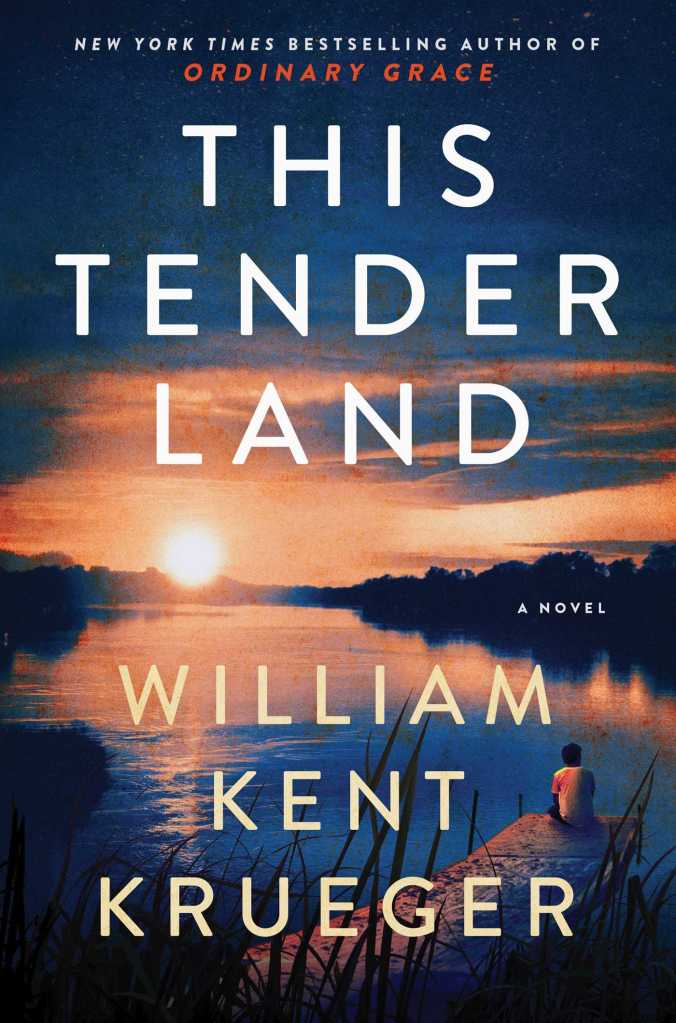
When I ran across the quote in This Tender Land, by William Kent Krueger, after which the book was named, I thought the reference too slight to justify calling it that. But there are, in fact, many tender and poignant moments in this book to be enjoyed and appreciated, not the least of which is expressed in the beautiful narrative of the natural world through which the characters pass.
I didn’t know what to expect from this story, but my pulse beat a little faster when I saw the description of four children traveling downriver by canoe; ever since having read The Adventures of Huckleberry Finn as a child, I have loved the adventurous nature of travel by water, somewhat in control of your vessel but ultimately subject to the whims of the ever-changing river. And yes, I know that Huck Finn has fallen out of fashion since its reexamination for egregious racism but, despite that, the central narrative of a couple of disadvantaged people at the bottom of the rungs of society encountering others supposedly more elevated along their way but themselves turning out to be the more ethical and compassionate is a powerful theme, repeated in this tale by Krueger.
Odie, 12, and his brother Albert, 16, are the only two white children at one of the notorious “training” schools for Indian children, this one in Minnesota. Albert is stolid and even-tempered, an engineer by talent as well as by nature, but the more volatile Odie is constantly in trouble for one reason or another, and at this school under the reign of Superintendent Brickwood (the Black Witch, as the boys call her), the last thing you want to do is stand out. The brothers have a best friend, Moses, an Indian boy about Albert’s age, whose tongue was cut out when he was too small to remember; due to the brothers’ having had a deaf mother, they are able to teach him American Sign Language and he is thus able to communicate.
The boys survive an existence marked by ragged clothes and and shoes with holes, too little food and too much labor, and constant persecution from the staff of the school by focusing on the good: They have a champion in two of their teachers—Herman Volz and Cora Frost—and Mrs. Frost does her best to ensure they spend carefree time in her company, helping out at her farm and playing with her beloved daughter, six-year-old Emmy, while Volz tries to protect them from the worst of the punishments inflicted upon them by Mrs. Brickwood and her henchman. But disaster comes calling, and the boys decide their only option is to run away from the school. Rather than take to the roads or the railroad—both almost guaranteed routes to recapture—they hit upon the idea of rowing Mrs. Frost’s canoe downstream from the small tributary near her house to a larger river within a few days’ travel, ultimately hooking up with the mighty Mississippi. They also, against their better judgment, take Emmy along with them, knowing that the charge of kidnapping will bring more avid pursuit.
The helpless and downtrodden yet stubbornly optimistic outlook of the main protagonist, Odie, is endearing and captivating. Likewise the natures of his three companions—his brother Albert, a realist with a soft heart; their friend Mose, unspoiled despite the terrible treatment he has received at the hands of multiple offenders; and the small but immensely matter-of-fact Emmy, with her weird fit-induced pronouncements—immediately draw the reader in and engender commitment to their fates.
The four Vagabonds, as Odie calls them in his made-up stories told around multiple campfires, go from bad to worse to better in the course of their journey. Ultimately, each is looking for “home,” whatever that means to them, and each finds a version of this waiting for them, although it may not be what they expected when they set out. This is a beautifully told odyssey of privation (it takes place during the height of the Depression, in 1932) and the powerful bonds of love and friendship that overcome all hardships. The epilogue, of which literary device I am usually not a fan, gives a look at how this significant period in their lives impacted everyone who participated, and brings the journey to a satisfying conclusion, once more along the banks of the Gilead River. I’m so happy I took this trip with the Vagabonds.
Bonus feature: Odie’s talent (other than storytelling) is that of playing the harmonica, and the author mentions a Spotify playlist (This Tender Land, by Jen Hatmaker Book Club) that enables the reader to experience the songs he (and other characters) played in the book, popular in that era and location in history.
For BHM
While my belief is that black history is history and should be taught as such, calling it out for a month a year at least gets some attention, since our school curriculum is still not what it should be. Likewise, calling out some black authors, and some non-black authors who have written effectively about black history and culture, is always a good idea, but the prompt is helpful to remind one. So…
Science fiction is one genre that can definitely usher you through time. Octavia Butler‘s Kindred, which some say is the first science fiction written by an African American woman, is a combination of memoir and time travel that transports 26-year-old Dana from 1976 California to antebellum Maryland, where she arrives just in time to save a white boy from drowning, then jumps back just before the shotgun staring her in the face can go off. Like Henry in The Time Traveler’s Wife, Dana’s jumps are inadvertent, but they serve a purpose in her life history. Butler manages to provide both a conversation about serious issues—slavery, human rights, and racial prejudice—and an exciting and complex story about human nature, love, and loss.
For a glimpse into the future instead of the past, try Parable of the Sower, set in that familiar dystopia known as Los Angeles in the year 2025 (not so far off!), and following the fortunes of Lauren Olamina, an 18-year-old pioneer of a new philosophy known as Earthseed. Parable of the Talents is the sequel.
Since Butler died tragically young (in 2006, at age 58), there will be no more of her seminal works featuring female black heroines, but her contributions to the science fiction world won her both the Hugo and Nebula awards multiple times, and she was the first science fiction writer ever to win the MacArthur Foundation “Genius” Grant.
Like a little mystery with your history? Try Barbara Hambly’s mystery series that begins with A Free Man of Color. Set in New Orleans in the 1830s (right after the Louisiana Territory was acquired by America), the characters are a rich mix of French, Spanish, and American, Creole, African slave, and “free people of color.” Benjamin January (or Janvier, depending on the language you’re speaking) is one of the latter, a Paris-trained surgeon who must earn his living in New Orleans as a piano player. Between his two professions he mingles with all levels of society, and inevitably someone turns to him for his appealing mix of compassion and good sense to help them solve a dilemma, a puzzle, or even a murder. There are 18 books, so if you’re hooked by the first one, you can relish Ben January’s world for a sumptuous long time.
Another book set in the same time period and also on the subject of the gens de couleur libre is Anne Rice’s second novel, The Feast of All Saints. If you thought Rice was only about vampires, think again: She researched this while in New Orleans planning out Interview with the Vampire, and in my opinion it’s the best thing she ever wrote (and I’m a fan of the vamps, and the witches too). Rich with the history of pre-Civil War New Orleans, with truly compelling characters, it is beautifully written, poignant, and emotionally overwhelming.
Some other books to which I’d like to draw your attention, that encompass the history of the present and the recent past:
The Rock and the River (about the Black Panther movement), by Kekla Magoon
How It Went Down (an account of a shooting, from 17 different viewpoints), also by Kekla Magoon
Flygirl, by Sherri L. Smith, about a black girl pilot trying to participate in World War II
Tyrell, by Coe Booth, a young adult novel representative of all too many young black men with few alternatives. A compelling voice and an engaging story.
March, by John Lewis, a series of three graphic novels about the Civil Rights Movement, by the senator who was by the side of Martin Luther King
Please note that this is a short, random, partial list of books that in no way represent the richness of writing available out there, but simply reflects some books I read, enjoyed, and appreciated for their topic and their tone. I hope you find something to enjoy.

Farthing
I am a big fan of science/speculative fiction writer Jo Walton, although I have found her offerings to be somewhat uneven between things I love and things I recognize as worthy while not personally caring for them. I was excited to discover that she had written an alternate history in which Great Britain negotiated its way out of World War II in return for a treaty with Hitler, who proceeded to conquer the European continent while sparing England across the Channel.
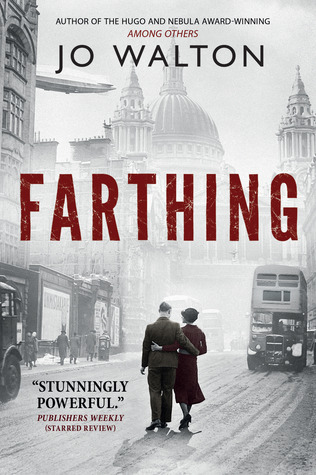
I thought Farthing was a new work, possibly designed to address the fascism and bigotry that have been revealing themselves these past few years in America; but after I got into it I discovered it had been published in 2006 and was, in fact, the first of a trilogy, the others being Ha’penny and Half a Crown.
I also found the book disappointing in some respects, but only because I had a particular expectation that it didn’t fulfill. I thought it was a full-on alternate history and would deal more specifically with the details of that world; instead, Walton used post-war Britain allied with Germany as a backdrop for a “locked-door” murder mystery novel reminiscent of Agatha Christie, which is not really what I wanted to read.
The details of the alternate history do matter to the story: Eight years after they overthrew Churchill and led Britain into a separate peace with Hitler, the aristocrats of the “Farthing set” are gathered for a weekend retreat at the Eversley’s estate. Lucy, daughter of the house, is one of the invited guests, although her new husband, David Kahn, a Jewish banker, is less welcome. Lucy has “thrown herself away” by marrying him, and is tolerated, rather than welcomed, into her old social circle as a consequence. Neither of them really wished to come to the country that weekend, but Lucy’s mother imperiously summoned them, and David felt perhaps she was holding out an olive branch, although Lucy, being more familiar with her mother’s prejudices, knows that can’t be the case.
Soon the two can only wish they had resisted the invitation and stayed in town; Sir James Thirkie, a friend of her parents who is also the person who engineered the historic agreement with Hitler for peace, has been murdered sometime between Friday night and Saturday morning, and some details of the murder look like they have been specifically engineered so it can be blamed on David Kahn.
Fortunately, the Scotland Yard inspector sent down to solve the case is less gullible than are the local police and sees the nature of the set-up; he doesn’t view Kahn as remotely likely in the role of murderer, but if he can’t see his way clear to accusing someone else, Kahn is likely to go down for it, as Jewish scapegoat on the scene. Inspector Carmichael does his level best to come up with a solution, but new details keep getting thrown at him that twist the mystery further this way and that until no one knows how it will end.
Although I recognized and appreciated both the set-up and the writing in Farthing, I felt somewhat dissatisfied after reading it. The mystery itself was not particularly intriguing, and the alternate history aspect left me wanting more world-building. I also wasn’t a big fan of the alternating point of view between first person (Lucy’s journal of the events) and third person (Inspector Carmichael’s investigation), although I did like both characters quite a bit. Character development is one of Walton’s strong suits, and she didn’t fail here, particularly as regards the inspector, whose ulterior motive for refusing to suspect David Kahn enriches the story.
It was strange to read the book from within the throes of the current political climate. I started the book two days before Election Day, and finished it a couple of days afterwards, and I did appreciate how the author asked the reader to consider the consequences of allowing fascist behavior to continue and grow. There is also a familiarity about the plight of the Jews in this book as compared with the history of black people in America; there are all these little bits of discrimination that each by themselves seem fairly innocuous (especially if you are not the party who is targeted by them) but taken collectively they are seen to intentionally omit, push out, reject, and deny full personhood.
I don’t think I am sufficiently enamored of this book to pursue reading the other two; but if you are a person who enjoys Agatha Christie or Dorothy Sayers mysteries and also appreciates good character development, witty dialogue, and an unexpected background for all of that, you might want to check out this trilogy.
My preference for Walton’s alternate history oeuvre is her three-book series that begins with The Just City. The Thessaly trilogy is based on the idea that the goddess Pallas Athene, curious as to its outcome, creates a society designed to follow the tenets of Plato’s Republic. She extracts 100 caregivers and 10,000 babies from various points in history (past, present, and future), puts them together on an island located in the distant past, and instructs the adults to raise the children strictly according to Plato to be their “best selves.” A few years into the experiment, she kidnaps and throws Sokrates into the mix, and then things get interesting.
Character
I haven’t made a post for a while now, for several reasons: I’m still finishing off Charlie Higson’s dystopian series for teens (I’m reading The End and hoping that all my many questions are answered); I started teaching my Readers’ Advisory class at UCLA this past Tuesday and have spent some of my time preparing for that (mostly cleaning up my combination office/art studio so it’s fit to be seen in the background of Zoom); and I’ve been rather caught up in the political events of the day (unhealthy obsession with Facebook posts). But I should be at the end of The End soon, and on to my next read.
In the meantime, the combination of contemplating “appeals” for readers’ advisory and doing a massive clear-out, clean-up, and re-shelving of my entire library of fiction in my four bedroom bookshelves caused me to think about the nature of “character” as a dominating force in fiction.
To explain a bit for those who are not up on librarian lingo, appeals are what we call the various reasons why people enjoy what they read. Some people are motivated by adrenalin and want something fast-paced and exciting; others love beautiful language and want to be wooed by unusual or lyrical phrasing; and one particularly powerful appeal is that of “character.” The ability to identify with or, alternatively, loathe a character or set of characters in a book is one aspect that draws people to read more. The success of the belabored Harry Potter franchise is largely due to the desire to find out what happens next to the maturing Harry and his friends, and all of us can probably think of a book or five whose characters were what kept us coming back to its pages. A few recent books in which character dominated include Eleanor Oliphant Is Completely Fine, A Man Called Ove, and The Seven Husbands of Evelyn Hugo. (A major clue as to whether the book is character-driven is if the main character’s name appears in the title. Witness Harry Potter and the….)
As I have mentioned here several times, belonging to the Facebook group “What Should I Read Next?” is sometimes an exercise in patience, because most of the readers there have become caught up in the bestseller craze and all end up reading the same 12 books. So in the effort to find them—and you—other compelling reads, I thought I would spend a blog post examining some of my past favorites that are wholly about the character.
A compelling writer of character-driven works is the author Mary Renault, and although her entire oeuvre contains much to appreciate, there is not another that rivals The Persian Boy, her tale of a bed slave named Bagoas who was abducted, gelded, and sold as a courtesan to King Darius of Persia. When Alexander and his Macedonian army conquer the Persians, Bagoas finds himself in a rather untenable position and decides he will achieve safety only by ingratiating himself with the conqueror himself. Although Alexander is quick to see the appeal of this highly motivated slave, he is slow to take advantage of his utter dependency, and the courtship between the two of them is both touching and fiery.

The Persian Boy is actually the second in a series of three books Renault wrote about Alexander. The early years, when he rises from a beleaguered son of warring parents to become the master of all lands he surveys, are covered in Fire from Heaven, in which he experiences love and trust for the first time with his best friend and fellow warrior, Hephaistion. But that book is far more event-driven, whereas The Persian Boy, being narrated from the point of view of someone with whom Alexander had a solely personal connection, is limited in scope in terms of world events but much more specific about the relationships. It is, in fact, a love story, and I would regard it as one of the great ones, containing as it does not just attraction or romance but also loss and pain, desire and jealousy, joy, courage, and cowardice. It is an exceedingly intimate view of Alexander the man beside that of Alexander the great warrior, and is filtered through the emotions and psychology of a patient bystander.
At the beginning of the third book, Funeral Games, Alexander the Great lies dying, surrounded by his former generals, satraps, and wives, all competing like wolves for the prizes of power and land. Only the two loves of his life, Hephaistion and Bagoas, realize and truly mourn what has been lost. Funeral Games documents the disintegration of the mighty empire built in 20 years and brings Alexander’s saga from age 12 to 33 to its close.
There is a variability of voice in these tales that lets them be read as a series but also allows the reader to experience them as stand-alone novels. The first is told in the first person by Alexander; the second is the purview of Bagoas; and the third is written from a third-person observer stance. I discovered and read The Persian Boy first, only picking up the others afterwards, and felt no sense that anything was missing in that first reading. When people ask for an LGBTQ love story that goes beyond the contemporary meet-cute or the simultaneous struggle with coming out that invades so many of these stories, my thoughts immediately return to the yearning and transcendent happiness contained with the pages of Renault’s classic work.
Another protagonist with whom I have been in love since the first time I read the book is Shevek, the humble man and brilliant physicist at the heart of Ursula K. LeGuin’s book The Dispossessed. The book is a recounting of an existential thought experiment: The author posits what would happen to individuals in a social system that rewards conformity, although that social system in this case is based on a sort of group anarchy. Urras is a world much like our own, driven by commerce. Within its teeming millions is a group of individuals who wish to live their lives quite differently and, because Anarres, the moon of their planet, is suitable (though not ideal) for human life, they are allowed to colonize it. The two societies make a pact that neither will invade the other and, for more than 100 years, not one individual from either society has crossed the line between them except for shipments of supplies that arrive and leave the small port on Anarres.
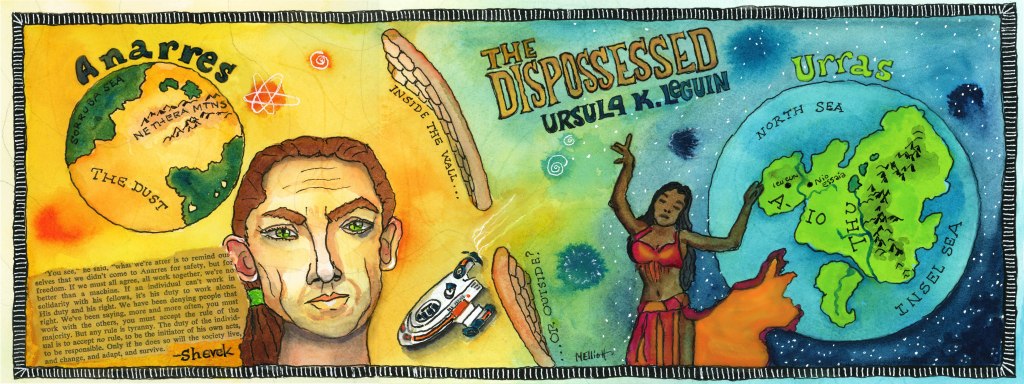
Shevek grows up in this ascetic society, a planned utopia where no one takes precedence over anyone else, where each is valued but all are expected to make their contribution to society in return for a place in it. He does his part, planting trees in the desert, drawing food service or waste management tasks for 10 days at a time, and through it all manages to find a great love, Takver, and have children; but while he goes through these tasks of daily life, his brain is operating on another plain—trying to understand temporal physics—that demands discussion, the exchange of ideas, and a close relationship with those on his mental level who are capable of understanding his brilliance. Ultimately, he makes the choice, despite the possibility of losing his home, his family, perhaps even his life, to go back to Urras to see what the scientists of that world have to offer him.
The fascinating part of the book is how the society on Anarres was originally founded as a profound act of nonconformity, and yet ends up suppressing originality and demanding obedience from a man chafing under its restrictions. LeGuin achieves her objective—the exploration of the concept of freedom—by letting the reader recognize the virtues of the system under which Shevek lives and
then realize how stifling it has become, without being either polemical or strident.
If it weren’t for the “stigma” of being categorized as science fiction, I believe this book would take its place amongst the most important of classic novels, and that Shevek would be a much more well-known protagonist in the reading world.
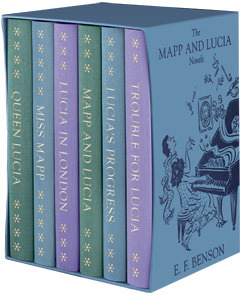
Some books you love for a protagonist, and some for an entire cast of characters. In the second category are the books by E. F. Benson that were latterly brought together in an Omnibus volume called Make Way for Lucia. There are six Mapp and Lucia novels in the series, and they must be read in order, for events take on importance in a specific sequence that must be appreciated.
At first glance, you might not think that a view into the social world of upper-middle class Edwardian village dwellers would be particularly compelling. But what you have to understand about the Mapp and Lucia books is the exaggerated degree of sheer triviality that guarantees a contrary fascination. Benson had a disdain for middle class people pretending to a rank to which they are not entitled, and his satires of these mushrooms trying to push their way into high society are brilliant and also funny as hell.
The books feature the feuding doyennes of Riseholme and Tilling, whose decidedly bourgeois residents get flustered in the presence of noble titles but king and queen it in the presence of everyone else. The main protagonists—or should we call them pugilists?—are Emmeline Lucas, designated “Lucia,” and Elizabeth Mapp. Though the stories begin with each of them ruling their respective roosts with total social supremacy in their separate villages, fate brings them together to hilarious effect. But the reader is not solely reliant on Lucia and Miss Mapp in these stories; Benson has created a whole cast of characters, including the dashing Georgie Pillson, aging bachelor, with his elbow-length cape and carefully trained piece of hair draped over his scalp; the drunken and slightly naughty Major Benjy; artist and naked sunbather Irene Coles; Mrs. Boucher with her daughters, Piggy and Goosie, in tow; and so many more. The tempests in the teapots that are the meat of these ’20s and ’30s comedies of manners are hilarious, witty, and slightly nasty. In other words, inspired. Auberon Waugh, eldest son of Evelyn, said,
“I might have gone to my grave
without ever knowing about
Lucia and Miss Mapp. It is not a risk
anyone should take lightly.”
It’s about time for me to read them for the third time.
I hope you have enjoyed this meander through some character-driven books, and that it will inspire you to look them up for yourself or to reflect on the characters that have come to life for you during your lifetime of reading. If any compelling ones occur to you, please share!

Class warfare
I decided to take a break from my pile of new books and re-read something I had previously enjoyed, written by Philippa Gregory.
I have to confess that most of her historical fiction featuring the Tudors has bored me silly for some reason—I have tried two different ones, and they just didn’t spark to life for me, despite being obsessed with this period of history and these characters back in my teen years. But the series I had in mind predated all of her “hits” and in fact was the first thing she ever wrote: The Wideacre trilogy, consisting of Wideacre, The Favored Child, and Meridon.

Together, they are the story of one small but perfect estate in Sussex—Wideacre—and the family who had title to and hold over it—the Laceys—in the time period of Georgian England. The trilogy spans three generations and marks massive changes in England, in the land, and in the family, which was steered badly astray by the obsession of one woman—Beatrice Lacey—for the land on which she grew up and which she is determined to have for her own, laws and rights of primogeniture notwithstanding. Her longing for the possession and control of Wideacre makes Scarlet O’Hara’s passion for Tara look like a tepid fancy.
I have actually read the third book, Meridon, several times, because it has elements I like: Travelers, a circus, horses, and a stubborn, suspicious, untrusting lost girl protagonist who immediately captured my imagination. But I decided to return to the first book instead, to refresh my memory of why I liked the entire trilogy so much.
After having finished Wideacre for a second time, I don’t think I will read through the subsequent books. Although I enjoyed it, it also made me a little weary, on two counts, the first being that it is 556 pages long, and the second that the protagonist got to me this time in a particular way that I think I didn’t entirely take in the first time through.
The thing I connected with most powerfully with the first read was the scene-setting. Wideacre is a palpable and powerful character in this book, as much as any of the humans depicted, and the descriptions and varieties of its beauty made me long to have the experiences Beatrice Lacey had, of riding the path up to the Downs to see the greater vista of the estate from their hilltops, of smelling the sweet scents of hay and wild poppies in the fields, of lying in a hollow in the shady woods or dangling my feet in the Fenny river. In that first read,
I could almost understand Beatrice’s obsession for her surroundings—we have all of us had some moment in our lives when our passions were invoked by a particular setting and we longed to be a part of it forever. But with my second read, I saw the sickness the single-minded pursuit of this one thing above all others brought with it to her life and the lives of all around her, despoiling the beauty she could have enjoyed freely, had she let go the need to possess it. This story is not for the squeamish—there are truly dark passages depicting the twisted relationships Beatrice creates to try to manipulate her way into the Squire’s role.
What struck me, however, with this re-read was a relevant passage that I reached almost at the end of the book. Beatrice has mortgaged the estate up to its eyebrows in order to break the entail and gift it to her heirs, and in doing so has bankrupted it, with the result that the people who live on her land, who were once important to her because they were part of her world, are now out in the cold while she rakes in every penny for herself. She is having a conversation with her tender-hearted and clear-eyed sister-in-law, who sees how she has wrecked the relationship with the cottagers and has challenged her on it. Beatrice tries to excuse her actions by saying that this is the new way of farming in England, that the investors must needs make a profit from the money they have provided. Celia’s response hit me right between the eyes.
“All of the people who write about the need for a man to have a profit are rich people. All they wish to prove is that their profits are justified. They will not accept the answer which is there before their eyes: that there is no justification.
“Why should the man who invests his money have his profit guaranteed, while the man who invests his labour, even his life, has no guaranteed wage?” she said. “And why should the man who has money to invest earn so very much more with his capital than a man could earn working at the very top of his strength, all day? If they were both to be rewarded equally, then after the debts had been paid and the new equipment bought, miners would live in houses and eat the food of the mine owners. And they clearly do not. They live like animals in dirt and squalor and they starve, while the mine owners live like princes in houses far away from the ugly mines.
“It is as bad here,” she said baldly. “The labourers work all day and earn less than a shilling. I do not work at all and yet I have an allowance of two hundred pounds a quarter. I have taken no risks with capital. I replace no machinery. I am paid simply because I am a member of the Quality and we are all wealthy. There is no justice in that, Beatrice. There is no logic. It is not even a very efficient way
to live.”
“Celia,” [Beatrice] said again, “you simply do not understand. The less we pay the labourers the more profit we make. Every landowner wants to make as much profit as possible. Every landowner, every merchant, every businessman, tries to pay as little as possible to his workers.”
[And then Beatrice taunts Celia about her allowance and her dowry lands, and Celia reveals that she has been spending all her allowance on food and clothes for the village.]
“When the landlords are against the tenants as you are, Beatrice,” Celia said dully, “and when the employers have decided to pay the least they can, charity has no chance. All we are doing is prolonging the pain of people who are dying of want.”
“It is an ugly world you and your political economists defend, Beatrice. We all know it should be different and yet you will not do it. You and all the rich people. It is an ugly world you are building.”
Reading this in a time when the United States government is handing out windfalls right and left to big business—banks, airlines—while refusing to supplement all those out of work due to the pandemic whose severity has been exacerbated by its negligence; reading this when, in the face of massive unemployment across our nation, the CEOs of the biggest companies are adding millions or billions a day to their personal fortunes, on which they pay no taxes and for which they apparently suffer not a moment’s guilt, showed me the depth and breadth of the evil that has overwhelmed our land. Yes, I am calling it evil, for I can think of no other word to describe the potential effect of the Republicans finally, after all these years of aspiring, to actually have the cancellation of Social Security and Medicare within their grasp, to surrender our national parks to oil drillers, to decimate our school systems, to pack our courts with toadies, to perpetuate lies, calumny and outright treason to keep a man in office who will facilitate their soulless predations, and then make up reasons why we should see it as a good thing.
I think my impulse to read this book at this time brought me to a place I needed to go, and this is also why I don’t intend to re-read the other two books, although they are gripping stories and worth your consideration. I’m afraid they will just make me too sad. I don’t bring politics to this blog, normally, but these are not normal times. If you have any empathy in your heart for the less fortunate who are falling through the widening cracks in this version of our America, please use your voice and your vote to change things to a world where we can all do better, together.
Expectations
One thing you have to do as a reader, if you are not to be eternally disgruntled with life, is to try not to have outsize expectations of authors. That’s tough sometimes, particularly if an author has never disappointed you with a single one of her books until the one you are reading right now, which you cannot believe came from the same person’s formerly fertile brain. Sometimes it’s not a matter of your icon having written a bad book, simply that she has written one that doesn’t resonate with you, or is directed to a different age group than you expected, or was written earlier in her career before she developed the amazing story-telling abilities that hooked you later on.
There are several authors I have run across who have surprised me in this way: One of them is Elizabeth George, whose masterful mysteries featuring the unlikely detective team of Thomas Lynley, son of the peerage, and Barbara Havers, woman of the people, cause me much excitement whenever they emerge. When I found out she was also trying her hand at young adult books, I was excited to see what she would produce, particularly because, as a teen librarian, I was always looking for a gifted “new” author to pitch to my YA book clubs. I read the first one the minute it hit the library shelf, and was both amazed and dismayed; where was the intricate plotting of her adult mysteries? This pseudo-paranormal mish-mash couldn’t be a product of the same sharp, incisive wit! I’m told that they did improve as she wrote more of them, but I never found out, I stopped at number one. I am still a dedicated fan of Lynley/Havers, and steadfastly ignore the rest.

Author V. E. Schwab
Another author where the contrast isn’t so wide but nonetheless exists is V. E. (Victoria) Schwab. Her book Vicious is among my top 10 favorite books of all time, and I tout her Shades of Magic series to all and sundry, from 12-year-olds to the elderly. But her two series for young adults—The Archived and Monsters of Verity—left me feeling not exactly disappointed but certainly underwhelmed. I did enjoy the first of her Cassidy Blake books (City of Ghosts) for slightly younger readers, and I am looking forward to reading her new, long-awaited The Invisible Life of Addie LaRue, which Schwab has spent 10 years bringing forth and of which she says, “I’ve put my heart and soul, my teeth and blood and bones into this one.” I’m really hoping that it falls into the “I want a copy so I can reread it multiple times” category and not into the “I’m wishing I had read something else this weekend” pile.
 Anyway…that’s a long preface to say that I have experienced something similar this week with the book I chose. A few years back I read Code Name Verity, by Elizabeth Wein, an historical fiction novel of World War II, set in Nazi-occupied France, with an American and a British protagonist, both women, one a pilot and the other a spy. To say the book captured my imagination as thoroughly as one of its protagonists is held hostage by the Germans is an understatement. I read it straight through in one sitting, and wept profusely several times, the first occasion on which a book has caused tears since I was a teenager. The story, and the specific way it was recounted, simply bowled me over, and I actually couldn’t read anything else for a couple of days while I thought about and recovered from the book.
I remember, when I read it, thinking, “I do not understand why this has been marketed and sold as a YA book. Will some teens love this book? Definitely. Is it a teen book? Not in the least.” I followed up by telling blog readers, “I find myself sad that [CNV] has been marginalized in any way from finding its full audience, because this book deserves to be widely read. Adults out there, recommend this to your teens, and then read it yourselves, and give it to your mother and your friends and to strangers on the bus.”
As you can imagine, this set up high expectations for all the rest of Wein’s oeuvre, and when I saw one of them for a discounted price from bookoutlet.com, I snapped it up and prepared to be wowed.
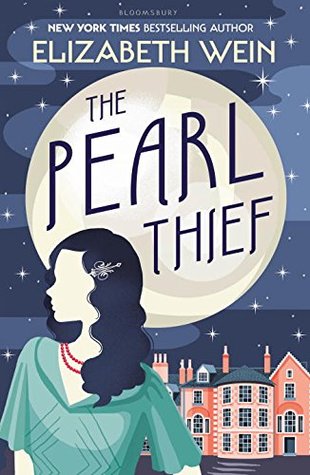 The book is The Pearl Thief, and it is as different as night and day or, to be specifically British about it, as chalk and cheese, to her previous work, even though its protagonist is one of the women from CNV, at age 15. And it is definitely written for a younger teenage audience. Before you expect me to pan it, let me say that it was a completely enjoyable read. But I was unconsciously expecting a level of drama and pathos, based on Code Name Verity, that simply didn’t manifest in this story.
If I hadn’t had specific expectations of this author, I still think I would have been intrigued by the book and its subject matter. It takes place in Scotland in 1938, and drops in at the end of an era for one family whose “perfect little Scottish estate, with a ruined castle and a baronial manor, nestled in woodland just where the River Fearn meets the River Tay” will no longer belong to the family, now that the death of Julia Beaufort-Stuart’s grandfather has triggered a reckoning. Lord Streathfern did all he could to save the house and the land for his heirs, but the combination of a lingering illness and a downturn in the economy made it necessary to sell up to a boys’ school, and the family are now inhabiting a small section of the house while the school administrators oversee the renovations and conversions necessary to turn it into the institution it will become. This will be Julie’s last summer on her grandfather’s land, with her brothers, her mother and grandmother, and the few servants left, and then they will move back to their own Craig Castle near Aberdeen, taking her widowed grandmother with them.
By broad contrast with Julie’s sheltered and privileged upbringing, the other vital characters in this story are the two teenagers, Ellen and Euan, in a family of Travelers who have spent seasons on Streathfern land time out of mind, helping harvest “tatties,” beating the bushes and collecting the downed birds during shooting holidays and, in between, collecting tin from the townsfolk and weaving baskets from the withies in the marshy land near the river. This land was ceded to them by right for the past 300 years in exchange for a small fortune in river pearls (which play a vital role in the story), but now the changing fortunes of the laird will mean change for them all.
As the story begins, Julie has just arrived home for the summer three days before she is expected. When no one is around up at the house, she changes out of her traveling outfit into a T-shirt and an old kilt and goes out hiking around the estate, reacquainting herself with her favorite haunts. One moment she is lying on the bank of the river with one arm immersed, tickling for trout in the deep, cold water, and the next she is awaking in a hospital ward with a splitting headache from a lump on her head, being treated with disrespect and disdain as the “tinker” girl they believe her to be. She discovers that she was found, unconscious, on a path in the woods, and brought into the hospital by two of the Travelers; once her mistaken identity is resolved, her mother is called, and she returns home, feeling battered and wondering about how it all happened.
It soon becomes clear that the thump on her head was no accident, and that it is probably directly related to a missing employee of the estate, who disappeared on the same day she landed in the hospital. Along with the two travelers, Euan and Ellen, she seeks out the reason why anyone would have sought to hurt her or the missing man and, in the process, must stand up for her Traveller friends as local bias against them starts framing Euan up for murder.
This book is a delightful combination of murder mystery, coming of age story, and a serious depiction of prejudice, as exhibited by many of the “regular” people towards the Travelers they hold in suspicion and distrust for their alternate lifestyle. Although it wasn’t quite what I expected in terms of drama and emotional engagement, it surprised me (in a good way) with its exposition of the themes Wein did choose to explore. I think adults could enjoy the book, but it is definitely written with teens in mind, and is one of those books one could recommend that promotes empathy to its young readers. The book would be appropriate for anyone 12 and up, although probably a lower age of 14 would find it more relateable.
This review is also to say, placing expectations on your favorite authors and holding them to some rigid ideal may make you miss out on books they wrote that are different but nonetheless effective and providing of considerable enjoyment.
ADDENDUM: Today (according to a post on Facebook) is National Book Lovers Day. I’m not making a special post like for the cats, because EVERY day is book lovers’ day here @TheBookAdept!
 The Book Adept