Class warfare
I decided to take a break from my pile of new books and re-read something I had previously enjoyed, written by Philippa Gregory.
I have to confess that most of her historical fiction featuring the Tudors has bored me silly for some reason—I have tried two different ones, and they just didn’t spark to life for me, despite being obsessed with this period of history and these characters back in my teen years. But the series I had in mind predated all of her “hits” and in fact was the first thing she ever wrote: The Wideacre trilogy, consisting of Wideacre, The Favored Child, and Meridon.

Together, they are the story of one small but perfect estate in Sussex—Wideacre—and the family who had title to and hold over it—the Laceys—in the time period of Georgian England. The trilogy spans three generations and marks massive changes in England, in the land, and in the family, which was steered badly astray by the obsession of one woman—Beatrice Lacey—for the land on which she grew up and which she is determined to have for her own, laws and rights of primogeniture notwithstanding. Her longing for the possession and control of Wideacre makes Scarlet O’Hara’s passion for Tara look like a tepid fancy.
I have actually read the third book, Meridon, several times, because it has elements I like: Travelers, a circus, horses, and a stubborn, suspicious, untrusting lost girl protagonist who immediately captured my imagination. But I decided to return to the first book instead, to refresh my memory of why I liked the entire trilogy so much.
After having finished Wideacre for a second time, I don’t think I will read through the subsequent books. Although I enjoyed it, it also made me a little weary, on two counts, the first being that it is 556 pages long, and the second that the protagonist got to me this time in a particular way that I think I didn’t entirely take in the first time through.
The thing I connected with most powerfully with the first read was the scene-setting. Wideacre is a palpable and powerful character in this book, as much as any of the humans depicted, and the descriptions and varieties of its beauty made me long to have the experiences Beatrice Lacey had, of riding the path up to the Downs to see the greater vista of the estate from their hilltops, of smelling the sweet scents of hay and wild poppies in the fields, of lying in a hollow in the shady woods or dangling my feet in the Fenny river. In that first read,
I could almost understand Beatrice’s obsession for her surroundings—we have all of us had some moment in our lives when our passions were invoked by a particular setting and we longed to be a part of it forever. But with my second read, I saw the sickness the single-minded pursuit of this one thing above all others brought with it to her life and the lives of all around her, despoiling the beauty she could have enjoyed freely, had she let go the need to possess it. This story is not for the squeamish—there are truly dark passages depicting the twisted relationships Beatrice creates to try to manipulate her way into the Squire’s role.
What struck me, however, with this re-read was a relevant passage that I reached almost at the end of the book. Beatrice has mortgaged the estate up to its eyebrows in order to break the entail and gift it to her heirs, and in doing so has bankrupted it, with the result that the people who live on her land, who were once important to her because they were part of her world, are now out in the cold while she rakes in every penny for herself. She is having a conversation with her tender-hearted and clear-eyed sister-in-law, who sees how she has wrecked the relationship with the cottagers and has challenged her on it. Beatrice tries to excuse her actions by saying that this is the new way of farming in England, that the investors must needs make a profit from the money they have provided. Celia’s response hit me right between the eyes.
“All of the people who write about the need for a man to have a profit are rich people. All they wish to prove is that their profits are justified. They will not accept the answer which is there before their eyes: that there is no justification.
“Why should the man who invests his money have his profit guaranteed, while the man who invests his labour, even his life, has no guaranteed wage?” she said. “And why should the man who has money to invest earn so very much more with his capital than a man could earn working at the very top of his strength, all day? If they were both to be rewarded equally, then after the debts had been paid and the new equipment bought, miners would live in houses and eat the food of the mine owners. And they clearly do not. They live like animals in dirt and squalor and they starve, while the mine owners live like princes in houses far away from the ugly mines.
“It is as bad here,” she said baldly. “The labourers work all day and earn less than a shilling. I do not work at all and yet I have an allowance of two hundred pounds a quarter. I have taken no risks with capital. I replace no machinery. I am paid simply because I am a member of the Quality and we are all wealthy. There is no justice in that, Beatrice. There is no logic. It is not even a very efficient way
to live.”
“Celia,” [Beatrice] said again, “you simply do not understand. The less we pay the labourers the more profit we make. Every landowner wants to make as much profit as possible. Every landowner, every merchant, every businessman, tries to pay as little as possible to his workers.”
[And then Beatrice taunts Celia about her allowance and her dowry lands, and Celia reveals that she has been spending all her allowance on food and clothes for the village.]
“When the landlords are against the tenants as you are, Beatrice,” Celia said dully, “and when the employers have decided to pay the least they can, charity has no chance. All we are doing is prolonging the pain of people who are dying of want.”
“It is an ugly world you and your political economists defend, Beatrice. We all know it should be different and yet you will not do it. You and all the rich people. It is an ugly world you are building.”
Reading this in a time when the United States government is handing out windfalls right and left to big business—banks, airlines—while refusing to supplement all those out of work due to the pandemic whose severity has been exacerbated by its negligence; reading this when, in the face of massive unemployment across our nation, the CEOs of the biggest companies are adding millions or billions a day to their personal fortunes, on which they pay no taxes and for which they apparently suffer not a moment’s guilt, showed me the depth and breadth of the evil that has overwhelmed our land. Yes, I am calling it evil, for I can think of no other word to describe the potential effect of the Republicans finally, after all these years of aspiring, to actually have the cancellation of Social Security and Medicare within their grasp, to surrender our national parks to oil drillers, to decimate our school systems, to pack our courts with toadies, to perpetuate lies, calumny and outright treason to keep a man in office who will facilitate their soulless predations, and then make up reasons why we should see it as a good thing.
I think my impulse to read this book at this time brought me to a place I needed to go, and this is also why I don’t intend to re-read the other two books, although they are gripping stories and worth your consideration. I’m afraid they will just make me too sad. I don’t bring politics to this blog, normally, but these are not normal times. If you have any empathy in your heart for the less fortunate who are falling through the widening cracks in this version of our America, please use your voice and your vote to change things to a world where we can all do better, together.
Expectations
One thing you have to do as a reader, if you are not to be eternally disgruntled with life, is to try not to have outsize expectations of authors. That’s tough sometimes, particularly if an author has never disappointed you with a single one of her books until the one you are reading right now, which you cannot believe came from the same person’s formerly fertile brain. Sometimes it’s not a matter of your icon having written a bad book, simply that she has written one that doesn’t resonate with you, or is directed to a different age group than you expected, or was written earlier in her career before she developed the amazing story-telling abilities that hooked you later on.
There are several authors I have run across who have surprised me in this way: One of them is Elizabeth George, whose masterful mysteries featuring the unlikely detective team of Thomas Lynley, son of the peerage, and Barbara Havers, woman of the people, cause me much excitement whenever they emerge. When I found out she was also trying her hand at young adult books, I was excited to see what she would produce, particularly because, as a teen librarian, I was always looking for a gifted “new” author to pitch to my YA book clubs. I read the first one the minute it hit the library shelf, and was both amazed and dismayed; where was the intricate plotting of her adult mysteries? This pseudo-paranormal mish-mash couldn’t be a product of the same sharp, incisive wit! I’m told that they did improve as she wrote more of them, but I never found out, I stopped at number one. I am still a dedicated fan of Lynley/Havers, and steadfastly ignore the rest.

Author V. E. Schwab
Another author where the contrast isn’t so wide but nonetheless exists is V. E. (Victoria) Schwab. Her book Vicious is among my top 10 favorite books of all time, and I tout her Shades of Magic series to all and sundry, from 12-year-olds to the elderly. But her two series for young adults—The Archived and Monsters of Verity—left me feeling not exactly disappointed but certainly underwhelmed. I did enjoy the first of her Cassidy Blake books (City of Ghosts) for slightly younger readers, and I am looking forward to reading her new, long-awaited The Invisible Life of Addie LaRue, which Schwab has spent 10 years bringing forth and of which she says, “I’ve put my heart and soul, my teeth and blood and bones into this one.” I’m really hoping that it falls into the “I want a copy so I can reread it multiple times” category and not into the “I’m wishing I had read something else this weekend” pile.
 Anyway…that’s a long preface to say that I have experienced something similar this week with the book I chose. A few years back I read Code Name Verity, by Elizabeth Wein, an historical fiction novel of World War II, set in Nazi-occupied France, with an American and a British protagonist, both women, one a pilot and the other a spy. To say the book captured my imagination as thoroughly as one of its protagonists is held hostage by the Germans is an understatement. I read it straight through in one sitting, and wept profusely several times, the first occasion on which a book has caused tears since I was a teenager. The story, and the specific way it was recounted, simply bowled me over, and I actually couldn’t read anything else for a couple of days while I thought about and recovered from the book.
I remember, when I read it, thinking, “I do not understand why this has been marketed and sold as a YA book. Will some teens love this book? Definitely. Is it a teen book? Not in the least.” I followed up by telling blog readers, “I find myself sad that [CNV] has been marginalized in any way from finding its full audience, because this book deserves to be widely read. Adults out there, recommend this to your teens, and then read it yourselves, and give it to your mother and your friends and to strangers on the bus.”
As you can imagine, this set up high expectations for all the rest of Wein’s oeuvre, and when I saw one of them for a discounted price from bookoutlet.com, I snapped it up and prepared to be wowed.
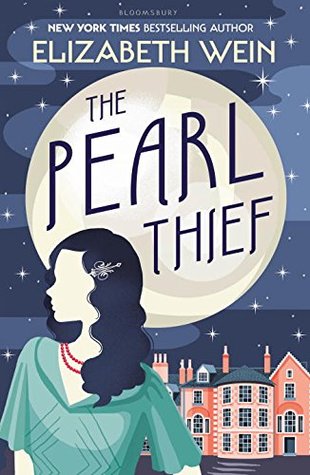 The book is The Pearl Thief, and it is as different as night and day or, to be specifically British about it, as chalk and cheese, to her previous work, even though its protagonist is one of the women from CNV, at age 15. And it is definitely written for a younger teenage audience. Before you expect me to pan it, let me say that it was a completely enjoyable read. But I was unconsciously expecting a level of drama and pathos, based on Code Name Verity, that simply didn’t manifest in this story.
If I hadn’t had specific expectations of this author, I still think I would have been intrigued by the book and its subject matter. It takes place in Scotland in 1938, and drops in at the end of an era for one family whose “perfect little Scottish estate, with a ruined castle and a baronial manor, nestled in woodland just where the River Fearn meets the River Tay” will no longer belong to the family, now that the death of Julia Beaufort-Stuart’s grandfather has triggered a reckoning. Lord Streathfern did all he could to save the house and the land for his heirs, but the combination of a lingering illness and a downturn in the economy made it necessary to sell up to a boys’ school, and the family are now inhabiting a small section of the house while the school administrators oversee the renovations and conversions necessary to turn it into the institution it will become. This will be Julie’s last summer on her grandfather’s land, with her brothers, her mother and grandmother, and the few servants left, and then they will move back to their own Craig Castle near Aberdeen, taking her widowed grandmother with them.
By broad contrast with Julie’s sheltered and privileged upbringing, the other vital characters in this story are the two teenagers, Ellen and Euan, in a family of Travelers who have spent seasons on Streathfern land time out of mind, helping harvest “tatties,” beating the bushes and collecting the downed birds during shooting holidays and, in between, collecting tin from the townsfolk and weaving baskets from the withies in the marshy land near the river. This land was ceded to them by right for the past 300 years in exchange for a small fortune in river pearls (which play a vital role in the story), but now the changing fortunes of the laird will mean change for them all.
As the story begins, Julie has just arrived home for the summer three days before she is expected. When no one is around up at the house, she changes out of her traveling outfit into a T-shirt and an old kilt and goes out hiking around the estate, reacquainting herself with her favorite haunts. One moment she is lying on the bank of the river with one arm immersed, tickling for trout in the deep, cold water, and the next she is awaking in a hospital ward with a splitting headache from a lump on her head, being treated with disrespect and disdain as the “tinker” girl they believe her to be. She discovers that she was found, unconscious, on a path in the woods, and brought into the hospital by two of the Travelers; once her mistaken identity is resolved, her mother is called, and she returns home, feeling battered and wondering about how it all happened.
It soon becomes clear that the thump on her head was no accident, and that it is probably directly related to a missing employee of the estate, who disappeared on the same day she landed in the hospital. Along with the two travelers, Euan and Ellen, she seeks out the reason why anyone would have sought to hurt her or the missing man and, in the process, must stand up for her Traveller friends as local bias against them starts framing Euan up for murder.
This book is a delightful combination of murder mystery, coming of age story, and a serious depiction of prejudice, as exhibited by many of the “regular” people towards the Travelers they hold in suspicion and distrust for their alternate lifestyle. Although it wasn’t quite what I expected in terms of drama and emotional engagement, it surprised me (in a good way) with its exposition of the themes Wein did choose to explore. I think adults could enjoy the book, but it is definitely written with teens in mind, and is one of those books one could recommend that promotes empathy to its young readers. The book would be appropriate for anyone 12 and up, although probably a lower age of 14 would find it more relateable.
This review is also to say, placing expectations on your favorite authors and holding them to some rigid ideal may make you miss out on books they wrote that are different but nonetheless effective and providing of considerable enjoyment.
ADDENDUM: Today (according to a post on Facebook) is National Book Lovers Day. I’m not making a special post like for the cats, because EVERY day is book lovers’ day here @TheBookAdept!
Historical fic for middle school
 The Gallery, by Laura Marx Fitzgerald, was a sweet, if slight, middle-grade book with some historical context that was fun to read about. It is billed as an art “mystery” taking place in the Roaring ’20s, although there wasn’t a lot about it that was too mysterious.
I liked the spunky protagonist, the 12-year-old kitchen maid Martha, and I enjoyed exploring her relationship with her mother, the housekeeper for the wealthy Sewells of New York City, as well as her interactions with the other staff, the family members, and various odd characters with whom she comes into contact. But I felt like the book would have been vastly better if there had been more of a connection between Martha and Rose Sewell herself, the mysterious “madwoman” sequestered in the attic about whom the book was supposedly written!
The 1920s setting was fun (Prohibition, extravagance, cool clothes), and I enjoyed learning more about the Irish working classes and the rich titans of industry, but the main reason for which I picked up the book—details of Rose’s art gallery, which is, let’s face it, in the TITLE—was a disappointment.
We got a few descriptions of a small percentage of all the supposedly amazing paintings from Rose’s collection that were squirreled away in her attic, a little Greek and Roman mythology thrown in to explain those images, one quick and unsatisfactory trek through the Met, and that was it. I felt like the central ploy—to “save” Rose (and her inheritance) and get her out of the attic—wasn’t explored nearly enough, and the ending was abrupt and somewhat disconnected from the rest of the story.
Also, I will echo another reviewer on Goodreads who deplored that this author actually gives away THE central plot point of Jane Eyre in a middle school book, thus spoiling the future reading of a classic! No, no, no!
This book had the feel and the potential of such entertaining historical fiction as Rhys Bowen’s Molly Murphy mysteries, but turned out to be hit or miss—pleasant, mildly entertaining, and mostly forgettable. Nice cover design…
Book women
There has been a recent controversy in book world about which librarians have been (sometimes vehemently) taking sides. I decided that, rather than go with the most convincing or simply abstain from the argument, I would read and find out for myself.
Two novels have been published about one subject in recent months, that subject being the Pack Horse Library Project. This was a Works Progress Administration (WPA) program established during the Great Depression that delivered books to remote regions in the Appalachian Mountains between 1935 and 1943. Nearly a third of the population of the United States had no access to library materials, and Kentucky led with an illiteracy rate of 31 percent. The terrain meant that traveling libraries couldn’t access most people in eastern Kentucky, so the Pack Horse Library Project picked up the slack by sending single riders into remote parts of the Appalachians with books in their packs.
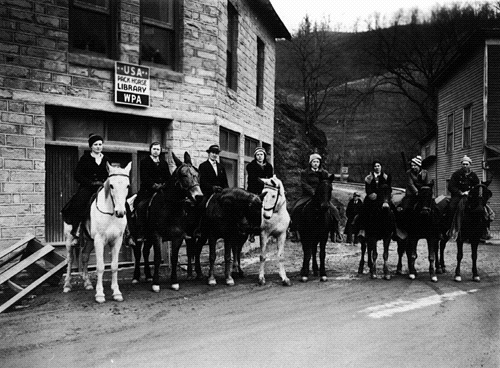
It also, of course, provided a much-needed income for those women who participated in the project. The WPA would pay $28 a month to women who were for various reasons the sole breadwinners for their families. This was, at the time, a salary that many men would have envied.
The two books in question are Kim Michele Richardson’s The Book Woman of Troublesome Creek, and JoJo Moyes’ The Giver of Stars. Book Woman author Richardson has raised the dreaded specter of plagiarism, due to some striking similarities between Moyes’s book and hers, while Moyes says she has never read Richardson’s book.
The timing was interesting: Richardson’s book was published in May, while Moyes’s book was slated for October. Moyes was still finishing up her book in September of 2018 when Richardson’s was being made available via both electronic galleys and advance review copies. A blogger who received one of the ARCs brought the similarities to Richardson’s attention, and this was echoed in a tweet by a bookseller. Moyes says she had no knowledge of Richardson’s book at that time.
Since both books are based on historical events, one would assume that similarities would arise based on common source materials consulted by each author. But Richardson maintains that the similarities are not, in fact, anything in the historical record, but are rather “fictional devices/plot points I invented.”
The truth is, if you read just the list of passages that Richardson calls out (there are eight of them), it does seem damning. And no one but Moyes herself can know whether she did, indeed, read Richardson’s book and incorporate these plot points into her own. But having read both books, I can say that the overall plots, the manner in which the books are written, the differing focus, and the cumulative effect of each novel as a story are significantly dissimilar, and that one person could easily read both books and be entertained.
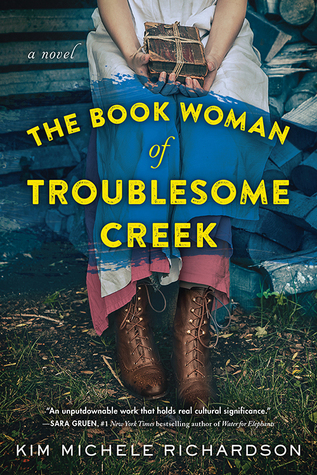 Although The Book Woman of Troublesome Creek is, indeed, about one of the WPA Pack Horse librarians, the focus of that book is almost entirely on a singular character, a coal miner’s daughter, Cussy Mary Carter. Cussy (or Bluet, as she is more commonly known to the people in her neighborhood) is one of the last of the blue-skinned people of Kentucky, a group that suffered from a rare genetic anomaly that caused their skin to carry a pale blue tint that darkened, with a blush, to the shade of a blueberry. Because of her skin color, she is feared or hated by a large percentage of the population of her rural Kentucky settlement, treated even worse than the regular “colored” people, and this proves to be a danger as she goes about her work as a Pack Librarian. But it also allows her a little hope, as the people who are grateful for her efforts to bring them books and reading begin to be open to the idea that she is no different from them despite her peculiar shade.
There are two parallel, almost equal protagonists in The Giver of Stars, and both to some extent also represent “the other” in their interactions with their society. One is Alice, an English girl who is wooed by Bennett Van Cleve, son of a wealthy coal mine owner, a big fish in a small town in Kentucky. Alice is desperate to escape her claustrophobic life in England, and decides that marrying Bennett and moving to Kentucky will be just the ticket. But her new life similarly begins to pall as she realizes that women have not much more than an ornamental role at her level of society. Just in time, the opportunity to be a Pack Librarian opens up, and in the face of no other volunteers, Alice jumps at the chance to do something different with her life.
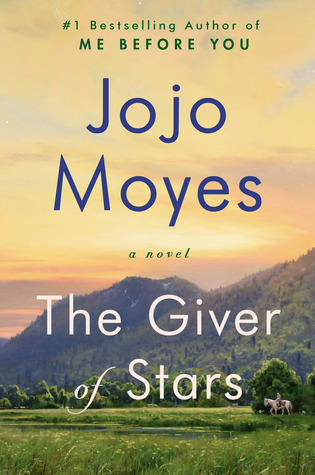 The other protagonist is Margery,
a tough hill woman who has had to make her own way in the world, and who is the de facto leader of this branch of the Pack Librarians. Although Alice admires Margery for her independence and accomplishments, Margery is reviled and looked down upon by the rest of the town for both her heritage and her present devil-may-care conduct when it comes
to men.
Although both books focus a fair bit on women’s rights (or the lack of them), their affect is quite different. Bluet’s story is an inturned one of a person who has been raised to be self-effacing—in fact, self-hating—and humble, while Alice and Margery are outspoken in their desire for and expectation of different treatment. Book Woman, despite its detailing of routes, methods, and circumstances of book deliveries, is more squarely a biographical piece about the solitary Cussy Mary Carter and her difficulties as a shunned minority, while in The Giver of Stars, much more detail is to be had about the workings of the Pack Horse Project as a whole. Richardson’s book is written in a more formal language, a literary collection of adjectives meant to give the reader a picture of both the extreme poverty and oppression and the transcendent beauty simultaneously present in Appalachia. Moyes writes with her usual straightforward narrative style, focused more on her excellent character-building than on language.
For these reasons, I can enthusiastically recommend both of these books as worthy of your time. I can’t honestly say that I prefer one over the other; both have merit in different arenas.
Regarding the similarities Richardson has called out, as I read through both books I attempted to explain them as coincidence, and was able to do so for about half of them. Ironically, one of the non-historical things that both authors included as part of their stories did, perhaps, make sense in terms of separate points each wished to make, but was not logical in context of the times.
As for the rest, since the publisher has declined to consider that the two works are substantially similar, which is the main test of copyright infringement, they are a matter for JoJo Moyes’s conscience; but unless you simply refuse to give her the benefit of the doubt, they should in no way preclude your enjoyment of both The Book Woman of Troublesome Creek and The Giver of Stars as good stories and fine contributions to the historical record.

Parenthetically, does it bother anyone else that the skin of the girl on the cover of Book Woman is NOT BLUE?
Fresh look: old book
Another entry for this occasional feature, looking back to favorite reads…
Louise Marley has written historical fiction, speculative fiction, and science fiction. I have two favorites:
 The Glass Harmonica has two protagonists in two different time periods, both of whom play the instrument (based on glass cups) invented by Benjamin Franklin (one in 1761 right after Franklin invented it, and one who is a classical musician in 2018), and it is a lovely combination of historical fiction and ghost story.
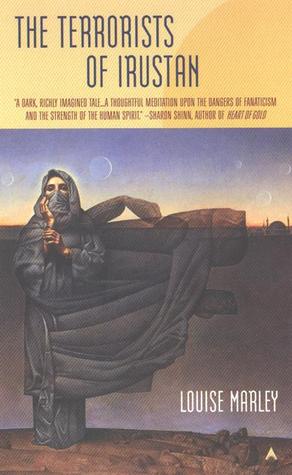 The Terrorists of Irustan is set in the future on another planet, giving it a science fiction classification, but the society on Irustan mirrors the claustrophobic restrictions imposed on women in conservative religious middle eastern countries today. The main character, Zahra, is a medicant and a subversive, hiding feminist heroism behind her silk veil, and her co-conspirator, Jing-Li, is perpetuating a fraud that could mean death were it discovered. The story is gripping, real, and relevant, a Handmaid’s Tale sort of dystopia.
Fresh look: old book
NEW FEATURE: I have so many years of eclectic reading in my past that several friends have suggested I go back and dredge up the memory of books that bowled me over when I read them first, and briefly share them here. I agreed that the chance to revisit some old favorites would be a pleasure. Also, in the context of giving good readers’ advisory services in the library, the truth is that the new books at the top of the bestseller list are checked out, with multiple (or hundreds of) holds, so it’s good to have backup in an old book that might fulfill the same desires as the new one. So here goes…
M. M. Kaye wrote a series of murder mystery/romances called Death in [fill in the blank], from Berlin to Zanzibar, as well as some straight-up romances set in exotic locales and involving typical male leads such as pirates and slave traders. But one of her books stands out far above the rest: The Far Pavilions. Even though she wrote some of them before and some of them after, I feel like all her other books were rehearsals so she could get everything right in this one.
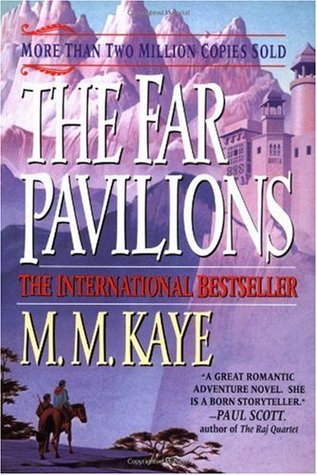 It’s a long and complicated epic with lots of historical context, and it paints such a vivid picture of India under the British Raj and Britain’s incursions into Afghanistan that you can almost smell the dust and hear the bullets whistling past your ears. The hero and heroine are the products of two separate cultures, and their status as misfits in both societies draws them together as children and reunites them as adults in a poignant love story that plays out against a volatile background of war and empire-building. The book is 958 pages long, and I have read it three times; I’m sure I’ll read it again someday! If you are a fan of historical fiction but are looking for something with a different setting to the ordinary, this book will fulfill those desires.
Birdie
The books of Kate Morton are at once endlessly fascinating and absolutely maddening. Each of them is a lengthy 450 to 650 pages, and they are as chock full of detail as any leisurely reader in search of information on a plethora of subjects, or in relationships as entangled as the particles in quantum physics could desire.
 Morton does write with a certain formulaic reliability: Each of her books contains some kind of perpetuating event that sends a person from the present day searching back into the past, whether it’s their own, that of a mother, aunt, or grandmother, or the history of someone who has at some point become significant in their lives. Most palpable in all her books is the sense of place—as focused as she is on character development and interaction, those characters operate from within a distinctive location—usually an old house, a garden, a bend in the river near a country town—and without that place, the lives and events about which the story turns would be greatly diminished.
Lastly, every one of her books contains a mystery, but not the sort easily solved with a little sleuthing on the part of a detective; not a straightforward murder, nor a conventional sort of crime. Instead, the mystery has multiple parts: a disappearance, a misunderstanding, a missing object, a mistaken identity, a masquerade. And it is up to the reader to bear with Ms. Morton and her characters as they painstakingly unravel all the elements to arrive at an eventual truth—but what a convoluted process that is! She weaves her characters’ lives together across generations, wars, marriages and divorces, sibling rivalries, and fated friendships, and it usually takes three-quarters of the book to bring each character together with the other person(s) in the story whose existence, actions, or contribution make him or her significant in the continuity of the tale.
The result of this form of story-telling is, as I noted, both fascinating and maddening. As you read and the story jumps from 1862 to 2017 to 1912 to 1962 and round about again, there are moments when you want to shout, Enough already! Extract all the bits about 1912 and tell them in a line, and then tell me what happened in 1944, and then in 1962, so I can see the progression and the logic and better encompass the story! But without the mystery of how all these people connect up across time, whether it is as relatives, lovers, or strangers who meet upon one single occasion, the reader would no doubt pay less attention to all the surrounding details, which are likewise sumptuous, atmospheric, sometimes educational, and always satisfying. And perversely, as you near the end of the book, there arises a strange reluctance to finish it; after all, you have just gotten to know all about these people, and now you have to let them go!
Kate Morton says her favorite part of writing a book is the research phase, when she is accumulating all the data that go into fleshing out the story in every direction. She has an obsession with houses, with objects, and with history, and likes nothing better than the opportunity to put them all together in an immersive relationship. And her background in speech and drama means she does it in a lyrical and literary voice.
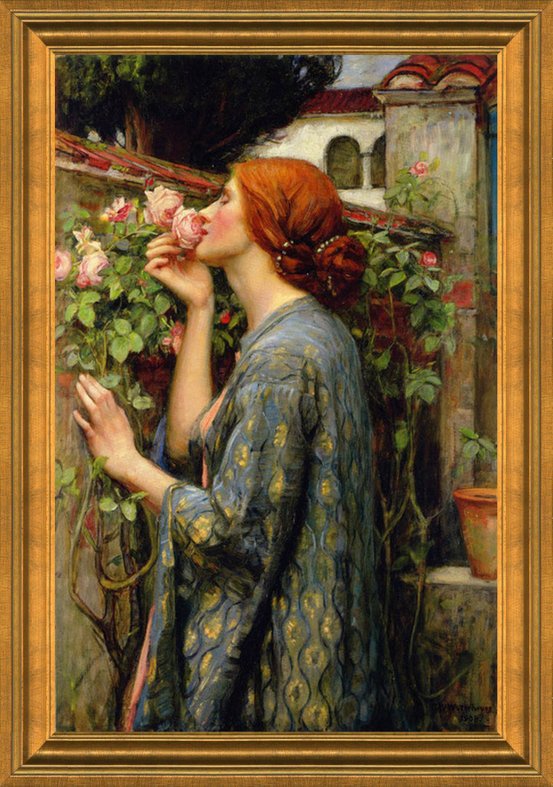
John William Waterhouse
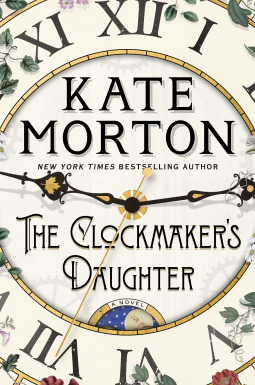
I was particularly excited to read her latest offering, The Clockmaker’s Daughter, because I knew it involved an artist, a portrait painter whose style resembled that of the pre-Raphaelites, and his model and muse, a beautiful girl with long red hair named Birdie but known as Lily.
Although there are many parts to this mystery, the understanding of just who Birdie was, what happened to her, and where she ended up is at the soul of this book, as is the house around which much of the story revolves, a gabled house with eight chimneys on a bend of the Thames river in Lachlade. Birchwood Manor and its surroundings come to life in this book, to the point where you long to be able to pass through the small wood, cross the meadow, and arrive at the surprising view of its façade before entering and making yourself at home.
It’s really difficult to describe the events of this book, as elaborate and jumbled together as they are. I think the publisher got it right in depicting the central scene as the one in 1862 when Edward Radcliffe, several of his artist friends and their spouses or models, and Edward’s little sister, Lucy, all descend upon Edward’s newly purchased house on the upper Thames to spend an idyllic summer in a daze of creativity and picnics by the river. By the end of the summer, one person is dead, another has disappeared, and a family heirloom is missing, and these events prove tragic for more than one of the participants.
More than 150 years later, a young woman archivist discovers a forgotten satchel containing an artist’s sketchbook with drawings of a house that seems overwhelmingly familiar to her, although she knows she’s never been there, along with a photograph of an arrestingly beautiful woman. Her curiosity about these items sparks an inquiry that connects in odd ways to her own past, and stirs up the memories of all who were both directly and tangentially involved.
The book reads like historical fiction, like a ghost story, like a memoir, and tantalizes with the mystery central to it all. Although it took time and patience to work my way through it, and an occasional bout of paging backwards to reread a passage, a paragraph, or a chapter, the arc of the story was well worth the trouble. I only wish I could have read it while sitting in the library at Birchwood, nursing a hot toddy, in wintertime.
 If I didn’t know better, I would believe that Kate Morton has found some incantation or charm, during all her researching, that has interrupted the aging process; she has both a degree and a masters, acted on the stage for a while before settling down to write, has a husband and three sons, and has written six books, with either two- or three-year intervals between the publication of each, and yet in her pictures and videos she looks like she’s about 30 years old. I’m hoping that the sole secret is that creative expression keeps one young!
Teen titles for adults
Just as there are “crossover” books written for adults but both suitable for and interesting to teens (see “Alex Awards“), there are also some teen books that are equally readable by adults. In fact, for some of them, it’s a shame that they have been marketed and sold as a Young Adult title, because they deserve to be widely read.
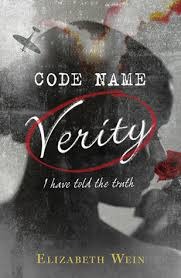 One of these is the historical fiction book Code Name Verity, by Elizabeth Wein.
The book starts out a little confusingly: It’s about two young women in World War II England, mostly before America has entered the war. One of the women is a spy; the other is a pilot. Together, they make a great team. But the team has been split up: One of them has fallen into Nazi custody, and is being tortured to write down every detail she can dredge up about the British War Effort. She decides to write it down not from her own point of view but from that of her friend’s. It took me a while to get comfortable with the way the narrative has been switched around, but once I did, I was riveted.
I can say almost nothing about this book without giving away significant details that you should be allowed to discover on your own. I will say that the first half of the book is heart-breaking, but by the time you get to the twist in the middle, you are no longer reading the story, you are living it. I am not an emotional reader, but this book made me weep, both with sorrow and with joy. This story is among the best historical fiction I have read.
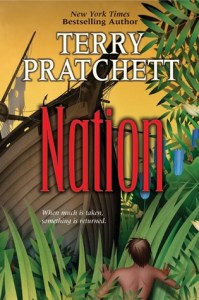 Nation, by the inimitable Terry Pratchett, creator of Disc World, is a stand-alone story of apocalyptic adventure in an alternate world much like ours. Its protagonist, Mau, is woefully unprepared for the catastrophe that changes everything; he has been living alone on the Boys’ Island, preparing to leave his boy soul there and make his transition to manhood in the ways of his tribe. But on the morning he sets out in his canoe to return to the island and people he knows as the Nation, everything there is destroyed by a giant tidal wave. The wave does wash something up on his shore, though—a ship with a sole survivor, a girl from an empire halfway around the globe, who will help him work through both shattering doubts and confidence-building certainties about the new life they both must create.
This book is deeply philosophical, examining complex religious and cultural concepts, but Pratchett dresses the philosophy in a wardrobe of ghosts and gods, talking parrots and mutineers, cannibals and secret treasures, forming a seamless story that keeps you enthralled to the very last page. While this was an honor book in 2009 for the Michael L. Printz Award for Excellence in Young Adult Literature and will certainly appeal to teens, it is a wonderful story for all ages. And, as with all Pratchett novels, it has many funny moments as well.
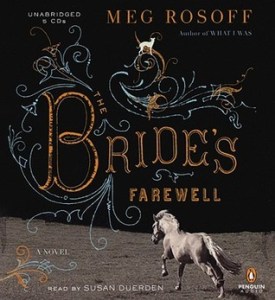 Although Meg Rosoff is best known for her post-apocalyptic teen book, Where I Live Now, one of her lesser known titles sticks in my mind as a great read for both older teens and adults. In The Bride’s Farewell, set in 1850s rural England and with a Hardyesque feel, Pell Ridley leaves her home in the middle of the night to avoid marrying her childhood beau; she can’t bear the thought of repeating her mother’s life of domestic drudgery and constant child-bearing. Her mute little brother, Bean, refuses to be left behind, so the two ride her white horse, Jack, to the Salisbury Horse Fair, hoping to find work. When she loses everything dear to her, Pell must discover her own resources—both inner and outer—and decide what’s worth fighting for, clinging to, or surrendering.
I couldn’t put this book down—I started it at 7:00 p.m. one night, and finished it at midnight. It contains wonderful scene-setting as well as compelling characters and situations. Rosoff’s language is spare, but deeply emotional.
So…adults out there—by all means recommend these to your teens, but read them yourselves as well! And mention them to your mother and your friends and to strangers on the bus!
Books for artists
Don’t you think that everyone likes to read a book with a protagonist or supporting character who shares something in common with them? As mentioned earlier in my review of The Art Forger, my particular extracurricular interest is painting, and I love books with art as a theme. So in the same train of thought as the books about books that readers love, here are some books about or containing art that artists may enjoy. Some are big family sagas or historical fiction, a few are coming-of-age stories, and the rest are all about the painting. There are both adult and young adult fiction titles included, but don’t let a label deter you: Read them all!
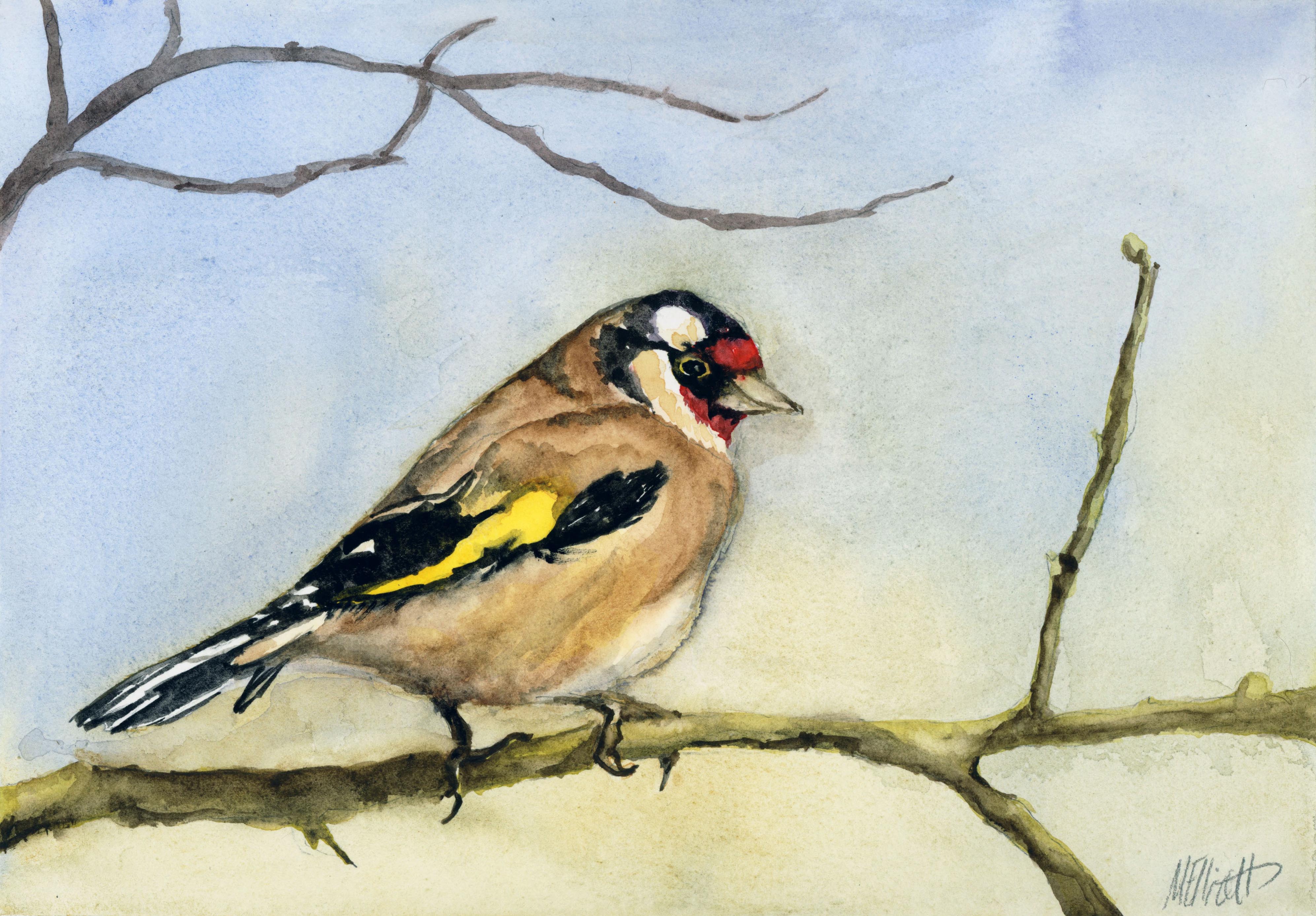 The Goldfinch, by Donna Tartt
Theo Decker survives a brutal bombing at an art museum that takes the life of his beloved mother. In the confusion during the explosion, Theo rescues (but then decides to keep for himself) a priceless painting, which comes to symbolize for him his idyllic lost youth. Powerful, moody, poetic (and lengthy) literary fiction. Winner of the Pulitzer Prize. Adult fiction.
The Very Picture of You, by Isabel Wolff
Elsa is a portrait painter who elicits the stories of those she paints while they pose for her, and discovers some truths about herself in the process, especially while painting her sister’s fiancé. Adult fiction.
The Shell Seekers, by Rosamunde Pilcher
Set partly in the past, partly in the present, this is the story of Penelope Keeling, whose father was a famous Cornish painter. Now in her declining years, her prize possession is a portrait by him called “The Shell Seekers.” Her three children all become aware of its value, and each has an opinion about what she should do with both the portrait and with herself. Penelope has different ideas. This is a wonderfully drawn family saga, and if you like books set in World War II, half of this book takes place during that time period, in Penelope’s youth. Adult fiction.
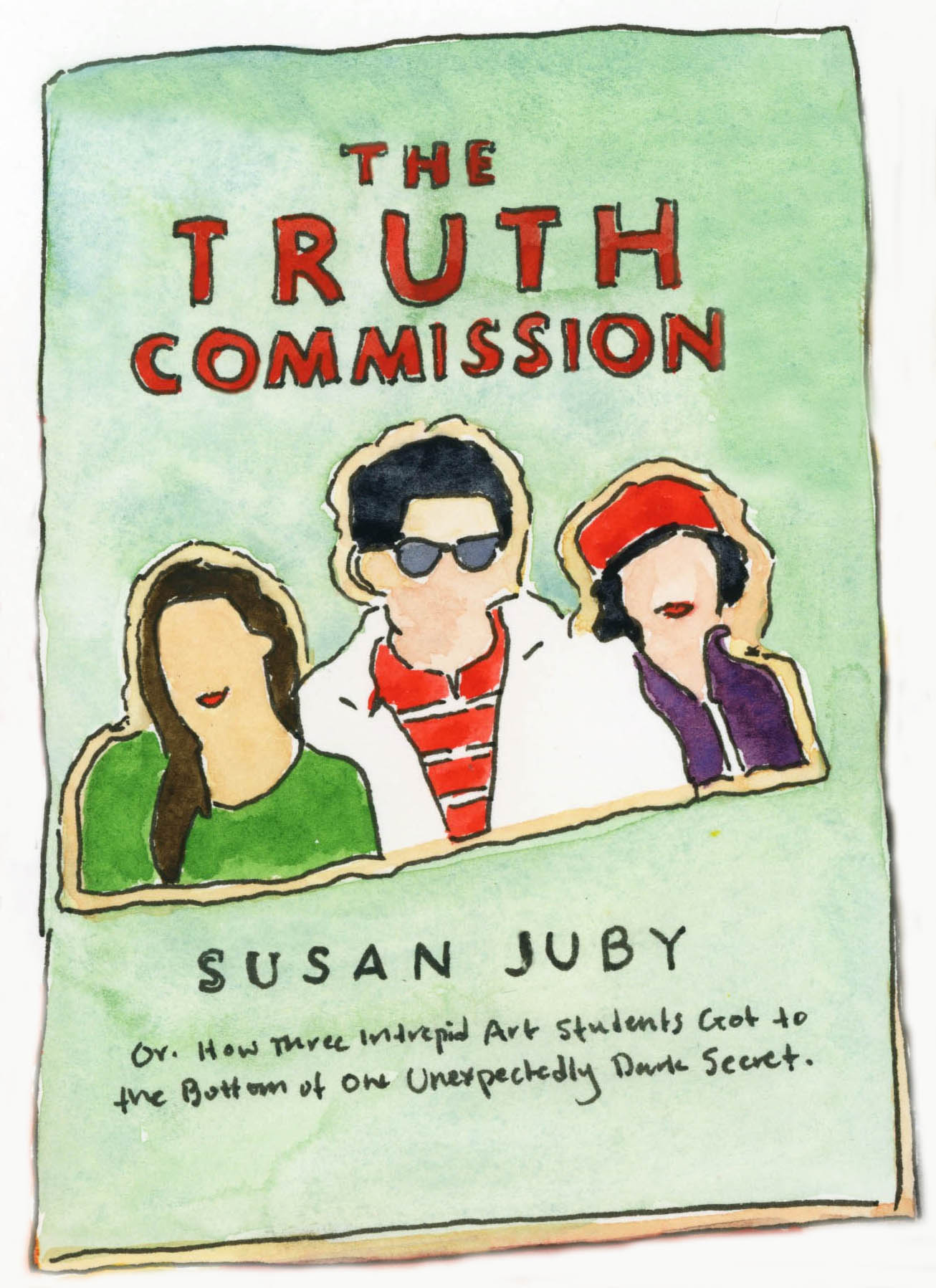 The Truth Commission, by Susan Juby
Dawn, Neil, and Normandy go to the Green Pastures School of Art and Applied Design. Each is artistic in a different way, as are all their crazy classmates, but Normandy has always felt overshadowed by her older sister, Keira, who preceded her at the school and went on to become a famous graphic artist. She is also discomfited by the fact that in her graphic novels, Keira has drawn her family—mother, father, and Normandy—as characters, and in a particularly unflattering (verging on vicious) way. Her response to this is to begin a project at school destined to bring the truth, however difficult and dangerous, into the open. YA fiction.
I Am Having So Much Fun Here Without You, by Courtney Maum
Not my favorite, but some people may like it. It’s about a guy who tries to bring some pizzazz into his life by having an affair. After having alienated both the mistress and the wife, he then tries to revive his ailing art career by exploring new media and methods. I liked it for the setting and the discussions about the art world. I never did figure out the title, because no one, anywhere in this book, is having any fun! Adult fiction.
A Paris Apartment, by Michelle Gable
Another one where the premise is better than the result, but again, the setting (Paris) and the convoluted process of holding a Sotheby’s auction for the art discovered in an untouched 70-year-old apartment was intriguing. Adult fiction.
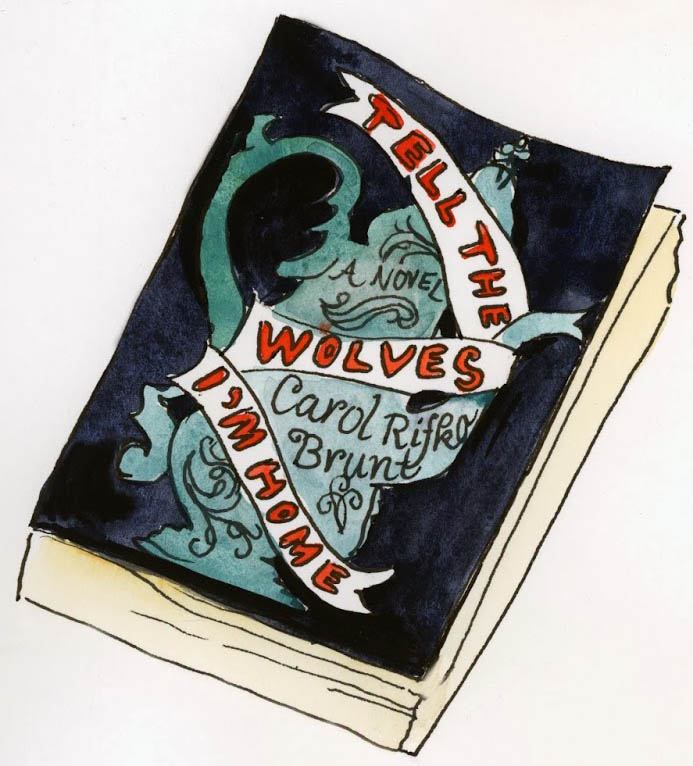 Tell the Wolves I’m Home,
by Carol Rifka Brunt
This book isn’t specifically about art, but uses it as a vehicle. June Elbus’s uncle, Finn Weiss, is dying of a mysterious disease (AIDS), and he chooses to spend his final days painting a portrait of his nieces, June and her older sister. Although the bulk of the book is June’s coming of age through the process of discovering and coming to terms with the secret parts of her uncle’s life that were kept from her by her parents, the painting plays an ongoing role throughout the book that ties it all together. An Alex Award winner. Adult fiction.
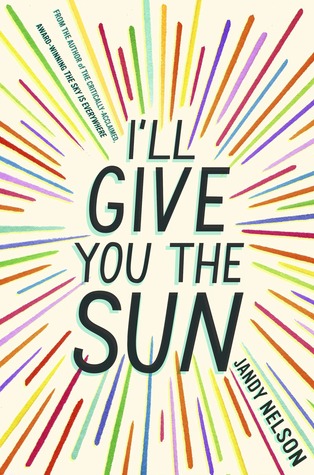 I’ll Give You the Sun, by Jandy Nelson
Twins Jude and Noah are both artistic, but Noah’s art just burgeons out of him. At 13, he is being coached by his mother to apply for an arts high school, while Jude is busy acting out as a typical teenage girl. Jumping to three years later, Noah has ceased to make any art, while Jude is struggling as a student at the school Noah was supposedly destined to attend. What happened in those intervening three years? And who will help the twins to regain their balance and express their art and themselves? Beautifully written and characterized, with a touch of magical realism that enhances the story. YA fiction (but should be for everyone).
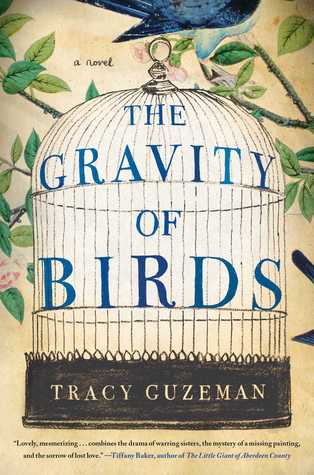 The Gravity of Birds, by Tracy Guzman
An art historian and an art authenticator are hired by a famously reclusive artist to sell a portrait that had a devastating effect on the two sisters who sat for it. But is the sale of the portrait the artist’s real motive? This is a fairly simple story, and simply written, yet the complexity of human emotions and betrayals involved made it intricate and nuanced, and the imagery is compelling. Adult fiction.
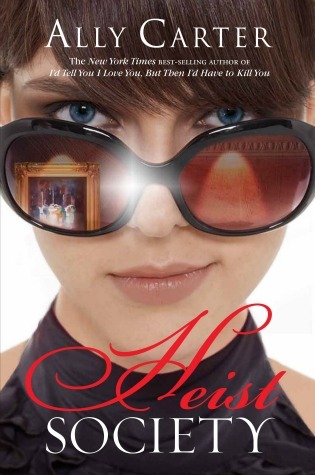 Heist Society (and sequels), by Ally Carter
An art caper book. The protagonist, Katarina Bishop, is the youngest generation in a family of international art thieves. A big robbery has taken place, and the mafia guy who owned the paintings thinks her father did the robbery, but he didn’t. She’s been given a deadline to give them back, so she and her cousins/friends have to figure out who DID take the paintings, and steal them back! Completely implausible, of course, but big fun. YA fiction.
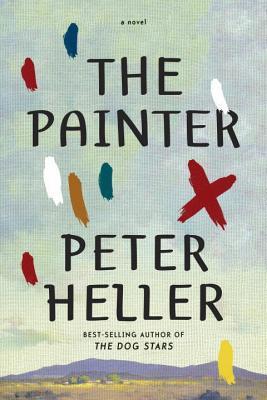 The Painter, by Peter Heller
This book pairs thoughtful, in-depth musing about life’s tragedies and how we react to them with breathless scenes of action worthy of the latest blockbuster thriller. The protagonist paints Expressionist masterpieces, while acting like a character gone astray from a Hemingway novel. I love all three of Peter Heller’s novels. Adult fiction.
The Improbability of Love, by Hannah Mary Rothschild
Annie is a hapless aspiring chef who happens upon a tiny Watteau painting in a junk shop, buys it for a new boyfriend who stands her up for their date, and then is intrigued enough by it to start looking into its history, which includes stories of Nazi Germany and the hidden and circuitous route the painting takes through centuries of diverse ownership. (The title of the book is the title of the painting.) Adult fiction.
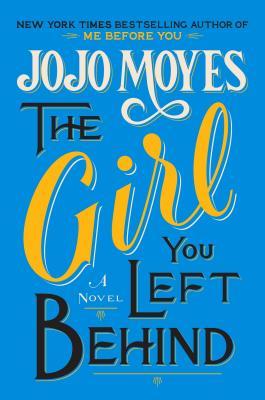 The Girl You Left Behind, by JoJo Moyes
In 1916, French artist Edouard Lefevre is forced to leave his wife, Sophie, and the portrait of her he has painted, to fight at the Front in World War I. A century later, Liv is given the painting as a wedding present by her new husband, shortly before his unexpected death. The past and present of the painting tie these two stories together and make for an engaging history. Adult fiction.
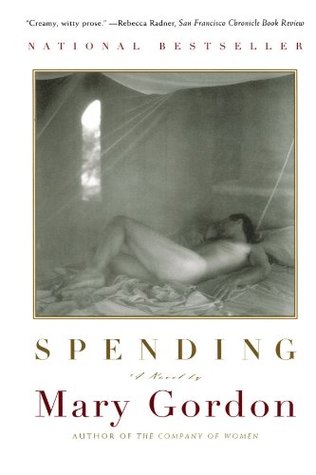 Spending, by Mary Gordon
Monica Szabo is a painter in her 50s who has struggled her whole life with the dichotomy between making a living and expressing her art. Then a man comes along who wants to be her patron, in the sense of classical artists who were sponsored by the Medici so they were free to make art. Monica struggles with the concept of being a “kept woman” even as she delights in the freedom to begin her most powerful and controversial work. Then their roles abruptly change, and new philosophical questions are up for review. An engaging story that addresses gender stereotypes, religion, and artistic integrity, without losing the immediacy of the relationship. One of those that merits a re-read. Adult fiction.
I’m sure there are many more books about painting to be discovered. When I do, I will share those, too!
Ahoy!
 Today, September 19, has been decreed (by two guys in Albany, Oregon) to be Talk Like A Pirate Day. While I enjoy the whimsicality of that, since my mind always goes to books I wondered what books would suit if it were READ Like A Pirate Day. So I decided to explore that idea.
There are, of course, the classics: Treasure Island, by Robert Louis Stevenson, and Captain Blood, by Rafael Sabatini. Who doesn’t remember those with fondness? But what books would a modern pirate read?
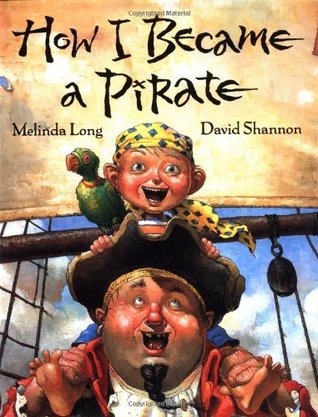 Perhaps, being a pirate with a somewhat busy lifestyle, he hasn’t had much time for literacy, so starting with a children’s book might be in order until he gets the hang of this reading thing. For instance, How I Became A Pirate, by David Shannon and Melinda Long, could be a great introduction. He might, however, be a vain pirate not fond of a character who claims that all pirates have green teeth. So perhaps moving on to a young adult novel would be wise.
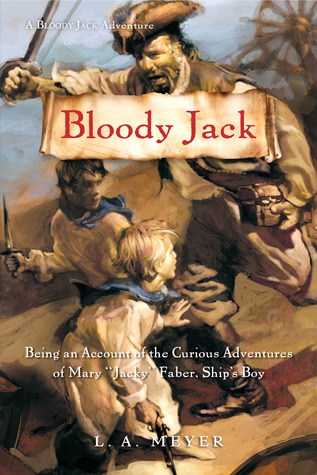 One could find enough reading to ride out the winter in the comfort of the captain’s cabin by perusing the Bloody Jack series, by L. A. Meyer. Jacky Faber is a ship’s boy on board HMS Dolphin. The only initial challenge is to keep the fact that “Jacky” is actually named Mary a secret from the rest of the crew. In a series of wild adventures that include shipwreck, boarding school, slavery, and piracy, Mary “Jacky” Faber spends a 12-book series getting herself and her friends into and out of hot water.
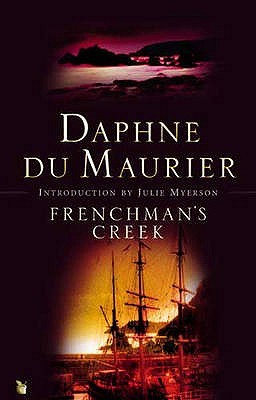 If the pirate wanted a break from sword fights and grog, Daphne du Maurier wrote a gripping romance set in Restoration England in which Lady Dona St. Colomb, sick of her indulgent life with her silly and ineffectual husband, takes the children and retreats to their estate in Cornwall, where the discovery of Frenchman’s Creek sets her on an adventure with a daring French pirate. But what happens when the adventurous have to come back to earth and recognize their responsibilities? Now the pirate is depressed. He needs some derring do, a bit of mayhem to get him out of the glumphs.
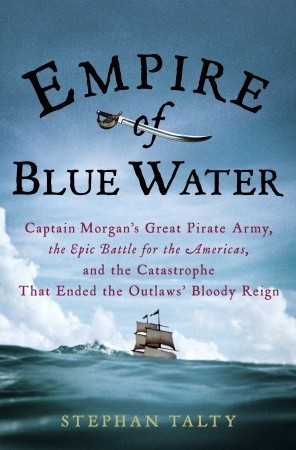 The perfect remedy is Empire of Blue Water, whose subtitle could itself take the pirate a day or two to parse: Captain Morgan’s Great Pirate Army, the Epic Battle for the Americas, and the Catastrophe That Ended the Outlaws’ Bloody Reign (whew!), by Stephan Talty. Although no extra description is necessary, let me just add that this is the real story of the pirates of the Caribbean, with terror, devastation, and political intrigue galore, enough to satisfy the most bloodthirsty of readers.
What is your favorite pirate tale? There are many more for the reading: This Goodreads list contains 537!
Get out there today and roll your rrrrrrrrrrrrs!
 The Book Adept