Public, secret lives

I finally got around to reading The Seven Husbands of Evelyn Hugo, by Taylor Jenkins Reid. Although she has written some other well-received books (Daisy Jones and The Six, Carrie Soto Is Back), this was the first of hers I have read. I’m always a bit skeptical about reading “popular” books, because I have been let down so many times by the promise created by all the hoopla, but I have to say that this one actually surpassed my expectations.
For those who have managed to avoid the book clubbers’ raves and have remained oblivious to this book, the basic outline is this: Evelyn Hugo is a Hollywood icon in her late 70s—retired, wealthy, and reclusive—who made it out of Hell’s Kitchen in the 1950s as a teenager and did whatever it took to become a Hollywood film star. Some of that meant entering into marriages for a variety of purposes that included true love, lust, ambition, politics, and money. Her relationships helped to shape both her career and her legend, but the men she married weren’t all of them the most important people to figure in her life—there is a story behind all the stories, and this is what Evelyn, now alone for many years, is ready to reveal while she still can.
She selects as her biographer a young journalist, Monique Grant, for reasons that are somewhat but not wholly connected to Monique’s writing abilities (and that’s another story) and gives her exclusive access. They spend days and nights together as Evelyn unpacks her entire glamorous and scandalous life—all the turning points, decisions, triumphs, and tragedies—until she finally reveals something that sets Monique back on her heels.
I’m not going to say much more about the story, because it’s one of those that you need to experience for yourself as you go along, rather than having it wrapped up in a couple of summarizing paragraphs. I will say that Jenkins’s writing style and the creation of the character and story of Evelyn are so evocative that you feel like you’re in the room with her as she tells it, as well as accompanying her to every movie set, red carpet, shop, motel, mansion, beach, or city street. It’s an enthralling look at Old Hollywood with its studio contracts and glitzy movie stars. The narrative creates a rich tapestry woven of ambition, betrayal, love, and a search for identity and authenticity. It’s full of historical detail and paints a colorful picture of the woman, her companions, and their backdrops.
My one caveat is that I would have liked to know just a little bit more about Monique Grant. Although we do get her basic story line, her character is so eclipsed by that of Evelyn that you tend to forget she’s in the room until Evelyn says “let’s stop there for today” and someone else’s hand reaches out to turn off the recording device.
Aside from that, I was captured and fascinated by this book and character from beginning to end, with no detail feeling extraneous. That’s a rarity, in my experience.
Boarding-school books
I’m off on my own personal nostalgia kick right now, re-reading Georgette Heyer novels to escape from the depressing real world of politics and sub-optimum health. But on one of the book-lovers’ pages on Facebook, a mom was asking for recommendations for her teenage son who is a reluctant reader, so I combed through my various categories of YA fiction for some and was thus inspired to write about this sub-set of coming-of-age fiction, the boarding-school book.
I think those who have never attended a boarding school are in some way fascinated with the culture—I know I always have been, from the time I read my first children’s book with a protagonist who had been posted off by their parents to “sleep-over” school. And there are a lot (hundreds) of examples out there of the away-from-home scholastic experience, from Harry Potter to A Separate Peace. There are books in every genre, for almost every age, so I thought I’d mark some of my personal favorites and some that seem to be perennially popular.
The boarding-school book is by no means limited to children and teens—there are many written for (and sometimes about) adults as well, especially if you include the college boarding experience. I’ll give age groups and categories and (in some cases) some brief synopses, and if you have the same interest I do, you can gravitate to whichever piques your interest.

For children, a classic example is
A Little Princess, by Frances Hodgson Burnett, about a young girl sent home to England from India, where her father is a successful merchant, because it was believed that the climate of India was not salubrious for British children. They were separated from their families and entrusted to the care of an English boarding school, where they would hopefully get an education and a proper upbringing and be reunited with their families when they were grown. Young Sara Crewe goes from riches to rags when her father disappears and is presumed dead, and Miss Minchin’s Select Seminary can no longer collect hefty fees for her maintenance. I sometimes think of this book as the child’s version of the first third of Jane Eyre, by Charlotte Brontë (although Sara is much better-natured than Jane ever was!). It’s a romantic story with a protagonist who remains upbeat and optimistic in the face of cruelty, guaranteed to appeal to the kind of reader I was at a young age.

There are many boarding-school books with more fantastical settings, the most well known probably being the Harry Potter books, in which gifted children are sent to Hogwarts School of Witchcraft and Wizardry to hone their talents. But in the fantasy category are also the Harper Hall books by Anne McCaffrey, which take place on the planet Pern and feature dragons and fire lizards in these stories of children studying to be professional musicians; and The Rithmatist, by Brandon Sanderson, featuring another magical school, this time for math geniuses with a little something extra. These are all for younger children and teens (maybe 4th through 8th grades?), although older teens and adults can (and do) enjoy these books as well.

In the specifically Young Adult category, there are fantasies, mysteries, and realistic fiction all set at private academies that either offer the standard schooling or are geared towards inhabitants with a specialty. For the middle school set: One realistic one in which the rule of the bullies and the plight of the bullied are revealed is The Mockingbirds, by Daisy Whitney. Another fairly normal boarding school that is the site of a mystery is the backdrop for the Truly, Devious trilogy by Maureen Johnson, in which death visits Ellingham Academy. And the Gallagher Girls series by Ally Carter (beginning with I’d Tell You I Love You But Then I’d Have to Kill You) showcases a girls’ school that is supposedly for the upper-crust daughters of the snobby set but is actually a training curriculum for those who wish to become undercover agents for the CIA and like agencies.

Among the boarding-school franchise for older teens, there are also a variety of settings. In the realistic category are such mainstream stories as Winger, by Andrew Smith (at a boys’ school focused on rugby); and Looking for Alaska, by John Green and Saving Francesca, by Melina Marchetta, both with a challenging co-ed population. A fun book in its development of one character from age 14 to 16 as she figures out how to dominate her environment is The Disreputable History of Frankie Landau-Banks, by E. Lockhart. Another is the trilogy by Stephanie Perkins that begins with Anna and the French Kiss, following a Georgia girl who is transplanted to an American school in Paris for her senior year.

A huge boarding-school subset is the paranormal category, with vampires dominating and witches coming in a close second—the Vampire Academy books by Richelle Mead, the Hex Hall series by Rachel Hawkins, the Gemma Doyle stories by Libba Bray, and Evernight, by Claudia Gray. One series that I particularly like and admire is Wayward Children by Seanan McGuire, which could arguably be classed as either YA or adult; the books are unusual, smart, and varied in their approach. I reviewed them on this blog when I first discovered them, and continue to find them unique.

Moving on to books more appropriate for adults, there are some in every category. The Magicians (and sequels) by Lev Grossman have been billed as Harry Potter for grown-ups. Mysteries that feature boarding schools include Well-Schooled in Murder, from the Inspector Lynley mysteries by Elizabeth George; The Secret Place, one of the Dublin Murder Squad books by Tana French; and The River King, by magical realism author Alice Hoffman. A book that is written about young people but is (in my opinion) too intense for their age group to read is Brutal Youth, by Anthony Breznican, a co-ed Lord of the Flies set in a Catholic private school in Pennsylvania. I didn’t so much enjoy reading it as remain fascinated and unable to put it down. It’s definitely powerful, and in some ways brilliant, but also stark and frightening. Gentlemen and Players, by Joanne Harris, is written from the point of view of the teaching staff at St. Oswald’s Grammar School for Boys, a cat-and-mouse tale of revenge as one staff member with secret ties to the school tries to destroy it from the inside. Finally, Never Let Me Go, by Kazuo Ishiguro, is dystopian literary fiction with a boarding school setting that may not be what you had in mind when you read the initial description, but it’s a fascinating premise with a heartbreaking (and kind of depressing) outcome.
This is a mere drop in the bucket of what’s out there; if you want to research this category further, go to Goodreads, select “browse” and “lists” and type “boarding schools” into the search box, and you will find multiple lists containing all these and many more. But the books mentioned here are a great start if you, like me, enjoy that particular setting for your fiction.

One last book
I managed to fit in one more before the artificial barrier that is New Year’s Eve divides us from our past and pushes us into the future. Don’t we as humans have weird customs? I mean, I understand turning-point events like the solstices and equinoxes, where something actually happens (the day becomes longer, the night becomes shorter, or vice versa, the seasons change, etc.), but artificial constructs like New Year’s Eve/New Year’s Day are a bit baffling. It would seem more logical that the winter solstice would be the year’s turning point, but no, it’s 10 days later. Why?
Anyway, enough with the futile speculation; I read another book! And although I technically finished it on New Year’s Day, since I read 93 percent of it before the turn of the year, I’m counting it as last of last, instead of first of next.
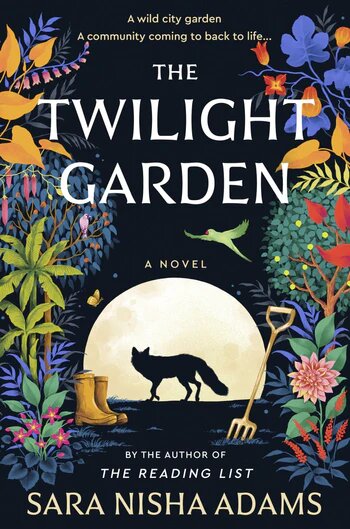
This one is called The Twilight Garden, by Sara Nisha Adams, author of The Reading List, which I previously reviewed here. That book caused a rather lengthy rant about all the things authors don’t know about librarians when they write their supposedly library-centered books; but while her research left a lot to be desired, she was a good storyteller and I like books about gardening, so I decided to give this one a try.
It takes place in a small neighborhood called Stoke Newington in the city of London, where two brownstone-like side-by-side residences (one owned, one rented) share a common garden space that was obviously at one point well cared for, but has been neglected by a string of tenants until it has become choked with nettles and bindweed, showing only faint outlines of its former glory. Living in one side of the property (renters) are Lewis and Winston, a couple who began as bankers at the same institution but who diverged sharply in their goals and aspirations when Winston decided the financial scene wasn’t for him and instead found a job as a clerk in a local grocery, while Lewis continued up the competitive ladder. On the other side (owners) are divorcée Bernice and her 11-year-old son, Sebastian (Seb), the mom prickly and privileged (Winston has nicknamed her Queen of Sheba) and the son friendly and disarming. None of them (except Seb) has any desire to spend a minute with the others and, in fact, Winston and Bernice have an initially adversarial relationship that annoys them both to no end. But when Winston, in the midst of life changes that make him desperate for something to occupy his time and his mind, begins laboring in the garden, prompted by some unexpected input, Bernice is first irritated but then intrigued. Soon the garden begins working its magic to bring these two and others together…
The book takes place with dual casts in two separate timelines, with the property as the unifying element; one timeline is in the 1970s-80s, while the other is (almost) present-day (2018-2019). With the exception of three people, all the major players are Indian immigrants or the children or grandchildren of immigrants, so there are some nice scenes featuring Gujurati cuisine and traditions accompanied by some less pleasant events tied to racism and prejudice. But the heart-warming scenes are far more prevalent than are the hints of discord, and the book is a lovely picture of what happens when people come together to celebrate their triumphs and share their losses while creating a beautiful garden that will have longevity. It’s populated by interesting and memorable characters and has enough specific gardening details to satisfy those who were drawn to it for that reason. A lovely read—not too heavy, but with plenty of depth. I also liked the perfectly narrative art of the cover.
Prescience
I have always been confused by how this word is pronounced; the syllables divide up as pre•science, but according to the dictionary, you pronounce it PRESH•ens. Before I looked it up the first time, I was pronouncing it “pre-science,” because the definition is “the fact of knowing something before it takes place,” so it made sense to me that it would be pre-, or before, science, because that would mean it was something known “before the fact.” In other words, a prediction, which is another weird word (previous to speaking it?). The English language is wild and wonderful.
Anyway, I thought it was an appropriate title for a review of Liane Moriarty’s most recent book, Here One Moment. A bunch of people get on a plane—parents, children, young people, middle-aged, elderly, all caught up in their own plans—and among them is an unremarkable older lady who rises to her feet during the long delay before takeoff and, pointing her finger at each passenger, methodically predicts their deaths (age and cause). Some laugh as if it’s a good joke (mostly those whose prediction is for 96 or 103, of old age), while others panic as she details disease, accident, or violence at a young age or in the immediate future. When the short flight is over and they all disembark, the incident is put out of the minds of most, whether it’s skeptically, uneasily, or forcefully, but when the first passenger dies exactly as the “Death Lady” predicted, the rest are no longer so dismissive.
After the events of the flight, the story jumps between multiple story-lines detailing the lives and reactions of half a dozen passengers, interspersed with chapters from the lady’s life, and we wait to see whether she is a delusional fraud or a true clairvoyant, worrying right along with those passengers with imminent and uncertain ends as they pretend normalcy, choose avoidance, or change their lives to avoid their fate.
The question for the reader is, of course, if you knew your death date, would you do anything differently? Would you try to defy fate, manipulate the statistical likelihoods, shift your timeline? The germane quote Moriarty used in the book was from Elisabeth Kubler-Ross:
“It is only when we truly know and understand that we have a limited time on Earth and that we have no way of knowing when our time is up that we begin to live each day to the fullest, as if it were the only one we had.”
I enjoyed the exploration of the Butterfly Effect idea and, of course, drew parallels with that movie and also with Final Destination. It’s also been compared with The Measure, by Nikki Erlick, which I have not read (except for the Goodreads summary). This book dragged a bit during the detailing of Cherry Lockwood’s life (the lady with the pointing finger), but suspense was maintained in the sections about each person who was dealing with the prospect of an imminent demise, of causes mostly not under their control. So although the book seemed to take me an inordinate amount of time to get through, I would recommend it for those who find this question philosophically intriguing. Not my favorite book of Moriarty’s, but also not my least favorite!
Old-fashioned feel
I have always enjoyed the books of Rosamunde Pilcher, although she wrote so few that I have had to resort to re-reading each of them multiple times (which is no hardship). I was therefore delighted when someone in the Friends and Fiction Facebook group mentioned that British author Marcia Willett wrote in a similar vein but that she liked Willett’s even better than Pilcher’s. I went to the Los Angeles Public Library website to see if they carried any of hers as e-books, given that I don’t get out much but can order books through Overdrive straight to my Kindle. I was happy to find a few, and checked out Indian Summer, which was almost immediately available.
After having read about 25 percent of the book, I logged onto Goodreads to enter it as my “currently reading” title and was shocked to discover that it had just been published in 2014, a mere 10 years ago. The book’s setting and characters and particularly the writing style are old-fashioned to the point that they remind me of some of my favorite authors of the 1940s-1960s—Rumer Godden, Elizabeth Goudge, Daphne du Maurier, James Hilton and Dodie Smith. In fact, this book reminds me particularly of Smith’s lesser known It Ends with Revelations, probably because of the theatrical connections of the books’ protagonists.
Willett’s earliest novel appears to have been published in 1995 (which may seem aeons ago to some of my younger blog-followers, but is just yesterday to someone born 40 years before that), and she didn’t begin writing until she was 50 years old; but that makes her about 80, not nearly elderly enough to channel this particular sensibility in her novels. It’s not just the setting, in rural Devon, that makes it feel this way; it’s the characters, who are generational landowners and tenants on the one hand and theater people and writers on the other, and in the way they relate to one another and to their environment. There is still that unspoken, unacknowledged consciousness of class that hasn’t existed to this degree in England for a while now (or at least I don’t think it has!) but is definitely still alive in this story. Additionally, there is a certain focus with which some of the writers from the era I mentioned approached their story-telling that includes a specific attention to nature and a leisurely and appreciative approach to the organic cycles of life that you simply don’t come across much in modern works.
The book revolves around a central character, Mungo, a retired theater actor and director whose primary residence is London but who also has a place in Devon, a part of the larger property owned by his brother. I say “revolves around” because while all the characters have at least a tenuous connection with Mungo, he mostly facilitates, rather than stars in, the little stories portrayed here. Mungo’s brother, Archie, inherited from their father, a conservative man who didn’t appreciate either Mungo’s profession or his sexual identity. Archie and his wife, Camilla, are struggling to make ends meet on the estate by renting out their two cottages. Philip and Billy are brothers who inherited the running of the “Home Farm” (a portion of Archie’s estate) from their father and will pass it to Philip’s son, unless Archie decides to sell up. Staying in the two cottages—one updated and the other dilapidated and awaiting repairs—are Emma, an army wife with two children, Joe and Dora, and a six-month lease; and James, a writer, who is wandering around Dorset for part of the summer, researching locations for his second book. Completing the cast are Kit, a friend of Mungo’s who has come down to consult with him on what to do about the reappearance of a figure from her past; and Marcus, a military friend of Emma’s husband who is trying to make time with her while her husband is away in Afghanistan.
Each of these characters or groups of characters stars in their own vignette within the larger picture of this Indian summer in Devon. Although there is one secret from the past that turns out to be rather shocking, for the most part the events are only exciting to those directly involved, being ponderings about what will or may happen in the future based on choices made now. There is a gentle humor revealed in the obliviousness of the author, who has met all the other locals but has not only completely misconstrued their personalities and concerns but has arrived at the assumption that life here in Devon is constant, unchanging, and bucolic, when in fact there are many tempestuous passions hiding behind the façades of everyone in the story.
While I could not agree with the woman who considered Willett superior to Rosamunde Pilcher in her authorial abilities, I did enjoy this gentle, rather charming tale of friendships and secrets in the English countryside.
Book pharmacy
The pandemic did something to our libraries from which I’m not sure they will ever recover completely: It made the in-person experience first precarious, then impossible, and then precarious again, as libraries first changed policies to prevent close contact, then completely closed their doors, and finally opened again only to discover that their patrons were either still being cautious or had completely changed their methods of book access and weren’t readily returning to their former habits.

My experience has been particularly acute, since, in the year after the formal lockdown when we were all mostly still staying away from any public place with more than half a dozen people in it, my disability began to ramp up to the point where making my weekly rounds to the market, the post office, the feed store, and the library became at first painful and then fairly impossible. The only time I go to the library nowadays is if I am booked to teach an art workshop at one of the local branches, and it takes me two hours to get ready and a double dose of Tylenol to weather climbing in and out of the car four times (leave-arrive, leave-arrive) and walking from the parking lot to the meeting room to set up for contour drawing or watercolor or T-shirt stenciling.
My previous library habits were filled with serendipity for my reading life; I had a particular routine that varied but usually included most of the same checkpoints. I would return my books and then look at the return shelves to see what “everyone else” had been reading and whether any of it looked intriguing to me. I would check the new books shelves and grab at least one or two unknown and untried authors. I would look to see if the latest volume in half a dozen mystery series I read had arrived, or if there was new science fiction, and I would visit the YA section for fantasy, because some of the best fantasy writers live there. And if all that failed to garner me at least half a dozen books to take home, I would stroll languidly up and down the aisles, looking for beloved authors, and would consider re-reading one of their books; but then I would also look around them on the shelves to see who I might discover because they were shelved close by. That’s how, while looking to see if there were any Rumer Goddens I hadn’t read, I noticed and borrowed the books of Robert Goddard. That’s how, while standing by the shelf containing Betty Smith and Dodie Smith, I found A Simple Plan, by Scott Smith. The books of Robert Heinlein led me to the Dune saga by Frank Herbert “next door.” In short, I can’t say enough about the expansion of one’s reading life through the luxury of browsing.
In my readers’ advisory class at UCLA, I used the book Reading Still Matters, by Catherine Sheldrick Ross, as one of the texts; Ross and her colleagues did multiple in-depth surveys and studies of thousands of readers to discover how they select, but I never realized, until I just now took the time to describe my own exact experience, that I almost perfectly characterize the habits of the successful readers she catalogues. Part of that book is also dedicated to the purpose of discovering what happens when a person’s own habits and methods fail them and they are flailing about trying to find a book. And now, I can relate to that, too….
These days, being so nearly housebound as I am, my choices suffer from a certain paucity. Although I belong to a couple of Facebook groups of avid readers, most of the time they all seem to be reading the same two dozen or so books, many of which are not to my taste. I have never been a peruser of the bestseller or award-winner lists in the newspaper or online, mostly because long experience has shown me that the former are not as good as their publisher’s blurbs declare, while the latter have won awards simply because some esoteric bunch of people decided they should, and we apparently have little in common! So without my library routine, I struggle to find what I want, just as much as any more naive reader with fewer developed resources. I wasn’t conscious of this until my annual Goodreads challenge (how many books you read in a year) began to number fewer and fewer books, mostly because I am not finding the ones that would hold my attention and keep me reading on a continuous basis. One year, while working full-time (at the library) with a long commute, I nonetheless managed to clock more than 150 books; but last year I struggled to complete 80, despite being retired and mostly at loose ends. Part of it, of course, is a certain lack of concentration that comes with my physical challenges, but I blame most of it on the functional lack of choice.
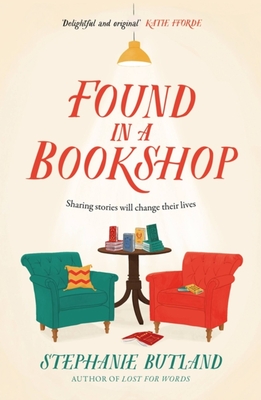
Being a readers’ advisor carries a certain amount of responsibility with it to keep up with current literary output while having a deep base of older choices on which to fall back, and I confess that I’m not as good at it as I have been in the past. But I still manage, in the Facebook reading groups (and sometimes on Goodreads) to find the books people want, if they give the slightest bit of personal information that would lead me to their preferences. And that brings me to the book I am currently reading (at last! you may be exclaiming with relief), which is called Found in a Bookshop, by Stephanie Butland, and which is resonating so closely with certain parts of my own personal experience that I am finding it positively cathartic.
I didn’t know, until I had already reached chapter 11, that it is actually a sequel to Butland’s book The Lost for Words Bookshop. But several Goodreads reviewers said you could read the second as a stand-alone, and I somehow couldn’t bring myself to stop, once started, so I’ll get to the first one when I am done with the second. (EDITED TO ADD: I apparently did read the first book, back in 2018, and gave it five stars. I didn’t review it here, since I hadn’t yet started this blog, and I don’t remember a thing about it! That’s kinda scary….)
A couple of Goodreads reviewers groused about the book being set during the Covid lockdown (“outdated” said one, while the other elaborated: “Boring. Too many characters. Hate Covid books. Could do without the author’s opinions. Glad I only spent 99 cents.”) but that was precisely what I loved most about it. Butland so perfectly captures the feeling of being isolated from everyone, from standing on one side of a door but not allowed to open it, the nervous retreat from other people when encountering them in public places, the quiet of the streets with nothing but essential traffic…it brought the whole thing back with complete clarity. I suppose some people wouldn’t want to experience that again, and while I didn’t precisely crave it, I found it comforting, in a way, to recognize that this author’s experience (and that of her characters) so perfectly echoed my own.
The description of the pervasive quiet of the bookshop without any of its customers and the nervousness of its proprietor and her employees as the lockdown went from weeks to months with no sign of abatement was evocative and painful. The vignettes of the various people who were tenuously connected through their previous status as customers of the bookshop were likewise poignant and familiar. But the thing that really got me, in the end, was that this was a story not just about Covid but about readers’ advisory. At some point, after one long-time patron mails a check and requests that the bookshop send her books each week—leaving the selection up to the staff—the owner, Loveday Carew, decides that she will enlist her employee, Kelly, to craft more of a presence on social media and then to advertise their services as a “book pharmacy.” Basically, they tell the town of York that they will be happy to select books for people who aren’t sure what it is they want or need, a sort of reading prescription, and either deliver them to their porch via bicycle, make them available for pickup, or send them in the post. And then the emails and letters start to arrive, some requesting specific genres or types of reading but others simply describing the feeling the reader wishes to experience and hoping the bookshop staff can figure out what book will produce that. The books couldn’t cure Covid, but they could do something about fear, boredom, loneliness, and the desire for escape. It was like this author took my favorite area of study—and my life’s preferred work—and laid it all out on the pages of her book.
In addition to all of this synchronicity with my own life’s experience, I love that in the “prescriptions” the bookshop staff write out for their customers I discovered at least a dozen intriguing titles with which I was unfamiliar, and which I promptly noted and added to my Goodreads “want to read” list. After doubling back to peruse the first book in this duology, I can scarcely wait to explore that extra list of smart suggestions from an author who has obviously done her homework. Great work, Ms. Butland!
Piglet
When they talk about reading this book, people have a lot to say about misogyny, about agency, about maintaining façades, but not so much about the thing that struck me, something pretty literal about the whole plot as it relates to the main character: People are failing her, life is failing her, and she is failing herself because she is trying to make and keep herself small.

A few people on Goodreads reacted negatively to this book as just another eating disorder saga. I didn’t read it like that at all. Yes, she has an intense relationship with food, but if everything else were copacetic, that would be considered normal—she’s a cookbook editor and a foodie, so what? But everything else isn’t right in Piglet’s life (imagine, for instance, going through life being called “Piglet” by all your loved ones!), and the common denominator is that she’s too big for the life she has been seeking.
She’s too big for the lower-middle-class background into which her parents and sister expect her to continue to fit herself; she’s too big for the upper-class environment to which she aspires—too flamboyant, too expressive, too filled with emotions. She’s too big to fit into the expectations of her fiancé, who wants her to act appropriately despite his own bad behavior. She’s too big physically—tall, awkward, a little overweight. And everyone faults her for this, and keeps encouraging her to cram herself into roles, relationships, corsets, dresses, mindsets, all of which goes against her nature. But it takes her just a little bit too long to figure out that none of the behavior she is forcing upon herself will fill up her hunger for love, for acceptance, for recognition. So she makes a series of disastrous decisions that feel inevitable in the moment, until they don’t and she rebels.
She has one voice of reason in all of this—her pregnant maid of honor, Margo, who ends up going into labor early and has to miss the wedding, but who persists in telling Piglet that she deserves more. Piglet doesn’t listen, but when she upends everything, Margo is the one she seeks out.

This is being touted as literary fiction, and I wouldn’t quite go there, but…the author is immensely skillful in the way she gets the reader to think about big-picture decisions by dwelling on seemingly incidental conversations and descriptions of food—choosing it, preparing it, eating it. She is also really good at creating essentially unlikeable characters and getting you to care about them. The book tells a story that is in one way small in scope, but in another is about a very big question: What’s the point? What do we want? In certain moments I felt an overwhelming impatience with Pippa’s choices (yes, that’s her real name)—or lack of them—but I have to confess that I mostly loved this book and found it as satisfying as one of the meals she makes during the course of the story.
Addendum: I found it fascinating that this novel was written by Lottie Hazell in conjunction with, and inspired by, getting her Ph.D. in Creative Writing, with a focus on food-writing in twenty-first-century fiction. I would definitely read another book by this author.
Binchy’s best?
The winning title for that is endlessly debated in Facebook reading groups, but having just completed my third (fourth?) reread, I can say that this is the one for me. It’s hard to synopsize Scarlet Feather, because there’s so much going on all at once in different arenas, but I’ll give it a shot.

Cathy Scarlet and Tom Feather met and became fast and eternal friends in catering school; both of them have had the unwavering aspiration to start a catering company together. Not a restaurant, but rather a company that cooks for large functions and intimate dinner parties alike and delivers (and sometimes serves) the food to whatever venue is required. The story begins on New Year’s Eve; Cathy is catering a party for her harridan of a mother-in-law, while Tom is out walking the streets trying to cool down after a jealous outburst when he saw his girlfriend on the dance floor with a drunken, handsy party goer. Tom happens upon a “premises” that would be perfect for their business, while Cathy encounters her husband’s niece and nephew, the twins Maud and Simon, at the NYE party. This evening kicks off the book.
Cathy is married to Neil, the son of Hannah and Jock Mitchell. Cathy’s mother, Lizzie Scarlet, used to clean for Hannah and bring Cathy along with her when Cathy was small, so the fact that Cathy has wedded the son of the snobbish Hannah is a big deal. Lizzie’s husband/Cathy’s father Muttie is a sweet man whose “bad back” has kept him from doing any meaningful work in his life but hasn’t prevented his frequenting the local bookie’s and spending every penny he can scrounge on the horse races. Neil is a barrister with big ideals to help people with immigration problems and find solutions for the homeless, and is constantly on call to deal with important issues.
Tom is involved with the beautiful Marcella, who aspires to be a model while working as a manicurist at Hayward’s, the big department store. She spends her off hours working out and attending any function where she has a chance of getting her picture taken and into the society pages in the newspaper, all to advance her dream career.
Maud and Simon are the young children of Jock Mitchell’s brother, Kenneth, and his wife Kay; Kenneth travels quite a bit with his friends, while Kay has a drinking problem, and their elder son, Walter, isn’t, shall we say, a responsible individual, so when the twins find themselves alone in the house on New Year’s Eve, they decamp to their uncle’s and become a problem that has to be solved by anyone willing to take it on. This turns out to be Cathy and Neil, aided by Lizzie and Muttie.
The feature that makes Scarlet Feather the one for me is Binchy’s treatment of the characters and how she shows their interactions, changes and growth. Specifically:
- Tom and Cathy and their passionate aspirations. I love a story about people who are determined in every way to do whatever they set their hearts on, and won’t be deterred. And the contrast between what they were doing and the lofty heights to which Cathy’s husband Neil aspired was a good reminder that yes, there are more important things in the world than running a small business, but the truth is, you never know what is your role in life, and how it will impact those around you. So it’s best to be focused on being impactful from whatever position in which you find yourself.
- Maud and Simon, the nine-year-old twins who are tossed from pillar to post throughout this story. There needs to be more emphasis on and exposure (in fiction and in life) of the plight of children who are not wanted by their biological family but who may be badly wanted by the many caregivers who step up to help them when they’re in need, as was also noted in the history between two other characters in the book. Also, the twins are so hilariously written, it’s a joy every time they appear on the page.
The one thing that irritates me about Binchy’s books, because it feels like simple laziness, is her insistence on using the same five surnames (and many of the same given names too!) for every character in every book she wrote. Scarlet and Feather were the anomalies in this one, for obvious reasons (had to have a title and a name for the catering company), but the rest are a small assortment of Ryans, Flynns, Daleys, Hayes, and Nolans, without an O’this or an O’that to be found, and I swear there is a girl named Orla in every book but it’s never the same girl. Since Irish monnikers run to two pages on the internet, a little more imagination in the naming would have been good. But that’s just pickiness—I really do enjoy her books to an extraordinary degree. You might, as well!

Binchy’s last
Before I began writing this, I did a search of my own blog to see if I had reviewed a Maeve Binchy book previous to this one, and I was surprised to find that I hadn’t. But I read all of them for the first time so many years ago that I guess they predate the inception of my becoming an independent reviewer. I am sure that I probably reviewed some for my library’s blog once upon a time, but after my retirement the new and “progressive” library director decided that a book review blog was unnecessary for a library (yeah, just ponder that for a minute) and discontinued it, so that legacy is lost.
I did find, however, that I had mentioned various writers and their books in connection to her, most of them falling short of the simple genius that was Maeve’s gift; usually, the publisher’s blurb that this or that tome was “perfect for fans of Maeve Binchy” just led to disappointment and unfavorable comparisons.

A Week in Winter is unfortunately her last book; she wrote it in early 2012, then passed away unexpectedly that July, and the book came out in October. She suffered terribly from osteoarthritis in her latter years, and also had heart disease, and died of a heart attack after hip surgery at age 72. But before that she wrote 17 novels, half a dozen short story collections, and a couple of plays, and was also a columnist for The Irish Times for about a decade. I started reading her in the ’90s, I think, and mostly kept up with every novel she wrote, with a couple of exceptions. But I somehow never went back and read this one, so when it came up on the Facebook “Friends and Fiction” page, it was a welcome reminder to do so.
It’s hard to say why her books are such genius—they are set in Ireland, either in the country or in Dublin, and center around family life, small businesses, and the tensions between Irish rural and urban life as influenced by the cultural changes that took place from World War II to the new century. They are small stories, in the sense that they focus in on one protagonist and the people—family, friends, work colleagues—directly connected to them in some way, and are both wholesome and somewhat uneventful, in contrast to so much that’s currently being published—no mysteries or thrills here. But Binchy had a way of understanding universals and then bringing them home at an intimate level that spoke to people, and with a couple of exceptions I have read her books two and three times to remind myself of how much I received from them.
This latest built on a formula she had used before, in which she began with the story of one character who she explored in detail, and then branched out to incorporate short vignettes of the lives of those who revolved around this character for some reason. She did it in her popular book Evening Class, which features Nora (known as Signora) as a teacher of Italian and then explores the back stories of all the students who enroll in her night class, going on to send them all together on a trip to Italy.
In A Week in Winter, the protagonist is Chicky Starr, who decides to turn an old mansion on the western coast of Ireland into a small hotel; the second half of the story develops around the people she recruits to help her, and all the guests who book in for the first week the hotel is open. But first we get the story of Chicky—who she meets and loves, why she leaves her family home in Stoneybridge and ends up in an impersonal existence in a boarding house in New York City, and what brings her back to Ireland to set up as a hotelier.
I will say that while I enjoyed reading this, it wasn’t my favorite of Binchy’s by a long shot; while I do like this formula, I find that I have preferred her novels that focus more closely on one set of people and don’t bring in so many attenuated stories of strangers to fill their pages—books such as Firefly Summer, Tara Road, The Glass Lake, and Scarlet Feather. But there was definitely an appealing story line that wended its way through all the connected lives, and it also made me want to travel to Chicky’s place and spend my own week in its comfortable, well-heated rooms, eating Orla’s good cooking, taking bird-watching walks along the rugged coastline, and finding a pub alive with good Irish music for an evening’s entertainment.

If you haven’t experienced Binchy’s books, you might be wondering what is so special about them. I don’t know that I can adequately explain it: They are cozy but not sappy, unchallenging but not unintelligent; and the characters and stories are so engaging that they make you want to know these people—frequent their restaurants and hotels and shops, live in their neighborhoods, have a mid-morning coffee break with them. The only writer whose name comes up consistently when anyone says they want to read someone who writes like Maeve Binchy is another of my favorites, Rosamunde Pilcher. They also remind me of a more old-fashioned version of Jenny Colgan’s books, but slightly less twee. (No offense to Colgan—I love her books—but they aren’t quite as universal as those of Binchy or Pilcher.)
If you haven’t read Binchy, don’t start with this one—pick one of the ones I named above, with characters you stick with throughout. Oprah featured Tara Road as one of her book club books in 1999, which may account for the exponential growth of Binchy’s readership; but I think she would have been a big seller, regardless. Try one and see if you agree.
The test of a good book

When I first read The Gravity of Birds, by Tracy Guzeman, in 2013, I said, “This is one of those books that I wanted to turn around and read again as soon as I finished it.” After having read it for the second time 10 years later, I experienced the exact same impulse as soon as I turned the last page.
There can be a few reasons for doing that:
1. You liked it so much that you don’t want to be done;
2. It was so complex that when you got to the end you said, Hey, wait a minute…and went back to see if you completely understood how to get to where you “got”;
3. You wanted to wallow more in the writing or the characters or the imagery or the story.
Parts of all three of those play into my desire to start over. Paradoxically, this is a fairly simple story, and simply written, yet the complexity of human emotions and betrayals involved made it intricate and nuanced, as does the language.
A reclusive artist who quit painting 20 years ago summons an art authenticator and an art historian who has documented the artist’s career to reveal to them that there is a painting of his that no one has ever seen. It is a triptych that includes a self portrait of the artist, Thomas Bayber, with two young girls. Bayber has the main central panel, but the two side panels are missing; he wishes to sell the work, but will only do so if it is complete, and he tasks the two men with locating the other panels. The pair set out on this quest, but the historian, intimately familiar with Bayber’s foibles, soon realizes it’s not just about the paintings but about the subjects contained within them; Bayber wishes to track down the “girls,” now in their 60s.
Natalie and Alice Kessler (19 and 14, respectively) are sisters, spending a month with their parents at a cottage by a lake, next door to the precociously talented painter, Thomas Bayber (28). The family befriends the young man, but there is a special bond between him and the young Alice, who is just beginning a lifelong challenge from rheumatoid arthritis. Their friendship is resurrected eight years later when Alice is on the cusp of some life decisions and goes back to the cottage for a contemplative weekend, unexpectedly encountering Thomas, who is on the outs with his family and staying next door again. Their relationship shifts to something more intimate until Alice figures out something from the past that causes a permanent rift, and there is no contact between them for 30-odd years. Meanwhile, Natalie keeps her thoughts to herself…
The characters are complex and three-dimensional, especially the sisters. But there is a lot of set-up and it took a long time to appreciate their subtleties, so once I did, I wanted to spend more time understanding them than the author had given me.
The imagery is powerful and descriptive—I so wanted the artists in this book to be real, so that I could look them up on the internet and see their paintings and sculptures. I could almost picture them, but I wanted to see them “IRL,” as they say.
The story took place on a triple timeline in multiple locales, so I felt the need to go back and check exactly when certain things happened and who knew what at the time they did.
It was a compelling first novel, but although Guzeman mentions in her afterword that she is working on another, none has been forthcoming. It would be a shame if this author never wrote anything else; but this book is a solid accomplishment that can stand as a testament to her talent. An evocative book that will stick with you.
 The Book Adept