News re: my dog
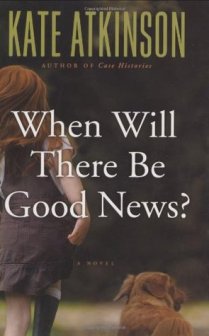 At the center of When Will There Be Good News, Kate Atkinson’s third Jackson Brodie novel, is a new character, Reggie. I enjoyed this book mainly because I so adored her. She is 16 (sweartogod), looks 12, acts 36, and is an old soul and a compassionate but completely pragmatic one. Best teenager in fiction for a while now.
While I found the multiple story lines of Dr. Joanna Hunter, whose family members were all inexplicably knifed to death in the middle of a field one day when she was a child, Joanna’s husband’s questionable business practices, Chief Inspector Louise Monroe’s domestic violence case, and the almost incidental appearance of Jackson Brodie (who is in-country for personal reasons and yet by a twist of fate ends up plumped down in the middle of all of these mysteries) all to be interesting, it isn’t until they get connected by Reggie that things really get going, even though she, like Brodie, is involved almost despite herself. The brief period when Louise, Jackson, and Reggie are all in the same room at the same time is my favorite scene in the book.
These books of Atkinson’s are so…perverse! Not in a sexual way, let me hasten to add, but in the sense that they are “contrary to the accepted or expected standard or practice.” You can’t actually call them mystery novels. I mean, there ARE mysteries, and many of them do get solved, but they are practically beside the point. The books are character studies, and there are few who are able to delineate a character as well as Kate Atkinson.
While I find these books frustrating in the way they meander off the beaten path and into prolonged ponderings about this or that (not to mention all the stream-of-consciousness literary references that keep popping up in Brodie’s dragonfly mind), the stories are always resurrected by the strength of the characters themselves.
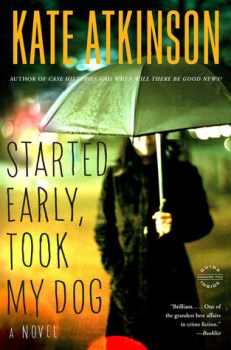 Because of that trait, I think I may have liked Started Early, Took My Dog the best so far of the Jackson Brodie books, although Jackson’s role in it is mostly ridiculous! The central mystery is set in Northern Yorkshire, where Jackson is trying to track down the birth parents of a client who was adopted in England at age two and then taken to New Zealand to grow up. But when Jackson discovers someone he thinks might have been the birth mother, a murder case from 1975 causes all kinds of people to come out of the woodwork to prevent the truth about police corruption and misbehavior from coming out.
The title of the book turns out to be a double entendre, since taking a dog away from his abusive master (literally beating the guy up after he takes out his ill temper on his dog by berating it and kicking it in the ribs) is one of Jackson’s more rational moments in the book.
In addition to the dog-napping (I always thought that should be nabbing, not napping), there is child-napping, and they are both accomplished by former police officers! Tracy Waterhouse, just retired from the force, working part-time as a mall security guard, and supposedly resigned to or even content with her single, childless existence, sees a prostitute dragging her small child through the shopping center while screaming at her, and snaps. She has money in her pocket intended for the Polish bloke remodeling her kitchen, but instead hands it off to Kelly Cross in exchange for her youngest child. Suddenly, Tracy has stepped from one side of the law to the other.
But IS Courtney the daughter of Kelly Cross? Tracy wonders. At first she thinks she’s simply being paranoid, but then she realizes that there are all sorts of people trying to “get in touch” who may have been sent to take Courtney back. Meanwhile, Jackson is, weirdly, encountering the same folks who are after Tracy, none of whom have either his quest or his best interests at heart.
Throw in other seemingly random characters whose histories and futures are tangled up somehow with these two, and things get truly confusing. It’s no wonder that the one piece of dialogue our Mr. Brodie repeats throughout the book is “I don’t understand.” It paints a pretty ineffectual picture of him as a private investigator, but certain leads to some interesting situations.
I liked this best mostly because of the characters of Tracy and Courtney. Tracy is large, awkward, stalwart, and ultimately heroic, while Courtney delights as only a truly quirky small child can. Between the two of them, they carry the story.

“Dragon,” courtesy of KJ Allison
As with the other Jackson Brodie books, the point is less about the mysteries and more about human themes of loneliness, grief, and dysfunction. Practically every character (except the determinedly upbeat Judith) is damaged and in need of love and/or salvation. Even the minor characters—Tracy’s colleague Barry, the aging actress Tilly—bring pathos to the story. And yet there is also humor, especially in the way Jackson’s role seems that of a character in a French farce, doomed to make his entrance from stage left just as his quarry (or his explanation) is departing from stage right.
I really hope that Atkinson plans to reveal the answers to some major cliffhangers left dangling off the edge at the end of this one: Who is Courtney, really? What was Jackson up to before he took on this case? Who is the murderer of a rather significant character? And I’m still waiting for the other shoe to drop with Louise, three books later. C’mon, Kate, resolution!
The Dry
After reading The Lost Man and being bowled over by it, I couldn’t resist moving on to Jane Harper’s other books, starting with her first, The Dry.
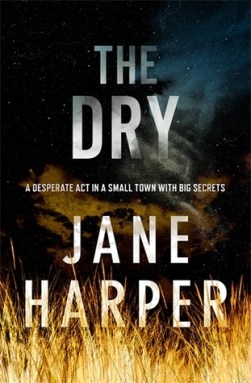 While this debut novel is more of a police procedural and less of an epic saga than The Lost Man, Harper doesn’t miss out on using the landscape as a big influencer on the townsfolk of Kiewarra. The sun blazes down, the blowflies hover, the river has dried up, and along with it have gone the fortunes of the farmers in this rural Australian community. The burning heat of the drought ratchets up the tension amongst everyone who lives there, and turns an already small-minded bunch into something mean.
A tragedy seemingly caused by this unbearable strain is the vehicle that brings Aaron Falk back to his adolescent home, 20 years after he and his father were driven away. Falk’s best childhood friend, golden boy Luke Hadler, is dead; he has apparently taken a shotgun and murdered his wife and young son, then turned the gun on himself. If Falk, now a forensic accountant, had his druthers, he would have sent flowers and stayed the width of the continent away from Kiewarra; but Luke’s parents beg him to come, and Luke’s father adds a cryptic note that causes Falk to panic just a little. This is not the first person Aaron has lost from this town, and despite a finding of suicide, the persistent suspicions cast on him after his friend Ellie Deacon’s death when they were 16 are what caused him to leave in the first place.
Despite significant opposition from the townspeople who hate him, Falk joins forces with the new cop in town, Sergeant Raco, who has had his own suspicions about how the Hadlers actually died but hasn’t gotten anywhere with them. Together he and Aaron begin to uncover the lies that were told, the secrets that have been kept, and the fears and assumptions that are slowly turning Kiewarra into a powder keg.
This was an excellently written mystery, with completely believable red herrings and a truly unexpected resolution. The element that carries it over the top is the attention to detail in both the characterization and the atmosphere. You know these people, and you feel their emotions; you learn this place and you feel its desolation. The narrative carries you along, moving seamlessly from Falk’s past with Luke, Ellie, Gretchen, and the townspeople who constantly have their eye on these teenagers into the present where everyone (except Ellie) has grown up and into themselves, for better or worse (mostly worse) and are all re-engaging over this new tragedy. A stunningly well-done piece of investigative fiction that might appeal to the readers of Craig Johnson’s Walt Longmire books.
Novel Christmas
For those who appreciate a lengthier read, I have attempted to round up some novels with Christmas themes or settings and, in doing so, not make you doubt my good taste!
 For ’tis true, ’tis true that a plethora of Christmas tales exist, but whether you want to read any of them is the question. I have, therefore, found a few I would consider a bit more literary, and a bunch that are connected to some genre series, since much may be forgiven your favorite authors when they sell out, er, decide to delight you with a Christmas-related chapter.
First off, consider two short, sparkling comedies set at Christmas-time by Nancy Mitford, the writer later known for Love in a Cold Climate. Christmas Pudding and Pigeon Pie are Oscar Wilde-ish “great house” stories with a cast of ridiculous upper-crust characters rivaled only by those depicted by E. F. Benson and P. G. Wodehouse.
Next, there’s Wishin’ and Hopin’, a Christmas story by Wally Lamb, which focuses on a feisty parochial school boy named Felix Funicello—a distant cousin of the iconic Annette.
In a similar humorous vein, check out comedian Dave Barry’s The Shepherd, the Angel, and Walter the Christmas Miracle Dog. Or, on a more sympathetic note, Frank McCourt’s Angela and the Baby Jesus, relating the story of when his mother Angela was six years old and felt sorry for the Baby Jesus, out in the cold in the Christmas crib at St. Joseph’s Church….
The Christmas Train, by David Baldacci, is not a book I have read, but it sounds like a perfect storm of circumstances guaranteed to be entertaining, landing a former journalist on a train over the Christmas holidays with his current girlfriend, his former love, and a sneak thief, all headed towards an avalanche in the midst of an historic blizzard.
Skipping Christmas, by John Grisham, follows the fate of Luther and Nora Krank, who decide that, just this once, they will forego the tree-trimming, the annual Christmas Eve bash, and the fruitcakes in favor of a Caribbean cruise.
 One of my personal favorites to re-read this time of year is Winter Solstice, by Rosamunde Pilcher. It is sentimental without being mawkish, and brings together an unusual cast of characters in an interesting situation bound to produce results.
Now we enter the realm of franchise genre fare with a nod to Christmas:
The Christmas Scorpion is a Jack Reacher story (e-book only) by Lee Child, in which Jack’s intention to spend the holidays in warm temperatures surrounded by the palm trees of California somehow lands him instead in the midst of a blizzard facing a threat from the world’s deadliest assassin.
There are many in the mystery category, from Agatha Christie to Murder Club to baked goods-filled cozies:
In Hercule Poirot’s Christmas, by Agatha Christie, a curmudgeonly father turns up dead after telling all four of his sons, home for Christmas, that he is cutting off their allowances and changing his will. Poirot suspends his own festivities to solve the murder.
James Patterson has a couple of entries: The 19th Christmas, a Women’s Murder Club book, and Merry Christmas, Alex Cross, starring his popular detective trying to make it back alive for the most sacred of family days.
Charlaine Harris’s unconventional pseudo-cozy series about housekeeper and body builder Lily Bard features Shakespeare’s Christmas, in which Lily solves a four-year-old kidnapping case while at home for her sister’s Christmas wedding.
In a similar manner (though with quite different affect!), Rhys Bowen’s Irish lass Molly Murphy attends an elegant house party at a mansion on the Hudson in The Ghost of Christmas Past, and tries to fathom the reappearance of a girl who disappeared 10 years ago.
 Anne Perry, known for her historical fiction featuring the Pitts (Charlotte and Thomas) and the rather darker William Monk, has written 16 Victorian Christmas mysteries to date, the latest being A Christmas Revelation (2018).
Cozy mystery writer and baker Joanne Fluke has written at least four full-length books plus some short stories enticingly evoking Christmas cake, sugar cookies, plum pudding, candy canes, and gingerbread cookies, all with the word “Murder” appended.
And Ellen Byron continues her hijinks in Bayou country with Maggie Crozat in A Cajun Christmas Killing, complete with recipes.
In the Western genre, you can find A Colorado Christmas, by William W. and J. A. Johnstone, in which one family’s Christmas gathering turns into a gunslinging fight for survival, and A Lawman’s Christmas, by Linda Lael Miller, a combination of love story and western set in 1900s Blue River, Texas.
One writer of whom I am fond, in the “relationship fiction” category, is Jenny Colgan, and she has made the most of her Christmas opportunities. The only problem with them is, each and every one is a sequel to one of her other books, so without reading the first, you will be somewhat lost inside the Christmas special. She has written four “Christmas at” or “Christmas on” books to date, set in the previously detailed locales of Rosie Hopkins’ Sweetshop, the Cupcake Café, the Island, and the Little Beach Street Bakery. But if you want some enjoyable, lighthearted fare a step beyond a simple romance, you may want to read the first books and come back for the Christmas ones.
In straightforward and utterly enjoyable chick lit, we have Christmas Shopaholic, by Sophie Kinsella, an ode to shopping with a Christmas theme for her popular heroine, Becky Bloomwood Brandon.
 And then we hit the high tower of paperbacks that is the romance genre. I’m not even going to try to name all the books written within the environs of romance series, I’ll just give you a list of authors, and if you see a familiar one, go look her up on Goodreads with the word “Christmas” appended to her name:
Mary Kay Andrews, Jennifer Chiaverini, Janet Dailey, Johanna Lindsey, Debbie Macomber, Fern Michaels, Linda Lael Miller, Phyllis Reynolds Naylor, Nancy Thayer, Sherryl Woods…and so on. There are PAGES of titles.
Finally, if you are a nonfiction kinda person, I’m tagging on a couple for you, too:
In I’m Dreaming of a Black Christmas, comedian Lewis Black says humbug to everything that makes Christmas memorable, in his own engaging, curmudgeonly style.
In their quest to provide mathematical proof for the existence of Santa, the authors of The Indisputable Existence of Santa Claus: The Mathematics of Christmas, by Dr. Hannah Fry and Dr. Thomas Oléron Evans painstakingly analyze every activity, from wrapping presents to cooking a turkey to setting up a mathematically perfect Secret Santa. Lighthearted and diverting, with Christmassy diagrams, sketches and graphs, Markov chains, and matrices.
If you can’t find something to read and enjoy from THIS list, I wish you a slightly exasperated Joyous Yule, and hope to find you something non-holiday-related to read in the New Year! —The Book Adept

Lost
Someone recommended Jane Harper to me as an author I might enjoy, so on my last virtual library visit, I downloaded The Lost Man to my Kindle. I forgot it was there and read other things, then realized I only had seven days left before it disappeared back into the library catalogue, so I put aside the Christmas-themed stuff for a minute and started it at 3 a.m. on Monday.
To quote another reviewer on Goodreads, this is less a novel and more an experience in which you lose yourself. And when you read it unencumbered by expectations, the power of its prose jumps out at you and grabs every bit of your attention.

The landscape, the Queensland (Australia) outback, is the most powerful character in the story. The landscape pares people down into either the essence or the caricature of themselves. Setting a mystery there is like creating a locked room puzzle (once you get in, there appears to be no way out), except that the room is an endless, airless, boiling plain of sand. The setting has dictated the style and pacing—spare, dry, concentrated.
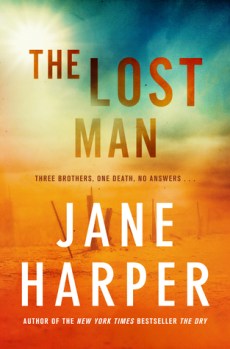 The characters, three brothers, run livestock on land that, while adjacent to each other’s holdings, is hours apart in travel time, from each other and from “town.” Nathan Bright, the eldest and the protagonist, works alone and lives alone on his land (a backhanded gift from his former father-in-law), a scandal in his past making him a pariah with everyone but his family, and uncomfortable even with them. Divorced and bitterly intent on prying some form of joint custody of his son, Xander, from his ex-wife, Nathan is inturned and enigmatic. Cameron, the middle son, a “hail fellow well met” type, and “Bub,” the youngest brother, a bit lost in the shuffle and wishing for other options, live and work together on their father’s former holdings, with Cameron’s wife and two children, the boys’ widowed mother, and various stockmen and itinerant workers.
At the beginning of the story, there is a small gathering at the stockman’s grave, a landmark headstone out in the middle of nowhere, so old that no one remembers who is buried there. Various legends remain about this eerie place, and it’s about to acquire one more: Cameron’s body has just been discovered in the slight shade cast by the stone.
Questions abound: How did he get there? Something had been troubling him—did he choose to meet his death by this unpleasant method? This is the premise of local law enforcement, and also of most of those who knew him…because if he didn’t, then the incredible isolation in which these people live leaves room for only a few suspects. The questions begin to prey on Nathan’s mind….
The mood and the tone of this book fascinated me. The characters remain enigmas for much of the story, their demeanors an exercise in taciturnity. Even the children are opaque. Likewise, the stark factors of living in the outback—reminding yourself to drink 10 times a day, attending the School of the Air via radio because the closest “local” school is 20 hours away in Brisbane, never leaving the property without noting down your destination and the expected time of return so a search party can be sent out if you miss your mark…all speak to a daily tension already so high that adding any sort of drama to it could spark a wildfire.
If you enjoy inhabiting an environment nothing like your own and learning what kinds of people are challenged by it to make a life there, this book will pull you in. If you are fascinated by the interplay of emotions between characters who have known each other forever and yet now doubt they know anything at all, this book will keep you guessing. Slow pacing and immaculate plotting give you questions and doubts just as the characters arrive at those same thoughts. It’s an emotionally charged but quietly told story that is probably my favorite read of 2019.
READERS’ ADVISORY NOTES: I’m trying to dredge up from my subconscious some other books that might share the appeals of this one. Perhaps The Road, by Cormac McCarthy, although it is such a stylized kind of work compared to this…. The River, by Peter Heller, has certain similarities. Maybe The Round House, by Louise Erdrich? or Bluebird Bluebird, by Attica Locke? The Lost Man gives me sort of the same feeling as reading “King Lear,” with the twisted family dynamics, the ugly lies and truths, the suspicions and doubts and manipulations.
One good turn
Can you be simultaneously enthralled with and utterly bewildered by the same book, the same author? If you read Kate Atkinson’s Jackson Brodie books, the answer is yes.
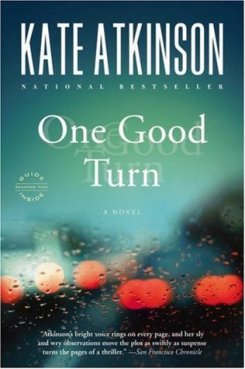 I reviewed Case Histories, her first book starring Brodie, a month or so back, and noted at the time that while I felt like Brodie was a great anchor for the three disparate cold cases being explored in that book, the mysteries were composed of equal parts frustration and intrigue. Little did I know the foreshadowing in which I was participating when I assayed to read the second Brodie book, One Good Turn.
In this book, Jackson is even less involved, in some ways, than in the last; he isn’t hired by anyone to do anything until more than two-thirds of the way through. For most of it, he is a hapless bystander forced into participation by circumstance, as are the other four (six? it’s hard to say) significant characters. You almost couldn’t call this “his” story, except peripherally.
The setting is the Edinburgh Festival (Fringe?), and Jackson is there to support his girlfriend, Julia, an actress appearing in an existential play in a grotty venue on an unappealing street at the heart of the city. He is not entirely comfortable in this mostly passive tag-along role, and in fact has been uncomfortable in general for some time—ever since he inherited big money from one of his clients and retired from his private detective gig to buy a villa in France. He feels at loose ends wherever he is, although being with Julia at least puts him in a committed relationship. He still reacts like a policeman, and is hard pressed not to act like one when the opportunity arises, as it eventually does in this book.
First, though, we meet the other significant protagonists in this crazy casserole of a story, who are on parallel tracks that converge at unexpected intersections as the book unfolds. There is Martin, a meek and reclusive writer of cosy mystery novels, who uncharacteristically intervenes in a road rage incident and is caught up in undesirable relationships with victims, perpetrators, and bystanders as a result; there is Gloria, whose dicey husband is in a coma after a night with a Russian prostitute; and there is Louise, a Scottish police detective, who is present on the scene of most of the significant events of the story. As they and Jackson each attempt to do the right thing, the “one good turn” for another person, the casualties mount up and the circumstances become ever more ridiculous. Instead of “one good turn deserves another,” it’s “one good turn deserves a murder.”

I guess you could say there is a larger mystery that encompasses all the smaller, bewildering coincidences that occur in the course of this tale; but the mystery isn’t really the point. The development of characters is the point, and the action is reliant on the personality quirks of each individual who enters the story to leave footprints, large or small. I would venture to say that Atkinson is evolving a formula, but it’s definitely not one that would be recognizable to mystery readers who are looking for logical plots, clear indicators of right and wrong, and a satisfying conclusion (although there is a final twist in this one that is definitely gratifying).
Atkinson does have a bad habit of introducing her characters and then going off on rambling revelations about their back story while the reader is hung up in the dramatic moment left in freeze-frame until she is done. But the jerky, start-and-stop momentum of this book seemed congruent with the atmosphere of a city overwhelmed by distracted holiday-makers, and we do eventually get to the point (or points).
There was less of Jackson in this one than I would have liked, and also less of Louise the police detective, who is obviously meant to be a love interest at some point (and if she’s not, I’m going to be unhappy with Kate). But the writing is a joy, and I will continue on with the Brodie saga, out of sheer curiosity about what choices he will make next.
B & B #2
I was delighted, upon browsing the seven-day checkouts in the Los Angeles Public Library
e-book catalog, to discover that there is already a new book out from Michael Connelly. That guy is prolific! It’s another that combines the efforts of long-time detective Harry Bosch with relative newcomer to the LAPD late shift Renée Ballard—Bosch #22, Ballard #3, and Connelly #33.
I was cautious about my feelings for Renée in The Late Show, the first book in which she appeared; after Connelly introduced Lucia Soto as a young partner for Harry a few books back, I was certain that she would be the next direction in which Connelly’s franchise would go, so I didn’t want to invest too much in yet another new character before knowing that person was around for the duration. But it’s looking like Ballard is the eventual successor to the world of Bosch, although that ascension is hopefully still at least a few more books in our future.
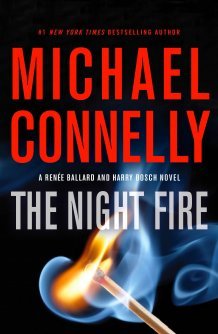 As I said in my review of Connelly’s previous book, Dark, Sacred Night, Connelly solidified Ballard in that book and began to build a bridge between the old veteran and the young fanatic. In The Night Fire, the two detectives train their shared gleam in the eye on another compelling cold case. John Jack Thompson, the mentor who bequeathed to Harry his motto “Everybody matters or nobody matters” back when Harry was just a rookie, instructed his wife, upon his demise, to seek out Bosch and hand over a 20-year-old murder book of an unsolved case. Now John Jack has passed, and the murder book has been passed down to Harry. It’s a puzzle, though, what the retired detective’s motives were in sequestering this case, since it doesn’t appear that he attempted to solve it. The murder book detailing the shooting of a young addict in a dark alley has been sitting stagnant in Thompson’s study for all this time. Enter Harry, who figures let’s get on it already and see what shakes out.
Harry is, however, fresh out of the hospital following knee surgery, and is hobbling around with a cane. Furthermore, he is all but suspended as a temp detective for the San Fernando Police Department due to shenanigans in his last outing with them, so he doesn’t have much pull or credibility left in any police venue. Ballard, however, is enough of a maverick to help him out, and is also a workaholic, restless soul just like Bosch, so she is ideal to pull in as the official part of this pairing.
In addition to sharing this case, Ballard has, as an active detective, cases of her own to pursue. And Harry has been tagged, mostly against his will as usual, to help his half-brother, defense attorney Mickey Haller, with a case in which Haller is convinced his client didn’t do the deed (as opposed to just arguing that, which is what he usually does). Getting his client off is the height of Haller’s expectations, but Harry can’t let it go at that; if Haller’s guy didn’t do it, somebody did, and Bosch wants to know who and put him or her in the crosshairs. So each of the detectives is busy on a couple of fronts, keeping things varied and exciting throughout.
This “partnership” is beginning to work smoothly in this volume, with both Bosch and Ballard coming to appreciate, understand, rely on, and enjoy the other’s working style. The moments when they meet up for a coffee, or a late lunch at Musso and Frank, and eagerly present their accomplishments, theories, and next steps to one another are among the best in the book, as you see these two intuitive and intelligent minds come together to combine their power. It’s like that feeling you get when you’re working on a school or business project with someone and they say just the right thing to spark your thoughts in a new and exciting direction. There are definitely sparks flying here. The Night Fire is a solid, entertaining, and forward-looking chapter in the Bosch iconography.

Titus Welliver as Bosch
Michael Connelly recently revealed in a speaking engagement for the L.A. Times Book Club that Harry (and Renée) will be taking a holiday this year. In his next novel he intends to revive the character of Jack McAvoy,
a reporter who appeared in two of his previous books, as a way to present the positive side of journalism in the current “fake news” climate; and the book after that will feature “Lincoln Lawyer” Mickey Haller. Hopefully this hiatus won’t spell the end of Bosch. At least we have the sixth season of television Bosch to which we can look forward.
Cold cases
I was a little wary when starting to read Case Histories, by Kate Atkinson, because I read her book Life after Life and, while I admired it, didn’t enjoy it much. But I think, in Jackson Brodie, she has found an anchor around which she can wrap the chain of her storytelling to keep it stable.
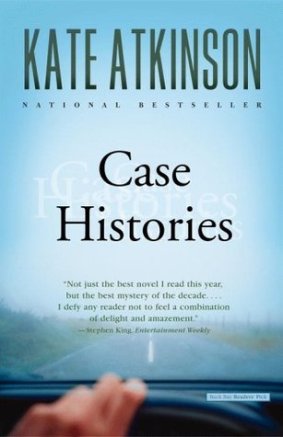 I will admit that it took me a while to get into this book and to understand what was going on; Brodie is a private investigator who has been invited for various reasons by family members or interested parties to look at three cold cases, the latest one already 10 years past, the oldest more than 30. Because Atkinson presents the case histories one at a time at the beginning of the book before ever mentioning Brodie’s name, profession, or involvement, the book initially seems disconnected by its three narratives, save for the fact that some crime has been committed in each. But having the case histories narrated by the people involved, rather than exclusively through the eyes of Brodie, makes the stories that much more powerful, and also allows us to encounter them as if we were standing in Brodie’s shadow, listening in and trying to make connections in the same moment he is.
I liked Jackson Brodie’s character, and the slow reveal of what his life is like and what kind of person he is. I also enjoyed the many and varied characters who took the lead in each of the histories, although I did have to scroll backwards on my Kindle a couple of times to remind myself of exactly who they were or how they were involved. Each of the mysteries consisted of equal parts frustration and intrigue, just enough so to keep me reading. But I don’t mind some complexity in a plot, if it serves the plot, which this absolutely did.
I have placed a hold on the next Jackson Brodie book at the library.
READERS’ ADVISORY NOTES: I think this book (and perhaps the rest, we shall see) would appeal to readers of such mystery icons as Ruth Rendell, Barbara Vine, and Patricia Highsmith. Perhaps also Tana French? Those writers produce dark, devious, complex mysteries in sophisticated language, and Atkinson nearly rivals them. And if you are a reader who enjoys Atkinson’s books but haven’t ventured back into the annals of these other writers, by all means do so!
Books for Hallowe’en
I went looking for scary reads to feature here, but although I found some things I liked, I struck out when it came to true horror. My selections turned out to be more suitable for the original pagan festival of Samhain, which marks the end of the growing season and honors the dead.
First, because I was in the mood to read something I already knew I liked, I did a re-read of Charlaine Harris’s four-book series about Harper Connelly. Harper has a strange gift, bestowed upon her when she was struck by lightning and lived: She can find dead people, and she can tell you how they died. Traveling with her step-brother Tolliver as her manager, she roves around the country giving the living (and the dead) closure, and getting paid for it. The problem is, although she can see the circumstances surrounding their death, the murderer, if such there be, is never included in the vision.
I don’t know what it is about this series that sets it apart for me, but I enjoy it more than any of Harris’s other series (which I also like). The combination of what Harper Connelly does and how she does it, combined with the poignant story of her hard life and the partnership with her “brother,” Tolliver, just pulls me in.


I hesitated on where to “store” this series on my “shelves” on Goodreads, however, because despite the fact that it contains paranormal activity and is occasionally pretty spooky, the books read more like mystery stories than anything else; once Harper discovers the cause of death, the next natural step is for the relatives and friends of the deceased (and the police) to want to know how, why, and who, if murder is the answer. So I put the series under paranormal AND mystery, and then decided against horror, even though there is some creep factor. Definitely worth a read, however. The four books are Grave Sight, Grave Surprise, An Ice Cold Grave, and Grave Secret.


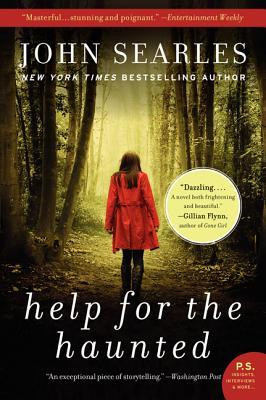
The next thing I picked up to connect with Hallowe’en was John Searles’s book, Help for the Haunted. The premise for this one sounded intriguing, and at first I thought it would be a good, spooky tale. The set-up of a couple who “helps” haunted souls was interesting, particularly because the author doesn’t go into much initial detail about exactly how they help, so I was left wanting more. The back-and-forth of the story from before to after the couple’s death, all told from the viewpoint of their youngest daughter, Sylvie, was puzzling, and the device of an unreliable narrator (because she was young and naive) and an unreliable secondary character (Sylvie’s volatile sister Rose, whose actions and viewpoints couldn’t be trusted) kept things suspended in “what if?” for quite a while.
 When I first started reading it,
I got a feeling not unlike reading We Have Always Lived in the Castle, by Shirley Jackson. Not to say that this anywhere equals the brilliance of that book, but just that you find yourself inside this family with people who seem normal but aren’t, and people who seem crazy but aren’t, and you keep reading because you want to find out what’s true.
Ultimately, this author left important revelations for way too long, spinning out the story with a few seemingly supernatural events here and there to string the reader along, but ultimately I became bored with all the back-and-forth that led nowhere. Once Sylvie determined that she would figure out who killed her parents, no matter what, and sought out such pivotal characters as her uncle, the man who wrote a not-entirely-flattering biography of her parents, and the man she initially suspected of their murder, things finally began to pick up again…only to mean virtually nothing in the face of a completely implausible, albeit surprising, ending.
This book could have been so much more—the characters of Sylvie and Abigail were particularly intriguing, and there were so many ways the author could have chosen to taken it…but he didn’t. I can’t say I liked it, but I can’t condemn it as wholly bad either. A good effort that ultimately disappointed. And I couldn’t even shelve it in “horror.” More gothic and paranormal than anything, with a small modicum of suspense.
 My final choice was Diane Setterfield’s book, Bellman & Black. This book has been on my “to read” list for awhile; I had previously read and greatly enjoyed The Thirteenth Tale by this author, and knew that even if this wasn’t the ultimate in horror, it would at least be intelligent, well written and well plotted. The jacket copy telling us “rooks never forget” sounded ominously Edgar Allan Poe-ish…
I am loving this book…but you couldn’t account it as horror by any stretch (at least not so far), although parts are foreboding, haunting, and mysterious. It has the same old-fashioned fairy-tale-retelling feel as a strange and fanciful book by Tom McNeal called Far, Far Away that I read a few years back with my high school book club.
Because I took so many days to read Help for the Haunted, I wasn’t able to finish Bellman & Black in time to review it for today’s post, so that will wait for a day or two—I still have about half the book to go.
But I feel pretty confident that Setterfield will not disappoint, and that it’s sufficiently ghost-filled to make for satisfying reading on All Hallows Eve.
In the spirit of the holiday and the theme of Bellman & Black, here are a pair of rooks, styled after Odin’s corvids Huginn and Muninn. Happy Hallowe’en, and Blessed Samhain to you!

The Man
Twice in two weeks I was able to read the latest in a mystery series I have followed from the beginning. What a treat!
Robert Crais has been writing the saga of Hawaiian shirt-wearing Private Investigator Elvis Cole and his sidekick, the inimitable Joe Pike of granite mien and special (forces) skills, for 18 books now, occasionally interspersing them with a stand-alone thriller here and there. Although I have mostly preferred the stand-alones to the series, I never miss any of Crais’s books, because he tells a good story and because I like that they are set in Los Angeles.
 There’s no denying that this series, like any other long-running one based on the same people in the same city, has had its ups and downs. There have been books I couldn’t put down for 48 hours straight, and others I could barely make it through. I liked A Dangerous Man for the very reason that a few other people cited for disliking it—it was straightforward. There have been a few of these that got so complex and brought in so many extraneous people and details that it spoiled the lead, which for me is always the partnership between Elvis Cole and Joe Pike, and how they have developed such synchronicity.
The initial encounter in this one was, as I said, simple—nobody calling the office with a long and complex tale to be sorted. Joe Pike goes to the bank, and Isabelle (Izzy) Roland is the teller who waits on him. Her boss asks her to take an early lunch, so she leaves the bank only minutes after Joe, who is still on the street by his car. A couple of guys in an SUV pull over next to her on the curb; one gets out and engages her in conversation, and before she knows it, she’s being forced into the car and abducted. Joe spots the look of panic on her face, and does what Joe does—he follows, he outwits, and he rescues, wreaking a little havoc on the kidnappers in the process and then turning them over to the police.
From this point on, it does grow a little more complicated, because the power behind the kidnappers redoubles efforts to get hold of Isabelle. When she calls Joe in a panic because SUVs have been trolling her street and then disappears, Joe appoints himself her bodyguard and avenging angel, but at this point also decides it’s time to pull in both John Chen (medical examiner) to run some fingerprints, and friend Elvis to use his P.I. contacts and figure out why these people are so determined to get control of a 22-year-old bank teller with an old car, a falling-down house, and no apparent reason to be of interest to anyone in particular.
It’s a believable story, well told, and holds your interest start to finish. The question I was left with was, is “the dangerous man” of the title the person who is relentless in his pursuit of Izzy? or is it Pike himself? In a showdown, I know who I would pick.
READERS’ ADVISORY NOTES: This is a series you could suggest to a mystery lover who is a fan of Michael Connelly, the other guy who writes a series (Bosch) based in Los Angeles. Although Harry Bosch is a policeman and Elvis and Joe are private/independent, they share the characteristics of being mavericks who take direction from no one and who are relentlessly determined in pursuing their objectives. Because of the locale, the scene-setting is quite similar, and I have always wished the two authors would get their characters (neighbors in the Hollywood Hills) to meet up and collaborate! Also, either series might appeal to people who like noir fiction, as all of these detectives tend to be involved with the darker elements of their trade, and sometimes the books feel like an offshoot of 1940s Hollywood, a lá Walter Mosley or Duane Swierczynski.
A feast
The mail brought me a delightful surprise this past week: Deborah Crombie’s latest in her Kincaid/Duncan mystery series. (I had forgotten that I had excitedly pre-ordered it a few months back.) It’s one of the British police procedural series that I follow religiously, but patience is required for this one, because Crombie is not a speedy writer. This is #18 in the series, and #17 was published in February of 2017, so it’s been a long 31 months in between.
 In A Bitter Feast, Scotland Yard Detective Superintendent Duncan Kincaid and his wife, Detective Inspector Gemma James, have been invited for a relaxing weekend in the Cotswolds countryside at Beck House, as guests of the family of Melody Talbot, Gemma’s detective sergeant. The Talbots are wealthy and somewhat notorious as the publishers of one of Britain’s major newspapers, and except for Duncan and Gemma and her friend Doug, Melody has been completely silent about the family connection so as not to influence her co-workers (for good or ill) due to her prominent family connections.
The weekend for which they have been invited is to feature a charity luncheon hosted at the Talbots’ home and catered by chef Viv Holland, whose current position as co-owner of a local pub doesn’t reflect her illustrious background as a Michelin chef. Lady Addie Talbot, always mindful of her own influence and desirous of helping her friends and protégés, sees this luncheon as an opportunity to increase the usually self-effacing Viv’s fame, and accordingly invites national food bloggers and restaurant critics; but this action sets some unexpected events into motion that will scar the day with tragedy and provoke additional crimes to cover someone’s tracks.
This was a somewhat subdued book in the series. That’s not to say it wasn’t thoroughly enjoyable, but it was a bit different in that Duncan and Gemma weren’t the principal cops on the case. You just knew, when the book opened with the prospect of an idyllic country weekend away for the entire Kincaid/James clan, that it was too good to be true, and sure enough a car accident puts Kincaid out of the picture before he can even arrive at the Talbot estate. When the investigation of the two people in the car that hit him turns up a finding of suspicious death, Gemma and Duncan both become involved in the solution of this and another, later crime; but because it’s not their turf, the lead is taken by a local inspector, and they are demoted to the role of helpers. Additionally, because of Duncan’s injuries he’s not his usual competent and capable self, distinctly shaken by the accident and its aftermath.
The mystery is a good one; I enjoyed the past-and-present details of the life of Chef Viv Holland, including all the delectable descriptions of the food she was producing, the cast of characters inhabiting her restaurants (Ibby, Jack, Antonia, Bea, and the charismatic but volatile Irishman, Fergus O’Reilly), and the complications of her personal life. Likewise, the disclosures about Melody Talbot’s parents, Ivan and Lady Addie, the picturing of their beautiful home with its Gertrude Jekyll-inspired gardens, and the sleepy autumnal setting of the golden Cotswolds is compelling and lends additional charm.
One thing that put me off a little: The book became particularly busy, with too much back-and-forth trading off of cars, duties, and childcare, because of the presence of the entire family. Although son Kit plays a somewhat pivotal role in this book, the constant need for Gemma or Duncan to find someone to watch Toby and Charlotte so they could go off and solve crimes added a lot of unnecessary detail, as did all the descriptions of places and activities pursued specifically to entertain the children, from zoos to ice creams to croquet. The story might have been less cluttered if the kids had all gone to the grandparents for the weekend, leaving Gemma and Duncan to enjoy their holiday unfettered and (later) to pursue their sleuthing. Of course, life is messy and cluttered and busy, so perhaps I am just reacting from the perspective of a single person without too much patience for this kind of thing!
Although this is not my favorite of Crombie’s series, it certainly stands up as a worthy participant, and is well worth the time. I just wish she were a faster writer; it’s a long time between books, and I miss Duncan and Gemma while they’re gone!

Upper Slaughter, The Cotswolds
READERS’ ADVISORY NOTES: This is a great series for dedicated mystery readers whose preference is for detectives with whom they can become familiar and develop continuity and relationship. Both the personal and professional lives of these two are intriguing, and even more so for being lived together. Crombie’s usual habit (not seen in this one) of alternating the lead in each book between Kincaid and James keeps the series fresh. The mysteries are usually satisfyingly complex and mystifying, and maintain attention throughout. And for those whose preference is specifically the British mystery, you can’t beat Crombie, her surprising nationality as a Texan notwithstanding.
 The Book Adept