Binchy lite?
Several people on the Friends and Fiction page on Facebook have noted, “I love Maeve Binchy, who else can I read who writes like she does?” Most have answered “Rosamunde Pilcher,” but that’s a fairly limited list of books, and then what? Several others mentioned a writer I’d never heard of, also Irish, named Patricia Scanlan, so I decided to check her out (yes, that’s a pun).

The first book I had sent to my Kindle was Francesca’s Party, written in 2020. It’s a classic scenario without the expected resolution: Loving wife (and housewife) of 20 years discovers her husband is cheating on her with a younger “career woman” from his office and goes to pieces. But before we get the scenes of weeping in the bathtub and eating tubs of ice cream, Francesca follows hubby Mark and new squeeze Nikki to the airport, gets their destination, and figures out where they will be staying. She then goes home, packs up a couple of suitcases of his clothes, flies there herself, and knocks on their door to dump the bags at his feet and tell the mistress he’s her problem now. And then she goes home and changes the locks.
So far, so good. But then we get a long slow narrative of rage, bitterness, humiliation, and hibernation on the part of Francesca, interspersed with commentary from the cheating spouse and triumphant girlfriend, and this portion of the book shows how dated the story has become. Somehow Binchy’s books manage to keep their sense of timelessness (for the most part), but this one of Scanlan’s goes in a bit too much for the clichés, and lets you know it’s definitely a product of its time. Scanlan’s writing is also not up to the standard of Binchy or Pilcher; it’s not bad, but it’s nothing out of the ordinary.
Francesca’s Party is, nonetheless, a successful story with a refreshing resolution that one wouldn’t necessarily expect, given the subject matter and the timestamp, and I might try another sometime. I would call it true chick lit; but hey, sometimes that’s what you want, right?
What I wished for
The Unmaking of June Farrow, by Adrienne Young, is the book I have been wishing to read. It’s both an elegantly written and a beautifully told story that incorporates a curse, a murder, something sort of like time travel but not exactly, and an emotionally complex web of relationships that are a pleasure to try to untangle. If I had to label it, I guess I would call it magical realism.

June Farrow was born into a family in which the women are believed to be cursed, and June intends to be the last member of this family in order to break that curse, resolving never to marry nor have children.
At some point in each of their lives, the Farrow women are overcome by madness—seeing, hearing, and experiencing things that aren’t there as their minds slowly unravel. June’s own mother, Susanna, became increasingly troubled, finally abandoning the infant June to be raised by her grandmother, then disappearing, never to be seen again. In the past year, June, 34, has begun to experience the warning signs that she, too, is beginning to lose touch with reality. She’s hearing phantom wind chimes, seeing a man’s silhouette looming and smelling cigarette smoke on the breeze from the open window, but there’s no one there. And then there is the red door that appears, standing in the middle of a field of tobacco or at the side of the road outside of Jasper, North Carolina, as if waiting for her to walk up, turn the knob, and step across the threshold. This is the story of what happens when she yields to that impulse.
I don’t want to tell much more than this, because you should be allowed, as I was, to unwrap this tale for yourself. I think it will be enough to say that it is immersive, atmospheric, romantic, and mysterious, and I thoroughly enjoyed it from beginning to unexpected end.

Witchy women

I just finished the book Weyward, by Emilia Hart. It’s one of those books that seduced me both with its cover (a crow and a bunch of beautiful botanical illustrations) and the first third of its description, which sounds like a gothic novel written by Victoria Holt or Mary Stuart. You know the plot—a young woman inherits a cottage in the country from an aunt she hasn’t seen since she was six years old, and retreats there to escape from danger, only to encounter more mysteries from her past, and ultimately comes into her own by recognizing how she fits into her family’s history.
I would have been happier, I think, had the plot just stuck to that, with some flashback through the lens of the character Kate. Instead, what this book does is present parallel stories of three young women from the same family/bloodline who lived in the cottage at widely disparate times, from 1619 to 2019, and it didn’t quite work for me. I felt constantly dissatisfied by the amount of information we would get about one of the three before jumping to one of the others; although I liked the characters, I felt like each of them was given short shrift because there wasn’t enough space to tell their stories as completely as might have been done. I also wasn’t sure I needed to read three such desperate accounts of physical, sexual, and emotional abuse!
The book is touted as empowering, but although each of the women—Altha, Violet, and Kate—triumphs over tragedy in the end, the fact that it is with the help of some witchy magical realism makes it harder to focus on their progress. And honestly, the story is quite polarizing, in that all the men are uniformly horrid (except for Kate’s father, who’s dead), and all the women are victims hyper-focused on childbirth and legacy, who manage to rise above with assistance from their connection with nature. I can’t decide if the book was too long or not long enough, because I felt periodically bored while reading it, but also wanted more details on some aspects!
Bottom line, I didn’t hate it but wish I’d spent my time reading something less depressing, for which I had more affinity. If you want a good witchy/magical book, read The Once and Future Witches, by Alix Harrow, instead, or try any one of half a dozen of Alice Hoffman‘s.
Kudos to the cover artist, though.
Unhappy fans
I miraculously got a checkout from my library for Emily Henry‘s latest, Happy Place, in about a third of the time I expected to wait. Then I read the reviews on Goodreads, which may furnish some explanation. Don’t get me wrong, every second or third review awarded five stars, but there were also those critical reviews between them for three, or even two or one star, a phenomenon I believe has not previously been experienced by this popular author.
The story involves six friends, five of whom bonded in college and have remained uncommonly close, and one extra who was pulled into the group when she became part of a couple with one member. In fact, four of the original five have coupled up with one of the others, and this is the source of the current problem.
Their “leader,” Sabrina (I call her that because she’s the impetus behind keeping them all together), comes from wealth, and a tradition the group has had for their entire friendship has been to spend a summer week together at her father’s Maine “cottage.” But her dad’s most recent spouse doesn’t want to maintain the association of the cottage to his first wife and insists that he sell it, so this is the friend-group’s last gasp at a holiday together there, fraught with all of the traditions they have created over the years.
Sabrina and Parth have made the week into even more of an event by surprising their friends with their engagement, with a wedding planned for the end of the week on Saturday before they all pack up to leave the cottage forever on Sunday. Given this special occasion, none of the friends feels like they can refuse the invitation, let alone spoil it with bad news, so this makes it difficult for Harriet and Wyndham, who broke up four months ago but haven’t told anyone. Their plan was for Wyn to bow out of the week with some excuse while Harriet broke the news to the rest of them, but instead they are both on premises with nothing revealed, and have been awarded the best room together, a double en suite featuring a bathroom with no door. Awkward. And painful, and sensitive, and embarrassing and almost impossible to endure. But Harriet and Wyn don’t want to spoil the week for the others, and they do want to be at the wedding, so they are gritting their teeth and playing a part in public while taking turns sleeping on the floor in private. The third couple, Cleo and Kimmy, have secrets of their own, and there is building resentment between Cleo and Sabrina to cap off the basic tension in the air.
Harriet is a surgical resident in a prestigious program in San Francisco, and Wyn was living with her before going home to Montana to deal with family issues and never coming back. The two had been together for eight years, and happy for the first six, but once they relocated to San Francisco everything seemed to go wrong for them, as individuals and as a couple. But Harriet never dreamed the result would be a few devastating sentences on the phone that severed their connection permanently.
I personally enjoyed the book, both because I am apparently a hopeless romantic at heart and because I relished the vicarious experience of having a solid group of friends on whom I felt like I could depend forever. Who doesn’t want people in their lives who know you, are there for you, and will reliably show up for your highs and your lows? It threw me back to seeing the movie The Big Chill in 1983 and wondering, 10 years after high school graduation and five years after college, who of my friends I would still know 10, 15, or 20 years later (answer: one). So I liked being immersed in the group dynamic.
I also found Harriet’s and Wyn’s descriptions and chemistry with one another compelling, and cringed at what they had to go through as they maintained a façade for their friends. And I coveted everything about that vacay in Maine, from the weather to the food to the Lobster Festival to the opulent yet cozy cottage. Basically, I plopped myself down in the middle of the plot and went with it.
Others, however, were not pleased. One pointed out that “miscommunication” was the worst trope ever, and when I reflected on it, I had to agree; I realized that I myself didn’t identify that as a problem because I, like Harriet, tend to hang back, keep my mouth shut, and wait for someone else to make the important moves, so it seemed familiar and therefore not bad. But it was! They were both thinking one thing in their heads and allowing different information to come out of their mouths; they were both pretending to be happy while being oh so sad; they were lying a lot; and if, after eight years together, neither of them could bring themselves, through embarrassment or shame or fear, to fight for the other person or for the relationship, they probably deserved to be unhappy. Another reader actually said “The pacing of this book, the alternating timelines, the character development, the relationships were all beautifully and expertly written,” and then gave it three stars because of that trope. Finally, one of the one-star awarders said “Fake, awkward, contrived, and so, so dull. I simply cannot read another novel held together by the characters’ absolute refusal to communicate.” So there’s that…
Someone else said they felt the side characters had no personality, that they had been crafted as one-note cardboard characters whose most prominent feature was anxiety, and then left to function on their own. Another called them “unlikeable and underdeveloped…I just didn’t feel like I could root for them as I have others of Emily Henry’s characters.” I certainly didn’t feel this way about the characters during the flashback portions of the book, but in the present-day renderings I could kind of see it.
Finally, a surprising number of people found fault with the sex scenes, which I personally thought were both convincing and, well, sultry!
My conclusion is that with this story you will either identify with some/one of the characters and go with the flow, or you will get caught up in the frustration presented by the miscommunication trope and dislike it. I imagine that my review and thoughts will have absolutely no affect on those who are die-hard fans, while others may broach the book out of curiosity, taking a 50-50 chance on their reaction. Feel free to comment below on which person you ended up being!
Life
Every once in a while I want a break from the drama of a murder mystery, a thriller, a fantasy of some kind. I want to read about and immerse myself in the personal and intimate details of one particular life, to match my emotions to the character’s and perhaps compare how we deal with the daily events that are, on the surface, mundane, and yet affect each of us dramatically when experienced. I suppose there are a lot of authors who write that kind of story, but I find there are few who keep things strictly to the believable without unnecessary embroidery, and without feeling the need to ameliorate discomfort. One of those, in his own small way, is Robin Pilcher, the author son of Rosamunde Pilcher, whose books I have mentioned here.
He sets his books in venues similar to those of his mother, having grown up, of course, in the same environment as she, in England and Scotland, partly in the city and partly in the countryside. He definitely has a formula, which is the triumph over personal adversity, many of his characters picking themselves up from some disaster and starting over, whether emotionally or financially (or both). Again, a familiar theme, but there’s something both sweet and intense about his characters that make his books rise above a simple statement of events to involve the reader more closely than perhaps other authors are able to achieve.
I had read and enjoyed his work before, and when I hit a lull in the parade of new books from favorite authors, I looked at my backlist of “want to read” and, seeing a couple of his titles, decided he was just the thing for me right now. I’m having a bit of a difficult time with my health and find myself wanting something immersive but not overly stimulating, if that makes sense. You could call it comfort reading, but it’s not the type like Jenny Colgan, which is more like wish fulfillment; it’s about real people who work things out, which is encouraging in itself.
The first book I picked up happened to be the first one he wrote, called An Ocean Apart. It’s about a man in pain who can’t quite figure out how to get past it. He’s the father of three children, and his wife, who felt meant to be his life partner from the first time he met her, has died of cancer. The children are coping fairly well, mostly by going back to boarding school and immersing themselves in familiar routines with schoolwork and friends, but David can’t seem to deal with the reality of her absence, and has desperately pursued the hard physical labor of restoring the gardens at his family’s ancestral home where his parents live, as a distraction from his thoughts.
In his despair, he has shunned his place of work, leaving his father and a new employee to fill the gap left in his absence; the family owns a whiskey distillery, and David is meant to be the marketing manager. An emergency of sorts comes up that needs addressing, and the new operations officer persuades David’s father that they should send David to a series of meetings in New York to cope with it, hoping that a change of scenery will work a transformation. Instead, David comes straight up against his memories of Rachel when one of their new client’s administrators asks if his wife will be joining him, and has an emotional breakdown complicated by a bad bout of the flu.
He ends up deciding that he simply cannot go back to Scotland yet to face his regular life, and takes a job as gardener to a family living on Long Island. The interlude provides the respite he needs, until a threatened takeover of the distillery wakes him up to his responsibilities to save the family business for his father, his children, and his community.
This book has just the right balance in its story and was quietly involving from beginning to end. It’s a bit of a slow start, but by the end I couldn’t put it down. So when I was finished, I decided to move on to…
The Long Way Home. I think I liked this book even more, although I didn’t know if I would at the beginning of it. Claire’s father dies when she is young, and her mother remarries to a man named Leo, with two children of his own. Although neither her mother nor she get along with the new steps, they try their best for Leo to create a family, and the three of them, at least, are very happy with one another at Leo’s large estate in the Scottish countryside. Claire also has a best friend, Jonas, who lives at the neighboring farm tied to the property, and the two are inseparable until one day when Jonas rejects her and walks away from the friendship without explanation.
Claire, who has had a crush on Jonas for the last couple of years, is devastated, and goes traveling for her gap year between high school and college to try to forget. She ends up meeting Art, a young chef, in Australia; the two of them migrate to America, and she never goes back to her childhood home until her mother dies and she returns for the funeral and for Leo.
It gradually becomes clear that Leo’s memory isn’t what it once was, and that he will need some significant assistance to continue living at the estate. His two children prove both uninterested and unhelpful, so Claire and Art step up, as does Jonas, who has returned to the neighborhood and bought his father’s farm from Leo, and is high in Leo’s confidence.
Claire and Art have the idea to turn Leo’s house into a conference center—it’s in the middle of golf course territory in Scotland and everyone thinks it’s a wonderful idea—and build him his own adjacent apartment near his beloved greenhouses. But as their plans move forward long distance while they run their restaurant in New York City, they gradually realize that both Jonas and another consortium of buyers are scheming to take over the property, pushing Leo out into a retirement home. Claire is determined this won’t happen, but she and Art first have to figure out what’s going on, and (whether it’s for profit or for revenge) how to make it work for Leo.
I think the thing I enjoyed most about this book was that it didn’t end in what I call a “reconciliation romance.” You know, those stories where the woman returns to the town of her youth, runs meet-cute into the former love of her life, and ultimately abandons everything to fall into his arms. There was a point early in the book where I thought, “Oh no, he’s going to tank Claire’s relationship with Art somehow, so she can finally be with Jonas,” but Pilcher is a better author than that, and actually allowed for the possibility of a story being sufficiently engaging without total wish fulfillment being satisfied! And he did it cleverly and with much entertainment value.
These are not scintillating NYT bestsellers, and since they were mostly set in the 1980s you will have some issues with the technology (especially the prevalence of the fax machine!), but if you are looking for a quiet but satisfying read that will leave you with a happy feeling without going over the top, you might want to try a few books by Robin Pilcher.
Two authors, one story?
In my last post, I wrote about two books by Jenny Colgan, set in a derelict bookstore in Edinburgh. The protagonist’s task is to work in the bookstore and try to help its elderly and somewhat hapless owner get it back in the black. In the course of doing this, she meets two men—one a wealthy, successful author, the other a penniless but quietly charming student—and has to choose between them. Against all odds, she manages to keep the bookstore going long after everyone thinks it will fail.

Just as I finished reading those, a hold from Los Angeles Public Library became available—The Lost and Found Bookshop, by Susan Wiggs. In it, the protagonist inherits her mother’s foundering bookshop in San Francisco. She needs to sell it, to settle the debts and also to provide for her grandfather, whose health is failing, but she can’t because it turns out he is the owner of record, and refuses to sell. So she has to jump in and try to save the store. In the process, she meets two men—one a wealthy, successful author who she persuades to do a book-signing, the other a carpenter/ handyman/musician who she hires to do some repairs around the place—and she has to choose between them. Through a series of happy accidents plus a lot of hard work, she keeps the doors open and makes her grandfather happy.
Leo Tolstoy said, “All great literature is one of two stories: A man goes on a journey, or a stranger comes to town.” A 1919 writing manual penned by Wycliff Aber Hill posited that there are only 37 basic plots in the world. In 2015, Matthew Jockers used a computer analysis of 40,000 novels to conclude that all literature follows only six possible stories. And how many people have repeated the old saw, “There is nothing new under the sun”? Still…when the formula already involves a bookshop in financial trouble and a young female protagonist sent in to save the day for its elderly owner, maybe its author could check other books about bookshops to see if at least some of the rest of the tropes could be tweaked or avoided?
Since The Lost and Found Bookshop‘s publication preceded that of Jenny Colgan’s books by about a year, Jenny is probably the one who should have done the checking; but I have to say that I preferred her books by a considerable margin for a couple of reasons, the first of which was a less-than-satisfying protagonist in this one. Natalie Harper is simply too self-involved and angsty to be as likeable as Carmen, and I found myself getting annoyed with the author about the things she left out that would have made this character more well rounded.
I did like the manner in which she addressed the subject of grief, and I enjoyed the mentions of actual books and authors throughout. Some of the historical back-story was interesting, especially the bits about the San Francisco earthquake. But the other reason I didn’t care for this one was the series of three discoveries based on that history, and how the characters dealt with them; this subplot was too implausible (and convenient).
There were also some nitpicky little omissions that bugged me. One example: One of the love interests notices that Natalie has amazing abs “that you only get from a lot of yoga,” but we never see her take an exercise class, participate in any kind of physical activity or, in fact, even mention something about exercise. Yeah, I know, it’s a small thing, but don’t you find it annoying when authors throw in details and then don’t follow through?
Finally, I hated the way she ended the book. I am a person who doesn’t care for totally open-ended stories; I like a real conclusion. But I also have a pet peeve, which is the use of an epilogue as a tool to tie things up with a bow (or multiple ribbons!) and that’s what Wiggs does here, in a cutesy way (everything is presented via a series of newspaper articles). I reviewed another book on this blog (Things You Save In A Fire, by Katherine Center) and panned it because I loved it until the 20-page epilogue, where the author ruined it for me by ruthlessly and thoroughly tying off every possibility other than the ones she chose.
So—not a bad read, but probably not one I would recommend over some other bookshop stories.
Person, place, thing
I wrapped up my wallow through the writings of familiar authors by reading two books that I really should have saved for six weeks or so but, once discovered, I couldn’t resist them. These were Jenny Colgan’s latest, a two-parter with the same characters and location, The Christmas Bookshop and Midnight at the Christmas Bookshop. Colgan has made a habit out of returning to the scene of a previous novel but setting the action at Christmas (Christmas at the Cupcake Café, Christmas on the Island, Christmas at Rosie Hopkins’ Sweetshop, etc.) but these sequels usually arrive after she has segued to another story or two and then returned. This two-fer is an almost-continuous tale all taking place within about a one-year period bracketed by Christmas seasons, so I was glad that I discovered them both at once and could read straight through from page one of #1 to the last page of #2.
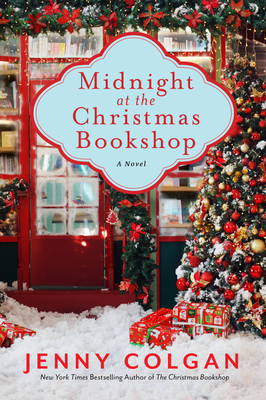
My title for this review takes into account a particular skill of Colgan’s, which is to present us with compelling characters with a specific objective in a spectacular setting that becomes every bit as important to the story as the protagonists. In this case it’s the city of Edinburgh, specifically the Old Town shopping district, so far holding out (for the most part) against the store chains and gimmicky tourist fare to present an authentic experience of one-off original shops, from a hardware store to a chic dress shop to a witch’s herbarium. The focus for Colgan’s bevy of characters is, as frequently happens in her books, a bookshop, in this instance a failing one. Mr. McCredie’s ancestors started the rare book store on the rambling bottom floor of their home, and he has lived and worked there his whole life but, despite his affinity for and encyclopedic knowledge about every sort of book, he’s a terrible salesman, a worse marketer, and is on the verge of forfeiting everything. Enter Carmen Hogan.
Carmen has, in rapid succession, lost her boyfriend, her job, and her apartment, and has been living in a state of denial at her parents’ place, tediously and repetitively grousing about everything and eating way too much junk food. Carmen’s parents are rather desperate to get her out of their house and back on her feet, and enlist Carmen’s sister, Sofia, to help them.
Sofia and Carmen have always been polar opposites: Sofia is the elder type A overachiever, and is now a successful lawyer with a happy marriage, three children (and another on the way), and a beautiful home in Edinburgh, and Mr. McCredie is one of her clients at the law firm. Carmen decided to skip college, and has worked in retail in a large department store since high school until the store closed and made her redundant. Sofia somewhat reluctantly asks Carmen to come live with her family, telling Carmen there is a job for her revamping an Edinburgh rare bookshop; what she doesn’t tell Carmen is that the sole objective is to get the store to turn enough of a profit during the next three months so as to make it an appealing prospect to a buyer, and that as soon as a sale takes place, Carmen will again be out of a job (and presumably a place to live).
While initially reluctant to go live with her sister, Carmen sees that she needs a change, and she loves books, so off she goes to Edinburgh. She is horrified by the magnitude of the job she has taken on: The store is in an advanced state of disrepair and disorganization, and Mr. McCredie is absolutely no use unless someone comes in looking for that one eclectic title about which he happens to know something. But she takes a deep breath and pitches in, and starts to make some headway, particularly when she is able to get a famous writer of self-help books to do a signing at the store. This guy and a student/lecturer at the college are the two love interests in the story, and Carmen goes back and forth between the glamour of the first, with his casual attention and expensive dinners, and the quiet regard of the second, a young Quaker with an intensity she has never experienced.
Carmen and Sofia continue to be mostly at odds, but Carmen discovers an affinity for children, specifically her young nieces and nephew, that she didn’t expect, and bonds particularly with the second daughter, Phoebe, who shares many character similarities with her Auntie Carmen.
There are other fun, although somewhat over the top, characters such as Skylar, Sofia’s yogini nanny, and Jackson, the millionaire who is out to ruin the quaint shopping district by remaking all the stores into purveyors of cheap “tourist tat” sporting too much Scottish tartan, and there are a few improbable story elements that made me say “hmm.” But…
I was truly astounded to see a bunch of two- and three-star ratings of these books on Goodreads, where Colgan normally has solid fours and fives. I thoroughly enjoyed both of them; the magical descriptions of Edinburgh in winter at Christmas made me want to go there despite an almost pathological dislike of cold weather; the children were funny and endearing and memorable; the bookshop’s problems and mysteries were involving; and I liked Carmen as the protagonist and driver of the narrative. I was totally immersed in this two-part story for four days, and was sorry when it ended. I’m hoping, as she occasionally does, that Colgan will go back for a third installment set in this world with these people, because I’d love to know what happens in their next chapters. If you’re looking for something to read to put you in the holiday mood, look no further.

Literature as solace

I’m not sure what to say about Good Night, Mr. Wodehouse, by Faith Sullivan. I was intrigued by the title, since I love what I have read by Wodehouse, notably the Bertie Wooster and Jeeves pairing. This book made me want to seek out his other books to see what I’ve been missing…but it didn’t particularly make me want to seek out others of this author’s. I did enjoy the book, but it’s what I would call a quiet read, almost too quiet for my taste.
It’s an old-fashioned story, told in a rather demure style (I wasn’t sure, initially, that this was a modern novel) about a woman who lives in a small town called Harvester, Minnesota, at the turn of the 20th century. The action begins around 1900 and finishes up when Nell Stillman is in her 80s, so the story encompasses many of the big changes of that century, including technological innovations (indoor plumbing, the telephone, airplanes) and two world wars, but all seen from the vewpoint of a 3rd-grade schoolteacher in a semi-rural, insular setting.
There isn’t much of a story arc; it’s more an accounting of one woman’s life as she moves through both historical and personal events. Hers has its share of tragedy and not a huge amount of joy; she is widowed young, loses her child’s sanity to the after-effects of war, and is plagued by the small-minded gossips and nay-sayers who surround her. But her growing love of all kinds of literature sustains her through many of her trials, particularly the writings of P. G. Wodehouse, with whom she has a personal relationship in her active imagination.
Life could toss your sanity about like a glass ball; books were a cushion. How on earth did non-readers cope when they had nowhere to turn? How lonely such a non-reading world must be.”
Nell Stillman, reader
The story has the feel, although not quite the literary quality, of the books of Kaye Gibbons; I haven’t read those for many years, but Gibbons’ book Charms for the Easy Life kept coming to mind for some reason while I was reading this—another small-town saga of generational and community ties featuring eccentric characters.
There were aspects that I found disappointing: A truly major character in the first half of the book (and my personal favorite) leaves the town in disgrace and the author simply drops her character except for a few sparse references towards the end. Similarly, when Nell is elderly she takes three young girls under her wing; they feature briefly but vividly, and then nothing more is heard about them. These weren’t major flaws, but they did cause my enjoyment of the book to be considerably less than if their arcs had been followed through.
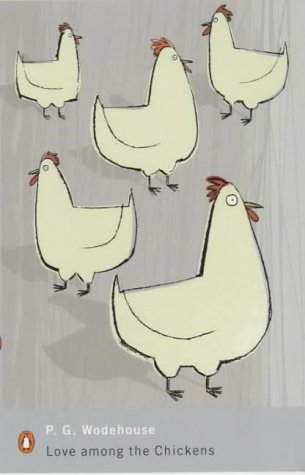
I found Good Night, Mr. Wodehouse to be a pleasant read, but it left me with no desire to find out more about either the main character herself or the town of Harvester, which is apparently featured in others of Ms. Sullivan’s works. I did, however, identify closely with all her sentiments about the blessings being a reader brings to one’s life, so I do plan to find and peruse a copy of Love Among the Chickens!
Travel fiction
A “beach read” is defined as “a book, usually fiction, that one might enjoy during a vacation or a day at the beach because it is engaging, entertaining, and easy to read.” And without doubt a subgenre of the beach read is the vacation saga, the “let’s run away from our lives for a while and see what happens” theme, or what I like to call the sub-subgenre “travel fiction.”
The question you have to answer, with this subgenre, is how much bad writing you are willing to endure in order to have the escapist experience because, let’s face it, books that carry their British or American or Irish protagonists away from their various unfortunate events (break-up, lost job, eviction) and their inhospitable environments (damp, gloomy weather, or a small town where they can’t avoid their ex-whatever) are turned out without a lot of editing by a bunch of publishers on a quest to score the next Emily Henry or Elin Hilderbrand or Jenny Colgan novel.
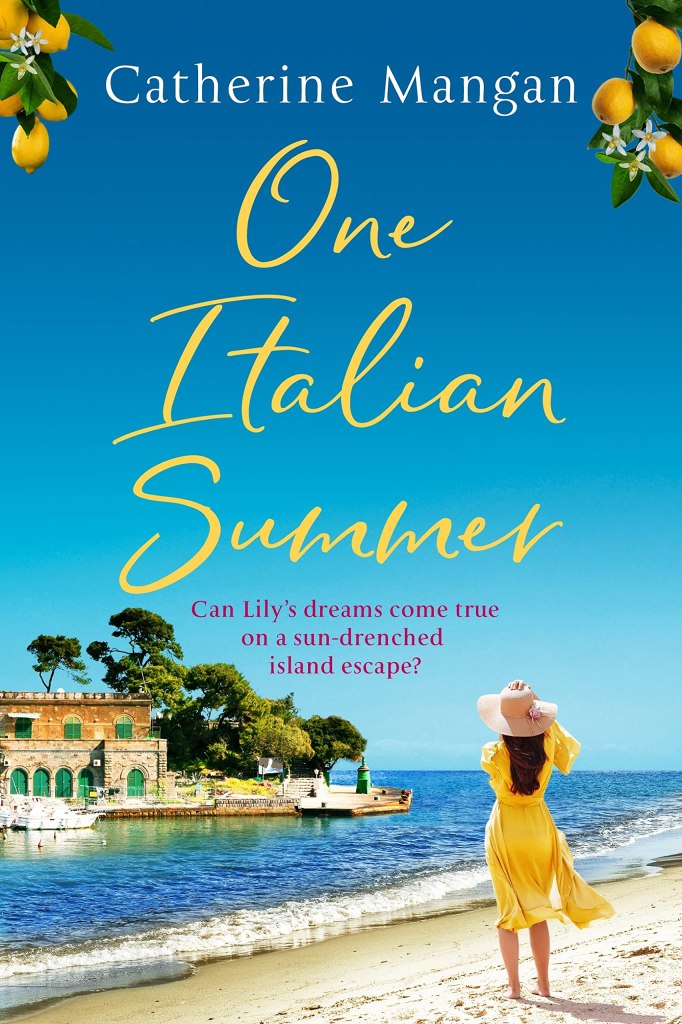
Even with the bad writing contained by those novels not written by the top 10 authors in this field, it’s hard to stay immune to their charms. All of us have a fantasy of what we would do should we decide to abruptly leave our mundane lives behind and simply refuse to come home when our dream vacation is supposed to end.
I recently read two such novels, and have to say that I extended my tolerance for bad writing almost to the breaking point in order to go with the transporting experience of escaping to an unfamiliar and potentially beguiling part of Italy. The two books were One Italian Summer, and The Italian Escape, both by Catherine Mangan, and the constant balancing act was the repetitive language and clichéd sentiments expressed by and about the characters on the one hand, versus the heft of lyrical descriptions of the balmy atmosphere, delectable food, and romantic prospects.
I have never understood why writers make such heavy work of finding original language with which to tell their story—it’s sloppy. I, myself, when writing a book review, an essay, or a paper, simply read each sentence and paragraph aloud to discover if I have used the same word twice (or three times or half a dozen) within the given piece of writing, and then I go back and find another word or another way to express the sentiment, using a thesaurus to good purpose to give my writing the variation necessary to make it feel fresh. Furthermore, if the writer isn’t up to this task, the editor needs must.

I therefore laughed out loud, after reading the painfully repetitive prose of the first chapters of One Italian Summer, when I came to an exchange on pages 70-71. The main character, Lily, having escaped from a break-up in New York City to be maid of honor at a “destination” wedding, is breakfasting alone early on her first day at an Italian resort on the island of Ischia. At a nearby table is an American named Matt, who murmurs “Cranky person. Ten letters.” She asks if he is talking to her, and he replies that he’s two clues away from finishing the New York Times crossword puzzle. She supplies the word “Curmudgeon,” and he expresses doubt that that’s even a real word.
“It’s my job to know words,” she replied matter-of-factly.
“You’re a writer?”
“No, but I write for a living.”
“Okay, is that supposed to be cryptic? How can you write for a living but not be a writer?”
“I’m a copywriter. I write for a living, but it’s just blurb for adverts and products, so I honestly can’t call myself a writer, not in the true sense of the word.”
Then she goes on to provide his final word, which is “capricious.”
“You’re like some sort of crossword Olympic champion!”
“I just need to know a lot of words in my line of work because you can’t keep saying the same thing over and over.”
Lily, p. 71
I laughed because this came after pages of heavy-handed, somewhat pedantic scene-setting narrative and excessive use of the words “so,” “like,” and “really,” not to mention describing someone as a “hot sweaty mess,” then a “shiny mess,” then a “pathetic mess,” in the space of six consecutive paragraphs.
If you can get past such pet peeves, the basic story lines of both of these books are sufficiently escapist to entertain anyone seeking a light read about a fantasy trip; in addition, the location of said trips, slightly off the beaten path of the usual retreats (Ischia rather than Capri; and Liguria, rather than Milan), make for some entertaining speculation about exploring them for yourself someday.
Both books include a little romance for their protagonists, but that is refreshingly not the main theme; rather, it’s the discovery of unexpected depths that lead to life changes. The first book details a week-long itinerary surrounding a lesbian wedding celebration, all of it fraught with way too many drunken evenings described in excruciating detail, while the second is the transformation of a Dublin girl who’s been dating her boss at a business with which she has little affinity who decides, after she’s dumped, that a big change is in order, and refuses to go home when her week in paradise is up. There’s a bit too much interference of a deus ex machina in the form of a wealthy, powerful, and indulgent older woman who takes a liking to protagonist Niamh and smooths her way to a ridiculous degree for a chance-met stranger, but hey, who doesn’t dream of a fairy godmother and wish to immerse themselves in this kind of fantasy?
Bottom line: Not too demanding, pleasantly diverting and, if you’re a foodie, way too provocative!
How it is
Laurie Frankel’s book is called This Is How It Always Is, I believe with the direct message (and hope) that someday it will not be this way. I am happy to say that I picked up this book without knowing anything about it, and therefore got to have the “clean,” straightforward experience of reading it without expectations. If you are contemplating reading it and okay with having its contents be a surprise, perhaps you should stop reading my review right here and go put your energy into the book instead.
If you do have some idea of what it’s about and want more perspective, or a simple reassurance that it will give you a distinctive understanding of the issue, then read on.
A few reviewers on Goodreads called this book sentimental (one even said “cloying”), but I didn’t find it so in the least. I thought it was a lovely, honest, positive depiction of the foibles of one large, eclectic family when confronted with the difficulties of navigating life in our culture.
Rosie and Penn already have a set-up that is not the norm in America: Rosie is an emergency room doctor, while Penn is a stay-at-home father working on a novel and caring for their large family—four boys, when the story opens. After having two in a row followed by twins, Rosie is longing for a girl (and fairly convinced she will finally have one), but Claude comes along and they are happy with their new baby, boy or not. But at an early age, Claude begins the show-and-tell process of becoming someone whose name for the next eight years will be Poppy.
After the initial surprise that when he grows up he wants to be a girl, Rosie and Penn step up for Claude. He is allowed to wear what he wants, play how he wants, and call himself the name with which he feels most comfortable, making an almost seamless transition at home between pronouns and names, from Claude to Poppy, son to daughter. But the transition for his brothers, his school, and the people in their orbit is not so seamless. After several parent-teacher and parent-administration discussions at school, the absurdity of the rules for a transgender child make themselves apparent: Wisconsin schools have accommodations for a trans student, but still somehow manage to insist that the gender binary be enforced. This is best illustrated in quotes from his teacher, Miss Appleton:
“Little boys do not wear dresses.
Little girls wear dresses. If you are a
little boy, you can’t wear a dress. If you are a little girl, you have to use the nurse’s bathroom.
***
“Meaning if he is a girl, he has gender dysphoria, and we will accommodate that. If he just wants to wear a dress, he is being disruptive and must wear
normal clothes.”
Meaning, in other words, that trans students must still check one box or the other, and adopt all the expected characteristics of the “selected” role of “male” or “female,” thus invalidating any character trait that might not conform to our static and polarized cultural gender norms. (Please note that I put the word “selected” in quotes on purpose.) One character comments,
“This is a medical issue, but mostly
it’s a cultural issue. It’s a social issue and an emotional issue and a family dynamic issue and a community issue.
Maybe we need to medically intervene so Poppy doesn’t grow a beard.
Or maybe the world needs to learn to love a person with a beard who goes by ‘she’ and wears a skirt.”
When Wisconsin proves to be hostile in several ways to the child Poppy is becoming, Rosie and Penn decide it’s time to go somewhere their child can find a greater degree of acceptance, and they move the entire family to Seattle, shaking up all their children’s lives in order to accommodate the needs of the youngest. For the eldest, Roo, this means leaving behind all those things that are precious to a high school teenager who has lived his entire life in one place with one group of friends. It has similar, though lesser, effects on the other three boys, who are divided between accepting the necessity of providing safety for Poppy while also believing it won’t make much difference. In this, they are perhaps more realistic than their parents. On the first day in their new house, Rosie and Penn reveal Poppy’s “secret” to their next-door neighbors (intending to be similarly honest with everyone in their new city), but the neighbors encourage them to allow Poppy to be a girl without revealing her past as a boy to anyone. This is how the entire family’s never intentional life of deception begins, and continues until Poppy is on the verge of puberty and the whole thing blows up in their faces.
I won’t say much more about the story, because I have already outlined the first half pretty thoroughly, and would like you to have a reading experience unfettered by expectations for the remainder of the book. I will say that I appreciated the author bringing in the situations of transgender individuals in more fluid societies, which is why I feature this painting at the end. If you read the book, which I hope you will do, you will understand its significance and inclusion.

 The Book Adept