The six pigs
The Cherokee don’t see the Seven Sisters when they look up at the sky and see the Pleiades. And in fact there are not just seven stars in that cluster, there are thousands; but the seven noted by most people are the brightest ones. The Cherokee call them “pigs in heaven,” and only identify six of them. Their legend says the “pigs” are a group of disobedient boys who neglected their chores. When they were rebuked by their mothers, they began to dance and then drifted up into the sky to hang there as a reminder that tribal children need to do right by their people, rather than adopting the American focus on doing right by themselves.
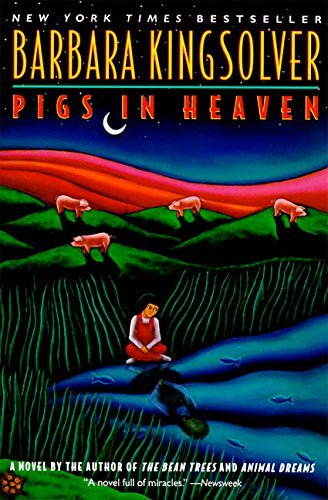
I just finished reading Barbara Kingsolver’s Pigs in Heaven, the sequel to The Bean Trees that I reviewed a couple of weeks back. It’s the continuation of the story of Taylor Greer and her adopted daughter, Turtle, who was dumped in Taylor’s passenger seat by a Cherokee woman on Taylor’s trip through Oklahoma.
When Taylor and Turtle end up on television as a result of an incident at the Hoover Dam, a tribal lawyer named Annawake Fourkiller sees the show, does some research, and discovers there is something fishy about Turtle’s adoption. She is pursuing it because Turtle is an example of a child who has been removed from her roots and her heritage, and Annawake thinks it is in her best interest to be returned to the tribe. Taylor, understandably, doesn’t agree; first, everyone in Turtle’s family failed her and allowed terrible things to happen to her, so Taylor figures they had their chance and blew it; and second, she has been Taylor’s child for more than three years now and to separate them would be irreparably harmful to them both. So she takes Turtle and disappears.
The rest of the book is split between Taylor and Turtle’s life on the run and scenes from the Cherokee Nation in Oklahoma where Taylor’s mother, Alice, has relatives, and where, it turns out, someone is looking for Turtle and asks the Nation for assistance.
There is a message running through this book that is a continuation of that in the first. My interpretation of it is that you can be born into family or you can create one, but in either case, people need connection, a safety net, people who love them. Again, this book written in 1993 resonated for me concerning present-day happenings: The current administration is in the process of invalidating the temporary asylum status of a large number of Haitians and Syrians. I saw a post from one man whose company employs a large number of the Haitians as workers, who commented that they were much the best workers he had ever had. All I could think was, Well, that’s a positive affirmation…but can we not value them simply for who they are rather than what they can do for us?
There were certain aspects of this book that I didn’t particularly enjoy (for instance, the insertion into the story of an odd woman who tags along for a while during Taylor and Turtle’s journey away from Tucson via Las Vegas), but that journey did illustrate the theme, which is that if you don’t have people backing you up, or you feel that you can’t call on them, then your life can become precarious and unworkable in a hurry. The parts I enjoyed the most took place in Oklahoma, when Taylor’s mother, Alice, goes to visit her cousin on the Cherokee Nation to meet with the lawyer and scope things out on behalf of Taylor.
I’m glad I reread this duology, and also glad to report that it remains relevant decades after it was written.
Discover more from The Book Adept
Subscribe to get the latest posts sent to your email.


