A pirate and a serial killer
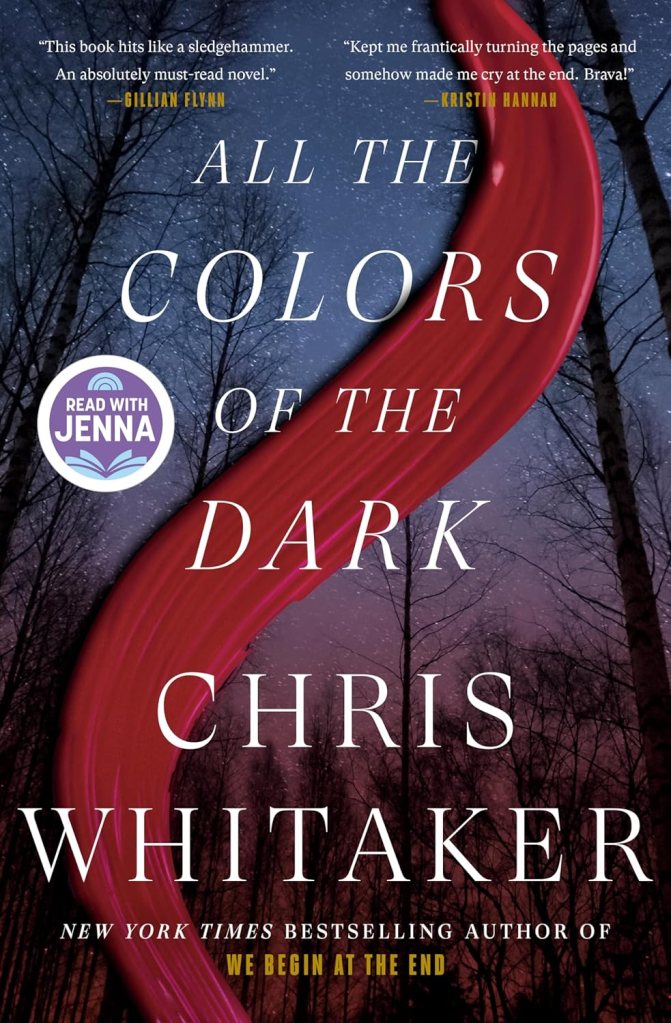
All the Colors of the Dark has been widely touted on all the Facebook readers’ pages I frequent, yet never really explained. The title alone made me curious, so I put it on the holds list at the library and waited a very long time for it.
When I started it, I was immediately filled with a sense of dejá vu; it reminded me forcefully of another dark, complex book I had read a few years back, but I couldn’t remember the name. I looked on Goodreads because I knew I had listed that book in my “coming of age” section, and then laughed; it was by the same author, Chris Whitaker, whose novel We Begin at the End bowled me over when I read it four years back.
I looked up my review of that book, and was not surprised to see that my description would pretty much do for both books:
“It is the saga of multiple people caught up despite themselves in various forms of tragedy they are mostly unable to avert.”
There are other similarities: The main characters begin as young teens with absent or derelict parents; they live in a small town and are outliers in their peer group; and they have an odd array of adults who try to look out for them but are mostly no match for what’s coming to them.
There are two characters around which the story revolves. The first is Joseph “Patch” Macauley, a boy born with one eye. His mother tried, in his younger years, to ameliorate this by sewing him a series of eye patches and buccaneer vests to let him play the pirate, but that may have made him even more of an outcast. The second is his best friend, Saint, a girl raised by her grandmother to be uniquely herself. In a small Missouri town where 13-year-old girls are mostly yearning to dress up, wear makeup, and start going on dates, Saint is more inclined to wearing overalls and keeping bees. The two are pretty much inseparable, each for their own reasons. Saint loves Patch and also wants to help him; Patch believes that Saint’s primary emotion for him is pity, because she invites him to dinner as often as she can, knowing that his mother can’t seem to hold down a job or keep the electricity on and the refrigerator stocked.
There is a girl at their school named Misty, a girl so far out of Patch’s league that even to speak to her might be considered sacrilege by her crowd of friends, a rich girl, a beautiful girl, a girl who takes life lightly—until the day she is kidnapped. Patch becomes her unexpected rescuer, and this act is like the butterfly that causes the tornado, enveloping everyone in his vicinity in chaos.
This book, like the other, is a complex interweaving of mystery, thriller, love story, and coming of age—or perhaps not that, but coming into one’s own. It’s about friendship, love, obsession, degradation, inspiration, hope. As with the first book of Whitaker’s, I don’t want to say too much more about the plot, partly because it’s too complicated to describe, but mostly because when you read it you need to do so without knowing what’s going to happen.
The thing that makes me know this is a great book is that it has some flaws that I would normally have been critical (or even scathing) about in a review. It’s far too long; at one point I thought I must be at least three quarters done, but looked at my Kindle gauge and discovered I was only 52 percent in. It has vastly unbelievable details and plot twists that, again, in another book I might have scoffed at. And he does what I dismissed in my review of the book Things You Save in a Fire as unforgiveable: He writes what feels like the end, but there are five more chapters, each of which also feels like the end until you finally get to the end. I usually hate that, but here I wanted so much to know what happened in every circumstance that I was grateful to turn a page and find more book behind it.
It’s not an easy book to read, for many reasons. There is a lot of tragedy and, just when you feel like you have encountered the worst, there’s more. But it’s also a book full of unexpected lightness and even humor, and if you are a fan of beautiful language and imagery, you will be captivated.
I won’t say it’s not a challenging read; but for me it was all-enveloping and, in the end, vastly satisfying. I will think about it for a long time.
Diana Wynne Jones
I have spent a lot of quality reading time with the novels of Diana Wynne Jones. Although she writes mostly for middle-schoolers, there are also a handful of books that, while ostensibly for the younger set, have content possibly more suited to the adult fantasy reader. My favorite of hers is Howl’s Moving Castle, which is definitely one of those that appeals to a wide range of ages; I also enjoyed its two sequels, which are not up to the first one but are nonetheless good. And I will argue with devotees of Miyazaki that if you have only seen the animated movie made about Howl, you have not experienced Wynne Jones’s version; while the film is a truly delightful visual expression, it doesn’t begin to offer the nuance of the book itself. The other series of hers I have read and enjoyed is the Chrestomanci Chronicles, which are near-perfect fantasies for middle-schoolers. I have not read Dark Lord of Derkholm, but will no doubt get to it one of these days, as I will the Dalemark Quartet.
Her stories often combine magic with science fiction, bringing in fairy tales, heroic legends, parallel universes, and a sharp sense of humor that sometimes verges on satire or parody. There are levels to her books that are the key to making them enjoyable to a wide age range; young children can read them for surface enjoyment while older teens and adults get the jokes.
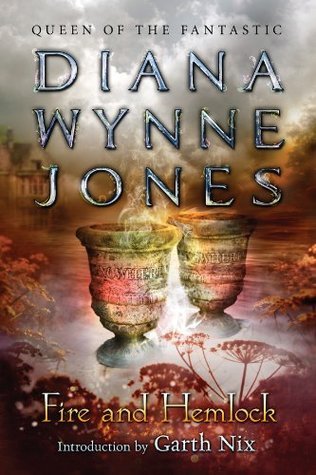
This past week I discovered that she also has some free-standing novels, and picked up Fire and Hemlock, which had an intriguing story line for which, in hindsight, I should have been better prepared.
The book owes its structure and character line-up to the ballad of Tam Lin, which dates from 1500s Scotland, and also to the story of Thomas the Rhymer, an actual Scots laird who lived from 1220 to 1298 whose story is confusingly similar to that of Tam Lin (both of them were kidnapped by the Queen of Elfland, although their destinies diverge after that initial act). I was embarrassingly unfamiliar with either of those legends going into reading this novel, and should have stopped the minute things got complicated and consulted Wikipedia for the synopses I finally ended up reading after I was done! Take heed of my experience and do that before you read this book if you want it to make sense. There are also echoes of both Hero and Leander and Cupid and Psyche, with echoes of T. S. Eliot. Diana Wynne Jones has written an explanation of her thoughts about the heroic that was included with my Kindle copy of the book, though it doesn’t appear except in later printed editions.
In the book, Polly Whittaker, 19, suddenly realizes that she has a set of double memories that began at the age of 10, which some entity is trying to make her forget. In the mundane set, she has been living an ordinary life: school, books, athletics, friends, irresponsible and uncaring parents, a loving but acerbic grandmother, and a boyfriend she’s not sure she wants. In the fantastical one, many of her actions are dictated by her sporadic but compelling friendship with a man she meets at a funeral, with whom she has an odd affinity. They experience some strange, inexplicable adventures together—are they truly magical?—but their friendship is threatened by menacing characters and events from which Tom Lynn attempts to shield Polly. She finally figures out what’s happening when it’s almost too late, and takes drastic action to secure both the memories and the relationship.
The book is such an odd mix of juvenile and adult that it was hard to read at some points, because it fluctuates between the mind of a young, naive girl and the definitely adult legend of a man in thrall to a wicked force that wishes to control his life. The narrative is carried by Polly, so we see everything through her clever and imaginative but innocent eyes, and if you are reading the book without knowledge of the backstory, it can be both frustrating and confusing, as well as long. I ended up liking it pretty well, and it’s probably Wynn Jones’s most ambitious plot in terms of the multiplicity of strands she introduces, but I was definitely happier with the straightforward, more mature, and somewhat humorous world of Howl’s Moving Castle.
Perfect stone fruit
Halfway through my reading of The Mare, my checkout period at the library ran out, and I couldn’t get the e-book back on my Kindle for about a week, so I took a break and read something else. I think reading The Mare may have provoked a subconscious connection to this book, which is also a coming-of-age story with a narrator on the cusp between child and teenager, but at a time when a “teenager” wasn’t what it is today. It is a book I have read before, but not for about 30 years, so the story has its place in my memory but has softened and faded to the point where I could experience it fresh.
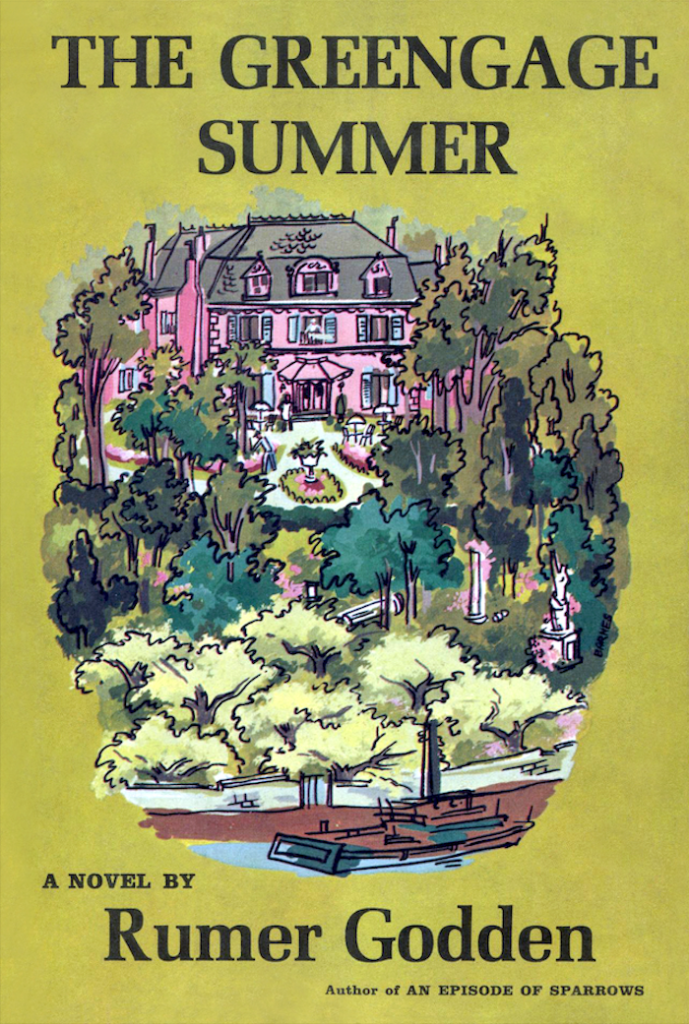
The Greengage Summer, written by Rumer Godden in 1958, is the story of a mother with five children who, at the end of her rope one summer, impulsively decides to pack them all up and take them to France—not as a reward, but to show them the battlefields and mass graveyards there in the hope that they will all become less obnoxious and selfish! There is a father, but he is a botanist who travels extensively for his work, leaving his family behind in Southstone, a provincial English village in which they live a thoroughly mundane existence under the watchful if stodgy eye of their Uncle William. They are not a well-to-do family; they wear uniforms to school and the rest of the time mostly hand-me-downs from their next eldest sibling, and their weekly pocket money is counted out in pence, not pounds. The children range widely in age: Joss is 16, Cecil 13, Hester 10, Willmouse (the only boy) is eight, and Vicky is five.
The family takes a long and exhausting train trip down to the Vallée de la Marne, in the Champagne district of France, their destination the Hôtel les Oeillets, a small pension in the countryside. But during the journey, the mother is bitten on the leg by a horsefly, and by the time they arrive she is so ill that she must be hospitalized with blood poisoning. The patronesse, Mademoiselle Zizi, is inclined to cut the children loose (despite their being unsupervised with nowhere to go), but Elliot, an English guest at the hotel, is prevailed upon by the mother to keep an eye on her family until she returns from hospital, so the five move in and start their holiday in France under his casual supervision.
None of them save Cecil speaks any French (Cecil had to learn endless French poems by heart as punishment for poor schoolwork, and it stuck with her), and all of them approach the holiday on their own terms. The book is narrated by Cecil, with insights provided both from her own observations and from the experiences of her siblings. Cecil is sitting squarely at that transition point between child and adult during this summer, while her sister Joss has suddenly crossed over to that place held by beautiful young girls in the first flush of their power as women. The others, known to the family as “the littles,” also go through some changes, as they all encounter their first introduction to an adult world in a different culture, untrammeled by the careful routines of their normal lives.
The name, The Greengage Summer, comes from the fruit orchard that is part of the grounds of the hotel, where greengage plums are ripening on the trees and plopping to the ground, begging to be consumed by the children who laze under their shade in the long afternoons by the river Marne. And like the fruit, the summer is filled for the children with flavor and sweetness that surrounds some hard stones or truths at the core.
There is more to the story—undercurrents, background information, and a mystery in which both the residents and the guests become caught up—but I don’t want to give away too much, because the book is a delight to read and I am happy to have rediscovered it, for myself and for those who read my reviews and might pick it up based on this introduction. In addition to story, there is a specific rhythm and artfulness in the way Godden tells a tale that makes me happily revisit most of her books, and this is one of my top five (out of the 60 she wrote). It’s also a great read to choose for the hot, languid month of August.
The characterizations of everyone involved—the children, the hotel employees, the guests—are wonderful, diverse and memorable, and the mood she creates of this leisurely sun-filled holiday fraught with dark undercurrents is engaging in the best way. It may be that switching over to this book halfway through my reading of The Mare is what gave me a certain dislike for and disappointment in that story, because The Greengage Summer has everything I love in a perfectly realized arc, right down to the last line of the novel.
The Mare (the girl)
Having read Horse, by Geraldine Brooks, a few months back, when someone recommended the book The Mare, by Mary Gaitskill, I was primed to read it, especially because the teenage main character was named Velvet, immediately transporting me back to the joy of reading National Velvet in my childhood. And, similar to that book, this story was about a disadvantaged child whose encounter with horses changes things for her, although the child in this one is a much more extreme example. I didn’t grow up in a financial or social environment that would indicate the need for escape, but I was an introverted, solitary child who longed for the connection with horses in lieu of any relationship with people, so books like this spoke to me, and still do.
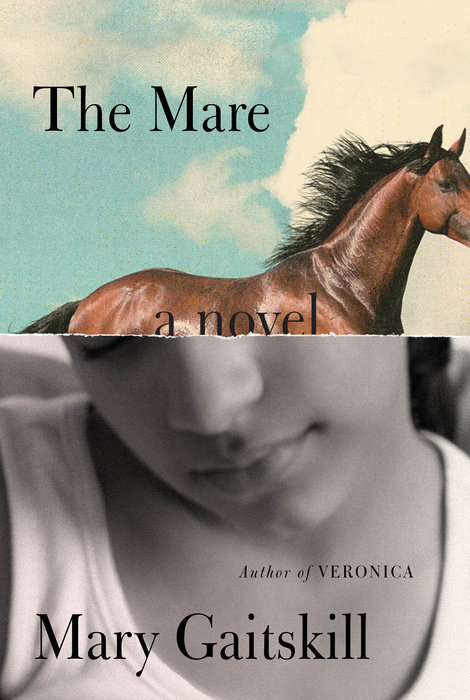
Velvet (short for Velveteen) Vargas is the daughter of a single mother, Sylvia, an immigrant from the Dominican Republic. They, along with Velvet’s little brother, Dante, live in Crown Heights (an inner city section of Brooklyn), and it is a limited, hand-to-mouth existence. Sylvia is hard and bad-tempered, shaped by the fearful responsi-bilities she has been forced to take on from a young age, and she is alternately loving, manipulative, and abusive with her children. The effect on Velvet’s sense of self, in particular, is both negative and confusing, and Velvet is a troubled, conflicted child.
Through Velvet’s school, they find out about the Fresh Air Fund; although the actual organization apparently sends children to six-week summer camps so they can have outdoor experiences and take leadership workshops, the program in this book pairs up inner-city children with more well-to-do host families from the country, with whom they spend a couple of weeks’ holiday. Both Dante and Velvet participate, although we never hear any more about Dante’s experience after he is put on a bus at Penn Station that first summer.
Velvet, age 11, is matched with Ginger and Paul, from rural upstate New York. Ginger is a painter, although she has been blocked for a long time; she is also a recovering alcoholic. Paul is a teacher, and met Ginger at an AA meeting. They have been together for some time without having children, and Ginger longs for some kind of connection; they initially sign up to host because Ginger wants to experience what it might be like to adopt an older child. (Paul has a daughter from a former marriage and is lukewarm, at best, about this.)
Ginger and Paul live near a horse stable, and it is the incentive of being able to ride horses that most appeals to Velvet about the experience. The book carries its characters through several years, as Velvet transitions from child to teenager while paying sporadic weekend and holiday visits to the couple’s home, and is told through the primary viewpoints of Velvet and Ginger, with a few scattered chapters giving added perspective from Paul and Sylvia.
The surface story is a coming-of-age saga, but the underlying context is the stark contrasts inherent in race and socioeconomic class. The switch between Velvet’s world and Ginger’s holds up the realities of inequality in our country by showcasing minority poverty and its relationship to white liberal guilt and its accompanying savior complex.
My reaction to the first part of the book was positive; it’s written in a rather quirky style that appealed to me because it was so internal. Conversations are had, but they don’t exist as present-tense dialogue; rather, each person is narrating from her sole point of view, and relating the conversations second-hand as she perceives them. It makes for an experience that is simultaneously cerebral and intimate.
The path of the story is choppy; sometimes we get to see the same scene and actions as experienced by Velvet and then again by Ginger, but at others we see things only from the one point of view and then the timeline is continued by the other, as when Velvet narrates her day at the barn and Ginger takes up the story when Velvet returns to the house and Ginger tries to get an account of the day’s events out of a recalcitrant and somewhat inarticulate teenager. Everything about the story is filtered through one or the other psyche (with the exception of the few short chapters related by Paul or Silvia), so there isn’t really a factual feel about it, since both viewpoints are opinion colored by personality and emotion.
Where the book started to break down for me was when Velvet (at home in Brooklyn) started paying attention to boys, and one boy, Dominic, in particular, and her attention is riveted on him to the exclusion of her own family, her host family, and the horses. Although it was probably a natural development in the life of a young girl from this neighborhood and, more widely, that of a pubescent girl from any neighborhood, it was a disappointing distraction from Velvet’s previous one-track focus on her almost mystical relationship with the horses and with one mare in particular.
The mare was a problem horse from whom everyone was warned off, as she was both unpredictable and occasionally vicious, but Velvet felt a kinship with the horse that developed, over the course of several years, into something so compelling that to draw the attention away from that to a helpless crush on an older boy who doesn’t really want her was disappointing. (Some of the best writing in the book is when Velvet is trying to articulate the feelings and internal dialogue between herself and the horses and how those translate into action.)
I also have to say that although I don’t mind stories that are more character- than plot-driven, I truly loathe ones that are open-ended, and when I got to the last page of this book I had a momentary flare of irritation that I had spent so much time persevering to finish reading it. In retrospect I don’t exactly regret it, but I really wish there had been a more definitive story arc with an end as engaging as its beginning.
Cream of the crop
I wasn’t going to post any further about my sojourn in the land of Regency Romance, but the last Heyer I reread was so delightful that I just have to share. I have previously mentioned a list of favorites here, and somehow this one didn’t make it onto that list, but I think it may be my new “best-of” pick. It’s The Foundling, written in 1948.

The name of the book is deceptive, because the foundling (orphan) in question is merely one small element in a much bigger story, and most of that story is about Adolphus Gillespie Vernon Ware (“Gilly”), the seventh Duke of Sale. Gilly is 24 years old, one year away from his majority, when he will take over control of his own estates from his guardian and uncle, Lord Lionel Ware. He is beset by irritations, but not the kind to which there seem to be any solution. He was a sickly child who has grown into a sturdy (if small and slight) adult, but his relatives and the raft of devoted family retainers who work for him will never let him forget that they have had good reason to mollycoddle him for his entire life, and he is constantly thwarted in the simplest of plans. He can’t do so much as take a walk to his club without his valet, his butler, or his agent insisting on ordering him a carriage for fear he will unduly exert himself or catch a chill. So when his young cousin, Matthew Ware, comes to him with a problem he is, himself, unable to solve, the Duke decides that he will take care of it without resorting to the advice of others. He will do so while masquerading as a plain “Mr. Dash,” not dependent on the benefits of birth and wealth; he manages to sneak off on his own, with no luggage, no carriage or horse, and no word to his servants or his uncle about either his intentions or his destination.
This incognito journey into the countryside to confront his cousin’s blackmailer leads to some interesting and signficant encounters that include a runaway schoolboy, a divinely beautiful but completely brainless orphan, and some villainous people and perilous situations. Meanwhile, back at his London abode, the hue and cry to discover his whereabouts is exacerbated by the belief by some that he may have run off due to an adverse reaction to becoming engaged to his lifelong friend, Lady Harriet. Others develop the theory that his cousin Gideon, who is his best friend but also his heir, may have “put him out of the way” in order to ascend to his title and massive fortune!
This is one of Heyer’s most complex and convoluted plots, with something happening every moment. Although the book is named after the fair Belinda (the foundling in question), her part in it is minor except as it motivates some of the adventures of “Mr. Rufford,” the name under which the duke is traveling. It is much less a romance (although there is a bit involved) than it is a coming of age of a man who, restricted from all autonomy since birth, finally rebels against all restraints, and his ensuing complicated adventures are the meat of the story.
I got through it in about 36 hours, because I couldn’t put it down. If you are inclined to try one of Heyer’s books for yourself, may I suggest this might be a good one to assay? (Yes, I am, at this point, speaking in the language of her characters. I think it’s time to move on to other literature.)
Boarding-school books
I’m off on my own personal nostalgia kick right now, re-reading Georgette Heyer novels to escape from the depressing real world of politics and sub-optimum health. But on one of the book-lovers’ pages on Facebook, a mom was asking for recommendations for her teenage son who is a reluctant reader, so I combed through my various categories of YA fiction for some and was thus inspired to write about this sub-set of coming-of-age fiction, the boarding-school book.
I think those who have never attended a boarding school are in some way fascinated with the culture—I know I always have been, from the time I read my first children’s book with a protagonist who had been posted off by their parents to “sleep-over” school. And there are a lot (hundreds) of examples out there of the away-from-home scholastic experience, from Harry Potter to A Separate Peace. There are books in every genre, for almost every age, so I thought I’d mark some of my personal favorites and some that seem to be perennially popular.
The boarding-school book is by no means limited to children and teens—there are many written for (and sometimes about) adults as well, especially if you include the college boarding experience. I’ll give age groups and categories and (in some cases) some brief synopses, and if you have the same interest I do, you can gravitate to whichever piques your interest.

For children, a classic example is
A Little Princess, by Frances Hodgson Burnett, about a young girl sent home to England from India, where her father is a successful merchant, because it was believed that the climate of India was not salubrious for British children. They were separated from their families and entrusted to the care of an English boarding school, where they would hopefully get an education and a proper upbringing and be reunited with their families when they were grown. Young Sara Crewe goes from riches to rags when her father disappears and is presumed dead, and Miss Minchin’s Select Seminary can no longer collect hefty fees for her maintenance. I sometimes think of this book as the child’s version of the first third of Jane Eyre, by Charlotte Brontë (although Sara is much better-natured than Jane ever was!). It’s a romantic story with a protagonist who remains upbeat and optimistic in the face of cruelty, guaranteed to appeal to the kind of reader I was at a young age.

There are many boarding-school books with more fantastical settings, the most well known probably being the Harry Potter books, in which gifted children are sent to Hogwarts School of Witchcraft and Wizardry to hone their talents. But in the fantasy category are also the Harper Hall books by Anne McCaffrey, which take place on the planet Pern and feature dragons and fire lizards in these stories of children studying to be professional musicians; and The Rithmatist, by Brandon Sanderson, featuring another magical school, this time for math geniuses with a little something extra. These are all for younger children and teens (maybe 4th through 8th grades?), although older teens and adults can (and do) enjoy these books as well.

In the specifically Young Adult category, there are fantasies, mysteries, and realistic fiction all set at private academies that either offer the standard schooling or are geared towards inhabitants with a specialty. For the middle school set: One realistic one in which the rule of the bullies and the plight of the bullied are revealed is The Mockingbirds, by Daisy Whitney. Another fairly normal boarding school that is the site of a mystery is the backdrop for the Truly, Devious trilogy by Maureen Johnson, in which death visits Ellingham Academy. And the Gallagher Girls series by Ally Carter (beginning with I’d Tell You I Love You But Then I’d Have to Kill You) showcases a girls’ school that is supposedly for the upper-crust daughters of the snobby set but is actually a training curriculum for those who wish to become undercover agents for the CIA and like agencies.

Among the boarding-school franchise for older teens, there are also a variety of settings. In the realistic category are such mainstream stories as Winger, by Andrew Smith (at a boys’ school focused on rugby); and Looking for Alaska, by John Green and Saving Francesca, by Melina Marchetta, both with a challenging co-ed population. A fun book in its development of one character from age 14 to 16 as she figures out how to dominate her environment is The Disreputable History of Frankie Landau-Banks, by E. Lockhart. Another is the trilogy by Stephanie Perkins that begins with Anna and the French Kiss, following a Georgia girl who is transplanted to an American school in Paris for her senior year.

A huge boarding-school subset is the paranormal category, with vampires dominating and witches coming in a close second—the Vampire Academy books by Richelle Mead, the Hex Hall series by Rachel Hawkins, the Gemma Doyle stories by Libba Bray, and Evernight, by Claudia Gray. One series that I particularly like and admire is Wayward Children by Seanan McGuire, which could arguably be classed as either YA or adult; the books are unusual, smart, and varied in their approach. I reviewed them on this blog when I first discovered them, and continue to find them unique.

Moving on to books more appropriate for adults, there are some in every category. The Magicians (and sequels) by Lev Grossman have been billed as Harry Potter for grown-ups. Mysteries that feature boarding schools include Well-Schooled in Murder, from the Inspector Lynley mysteries by Elizabeth George; The Secret Place, one of the Dublin Murder Squad books by Tana French; and The River King, by magical realism author Alice Hoffman. A book that is written about young people but is (in my opinion) too intense for their age group to read is Brutal Youth, by Anthony Breznican, a co-ed Lord of the Flies set in a Catholic private school in Pennsylvania. I didn’t so much enjoy reading it as remain fascinated and unable to put it down. It’s definitely powerful, and in some ways brilliant, but also stark and frightening. Gentlemen and Players, by Joanne Harris, is written from the point of view of the teaching staff at St. Oswald’s Grammar School for Boys, a cat-and-mouse tale of revenge as one staff member with secret ties to the school tries to destroy it from the inside. Finally, Never Let Me Go, by Kazuo Ishiguro, is dystopian literary fiction with a boarding school setting that may not be what you had in mind when you read the initial description, but it’s a fascinating premise with a heartbreaking (and kind of depressing) outcome.
This is a mere drop in the bucket of what’s out there; if you want to research this category further, go to Goodreads, select “browse” and “lists” and type “boarding schools” into the search box, and you will find multiple lists containing all these and many more. But the books mentioned here are a great start if you, like me, enjoy that particular setting for your fiction.

Horse

Although I started out as a little girl who liked dolls, as I got older I turned into a horse fan(atic). (My mother continued to collect Madame Alexander dolls on my behalf long after my interest waned.) I went through that stage around 9-13 years old where I read everything horse-related I could find: the Marguerite Henry tales of the wild ponies of Chincoteague; Black Beauty, by Anna Sewell (multiple times); My Friend Flicka, by Mary O’Hara; National Velvet, by Enid Bagnold; and all the Black Stallion books by Walter Farley. With my parents and their best friends, I spent two spring vacations at a “dude ranch” in Arizona, riding daily for two weeks each year (the photo is from there). After that I begged for riding lessons in my home town of Riverside, California, and spent some months riding an ornery “rental” horse named Shadow who dumped me off more than once in the (thankfully soft) dry river bottom of the Santa Ana river. (I wasn’t that bad a rider; I was jumping him over logs and bushes at the time, fantasizing about being Velvet Brown in the Grand National, and he had a spiteful habit of blowing up his belly when his girth was being tightened so that the saddle would go sliding at inopportune moments.)
My ultimate goal was, of course, to have my own horse, and I almost fulfilled that wish; my grandfather, a farmer who was essentially a childlike man notorious for making rash decisions without considering consequences, went to the local livestock auction in Chowchilla one Saturday morning and bought me an unbroken palomino colt. I was overjoyed, but my parents sat me down and explained to me that it wouldn’t be realistic to keep a horse in Riverside, where he would have to be boarded out and I, with my crowded schedule of academics, piano lessons, and thrice-weekly church, would have scant time to see him, let alone ride or care for him. There was also the matter of the expense of both training and boarding him, which we couldn’t really afford. I was devastated, but I was at heart a sensible and agreeable child, with the result that Granddad sold him on to another buyer, and I went back to my books. I never did, however, wholly lose the longing for a horse companion; I wasn’t so much into riding, I just liked being around horses. Their energy and temperament held a fascination for me that has never waned.

It was, therefore, probably inevitable that I would at some point get around to reading Geraldine Brooks’s book Horse. I resisted for a while, for a couple of reasons: First, I’m not drawn to historical fiction; it seems to me that the history so often interferes with the author’s ability to tell a good story, being constrained by actual events (and feeling the need to include them all!). I tend to steer clear of anything “based on a true story.” I have discovered a few exceptions that I love, but mostly I avoid these books for fear of disappointment. (Also, does everyone in the world have to write a book set during World War II?!) The other reason was because I read her book March and, contrary to the popular opinion, didn’t care for it much. Louisa May Alcott’s Little Women books were cherished childhood favorites, and Brooks exploded some of the myth in her tale of Mr. March in ways I didn’t appreciate (and also, I found parts of it vastly boring).
But…horses. HORSE. So I put my name on the library waitlist and was finally granted access to the e-book last week. It was both more and less than I was expecting, and I thoroughly enjoyed some parts while being put off by others.
The story is set in three time periods and jumps back and forth between those and also between multiple narrators in each one. The first takes place in the years just prior to the Civil War, and begins with the birth of a bay foal who will become the famed and gifted racehorse Lexington. The enslaved boy Jarret becomes first his groom, later his trainer, and his fiercest advocate as they essentially grow up together. The other spokesman in this time period is an equestrian portraitist, Thomas Scott. The second (much less significant) storyline is set in New York City’s art world of the late 1950s, from the viewpoint of art dealer Martha Jackson. The third, contemporary tale occurs in Washington, D.C. in 2019, with Jess, an Australian woman who works at the Smithsonian Institution’s Osteology Prep Lab (she articulates skeletons for display), and Theo, a Nigerian-American Ph.D. student writing a dissertation about American equestrian art (specifically focusing on images of slaves in paintings of racehorses). All these timelines are connected by a portrait of a horse and his black groom that Theo discovers abandoned on his neighbor’s curb. The horse is Lexington, the groom is Jarret, and the book weaves together all the connecting threads.
The relationship between Jarret and Lexington is moving, poignant, and sometimes heartbreaking. The back story of the history of American horse-racing, specifically in the South, was fascinating to me, as were the contemporary details about the science of the preservation of natural history and the restoration of paintings.
There is, of course, a subtext to the entire book, which is racism. It is effectively and affectingly dealt with in the pre-Civil War sections by the clear depiction of the sale of humans being much more common and vastly less considered than the sale of horses.
I found the theme less compelling when Brooks moved to the present-day embedded culture of racism in America. The societal injustices of slavery were clear-cut, anger-provoking, and heartbreaking; but I felt like once she approached the more subtle but nonetheless ubiquitous prejudices of the present day, she fell too often into either avoidance or cliché. I particularly didn’t like the egocentric behavior of Jess, who let her initial reaction to Theo become an ongoing mea culpa that was much more concerned with her own embarrassment than it was about her injury of Theo.
Despite those caveats, the depth of the research and Brooks’s deft mix of history, science, and art were enthralling, especially due to her evocative writing. The horse-racing scenes were both powerful and visceral, and the pictures she paints of the various settings and environments are beautiful and memorable. Even with its flaws, I’m glad I read this book.
Beyond Cerulean
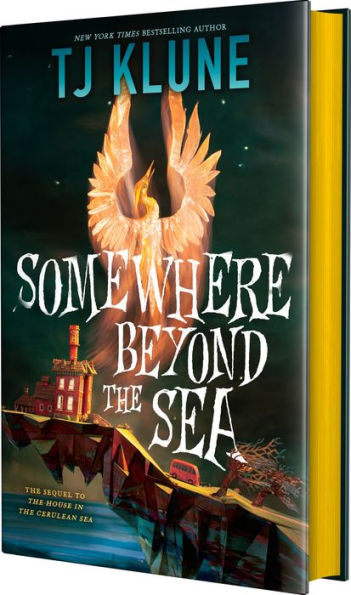
Just as I began my review of the first book (The House in the Cerulean Sea) with the words
“I had high hopes that I would love this book,” I hoped to wrap up my review of this one, its sequel, with the same conclusion I drew then—”This book was an unalloyed delight from start to finish.” Alas, I can’t quite say that.
Many of the same delights were present, the chief of them being the wonderful characters. A big pleasure of this book was to see how the children of the Marsyas Island “orphanage” have grown and come into their own under the positive attention of Arthur Parnassus and his partner, Linus Baker. My favorite parts of the narrative were the insights and revelations from Sal, Phee, Chauncey, Talia, Lucy, and Theodore, and the fresh perspective from David, the yeti child new to the family. The interactions, in particular, between David and the other children were such lovely models of how to bring someone into your orbit and make them feel wanted.
I also initially liked the political nature of the tale—the defiance of those in power when they try to use fear to silence and censor outliers. The opening—in which Arthur Parnassus testifies in public to the committee overseeing DICOMY and DICOMA about the abuse he suffered as a child at the hands of the department supposedly detailed to protect him—was a dramatic kickoff to the book-long campaign setting Arthur and Linus and their little band of hopefuls against the gaslighting of a self-serving, unaccountable government. The book is obviously meant to encourage people who have been “othered”—LGBTQ, as well as those who are racially and ethnically diverse—to stand up in solidarity and resist oppression and marginalization. The continuing revelations about the treatment of the magical community hark back to indigenous colonization and even genocide, and the story is also plainly intended to enlist “the rest of us” to stand with the othered, as Klune illustrates with his conversion of the townspeople of Marsyas into allies and supporters.
There are some dramatic moments that live up to this goal. I found it quite arresting when there was suddenly a realization by Arthur that rather than constantly fighting, he can just refuse outright to play the game. Instead of either resisting or buying into the government constraints, he has the ability simply to refuse to acknowledge their authority. It was a textbook lesson in how to leave someone flatfooted—stop collaborating with them in their appropriated self-importance.
But there are also a number of events that are so preachily on the nose (and in some cases either patently ridiculous or hail-mary impossible) that they actively take away from the message. I feel like those were a direct result of the “elephant in the room,” who appears by name in the acknowledgments but is caricatured and parodied in the book in the person of Jeanine Rowder, villainous government official. The choice Klune made to take on the anti-trans author J. K. Rowling by writing her into his book as the villain is the moment at which he lost the plot for me. The book morphed into a vehicle to scapegoat and belittle, on a too-personal level. Am I saying she doesn’t deserve pushback for her targeting of people who do her no harm? No. But there are many more egregiously hateful people in this world on whom a book villain might have been modeled, and perhaps the story wouldn’t have become so pointedly petty in the process. It felt like the set-up of a straw man to symbolically knock down. I wanted more nuance.
I still enjoyed most of the book. But the turn things took did make me sit back and wonder: Was there sufficient purpose to this sequel? Or did the personal agenda derail it from being what Klune intended? I’m honestly not sure.
I am also not fond of a deus ex machina-type resolution, so…there’s that.
My final conclusion is that I don’t regret reading the book, and would encourage others to do so—with the caveat that they take from it the intended message, the parts that are true heirs to the sentiments of the first one. Is that good advice? I don’t know. You’ll have to take your chances and come back to me on that.
American classic
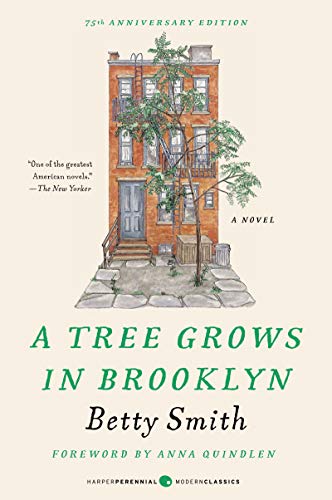
I don’t have much to say about A Tree Grows in Brooklyn, by Betty Smith, that hasn’t already been said. This is probably my third or fourth time reading it, but I haven’t done so for a couple of decades so I decided to revisit it. I remembered the brilliant, colorful depiction of life in Brooklyn in the early 20th Century, but had forgotten the simple yet elegant and nuanced language with which it is described. I remembered most of the details of Francie Nolan’s life, but some of the wonderful details of the outlying characters—her sexy Aunt Sissy, the interactions of Willie with his horse, Drummer, the English teacher who praised Francie’s artificial flights of fantasy but denigrated her realistic portrayals of Broolyn life—I happily rediscovered.
The story is funny and tragic, lighthearted and heartfelt, emotional, a little sentimental, inspiring. It kept my attention throughout, and I loved sitting down each day to another chapter. I would hand it to almost anyone over the age of 12—most girls, some boys—who wanted to be both entertained by and enlightened about the human condition.
One warning: If you have never read it and happen to pick up the edition with the forward by Anna Quindlen, save that to read later, because it delivers a few spoilers.
Dog Day Afternoon

No, this isn’t a post about a 1975 bank robbery movie. But the title seemed appropriate, given that it’s National Dog Day and also that I am getting such a late start that my post won’t be available until after noon, one of those hot, sleepy afternoons when dogs (and people) prefer to lie around and languish (i.e., read!) during the summer heat. I did some pre-planning for this post by making a list of some pertinent dog-oriented books, but then my distracted brain failed to follow up, so a list is pretty much all you’re going to get this time. But don’t discount it just because it’s not elaborated upon; these are some great reads, encompassing fantasy, mystery, dystopian fiction, science fiction, some true stories, and a short list for children.
NOVELS FOR ADULTS (AND TEENS)
The Beka Cooper trilogy (Terrier, Bloodhound, Mastiff),
by Tamora Pierce
A Boy and His Dog at the End of the World, by C. A. Fletcher
Iron Mike, by Patricia Rose
A Dog’s Purpose, by W. Bruce Cameron
First Dog on Earth, by Irv Weinberg
The Companions, by Sheri S. Tepper
The Andy Carpenter mysteries, by David Rosenfelt
The Dog Stars, by Peter Heller

DOGGIE NONFICTION
Marley and Me: Life and Love with the World’s Worst Dog,
by John Grogan
Best Friends: The True Story of the World’s Most Beloved
Animal Sanctuary, by Samantha Glen
James Herriot’s Dog Stories, by James Herriot
A Three Dog Life, by Abigail Thomas
Inside of a Dog: What Dogs See, Smell, and Know,
by Alexandra Horowitz

CHILDREN’S BOOKS WITH DOGS
Sounder, by William H. Armstrong
No More Dead Dogs, by Gordon Korman
Harry the Dirty Dog books, by Gene Zion
(illustrator Margaret Bloy Graham)
Bark, George, by Jules Feiffer (one of the best for reading aloud!)
And for those who wanted more, here is an annotated list of more dog days books from a previous year, along with some suggestions for dog lovers that go beyond reading about them.
 The Book Adept