Blood sport
There seem to be several opinions about why horse racing has been called a blood sport. One definition I found submitted that it was because of the term “bloodstock”—the selective aristocratic breeding of thoroughbreds from pure bloodlines. But most historical definitions cite the concept of bloodshed involved in sporting events such as bull- and bear-baiting and cock fighting. In recent times, the definition has been expanded to also include the intense physical toll on the horses, track safety issues, and the treatment of retired race horses.

These are the putative meanings behind the title of Blood Sport by Dick Francis but, ever a one to find a clever double entendre, the plot turns the pursuit of horse thieves into a blood sport as well, since they are not inclined to be either found out or deprived of their ill-gotten gains.
Gene Hawkins is a “civil servant” from an unnamed department whose job seems to consist of screening people for highly sensitive work. It is several times implied that this job includes forays out of the office for some high-risk hijinks as well. Gene is good at his job—he is intelligent, innovative, introverted and, at the moment, clinically depressed after a failed relationship brings home to him how pointless much of his life is turning out to be. He is confronting the challenge of how to fill three weeks of vacation time when his boss (possibly fearing that he will succumb further to his depression) asks him to take on a special project.
Dave Teller is a millionaire American who purchased an expensive and prestigious racing stallion with plans to breed future winners for the track, only to have the horse go missing. Weeks after it escaped its paddock, the insurance company and Gene’s boss are both thinking this might have been a theft rather than an accident, especially because two other horses (one of whom was also partially owned by Teller through a syndicate) went missing in a strikingly similar way.
Gene takes the case and pursues people and clues from New York to Wyoming, California, and Arizona. Although he was initially hired to find the latest missing horse, he eventually has his eye on locating the other two as well, and goes about all of it in a clever, understated way that holds your attention from beginning to end.
This was an unusual—and somewhat dark—story from Dick Francis in a few ways: First, it took place primarily in America and, while it was tangentially about horse-racing, had none of the usual scenes from the track and the breeders’ farms. Second, the protagonist is emotionally in a bad place. Francis has gone there before (as when Sid Halley, champion jockey, loses his hand in a terrible accident in Odds Against), but never has that mood suffused a book as it did this one. And finally, while there has been some form of violence present, usually perpetrated by a central villainous character, in most of Francis’s somewhat formula stories, it has rarely felt as personal as it does here. Still, this was a solid mystery with an ingenious plot that was just sufficiently convoluted to keep me reading. I’m glad I didn’t miss this one.
Heists and capers
I am a big fan of heist plots, particularly if they are art-related. When I was a teen librarian I enjoyed the Ally Carter Heist Society books, and really liked the crew and their capers portrayed by Leigh Bardugo in the Six of Crows duology. One of my favorite fantasies is the Queen’s Thief series by Megan Whalen Turner, and I also thoroughly enjoy more mainstream heist books like The Great Train Robbery, by Michael Crichton, or The Lock Artist, by Steve Hamilton, which includes the ideal combination of safe-cracking and the creation of graphic novels. I also enjoy all the movies in this sub-genre, such as The Italian Job, The Thomas Crown Affair, Tower Heist, Baby Driver, and the Ocean franchise. And I just finished binge-watching the TV series White Collar, which follows a thief and forger who works with the FBI in order to achieve a limited amount of freedom (he’s not in jail, but wears an anklet that limits his radius to two square miles of New York City). So when I saw that one of last week’s Amazon Kindle First Reads was an art forgery mystery, I enthusiastically grabbed Veridian Sterling Fakes It, by Jennifer Gooch Hummer.
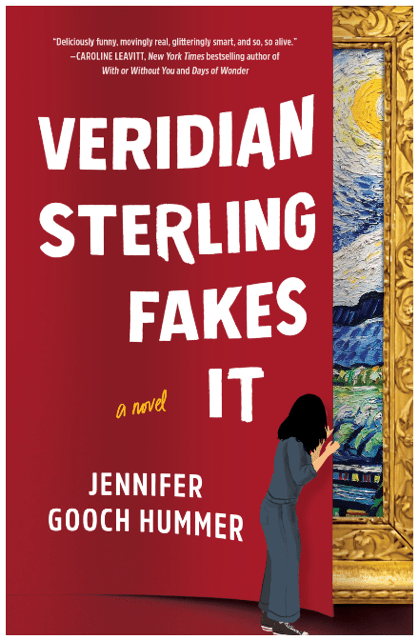
I won’t say that I was disappointed; it was sufficiently populated with interesting characters and situations and art-related historical facts that I read it with a certain amount of pleasure. But ultimately the book never really figured out what it wanted to be, and this lack of definitive direction made it a somewhat meandering and diffuse story with a lot of implausible elements and some clichés I could have done without. There are multiple different directions in which the author takes a few steps and then draws back instead of fully committing, which proves to be a frustrating narrative to read.
Veridian Sterling is a recent grad from the Rhode Island School of Design, with the typical hopes of everyone who excels in their art school classes and hopes that will translate into finding a gallery to display their work, interest (and sales) from the world of art aficionados, making a name for themselves…. And, like most art school grads, she quickly discovers that none of that is going to be forthcoming and that if she wants a place to live and food on her plate, she’d better find a “day job” to sustain her while she works on the rest of the dream. Veri has a job in the beginning at a laundromat/dry cleaners, but when she loses that she takes a position as an assistant at an art gallery that has rejected her paintings. The owner happens to be a former friend and roommate of Veri’s mother’s, when her mother was herself at RISD, and she is all too obviously modeled on Miranda Priestly from The Devil Wears Prada but without the icy demeanor and impeccable taste or, in fact, any redeeming qualities whatsoever. I found this character to be unnecessarily shrill and unlikeable and wished the author had chosen a different option.
We get a lot of stuff about working in the gallery and living her life, meeting an intriguing guy (the driver for a wealthy art dealer who visits the gallery regularly), discovering things she didn’t know about her mother, and various interactions with her best friend, all of which are overlaid with a level of stress that should be building up to something but takes an awfully long time to do so. By the time we finally get to the crux of the story (the mystery, the art crimes, the revelations), we’re just a teensy bit exhausted by the angst and the minutiae. Said plot point doesn’t even arrive until well past halfway through the book, and turns out not to be much of a mystery. While there was a build-up to what should have been the high drama, it felt like the stress level remained almost constant throughout, which did a big disservice to the revelatory bits.
In fact, while reading this book I was constantly reminded of one with a somewhat similar plot that I read and thoroughly enjoyed a few years back (in fact, I liked it enough to read it three times in six years!), so I’ll put in a plug for that one here. It’s The Art Forger, by Barbara A. Shapiro (see my review by clicking the title link), and that author achieved what I think this one was hoping to accomplish, by smoothly combining the multiple levels of mystery, art, and moral dilemma. One of the mistakes I think Hummer made was in attempting to include the slightly goofy humor and irony of such books as Finlay Donovan Is Killing It, by Elle Cosimano, but in trying to be all things to all readers, she couldn’t successfully pull together all the elements to make it work. So if you want a fairly lightweight version of the art forgery world, read this book; if you’d prefer an in-depth exploration of the same theme, go for Shapiro’s instead.
Finally, Christopher Booker famously made the case in 2004 for there being only seven basic narrative plots in all of storytelling and, having just finished watching White Collar, I do wonder whether part of this plot was a result of that coincidental symmetry or else this author did some binge-watching of her own….
 The Book Adept