Marine biology and spies
While awaiting about six different e-books on my “holds” list at Los Angeles Public Library, I succumbed to one of those BookBub daily reading recommendation emails containing various books they offer for between 99 cents and a couple of bucks—which is unfortunately about what some of them are worth in terms of writing and readability. But I have to say that Immortal Red, by Keith Hummel, surprised me in a mostly positive way, and I enjoyed working my way through its labyrinthine story line and getting to know its many, mostly nefarious characters.
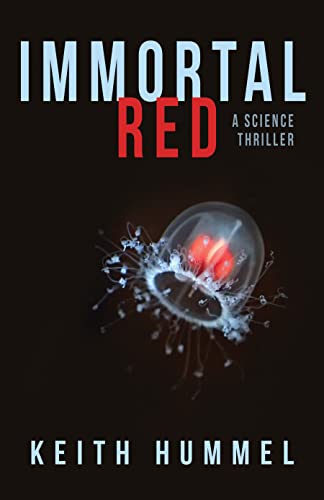
The description of the book in blurbs and on Goodreads leads one to believe that it’s heavy on science: A marine biologist snorkeling off the coast of Cape Fear, North Carolina makes the chance discovery that Turritopsis dohrnii, a dime-sized jellyfish with a bright red stomach, seemingly has the gift of immortality. At the moment of death due to old age or massive trauma, the jellyfish has the ability to fully rejuvenate at a cellular level and emerge as a young adult again. After collecting specimens and observing numerous repetitions of this phenomenon in her lab, the scientist applies for research grants and thus brings herself to the attention of an elderly black-ops CIA mastermind who wants her to develop practical applications for humans—in other words, make him immortal. He has a plan to dole out this secret miracle to an elite group of people who he envisions subsequently running the world, with him, of course, spearheading things.
When the scientist isn’t in agreement with his goals and hides any positive outcomes of her experiments, things don’t go well for her or her husband, a wannabe spy under the sway of the megalomaniacal CIA guy and his minions. Then ensues a breathless search for the scientist’s research, and the story morphs into a full-throttle CIA spy novel.
Reading this was initially a little slow, because almost the entire first half is basically developing knowledge and back story; but once the research is in the wind, things take off and get increasingly exciting. The writing flows naturally, the characters are fairly well developed (for a fast-paced thriller, that is, not at the level of literary fiction), and the conversations and interactions ring true.
This is a first novel for Hummel, who has on his resumé many elements that make him well qualified to write this book: “Keith Hummel has more than 70,000 hours as an emergency medicine physician. He has flown helicopters, driven tanks, and restored classic Porsches. He is currently the medical director for a major defense contractor.” He also operates as DoctorFiction on Tumbler, where he assists other novelists in the effective use of medical and trauma situations.
Word to those who don’t like sequels: The book wraps up some things, but ends on a pretty significant cliffhanger. So don’t put in the time if you aren’t willing to wait to see what happens to the survivors!
Not so magical
I am a huge Alice Hoffman fan. I love magical realism, particularly the brand of it to which she introduced me in early works such as Seventh Heaven, Turtle Moon, and (perhaps her most famous) Practical Magic. I also love her books that don’t contain that specific element but that do include a well-developed sense of whimsy, like one of my personal favorites, Second Nature. I haven’t loved all of her books unreservedly; some are too dark for me. But I’m always willing to give a book of hers a try.
I am also a huge fan of time travel stories. My absolute favorites are by Connie Willis (Doomsday Book and To Say Nothing of the Dog), but I have 25 novels on my Goodreads “time travel” list, and there are only three or four that I didn’t love. If the author takes proper account of the anomalies and forms a logical theory of the mechanics of time travel itself, I’m in. And sometimes, even if they don’t, I’m down with it if the story is sufficiently engrossing.
Finally, I seek out books about books, and this one is definitely a love letter to literature with its focus on the redeeming power of reading and specifically on the life and works of American novelist Nathaniel Hawthorne.

Given those three overwhelmingly positive statements—Hoffman fan, time travel aficionado, lover of books about reading—you would think that Hoffman’s latest book, The Invisible Hour, would be a big-time winner with me. I liked the premise: It’s about a young girl who grows up as a member of a cult in western Massachusetts. Mia is the daughter of Ivy Jacob, child of an affluent Boston family, who got pregnant as a teenager, ran away from home, and joined the Community, mostly as a result of the charismatic influence of its leader, Joel Davis, whom Ivy later marries. But Joel turns out to be a repressively controlling personality, imposing strict rules and regulations on members of the commune and forbidding them contact with the outside world. Ivy, who regrets marrying him and who loves her daughter more than anything, contrives to provide a bit of an outside life for Mia by introducing her to the library in the nearby town and abetting her in borrowing and hiding books to read. At the library, Mia discovers a first edition of The Scarlet Letter, by Nathaniel Hawthorne, and the story’s similarity to her mother’s intrigues her, as does the strange inscription in the book. Later, in an extreme moment in her life, Mia is transported back to the year 1837, where she meets the young Nathaniel Hawthorne some years before he writes what is considered to be his career masterpiece.
The first half of the book revolves around this mother-daughter relationship and explores themes such as familial love, the power of books and reading, and women’s rights, the last theme quite relevant at the current moment as we seem to be reverting in our country to the denial of female autonomy. While the story dealt with the cult years and focused on Mia and Ivy, it was compelling and immediate, containing all the beautiful prose for which I love Alice Hoffman’s books. But once Mia leaves the Community, there is a shift in the narrative so that it becomes much less richly detailed, a chronicling of events rather than an immersive, imagery-filled experience.

And then, when the time travel happens, it feels abrupt and insufficiently explained, and the narrative changes once more, becoming a dry, biographical account of the life of Nathaniel Hawthorne. While the character himself is intimately painted at his introduction and has moments of vulnerability that make him appealing, the discursive nature of the text regarding his timeline and career kept throwing me out of the story and into fact-absorbing mode, and I found it quite jarring. Additionally, the fascinating part of Alice Hoffman’s use of magical realism has always been, to me, the way she sprinkles it throughout a story, letting odd incidents pop up in the midst of an otherwise ordinary sequence of events; but in this book, there is none whatsoever in the first two-thirds of the book, and then the last third is completely focused on the magic. I can’t believe I’m saying this about a book of Hoffman’s, but it just doesn’t work.
I was sufficiently invested in Mia’s story that I was willing to go with it, so I did finish reading the book; but there was one “what the hell?” moment that set me back on my heels. I actually went to Goodreads before writing this and combed through every review on there looking for a “spoiler” entry about this anomaly and, unbelievably, absolutely no one mentioned it as a problem. I won’t say what it was, but it has to do with creating a thoroughly predictable character and then having that person act so uncharacteristically as to invalidate everything that went before. It was an awkward contrivance and frankly made me mad, given that it takes place just pages from the end.
I’m starting to feel like I should be working for Kirkus Reviews (librarians who regularly read reviews know theirs are always the most scathing), and I never intended this blog to be like that, but…do yourself a big favor and read some other Alice Hoffman books, and/or maybe go reread The Scarlet Letter, just for kicks. I won’t say you shouldn’t read this book, because for every person who dislikes it there is one or more who loves it, but that’s my opinion, for better or worse.
What I wished for
The Unmaking of June Farrow, by Adrienne Young, is the book I have been wishing to read. It’s both an elegantly written and a beautifully told story that incorporates a curse, a murder, something sort of like time travel but not exactly, and an emotionally complex web of relationships that are a pleasure to try to untangle. If I had to label it, I guess I would call it magical realism.

June Farrow was born into a family in which the women are believed to be cursed, and June intends to be the last member of this family in order to break that curse, resolving never to marry nor have children.
At some point in each of their lives, the Farrow women are overcome by madness—seeing, hearing, and experiencing things that aren’t there as their minds slowly unravel. June’s own mother, Susanna, became increasingly troubled, finally abandoning the infant June to be raised by her grandmother, then disappearing, never to be seen again. In the past year, June, 34, has begun to experience the warning signs that she, too, is beginning to lose touch with reality. She’s hearing phantom wind chimes, seeing a man’s silhouette looming and smelling cigarette smoke on the breeze from the open window, but there’s no one there. And then there is the red door that appears, standing in the middle of a field of tobacco or at the side of the road outside of Jasper, North Carolina, as if waiting for her to walk up, turn the knob, and step across the threshold. This is the story of what happens when she yields to that impulse.
I don’t want to tell much more than this, because you should be allowed, as I was, to unwrap this tale for yourself. I think it will be enough to say that it is immersive, atmospheric, romantic, and mysterious, and I thoroughly enjoyed it from beginning to unexpected end.

Scalzi saves the day
So…I have a couple of rules that I rarely break here. One is that I don’t utterly pan a book, but rather try to say something nice even if it wasn’t a book I enjoyed, and if I can’t do that, I simply ignore it. The other is not to review books that I haven’t finished, because I spent so many years as a librarian having to argue with self-righteous people who wanted to get books pulled and banned from the library shelves simply on hearsay when they hadn’t personally read the book for themselves. But…sometimes I succumb to temptation. And I’m not trying to persuade anyone not to read a book, I’m just saying why I quit after five chapters.

After a lot of positive hype in two Facebook book groups, I decided to read Go As A River, by Shelley Read, as my first book of the year. The description was intriguing—a combination of historical small-town fiction and coming-of-age novel—and people had praised it for its literary language. Within a few chapters of beginning it, not only was my interest flagging, but I was becoming actively irritated; when I finally decided to quit reading, I skimmed some reviews on Goodreads (fives down to twos) and decided that this time I would leave one, even though I had categorized this book as “Changed my mind.” Here is that review:
I’m wondering why no one is focused at all on the thing that has stopped me reading Go As A River after five chapters?
The people who disliked the book mainly say it’s because of the too minimal dialogue and too florid description, or the theme of unrelenting heartbreak, or their lack of interest in nature or motherhood. And many who disliked the book still cite the writing as beautiful and lyrical. Not one seems to have been bothered by the thing I dislike the most in storytelling, which is foreshadowing. I don’t know if it continues throughout the book, but the first few chapters are rife with text dedicated to phrases (or sentences or paragraphs) of “if only she had known,” or “she was to learn this lesson from him one day, but not just yet” or “she came to wish that he had left town that day instead” or some such. It completely steals both the momentum and the element of delightful surprise that comes from reading a story from start to finish without all the ominous “da da da DUM” of foreknowledge.
Also, the so-called beautiful writing is so over the top! Just to use one example: The main character, Victoria, mentions that her uncle-in-law went away to fight in World War II just a few short months after he married her aunt. Then she seemingly cuts away to describe an event that took place in her town, in which a man stalls out his roadster on the railroad tracks and the car is hit and destroyed by the train. She mentions that it grew into an elaborate tale about the supposedly gruesome details of the death of the driver (decapitated, splatted on the windshield of the train engine, etc), despite the fact that he had actually jumped clear of the car before the train hit. But this detail has absolutely nothing to do with how the author is using this simile, because after going on for three full paragraphs about it, she then says that what that train did to that car (i.e., mangled it beyond recognition) was what World War II did to Victoria’s Uncle Og, changing him from a young, enthusiastic, engaging, funny guy into a bitter, mean, spiteful slob in a wheelchair who delights in provoking discord. And she keeps doing this kind of thing, but as far as I can tell it’s just an exercise in “look at me,” because few of these passages materially advance the narrative, or give any significant perspective to either the main thread or any side story. She could have just said “the war didn’t treat my uncle kindly” and his nastiness and lack of mobility would have revealed what she meant. My ultimate reaction to the part of this book that I did read is total exasperation. No thank you.

After this inauspicious beginning to my reading year, I was about to begin searching my TBRs for something else when Los Angeles Public Library let me know that a book on my holds list had become available—Starter Villain, by John Scalzi, a completely different genre of book, without either baggage or literary pretensions—so I checked it out to my Kindle and began to read. I’m so glad that this book popped up when it did, because it completely saved my mood and provided a delightfully fresh interlude.
Scalzi seems to write two kinds of books, the first being the fairly straightforward story of something-or-other happening in space and/or on other planets—colonization, exploitation, war, murder mysteries with a technological twist—the kind of thing that Heinlein wrote about, but considerably updated. These would be his Old Man’s War series, his Interdependency trilogy, the Locked In books. The second category is when he takes some premise based in more outlandish science fiction—environmentally challenged dinosaurs on an alternate-dimension Earth, aliens on a religious quest, sentient fuzzy monkey-like beings threatened by a planetary takeover—and goes to town with all the wry and unexpected humor he’s been storing up while writing the serious stuff. While I have enjoyed all his books, I think these are my favorites; The Android’s Dream is one of the funniest books I have ever read, in any genre. Starter Villain joins the ranks of this second group of books and, despite its fairly short length, gives full value to those looking for a clever, twisty, funny read.
Charlie had a career as a journalist, but when everything went digital he lost that gig, along with the majority of other newspaper writers on the planet. Around that same time, his dad got sick, so rather than find a new job, Charlie elected to do some substitute teaching to fill in the financial holes while living with his dad and caring for him. But after his dad died, he felt both stalled and trapped, and hasn’t really made a move since. He’s still living in his dad’s house, but he shares the inheritance with three half-siblings, all of whom want him to move out and sell up, and the subbing doesn’t really pay the bills.
His new dream is to buy the town’s most popular pub—both the business and the building it’s in are recently up for sale, and he’s trying to think of a way to finagle it, but the bank looks askance at a divorced part-time substitute teacher whose meager liquidity is dependent on three uncooperative siblings. Then his Uncle Jake dies, and he is distracted from his life plans when his uncle’s right-hand assistant shows up at his house with a request from his uncle to conduct the funeral. Despite the fact that Charlie’s father and uncle were estranged from the time Charlie was five years old, he feels some obligation, as Jake’s only remaining next of kin…not to mention that Jake was an extremely wealthy man and there may be something in it for Charlie.
Becoming involved with his uncle’s estate, however, also means he has come to the extremely unwelcome attention of the other wealthiest men in the world—rich, soulless, and very curious about what will happen if and when Charlie inherits. But Jake has left Charlie some unexpected advantages to help him with his new profession as a “starter” villain, and he finds himself carried along in his uncle’s wake, trying to make sense of what is happening and what will happen next if he fulfills his destiny as heir apparent.
This is one of Scalzi’s most entertaining ventures. Charlie is a wonderful character—innocent, sincere, and somewhat bumbling, but not unintelligent; and although part of him is reluctant to become ensnared in Jake’s labyrinthine business dealings, he is nonetheless fascinated by some of their more outlandish results. The supporting characters are intriguing, the villains are, well, villainous, and it doesn’t hurt that genetic engineering has provided some unlikely spies who are on Charlie’s side—at least for now. It has a decidedly contemporary vibe, what with its themes of income inequality, workers’ rights, animal liberation, unions, nepotism, and corruption in capitalism. It’s also whimsical, silly, irreverent, and occasionally laugh-out-loud funny. Grab this one with gusto. [Warning to those who care: Lots of strong language, and a fair bit of over-the-top violence.]

Day for cats
A friend’s post on Facebook reminded me that today is International Cat Day, which I dare not let go by unremarked, lest Gidget do some big-time scolding (at which she is quite proficient!). So here are some titles guaranteed to appeal to readers of various types who are also cat lovers.

MISCELLANEOUS STUFF YOU WON’T WANT TO MISS
The Dalai Lama’s Cat, by David Michie, in which the Tibetan Buddhist leader’s cat offers insights on happiness and meaning.
The Rabbi’s Cat, by Joann Sfar, a graphic novel about a cat who eats the family parrot, gains the ability to speak, and demands a Bar Mitzvah, by a celebrated French comic artist.
James Herriot’s Cat Stories, by, you guessed it, James Herriot! Celebrating his feline friends…
On Cats, by Charles Bukowski, the irreverent and profane poet whose primary subjects of women and booze also apparently expand to include his take on cats.
The Travelling Cat Chronicles, by Hiro Arikawa, in which Nana the cat and her person, Satoru, go on a road trip, for what purpose Nana isn’t quite sure. Be prepared to cry.
The Cat Who Went to Paris, by Peter Gethers, the story of how a Scottish Fold kitten named Norton turned a curmudgeonly cat hater into a compassionate human.
A Street Cat Named Bob: How One Man and His Cat Found Hope on the Streets, by James Bowen. It’s all there in the very long title.
I Could Pee On This, and Other Poems by Cats, by Francesco Marciuliano. From the singular minds of housecats.
Old Possum’s Book of Practical Cats, by T. S. Eliot, in which the author describes cats each by their distinct personality.
The Tribe of Tiger: Cats and Their Culture, by Elizabeth Marshall Thomas, a naturalist and anthropologist who explores the worlds of lions, tigers, pumas, and housecats.

MYSTERIES
The Cat Who… mysteries, by Lilian Jackson Braun, in which a reporter and his cat solve mysteries. First book: The Cat Who Could Read Backwards.
The Mrs. Murphy mysteries, by Rita Mae Brown & Sneaky Pie Brown, in which Mrs. Murphy and her human companion solve mysteries. First book: Wish You Were Here.
The Joe Grey mysteries, by Shirley Rousseau Murphy, in which there are talking cats and also a human who discovers an ability to morph into a cat. First book: Cat on the Edge.
SCIENCE FICTION/HORROR
Catfantastic: Nine Lives and Fifteen Tales, by Andre Norton, editor, in which sci fi and fantasy writers tell tall tales about furry felines. (Short stories.)
The Chanur novels, by C. J. Cherryh, in which a leonine species—the Chanur—take in a human refugee and by so doing threaten the interspecies Compact. First book: The Pride of Chanur.
The Cinder Spires books, by Jim Butcher, in which there are also cat clans and some naval airship action. First book: The Aeronaut’s Windlass.
The Cult of the Cat books, by Zoe Kalo, in which Trinity is left with a dead grandmother and a thousand grieving cats. A sort of Egyptian urban fantasy. First book: Daughter of the Sun.
Pet Sematary, by Stephen King. I always have trouble with the spelling of this one, seeing as how it’s spelled “cemetery.” Hm. But if you like to be scared by revenants, this one’s for you.
FOR SMALL, MEDIUM, AND LARGE CHILDREN:
Millions of Cats, by Wanda Gág, in which a lonely old couple acquires companions. This is known as the original picture book for children.
The Owl and the Pussycat, by Edward Lear. A classic.
Time Cat, by Lloyd Alexander. He can talk, he can time travel…what’s not to like? By the wonderful author of The Prydain Chronicles.
The Fur Person, by May Sarton. Yes, that May Sarton. A charming tale about a Cat About Town who decides to become a Fur Person instead. It could be read as either a children’s book or a novelty book for adults.
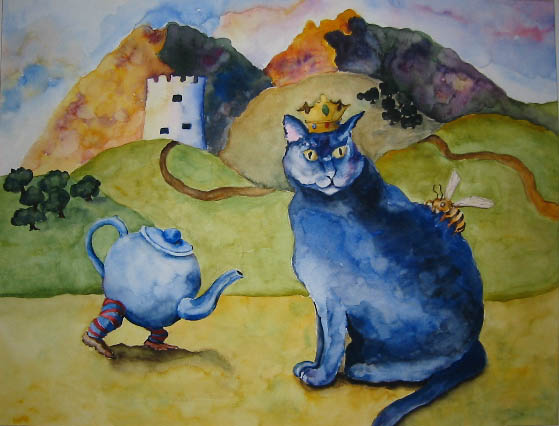
The Warriors books, by Erin Hunter, in which a house cat discovers clans of cats living in the wild in the forest…. First book: Into the Wild.
The Wildings books, by Nilanjana Roy, in which a small band of cats lives in the alleys and ruins of Nizamuddin, an old neighborhood in Delhi, India.
The Feline Wizards series, by Diane Duane, in which feline wizards time travel to avert disasters. First book: The Book of Night with Moon.
Tales of the Barque Cats, by Anne McCaffrey, in which cats are essential members of the crews of space vessels…until an epidemic threatens their extinction.
For many, many more books with or about cats, hit up this gargantuan list on Goodreads of Great Cat Books (1,511).
The pinnacle of Schwab
There are a few authors whose books I pretty consistently love and will always read, and V. E. (Victoria) Schwab is one of them…with a caveat. She writes adult books and she writes for young adults, and I am passionate about most of the adult ones but not so much for the YA, which is too bad, considering YA is my “specialty” (having been a teen librarian for all those years). I can’t quite figure out how someone can be brilliant for one age group and less so for another, but there it is; although I like a few of her YA books quite a bit, there are others I found somewhat “meh.” For instance, although I enjoyed the Cassidy Blake series (meant for middle-schoolers), both the Archived and the Monsters of Verity novels left me wishing they had better world-building, less confusion, and more logic. I should say, though, that there are many teens who absolutely love her YA series, so perhaps Schwab is actually good at gauging how to write for teens, and I am just not that demographic and should quit talking!
For me, the two adult series where she really shines are Shades of Magic and this week’s re-reads, Villains, which begins with one of my all-time favorite books, Vicious.
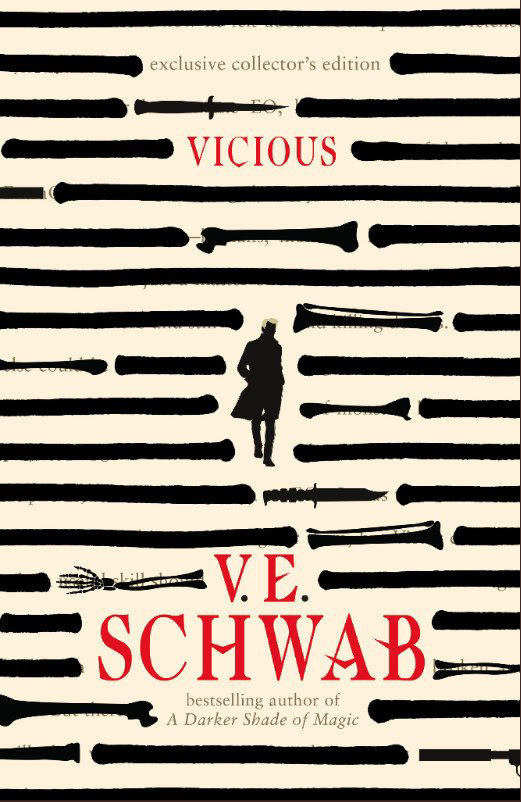
Vicious turns everything you think you believe on its head, in terms of likeable versus unlikeable protagonists (antagonists?), because it has one who is set up as a hero but who gives you the heebie-jeebies, and another, a supposed villain, who you root for even though in some ways he is a distinctly unpleasant person. Moral ambiguity is definitely the theme.
Vicious is elegant and spare, with just the right amount of detail and not an ounce more or less. It has an array of fantastic characters who come across fully fleshed out with only a few sentences of description. I can’t believe it was Schwab’s first book for adults—it’s masterful. I have read it at least three times (maybe four?), and its sequel, Vengeful, is equally as compelling. I wrote a review of the two books here, if you’d like to know more about them (before reading them yourself!). The other thing to know is that there is a third book coming. I don’t know when—Schwab has gone off in five different directions since she wrote this, from her massive The Invisible Life of Addie Larue to her ExtraOrdinary comics series (based on the Villains universe) and also the first book of a new YA series, Gallant—but we do know it will be called Victorious, and that there are already 25,000 people on Goodreads who have put it on their “TBR” list as soon as it hits the bookstores (no pressure, Vee!). I hope she doesn’t delay too much longer…
Hiatus, nostalgia, TV
I haven’t published anything here for a while because I started reading Demon Copperhead, the new book from fave author Barbara Kingsolver, and it has been taking forever. I am enjoying the voice of the protagonist and the high quality of her descriptive writing and somewhat quirky scene-setting, but the combination of the length of the book and the depressing quality of the narrative finally got to me at about 83 percent, and I set it aside to take a quick refreshment break.
I re-read two books by Jenny Colgan—Meet Me at the Cupcake Café, and The Loveliest Chocolate Shop in Paris—for their winning combination of positivity, romance, and recipes, and enjoyed them both. My plan was to go back to Kingsolver today, but instead I found myself picking up Dying Fall, the latest Bill Slider mystery by Cynthia Harrod-Eagles, which has been in my pile for months. I will get back to Demon Copperhead at some point, but the mood isn’t yet right.

Meanwhile, Netflix made me happy this weekend, having come out with season one of Lockwood & Co., adapted, partially written, and directed by Joe Cornish, and based on the young adult paranormal mystery series by author Jonathan Stroud. This has been a favorite series of mine since I read book #1 with my middle school book club and eagerly perused all the rest as they emerged from his brain onto the page (there are five books and a short story in it).
The series is set in a parallel world where Britain has been ruled for 50 years by “the Problem”—evil ghosts that roam freely, but can only be dealt with by children and teenagers young enough to be in touch with their perceptive gifts. Adults can be harmed by them but can’t see or even sense them, while the youth still see, hear, and sense their presence and fight them by discovering their “source” (the place or object to which they are attached) and either securing or destroying it.
The mythology seems to have evolved at least partially from faerie, vampire, and werewolf lore: The main weapons are iron chains, silver containers, running water, salt bombs, lavender, and longswords! The ghost-hunting teens are most of them employees operating under the supervision of corporate, adult-run agencies, but Lockwood & Co. is independent of adult supervision. It’s a startup existing on the fringes, run by two teenage boys—Anthony Lockwood, the putative boss and mastermind, skilled sword fighter and ingenious planner, and George Karim, the brainy researcher who provides background for their cases from the city’s archives. The two have advertised for and just recently acquired a girl colleague, Lucy Carlyle, who is new to London and technically unlicensed, but more psychically gifted than anyone they have ever met. This renegade trio is determined not just to operate on their own but to outdo the agency blokes in all their endeavors, so they take risks no adult at the corporations (or at DEPRAC, the Department of Psychical Research and Control) would sanction, in order to gain both notoriety and clients.

Cornish and his colleagues have nicely captured both the flavor of the overwrought atmosphere of beleaguered London and the perilous camaraderie of the principal characters—Lockwood, George, and Lucy—in their series. Season one covers the events from books #1 (The Screaming Staircase) and #2 (The Whispering Skull), so one assumes there will be at least one and perhaps two more seasons, if viewers make it popular enough for renewal. I certainly hope they do! But in case that doesn’t happen (or even if it does), the books are out there, and well worth your attention (and I don’t just mean middle-schoolers!).
Subversive, epic
This week when my Kindle ran out of juice and I wanted something to read before bed, I impulsively picked up a book I have read several times before (although it inexplicably remained uncatalogued on Goodreads): The Terrorists of Irustan, by Louise Marley. I have mentioned it at least twice before on this blog, but after reading it for, I think, the fourth time, I wanted to give it a space of its own, because I think it’s that important.
This book is hard to classify. It is science fiction, set as it is on a planet distant from Earth, colonized for the purposes of mining a precious material (rhodium) that is sold back to the industries on the parent planet; it is also powerfully dystopian; and it is definitely a feminist manifesto.

Lest any of those put you off from reading it, it is also a grippingly told story with powerful scene-setting and characters you won’t easily forget. If none of those themes sounds appealing to you, read it for the story!
The book takes place in the future on a planet that was settled by humans long ago, but the society on Irustan is ruled by the Second Book of the Prophet, and mirrors (and expands upon) the claustrophobic (especially for women) religions of middle eastern countries today. Everything is governed according to this restrictive religion, and as long as the rhodium keeps coming, Earth’s Port Authority on the planet refuses to intervene.
On Irustan, the men dominate every aspect of the culture, while the women remain virtually invisible: They do not appear outside the home without being wrapped head to foot in veils, and may not communicate directly with any man save their husband and the servants of their household, nor be seen by them. They may not own property, drive, or use a wave-phone. Their husbands have complete control over their destinies and those of their children. The highlight of their lives is “Doma Day,” once a week when the husbands all go to the temple and the wives and children are allowed to gather at the homes of their close friends to socialize, trade gossip, and share a meal.
The main character is Zahra IbSada, one of the women on the planet with a tiny portion of independence. In this world of male dominance, there is a strong taboo against even the acknowledgment by men of illness or infirmity, so any kind of medical treatment has to fall to a small group of women (fewer than 100 for the entire population of the planet) who are trained as “medicants.” They are a somewhat poor excuse for doctors, because their training is severely restricted, but they are aided by amazing medical technology from Earth, where machines have been developed that can diagnose illness and provide remedies directly into the bloodstream. The medicants are instructed in the use of these machines and most go no farther in their development as doctors.
Zahra is one such medicant, with better training than most due to the woman with whom she apprenticed, and also because of her own insatiable appetite for medical knowledge. The medicants treat the colonists injured in the rhodium mines, dosing them regularly with a drug therapy that prevents them from contracting a deadly prion disease from inhaling the dust, and also minister to any others who are sick or injured. This gives them an extraordinary knowledge of the private lives of those on their clinic list, and ultimately provokes Zahra to make a controversial personal decision in the course of her duties that will have unexpectedly wide ramifications.
Zahra is aided in this course of action by a Port Authority employee, a longshoreman who is in charge of delivering the medical supplies shipped from Earth to the various women’s clinics. Jing-Li comes from the ghettos of Hong Kong and used a job working for Port Authority as a way to leave Earth without having to go to college or obtain a career that would qualify a person for interplanetary travel, an option that was unavailable to someone from Jing-Li’s social class. The collaboration between the two is slight but powerful, and their fates end up being intertwined as Zahra seeks a way to change the oppressive social structures of her world.
Somewhere in The Handmaid’s Tale, Margaret Atwood comments about how extremist Eastern religions are not that different from extremist Western religions; The Terrorists of Irustan is Louise Marley’s example of a faux Middle Eastern counterpart to Atwood’s book, and I believe should be read with the same attention given to that classic. (And yes, it would make an amazing series as well!)
Interdependency
The empire in John Scalzi’s series by that name takes interdependence to new heights (pardon the pun, it’s set in space). As Wil Wheaton, narrator of the audiobooks, comments, “The Collapsing Empire [first book in the trilogy] works as a wonderful SF tale…but it also has important allegory, metaphor, and commentary on some things that are going on right now, for readers who are open to that sort of thing. For those who aren’t, it doesn’t beat you over the head with it, which is a neat trick.”
The few planets and many human habitats of various construction that are flung across the universe are connected by something called the Flow, which confounds natural physics by providing a river-like network between all the settlements. To use it for travel, spaceships must have a field that creates a “bubble” around them, whereupon they can onramp into the Flow, which carries their ship until they pop out at their destination, days, weeks, or sometimes months later—it’s somewhat predictable, but not reliably so.
The Interdependency has a top-down, static structure of emperox (the non-gendered term for their emperor), noble houses, trade houses, and everybody else. To keep all these widely spaced settlements together and avoid interstellar war, both necessities and luxuries have been assigned to or co-opted by the “houses,” which have monopolies on certain goods and services, for which the other houses trade and bargain, to the extreme that there are built-in fail-safes to ensure no one impinges on the monopolies. For instance, if a particular kind of fruit is sold, one would imagine that the seeds from that fruit could be collected by the buyer and grown elsewhere, thus disrupting the monopoly; but in anticipation of this, the produce has been designed so that the seeds go sterile after a short period of time, preventing anyone else from benefitting. (Don’t ask me how, just go with it.) The monopolies are jealously guarded, and there is a certain amount of jockeying for dominance amongst the nobles, but the empire’s structure is mostly stable, and lends itself to centralized control.
This has all worked for millions of years, barring an occasional assassination of an emperox, or a change in fortune for one of the houses. But all of that is about to change, for the simple and terrifying reason that the Flow has become erratic and, in fact, is about to fail in spectacular fashion, according to one lone physicist on the planet End, the furthest planet in the universe from the Hub, the center of the empire. When it collapses, most of the human habitats will be isolated within their systems and, without the cooperative network of supplies and services set up and supplied by the Interdependency through the Flow, they will fail to support their populations in fairly short order, presenting a stark fate of death by starvation or faltering life support systems.
Compounding this, the emperox who commissioned the physicist to research and report on the Flow has just died and, contrary to his plans and those of one of the other predominant noble houses, his illegitimate daughter, Cardenia Wu, has succeeded to the throne. She is naive, inexperienced, and not a particularly willing heir; but when the physicist sends his son, Marce, from End to the Hub to report the problem with the Flow to the emperox, Cardenia realizes she must rise to the challenge of saving as many as possible of the billions of people dependent on her empire. The noble and trade houses, of course, have other ideas, including eliminating Cardenia and putting one of their own clever but venal people in her place, and saving themselves (and their money, goods, and dominance) first, while leaving the commoners to their fates.
This is the rather long set-up and partial story of The Collapsing Empire, The Consuming Fire, and The Last Emperox.


This has been deemed a “space opera” by many reviewers and readers; I tend to think of space operas as the wild west played out in space, with smuggling, chases, and shoot-em-ups being more prevalent than, say, the thoughtful dissection of an empire into its component parts and the contemplation of what will happen to it, should no one take responsibility. The books definitely have some aspects of space opera, as there is a lot of adventure, multiple coups and assassinations (both attempted and achieved), and various exploding ships (due to both battles and sabotage). But along with all that are some amazing characterizations of both heroic and nefarious figures, along with some truly labyrinthine plotting, so the trilogy is a pleasure to read for both adventure-seekers and philosopher-anthropologists. Along with the clever, sometimes laugh-out-loud triumphs of one character over another, there is also much to consider from both an intellectual and practical viewpoint, with parallels, as Wheaton noted, to many aspects of our own culture’s functionality and possible future.
Scalzi has pulled off a coup, himself, by managing to marry the level of detail contained within his Old Man’s War series with the humor and humanity of his more lighthearted works (such as my favorite, The Android’s Dream). The dialogue is witty, the descriptions are engaging, the world-building is thorough, and the group of main characters who tell the story—the Flow physicist, the new emperox, the trade representative of a major family, and the wannabe traitor—are quirky, endearing, and profane. (If crass language bothers you, this is not the series for you!) I thoroughly enjoyed this three-part story, and couldn’t wait to see what happened.
Light but clever
Looking for a time-out from some of the more intense stories I have been reading lately, I picked up science fiction author John Scalzi’s latest stand-alone, The Kaiju Preservation Society, for some light relief, and it was just the break I needed.
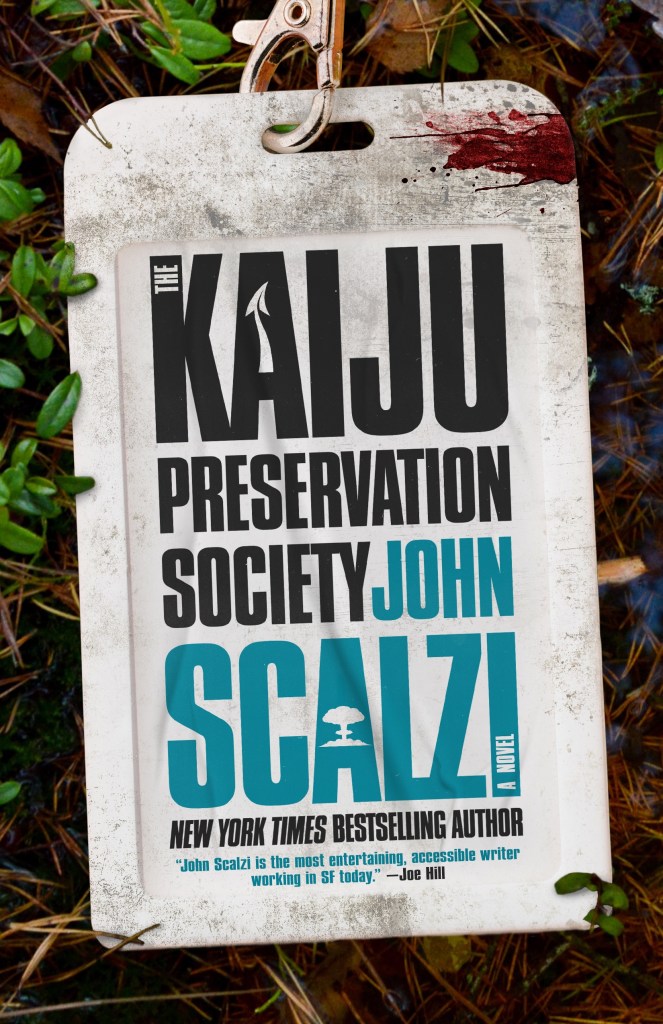
Protagonist Jamie Gray, a mid-level executive of the food delivery service füd-müd (you do get the significance of the umlauts, right?), is laid off during the Covid 19 pandemic with the option to take up a “career” as a delivery driver for that same company—which he does, because there’s nothing else on offer in the closed-door economy. He is saved from this mundane and less-than-lucrative existence when he makes multiple deliveries to a former college classmate, Tom, who solicits Jamie to join his team to work at an “animal rights organization” that is targeted towards “large animals.”
Tom has all the big-brained doctors of various subjects that he needs; what he doesn’t have, due to a last-minute dropout, is someone to do the grunt work of “lifting things,” which Jamie decides is a step up from pizza guy. Tom is a little cagey about the precise details, and Jamie will have to make a six-month commitment, but it still sounds better than what he has going on. So Jamie accepts Tom’s offer, only to discover that the endangered animal actually exists on an Earth that is an alternate, parallel reality to this one, and his job is to help the team keep the animals safely on their side of the border.
The Kaiju are the creatures who served as models for the movie monster Godzilla, and they’re not just big and hangry, they also happen to carry the capacity for nuclear explosions in their guts. Naturally, there are people in our Earth reality who are wanting to exploit this, and it’s the team’s mandate to protect “the universe’s largest and most dangerous panda.”
“KPS is not, and I say this with absolutely no slight intended, a brooding symphony of a novel. It’s a pop song. It’s meant to be light and catchy, with three minutes of hooks and choruses for you to sing along with, and then you’re done and you go on with your day, hopefully with a smile on your face.”
— Scalzi’s Author’s Note.
This book is every bit as goofy as it sounds, and the suspension of disbelief is gigantic, but it’s also witty, clever, and surprisingly relevant, with great world-building, a diverse cast, some fun science talk, and a lot of entertaining banter as a counterpoint to the crapfest that was the height of the pandemic. Finally, it was refreshing, in our current context, to have the rich and entitled tool of a bad guy get his comeuppance in several ways (minor spoiler). One Goodreads reviewer described this book as “Guardians of the Galaxy meets Jurassic Park,” and that’s a pretty solid vision of this cathartic distraction.

It’s not my favorite stand-alone by Scalzi (that would have to be The Android’s Dream, which is one of the consistently most entertaining books ever), but it’s definitely a pop treat.
 The Book Adept