A pirate and a serial killer
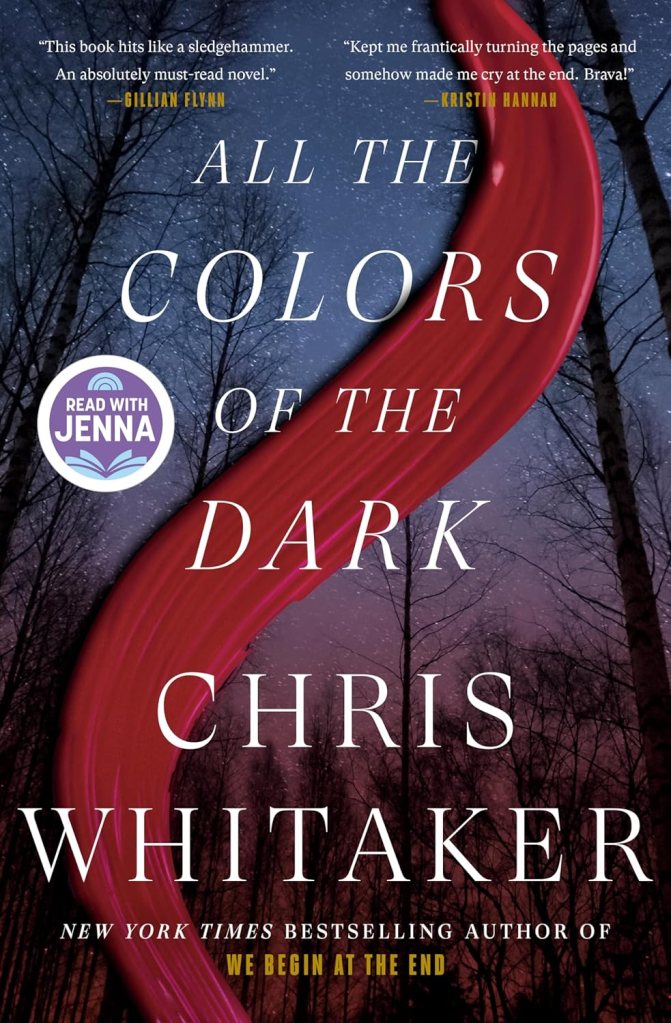
All the Colors of the Dark has been widely touted on all the Facebook readers’ pages I frequent, yet never really explained. The title alone made me curious, so I put it on the holds list at the library and waited a very long time for it.
When I started it, I was immediately filled with a sense of dejá vu; it reminded me forcefully of another dark, complex book I had read a few years back, but I couldn’t remember the name. I looked on Goodreads because I knew I had listed that book in my “coming of age” section, and then laughed; it was by the same author, Chris Whitaker, whose novel We Begin at the End bowled me over when I read it four years back.
I looked up my review of that book, and was not surprised to see that my description would pretty much do for both books:
“It is the saga of multiple people caught up despite themselves in various forms of tragedy they are mostly unable to avert.”
There are other similarities: The main characters begin as young teens with absent or derelict parents; they live in a small town and are outliers in their peer group; and they have an odd array of adults who try to look out for them but are mostly no match for what’s coming to them.
There are two characters around which the story revolves. The first is Joseph “Patch” Macauley, a boy born with one eye. His mother tried, in his younger years, to ameliorate this by sewing him a series of eye patches and buccaneer vests to let him play the pirate, but that may have made him even more of an outcast. The second is his best friend, Saint, a girl raised by her grandmother to be uniquely herself. In a small Missouri town where 13-year-old girls are mostly yearning to dress up, wear makeup, and start going on dates, Saint is more inclined to wearing overalls and keeping bees. The two are pretty much inseparable, each for their own reasons. Saint loves Patch and also wants to help him; Patch believes that Saint’s primary emotion for him is pity, because she invites him to dinner as often as she can, knowing that his mother can’t seem to hold down a job or keep the electricity on and the refrigerator stocked.
There is a girl at their school named Misty, a girl so far out of Patch’s league that even to speak to her might be considered sacrilege by her crowd of friends, a rich girl, a beautiful girl, a girl who takes life lightly—until the day she is kidnapped. Patch becomes her unexpected rescuer, and this act is like the butterfly that causes the tornado, enveloping everyone in his vicinity in chaos.
This book, like the other, is a complex interweaving of mystery, thriller, love story, and coming of age—or perhaps not that, but coming into one’s own. It’s about friendship, love, obsession, degradation, inspiration, hope. As with the first book of Whitaker’s, I don’t want to say too much more about the plot, partly because it’s too complicated to describe, but mostly because when you read it you need to do so without knowing what’s going to happen.
The thing that makes me know this is a great book is that it has some flaws that I would normally have been critical (or even scathing) about in a review. It’s far too long; at one point I thought I must be at least three quarters done, but looked at my Kindle gauge and discovered I was only 52 percent in. It has vastly unbelievable details and plot twists that, again, in another book I might have scoffed at. And he does what I dismissed in my review of the book Things You Save in a Fire as unforgiveable: He writes what feels like the end, but there are five more chapters, each of which also feels like the end until you finally get to the end. I usually hate that, but here I wanted so much to know what happened in every circumstance that I was grateful to turn a page and find more book behind it.
It’s not an easy book to read, for many reasons. There is a lot of tragedy and, just when you feel like you have encountered the worst, there’s more. But it’s also a book full of unexpected lightness and even humor, and if you are a fan of beautiful language and imagery, you will be captivated.
I won’t say it’s not a challenging read; but for me it was all-enveloping and, in the end, vastly satisfying. I will think about it for a long time.
Malbrey #2
I had no real intention, after finishing Gentlemen and Players, of continuing to read the Malbrey series (or at least not now), but the sequel was available at the library while everything else in which I was interested was wait-listed, and I did kinda want to know what happened next and to whom, so…I checked it out.
I almost quit reading Different Class about 30 percent in because, in the flashback portion of the story, one of the little sociopathic boarding school boys tortures a mouse, and I really don’t need to be reading about that right now.

But…I kept going. And it was for one specific reason, which was that I haven’t recently encountered another author whose use of metaphor and language spoke to me like Joanne Harris’s does.
One example was when a new teacher joins the staff and the protagonist (Classics Master Roy Straitley, still) notes that he’s a “Suit,” and basically falls into line in every respect with Dr. Devine, his mentor on the staff. Straitley remarks that the new teacher is “a bonsai version of himself,” the most vividly literary way ever to say that Dr. Devine has a “mini-me.” I love a literary phrase that also makes me laugh out loud and picture Mike Myers in a bald cap and a white suit.
Another is when Straitley is reflecting about the new school Head, who has turned out to be one of Roy’s troubled students from 20-some years ago, and ruminates, “”He’s the one releasing the ghosts, like a child with a magic lamp that, instead of casting light, releases nothing but darkness…”
Then I hit the 50 percent mark and decided that, after all, literary language could only make up for so much. The animal torturer moved on to multiple and then increasingly more horrifying subjects to satisfy his “condition,” as he calls it, and yeah, it turns out that I’m one of those bleeding hearts who can cheerfully regard the murder of a fellow human being when it furthers the mystery, but draws the line at killing off the dog (or pulling the wings off of flies, for that matter). Basically, the balance shifted and I cared less about literary expression and more about not putting any more nightmarish visions into my long-term memory. So Joanne Harris will have to find another reader, because although this guy will probably get his in the end, I can’t bear to read through all the things he did to deserve it. On to less disturbing material…
Plagued by the penultimate
Have you ever reached the denouement of a book, the place where all the hints and clues and separately insignificant moments are tied up for you so that you have that blinding flash that the author has purposefully manipulated, that one in which you say “aHAH!” and suddenly understand everything that has been happening? You feel so satisfied with that moment of revelation, only to turn the page and realize, after flipping even further, that there are still multiple chapters to go in the book—and maybe you felt impatient and somewhat robbed of your moment at having to keep reading?
I, like so many other people, have incorrectly thought of the word “penultimate” as meaning the last, or the greatest, something that is somehow beyond the ultimate when, in fact, the definition of penultimate is, in Brit-speak, “the last but one,” or in American, next to last. It is the part just before the last. And this is what I see as a big flaw in so many books, the most recent one I have read being Gentlemen and Players, by Joanne Harris of Chocolat fame.

I have mentioned several times in various reviews on this blog how much I loathe an epilogue—the wrap-up in which the author apparently grows tired of showing the reader and decides to tell instead, an action I almost always consider an easy out. I wrote about it most notably in my review of Things You Save in a Fire, in which the author wrote a near-perfect ending but then continued past it to wrap up each and every little hangnail, robbing the reader of the feeling of completion in order to give the author the satisfaction of thorough explanation. I concluded that review by saying, “The difference between an author who knows when to quit and one who doesn’t can be as slight as 20 extra pages, but what a difference it makes. After all, isn’t imagination a big part of enjoyment when it comes to the peculiar habit of reading?”
This was also my experience with Gentlemen and Players.
There are two narrators in this book about a posh British boys’ school called St. Oswald’s: the classics professor, Roy Straitley, otherwise known as Quasimodo (his room is in the Bell Tower and, yes, he’s a bit hunched), and a mysterious antagonist who shares a complicated past (and a deceitful present) with the school and whose stated intent from the beginning is to bring the school down by irretrievably tarnishing its reputation. Straitley (for the most part) narrates the action taking place in the present, while the mystery person is concerned with telling about the experience of being raised in close involvement with the school and its professors, students, administrators, and staff, but nonetheless remaining an outsider, never being able to be of the school. It is an exploration of age, gender, class, work ethic, and values—but all of those are subsumed in its identity as a psychological thriller, a cat-and-mouse game.
The prose is literary, as is appropriate for a tale about a school that still values the teaching of Latin (its motto is Audere, agere, auferre—to dare, to strive, to conquer); but we are at the juxtaposition of old and new as dusty classrooms make way for computer labs and crusty eccentrics have to learn how to check their email to get departmental updates.
The mystery part of the plot is undeniably thrilling; but in order to reach it, there is a lot of set-up in the present and a lot of flashback to the past that is occasionally a slog to navigate. I’m not saying it’s not necessary; I’m just not sure the payoff is adequate. I will say that it is quite crafty, and the twists and turns the story takes are worthy of a Patricia Highsmith novel. But after experiencing the major revelations near the end, I could have wished that they had been the finale, rather than the penultimate. Granted that there are sequels and the extension of the story beyond its climax does lead the reader towards those stories; but I’m not sure I believe the let-down from that rather spectacular revelatory climax was justified.
There are three sequels to this book, although I find it hard to image there is that much more material to explore here, and you could easily read this as a stand-alone and be done. I may read the others at some point, to find out. I have vastly enjoyed some of Harris’s other works, including Chocolat and Peaches for Father Francis, Five Quarters of the Orange, and Blackberry Wine.

One purely cosmetic warning about this book: If you decide to read it in Kindle form, as I did, you may find it quite confusing when the narrator switches from one protagonist to the other, because there is no indication of who is speaking, beyond tone and context. In the hardcover and paperback books, symbolism in the graphic form of a White King or a Black Pawn from a chess set at the beginning of each chapter signalled from whom we were hearing. This would have been easy to incorporate on the Kindle version, and that they didn’t was a problem.
Chartreuse
I just finished reading The Grey Wolf, Louise Penny’s latest (#19) in her Chief Inspector Armand Gamache series, and I am torn.

On the one hand, I found myself thinking, during the course of the extremely intricate narrative in which both the reader and Gamache himself are unsure who can be trusted, who is in the know, and who is culpable, that I was enjoying a complex plot in which I wasn’t sure, at any moment, what was to happen next, or who was responsible. I have been reading too many suspense or thriller novels recently that had about as much subtlety as a romcom and disappointed my need for intelligent thought. From that standpoint, I appreciated the complexities of The Grey Wolf. I also enjoy Gamache’s philosophical musings about people and life, and his lyrically worded observations of nature. So there were definitely things to like.
On the other hand…

I found myself agreeing with another Goodreads reviewer, who said about this plot, “Penny needs to go back to solving homicides, not national security and international intrigue issues.” It seems like she is making a shift to writing thrillers rather than mysteries. I also agreed with several others who opined that although the plot itself is pretty clear—there is a scheme to poison the drinking water of Montréal by a ruthless person or persons who don’t mind killing anyone who knows anything and/or speaks out—the working out of it, with the jaunts to Washington, D.C., Rome and France, to obscure towns in the wilds of Quebec and to cloistered monasteries whose recipe for a well-known liqueur is another red herring, is overly convoluted and, honestly, somewhat ridiculous. I became skeptical that there was literally no one in the government to trust, other than Gamache’s son-in-law Jean-Guy Beauvoir and his compatriot Isabelle Lacoste (this must be the most corrupt government in Canadian history!) and somewhat bored by the round-and-round nature of clues that led to nothing but more obfuscation.
So…although I am always happy to discover a new Gamache mystery, this one left me more dissatisfied than not.
Also, on a separate topic, am I misremembering, or has Penny rewritten “history”? How is Gamache still in his 50s? I can’t recall the specific book, but I thought he had passed into his 60s in a previous story. And didn’t his godfather, Stephen Horowitz, who is referenced in this book, die in Paris, in All the Devils Are Here? And although I did remember the involvement of Gamache and Beauvoir with the Gilbertine monks from A Beautiful Mystery (book #8), all this back story about this “old adversary” who is now assistant to the deputy prime minister—is my memory so bad that I simply don’t remember that plotline, or WAS there no book and Penny is just making up a shared past for them for The Grey Wolf?
I’m not ready to call it a day on the further tales of Chief Inspector Armand Gamache of the Sûreté du Québec (especially because this book ended on a cliffhanger), but I’m approaching them with less expectation of true love than I used to do.
Giving up Cheetos
If you read only my last couple of posts, you would conclude that I am an overly critical nonreader rather than a lover of books who wants to share my experiences! I assure you that’s not the case, but…hmm.

Last year I read The Housemaid and The Housemaid’s Secret, by Freida McFadden, and likened them to Cheetos: Addictive and entertaining but not in any way subtle or nutritionally redemptive. At the conclusion of my review of the two books, I commented that I was looking forward to book #3 in the junk food franchise. The Housemaid is Watching released a couple of weeks ago, on June 11th, and somehow there was an E-book copy available from my library’s catalog (maybe that should have seemed more revelatory), so I checked it out and got ready to pick up Millie’s story the minute I was done with Veridian’s and with Walt’s (see last two blog posts).

I went to Goodreads and read the synopsis, which places us 11 years after the activities of book #2; Millie has married Enzo and they have a couple of kids, and after scraping and saving for years they have managed to buy a house in a somewhat snooty suburban neighborhood. Millie is thrilled to have finally achieved this pinnacle, but soon, inevitably, things begin to go wrong, starting with weird neighbors, children acting out, shady/skeezy behavior from her husband…in other words, typical Millie World.
I was all set to start indulging in a feast of salty orange puffery when I paused to read some reviews. The first one was a five, but the rest…well…some adjectives included “underwhelming,” “unbelievable,” “messy,” “predictable”…. As a result, what this turns out to be is not a review but a renunciation of a certain level of junk food. Some of the complaints served to remind me of the frankly unbelievable plot points from the previous book and my reaction to them, and I decided to follow my instincts with reading the way I have learned to with actual food: Seek out something that has both substance and the flavor factor—in other words, get the yummy potato chips that are kettle-cooked in the good oil and are doused in half the salt, and forego the fake cheesy stuff that will tantalize but not satisfy.
I guess I now have a new category: Instead of “DNF” for “Did Not Finish,” it’s “DNS” for “Did Not Start.” It won’t count for my Goodreads total for the year, unfortunately. Now to scope out my next book with high hopes for a good report….
Darlings
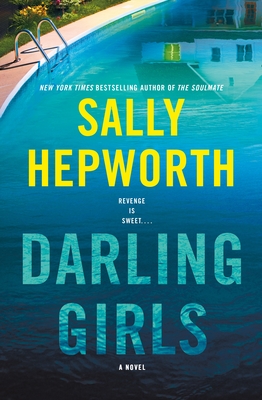
The title of this book is pretty good at pointing up the false affection shown to three foster children by a deeply narcissistic sociopath masquerading as a loving foster mother. I don’t have a lot to say about this book; I enjoyed it less than my favorite of Sally Hepworth’s (that would be The Good Sister) and more than my least favorite (The Mother-in-Law), so it falls somewhere in the middle with the others of hers I have read (three to date).
I did like the format Hepworth chose, in which we get the alternating point of view of each of the three foster sisters—Jessica, Alicia, and Norah—in adulthood and also in childhood (present and past). I didn’t care much for the psychiatrist session segments of the book, mostly because I was so uncomfortable with the way she wrote the therapist’s part (he was so repellent!), but it did render a little more intrigue as the story went on. I felt like the murder mystery was a bit generic—I mean, after we get an idea of who Miss Fairchild (the foster mother) is underneath her sugary sweet façade, it’s hard to believe any red herrings about who could have been responsible for the body buried under the house (that’s a minor spoiler, we find out about the body almost immediately). But the thought that the killer (if there is one) might get away with it definitely carried the suspense further, a good move on the author’s part.
I think part of the reason I didn’t love this book, apart from it feeling obvious in some respects, is that I didn’t feel a strong connection to at least one of the foster children (which turned out to have some basis in reality). I won’t say which one, because that would spoil things further. But it was a fairly engrossing read, and I think most people would find it a quite satisfying example of relationship fiction with a suspense twist. It also points up the ongoing problem of the way fostering is handled and the many opportunities for abuse of that system, which I appreciate.
Three stars out of five for me. But you might like it better.
Books to TV (or movie)
I am usually quite critical of how a favorite book is translated to television or movie form, and in the past I would most likely have favored the book over the visual version almost every time. But in this day of bountiful offerings on a dozen pay channels, the properties are bought and transformed at such a rapid rate that I have found myself getting to know stories and characters on my television screen ahead of reading their origin stories, and in some cases I have to confess that I have enjoyed them far more than I later did the books.
Some for-instances: The writing is sharper and more clever in Shonda Rimes’s Bridgerton than in the books, so much so that I didn’t even finish reading the first book. The racial themes and the character motivations depicted in the Hulu production of Celeste Ng’s Little Fires Everywhere were less enigmatic and more relateable than in the written version. And although I read it first and gave five stars to Liane Moriarty’s suspenseful and engaging Big Little Lies, I equally loved the HBO version for the sheer star power represented and how well they pulled the whole thing off.
I also have to give exceedingly belated and somewhat awed credit to the team of Denis Villeneuve, John Spaihts, and Eric Roth (co-writers) and Villeneuve again as the director of the new version of Dune. After suffering through David Lynch’s 1984 version and Sci-Fi Channel’s three-part miniseries in 2000, I found myself devoutly hoping that no one else would try to take on the depiction of this classic on film or television, but the new one feels, finally, like the intentions of Frank Herbert have been realized.
This all brings me to my latest book-vs.-television experience, which has been quite a bit bumpier and more jarring than anything I have yet mentioned.
I started watching the ABC TV show Will Trent with its premier episode, and immediately fell in love with the protagonist, his dog, and the rest of the excellent cast. I didn’t even realize, until near the end of Season Two, that the material came from a series of novels by author Karin Slaughter; the minute the season ended I decided I would spend the time until Season Three reading the original stories. And what a shock it was….
First of all, let me say what things are similar about the series. Will Trent and Angie Polaski grew up as lifelong friends in the foster child system. Will now works for the Georgia Bureau of Investigation (GBI), while Angie is a police officer (Vice) for Atlanta PD. Will’s boss is named Amanda, and she knows a lot about him. Her secretary’s name is Caroline. There is a police officer named Michael Ormewood. And there is a cheeky chihuahua named Betty, an adorable but somewhat ludicrous pet for Will. And…that’s pretty much it.
In the TV series, Will is short, compactly built, and Latino. In the books, Will is tall, blond, and blue-eyed, with significant facial scarring. In the TV series, Angie is tough on the surface but exceedingly vulnerable not too far beneath; she is struggling desperately to stay clean from a severe drug habit, and is involved with Will in a sexual relationship that occasionally verges on emotional. In the book, Angie is tough almost through and through, with a tiny bit of her left open to caring for her friend Will; they “broke up” almost two years ago, because Angie knows she’s not good for him and needs to leave him alone if he’s ever to achieve happiness with someone else. On TV, Will is almost immediately paired with Faith Mitchell as his new partner, while in the books she is still on the horizon by the end of book #1. On TV, Michael Ormewood is Angie’s partner on the police force and also works frequently with Will. He’s not entirely likeable, being reckless and kind of a chauvinist, but he’s basically not a bad guy. In the books, well, that would be a spoiler, but Ormewood isn’t who he seems. He’s also short, compact, and dark-complected in the books, while he’s tall, blond, and blue-eyed in the TV show—the exact opposite of the Will-to-Will transition! The only consistent character between the two mediums is Betty.

After having loved the TV show so much, I struggled for the first third of the book with the written versions of these characters. I came to terms most quickly with the character of Will, because despite the physical differences, the inside person is consistent, from the crippling guilt to the dyslexia to the brilliant insights, and the outside Wills both wear three-piece suits as armor. But I mourned the loss of the vulnerable friend/lover Angie, and when I read in the afterword that there is a “legitimate” love interest for Will starting with book #2, I wasn’t sure I wanted to continue. As for Ormewood…I don’t know how I can look at TV Michael the same after reading about Book Michael. By the end of Triptych I had subconsciously decided that it was worth continuing with Slaughter’s written version, but I honestly don’t think I’ll ever find these people either as likeable or as engrossing as the TV characters, and that’s a real departure for me!
Someone in my “Friends and Fiction” Facebook group told me that I should go back and read the series Slaughter wrote before she arrived at the first Will Trent book in order to thoroughly understand the back story; perhaps I will do that and see where it gets me.
Finlay’s road trip

I was excited to get the notice from the library that Finlay Donovan Rolls the Dice, the latest in the series by Elle Cosimano, had landed on my Kindle this week. The overwrought novelist-turned-criminal’s story continues right from where Book #3—Finlay Donovan Jumps the Gun—left off. The open questions at the end of that book: Will Finlay’s nanny, Vero, get out from under her debts to low-life underworld characters? Will her sister Georgia manage to make things last with new FBI girlfriend Sam? Will Finlay convince ex-hubby Steve that things are over between them, and will she finally manage to have a real relationship with police detective Nick—a problematic quandary since she has participated in so many criminal activities to which she can’t “cop,” pardon the pun. Will Finlay and Vero take back the Aston Martin that someone stole from them and also rescue Vero’s crush, kidnap victim Javi? There were so many dangling threads to remember that I almost immediately wished I had stopped to reread #3 before assaying #4!
Because I had read that book within days of its release more than a year ago, it took me a while to get into the rhythm of this new book. The series is really one long story, so you have to be up on all the events from page one of Book #1 in order to really get what’s going on. You also have to understand what this series is and what it is not; while there is a boatload of illegal activity taking place on its pages, it’s really more of a French farce than it is a mystery or thriller, although the fast pace and quick twists and turns certainly make it exciting. Someone on Goodreads compared Finlay and Vero to Lucy Ricardo and Ethel Mertz and, although they are smarter and more savvy, the relationship between them and among all the other disparate characters, from teen hackers to police officers to mob bosses, does bear a certain similarity—and that chemistry is Cosimano’s real advantage.
In Book #4, the cast all take a complicated road trip to Atlantic City in pursuit of their various objectives—and everybody, and I mean everybody, comes along, from Finlay’s mom, kids, and ex-husband to all the cops (crooked and straight) and criminals (major and minor). There are numerous misdirections of everyone involved, no one seems to have a real handle on what’s going on, and all are giving a good imitation of chickens minus their heads.
My ultimate conclusion after reading this chapter in Finlay Donovan’s story is that it was a little too busy. There were so many things happening to so many people all at once, and their connections were sometimes so confusing (wait—who is Ricky, again?) that it was hard to keep straight at times, which meant there was less focus on the strengths of the franchise—the snarky banter, the romantic entanglements, the misunder-standings that propel the heroine and her cohorts. I did enjoy it, but I’m glad that a few characters permanently exited the page (no, I’m not saying who, though some will be a surprise and others not) so that perhaps the next book will be less frenetic and more tightly focused. I did enjoy getting to know Finlay’s mom, Susan, but I also wanted a little more of the Nick/Finlay inter-action, I wanted to hear about Zach’s progress with potty training and Delia’s latest faux pas; and the characters’ days-long lack of sleep and irregular meals made me almost as tired as they were!
I hope that Elle takes a deep breath and keeps everyone closer to home for the next one. Yes, there will be a next one—there was a significant cliffhanger at the end of Dice about nosy neighbor Mrs. Haggerty that leaves us waiting eagerly for its resolution in (sigh) another year!
Marine biology and spies
While awaiting about six different e-books on my “holds” list at Los Angeles Public Library, I succumbed to one of those BookBub daily reading recommendation emails containing various books they offer for between 99 cents and a couple of bucks—which is unfortunately about what some of them are worth in terms of writing and readability. But I have to say that Immortal Red, by Keith Hummel, surprised me in a mostly positive way, and I enjoyed working my way through its labyrinthine story line and getting to know its many, mostly nefarious characters.
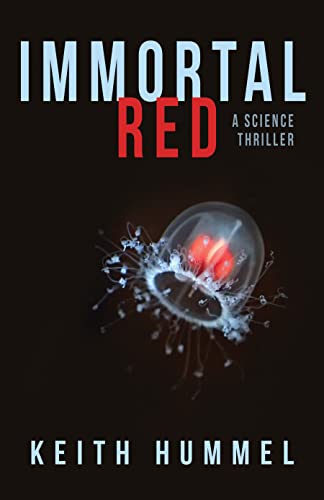
The description of the book in blurbs and on Goodreads leads one to believe that it’s heavy on science: A marine biologist snorkeling off the coast of Cape Fear, North Carolina makes the chance discovery that Turritopsis dohrnii, a dime-sized jellyfish with a bright red stomach, seemingly has the gift of immortality. At the moment of death due to old age or massive trauma, the jellyfish has the ability to fully rejuvenate at a cellular level and emerge as a young adult again. After collecting specimens and observing numerous repetitions of this phenomenon in her lab, the scientist applies for research grants and thus brings herself to the attention of an elderly black-ops CIA mastermind who wants her to develop practical applications for humans—in other words, make him immortal. He has a plan to dole out this secret miracle to an elite group of people who he envisions subsequently running the world, with him, of course, spearheading things.
When the scientist isn’t in agreement with his goals and hides any positive outcomes of her experiments, things don’t go well for her or her husband, a wannabe spy under the sway of the megalomaniacal CIA guy and his minions. Then ensues a breathless search for the scientist’s research, and the story morphs into a full-throttle CIA spy novel.
Reading this was initially a little slow, because almost the entire first half is basically developing knowledge and back story; but once the research is in the wind, things take off and get increasingly exciting. The writing flows naturally, the characters are fairly well developed (for a fast-paced thriller, that is, not at the level of literary fiction), and the conversations and interactions ring true.
This is a first novel for Hummel, who has on his resumé many elements that make him well qualified to write this book: “Keith Hummel has more than 70,000 hours as an emergency medicine physician. He has flown helicopters, driven tanks, and restored classic Porsches. He is currently the medical director for a major defense contractor.” He also operates as DoctorFiction on Tumbler, where he assists other novelists in the effective use of medical and trauma situations.
Word to those who don’t like sequels: The book wraps up some things, but ends on a pretty significant cliffhanger. So don’t put in the time if you aren’t willing to wait to see what happens to the survivors!
Silence is golden

I picked up The Silent Patient, by Alex Michaelides, on the basis of a bunch of enthusiastic reviews by people on two Facebook reading group pages, and after finishing it, I have to ask…WHY?
I’m not going to use up a lot of space on this one. You may decide to read it anyway, and be as enamored of it as the many who gave it five stars on Goodreads. But here are my thoughts:
The main character is a psychotherapist, but his actions in this book lack any credibility, and in fact may well do a disservice to those who are considering therapy. It’s not the character himself (although I found him to be an unsympathetic one practically from the first page), it’s the lack of knowledge exhibited by the author concerning mental health diagnoses, treatments, and medications. Yes, it’s fiction, and in some instances I would say, Read it for the plot, the suspense, the twists, and don’t pay too much attention to minor inaccuracies; but this book goes too far. The drugs he mentions don’t act as he says they do. The treatment methods are slipshod and would never be tolerated by any facility for whom a licensed psychotherapist would work. The procedures in the supposedly locked and secure facility are laughable. The personal interactions between doctors and patients, doctors and doctors, spouses, and strangers on the street are not believable.
Aside from that, the characters are wooden, the plot is all over the place—including half a dozen unnecessary sub-plots that are nothing but blatant red herrings to distract you from what the other hand is doing—and there’s a fair bit of misogyny exhibited by most of the male characters, and uniformly negative portrayals of the female ones.
My headline for this review may be misleading: You could have taken it to imply that this book with “silent” in the title is golden, i.e., I’m recommending it. You would be wrong. While it may have turned out to be golden in terms of profits, my sole piece of advice would be to take it off your TBR list and breathe a sigh of relief that I saved you from wasting valuable leisure reading time.
 The Book Adept