Starts with “D”
I haven’t been on here for a while because I started reading a trilogy and decided that, since all three books were already published and I could read straight through it, I would wait until I was finished and review the whole thing.
The trilogy is by author Brigid Kemmerer. The books are Defy the Night, Defend the Dawn, and Destroy the Day. I can’t say that I totally get the significance of each book title in context of the overall story, but you have to call them something, right? And alliteration always sticks in the brain…
I first discovered Kemmerer when I noticed her “Elementals” series in the YA stacks at the library, about four brothers with paranormal powers. I wasn’t drawn to those at all, and never read them, but when I read her stand-alone non-fantasy young adult novel Call it What You Want, I was bowled over and immediately followed up with the duology Letters to the Lost and More Than We Can Tell, and then found her other stand-alones.
When she started writing fantasy again, I felt confident to buy these books for my teen readers, but I had a little misgiving, because her first outing in the Cursebreaker series was a retelling of the Beauty and the Beast story. Since I would always prefer an original story to a retold tale, and since B&B is also one of my least favorite fairy tales, I almost regretted it; but I liked her writing enough to give it a chance, and ended up appreciating what she did to make it less sexist and cringeworthy! I never got around to reading any of the sequels, because I concluded that her real strength lies in writing about real teenagers in the throes of their confusing, sometimes difficult lives. But when I noticed this new trilogy and realized she had just finished it, I decided to check it out.
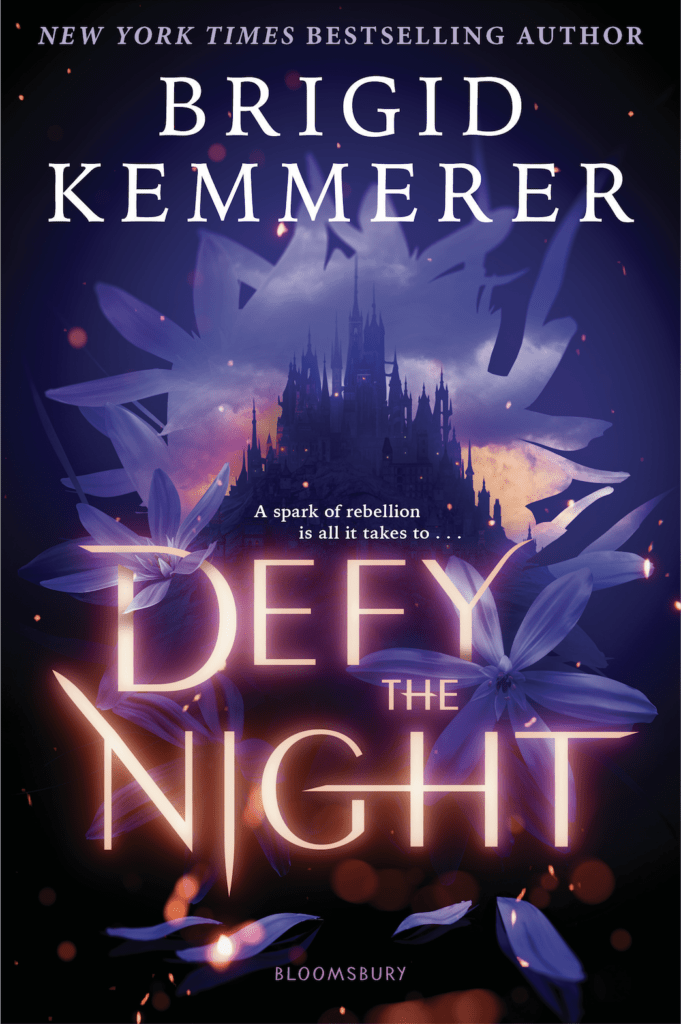

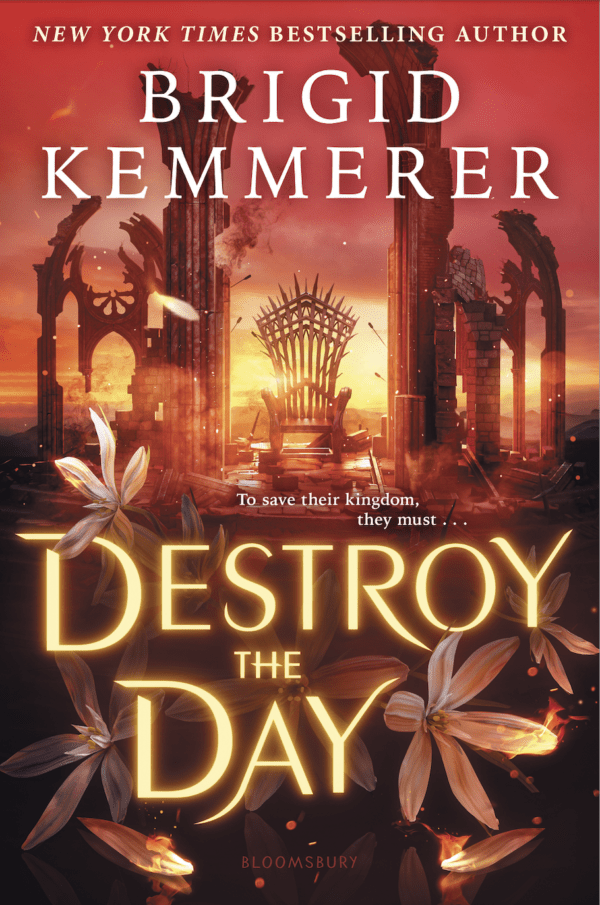
I did enjoy it; but I don’t think it changed my mind about where her true gifts lie, and I’m kind of sorry about that, because it seems she has fully committed to fantasy at this point in her career. Don’t get me wrong: The books are good, with flowing prose, great characters, decent world-building, and an original fantasy story (not a retelling this time). I just like her contemporary teen novels much better.
These are likewise meant for older teens; but that was one of the things I had a little difficulty accepting. The main characters, including the king and his brother the king’s justice (think enforcer) are all supposedly under 20 years old and, given that they have been ruling the kingdom of Kandala with an iron hand since they were 18 and 15, believability was strained. When in the third book the younger brother (Corrick) turns 19, I immediately thought yeah, no way. The story would have been much more realistic had the characters started out in their early 20s, but I guess that would disqualify the books for YA publication?
This trilogy is filled with political intrigue and drama. The basic plot is this: Harristan and Corrick’s parents are assassinated by one of the kingdom’s consuls, and Harristan becomes king of Kandala at the tender age of 17. Shortly after the brothers find themselves thrust into power, a devastating illness begins to spread throughout the kingdom. There is a remedy, a flower that grows in just two of the districts of Karala, each ruled by a consul, but the availability of the elixir made from Moonflowers is limited and the consuls who control its source are holding the kingdom hostage by doling it out selectively and at a high price. There isn’t enough to keep the common people from sickening and dying, and rebellion seems imminent.
Prince Corrick, frustrated by his role as King Harristan’s enforcer of the strict laws against smugglers and illegal traders of the blossoms, sneaks out at night to meet up with commoner Tessa, a young apothecary whose parents died trying to help their neighbors. He masquerades as Weston Lark, a young revolutionary, and the two bring doses of the elixir Tessa brews from the petals they are supposedly stealing from the palace to the folk living in the Wilds, but it’s never enough. Events take a turn that cause Tessa to try to sneak into the palace to confront the king, but her intentions in taking this step are changed when she discovers that nothing is as she expected when it comes to Harristan and his brother.
There are several big twists and surprises starting in the first book and continuing in the other two. In the second, some of the characters respond to an offer of help (and trade) from the neighboring kingdom of Ostriary and agree to go there to research the possibilities, leaving King Harristan to try to fix his dangerously divided kingdom, and the third book wraps all of it up and brings everyone back together. I don’t want to say more than that about any of it, because if you plan to read it you will need to experience it as you go, but it’s sometimes great, mostly good, and also has its occasional dull moments or weird segues like most fantasies do. There are a few things that frustrated me because they either suffered from inadequate explication or remained completely a mystery; but over all, a worthy effort. Kemmerer’s lively and interesting characters are, as always, her strong suit.
Diana Wynne Jones
I have spent a lot of quality reading time with the novels of Diana Wynne Jones. Although she writes mostly for middle-schoolers, there are also a handful of books that, while ostensibly for the younger set, have content possibly more suited to the adult fantasy reader. My favorite of hers is Howl’s Moving Castle, which is definitely one of those that appeals to a wide range of ages; I also enjoyed its two sequels, which are not up to the first one but are nonetheless good. And I will argue with devotees of Miyazaki that if you have only seen the animated movie made about Howl, you have not experienced Wynne Jones’s version; while the film is a truly delightful visual expression, it doesn’t begin to offer the nuance of the book itself. The other series of hers I have read and enjoyed is the Chrestomanci Chronicles, which are near-perfect fantasies for middle-schoolers. I have not read Dark Lord of Derkholm, but will no doubt get to it one of these days, as I will the Dalemark Quartet.
Her stories often combine magic with science fiction, bringing in fairy tales, heroic legends, parallel universes, and a sharp sense of humor that sometimes verges on satire or parody. There are levels to her books that are the key to making them enjoyable to a wide age range; young children can read them for surface enjoyment while older teens and adults get the jokes.
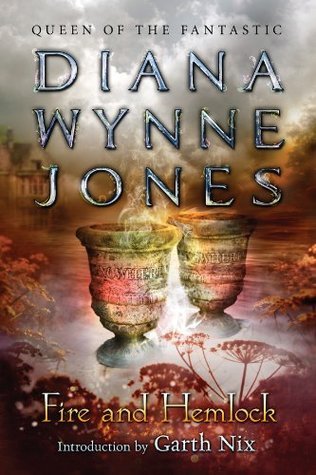
This past week I discovered that she also has some free-standing novels, and picked up Fire and Hemlock, which had an intriguing story line for which, in hindsight, I should have been better prepared.
The book owes its structure and character line-up to the ballad of Tam Lin, which dates from 1500s Scotland, and also to the story of Thomas the Rhymer, an actual Scots laird who lived from 1220 to 1298 whose story is confusingly similar to that of Tam Lin (both of them were kidnapped by the Queen of Elfland, although their destinies diverge after that initial act). I was embarrassingly unfamiliar with either of those legends going into reading this novel, and should have stopped the minute things got complicated and consulted Wikipedia for the synopses I finally ended up reading after I was done! Take heed of my experience and do that before you read this book if you want it to make sense. There are also echoes of both Hero and Leander and Cupid and Psyche, with echoes of T. S. Eliot. Diana Wynne Jones has written an explanation of her thoughts about the heroic that was included with my Kindle copy of the book, though it doesn’t appear except in later printed editions.
In the book, Polly Whittaker, 19, suddenly realizes that she has a set of double memories that began at the age of 10, which some entity is trying to make her forget. In the mundane set, she has been living an ordinary life: school, books, athletics, friends, irresponsible and uncaring parents, a loving but acerbic grandmother, and a boyfriend she’s not sure she wants. In the fantastical one, many of her actions are dictated by her sporadic but compelling friendship with a man she meets at a funeral, with whom she has an odd affinity. They experience some strange, inexplicable adventures together—are they truly magical?—but their friendship is threatened by menacing characters and events from which Tom Lynn attempts to shield Polly. She finally figures out what’s happening when it’s almost too late, and takes drastic action to secure both the memories and the relationship.
The book is such an odd mix of juvenile and adult that it was hard to read at some points, because it fluctuates between the mind of a young, naive girl and the definitely adult legend of a man in thrall to a wicked force that wishes to control his life. The narrative is carried by Polly, so we see everything through her clever and imaginative but innocent eyes, and if you are reading the book without knowledge of the backstory, it can be both frustrating and confusing, as well as long. I ended up liking it pretty well, and it’s probably Wynn Jones’s most ambitious plot in terms of the multiplicity of strands she introduces, but I was definitely happier with the straightforward, more mature, and somewhat humorous world of Howl’s Moving Castle.
Egypt by another name
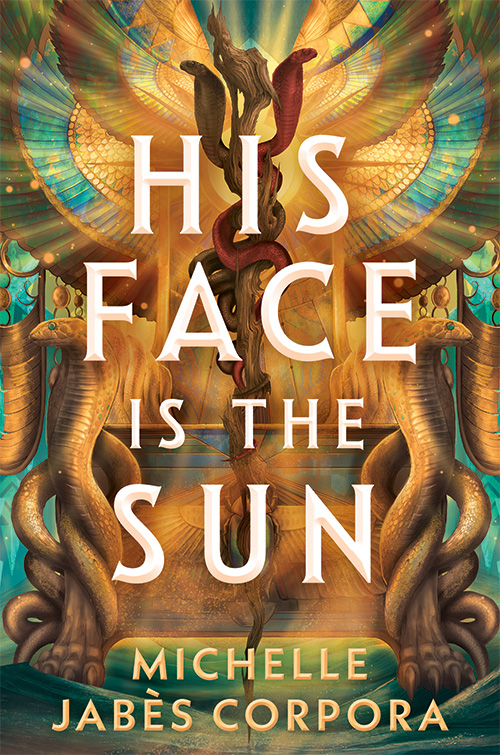
I picked up a Kindle deal for a new YA fantasy a few weeks back, and finally got around to reading it. The book is His Face is the Sun (Throne of Khetara #1), by Michelle Jabès Corpora, and it’s being billed as something that the readers of several other teen fantasy writers (Bardugo, Mafi, Tahir) would enjoy. And although I believe that is true, I’m not sure they should have focused it so relentlessly at the Young Adult market. In fact, I often feel that way when it comes to fantasy and science fiction.
In other genres (realistic stories, romance, coming of age), the audience can be clearly demarcated as teens, ages 13-18 or whatever—many adults aren’t interested in teen angst-ridden 15-yo first love stories. But with fantasy, if the world-building is thorough and convincing and the protagonists are engaging, I often feel these books are done a disservice not to be marketed widely. This one, for instance, ended up pretty quickly in the bargain Kindle bin (I think I paid $1.99), and it shouldn’t have, because it’s a really beguiling read. So adult fantasy lovers, pay attention and check it out, because if you enjoy it, there are two more books to come. (Also, this series is directed at more mature teens, due to some frank content, just fyi.)
The kingdom of Khetara is a faintly disguised Egypt, with some of the same gods under the same names and also under different ones, and similar dynasties of rulers and conquered peoples. It could almost be historical fantasy, but the author chose to create her own stage within the auspices of Egyptian history. There are priests and oracles, there are competitors vying for the pharoah’s throne, there are rebellious mistreated commoners, all set against a background of desert, river, village, palace, and temple, brought to life in beautifully detailed descriptions (that don’t slow the story at all). There is a mythology-based magic system that winds through the entire story in an organic manner and, although there is a little romance, this is primarily an epic fantasy focused on history, politics, magic, and destiny.
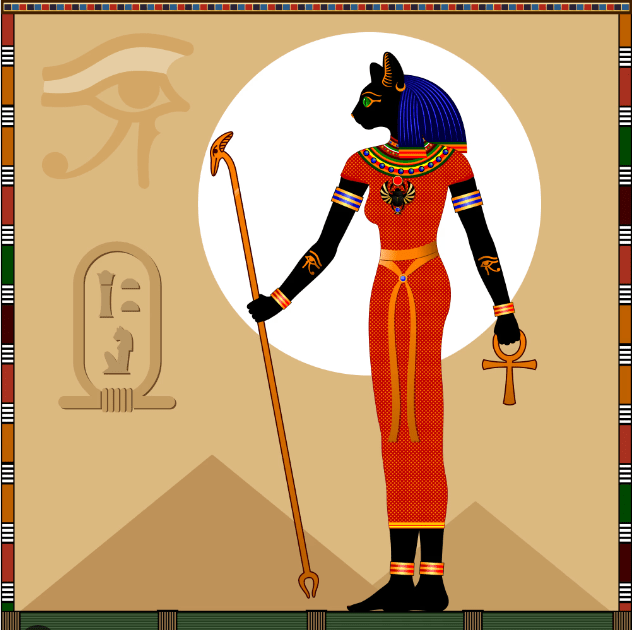
The main characters are four people who couldn’t be more different: Princess Sita, one of the triplets to whom the current Pharoah is father; Nefermaat, a bewildered young village girl who, after a spontaneous vision brought on by the annual parade for the goddess Bastet, has been whisked from her home to the capitol to train as a priestess; Raetawy, leader of a rebel group of farmers oppressed by the pharoah’s punitive taxes; and Karim, a young grave robber who unearths more than he bargained for and sets in motion some of the events envisioned by Neff and anticipated by Sita’s brother Mery, who is determined to rule Khetara sooner rather than later.
Although four protagonists is a lot, Corpora does a wonderful job of developing each of them with clear personalities and motives, and separates their subplots (politics, magic, rebellion, and fortune-seeking) while intersecting them at the appropriate moments to keep us intrigued. (Oh, and there’s a delightful fifth narrator—only encountered a few times—who further draws things together.)
I was completely involved in this story from beginning to end and, when I encountered that cliffhanger and realized that this book had just been published in May and I would have to wait at least a year for the next one, was sorry that I had read it so quickly. I will do a reread when the sequel comes out, to catch all the delightful detail that I may have skimmed over while trying to absorb the book as a whole. If you ever thrilled to the stories of adventures down the Nile, hotly contested dynasties and mysterious portents, you will want to read His Face is the Sun.

Boarding-school books
I’m off on my own personal nostalgia kick right now, re-reading Georgette Heyer novels to escape from the depressing real world of politics and sub-optimum health. But on one of the book-lovers’ pages on Facebook, a mom was asking for recommendations for her teenage son who is a reluctant reader, so I combed through my various categories of YA fiction for some and was thus inspired to write about this sub-set of coming-of-age fiction, the boarding-school book.
I think those who have never attended a boarding school are in some way fascinated with the culture—I know I always have been, from the time I read my first children’s book with a protagonist who had been posted off by their parents to “sleep-over” school. And there are a lot (hundreds) of examples out there of the away-from-home scholastic experience, from Harry Potter to A Separate Peace. There are books in every genre, for almost every age, so I thought I’d mark some of my personal favorites and some that seem to be perennially popular.
The boarding-school book is by no means limited to children and teens—there are many written for (and sometimes about) adults as well, especially if you include the college boarding experience. I’ll give age groups and categories and (in some cases) some brief synopses, and if you have the same interest I do, you can gravitate to whichever piques your interest.

For children, a classic example is
A Little Princess, by Frances Hodgson Burnett, about a young girl sent home to England from India, where her father is a successful merchant, because it was believed that the climate of India was not salubrious for British children. They were separated from their families and entrusted to the care of an English boarding school, where they would hopefully get an education and a proper upbringing and be reunited with their families when they were grown. Young Sara Crewe goes from riches to rags when her father disappears and is presumed dead, and Miss Minchin’s Select Seminary can no longer collect hefty fees for her maintenance. I sometimes think of this book as the child’s version of the first third of Jane Eyre, by Charlotte Brontë (although Sara is much better-natured than Jane ever was!). It’s a romantic story with a protagonist who remains upbeat and optimistic in the face of cruelty, guaranteed to appeal to the kind of reader I was at a young age.

There are many boarding-school books with more fantastical settings, the most well known probably being the Harry Potter books, in which gifted children are sent to Hogwarts School of Witchcraft and Wizardry to hone their talents. But in the fantasy category are also the Harper Hall books by Anne McCaffrey, which take place on the planet Pern and feature dragons and fire lizards in these stories of children studying to be professional musicians; and The Rithmatist, by Brandon Sanderson, featuring another magical school, this time for math geniuses with a little something extra. These are all for younger children and teens (maybe 4th through 8th grades?), although older teens and adults can (and do) enjoy these books as well.

In the specifically Young Adult category, there are fantasies, mysteries, and realistic fiction all set at private academies that either offer the standard schooling or are geared towards inhabitants with a specialty. For the middle school set: One realistic one in which the rule of the bullies and the plight of the bullied are revealed is The Mockingbirds, by Daisy Whitney. Another fairly normal boarding school that is the site of a mystery is the backdrop for the Truly, Devious trilogy by Maureen Johnson, in which death visits Ellingham Academy. And the Gallagher Girls series by Ally Carter (beginning with I’d Tell You I Love You But Then I’d Have to Kill You) showcases a girls’ school that is supposedly for the upper-crust daughters of the snobby set but is actually a training curriculum for those who wish to become undercover agents for the CIA and like agencies.

Among the boarding-school franchise for older teens, there are also a variety of settings. In the realistic category are such mainstream stories as Winger, by Andrew Smith (at a boys’ school focused on rugby); and Looking for Alaska, by John Green and Saving Francesca, by Melina Marchetta, both with a challenging co-ed population. A fun book in its development of one character from age 14 to 16 as she figures out how to dominate her environment is The Disreputable History of Frankie Landau-Banks, by E. Lockhart. Another is the trilogy by Stephanie Perkins that begins with Anna and the French Kiss, following a Georgia girl who is transplanted to an American school in Paris for her senior year.

A huge boarding-school subset is the paranormal category, with vampires dominating and witches coming in a close second—the Vampire Academy books by Richelle Mead, the Hex Hall series by Rachel Hawkins, the Gemma Doyle stories by Libba Bray, and Evernight, by Claudia Gray. One series that I particularly like and admire is Wayward Children by Seanan McGuire, which could arguably be classed as either YA or adult; the books are unusual, smart, and varied in their approach. I reviewed them on this blog when I first discovered them, and continue to find them unique.

Moving on to books more appropriate for adults, there are some in every category. The Magicians (and sequels) by Lev Grossman have been billed as Harry Potter for grown-ups. Mysteries that feature boarding schools include Well-Schooled in Murder, from the Inspector Lynley mysteries by Elizabeth George; The Secret Place, one of the Dublin Murder Squad books by Tana French; and The River King, by magical realism author Alice Hoffman. A book that is written about young people but is (in my opinion) too intense for their age group to read is Brutal Youth, by Anthony Breznican, a co-ed Lord of the Flies set in a Catholic private school in Pennsylvania. I didn’t so much enjoy reading it as remain fascinated and unable to put it down. It’s definitely powerful, and in some ways brilliant, but also stark and frightening. Gentlemen and Players, by Joanne Harris, is written from the point of view of the teaching staff at St. Oswald’s Grammar School for Boys, a cat-and-mouse tale of revenge as one staff member with secret ties to the school tries to destroy it from the inside. Finally, Never Let Me Go, by Kazuo Ishiguro, is dystopian literary fiction with a boarding school setting that may not be what you had in mind when you read the initial description, but it’s a fascinating premise with a heartbreaking (and kind of depressing) outcome.
This is a mere drop in the bucket of what’s out there; if you want to research this category further, go to Goodreads, select “browse” and “lists” and type “boarding schools” into the search box, and you will find multiple lists containing all these and many more. But the books mentioned here are a great start if you, like me, enjoy that particular setting for your fiction.

Wrapping up

This year it feels more like a winding down than a wrapping up. I read the fewest books in one year since I started doing the Goodreads Challenge 12 years ago. That year I read 75 books; my highest number ever was in 2019, when I read 159 books while working full-time from January to October (I retired from the library in October of that year). You would think it would be the reverse, since I have so much more time now than I did then; but there were some factors at play that ensured I would read a lot more then. First, I was running three teen book clubs, so I had to read one book per month for each club, plus a couple extra books in each age range (the clubs were 6th- and 7th-graders, 8th- and 9th-graders, and grades 10-12) so I would have ideas to propose as the following month’s read. I was also reviewing books for both the teen and adult library blogs (both of which I supervised), so I was heavily invested in spending all my spare time reading new teen and adult fiction to showcase there. And finally, of course, there was a certain amount of reading for my own particular pleasure! I basically worked, commuted, ate, slept, and read, and did absolutely nothing else!
Nowadays there are circumstances that tend to decrease my reading time: With my particular disability, sitting in one position for long periods of time isn’t great for keeping my legs at their best possible condition for mobility. I also watch a lot more on television these days, now that streaming services let you binge-watch an entire five-season show, one episode after another for as long as you can stay awake, as opposed to waiting for one weekly episode for a 12- to 20-week season and then waiting in turn for the following season. And I spend way too much time “doom-scrolling” political stuff online, or keeping up with friends on Facebook. Finally, once I took up painting I started spending at least a few days a week focused on making a portrait or two or a still life featuring items from my antique collection.
Anyway, this year I read a meager-for-me 66 books. Some of them were literary and some of them were chick lit, some were re-reads of beloved stories, and others were authors previously unknown. My statistics include:
23,782 pages, with an average book length of 360 pages
(shortest was 185, longest was 698)
Average rating was 3.6 stars
Some favorite new titles were:
The Unmaking of June Farrow, by Adrienne Young
Starter Villain, by John Scalzi
Vera Wong’s Unsolicited Advice for Murderers, by Jesse Q. Sutanto
The Long Way to a Small, Angry Planet, by Becky Chambers
All the Dead Shall Weep, and The Serpent in Heaven, by Charlaine Harris
Found in a Bookshop, by Stephanie Butland
I felt throughout the year like I was having trouble discovering books that really resonated with me. Although I had some pleasurable reading discoveries, I never found that one book or series or author that really sucked me in and kept me mesmerized for hours at a time. I found myself reading during breakfast or on my lunch break and easily stopping after a chapter or two to go do something else, rather than wanting to settle in for a solid afternoon of reading. I’m hoping to find more compelling books in the new year. But reading continues to be one of my best-beloved pastimes.
Dog Day Afternoon

No, this isn’t a post about a 1975 bank robbery movie. But the title seemed appropriate, given that it’s National Dog Day and also that I am getting such a late start that my post won’t be available until after noon, one of those hot, sleepy afternoons when dogs (and people) prefer to lie around and languish (i.e., read!) during the summer heat. I did some pre-planning for this post by making a list of some pertinent dog-oriented books, but then my distracted brain failed to follow up, so a list is pretty much all you’re going to get this time. But don’t discount it just because it’s not elaborated upon; these are some great reads, encompassing fantasy, mystery, dystopian fiction, science fiction, some true stories, and a short list for children.
NOVELS FOR ADULTS (AND TEENS)
The Beka Cooper trilogy (Terrier, Bloodhound, Mastiff),
by Tamora Pierce
A Boy and His Dog at the End of the World, by C. A. Fletcher
Iron Mike, by Patricia Rose
A Dog’s Purpose, by W. Bruce Cameron
First Dog on Earth, by Irv Weinberg
The Companions, by Sheri S. Tepper
The Andy Carpenter mysteries, by David Rosenfelt
The Dog Stars, by Peter Heller

DOGGIE NONFICTION
Marley and Me: Life and Love with the World’s Worst Dog,
by John Grogan
Best Friends: The True Story of the World’s Most Beloved
Animal Sanctuary, by Samantha Glen
James Herriot’s Dog Stories, by James Herriot
A Three Dog Life, by Abigail Thomas
Inside of a Dog: What Dogs See, Smell, and Know,
by Alexandra Horowitz

CHILDREN’S BOOKS WITH DOGS
Sounder, by William H. Armstrong
No More Dead Dogs, by Gordon Korman
Harry the Dirty Dog books, by Gene Zion
(illustrator Margaret Bloy Graham)
Bark, George, by Jules Feiffer (one of the best for reading aloud!)
And for those who wanted more, here is an annotated list of more dog days books from a previous year, along with some suggestions for dog lovers that go beyond reading about them.
Miscellaneous reads
In general, I try to blog about every book I read, but sometimes either there’s not much to say, or there’s something to be said that isn’t positive, either of which can stop me. But in the interest of an even flow of content…

I read the next book in Dana Stabenow’s Kate Shugak mysteries set in Alaska, and liked it quite as well as the first two, if not more. In Dead in the Water, Kate has to join up as a crew member of a fishing boat in search of expensive and difficult to harvest crabs in the Bering Sea in order to get a handle on a missing persons case she inherited from her former employer, the Anchorage District Attorney. The author’s own youthful experiences on an Alaskan fishing boat inform this volume with a real feel for what the life is like, and taking Kate out of her normal setting and putting her at a disadvantage among strangers ups both the tension and the quality of the storytelling. I will continue with this series anon.

I then picked up a young adult novel, in an attempt to get some new titles onto my “read” list; I will be teaching Young Adult Literature again at UCLA’s library school next spring, and since I retired from my job as a teen librarian I have fallen woefully behind with my reading. Unfortunately, I won’t be recommending The Upside of Falling Down, by Rebekah Crane to anyone. It had an interesting premise—Clementine Haas is the sole survivor of a plane crash, and wakes in a hospital in Ireland with trauma-induced amnesia that stubbornly hangs on for weeks. Her father’s imminent arrival from Chicago to take her home provokes a panicked response as she worries that she won’t recognize him or any part of her life in America, and she runs away, falling in with a kind young man who takes her back to his small Irish village and gives her license to stay there for as long as she needs. And then, of course, stuff happens…
I thought the book was only okay. The characters were all suspect—untrustworthy, and not particularly likeable. The best character in the book was, ironically, neither of the main protagonists; the “mean girl” sister stole every scene in which she appeared. And the events of the last third of the book were just too pat to be either believable or entertaining. Give it a miss. There’s a multitude of better YA novels out there, some of which I will hopefully be reading and reviewing soon.
Hiatus, nostalgia, TV
I haven’t published anything here for a while because I started reading Demon Copperhead, the new book from fave author Barbara Kingsolver, and it has been taking forever. I am enjoying the voice of the protagonist and the high quality of her descriptive writing and somewhat quirky scene-setting, but the combination of the length of the book and the depressing quality of the narrative finally got to me at about 83 percent, and I set it aside to take a quick refreshment break.
I re-read two books by Jenny Colgan—Meet Me at the Cupcake Café, and The Loveliest Chocolate Shop in Paris—for their winning combination of positivity, romance, and recipes, and enjoyed them both. My plan was to go back to Kingsolver today, but instead I found myself picking up Dying Fall, the latest Bill Slider mystery by Cynthia Harrod-Eagles, which has been in my pile for months. I will get back to Demon Copperhead at some point, but the mood isn’t yet right.

Meanwhile, Netflix made me happy this weekend, having come out with season one of Lockwood & Co., adapted, partially written, and directed by Joe Cornish, and based on the young adult paranormal mystery series by author Jonathan Stroud. This has been a favorite series of mine since I read book #1 with my middle school book club and eagerly perused all the rest as they emerged from his brain onto the page (there are five books and a short story in it).
The series is set in a parallel world where Britain has been ruled for 50 years by “the Problem”—evil ghosts that roam freely, but can only be dealt with by children and teenagers young enough to be in touch with their perceptive gifts. Adults can be harmed by them but can’t see or even sense them, while the youth still see, hear, and sense their presence and fight them by discovering their “source” (the place or object to which they are attached) and either securing or destroying it.
The mythology seems to have evolved at least partially from faerie, vampire, and werewolf lore: The main weapons are iron chains, silver containers, running water, salt bombs, lavender, and longswords! The ghost-hunting teens are most of them employees operating under the supervision of corporate, adult-run agencies, but Lockwood & Co. is independent of adult supervision. It’s a startup existing on the fringes, run by two teenage boys—Anthony Lockwood, the putative boss and mastermind, skilled sword fighter and ingenious planner, and George Karim, the brainy researcher who provides background for their cases from the city’s archives. The two have advertised for and just recently acquired a girl colleague, Lucy Carlyle, who is new to London and technically unlicensed, but more psychically gifted than anyone they have ever met. This renegade trio is determined not just to operate on their own but to outdo the agency blokes in all their endeavors, so they take risks no adult at the corporations (or at DEPRAC, the Department of Psychical Research and Control) would sanction, in order to gain both notoriety and clients.

Cornish and his colleagues have nicely captured both the flavor of the overwrought atmosphere of beleaguered London and the perilous camaraderie of the principal characters—Lockwood, George, and Lucy—in their series. Season one covers the events from books #1 (The Screaming Staircase) and #2 (The Whispering Skull), so one assumes there will be at least one and perhaps two more seasons, if viewers make it popular enough for renewal. I certainly hope they do! But in case that doesn’t happen (or even if it does), the books are out there, and well worth your attention (and I don’t just mean middle-schoolers!).
Fictional Food
I guess that should really be “food in fiction,” because there’s nothing fictional about the food except that it appears in a novel.
Are you one of those readers who has to ration your supply of cozy mysteries because every time the author describes some sumptuous treat in the pages of your book, your tendency is to fetch some to enjoy yourself while reading? It’s all too easy to put on a pound or two if you let fiction be your guide, and the food to which I am specifically referring on this Hallowe’en day is, of course, that treat traditional to Thisby Island, the infamous November cakes created by Maggie Stiefvater for the pages of her book The Scorpio Races.

Every October on the island of Thisby, the capaill uisce, or water horses, emerge from the sea like foam made flesh. The giant horses are a danger to anyone who comes near, being both predatory and carnivorous, but the islanders have a yearly tradition of capturing and training them to run a race along the beach on the first day of November. Winning the Scorpio Races yields both fame and substantial fortune, but the races also take many lives. Katherine (called Puck) has decided to enter her land mare in the races to earn the money to save her home, while Sean Kendrick is competing for the right to buy the water-horse stallion Corr. The two teens, both orphaned by capaill uisce, become both allies and competitors in this race for glory or death.
In the cold and damp that is a Thisby November (think Wales or Ireland climate), there is nothing more welcome than a cup of salted butter tea (thanks, I’ll stick to English Breakfast) and a hot, sweet, buttery November cake. Here is a link to the recipe, created by Maggie. They are not simple to make, nor are they cheap, but they are well worth the trouble. The description from the book:
Finn finds my left hand, opens my fingers, and puts a November cake in my palm. It oozes honey and butter, rivulets of the creamy frosting joining the honey
The Scorpio Races
in the pit of my hand.
It begs to be licked.”
Maggie Stiefvater

If your food plan doesn’t allow for such treats, at the least you can make a yearly tradition of reading The Scorpio Races, one of my favorite books by Maggie Stiefvater and perhaps soon to be one of yours as well.
Readers (and artists) in the family
For the past few months, my cousin Kirsten has been perfecting the art of making paper flowers from the pages of her favorite books. The Arcana Chronicles, by Kresley Cole, is a post-apocalyptic young adult series (five books in total), and she’s just starting a read-along with a fan group on Facebook (it’s a re-read for her).
In the first book, Poison Princess, in which tarot cards come to life, activated by an event called the Flash, red roses have a special significance for the Empress card, which plays a primary role in the series.
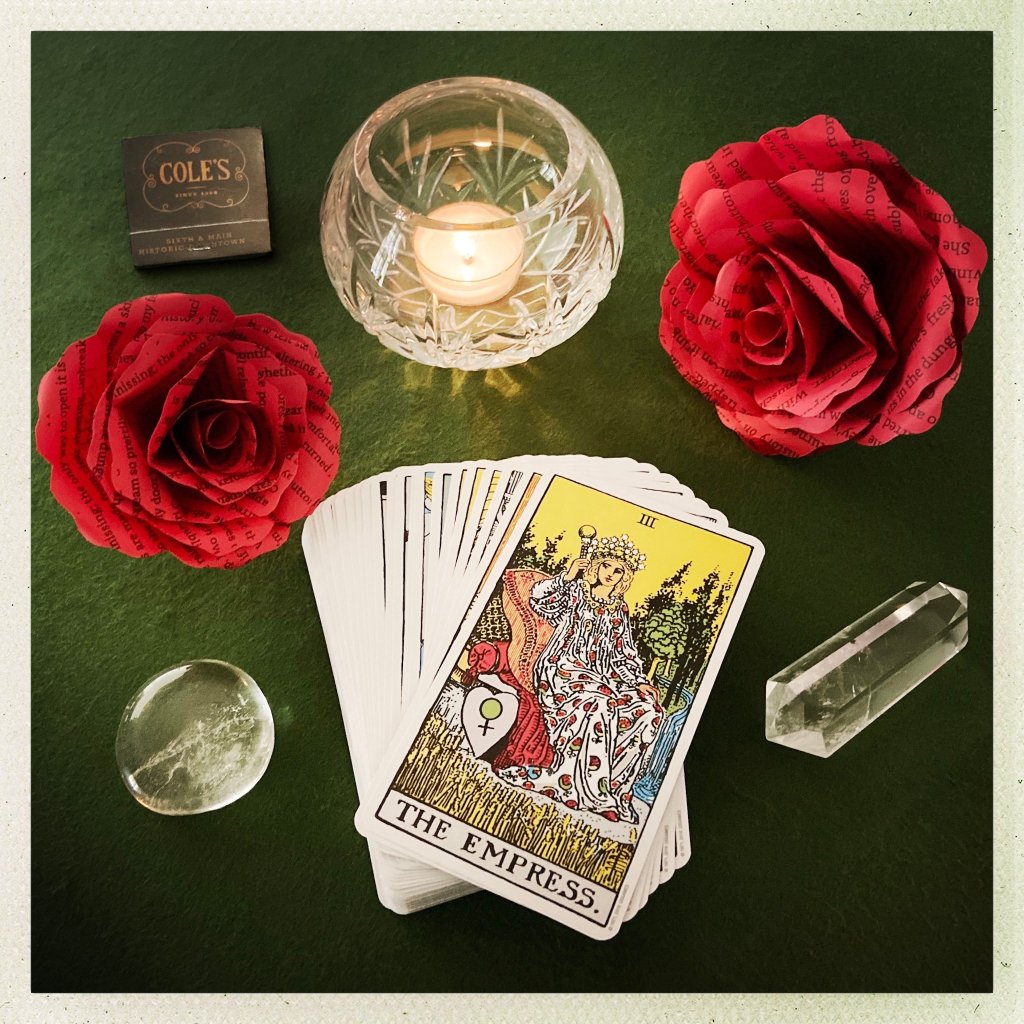
I haven’t read the Arcana Chronicles (or any of the books), and on Goodreads it seems to be one of those polarizing series that gets either five stars or one, but I couldn’t resist featuring Kirsten’s beautiful roses, for which she “used a basic technique for the flower, but created my own pattern for the curves and the underside (so as to display the title page), then used a pre-fab pattern for the sepals and leaves, but modified it slightly.”
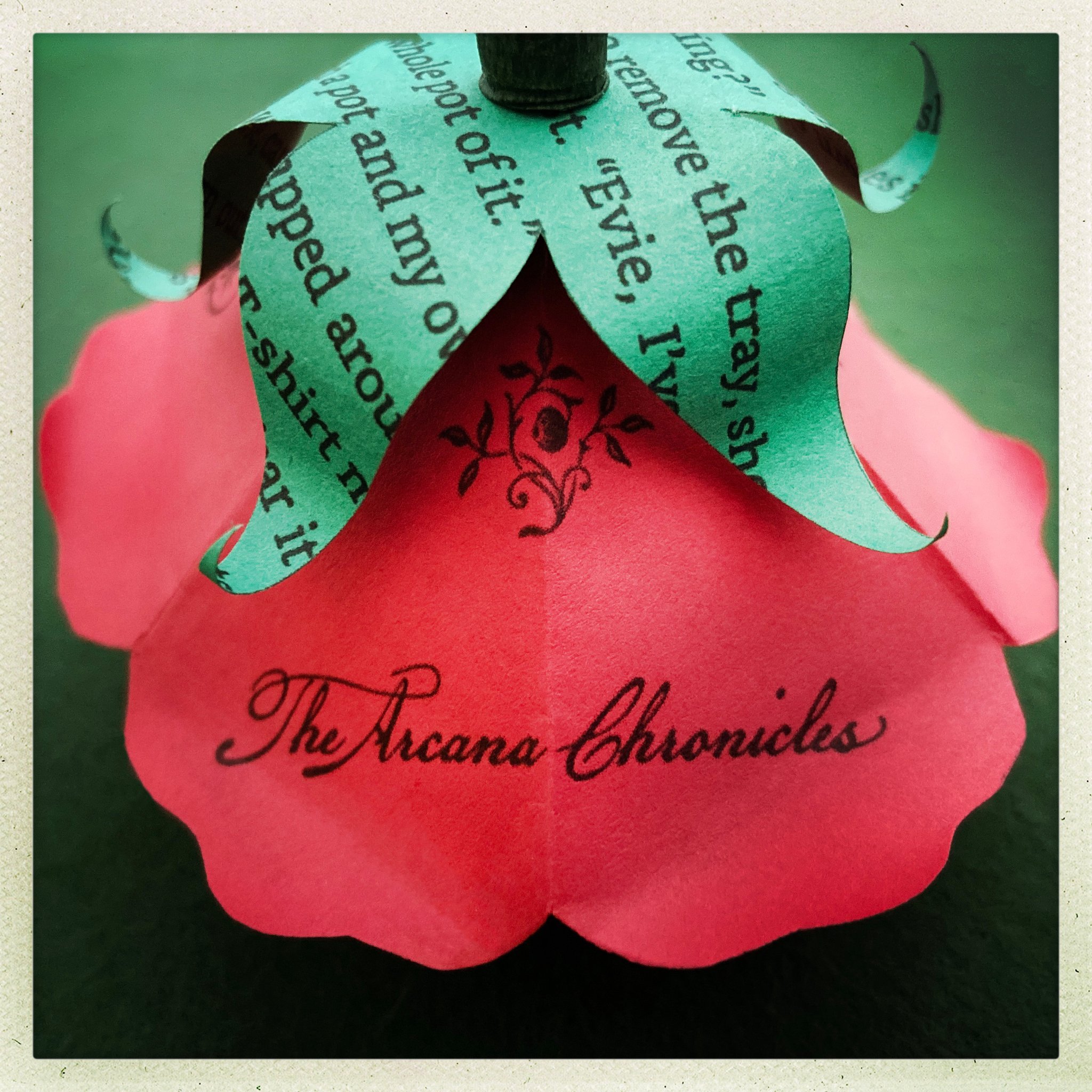

So creative! Thanks, Kirsten, for allowing me to show them off.
 The Book Adept