Missing Francis
I am a huge fan of Dick Francis mysteries. When he passed away and his son took up his mantle, I decided to reserve judgment until I had read a few. (I had been burned once before by this dynamic when the brilliant and innovative Frank Herbert died and his son Brian started writing decidedly inferior sequels to his Dune series.) It was noted that Felix had helped Dick with the massive research required to deliver his books, and since I was cognizant of what that involved (Dick’s books were chock full of interesting details about all sorts of things), and since it was also noted that Felix had co-written the last few, I believed that Felix might just have the master’s touch.
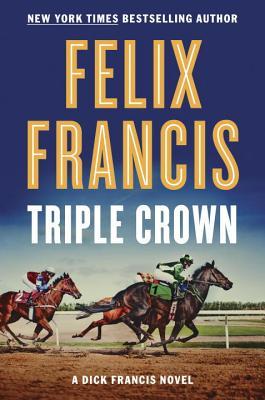
I have read several of Felix’s books since he began writing on his own, and while they weren’t quite Dick Francis, they weren’t bad. I enjoyed both Bloodline and Damage, and when I saw that Triple Crown was another book featuring Jeff Hinkley (the protagonist of Damage), I was somewhat enthusiastic about picking it up.
I think it will be my last authored by Felix.
I am not an apologist for such American quirks as overly armed police officers, or the animal cruelty that is present in the branding of cattle and horses, or the convoluted groups of associated government departments that nonetheless refuse to work together. Quite the contrary, in fact: Based on my experience working as a librarian who was constantly called upon to be a social worker for certain of our patrons, I applaud the recent movement towards scaling back police influence to do the things they are actually trained to do. I am a vegetarian and deplore all forms of deliberate injury to animals; and I think the level of jockeying for power in Washington is ludicrous. But that doesn’t mean I want to read about all those things and, if I did, it certainly wouldn’t be in the pages of what is supposed to be an entertaining mystery novel.
The plot seems like a reasonably good one: Jeff Hinkley, who works as a covert investigator for the British Horseracing Authority (BHA), is requested to come to America to help their Federal Anti-Corruption in Sports Agency (FACSA) find out who in their organization is passing on confidential information that will help horse trainers and owners evade arrest when they get up to such things as drugging rival horses. After consulting with the agency’s Deputy Director, by whom he was invited to come, Hinkley sets up a sting operation in which he goes undercover as a groom for a trainer believed to cut corners to win races, hoping that, as an insider, he will be able to find information on the mole. As he discovers some horrifying steps this trainer is taking to win the Triple Crown, his added motive becomes to root out this corruption before more horses die.
The execution of the story turns into a vehicle for Francis, disguised as Hinkley, to exhibit a condescending supercilious attitude toward American horse-racing when compared with the British, and this attitude constitutes almost the only defining trait of the protagonist—he is otherwise so unmemorable that near the end of the novel, when he decides to dye his hair and beard dark as a disguise, I was utterly surprised that he had been a blond previous to the dye job, because his physicality was left so vague throughout the book. Hinkley is completely lacking in the charm, intelligence, or wit of a Dick Francis hero. He is a fatal combination of bland and pompous that endears him to no one, including his fellow characters or the reader.
In addition to the rather overbearing anti-American themes is the pedantic tone of his explanatory passages, which constantly trip you up and shove you out of the story. The dialogue is likewise stilted and formal, and the character development is rudimentary at best, and laden with offensive clichés. Hinkley’s attitude toward his co-worker, Maria, the Puerto Rican hot walker for the stable, basically consists of his observation that she’s a hot mama; his Mexican roommate is a drunkard and a simpleton; he seems surprised that a female federal agent could be such a crack shot; and another female agent becomes a stereotype of a whiny mistress to her colleague’s married man. Dick Francis’s gentle misogyny was both understandable (due to his age and upbringing) and predictable; but what is Felix’s problem with women in particular? It seems that, along with not respecting them, he doesn’t particularly admire them either. At least his father had a healthy appreciation and understanding of relationships and knew how to write them.
My constant feeling during the reading of this novel was that I was trudging through a quicksand of expository prequel while hoping the actual story would pick up at some point and become involving, but it never did. By the time the book reached the intended climactic scenes, I simply didn’t care—and the lackluster way in which they were written confirmed those feelings.
Next time I’m feeling nostalgic for an exciting mystery with a horse racing theme, I’ll go back and re-read the real thing. And perhaps, at this point, this Francis should quit putting “A Dick Francis Novel” on his covers.
“Beach read”
There is a certain expectation when you see those words. Beach read. Like romcom. Or cozy. Or whatever genre you’re expecting.
I wasn’t exactly expecting what I got from Beach Read, by Emily Henry. I picked it up because all the women on my “What should I read next?” Facebook group keep pushing it, and it sounded more appealing right now than American Dirt or A Man Called Ove or Small Great Things. And I think on balance it probably was, but…

First of all, there is almost no beach in Beach Read, and the beach that there is resides on Lake Michigan, so…is that a beach? They say you can’t see the other side and it feels like an ocean, but as a California almost-native, I have my doubts. Anyway, I think the characters end up at the beach maybe three times? twice together and once the protagonist goes on her own, and the atmosphere and set-up just aren’t there.
Second, my idea of what a genuine beach read is supposed to be is a book that is casually engaging. You can take it or leave it, which means that you take it with you in the morning when you trail down to the beach with your chair and towel and umbrella, and maybe you read it for a little while, and then you put it aside in favor of sleeping or swimming or making a sand castle or simply staring out at the water until you go sun-blind. And that evening, or the next day, you desultorily pick it up again and keep going, but there’s no pressure, there’s no urgency. As my cousin Toni from Texas always says, “This is so pleasant.” That’s the epitome of a beach read. Which this was not.
THIS book was smart and funny, a little convoluted, with more angst than one would expect in a beach read. It had, in my opinion, a few too many coincidences upon which it depended—the meet-cute was a little more a saccharine surprise, and that also goes for many of the side characters, who give off a whiff of too-good-to-be-trueness as they enter and exit the scenes. But what this book really has going for it is two good protagonists who indulge in banter that is truly witty. And in between, their chemistry smolders for about two-thirds of the book until you’re ready to implode on their behalf, so you get the best of both worlds—smart-ass reality, and romantic fantasy. Also, because the characters are both novelists, you hear a lot about the creative process in a not-pretentious way, which was a bonus for me. All the background and family stuff, while giving context to why both characters were so difficult, was sort of generic and could have been swapped out with different BS, but you can’t deny the characters who were created from that morass—they were awesome. Naming your two protagonists January and Augustus might be considered a little over the top, but hey, they’re novelists and their parents must have known not to name them Tiffany and Jason, right?
So, while it wasn’t the quintessential beach read I was expecting, since I mostly read it on my Kindle under the covers on nights when I couldn’t sleep, I forgave it for that and enjoyed it thoroughly.
Undeniably not done
In between other more serious fare, I checked out the Kindle copies of the next three books in the Lucy Valentine psychic matchmaking series. I had enjoyed the first two, and thought I’d like to find out what happened to all the engaging characters (pardon the pun), most of all Lucy and her beau, Sean.
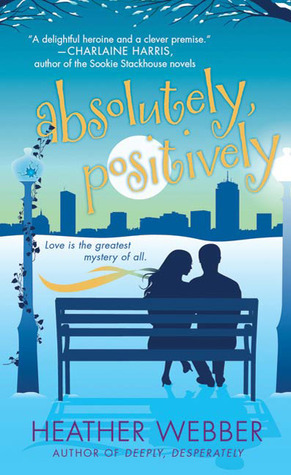
First was Absolutely, Positively, in which Lucy’s psychic ability to find things is finally unmasked to the public and she has to deal with the fallout, while discovering a new method to find “lost loves” with it that expands her father’s matchmaking business to a new department that includes Lucy plus private eyes Sean and his brother.
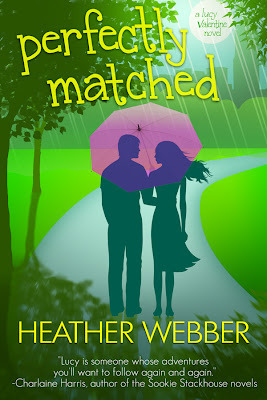
Then came Perfectly Matched, in which she hooks up with a bunch of other psychics to try to bring out more abilities and hone the one she has. Meanwhile, someone is targeting her boyfriend and his brother by setting fires at all the places where they grew up, and Lucy becomes increasingly desperate to discover why and, more important, who, before something bad happens. Lastly was Undeniably Yours, in which her policeman friend, Aiden, seeks her help finding a lost reporter, who also happens to be the mother of his (previously unknown) child.
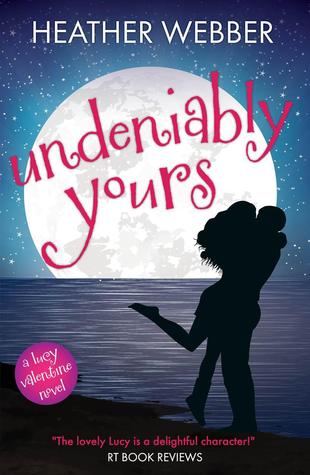
I still liked the series after going through the next three books; the author is great at reminding you what has happened, adding to it by expanding knowledge and relationships in the next volume, and still drawing out the suspense in various pairings as well as various themes so you want to go on to the next.
What made me crazy was finding out that this isn’t the end of the series! If you picked up a book called Undeniably Yours with the couple in question in a clinch on the cover, wouldn’t you assume that this is the book in which the drawn-out relationship that started in book #1 would finally reach its HEA (happily ever after)? Well, I did, and I was mistaken! There are still things for the main couple (and other secondaries) to do, places to go, states to achieve (as in matrimony or whatever), and we leave them in the midst of a massive home remodeling project! So there will be more Lucy Valentine tales in my future after all. I don’t know whether I’m mad or glad.
I’m struggling a little with where to put these books in terms of genre. Is it magical realism if people have psychic abilities, or is it just paranormal fiction? Is it a romance if half the characters belong to a family of matchmakers and keep putting people together, or does it just have romantic elements? And is it relationship fiction, or is it a mystery cozy? There IS a mystery of some kind in each one…
Whatever. I enjoyed these books, and felt like each one improved upon the last, so that’s something.

When great trees fall,
rocks on distant hills shudder,
lions hunker down
in tall grasses,
and even elephants
lumber after safety.
When great trees fall
in forests,
small things recoil into silence
their senses
eroded beyond fear.
When great souls die,
the air around us becomes
light, rare, sterile.
We breathe, briefly.
Our eyes, briefly,
see with
a hurtful clarity.
Our memory, suddenly sharpened,
examines,
gnaws on kind words
unsaid,
promised walks
never taken.
Great souls die and
our reality, bound to
them, takes leave of us.
Our souls,
dependent upon their
nurture,
now shrink, wizened.
Our minds, formed
and informed by their
radiance,
fall away.
We are not so much maddened
as reduced to the unutterable ignorance
of dark, cold
caves.
And when great souls die,
after a period peace blooms,
slowly and always
irregularly. Spaces fill
with a kind of
soothing electric vibration.
Our senses, restored, never
to be the same, whisper to us.
They existed. They existed.
We can be. Be and be
better. For they existed.
—Maya Angelou

All the Devils
If it’s September, it must be time for Louise Penny’s yearly addition to the chronicles of Armand Gamache, always a highly anticipated treat. I am happy to say that this year’s offering renewed my faith in her continued skill to deliver a nuanced, perplexing, utterly enjoyable mystery. (I wasn’t so happy with last year’s book.)

All the Devils Are Here disrupts tradition by setting the entire story in France, rather than centering it in the mysterious town of Three Pines (outside of Montreal) where the Gamaches currently live. Armand and Reine-Marie have traveled to Paris to be in at the birth of their daughter Annie’s and son-in-law Jean-Guy Beauvoir’s second child. The Gamaches’ son, Daniel, and his wife and two daughters have lived in Paris for some time, but the Beauvoirs have only recently moved there, after Jean-Guy chose to leave the Sûreté du Québec for the private sector, an engineering firm in Paris, so this trip reunites everyone in the family.
Paris is also a home to Armand’s beloved godfather, Stephen Horowitz, who raised Armand from about age nine. Although his godfather remains hale and hearty, the man is 93 years old, so there may not be many more encounters in their future, and the occasion of the birth of Armand’s granddaughter is a particularly joyful one to share with Stephen, who serves in the capacity of great-grandfather.
Horowitz is a billionaire with diverse interests, and it becomes apparent to Armand that he is in Paris for more than just the birth. His cryptic statement (taken from Shakespeare’s The Tempest) that “Hell is empty and all the devils are here” reverberates in Armand’s mind throughout this trip. Stephen’s specialty in business has always been to root out corruption and bad dealings within and amongst companies and to reveal or thwart them somehow before they can do more harm but, contrary to his usual practice with Armand, he is silent about whatever issue is pending.
After a dinner en famille at their favorite restaurant, Armand and Reine-Marie watch in horror as a van barrels towards and runs down Stephen, who is crossing the street while looking at his telephone and pauses at the sight of the Eiffel Tower lighting up for the evening. But this was no accident; the hit-and-run was deliberate, and starts the story rolling as the family begins to ponder who would want to harm or kill Stephen and why. It soon becomes apparent that the Paris police, possibly at the very highest levels, are involved/not to be trusted, and Armand, his wife, and his two sons are soon playing a game of cat and mouse, hoping to avoid bad consequences while ferreting out the mystery Horowitz (now in a coma from which he is not expected to recover) has left behind for them to handle.
Paris is not a city about which I can be objective. It enthralls me whenever I am there, whether that’s literally (only twice and that briefly) or within the pages of a book. Penny makes the city one of the chief characters in the novel, especially as she weaves the histories of Horowitz and the various Gamache family members into its environs—Stephen’s presence in the Resistance, Armand’s marriage proposal to Reine-Marie, their current wanderings amongst its landmarks and personal favorite haunts. I thought, as so many others have said, that I would miss the critical element of Three Pines in this book, but I actually think it was brilliant to extract all of the characters from their regular venue—it made the story much more about their interactions and relationships when not constrained by the familiarity of background, especially set against the magnificence of Paris.
Armand’s family is front and center in this book, and we get to know some previously less prominent characters much better, including Reine-Marie and especially Daniel. There has been an estrangement between Armand and his son since Daniel’s adolescence, and this relationship is finally put under the microscope as the two men have to deal with the reality of mutual dependence to save them all from disaster. The scenes between them are among the most emotionally charged we have seen in this series, and that is saying something, considering Penny doesn’t shy away from interpersonal angst or joy.
The mystery, murder, and mayhem are likewise intricate, puzzling, exciting, and ultimately satisfying, involving as they do the past and present of all the characters and drawing in the movers and shakers of society and business and their contracted mercenaries. Penny really makes the reader stay on his or her toes along with the principals in her novels, in order to understand and solve this kind of puzzle.
I would like to say that I do still feel Penny has changed her narrative writing style for the worse, using as she does so many strung-together incomplete sentences punctuated by periods where there should be commas and semicolons: “The cracked and faded picture showed a young woman. Smiling. But her eyes were grave. And beside her was a young man. Arm across her shoulder.”
But…with a triumph this big under her belt, I’m not going to quibble overmuch. I can think of only one or two other entries in this series that I found so compelling. After my comparative disappointment with last year’s book, to say I am relieved is a big understatement.

Keepers
As I have previously mentioned, I belong to a group on Facebook called “What Should I Read Next?” It takes a lot of patience to stay with the group, despite my love of delivering good readers’ advisory to its members, mostly because everyone in it seems to read the same 12 books and enthuse as if they are an original discovery about which no one can have heard. The adminstrator should change the title of the group to “The Nightingale and A Man Called Ove hang out Where the Crawdads Sing with Verity.” Another frustration with the group is that they ask the same questions over and over and over again, such as “Kindle or real book?” “I’m not enjoying this book, should I quit or keep going?” “How do I get my X-yo kid to read?” and a biggie, “What do you do with your books when you’re done reading them?”
This last came up for me this week. My answer to that question is,
If I like it well enough to re-read it, I will keep it. If it is part of a
series I like, I will keep it. If it is one of an oeuvre of a favorite author, I will probably keep it, unless I really dislike it. Everything else gets recycled—given to the library, placed in the local Little Free Library cabinet, or donated to Vietnam Veterans so they can sell the books and help the needy. Even with this strict list of criteria, I still own hundreds of books.
The subject also arose because I was distracted from my reading trajectory by a Facebook friend. I don’t know her well, but she’s an amazing artist whose product and output I admire. She commented on her page that she was re-reading a favorite series of books for the third time, and that she liked them as well and derived pleasure from reading them the third time as much as she had the first. For me, that’s a big deal. I don’t spend re-reading time lightly. I looked up the first book on Amazon, where it was on sale, so I bought it, and when I finished my slightly fluffy cozy mystery reads last week, instead of advancing on to Louise Penny and Jo Walton I detoured to Everything We Keep, by Kerry Lonsdale.
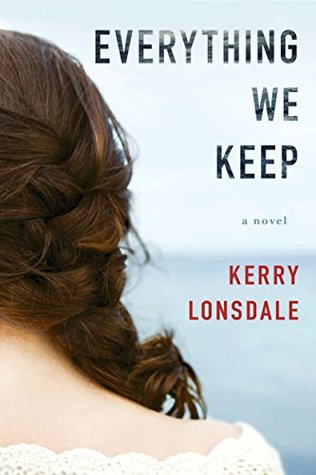
The book title is unfortunately not prophetic: This is not a keeper. (Sorry, Judy.) But before we get to that, what are the odds that, completely at random, I would pick up not one but two series in which psychics figured prominently, in a one-week period? Not to mention psychics with almost the same name?
In my last set of reads, Lucy Valentine had begun coming into her own as a psychic who could use her gift for finding inanimate objects in a creative way to aid her in finding people. Imagine my surprise, therefore, when I started to read Everything We Keep. The story opens at a funeral for a young man named James, and the book is narrated by his erstwhile fiancée, Aimee. The wedding date had been set, the guests had been invited, the flowers had been ordered, and then, two months before, the groom had traveled on business to Mexico, gone missing while out on a fishing trip, and washed ashore weeks later. Not of a mind to be wasteful, the groom’s mother (a cold-hearted one, apparently) decided that the funeral would be held on the wedding day, since the church and flowers were already booked and paid for and the guests had made their travel plans.
After the funeral, as Aimee is attempting to be by herself for a few moments to recover her sorely shaken equilibrium, a young woman approaches her, introduces herself as “Lacey,” and claims that Aimee’s fiancé, James, is alive—he’s not in the coffin, he’s in Mexico, and he’s in danger, so don’t tell anyone, but he needs your help, Aimee! I paused to check the cover of the book for the author’s name, crazily wondering if this could be a later work by the same author who decided to put her psychic character undercover under a slightly different pseudonym in a drama instead of a comedy.
Unfortunately, that wasn’t the case, because despite its dramatic beginnings, this book petered out into a snooze-fest that made Heather Webber’s light and entertaining Lucy Valentine series seem positively frenetic by comparison.
Let me ask you one question, although I think I know the answer: If you had grown up with a boy as his best friend, if this friendship had later turned to love, and if you couldn’t imagine your life without him, if he died just shy of your wedding day and then someone came to you to tell you he was, in fact, alive, and the whole thing was a hoax, wouldn’t you at least check it out? Wouldn’t you immediately (and that’s the key word) borrow, beg, or steal the airfare from someone and head south to see for yourself? Wouldn’t you call the psychic or go to her address and, instead of driving by and thinking “This is crazy” and aborting your trip, stop the car, go into the house, and confront her to discover what she knows or thinks she does? Wouldn’t you at the very least hire a private detective in the country where your lost love supposedly now resides and see if there is any truth to the story?
Nope. Aimee dithers. She worries at the thought, she wonders, she talks. For a YEAR. During that year, she opens a café with money given her by James’s brother as part of his estate, she meets a new guy, Ian (a photographer who takes pix of beautiful landscapes) and designs the interior colors of her café to complement her favorite one of his photos (a beach in Belize) with which he gifts her, and she begins falling in love with said photographer while refusing to do anything about it until she’s sure James is dead. But what does she do to become sure? Does she respond to two more contacts from the psychic? No. Does she listen to the private investigator whom she finally does hire, more than a year after the trail has gone cold, when he tells her there’s nothing and she should give it up? No. When she finally does decide that she needs to know, once and for all, there is no logical reason for why this urge has suddenly come upon her…she drops everything and buys a ticket to Mexico, and she takes Ian along with her. And while she is looking for any sign of James, Ian is having an epiphany in his art career in which he starts taking pictures of people instead of landscapes. No, I’m not kidding.
I won’t go any further because it would be all spoiler from here on out. But if you can get to this point in the book without throwing it across the room, you can find out what happens for yourself. There are two sequels. To say I don’t care would be quite the overstatement. Goodreads reviewer Molly delivered the best few lines I’ve read in a long time:
“If a Thomas Kinkade painting has ever made you tear up a little, this book is for you. Someone reading this is saying,
‘A Thomas Kinkade painting HAS made me tear up a little, you hipster asshole.’ I’ll own it.”
What can I say. I’m an art snob too. And Everything We Keep is going to the Vietnam Vets.
True love, mispers
Although I have a bunch of books lined up to read, including the latest Inspector Gamache mystery from Louise Penny and a new Jo Walton, whom I adore but who is always a challenging author, I decided to take a different kind of a break and read some light, bright, silly fiction for a couple of days. I’ve been working hard on getting ready for my Readers’ Advisory class at UCLA, which starts on September 29th, and also suffering some setbacks with recent art projects as I struggled with a new technique (not to mention the news, which is always fraught these days), so the last thing I need is something else that is too taxing. A reader on Facebook recommended the Lucy Valentine books by Heather Webber as good escapist fare, so I launched into Truly Madly and followed up with Deeply Desperately.

The premise is that Lucy Valentine comes from a long line of matchmakers blest by Cupid himself with a secret ability: They can see people’s auras, and thus match them up according to color, giving the Valentines a 97 percent success rate and making them renowned and also wealthy. Lucy, however, has renounced her trust fund and has been trying to make it on her own, because she doesn’t possess the family talent: She suffered an electrical shock at age 14 that killed her ability to read auras and replaced it with a talent for finding lost objects, which makes her terrible at the family business but handy to have around if your car keys are missing.
The issue the Valentines have that confounds their talent and sometimes their happiness is their own inability to sustain a relationship: Lucy’s parents have been broken up for 20-some years, but maintain a façade of happily married life in order not to ruin their rep as matchmakers; her grandmother, Dovie, got divorced from her beloved Henry a scant year after they got together; and Lucy herself has never had a long-term relationship. They call it “Cupid’s Curse,” and it’s almost as big a secret as their ability to read auras: After all, will people trust a matchmaker who can’t him- or herself keep a relationship going?

But many things are about to change for Lucy: After a scandal (her father was caught in a public display of “affection” with a woman not his wife on a night-time beach) and a subsequent heart attack (brought on by the stress?), Lucy’s parents have gone away to St. Lucia together to let him recover and also to escape the press, leaving Lucy in charge of the agency, to her combined pride and dismay. Sam, the private investigator who rents the top floor in the Valentine building, has just taken on his younger brother, Sean, to help him with the business, and when Lucy gets a vision of a missing wedding ring that shows it gracing the finger of a dead woman, she asks Sean to assist her in solving the mystery. There is a spark between Sean and Lucy that threatens her equilibrium and is obviously reciprocated,
but Lucy, wary of “the curse,” tries to avoid entanglement—at least for now. Meanwhile, Lucy is beginning to see that her gift of finding lost objects just might be able to translate to finding lost people as well, as long as she can get all the factors to work together…
The touch of magical realism (the reading of auras and the finding of lost things) gives the cozy mystery format a charming aspect. Webber knows how to write effective, likeable characters and likewise how to set scenes and describe surroundings, and there is a tiny bit of steam in Lucy’s relationship without its getting either sappy or overly explicit, plus a grace note of humor that lifts them above the common cozy. The author seems to be able to hit just the right combination of whimsy, mystery, and romance, without getting too heavy-handed in any of those areas, rendering the books delightfully engaging. They aren’t anything I would normally seek out, but they have definitely provided the necessary antidote to the seriousness all around me, and I may continue with the series (there are three more so far) to prolong my respite.
Class warfare
I decided to take a break from my pile of new books and re-read something I had previously enjoyed, written by Philippa Gregory.
I have to confess that most of her historical fiction featuring the Tudors has bored me silly for some reason—I have tried two different ones, and they just didn’t spark to life for me, despite being obsessed with this period of history and these characters back in my teen years. But the series I had in mind predated all of her “hits” and in fact was the first thing she ever wrote: The Wideacre trilogy, consisting of Wideacre, The Favored Child, and Meridon.

Together, they are the story of one small but perfect estate in Sussex—Wideacre—and the family who had title to and hold over it—the Laceys—in the time period of Georgian England. The trilogy spans three generations and marks massive changes in England, in the land, and in the family, which was steered badly astray by the obsession of one woman—Beatrice Lacey—for the land on which she grew up and which she is determined to have for her own, laws and rights of primogeniture notwithstanding. Her longing for the possession and control of Wideacre makes Scarlet O’Hara’s passion for Tara look like a tepid fancy.
I have actually read the third book, Meridon, several times, because it has elements I like: Travelers, a circus, horses, and a stubborn, suspicious, untrusting lost girl protagonist who immediately captured my imagination. But I decided to return to the first book instead, to refresh my memory of why I liked the entire trilogy so much.
After having finished Wideacre for a second time, I don’t think I will read through the subsequent books. Although I enjoyed it, it also made me a little weary, on two counts, the first being that it is 556 pages long, and the second that the protagonist got to me this time in a particular way that I think I didn’t entirely take in the first time through.
The thing I connected with most powerfully with the first read was the scene-setting. Wideacre is a palpable and powerful character in this book, as much as any of the humans depicted, and the descriptions and varieties of its beauty made me long to have the experiences Beatrice Lacey had, of riding the path up to the Downs to see the greater vista of the estate from their hilltops, of smelling the sweet scents of hay and wild poppies in the fields, of lying in a hollow in the shady woods or dangling my feet in the Fenny river. In that first read,
I could almost understand Beatrice’s obsession for her surroundings—we have all of us had some moment in our lives when our passions were invoked by a particular setting and we longed to be a part of it forever. But with my second read, I saw the sickness the single-minded pursuit of this one thing above all others brought with it to her life and the lives of all around her, despoiling the beauty she could have enjoyed freely, had she let go the need to possess it. This story is not for the squeamish—there are truly dark passages depicting the twisted relationships Beatrice creates to try to manipulate her way into the Squire’s role.
What struck me, however, with this re-read was a relevant passage that I reached almost at the end of the book. Beatrice has mortgaged the estate up to its eyebrows in order to break the entail and gift it to her heirs, and in doing so has bankrupted it, with the result that the people who live on her land, who were once important to her because they were part of her world, are now out in the cold while she rakes in every penny for herself. She is having a conversation with her tender-hearted and clear-eyed sister-in-law, who sees how she has wrecked the relationship with the cottagers and has challenged her on it. Beatrice tries to excuse her actions by saying that this is the new way of farming in England, that the investors must needs make a profit from the money they have provided. Celia’s response hit me right between the eyes.
“All of the people who write about the need for a man to have a profit are rich people. All they wish to prove is that their profits are justified. They will not accept the answer which is there before their eyes: that there is no justification.
“Why should the man who invests his money have his profit guaranteed, while the man who invests his labour, even his life, has no guaranteed wage?” she said. “And why should the man who has money to invest earn so very much more with his capital than a man could earn working at the very top of his strength, all day? If they were both to be rewarded equally, then after the debts had been paid and the new equipment bought, miners would live in houses and eat the food of the mine owners. And they clearly do not. They live like animals in dirt and squalor and they starve, while the mine owners live like princes in houses far away from the ugly mines.
“It is as bad here,” she said baldly. “The labourers work all day and earn less than a shilling. I do not work at all and yet I have an allowance of two hundred pounds a quarter. I have taken no risks with capital. I replace no machinery. I am paid simply because I am a member of the Quality and we are all wealthy. There is no justice in that, Beatrice. There is no logic. It is not even a very efficient way
to live.”
“Celia,” [Beatrice] said again, “you simply do not understand. The less we pay the labourers the more profit we make. Every landowner wants to make as much profit as possible. Every landowner, every merchant, every businessman, tries to pay as little as possible to his workers.”
[And then Beatrice taunts Celia about her allowance and her dowry lands, and Celia reveals that she has been spending all her allowance on food and clothes for the village.]
“When the landlords are against the tenants as you are, Beatrice,” Celia said dully, “and when the employers have decided to pay the least they can, charity has no chance. All we are doing is prolonging the pain of people who are dying of want.”
“It is an ugly world you and your political economists defend, Beatrice. We all know it should be different and yet you will not do it. You and all the rich people. It is an ugly world you are building.”
Reading this in a time when the United States government is handing out windfalls right and left to big business—banks, airlines—while refusing to supplement all those out of work due to the pandemic whose severity has been exacerbated by its negligence; reading this when, in the face of massive unemployment across our nation, the CEOs of the biggest companies are adding millions or billions a day to their personal fortunes, on which they pay no taxes and for which they apparently suffer not a moment’s guilt, showed me the depth and breadth of the evil that has overwhelmed our land. Yes, I am calling it evil, for I can think of no other word to describe the potential effect of the Republicans finally, after all these years of aspiring, to actually have the cancellation of Social Security and Medicare within their grasp, to surrender our national parks to oil drillers, to decimate our school systems, to pack our courts with toadies, to perpetuate lies, calumny and outright treason to keep a man in office who will facilitate their soulless predations, and then make up reasons why we should see it as a good thing.
I think my impulse to read this book at this time brought me to a place I needed to go, and this is also why I don’t intend to re-read the other two books, although they are gripping stories and worth your consideration. I’m afraid they will just make me too sad. I don’t bring politics to this blog, normally, but these are not normal times. If you have any empathy in your heart for the less fortunate who are falling through the widening cracks in this version of our America, please use your voice and your vote to change things to a world where we can all do better, together.
The Disenchantments

Best friends Colby and Bev made up their minds in middle school that they were not going to be ordinary, were not going to do what everyone else does after high school—go to college, especially as a default. They may go to college someday, maybe even in a year, but in between, they want to have an adventure. They have been saving their money since they were 14, and are all set to spend some time with Colby’s mother in Paris (she’s there taking an immersion French class), and then go to Amsterdam, see a whole archipelago of islands and…who knows what else? The year is before them, and it’s up to them to choose. All their classmates are in awe of their plan, including sisters Meg and Alexa, the other two members with Bev in an enthusiastic (if not terribly good) girl band called The Disenchantments. The plan is: Graduate, spend a week on the road doing gigs with the band in small towns between San Francisco and Portland, drop Meg at her college there, take Alexa (who is a year younger and won’t graduate until next year) back home to San Francisco, and fly.
Imagine, therefore, how Colby feels when he pulls up in his uncle’s VW van to pick up the girls for their road trip, mentions to Bev (for the third time) that they really need to buy their plane tickets, and Bev blurts out that she has been accepted to the Rhode Island School of Design and isn’t going with him to Europe. She tries to play it off like a last-minute exciting chance that she got accepted…but we all know (as does Colby) that to get into a college you have to apply, to send transcripts and letters of recommendation and (for a prestigious art school) put together a portfolio. So this wasn’t exactly spontaneous, and yet Bev has gone along with him for months, supposedly sharing his enthusiasm for reading travel guides, making note of cool restaurants and must-see museums, and lying the whole time. And now they are shut up in a van together for a week, and Bev won’t talk or tell him why. It doesn’t help, of course, that Colby cherishes unrequited love for Bev.
This all sounds like a set-up for a slog through romantic teen angst, but it doesn’t turn out that way, not for the most part. For one thing, the chemistry between the four of them, the adventures they have while playing their gigs, and the good intentions of all involved—despite bad behavior—save the story from the utter mawkishness that it could have become. While relationships are important to the story, they encompass more than the romantic—we see the connections with family, friends, strangers that turned into friends, and strangers encountered once and left behind, and the book features some real moments with all of those.
The book was more of a quest for understanding and purpose, with Colby pondering his options for the next year. At that age, making a choice seems so definite and so daunting, but with Bev’s defection he is forced to realize that it’s really all up to him. Nina LaCour has set up a story that deals kindly and imaginatively with beginnings and endings, and captures both the intensity and uncertainty of teens on the cusp of adulthood.
It’s also a fun catalog of music preferences amongst the four, and the story of what it’s like to play your music in questionable venues you booked sight unseen, as well as a separate small quest to find out the origins of a tattoo—all of which lightens the mood from what could have been a fatally serious story.
I wish that whoever designed the cover had paid a little more attention. Some of the details of the four teens are right, and some are dead wrong, and it would have been so simple to dress them appropriately for this cover shoot so you could have teenagers say “Wow, that looks just like them!” The descriptions were vivid—why not go with them?
In terms of age group, I would say 15 and up.
Enchanting
Did I mention that I can’t resist a book with ravens, crows, or other corvids? Or a book that features an artist or painter? I found one that incorporates both, and bought it mostly based on its title and cover: An Enchantment of Ravens, by Margaret Rogerson.
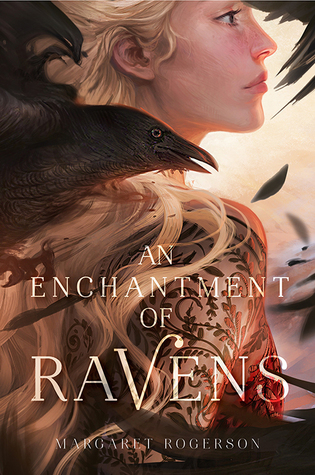
The story in brief: Isobel is a portrait painter who lives in Whimsy, a town outside of time (it’s always summer there, the seasons never change) because it is adjacent to Faerie and the “fair folk” like to wander the town in their avid pursuit of what they call “Craft,” which is anything creative made by human hands. Faerie don’t “do” Craft—in fact, if they take up a pen, a brush, a sewing needle, they crumble to dust. So they are eternally fascinated by its expression, and will pay in valuable enchantments.
Although she has made many portraits of and for the fair folk, Isobel’s most esteemed patron is Gadfly, who seems particularly smitten with himself and for whom she has painted multiple pictures. One day Gadfly tells her he has recommended her to Rook, the autumn king, who wishes a portrait. This flusters Isobel, because of his rank and because he hasn’t been seen in a hundred years. But he turns out not to be so intimidating (although definitely self-regarding), and while painting him, Isobel and he develop an affinity for one another, although it is far stronger on Rook’s part than it is on Isobel’s. She knows better than to fall in love with a member of the fair folk—that would be to break the “Good Law,” and there are two choices after the law is broken: Death to both faerie and human, or the human drinks from the Green Well and becomes a faerie herself. Since she desires neither, she protects her heart and remains wary.
As she paints Rook’s portrait, however, she struggles for the first time with a likeness, and when she finally solves the problem, she has inadvertently painted human sorrow in the eyes of the autumn king. He is so incensed by this that he drags her off to his court to stand trial for this crime, and that’s the beginning of their adventure together.
I enjoyed reading the first part of this story quite a bit: The details of the painting were realistically rendered, and the banter between Isobel and her clients was entertaining, as were her behind-the-scenes thoughts and her back story. I gave a big sigh as I continued, however, because I thought to myself, This is going to turn into a typical mushy YA romance—they will probably fall in love and it will end disappointingly.
I was pleased and relieved to discover myself mistaken: Isobel has a lot more to her than do most YA heroines, and she sees her adventure with Rook as a task to endure and complete with the goal of getting back to her foster mother, Emma, and her twin “sisters,” March and May (they were formerly goat kids, turned into girls by a drunken fair one and adopted by Emma and Isabel). It is her stubborn resolution that saves her (and sometimes Rook) from misadventure for a good part of the book.
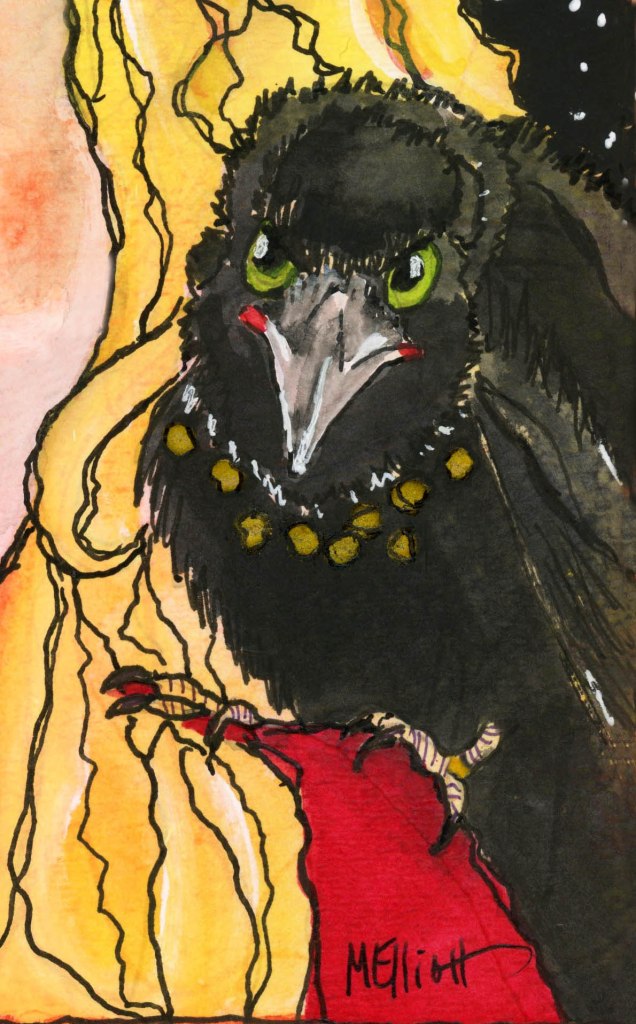
I won’t reveal more of the story; I will only say that while parts were predictable fairy tale trope, most of it is fresh and not typical. See for yourself—it’s not a long read, and I found it entertaining.
If you like it, you might also enjoy The Bride’s Farewell, by Meg Rosoff; Far, Far Away, by Tom McNeal; or Reckless, by Cornelia Funke, all of which are different from one another but share the quality of quirky original fairy tale with An Enchantment of Ravens.


