Faerie tale magic
Spinning Silver, by Naomi Novic, is so exquisite, both in the writing and in the telling, that after having spent three days reading at breakfast, lunch, and bedtime, I stayed up from 2:00 until 4:00 a.m. this morning to finish it; and when I got up at 9:00 and made my breakfast, rather than starting a new book I opened Spinning Silver
to page one and began reading again, to remind myself of all the reasons why.
 I purposely used the alternate spelling of “fairy” in the title because, although this book is billed as a fairy tale retelling, it is light years away from most of those. It borrows a couple of basic concepts from “Rumpelstiltskin,” turns them completely on their heads, and goes on with a story nothing like that mean little tale. There are actual faerie in this book, but they have more to do with the fey creatures of Celtic lore than with any relatively prosaic fairy godmother from the Grimms’ tales.
This is, above all, a character-driven story, and so you have to be patient as a reader for the first little while until you are sufficiently acquainted with the three protagonists. As a readers’ advisor, I am always one to tell a reader that if they aren’t enjoying a book in the early chapters, by all means drop it and find another. I’m not saying that this book isn’t good from page one—it is. And things begin happening from fairly early in the story; but it takes about 120 pages (which is a pretty big commitment out of 480) to complete your introduction to the pivotal characters and provide some action that really moves their joint story forward in a significant way.
As a person who loves character development, that didn’t matter to me in the least, because I was so fascinated with the way the first protagonist, Miryem, morphs from a cold, hungry, desperate girl into a tough, confident one who, once she decides that she is the one who will have to take care of her family, shows no hesitation.
Miryem and her parents, the Mandelstams, are Jews living on the outskirts of their little village near the forest. Miryem’s mother’s father is a moneylender in the larger town of Vysnia, and a hugely successful one; but Miryem’s father, who decided to take up the same profession based on the dowry from his wife, is too gentle to make a living the same way. When he attempts to collect on the money he has lent, his customers jeer at him, shout racial epithets, and chase him from their doorsteps, or else make excuses that they know will touch his soft heart and cause him to give way. All around the Mandelstams, the other people in the village are benefiting from the money they have borrowed, with their investments in more livestock, better farm tools, warm clothing, and fields of crops, while the Mandelstams starve. Finally, with her mother ill and her father helpless and discouraged, Miryem decides that she will have to be the moneylender of the family and, taking up her basket, she treks from door to door insisting on her just desserts. Soon there is a new thatched roof, warm clothing, and meat in the pot, but her parents weep that she has become cold inside from this “unladylike” profession.
Meanwhile, six miles away, Wanda lives with her Da and her brothers, Sergey and Stepon. Her mother is dead, buried in the yard under a white-blossoming tree with her six miscarried baby boys, and her father is a drunkard and a wastrel who has borrowed six gold kopeks from the moneylender, more than he will ever be able to repay. When Miryem comes calling asking for payment on the debt, he reviles her and tries to drive her away. She knows that if she lets him win she will confront the same problem at every turn, so she tells him that his daughter, Wanda, may pay off his debt a half cent a day by working for her and her parents. Although Miryem believes this will be a hardship, Wanda is secretly delighted, since it gets her out of the house and away from her father’s constant abuse; so Wanda becomes a fixture in the Mandelstam household, and soon becomes the debt collector in Miryem’s stead, while Miryem pursues other business.
Finally, after an ill-advised boast by Miryem about being able to turn silver into gold attracts the attention of the king of the Staryk, who comes to her with a bargain she is unable to refuse, we meet the third leg of the stool of this story: Irina, daughter of a duke and a quarter-breed Staryk “witch” and, up to this point in life, a plain and silent girl with no expectations. But the advent of Staryk silver alters her worth in the eyes of her ambitious father, and she suddenly finds herself betrothed to the dashing Tsar Mirnatius, who is both less and a lot more than he seems, with dire effect. Although the men in the book play pivotal roles, it is this triad of women whose thoughts and actions control the progression of their layered, interwoven lives, and who end up saving the kingdom of Lithvas from powerful enemies.
The themes in this book—agency, self determination, pride, empathy, duality, the embracing of family wherever you find it—are pervasive, and poignant but also raw. Watching each protagonist rise to her challenges with ingenuity and quiet determination was a joy. And the best praise I can give is that the quality of the character development, the language, the scene-setting, everything you would want from a story like this were maintained from beginning to end. The final sentence was as satisfying as all the rest, and was the perfect ending to a gripping and entertaining tale. It’s been a long time since I read a book that I loved with as much fervor as this one. I wish I hadn’t waited so long to read it after I heard about it. I was and am thoroughly beguiled.
ADDENDUM: I must address one issue with this book that was brought up to me by a friend on Goodreads. Although the author otherwise goes out of her way to be inclusive and expansive in her representation of characters of different religious and economic status, she is not similarly sensitive when it comes to the one gay character in the book. There is a courtier who makes it obvious that he is smitten with his cousin the Tsar, and Novik has the protagonist Irina scheme to marry him off to a woman for her own political gain, and is mocking and dismissive of his true preferences, actually threatening him to get him to comply with her plan. Novik needs to recognize that gay people merit the same sensitivity of treatment as her other represented groups. She should know that bad gay representation is worse than no gay representation. Yes, it’s two pages out of 480, but it continues a precedent and a prejudice that should not be present in this jewel of a book. I’m sorry to see it here.
Expansive Paris
I am an unabashed Francophile. I have been to Paris twice, and to the French countryside once for a painting vacation, and aspire to return there at any opportunity. I have mentioned here before that I am attracted to any book with France (particularly Paris) as its setting, and have reviewed a few worth reading. I was therefore excited to discover The Paris Key, by Juliet Blackwell, and to realize that it combines multiple elements that appeal to me in a story.
 I ended up liking it a lot, but for complicated reasons. Although I expected to like it for the same reason that I have enjoyed, for instance, the books of Jenny Colgan—because the main character realized something about herself that made her elect to drastically change her lifestyle—that aspect of it wasn’t nearly as powerful as it could have been.
What I loved is the gradual exploration throughout the text not just of Paris as a city, but also of the French as a culture, a people, and a lifestyle. The author really got it that the daily priorities in France are completely different from those in America, that it’s a slower, more reflective, less frenetic, more contemplative lifestyle, valuing family, friends, and physical, visceral experiences such as cooking, eating, walking, sleeping, over the career, business, and industriousness focused on by Americans, the infernal “what you do for a living” that seems to take precedence over everything.
There is a moment when the protagonist, Genevieve, gets it too,
when the attractive Irishman Killian invites her to continue on to another destination after they have been out and about together for a while. Her first impulse is to say “I should get back,” and then she realizes: For what reason am I rushing back? I have no deadline, the work will still be there, I can be solitary later, this is an experience that I should embrace, and she does. It was in these moments that the book had weight.
The other thing that I enjoyed was learning more about the unusual vocation of locksmith, especially as expressed in a city as old as Paris, where the locks can vary from ancient to modern, and the duties of the locksmith include repairing and refreshing the old locks as well as installing new ones. It gave a glimpse into buildings with architectural details beautifully described by the author, and that loving attention to detail was a big feature for me.
Additionally, the temptation of the locksmith, to go anywhere simply because she is able, was tantalizing. The main character shared an addiction with me, which is to get to know people by observing the surroundings they choose to create for themselves—perusing their bookshelves, noting their choices of furniture, fixtures, and accessories, and rounding out what you perceive of them by seeing their “native habitat.” In other words, indulging a penchant
for nosiness!
The story itself was eclipsed for me by these other elements. Genevieve is a fairly typical heroine whose emotions have been locked up (yes, there is a lot of symbolism of this kind, some of it overwhelmingly obvious or even trite) by various childhood and adult events or traumas, who needs to work them out and open herself up to life (wince with the lock-and-key metaphors again!). Likewise, there is a mystery she desires to solve about her mother’s past that no one will openly reveal to her, so she must go digging through the possessions left by her Uncle Dave (the deceased locksmith from whom she is taking over the business) and also try to access memories from her Aunt Pasquale (who suffers from Alzheimer’s and is therefore an unreliable witness). The “mystery” becomes all too clear to the reader long before Genevieve herself suspects, which I found a bit unbelievable. And finally, as I have objected to in other reviews, this author had a bit of that compulsion to wrap things up too tidily at the end that I sometimes find grating. This wasn’t as bad as some, but there were issues and encounters that could have been let lie while closure was still provided.
I did appreciate the colorful characters Blackwell created to populate the quaint and insular Paris neighborhood, although a few were a bit stereotypically French—that is, overly vivacious, grumpy, and so on. But over all, this book and its slice of Paris life amply satisfied my fixation, and was a pleasant enough story along with it that it proved to be an enjoyable read.
 It brought a favorite book to mind because of the locksmith theme, although the story, characters, setting, and the very locks themselves couldn’t be more different. That book is The Lock Artist, by Steve Hamilton. The similarity is in the feature of the seasoned locksman who takes a novice under his wing and teaches him or her a rare and intricate trade. If you’re in the mood for a thriller with some truly unusual elements to it, including some psychological content, a lot of law-breaking, and some romance, pick up Hamilton’s book. As I summarized it on Goodreads, “Lock-picking, low-lifes, and love!”
Light fare
In these very serious times, I’ve been doing some reading of not-so-serious books. I like to think of them as junk food, although I don’t want to seem like I am denigrating these books or the reading of them by me or anyone else. I’m just saying that, like the difference between eating a gourmet four-course dinner or grabbing some cookies to satisfy your sweet tooth, there is a difference, both in the writer’s skill and in the reader’s level of engagement. Even if you are eating cookies, you are getting some nutrition along with your treat,
whether it’s from oatmeal or nuts or dark chocolate. You just aren’t participating at the level of a good salade niçoise or some mushroom bourgignon! (In these self-isolating times, many of us are also participating to a greater degree in cooking and baking—
can you tell?)
 Anyway, my latest foray into relationship fiction is a duo by Irish writer Felicity Hayes-McCoy that, predictably for me, have to do with books and librarianship. The Library at the Edge of the World (Finfarran Peninsula #1) is described by its publisher as “a warm, feel-good novel about the importance of finding a place where you belong, perfect for fans of Maeve Binchy.” I think that stretches its importance a bit; I would be inclined to call these “Binchy lite.” But it is a lovely look at a few key people and a bunch more peripheral ones in an interesting locale teetering between community and estrangement. It reminded me a bit more of Jenny Colgan’s books.
Hanna Casey works as the librarian in Lissbeg, one of the small towns along the Finfarran peninsula. Her family goes way back on Finfarran but, until a few years ago, Hanna had embraced a much more active, well-to-do, and interesting life in London with her lawyer husband, Malcolm, and her daughter, Jasmine. Then she was devastated to discover that her husband had been having a long-term relationship with a colleague at work, a woman who purported to be her good friend, and in her anger and hurt she decamped with Jazz back to Ireland, telling her husband she wanted nothing from him. A few years later she is beginning to regret that hasty decision, as living with her outspoken and idiosyncratic mother in a small cottage is definitely beginning to pall, particularly since their buffer, Jasmine, has finished school and is pursuing a career elsewhere.
This is not the typical librarian pictured in this kind of feel-good fiction: Hanna wanted to be an archivist, dealing with great works of art in the rarefied atmosphere of a city museum or gallery, and somewhat resents the “depths” to which she has fallen as a small-town public librarian. She is in her early 50s, yet acts like some of the crotchety old-school librarians we all dreaded in our youth, who shushed us or kicked us out of the library for every tiny noise infraction and weren’t interested in providing such heretical innovations as computer classes or toddler story times.
Hanna’s saving grace is that she has come, gradually over the years, to believe in the power of reading, and spends two days a week driving a bookmobile to the far-flung tiny farming communities that populate most of the peninsula, developing a feel for what books to bring the many characters she encounters.
She has recently rediscovered a legacy left to her by her aunt, a piece of property that she couldn’t imagine being of any use to her while she was raising her daughter and decorating her beautiful home in London; but it has suddenly occurred to her that it might be an “out” to her nigh-intolerable living situation, and she thinks if she is careful with her money and can also get a loan, she can renovate Maggie’s old cottage and live in splendid isolation on the bluffs above the sea.
Then, plans by the bureaucrats of Finfarran come to light, which will polarize the peninsula by centralizing services in a grand new center located in the most populous town, thus cutting off all the small businesses and tourist attractions everywhere else, and also closing Hanna’s library. Hanna wakes up from her dazed existence and suddenly discovers within herself the will to fight for what she wants, and seeks allies to preserve a lifestyle she didn’t realize she had come to love.
I enjoyed this story quite a bit. I liked getting a look at rural life in the Irish countryside; the quirky characters were well developed and fun; and the story line was a good message about inclusiveness and community being more important than short-sighted financial success. The ending was a little pat, but played nicely off of Hanna’s former aspirations as an archivist.
The sequel, Summer at the Garden Café, was good, but not quite up to the first one. It furthered some of the relationships established in that book, it gave some interesting insight into the relative who left Hanna her house, and it moved some pieces around on the chessboard between London and Ireland. Basically, it was pleasant and innocuous, connecting here and there with real emotions when it details the situation of Hanna’s daughter, Jasmine.
There is a third book, The Mistletoe Matchmaker, which pulls in a different family mentioned peripherally in the first books, and sets up a romance for the Canadian granddaughter visiting her Irish family. I placed a hold on the e-book at the library, and will eventually report on the last of the trilogy. (If it is the last…)
Little Fire
I just finished reading Little Fires Everywhere, by Celeste Ng. I have had the e-book on reserve at the library for two months, because I saw that there was going to be a television show based on it on Hulu, and I always like to read the book first. But there were so many people trying to do likewise that although I reserved it in March, I didn’t get the book until May 1st, and in the meantime I couldn’t resist watching the show.
I’m going to say something that I’m not sure I have ever said in my history of reading: I liked the show better. Much better. I expected to enjoy it, given that it stars Reese Witherspoon and Kerry Washington, both of whom I admire and respect as actors and also as producers. But the changes they made to the script that differed from the book made the story come alive in a way that it just didn’t on the page.
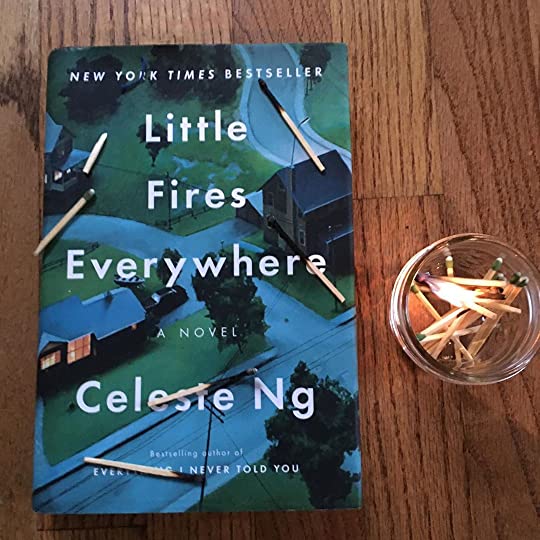
Elena Richardson is a “legacy” citizen of Shaker Heights, Ohio. Her ancestors were among the people who dictated the layout, rules, and boundaries of what kind of town it would be, and despite an initial passion in her teens to make a name for herself as a journalist, Elena settled instead into the comfortable and expected lifestyle of an upper-class wife and mother by marrying a lawyer, having four children in five years, and working part-time as a reporter for the small daily newspaper.
Mia Warren is an itinerant artist, a single mother with a teenage daughter, who has spent the past 15 years moving from town to town as whim, art, or necessity bade her. She has come to Shaker Heights partly for the sake of her daughter, who yearns for a more settled lifestyle; Mia has heard good things about the educational system and thinks that perhaps they could stay for a while, maybe until Pearl graduates from high school. Mia and Pearl rent a duplex from Elena Richardson, and from this point the lives of the members of the two families become increasingly tangled, first by the children and later by the adults.
A story within the story, a custody battle over an abandoned Chinese baby, becomes at least partially the issue that tears the families (and to a certain extent the community) apart, but it’s only a catalyst for what’s really happening, which is all focused on the issue of motherhood: what it is and isn’t, what it should be, the despair in the face of the lack of it, and the kinds of love that exist between mothers and children.
The thing is, it’s a good book. The characterizations are interesting and thorough, the issues are targeted, there is a lot of nuance, and Ng has a beautiful command of language that ups this into literary territory. It is not a fast-paced, easy-to-read thriller with a suburban setting—it’s a deliberate piece of fiction focused on middle-class ethics that requires the reader’s attention to detail. But I titled this review “Little Fire” on purpose, because in comparison to the TV show, the passion is lacking.
Some might say that I’m showing my preference for soap opera over real content, but I don’t believe that is the case. The TV show, by specifying that Mia and Pearl are black, opens up a whole different atmosphere and theme not present in the extremely low-key and nonspecific text, and makes racism a huge topic of the story. When questioned about this change, Celeste Ng said that when she was writing she didn’t feel capable of adequately portraying black experience, since it wasn’t hers; but the effect of what she did instead, which was to leave you constantly wondering exactly what the differences were that came between these families, watered things down for me.
The relationships themselves are much more intense, because more personal, in the show than in the book, particularly that of Mia with her photographer mentor, of Elena and Pearl, of Mia and Izzy, and in the subplot involving Bebe, the natural mother of the abandoned infant, May Ling / Mirabelle. The argument could be made that the characters of Elena and Mia are more polarized and therefore more stereotypical in the show; but this decision also allows for three or four of the best moments on TV, as white privilege is skewered in a way I have seldom seen, and a few sharp lines decimate attitudes that have taken centuries to build. There is a lot of “calling out” in the show, but in the context of the story it doesn’t feel like a history lesson, it feels like some sharp, intelligent people seeing through some lazy, careless, unaware ones. And no, it’s not all about race by a long shot—there are so many other forms of privilege that are exposed here.
Celeste Ng is a producer on the series, but she is one of many, and the show is obviously the child of Witherspoon and Washington. I wonder, given that she has no writing credit on any of the episodes, whether she went along with the changes reluctantly or was enthusiastic about the expansion of her work into some new realms. The book is thoughtful, well written, descriptive, expressive, and worthy of your attention; but the show is something more.
Whoever’s vision held sway, the Hulu production is a masterful accomplishment as the melding of written and visual arts by some talented, insightful women.
One last title
When I dialed up Los Angeles Public Library’s catalog and looked at their e-book selection for Brigid Kemmerer, I found one more book that wasn’t included in either the Elementals, the contemporary fiction, or the Cursebreakers. It was a stand-alone and it was available, so I downloaded it.
 Thicker Than Water is an anomaly, in that it starts out like a contemporary, turns into a murder mystery, and then makes a shift into the weird.
Thomas Bellweather is in trouble, with pretty much no one to whom he can turn. A few weeks ago, he and his mom moved to the town of Garretts Mill so that his mom could make a happy second marriage with her boyfriend, Stan. But two weeks after the wedding his mother has been murdered, and he’s left alone with his brand-new step-dad in a town full of strangers…many of whom believe that he was the killer. There’s not enough proof to lock him up, but there’s plenty to make every cop in town suspect him. Three of those cops, brothers, have a little sister named Charlotte who seems to be the only person interested in finding out the truth and, at least tentatively, extending a hand of friendship to him. But every time the two of them try to get together to work things out, mishaps turn into drama, and Thomas is deeper in trouble. Then, while looking through boxes of his mother’s things in the garage, Thomas makes a strange discovery about her past that turns everything he knows upside down. What, if anything, does this have to do with what’s happening today?
This book was immediately both frustrating and gripping. All the people in town who dedicate themselves to keeping Thomas and Charlotte apart, thereby delaying the vital information they need to discover to keep Thomas out of jail, was crazy-making, as was Charlotte’s alternating stance between trust and fear of Thomas. But what was weird to me was the pacing. The fact that the two protagonists are constantly being separated meant that the story line dragged behind where it “should” have been for a large part of the book, but then…
Since I was reading the book on my Kindle, I paid attention to the “percentage” of book finished. When something super significant happened, I glanced to the bottom of the screen and saw that the book was already at 81 percent, but this book was billed as a stand-alone. Hmmm, I thought: For me to get what I need from this story, we shouldn’t be at more than 65 percent at this point! (the voice of experience speaking) And sure enough, although everything was sufficiently revealed to solve the initial mystery, I was left with so many questions!
I can’t detail them here, because it would completely ruin the book for anyone reading this review, but I will say that I think Brigid Kemmerer owes us a sequel. These characters deserve more closure, and more exposure! The twist at the end needs further exploration and explanation! C’mon, what do you say?
Historical fic for middle school
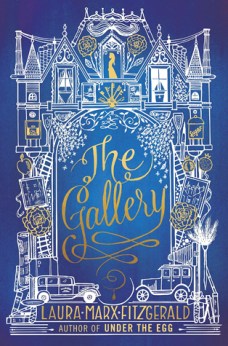 The Gallery, by Laura Marx Fitzgerald, was a sweet, if slight, middle-grade book with some historical context that was fun to read about. It is billed as an art “mystery” taking place in the Roaring ’20s, although there wasn’t a lot about it that was too mysterious.
I liked the spunky protagonist, the 12-year-old kitchen maid Martha, and I enjoyed exploring her relationship with her mother, the housekeeper for the wealthy Sewells of New York City, as well as her interactions with the other staff, the family members, and various odd characters with whom she comes into contact. But I felt like the book would have been vastly better if there had been more of a connection between Martha and Rose Sewell herself, the mysterious “madwoman” sequestered in the attic about whom the book was supposedly written!
The 1920s setting was fun (Prohibition, extravagance, cool clothes), and I enjoyed learning more about the Irish working classes and the rich titans of industry, but the main reason for which I picked up the book—details of Rose’s art gallery, which is, let’s face it, in the TITLE—was a disappointment.
We got a few descriptions of a small percentage of all the supposedly amazing paintings from Rose’s collection that were squirreled away in her attic, a little Greek and Roman mythology thrown in to explain those images, one quick and unsatisfactory trek through the Met, and that was it. I felt like the central ploy—to “save” Rose (and her inheritance) and get her out of the attic—wasn’t explored nearly enough, and the ending was abrupt and somewhat disconnected from the rest of the story.
Also, I will echo another reviewer on Goodreads who deplored that this author actually gives away THE central plot point of Jane Eyre in a middle school book, thus spoiling the future reading of a classic! No, no, no!
This book had the feel and the potential of such entertaining historical fiction as Rhys Bowen’s Molly Murphy mysteries, but turned out to be hit or miss—pleasant, mildly entertaining, and mostly forgettable. Nice cover design…
More Kemmerer!
After completing and thoroughly enjoying Brigid Kemmerer’s Call It What You Want earlier this week, I was positively compelled to read two of her other contemporary realistic teen fiction novels: Letters to the Lost, and More Than We Can Tell. Previous to 2015, Kemmerer was apparently known for her “Elementals” series about four brothers with paranormal powers, but when I read the descriptions, I wasn’t enticed to read one. I can’t say the same for her contemporary realistic novels, which I have practically inhaled one after another without stopping, becoming incensed when my Kindle ran out of juice at 2:30 in the morning about 40 pages from the end of the last one!
These books remind me of a few other authors—Dessen, Caletti, Rowell—because their books also contain that ideal combination of relationship and life events that propels the story. Even though there are elements of romance to each book, the primary motivation is understanding, empathy, and relationship. Although I have seen some young reviewers on Goodreads remark on the swoon-worthiness of various protagonists (as do some of the other characters!), most recognize that they are not reading these books for the romance but for the real-life transformations that occur as a result of the connections made by the people in Kemmerer’s books.
 Letters to the Lost is, as one might assume from its title, an epistolary tale. While working his community service gig at the local cemetery by clearing up the debris left by its visitors and then mowing the plots, Declan Murphy finds a letter left by one of the headstones. When he picks it up and reads it, he feels a surprising affinity with the feelings expressed by its author and, in an impulsive moment, he pulls a pencil out of his pocket, appends the words “Me, too” to the end of it, and lays it back on the grave, never dreaming that the original writer would come back to find his alteration of her letter.
Juliet Young, who has been heartbroken for four months since the death of her photojournalist mother in a hit-and-run, is outraged when she sees that someone has dared to appropriate her grief, and writes another, indignant letter addressing not her mom but the encroaching P.S. person. This is the beginning of both a correspondence and a friendship that grows faster than either could have dreamed, as they each feel free in their anonymity to express some of their deepest feelings and fears.
The truth is, Declan and Juliet are not complete strangers to one another; but the public personnas they wear at school have blinded each other and almost everyone else to who they are or have the potential to be. It takes some extraordinary events to bring them out of hiding, for one another and with all the other people in their lives with whom they need to clear the air.
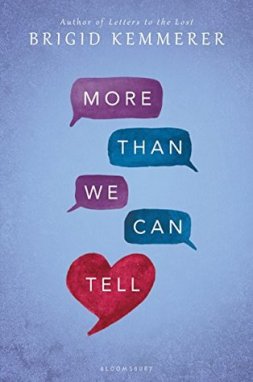 In More Than We Can Tell, one of the significant sidekicks from Letters to the Lost gets his own tale, which is a more than satisfying happenstance for those who loved the first book. He was an intriguing and important character in the first story, but although we gleaned bits and pieces of his history, there was so much more to tell. As in Letters, and also in the book I read earlier, Rev Fletcher gets a counterpart, Emma Blue, to help him reveal his story while dealing with the fallout from her own, and together the two are able to transition some difficult events with all the ambivalent feelings they stir up.
Rev has loving adoptive parents who took him in 10 years ago at age seven, and adopted him a few years later. He has for the most part put the effects of his troubled early childhood aside, but when he turns 18 and receives a letter from the father who abused him both mentally and physically, it sends him into a tailspin from which he is having a hard time recovering.
Emma has parents who love her, but her mother is hypercritical of Emma’s choice to follow in her father’s footsteps as a creator of video games. To escape the bickering between them, Emma focuses all her time and attention on the perfecting of a computer game she has created from scratch. But when an intrusive and insistent “troll” begins harassing her online, she is reluctant to reveal this problem to a mother who will order her to stop or a father who will be disappointed in her less-than-perfect design security.
Rev and Emma meet, and each serves as an outlet for the other’s private fears. But then issues arise that cause a lack of trust, and it’s not clear whether the budding relationship will survive them.
These books, while sounding formulaic (the alternating points of view, the pairing of two protagonists, the problems they must overcome) are in all honesty totally immersive, nuanced, and redemptive in tone. I can’t imagine a teenager who couldn’t relate to at least one, if not all, of these characters, and the “lessons” that are being taught are not heavy-handed. Some of the messages—that you can ask for what you want instead of passively waiting to be given it; that unkindness should always be resisted on your own behalf and that of others; that talking to people will mostly relieve all kinds of unfortunate misunderstandings; and that a moment is just a moment and a day is just a day, always making room for a different choice or change—are beautifully illustrated by these stories.
I do plan to read the sequel to the Beauty and the Beast fairy tale retelling Kemmerer has written, and I still maintain hers is one of the better and more original one of these out there, but I think her true strength lies in writing about real teenagers in the throes of their confusing, sometimes difficult lives.
I also have great admiration for her, in that she has written at least a dozen books between the years of 2012 and 2020, while simultaneously being married and having four sons!
Contemporary YA
While scrolling through books on bookoutlet.com in the search of a few more to round out my $35 minimum, I came across Call It What You Want, by Brigid Kemmerer. The name sounded familiar to me, so I looked her up on Goodreads and realized that she was the one who wrote the fairy tale retelling of Beauty and the Beast that I liked so much, so although it didn’t appear to be fantasy, I decided to try this one, which seems to have been written (or at least published) between that book and its sequel, A Heart So Fierce and Broken, which I also own but have not yet read.
 Having read both books, I can see that Kemmerer has created for herself something of a formula, although in this case that’s a good thing. One of the ways that her fairy tale book worked was to tell it from two perspectives—those of the enchanted prince and the commoner girl—and this book echoes that by also giving us two protagonists with story lines that intersect.
The male protagonist, Rob, is a victim of circumstance, although many of his peers think he is more than that. Rob’s father, Rob Sr., a financial advisor, was a mini Bernie Madoff who ran a Ponzi scheme on his clients that lost them all their money. To add insult to injury, when he was turned in Rob’s father tried and failed to commit suicide, and survived in a vegetative state, needing constant care from his now destitute wife and son. Rob had been working as an intern in his father’s company when all this transpired, and despite his protestations of ignorance, his classmates and their parents who were injured by his father’s actions refuse to believe that he wasn’t “in the know,” causing him to become a pariah at his high school. He’s basically putting his head down and trying to survive for the rest of his senior year until he can get out of town.
The female protagonist, Maegan, has her own issues: Despite being an honors student with high grades, Maegan questions her abilities and makes an impulsive decision to cheat during her SAT test. She is caught, resulting in 100 other kids’ tests being invalidated and discarded. So Maegan has her share of abuse to survive, and is likewise walking around school in a solitary bubble. Fun fact: Maegan’s dad is the cop who arrested Rob’s dad.
The two share a calculus class, and when their teacher pairs everyone up for a class project, Rob and Maegan are the two conspicuously left standing, ending up together. Neither of them is happy about this and both consider asking the teacher to change the assignments, but with the prospect of having to be third wheels on teams who don’t want them, they resign themselves and tentatively try for a way to work together.
Kemmerer does a brilliant job of first investing you in their situations and then illustrating how these two closed-off teens are gradually able to open up to one another and seek sustenance in an unlikely friendship. Prior to Rob’s family’s “fall,” he was one of the privileged, über-popular lacrosse stars, while Maegan’s family is from much humbler blue-collar origins, although Rob and Maegan’s sister, Samantha, share a love of lacrosse that bridges an initial gap. The sub-plots in the book, involving Rob’s former best friend, Connor, who is determined to constantly remind everyone of Rob’s supposed culpability, Rob’s new and unexpected friend, Owen, with whom Rob conceives of a “Robin Hood” plan to assist the have-nots, and Maegan’s sister Samantha’s secret pregnancy, further enliven the story.
The book explores such themes as right and wrong (doing right for the wrong reasons and wrong for the right ones), trust, responsibility, mistakes, and transparency, but does so in such a way that the reader never feels imposed upon by those themes. Kemmerer presents black and white and every shade of gray as they appear to all participants and makes the reader as eager as the characters to resolve the issues, find justice, and give the misunderstood some relief. There is romance, but it’s far from the dreaded insta-love; this is realistic young adult fiction at its best. If you are a teen who enjoys contemporary fiction, this is a writer who will give you what you want.
I have already lined up Kemmerer’s other two contemporary novels on my Kindle.
2nd chance romance
I have to admit that I don’t know how I ended up with this book. I ordered a bunch from bookoutlet.com (you have to spend $35 to get free shipping, and since the books are mostly between $3.50 and $6 apiece, that’s quite a few books), and this was in the box. I’m sure something about the description appealed to me (probably the “second chance” aspect of the love story), or I liked the beautifully painted gouache cover, or maybe I was subconsciously influenced by the fact that the word “girl” was in the title? Ha! No. Or maybe I decided I needed to read more romance, since that is a weak spot in my readers’ advisory repertoire.
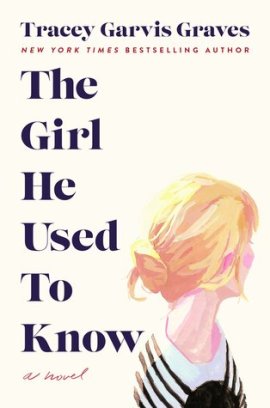 Anyway, I just finished The Girl He Used to Know, by Tracey Garvis Graves. I have never heard of her, but she is apparently a fairly popular romance writer, although her name does not percolate to the top of the heap in the same way as do those of some of the other authors with whom her writing has been compared. This is where labeling gets a little sticky, because I can’t decide whether this belongs properly in the full-on romance category or should be shunted over to what I call “relationship fiction,” which is where the feel-good romances with more substantive stories, such as some of those by JoJo Moyes or Liane Moriarty, end up.
The thing that made this book memorable is that the protagonist, Annika, is not neurotypical. She is on the autism spectrum, although that fact isn’t clearly dealt with until midway through the book. Rather, she is initially represented as “weird”—fragile, difficult, obsessional, a misfit.
Because the book takes place in two time frames, 10 years apart, and begins from the latter time frame, the Annika we meet up front is calm, poised, fairly self-aware, and well established in her life as a librarian in Chicago. We rapidly realize that she has had issues in her past because of her regular consultations with her therapist on how best to handle certain events in her life, but she doesn’t seem so different from a lot of people. My first reaction to her was that perhaps there were incidents of abuse in her past, and this is what has caused her social ineptitude.
Then we meet the Annika of 10 years ago, who panics after a week at college, refuses to leave her room, and calls her parents to come get her. The Annika who looks at people’s noses because she can’t look them in the eye, who wears baggy clothes because they are comfortable and also don’t draw attention, who spends all her time with books and animals and has no friends, and we start to get the idea that there is a real difference between this girl and a simple introvert or someone who has been scarred by just one past incident.
The book is told from two perspectives as well as from two time-frames—it’s co-narrated by Annika and by Jonathan, her first real boyfriend in college and the man whose heart she apparently broke. Near the beginning of the novel, the two run into each other in the grocery store and discover that Jonathan moved back to Chicago after his divorce a couple of years back, and that they don’t live too far apart. Annika makes it obvious that she is interested in rekindling things, but Jonathan is more cautious after how thoroughly she let him down 10 years before. And from this point, the chapters flash back and forth between narrators and between past and present to give us an idea of both the personalities and the relationship, and how they have changed and not changed.
I found that the best bits of the novel were the unintentional faux-pas moments caused by Annika’s skewed socio-emotional IQ. She is literal, she is blunt, she is confused by the necessity to do such things as read faces and moods, adapt to the “games” played by most people, or be social when she is feeling anything but. There were a few exchanges in the book that I loved: At the library she has a co-worker who has been on the job three months longer than she has, and uses that as an opportunity to patronize Annika and question her use of her time. When Jonathan arrives at the library to pick Annika up for a date, the colleague steps up and introduces herself as “Annika’s superior,” and without taking a beat, Annika says to Jonathan, “She is not my superior, I don’t report to her. Where are we going for dinner?”
Sadly, I didn’t feel like Annika’s true plight in life was sufficiently exposed. There were moments that showed what traps a beautiful girl with no social cues is likely to encounter, as when a boy who purported to like her has invited her to his dorm room to make out while three of his friends watch. Her roommate Janice rescues her from this situation (and from others), but it didn’t feel like the incident registered at all with Annika. Likewise, when Annika innocently details for Jonathan her blow-up with another boyfriend, who takes her to her favorite restaurant and ends up publicly berating her because she’s so beautiful but “then you have to open your mouth,” Jonathan immediately grasps the full import of the moment, but Annika is simply happy to be back at a restaurant she always liked. These were telling scenes, but there weren’t enough of them, or of the smaller moments in life when autism comes up against the ignorance and/or bad behavior of so-called “regular” people.
I also found the character and personality of Jonathan rather bland. It was refreshing how he found Annika’s directness and naiveté endearing rather than irritating or off-putting, but Graves perhaps paints him as too much of a saint, without some of the more natural reactions to circumstances that the majority of people would have. I thought back to Graeme Simsion’s book, The Rosie Project, and the much more down-to-earth interaction between the precise, literal Don Tillman and the woman who finds him completely frustrating and yet engaging in his innocence and bewilderment about the social norms that escape him.
Despite some character deficits, however, I was completely into the relationship between these two…until the final events of the story. I’m not going to reveal them here, but my reaction was horrified exasperation with the author for using an outside drama to give her a conclusion instead of finding her own. For about 90 percent of this book, I would have given it at least 3.5 stars, but the ending dropped it down to 2.5! So I don’t know whether to recommend it for its merits as a refreshing look at the differently abled, or pan it for its clichéd ending. You will have to decide for yourself.
Spooky YA
When placing a recent book order, I decided to catch up with some YA books that have been out for a few years, some so I could move further into the series, others just because I felt they were books I should have read in order to maintain “street cred” as an expert in young adult literature for my class at UCLA. One such book was City of Ghosts, by V. E. (Victoria) Schwab.
I was initially taken aback as I began to read, because all of Victoria’s other YA books are targeted more towards high school students, and
I had expected the same here. City of Ghosts is definitely a middle school offering—in fact, if a kid is a precocious reader, I think this could reach down into the upper levels of grade school—5th grade
for sure. But once I realized what I was reading, I settled in to enjoy this story.
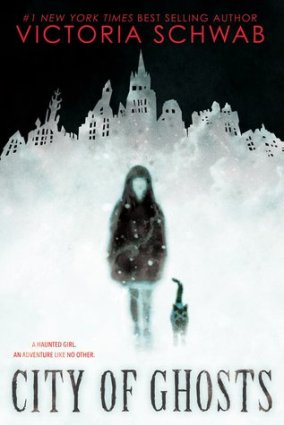 Cassidy Blake died by falling into a river. She was saved from permanent death, however, by a ghost named Jacob, who snapped her out of it and in the process became somehow attached to her. Now he is her faithful invisible sidekick in her world, and because of her NDE (near-death experience), she is a regular guest in his world, which she has nicknamed “the Veil,” because when she enters the world of ghosts, it’s like pulling back a curtain and stepping through a window.
Cassie’s parents are ghost-hunters, of a sort. Nothing so crass as the people on TV who stumble around in dark houses trying to film ghosts as proof they exist—her father is an historian, while her mother enjoys the story aspect and is enthralled by old folk tales of ghosts and specters. Now, however, the two have been invited to host a TV show about the world’s most haunted places. The first filming site is the ancient city of Edinburgh, Scotland, which teems with restless phantoms. Cassie has no idea what she will confront in a city so steeped in haunted history.
The descriptive language, particularly Cassidy’s sensations inside and outside of “the Veil,” lent a lot to the power of the story. I had a bit of a hard time believing that while her parents were “inspecters,” they didn’t believe in Cassidy’s sidekick, or see that there was something going on with her. I know her dad was fixated on the historical and didn’t endorse the supernatural aspect, but it seems like her mother, so involved with the legends, could have been a little more receptive—or perceptive. Maybe that changes in the next books in the series?
The introduction of the ghost hunter Lara and the mysterious Findley added a lot to the story, as did Cassie’s encounters with both personal and historical aspects of “ghosthood.” The “villain” was a convincing choice as an avatar from several cultures, and yielded a satisfyingly scary climax to the story.
Some of the material here is familiar from other writers and other series, particularly the concept of the near-death experience providing a heightened sensitivity to ghosts, and the idea of people sending ghosts trapped in the “in-between” to their final rest by releasing them from their rote repetition of a particular moment in their life/death. The first concept is dealt with in greater depth in Maureen Johnson’s three high school paranormal mysteries, Shades of London, in which a girl first discovers her own ability to see ghosts, and then finds out that there is a coterie of secret ghost-fighting police, called the Shades, who want her to join up with them. The second is covered in the delightful five-book Lockwood & Co. series by Jonathan Stroud, set in an alternate universe where “the Problem” (ghosts everywhere) is out of control, and only children are able to see and fight them. Schwab’s account is by no means derivative—I only mention these other series because they could be a natural progression as the younger middle schoolers who enjoy City of Ghosts want older fare.
Since Schwab has written three series for older teens (The Archived, Monsters of Verity, and The Near Witch), you might think I would refer young people to those; but honestly, I didn’t enjoy any of them beyond a point. This is odd, because her adult books (the Shades of Magic series, and the Vicious books) are among my all-time favorites—to the point that I have re-read all of them several times. My experience with teenagers from my librarian days is that they feel likewise—they are tepid about her YA books, but madly enthusiastic about the ones she has written with adults in mind. And especially with the Shades of Magic books, she has provided for the attraction of that audience by creating two protagonists young enough to appeal to teens while complex enough to attract adults.
I find it so odd when one writer writes for two audiences with such different results, but I have encountered it numerous times. I love the adult mysteries of Elizabeth George, but practically panned her young adult paranormal series. It’s also interesting when someone writes under two names, and you read both of them as separate authors, come to completely different judgments about their work, and then discover that they are the same person, as happened to me with mystery writer Barbara Vine, who is also Ruth Rendell. While I like Rendell’s books, I find them a little dry, a little cold, and sometimes frankly off-putting, whereas Vine’s books are much more to my taste—softer, more intimate, less clinical.
If you are a young adult, you should certainly not take my word for it that Victoria Schwab’s YA books won’t be to your liking. There are so many YA books that I have loved while teens said “take it or leave it,” and so many others that I couldn’t stand but about which teens gush over how good they are. But I can tell you that my recommendations of her adult books have met with universal approval, and I look forward to the new one arriving this year in October—The Invisible Life of Addie LaRue. That is one book for which I will put in an advance order.
There is currently another Cassidy Blake book to be read (Tunnel of Bones), shiveringly set this time in the catacombs of Paris, and a third book in the series is due out in 2021.

 The Book Adept