Egypt by another name
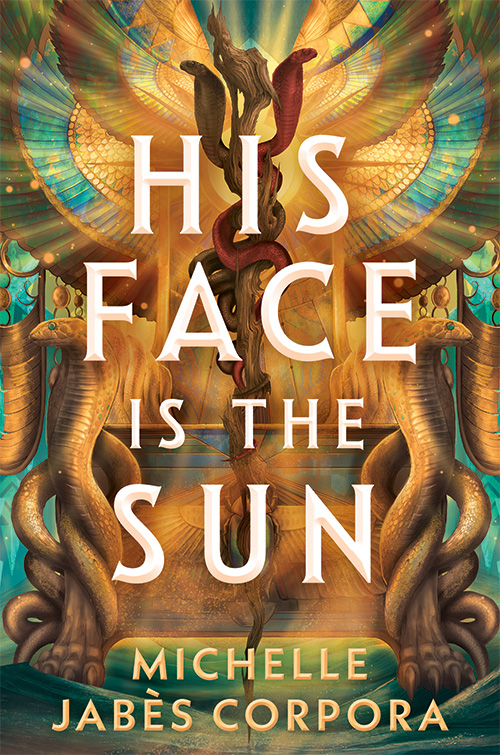
I picked up a Kindle deal for a new YA fantasy a few weeks back, and finally got around to reading it. The book is His Face is the Sun (Throne of Khetara #1), by Michelle Jabès Corpora, and it’s being billed as something that the readers of several other teen fantasy writers (Bardugo, Mafi, Tahir) would enjoy. And although I believe that is true, I’m not sure they should have focused it so relentlessly at the Young Adult market. In fact, I often feel that way when it comes to fantasy and science fiction.
In other genres (realistic stories, romance, coming of age), the audience can be clearly demarcated as teens, ages 13-18 or whatever—many adults aren’t interested in teen angst-ridden 15-yo first love stories. But with fantasy, if the world-building is thorough and convincing and the protagonists are engaging, I often feel these books are done a disservice not to be marketed widely. This one, for instance, ended up pretty quickly in the bargain Kindle bin (I think I paid $1.99), and it shouldn’t have, because it’s a really beguiling read. So adult fantasy lovers, pay attention and check it out, because if you enjoy it, there are two more books to come. (Also, this series is directed at more mature teens, due to some frank content, just fyi.)
The kingdom of Khetara is a faintly disguised Egypt, with some of the same gods under the same names and also under different ones, and similar dynasties of rulers and conquered peoples. It could almost be historical fantasy, but the author chose to create her own stage within the auspices of Egyptian history. There are priests and oracles, there are competitors vying for the pharoah’s throne, there are rebellious mistreated commoners, all set against a background of desert, river, village, palace, and temple, brought to life in beautifully detailed descriptions (that don’t slow the story at all). There is a mythology-based magic system that winds through the entire story in an organic manner and, although there is a little romance, this is primarily an epic fantasy focused on history, politics, magic, and destiny.
The main characters are four people who couldn’t be more different: Princess Sita, one of the triplets to whom the current Pharoah is father; Nefermaat, a bewildered young village girl who, after a spontaneous vision brought on by the annual parade for the goddess Bastet, has been whisked from her home to the capitol to train as a priestess; Raetawy, leader of a rebel group of farmers oppressed by the pharoah’s punitive taxes; and Karim, a young grave robber who unearths more than he bargained for and sets in motion some of the events envisioned by Neff and anticipated by Sita’s brother Mery, who is determined to rule Khetara sooner rather than later.

Although four protagonists is a lot, Corpora does a wonderful job of developing each of them with clear personalities and motives, and separates their subplots (politics, magic, rebellion, and fortune-seeking) while intersecting them at the appropriate moments to keep us intrigued. (Oh, and there’s a delightful fifth narrator—only encountered a few times—who further draws things together.)
I was completely involved in this story from beginning to end and, when I encountered that cliffhanger and realized that this book had just been published in May and I would have to wait at least a year for the next one, was sorry that I had read it so quickly. I will do a reread when the sequel comes out, to catch all the delightful detail that I may have skimmed over while trying to absorb the book as a whole. If you ever thrilled to the stories of adventures down the Nile, hotly contested dynasties and mysterious portents, you will want to read His Face is the Sun.

Cozy with nuance
I don’t remember who recommended this book to me; maybe I just read a review of it somewhere, or it popped up in my Kindle best buys or something. But probably someone told me about it because the main character is a librarian. (When you yourself are a librarian, people do that.)

Fried Chicken Castañeda, by Suzanne Stauffer, is a first book for this author, who was also a librarian for 20 years in New York City and Los Angeles, and then got her Ph.D. at UCLA in 2004 (I missed her by a year!) and went on to teach at the School of Information Studies at Louisiana State University. She is also a historian of libraries (you can see a list of her published papers on Wikipedia.
But the protagonist of her book, Prudence Bates, is bored with her career at Cleveland Public Library, and decides to go on hiatus to try something new. It’s early 1929, and Prudence has thus far led an extraordinarily limited life. Her father died a few years back, and her life choices have been truncated by the desire to spare her mother solitude. She wanted to go away to college, but instead attended one close to home so as not to leave her mother alone. She wanted to be an anthropologist who travels for research, but instead chose library science because she could get a local job to be there for her mom. But now her mother and Prudence’s nice enough but, yes, rather boring boyfriend are both pressuring her to settle down, and she’s so tired of fending them off that she almost succumbs.
Her boss at the library senses her ennui in the nick of time, and proposes that she attend a library program about young women couriers for the Fred Harvey Southwestern Indian Detours, who lead tours from the Santa Fe Railroad depots in the West to explore Native American art and culture. The stated goal by the library director was for her to emulate the presentation by developing similar programming for the library, but Prudence is so entranced by the life these nomadic tour guides describe that she packs her bags and heads out to New Mexico to train for a courier job. She has the college degree they require but not the familiarity with the terrain, so she stops off for a week on her way to the interview in the small town of Las Vegas, New Mexico, to begin to get acquainted with life in this corner of the world that is so different from her native Cleveland.
This book reminded me, for some reason, of the Molly Murphy mysteries by Rhys Bowen. They are not superficially too similar; but both protagonists are young, optimistic, and somewhat cheeky, and they both travel far outside their childhood norms to experience a different kind of life. The story also made me think of Dead to Me, by Mary McCoy, yet another librarian author (this one works at Los Angeles Public Library), because it’s set in a particular part of the past that yields extra interest; that book takes place during Hollywood’s Golden Age, while this one navigates the perils of Prohibition.
Stauffer has done her historical research, with the result that the background is filled with details about Pullman train travel, the fashions of the day, and the specific environment in the small New Mexico town Prudence chooses to explore. But what I liked best is that she didn’t shy away from permeating her narrative with the huge cultural divide of that era between the well-off white folk traveling on the trains and the Indian cultures these people are “touring” from a position that could be described as both superficial and patronizing. She is not at all heavy-handed, but does manage to insert reactions and observations designed to highlight such themes as racism, wealth inequality, and cultural diversity as her heroine gets to know the people who actually live and work in the towns through which she will be leading her tours, employed by the railroad and by the Harvey company.
The mysteries in this book are not quite as compelling (probably because there is so much character development and scene-setting to accomplish), but they are mixed up with a bit of romantic tension between Prudence and Jerry Begay, a Navajo man she meets on the train, that lend an extra spark.

the Castañeda Hotel in Las Vegas in 1926.
It’s not a book I would rave about and recommend to everyone I know; but it was certainly one of the better cozy/historical mysteries I have read, good for a couple of afternoons of entertainment. I would willingly pick up a sequel to find out more about the career of the gutsy Prudence as she pursues her dream. I hope she writes one!
Cream of the crop
I wasn’t going to post any further about my sojourn in the land of Regency Romance, but the last Heyer I reread was so delightful that I just have to share. I have previously mentioned a list of favorites here, and somehow this one didn’t make it onto that list, but I think it may be my new “best-of” pick. It’s The Foundling, written in 1948.

The name of the book is deceptive, because the foundling (orphan) in question is merely one small element in a much bigger story, and most of that story is about Adolphus Gillespie Vernon Ware (“Gilly”), the seventh Duke of Sale. Gilly is 24 years old, one year away from his majority, when he will take over control of his own estates from his guardian and uncle, Lord Lionel Ware. He is beset by irritations, but not the kind to which there seem to be any solution. He was a sickly child who has grown into a sturdy (if small and slight) adult, but his relatives and the raft of devoted family retainers who work for him will never let him forget that they have had good reason to mollycoddle him for his entire life, and he is constantly thwarted in the simplest of plans. He can’t do so much as take a walk to his club without his valet, his butler, or his agent insisting on ordering him a carriage for fear he will unduly exert himself or catch a chill. So when his young cousin, Matthew Ware, comes to him with a problem he is, himself, unable to solve, the Duke decides that he will take care of it without resorting to the advice of others. He will do so while masquerading as a plain “Mr. Dash,” not dependent on the benefits of birth and wealth; he manages to sneak off on his own, with no luggage, no carriage or horse, and no word to his servants or his uncle about either his intentions or his destination.
This incognito journey into the countryside to confront his cousin’s blackmailer leads to some interesting and signficant encounters that include a runaway schoolboy, a divinely beautiful but completely brainless orphan, and some villainous people and perilous situations. Meanwhile, back at his London abode, the hue and cry to discover his whereabouts is exacerbated by the belief by some that he may have run off due to an adverse reaction to becoming engaged to his lifelong friend, Lady Harriet. Others develop the theory that his cousin Gideon, who is his best friend but also his heir, may have “put him out of the way” in order to ascend to his title and massive fortune!
This is one of Heyer’s most complex and convoluted plots, with something happening every moment. Although the book is named after the fair Belinda (the foundling in question), her part in it is minor except as it motivates some of the adventures of “Mr. Rufford,” the name under which the duke is traveling. It is much less a romance (although there is a bit involved) than it is a coming of age of a man who, restricted from all autonomy since birth, finally rebels against all restraints, and his ensuing complicated adventures are the meat of the story.
I got through it in about 36 hours, because I couldn’t put it down. If you are inclined to try one of Heyer’s books for yourself, may I suggest this might be a good one to assay? (Yes, I am, at this point, speaking in the language of her characters. I think it’s time to move on to other literature.)
Escape from…
I have a number of books on my “TBR” list, but about a week and a half ago I decided to forego all of them for now and retreat into pure denial of everything that’s happening in the world and all the trials of my personal existence by rereading (some for the third time) a string of Georgette Heyer Regency romances.
I started out with three of my favorites—The Grand Sophy, April Lady, and The Convenient Marriage—and then took potluck on the public library website by reading whatever was immediately available, since the idea was a continued getaway rather than a long wait on a hold. And yes, most of her books still have holds on them, more than 50-75 years after their publication!
So I continued on after that with Charity Girl, The Unknown Ajax, and False Colours, which I just started. I have hopes, after this, of snagging Cotillion, Sprig Muslin, and The Foundling, by which time I’m hoping that I will have completely sated my appetite for drawing room drama, complicated toilettes, and witty banter, at least for a good while.
If you are, at this point, losing all respect for me as a reader and reviewer, let me tell you that you are “fair and far out” (under a misapprehension) should you believe that there is no redeeming value to these books. I defy anyone to find a contemporary romance writer who can rival their language, the sometimes labyrinthine plotting, the wonderfully droll characterizations, and the descriptive scene-setting, not to mention the perfectly evoked fashion in which everyone, male and female, is attired.
Perhaps I will follow up this binge by reading Everything I Needed to Know About Life I Learned by Reading Georgette Heyer, by Miss Cooke (2016). Although since this “book” is only 55 pages long, I suspect I could do a better job of writing a similarly titled volume!
Horse

Although I started out as a little girl who liked dolls, as I got older I turned into a horse fan(atic). (My mother continued to collect Madame Alexander dolls on my behalf long after my interest waned.) I went through that stage around 9-13 years old where I read everything horse-related I could find: the Marguerite Henry tales of the wild ponies of Chincoteague; Black Beauty, by Anna Sewell (multiple times); My Friend Flicka, by Mary O’Hara; National Velvet, by Enid Bagnold; and all the Black Stallion books by Walter Farley. With my parents and their best friends, I spent two spring vacations at a “dude ranch” in Arizona, riding daily for two weeks each year (the photo is from there). After that I begged for riding lessons in my home town of Riverside, California, and spent some months riding an ornery “rental” horse named Shadow who dumped me off more than once in the (thankfully soft) dry river bottom of the Santa Ana river. (I wasn’t that bad a rider; I was jumping him over logs and bushes at the time, fantasizing about being Velvet Brown in the Grand National, and he had a spiteful habit of blowing up his belly when his girth was being tightened so that the saddle would go sliding at inopportune moments.)
My ultimate goal was, of course, to have my own horse, and I almost fulfilled that wish; my grandfather, a farmer who was essentially a childlike man notorious for making rash decisions without considering consequences, went to the local livestock auction in Chowchilla one Saturday morning and bought me an unbroken palomino colt. I was overjoyed, but my parents sat me down and explained to me that it wouldn’t be realistic to keep a horse in Riverside, where he would have to be boarded out and I, with my crowded schedule of academics, piano lessons, and thrice-weekly church, would have scant time to see him, let alone ride or care for him. There was also the matter of the expense of both training and boarding him, which we couldn’t really afford. I was devastated, but I was at heart a sensible and agreeable child, with the result that Granddad sold him on to another buyer, and I went back to my books. I never did, however, wholly lose the longing for a horse companion; I wasn’t so much into riding, I just liked being around horses. Their energy and temperament held a fascination for me that has never waned.

It was, therefore, probably inevitable that I would at some point get around to reading Geraldine Brooks’s book Horse. I resisted for a while, for a couple of reasons: First, I’m not drawn to historical fiction; it seems to me that the history so often interferes with the author’s ability to tell a good story, being constrained by actual events (and feeling the need to include them all!). I tend to steer clear of anything “based on a true story.” I have discovered a few exceptions that I love, but mostly I avoid these books for fear of disappointment. (Also, does everyone in the world have to write a book set during World War II?!) The other reason was because I read her book March and, contrary to the popular opinion, didn’t care for it much. Louisa May Alcott’s Little Women books were cherished childhood favorites, and Brooks exploded some of the myth in her tale of Mr. March in ways I didn’t appreciate (and also, I found parts of it vastly boring).
But…horses. HORSE. So I put my name on the library waitlist and was finally granted access to the e-book last week. It was both more and less than I was expecting, and I thoroughly enjoyed some parts while being put off by others.
The story is set in three time periods and jumps back and forth between those and also between multiple narrators in each one. The first takes place in the years just prior to the Civil War, and begins with the birth of a bay foal who will become the famed and gifted racehorse Lexington. The enslaved boy Jarret becomes first his groom, later his trainer, and his fiercest advocate as they essentially grow up together. The other spokesman in this time period is an equestrian portraitist, Thomas Scott. The second (much less significant) storyline is set in New York City’s art world of the late 1950s, from the viewpoint of art dealer Martha Jackson. The third, contemporary tale occurs in Washington, D.C. in 2019, with Jess, an Australian woman who works at the Smithsonian Institution’s Osteology Prep Lab (she articulates skeletons for display), and Theo, a Nigerian-American Ph.D. student writing a dissertation about American equestrian art (specifically focusing on images of slaves in paintings of racehorses). All these timelines are connected by a portrait of a horse and his black groom that Theo discovers abandoned on his neighbor’s curb. The horse is Lexington, the groom is Jarret, and the book weaves together all the connecting threads.
The relationship between Jarret and Lexington is moving, poignant, and sometimes heartbreaking. The back story of the history of American horse-racing, specifically in the South, was fascinating to me, as were the contemporary details about the science of the preservation of natural history and the restoration of paintings.
There is, of course, a subtext to the entire book, which is racism. It is effectively and affectingly dealt with in the pre-Civil War sections by the clear depiction of the sale of humans being much more common and vastly less considered than the sale of horses.
I found the theme less compelling when Brooks moved to the present-day embedded culture of racism in America. The societal injustices of slavery were clear-cut, anger-provoking, and heartbreaking; but I felt like once she approached the more subtle but nonetheless ubiquitous prejudices of the present day, she fell too often into either avoidance or cliché. I particularly didn’t like the egocentric behavior of Jess, who let her initial reaction to Theo become an ongoing mea culpa that was much more concerned with her own embarrassment than it was about her injury of Theo.
Despite those caveats, the depth of the research and Brooks’s deft mix of history, science, and art were enthralling, especially due to her evocative writing. The horse-racing scenes were both powerful and visceral, and the pictures she paints of the various settings and environments are beautiful and memorable. Even with its flaws, I’m glad I read this book.
Reimagining
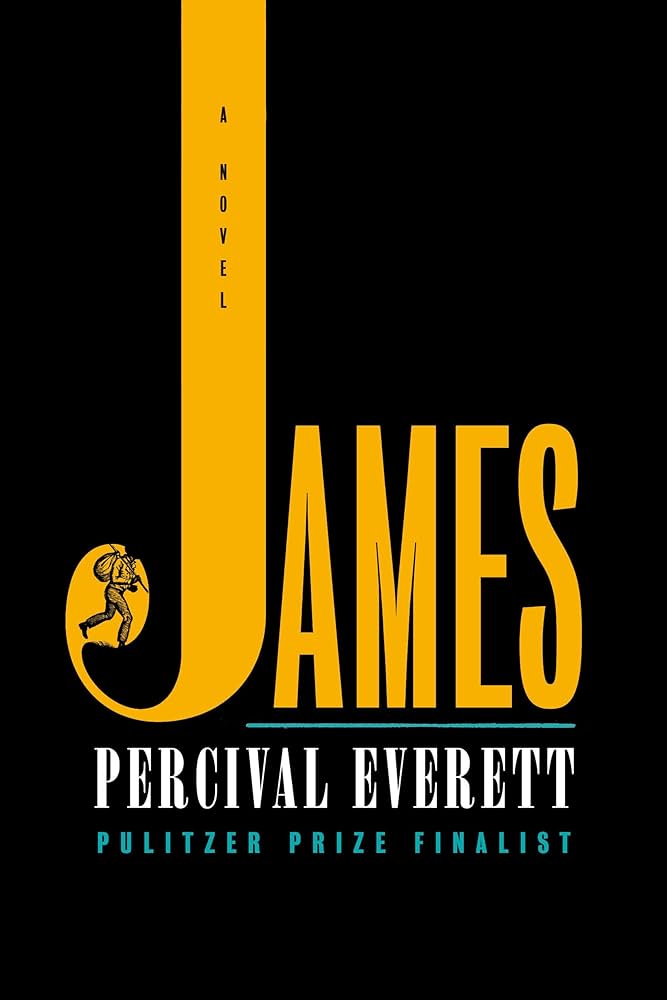
I just read James, by Percival Everett. Despite being 300 pages, it was a quick read, unlike the story from which it was taken, which took me twice as long to reread. I think there were two reasons for this one going so quickly: One was that it leaned on the presumption that you already knew the original tale and therefore the author gave himself permission to shorthand much of the action and description from that book; the other was that almost the whole story took place in either internal or external dialogue, without a lot of world-building, scene-setting, or exposition.
These things led to an interesting experience if you were hoping to confront this old story from a completely new perspective. I wanted to embrace this book, but I struggled a bit.
The premise that the slaves spoke patois in front of the white “massas” but used the common language when alone seemed a natural outgrowth of their situation; they had to communicate important information with one another without the white people catching on to what was being said, and they had to hide their real personalities behind a façade of ignorance, foolishness, and passivity, so they learned code-switching from childhood. Everett completely enthralled me with this; but then he took it a little too far. I expected the character James to be a bit more than ordinary, given his interactions with Huck and others in the original, but did his life experience really allow him the latitude to become as extraordinary as Everett has written him?
He is painted as an educated man—not just a slave who has learned to read and to speak with a careful use of diction. Would the surreptitious reading sessions in Judge Thatcher’s study in the wee hours really lead to a thorough understanding of the works of Voltaire, Rousseau, and John Locke? Even southern college-educated men of that day were not necessarily cognizant of the intricacies of philosophical thought, so the requirement that we believe it of a man who has had to gain all his education on the sly in stolen moments is a little hard to meet.
This was, to my mind, a central flaw of this book, for the simple reason that we went from perceiving the disguise the original “Jim” presented to the world—the stereotypical shuffle-footed, awkward, ignorant, well-behaved and possibly well-intentioned slave—to yet another disguise for “James”—the cynical, perceptive, erudite man who is playing that character for half his world while laughing about it with the other half. I actually liked that for its dark irony; what I’m trying to say is that there was an opportunity here for us to get to know the real person, but except for some tantalizing and admittedly affecting glimpses here and there, we went from one façade to another. With as much internal dialogue as there was from James, there was nonetheless too little understanding of the man himself. While being able to recognize that he is quick-witted, thoughtful, and compassionate, I didn’t feel that I really understood how he acquired all those positive character traits, because he doesn’t let us in.
The other thing the book thoroughly exhibits is the two-faced nature of slave owners who wish to be regarded as benevolent protectors of their “childlike servants,” but turn on a dime, when challenged, to become brutalists who exult in wielding a belt or raping a child. And again, I found myself applauding the exposure of the stereotypes but wincing at the one-dimensional portrayals—not so much of the slave-owners, but of the slaves! Several other reviewers have noted that the women in this book seem to be present on the page merely to highlight their own ill treatment; they have no agency and almost no personality but are merely offered up as horrifying examples of the results of human ownership. Again, I have no quarrel with exposing the heinousness of the practice, but how much more affecting would the book have been had readers been able to better identify with these women as individuals with personality?
I don’t want to come across as hyper-critical of this book. I admired what he tried to do and was caught up in it while reading it. I am also a fan of his writing style and language, which can be beguilingly beautiful. It actually troubles me to go against the reviewers who gave it unreserved praise (not to mention the National Book Award!). But afterwards, while reflecting on what I had read, I also wished there had been more—more story, more depth of character, more nuance, more exploration. I am curious, now, to read others of his books to see what my reaction to him as a writer might be when not influenced by the rewriting-of-a-classic aspect of this one. I’m sure you’ll hear more about it from me eventually.
Wrapping up

This year it feels more like a winding down than a wrapping up. I read the fewest books in one year since I started doing the Goodreads Challenge 12 years ago. That year I read 75 books; my highest number ever was in 2019, when I read 159 books while working full-time from January to October (I retired from the library in October of that year). You would think it would be the reverse, since I have so much more time now than I did then; but there were some factors at play that ensured I would read a lot more then. First, I was running three teen book clubs, so I had to read one book per month for each club, plus a couple extra books in each age range (the clubs were 6th- and 7th-graders, 8th- and 9th-graders, and grades 10-12) so I would have ideas to propose as the following month’s read. I was also reviewing books for both the teen and adult library blogs (both of which I supervised), so I was heavily invested in spending all my spare time reading new teen and adult fiction to showcase there. And finally, of course, there was a certain amount of reading for my own particular pleasure! I basically worked, commuted, ate, slept, and read, and did absolutely nothing else!
Nowadays there are circumstances that tend to decrease my reading time: With my particular disability, sitting in one position for long periods of time isn’t great for keeping my legs at their best possible condition for mobility. I also watch a lot more on television these days, now that streaming services let you binge-watch an entire five-season show, one episode after another for as long as you can stay awake, as opposed to waiting for one weekly episode for a 12- to 20-week season and then waiting in turn for the following season. And I spend way too much time “doom-scrolling” political stuff online, or keeping up with friends on Facebook. Finally, once I took up painting I started spending at least a few days a week focused on making a portrait or two or a still life featuring items from my antique collection.
Anyway, this year I read a meager-for-me 66 books. Some of them were literary and some of them were chick lit, some were re-reads of beloved stories, and others were authors previously unknown. My statistics include:
23,782 pages, with an average book length of 360 pages
(shortest was 185, longest was 698)
Average rating was 3.6 stars
Some favorite new titles were:
The Unmaking of June Farrow, by Adrienne Young
Starter Villain, by John Scalzi
Vera Wong’s Unsolicited Advice for Murderers, by Jesse Q. Sutanto
The Long Way to a Small, Angry Planet, by Becky Chambers
All the Dead Shall Weep, and The Serpent in Heaven, by Charlaine Harris
Found in a Bookshop, by Stephanie Butland
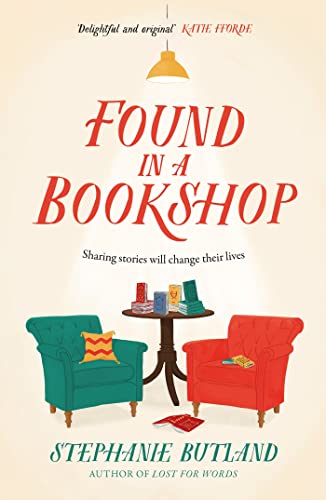
I felt throughout the year like I was having trouble discovering books that really resonated with me. Although I had some pleasurable reading discoveries, I never found that one book or series or author that really sucked me in and kept me mesmerized for hours at a time. I found myself reading during breakfast or on my lunch break and easily stopping after a chapter or two to go do something else, rather than wanting to settle in for a solid afternoon of reading. I’m hoping to find more compelling books in the new year. But reading continues to be one of my best-beloved pastimes.
Revisiting a classic
I believe that I have only read The Adventures of Huckleberry Finn once, somewhere around 6th grade, but I might have read it in high school as well. Certainly, though, it was all before I was 20 years old, so it’s been decades. I revisited it now because I decided I wanted to read James, by Percival Everett, but didn’t feel like I sufficiently remembered the events of the original to move directly to reading this updated story.

Although there are parts that drag (the lengthy saga involving the king and the duke) and parts that are actively irritating (the Tom Sawyer segment), I was surprised at how much I enjoyed the book as a whole. Hemingway famously labeled it as seminal to American fiction, and although I’m not sure I would agree as regards American fiction as a whole, it certainly is both masterly and intermittently brilliant as regards its own era. The breadth of subjects Mark Twain addresses in this book, supposedly a sequel to The Adventures of Tom Sawyer but in reality light-years beyond that “boys’ story,” is amazing: racism, of course, but also friendship, war, religion, and freedom, in some truly profound passages. The genius of it is that he refrains almost completely from proselytizing or moralizing, but conveys his message through the thoughts, actions, and dialogues of the people of the time.
The profundity of the story rests almost entirely in who Twain casts as his protagonists—first, an adolescent boy at the very bottom of white society, the uneducated, shiftless, indigent son of the town drunk, one whose morals should have been most suspect, given his upbringing in an atmosphere of alternating brutality and neglect. And of course, the second main character, because of the historical setting, is rated by other characters as even lower than Huck, because he is a man of color and therefore considered no more than a piece of property, in some instances valued less than a piece of land, a gun, or even a hunting dog. These two adventurers turn out to be the most honorable characters of the story, in contrast to the so-called “good people,” the supposed salt of the earth who are (with a few exceptions) seen to be primitive, ignorant, bigoted, and cruel.
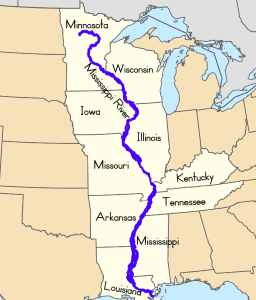
But it’s not just a story that was progressive for its day, shining a spotlight on the upside-down morals of the slavery-era South and poking at a society based on exploitation. It’s also a collection of frequently lyrical descriptions of the beauty of the world (Twain’s enduring love for the Mississippi River shines through), combined with sometimes hilarious tongue-in-cheek humor and poignant moments of reflection and self-realization that contrast beautifully with the specific historical context. The ultimate significance of the story is the moment when Huck decides that although the “right” thing for him to do, according to societal mores, would be to report the runaway slave Jim to his white mistress, he is willing to take “sin” upon himself by breaking the law, ignoring the common view, and refusing to turn in his friend. He firmly believes he is in the wrong, but is willing to embrace those consequences because the empathy he has developed by his daily existence living on a raft with this sweet man who has treated him with nothing but kindness is stronger than the “norms” to which he has been conditioned.
This book is frequently banned from schools and libraries, for one of two reasons: Either that segment of our society wishes to bury the shameful history of this era under a rug and refuse to acknowledge it, or (ironically) it wishes to make an example of it by citing the lack of political correctness inherent in the book’s language and attitudes. Both reasons, it should be obvious, miss the point of keeping this book in the classics lexicon. It takes place at a specific moment in time, and is voiced by a narrator with a perspective, an ideology, and a language consistent with that moment. We should rather be illuminating it for its honesty and using its characters as examples.
People are fond of saying we’ve come a long way from those times, but in many aspects that progress can be seen to be exceedingly superficial (particularly in the current political climate that is an excuse for misogyny and racism), and the perusal of this novel should point that out to us in a powerful manner. I am hoping that the book James that I plan to read after this will make best use of Mark Twain’s look at the hypocrisy of the America of his day, contrasted with Huck Finn’s astonishing moral evolution.
One Goodreads reviewer made the point that a classic is “a book that can still inspire discussions in a classroom some 135 years after its initial publication.” Another added that we are living in an era wherein this discussion would get a teacher fired in any number of states. All we can hope is that there are teachers still brave enough to bring the message of this book to their students, while pointing up the continuing diminishment of people of color in much of current American history and literature.
American classic
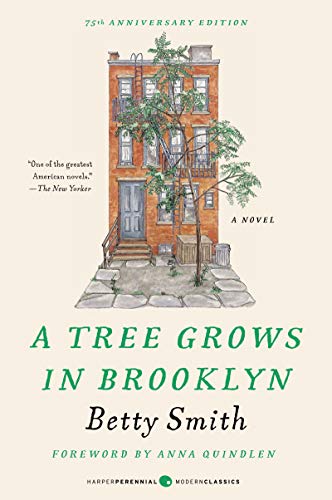
I don’t have much to say about A Tree Grows in Brooklyn, by Betty Smith, that hasn’t already been said. This is probably my third or fourth time reading it, but I haven’t done so for a couple of decades so I decided to revisit it. I remembered the brilliant, colorful depiction of life in Brooklyn in the early 20th Century, but had forgotten the simple yet elegant and nuanced language with which it is described. I remembered most of the details of Francie Nolan’s life, but some of the wonderful details of the outlying characters—her sexy Aunt Sissy, the interactions of Willie with his horse, Drummer, the English teacher who praised Francie’s artificial flights of fantasy but denigrated her realistic portrayals of Broolyn life—I happily rediscovered.
The story is funny and tragic, lighthearted and heartfelt, emotional, a little sentimental, inspiring. It kept my attention throughout, and I loved sitting down each day to another chapter. I would hand it to almost anyone over the age of 12—most girls, some boys—who wanted to be both entertained by and enlightened about the human condition.
One warning: If you have never read it and happen to pick up the edition with the forward by Anna Quindlen, save that to read later, because it delivers a few spoilers.
Gunnie Rose continues!
At the end of my review of the third book in this series, I devoutly hoped there would be more, and I discovered last week that Charlaine Harris has come through with two more volumes while I wasn’t looking! Imagine my delight at getting to continue this entertaining dystopian historical fantasy mash-up for not one book but two!

You can read my entire review of the first two here, and the third one here, but just to quote myself to give a reaction to those too impatient to do so,
“This series is pure delight, from the elaborate world-building to the laconic Western flavor of Texoma, and the characters are so alive they could step off the page. Harris has written this with just the amount of detail you crave, without drowning you in either description or explanation, and the pace of this mystery/adventure story is perfect. The minute I finished the first book, I jumped without hesitation into the second one.”
You really should read at least my review of the first two, because it gives a thorough description of a rather complicated world-building exercise. But even there, Harris achieves the maximum in understanding with the minimum of detail. She is apparently no more a fan of the info-dump than am I, for which I am thankful.
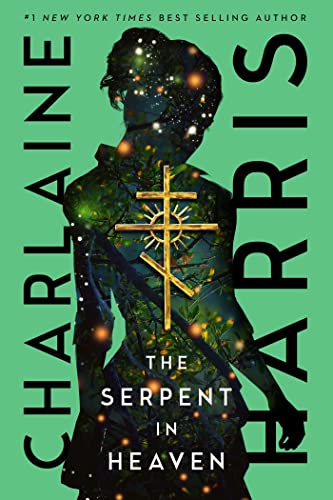
The fourth book, The Serpent in Heaven, picks up pretty much where the third left off; Felicia is now a school boarder at the Grigori academy in San Diego. She was initially admitted as a sort of honorary student because of the need to keep her safely squirreled away, since she is one of the few blood donors remaining who can save young Tsar Alexei’s life should he have a mishap (he’s a hemophiliac). But in this book, due to some unexpected hazards at the school, Felicia reveals the true scope of her wizardy powers and gets promoted to the “real” classes to learn to control, direct, and expand them, mentored by the curmudgeonly Victor.
This book was told from the first person viewpoint of Felicia herself, which added an extra element to the story, since in the course of her narration you get to know her much better and understand her background, upbringing, and level of skill. Lizbeth (Gunnie) and Eli are mostly missing from this chapter, because they have married and gone off to live in Texoma after the disastrous coup that disgraced parts of Eli’s family in the last book. We get news of them only through an occasional letter or telegram or word-of-mouth message. I thought this would be upsetting to the narrative, but I was completely absorbed in Felicia’s story and didn’t miss them, for the most part, compelling characters though they are.

Harris makes up for this in book #5, All the Dead Shall Weep, when Felicia, accompanied by Eli’s brother Peter, goes to visit Lizbeth and Eli in Texoma, mostly to get away from an ongoing threat of kidnapping by various factions who have figured out her value as a wizard and want to (either voluntarily or forcibly) marry her into their bloodline to amp up their descendants’ talent pool. But bad fortune follows Felicia like a hungry stray dog, and there’s also a new military rebellion beginning to muster, with which the sisters and their men must contend. This book is told by alternating narrators Lizbeth and Felicia, which was initially jarring when I didn’t realize the voice had changed, but actually really helpful in giving all the behind-the-scenes thoughts and feelings you craved from these characters.
And this fifth book ends on a truly ominous cliffhanger, historical in nature, which bodes well for more sequels, though ill for their contents! Still a fan. Check them out!
 The Book Adept