California Bear
I posted on author Duane Swierczynski‘s Facebook page this week that I thought it highly suspect that this “Would you prefer to be lost in the woods with a man or a bear?” online meme took root just as his new book came out. In return, I only received a laughing emoji, so I’m not entirely convinced he didn’t plan the whole thing, LOL.

The male characters in this book would certainly make women tend to choose the real bear over any of them as a preferred companion. We have an opportunistic, venal ex-LAPD cop; another man convicted of murder who is out of prison after just a few years due to a technicality that overthrew his sentence; a dormant but still terrifying serial killer; at least one copycat; and a Hollywood producer; and it’s hard to say in the beginning which of them is the worst!
The book is a send-up of the true-crime franchise, particularly the television biopics that exploit the circumstances of people’s worst days ever by giving a voice to killers, rapists, and the like. The basic, initially somewhat confusing story is that Cato Hightower, a retired cop, has worked hard to get Jack “Killer” Queen out of prison because he wants a piece of the payoff Queen will receive for supposedly being wrongly convicted. But Hightower also has a vision of Jack helping him with ongoing “projects,” one of which is running down the serial killer known as the California Bear and blackmailing him to keep his name out of the spotlight. Ironically, however, the Bear (along with a few other people) is eager to get credit for his past reign of terror, over now for about 40 years, by working with a Hollywood producer named David Peterson to make a true crime feature with a big payoff.
The significant women “actors” are two: Hightower’s wife, Jeanie, who has turned her genealogy research into a business and in the process winkled out the identity of the California Bear; and Jack’s daughter, Mathilda Finnerty, who has just been diagnosed with a debilitating form of leukemia that keeps her hospital-bound but fails to dim her incisive mind as she seeks to prove her father’s innocence and also figure out the whole California Bear conundrum.
There’s plenty of exciting action in this book, although the switches from narrator to narrator prove occasionally confusing, especially when the story of the Bear takes an unexpected turn. But the charismatic characters of Mathilda and her anxious, guilt-ridden father carry the story and keep interest up to the end.
I promised a personal story to go along with this review, so here it is: Duane Swierczynski and his family were patrons at Burbank Public Library when I worked there as teen librarian from 2008 to 2019, and his two children participated in my teen programs. I was introduced to his books by one of my co-workers, who was a big fan, and we read his excellent book Canary in my high school book club. Later on, when I was teaching Readers’ Advisory and Young Adult Literature classes at UCLA in the masters program for librarians, I invited Duane to be a guest speaker, so I got to know him a little.
But the story involves the co-worker who was a major Swierczynski fan; when he was about to retire, I was racking my brain trying to think of a gift I could give him at his going-away party, and lit on the idea of contacting Duane to see if I could get an autographed book or poster or something to give him. Duane didn’t have anything lying around that would work, so instead he generously and surprisingly suggested that he could name a character after my friend in the book he was currently writing, and I enthusiastically accepted. Then I interviewed Duane about significant elements and settings in the book, and I made my co-worker a certificate to announce my gift to him, which was actually a gift from Duane! Here is the certificate:

And that is how the true-crime producer in California Bear was christened David Peterson! He’s a bit younger and better dressed, but talks almost as much as the real David, and it was really fun to read the book, knowing the back story.
There is another, sadder back story that involves Duane’s daughter, Evie, the model for the character of Mathilda, but I’ll let you discover that one for yourself by reading the book (and the afterword).
Weirdly, just a couple of weeks before I started reading this book I saw a notice on Facebook on the “Lost Angeles” page that Patrick’s Roadhouse, a major setting in the book, had closed; reopening is subject to the negotiation of a new lease, which depends on an initiative by a former customer to raise $250K through a GoFundMe to pay back rent (they got behind during Covid) and do some renovations. They have raised more than $70K so far; if you’d like to contribute to bring back this 50-year icon on the Santa Monica coast, here’s a link to the fundraiser:
https://www.gofundme.com/f/help-save-patricks-roadhouse-a-california-icon

Mystery?
This weekend I decided to read A Drink Before the War, the first book in Dennis Lehane’s Kenzie/Gennaro mystery series, and I admit my feelings about it are mixed. On the one hand, the guy can write—I knew this about him from reading a couple of his stand-alones, and in this one he really paints a vivid picture of both characters and environs, with an atmosphere that has all the gritty feel of the streets of Southie in Boston that we have seen in the movies.
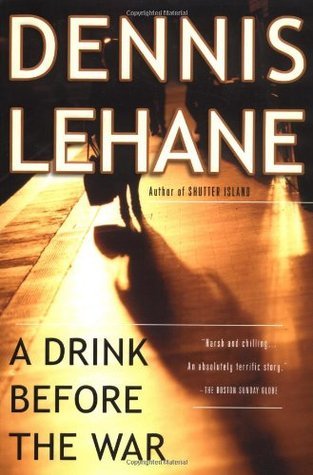
On the other hand, the mystery wasn’t much, it was resolved a little too easily, and everybody in this book was so dark and dour that it was hard to fight against the mood seeping into my daily life. It may account for why I haven’t done much of anything during the past couple of days—a depressed mood makes for lethargic behavior.
I don’t want to jump too quickly to the conclusion, however, that this series (and this writer) are not for me; if I had stopped, for instance, with Still Life, the first book in Louise Penny’s Armand Gamache tales, I would have missed out on a lot, but that first volume was among the worst three in the entire series of 19 and counting.
I liked the main characters of Patrick Kenzie and Angela Gennaro quite a lot—enough to want to know what happens to them next. But the story of corrupt politicians, depraved drug lords and their street gangs, and the misery and death that both sides bring to almost everyone around them was a little too much for me. You couldn’t call this noir, since that subgenre’s protagonists have nothing of the hero about them, which isn’t true of Kenzie and Gennaro. But the protagonists of noir are victims, suspects, or perpetrators, and the two private detectives featured here also share those aspects in the course of this story. They are gloomy, they are pessimistic, and there isn’t much that’s pretty about their lives. Still, there is definitely a good-guy/bad-guy divide here that has the pair on the right side, mostly.
To compound my mood, the next book on my list (just arrived on my Kindle from the library) is California Bear, the brand-new book from Duane Swierczynski, who is known for his noirish way with a plotline. I do, however, have an upbeat, kind of funny story that goes with that book (I’ll tell you all about it when I write the review), so that may salvage my attitude going into that one.
Silly sequel
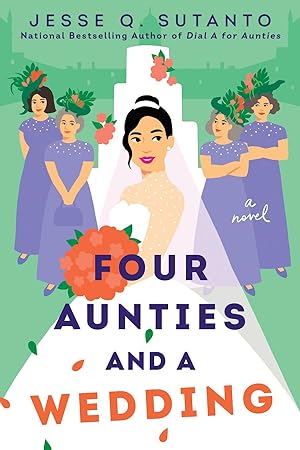
I just finished the sequel—Four Aunties and a Wedding—to yesterday’s book by Jesse Sutanto. It was, like the first, full of the antics of Medellin “Meddy” Chan and her idiosyncratic Indo-Chinese aunties, this time on her wedding day, and although it still had the trademark 2nd-language bloopers and irrational beliefs and superstitions of the first, it was even more frenetic.
Perhaps too frenetic. On the one hand, the descriptions of the aunties’ signature wedding-day outfits and their acquisition of vernacular Brit-speak so as to fit in when they go to London and meet Nathan’s family (their most favored expression being “the dog’s bollocks”) was highly entertaining, and the few interactions between Meddy and bridegroom Nathan were sweet and soulful. But these things were overwhelmed by a plot that took the hard-to-believe events of the first book to a whole less plausible level. (What I’m trying to say here is, it was way over the top.)
Meddy and Nathan are getting married at Christ Church, Oxford, which solves several problems: It’s the hometown of Meddy’s uptight new in-laws, which makes them happy (plus being a beautiful venue), but it lets her off the hook regarding inviting everyone in her entire insanely extended Chinese-Indonesian family, cutting the guest list from the thousands to a mere 200+. She and Nathan want the aunties to enjoy being guests at the wedding, so they have decided to find other vendors to supply the wedding with cake, flowers, makeup, photography, etc. But, as is typical in Meddy’s life, the aunts have worked out a “surprise” for her that she can’t be appropriately filial and still turn down: They have found another Chinese-Indonesian family of five who also do weddings, and hired them on the couple’s behalf.
The first meeting and all the planning goes unexpectedly smoothly, but then Meddy overhears her contemporary, the photographer Staphanie (yes, it’s spelled that way), talking about “taking someone out” on her big day and learns, to her horror, that the family of wedding vendors is Mafia and will reveal her family’s secret (from the first book) if she tells anyone. After this the entire book kicks up the adrenaline to a ridiculous degree as the aunties and Meddy scramble to keep anyone from killing anyone else while keeping it all from Nathan and his parents.
The parts with which I had the most trouble were the actual mechanics of the wedding day. First of all, if any bride spent this much time behind the scenes, ignoring her bridegroom and her guests in favor of running around with her aunts, neither the groom nor the guests would remain so sanguine. Second, about those guests: A few of Nathan’s business investors are highlighted as Meddy and the aunts try to figure out the intended target of the Mafia “hit,” but the rest remain a faceless mass, which is a bit antithetical to the whole idea of only close family and friends attending the wedding. Where were they, and what was their response when Meddy kept disappearing and the aunts became increasingly more embarrassing? And after the description of Meddy’s dress as being tightly corseted on the top half and unbelievably tulle-heavy (and too wide to fit in elevators) on the bottom half, it was hard to believe the things she was accomplishing while wearing it, especially without ripping it or getting it dirty. The thing that bothered me the most, though, was the thought of the total ruin of what was supposed to be a joyful and important occasion. It leant an air of melancholy to this slapstick comedy that lessened its potential impact.
But…I can’t say I didn’t enjoy it, because I did. One thing I liked about both of these books was the highlighting of Indonesian and Chinese cultures, with the contrasts between the lower and upper socioeconomic families and how different they can be despite common descent. The author states that she hoped to create sympathy and understanding without verging on stereotype, and for the most part she pulled it off, although better in the first book than in the second. I’m a little concerned that venturing on volume three may top off my tolerance for quirky mayhem and send me over the edge into annoyance, but I will probably still read it and then complain about it because hey, that’s what I do!
If you enjoyed such reads as the Finlay Donovan series by Elle Cosimano, as I mentioned in my last review, then the Aunties books may be something you would also want to read.
An author new to me
I have somehow gotten through a long life of reading without ever broaching Tess Gerritsen‘s catalogue of novels, even though my genre divisions on Goodreads show that I have read more than twice the number of mysteries than I have read books in any other genre. That’s probably more common than you’d think, if you are a mystery reader, simply because mystery writers are, as a rule, prolific, and also tend to define a character and then stick with him or her, so that if you like continuity, you will probably embrace a series of, say, 18 books featuring the same protagonist.

I decided to start with one of her recent novels, The Spy Coast, which is the “Martini Club” series, book #1. When I began it, though, I didn’t realize just how new it is—the #2 book isn’t even due out until March of next year. So after I finished it and found it good, I went looking at the rest of her backlist, and I’m not sure, even though I enjoyed this one, that I will continue with any of her others. That is because they are divided into one long series—Rizzoli and Isles—and a bunch of stand-alones categorized as medical mysteries, no doubt based on her previous life as a doctor.
Although several readers say that the TV show is quite different from the books, I will probably avoid both the series and the stand-alones, simply because I am not a fan of medical mysteries. I read some of the seminal volumes with that theme by author Robin Cook back when I was a teenager, and also followed Patricia Cornwell’s Kay Scarpetta series for the first 10 books or so. Although I enjoy a pandemic when it’s the kick-off for a good dystopian novel, I discovered that I don’t care for all the other medical details included in this sub-genre. I don’t like the mad scientist vibe, the experimenting, the gory details of unnecessary operations and deliberate dismemberments. I prefer the focus to be on the mystery, the whodunnit, the why and the who, not the (sometimes excruciatingly detailed) how. I don’t mind a good pathologist as one of the team, but I’m not so interested in their work that I want that to be the featured character.
This Tess Gerritsen novel has none of the medical aspects, and initially appealed to me because it’s about retired people! For the same reason that I enjoyed the movies Red and Red II, in which Bruce Willis as Frank Moses “gets the band back together” when he calls up Morgan Freeman, John Malkovich, and Helen Mirren as delightfully quirky retired Black-ops agents to tie up some decades-old loose ends that are threatening all their lives, the description of the Martini Club as a bunch of elderly hyper-talented CIA agents now existing quietly in a small coastal village in Maine piqued my imagination.

Main character Maggie Bird (who could definitely also be played appealingly by Helen Mirren) is happily living in an upscale log cabin and collecting blue eggs every morning from her flock of Araucana chickens until a youthful agent, organization unknown, arrives and asks about a still-secret mission from Maggie’s past, then turns up dead in her driveway a day later. The town’s acting police chief, Jo Thibodeau, is baffled by why Maggie doesn’t seem more emotionally affected by this, and her suspicions grow when she discovers Maggie and four of her neighbors taking potluck the following evening while looking over a topographical map of the area and discussing shoe prints, tire tracks, and firepower rather than having quiet hysterics at the news of murder in their town, as she believes “normal” seniors would. But Jo won’t get much out of these close-mouthed individuals beyond a bland expression and polite agreement with whatever she says.
Gerritsen does a nice job of splitting the book between the main narrator and several temporary ones as she jumps back and forth between past and present, revisiting the events that perpetuated the current crisis. Both the complicated plot and the colorful travelogue are vivid, as are the characterizations, and I didn’t see most of the events or the resolution coming. I’ll definitely read the sequel to this one; I’m just regretful that the discovery of this author won’t lead to a long binge of her back catalogue.
Reliable, still fresh

I just read Michael Connelly’s latest, the seventh in his books featuring Mickey Haller, the Lincoln Lawyer, and I was pleased and satisfied by Resurrection Walk. Those who follow/read this blog will know that I have expressed some degree of dismay about where the Bosch books are heading, with possible successors trying to take over but without either the pizzazz or the character depth that are inherent in Hieronymus “Harry” B. But Connelly has managed to map a new route for Haller, using as a starting point the exoneration of Jorge Ochoa from a previous book. Mickey got such a buzz from reopening that innocent client’s case and freeing him from prison that he has decided this will be a regular feature of his practice, his pro bono contribution to being a defense attorney. He calls the results the “Resurrection Walk,” because the person without hope gets to emerge from prison to walk free again. And he has enlisted veteran police detective and half-brother Harry Bosch to be one of his investigators.
Since Harry has such an aversion to helping the “other side” (defense) after a long and storied career as prosecution’s darling, he and Haller have agreed that he will only serve as a clearing house, and not take an active part in the actual defense process. Even though Harry is retired, he has a care for his reputation as a dogged seeker of justice for the criminals he has apprehended, and he also realizes that his participation for the defense could have repercussions for daughter Maddie, who’s just coming up through the ranks at LAPD. But after sorting through the pile of letters received by Haller from dozens of the incarcerated who maintain their innocence and are looking for his help, Harry finds one that rings true, and is drawn into a more active role.
He looks through the case of Lucinda Sanz, a wife and mother who was convicted of the shooting death of her ex-husband, sheriff’s deputy Roberto Sanz, and realizes that there is a lot of unexplained and unexplored territory in her case. The laser focus on her from the sheriffs’ department as the perfect and only suspect triggers the hairs on the back of Harry’s neck, and he tells Mickey he thinks they have a winner. The fact that they will now be pitted against a bureaucratic entity determined to protect one of its own makes the case a tricky one, ultimately fraught with danger for all involved.
Although the essence of Harry was, once again, a little bit lacking—he was portrayed somewhat woodenly, as has happened before when he is the secondary, rather than the main, character—it was less a problem this time, and the interactions between he and his half-brother and current employer were more characteristic. For instance, Harry agrees that he will be Mickey’s driver while they are investigating a case, but only if Mickey sits up front in the passenger seat, because Harry’s dignity won’t allow him to be cast as chauffeur. As far as the central mystery goes, it is often Harry’s intuition that brings out the facts necessary to make the case, although it is Mickey’s talents as the concocter of labyrinthine defense moves that ultimately wins through. The book has great suspense, with a lot of setbacks and some perilous moments, and ends with the promise of a twist in the future for Mickey. This is a solid and entertaining entry in Connelly’s franchise.
Parenthetically, if you are an Amazon Prime member and a Connelly fan, I can’t stress enough how wonderful is the “Bosch” series starring Titus Welliver in the title role, with fantastic portrayals of all the supporting characters by an array of both well known and relatively unknown actors. The TV series is pretty closely based on Connelly’s books in sequential order, and is every bit as involving. There are seven seasons of Bosch and, just when you sorrowfully get to the end of that binge, you discover that there is a new show, called “Bosch Legacy,” which has a somewhat narrower focus on Harry, his daughter Maddie, and defense attorney Honey Chandler. There are two seasons so far, with one more to come. I understand that there will also be a spinoff series featuring Detective Renée Ballard, hopefully with Welliver etc. still serving as secondary characters.

What I wished for
The Unmaking of June Farrow, by Adrienne Young, is the book I have been wishing to read. It’s both an elegantly written and a beautifully told story that incorporates a curse, a murder, something sort of like time travel but not exactly, and an emotionally complex web of relationships that are a pleasure to try to untangle. If I had to label it, I guess I would call it magical realism.

June Farrow was born into a family in which the women are believed to be cursed, and June intends to be the last member of this family in order to break that curse, resolving never to marry nor have children.
At some point in each of their lives, the Farrow women are overcome by madness—seeing, hearing, and experiencing things that aren’t there as their minds slowly unravel. June’s own mother, Susanna, became increasingly troubled, finally abandoning the infant June to be raised by her grandmother, then disappearing, never to be seen again. In the past year, June, 34, has begun to experience the warning signs that she, too, is beginning to lose touch with reality. She’s hearing phantom wind chimes, seeing a man’s silhouette looming and smelling cigarette smoke on the breeze from the open window, but there’s no one there. And then there is the red door that appears, standing in the middle of a field of tobacco or at the side of the road outside of Jasper, North Carolina, as if waiting for her to walk up, turn the knob, and step across the threshold. This is the story of what happens when she yields to that impulse.
I don’t want to tell much more than this, because you should be allowed, as I was, to unwrap this tale for yourself. I think it will be enough to say that it is immersive, atmospheric, romantic, and mysterious, and I thoroughly enjoyed it from beginning to unexpected end.

Cozy does a morph

I just finished reading Murder at an Irish Wedding, the second in the Village Mystery series by Carlene O’Connor. I enjoyed it almost as much as I did the first book. The occurrence of a celebrity wedding taking place in the village at Castle Kilbane gives the opportunity for a whole new cast of suspects in the death of the best man, with exciting red herrings. But…I’m wondering if O’Connor knows the “rules” for cozy mysteries.

See, although there are other common characteristics (small town setting, quirky cast, violence taking place off the page), the one thing central to them is that the person who is solving the murders is doing so by accident, or because she is nosy and gains access to information she shouldn’t have, or she thinks of it as a hobby. So with a cozy you get, not a detective, private or otherwise, as your protagonist, but an amateur—a gardener, a yoga instructor, a baker, a priest; you get Jessica Fletcher!
But in the synopsis for the third book in this series, O’Connor has revealed (not really a spoiler, it’s in the Goodreads summary) that Siobhán O’Sullivan, eldest of six siblings, manager of Naomi’s Bistro in Kilbane, County Cork, Ireland, and the solver of two murders, is about to become part of Garda Síochána, the Irish police force.
So…does this series remain categorized as cozy?
A good time for cozy
After I finished the “regular” mysteries by Carlene O’Connor (my previous post) I had another book lined up to read, but I tackled the first couple of chapters and found I had no desire to continue. I checked for other O’Connor books on my Kindle Unlimited account, and discovered that the first in her Irish Village Mystery Series was on special for a reasonable price, so I grabbed it and started reading, and was immediately taken with it.

The book, Murder in an Irish Village, stars the six O’Sullivan children—Siobhán, James, Grainne, Ciaran, Eoin, and Ann, with Siobhán (Shuh-VAWN) being the eldest at 22 and in descending steps from there. The clan runs Naomi’s Bistro in the village of Kilbane in County Cork, Ireland, a restaurant named after their mother, who died along with their dad in a drunk driving accident earlier in the year. The drunk in question is in prison, but his brother has just revealed to Siobhán that someone besides Billy (he won’t say who) was actually responsible for the crash that killed them.
Then a dead man turns up, seated at a table in their bistro before opening, dressed in a suit and tie—and with the handles of a pair of pink scissors protruding from his chest. Siobhán’s brother James is first suspected and then arrested for the murder, but though the rest of the village believes it’s likely, Siobhán knows her brother couldn’t have done it, so she sets out to solve the crime and save the family and their livelihood (murder on the premises presumably putting a damper on the appetite).
This was a somewhat suspenseful and utterly charming example of a cozy mystery. The insular small-town attitudes were right on, the characters and scene-setting were both compelling and convincing, and the somewhat bumbling attempts of Siobhán to “help” her crush, the garda (policeman) Macdara, solve the crime were mostly pretty funny, though ingenious as well. I will happily keep reading this series while waiting for some of O’Connor’s more serious mysteries to drop.
On to Murder at an Irish Wedding!
“New” mystery writer
I have just discovered the County Kerry mysteries by writer Carlene O’Connor, who is American by birth but Irish by heredity and has made the most of it. I initially thought she was a new author, because she only had two books out in this series, one written last year and one this: No Strangers Here, and Some of Us Are Looking. But it turns out she has been penning mysteries for some time, but in a different subcategory. She has two other series, both of them “cozy” mystery: The Irish Village Mystery Series, (8 books so far), and The Home to Ireland Series (2 books). But these County Kerry ones are not cozies, they are straight-up mystery.
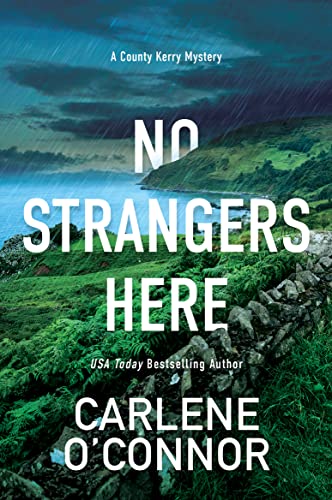

You could maybe call them borderline cozy, because one of the regularly featured characters isn’t a detective, she’s a veterinarian—the diminutive but feisty Dr. Dimpna Wilde. But there is also a main policeman, Detective Inspector Cormac O’Brien, recently transplanted from Killarney to the Dingle peninsula, and a local policewoman, Barbara Neely, under whose jurisdiction the somewhat grisly murders from both books fall. In addition to these principal protagonists, there is a highly colorful bunch of characters who could only be Irish, including Dimpna’s idiosyncratic extended family (parents, brother, son, and a few more sinister connections), Cormac’s Mam, office staff members at the veterinary clinic, subordinate officers at the police station, and a plethora of fascinating villagers only too ready to get up in each other’s business and then spread the gossip far and wide. There are also, thanks to Dr. Wilde’s veterinary practice, a supporting cast of endearing animals, from cats and dogs to donkeys, sheep, bulls, and bunnies.
The world-building is effective, making excellent use of the natural setting of the Dingle peninsula and all the towns, villages, nature preserves, cliffs, harbors, and wild places that exist there, nicely described and incorporated into the action.

The mysteries are complex, there are plenty of promising red herrings, and the personal relationships developing amongst the characters—particularly between Dr. Wilde and DI O’Brien—keep you reading to see what happens. In short, based on these two books I will definitely keep going. And, also based on these, I will try out her cozy series, even though my general preference is for mainstream mystery, because the totality of her story-telling is that good.
Psycho Thriller
Yes, “psycho” is an abbreviation for psychological thriller, but also…well, there are characters in this book that might qualify for the title without the abbreviation.
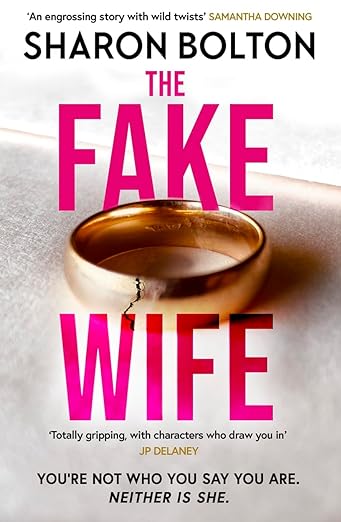
The Fake Wife was not my favorite Sharon J. Bolton thriller, but at this point Bolton is almost an automatic read for me. The book is certainly full of twists and turns, some expected and some definitely not. It’s complex and intriguing, but you really have to pay attention to know what’s happening at any given moment. There are multiple flashbacks from several characters to follow, and we get threads of the story from all directions—the victims, the perpetrators, the cops—that all weave together to gradually reveal what’s going on.
As the book opens, Olive Anderson is having dinner on her own in her hotel dining room in Hexham. A beautiful stranger walks up and seats herself at Olive’s table as if she belongs there, and then starts an elaborate game of pretense, engaging the waiter in banter and implying she is Olive’s wife. Olive is intrigued and decides to play along—it’s a lot more fun than sitting there by herself mulling over her marriage to Labour MP Michael Anderson. But as the evening goes on, the lighthearted pretense morphs into something else, and soon Michael is reporting Olive as missing and DS Lexy Thomas and traffic cop PC Garry Mizon are teaming up to try to solve what becomes an increasingly complex and bewildering situation.
This is an immersive domestic puzzle combined with a police procedural, adding more characters into the mix as the plot continues, with back stories that completely change what you were thinking at the beginning. It’s almost impossible to figure out who is telling the truth—if anyone is. The characterizations are excellent, and as for the setting, the beautiful but frigid winter scenery in the north of England provides both background and an extra sense of menace. If you like reading books that are set at the same time of year and in the same climate you are currently inhabiting, this is definitely a winter tale!
I’m kind of hoping Bolton decides to bring back the odd police couple in another book—their relationship provides both depth and humor in a story that is otherwise kind of dark. But if you enjoy dark (and confusing and exciting and suspenseful), this book might be a good one for your reading list.
 The Book Adept