Reliable, still fresh

I just read Michael Connelly’s latest, the seventh in his books featuring Mickey Haller, the Lincoln Lawyer, and I was pleased and satisfied by Resurrection Walk. Those who follow/read this blog will know that I have expressed some degree of dismay about where the Bosch books are heading, with possible successors trying to take over but without either the pizzazz or the character depth that are inherent in Hieronymus “Harry” B. But Connelly has managed to map a new route for Haller, using as a starting point the exoneration of Jorge Ochoa from a previous book. Mickey got such a buzz from reopening that innocent client’s case and freeing him from prison that he has decided this will be a regular feature of his practice, his pro bono contribution to being a defense attorney. He calls the results the “Resurrection Walk,” because the person without hope gets to emerge from prison to walk free again. And he has enlisted veteran police detective and half-brother Harry Bosch to be one of his investigators.
Since Harry has such an aversion to helping the “other side” (defense) after a long and storied career as prosecution’s darling, he and Haller have agreed that he will only serve as a clearing house, and not take an active part in the actual defense process. Even though Harry is retired, he has a care for his reputation as a dogged seeker of justice for the criminals he has apprehended, and he also realizes that his participation for the defense could have repercussions for daughter Maddie, who’s just coming up through the ranks at LAPD. But after sorting through the pile of letters received by Haller from dozens of the incarcerated who maintain their innocence and are looking for his help, Harry finds one that rings true, and is drawn into a more active role.
He looks through the case of Lucinda Sanz, a wife and mother who was convicted of the shooting death of her ex-husband, sheriff’s deputy Roberto Sanz, and realizes that there is a lot of unexplained and unexplored territory in her case. The laser focus on her from the sheriffs’ department as the perfect and only suspect triggers the hairs on the back of Harry’s neck, and he tells Mickey he thinks they have a winner. The fact that they will now be pitted against a bureaucratic entity determined to protect one of its own makes the case a tricky one, ultimately fraught with danger for all involved.
Although the essence of Harry was, once again, a little bit lacking—he was portrayed somewhat woodenly, as has happened before when he is the secondary, rather than the main, character—it was less a problem this time, and the interactions between he and his half-brother and current employer were more characteristic. For instance, Harry agrees that he will be Mickey’s driver while they are investigating a case, but only if Mickey sits up front in the passenger seat, because Harry’s dignity won’t allow him to be cast as chauffeur. As far as the central mystery goes, it is often Harry’s intuition that brings out the facts necessary to make the case, although it is Mickey’s talents as the concocter of labyrinthine defense moves that ultimately wins through. The book has great suspense, with a lot of setbacks and some perilous moments, and ends with the promise of a twist in the future for Mickey. This is a solid and entertaining entry in Connelly’s franchise.
Parenthetically, if you are an Amazon Prime member and a Connelly fan, I can’t stress enough how wonderful is the “Bosch” series starring Titus Welliver in the title role, with fantastic portrayals of all the supporting characters by an array of both well known and relatively unknown actors. The TV series is pretty closely based on Connelly’s books in sequential order, and is every bit as involving. There are seven seasons of Bosch and, just when you sorrowfully get to the end of that binge, you discover that there is a new show, called “Bosch Legacy,” which has a somewhat narrower focus on Harry, his daughter Maddie, and defense attorney Honey Chandler. There are two seasons so far, with one more to come. I understand that there will also be a spinoff series featuring Detective Renée Ballard, hopefully with Welliver etc. still serving as secondary characters.

What I wished for
The Unmaking of June Farrow, by Adrienne Young, is the book I have been wishing to read. It’s both an elegantly written and a beautifully told story that incorporates a curse, a murder, something sort of like time travel but not exactly, and an emotionally complex web of relationships that are a pleasure to try to untangle. If I had to label it, I guess I would call it magical realism.

June Farrow was born into a family in which the women are believed to be cursed, and June intends to be the last member of this family in order to break that curse, resolving never to marry nor have children.
At some point in each of their lives, the Farrow women are overcome by madness—seeing, hearing, and experiencing things that aren’t there as their minds slowly unravel. June’s own mother, Susanna, became increasingly troubled, finally abandoning the infant June to be raised by her grandmother, then disappearing, never to be seen again. In the past year, June, 34, has begun to experience the warning signs that she, too, is beginning to lose touch with reality. She’s hearing phantom wind chimes, seeing a man’s silhouette looming and smelling cigarette smoke on the breeze from the open window, but there’s no one there. And then there is the red door that appears, standing in the middle of a field of tobacco or at the side of the road outside of Jasper, North Carolina, as if waiting for her to walk up, turn the knob, and step across the threshold. This is the story of what happens when she yields to that impulse.
I don’t want to tell much more than this, because you should be allowed, as I was, to unwrap this tale for yourself. I think it will be enough to say that it is immersive, atmospheric, romantic, and mysterious, and I thoroughly enjoyed it from beginning to unexpected end.

Cozy does a morph

I just finished reading Murder at an Irish Wedding, the second in the Village Mystery series by Carlene O’Connor. I enjoyed it almost as much as I did the first book. The occurrence of a celebrity wedding taking place in the village at Castle Kilbane gives the opportunity for a whole new cast of suspects in the death of the best man, with exciting red herrings. But…I’m wondering if O’Connor knows the “rules” for cozy mysteries.

See, although there are other common characteristics (small town setting, quirky cast, violence taking place off the page), the one thing central to them is that the person who is solving the murders is doing so by accident, or because she is nosy and gains access to information she shouldn’t have, or she thinks of it as a hobby. So with a cozy you get, not a detective, private or otherwise, as your protagonist, but an amateur—a gardener, a yoga instructor, a baker, a priest; you get Jessica Fletcher!
But in the synopsis for the third book in this series, O’Connor has revealed (not really a spoiler, it’s in the Goodreads summary) that Siobhán O’Sullivan, eldest of six siblings, manager of Naomi’s Bistro in Kilbane, County Cork, Ireland, and the solver of two murders, is about to become part of Garda Síochána, the Irish police force.
So…does this series remain categorized as cozy?
A good time for cozy
After I finished the “regular” mysteries by Carlene O’Connor (my previous post) I had another book lined up to read, but I tackled the first couple of chapters and found I had no desire to continue. I checked for other O’Connor books on my Kindle Unlimited account, and discovered that the first in her Irish Village Mystery Series was on special for a reasonable price, so I grabbed it and started reading, and was immediately taken with it.

The book, Murder in an Irish Village, stars the six O’Sullivan children—Siobhán, James, Grainne, Ciaran, Eoin, and Ann, with Siobhán (Shuh-VAWN) being the eldest at 22 and in descending steps from there. The clan runs Naomi’s Bistro in the village of Kilbane in County Cork, Ireland, a restaurant named after their mother, who died along with their dad in a drunk driving accident earlier in the year. The drunk in question is in prison, but his brother has just revealed to Siobhán that someone besides Billy (he won’t say who) was actually responsible for the crash that killed them.
Then a dead man turns up, seated at a table in their bistro before opening, dressed in a suit and tie—and with the handles of a pair of pink scissors protruding from his chest. Siobhán’s brother James is first suspected and then arrested for the murder, but though the rest of the village believes it’s likely, Siobhán knows her brother couldn’t have done it, so she sets out to solve the crime and save the family and their livelihood (murder on the premises presumably putting a damper on the appetite).
This was a somewhat suspenseful and utterly charming example of a cozy mystery. The insular small-town attitudes were right on, the characters and scene-setting were both compelling and convincing, and the somewhat bumbling attempts of Siobhán to “help” her crush, the garda (policeman) Macdara, solve the crime were mostly pretty funny, though ingenious as well. I will happily keep reading this series while waiting for some of O’Connor’s more serious mysteries to drop.
On to Murder at an Irish Wedding!
“New” mystery writer
I have just discovered the County Kerry mysteries by writer Carlene O’Connor, who is American by birth but Irish by heredity and has made the most of it. I initially thought she was a new author, because she only had two books out in this series, one written last year and one this: No Strangers Here, and Some of Us Are Looking. But it turns out she has been penning mysteries for some time, but in a different subcategory. She has two other series, both of them “cozy” mystery: The Irish Village Mystery Series, (8 books so far), and The Home to Ireland Series (2 books). But these County Kerry ones are not cozies, they are straight-up mystery.
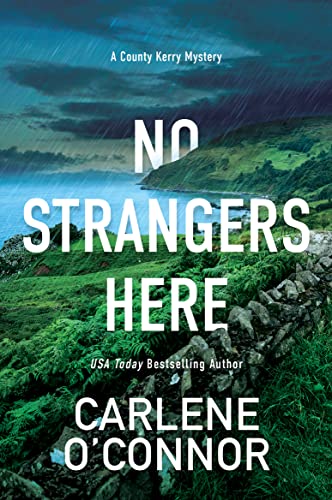

You could maybe call them borderline cozy, because one of the regularly featured characters isn’t a detective, she’s a veterinarian—the diminutive but feisty Dr. Dimpna Wilde. But there is also a main policeman, Detective Inspector Cormac O’Brien, recently transplanted from Killarney to the Dingle peninsula, and a local policewoman, Barbara Neely, under whose jurisdiction the somewhat grisly murders from both books fall. In addition to these principal protagonists, there is a highly colorful bunch of characters who could only be Irish, including Dimpna’s idiosyncratic extended family (parents, brother, son, and a few more sinister connections), Cormac’s Mam, office staff members at the veterinary clinic, subordinate officers at the police station, and a plethora of fascinating villagers only too ready to get up in each other’s business and then spread the gossip far and wide. There are also, thanks to Dr. Wilde’s veterinary practice, a supporting cast of endearing animals, from cats and dogs to donkeys, sheep, bulls, and bunnies.
The world-building is effective, making excellent use of the natural setting of the Dingle peninsula and all the towns, villages, nature preserves, cliffs, harbors, and wild places that exist there, nicely described and incorporated into the action.

The mysteries are complex, there are plenty of promising red herrings, and the personal relationships developing amongst the characters—particularly between Dr. Wilde and DI O’Brien—keep you reading to see what happens. In short, based on these two books I will definitely keep going. And, also based on these, I will try out her cozy series, even though my general preference is for mainstream mystery, because the totality of her story-telling is that good.
Psycho Thriller
Yes, “psycho” is an abbreviation for psychological thriller, but also…well, there are characters in this book that might qualify for the title without the abbreviation.
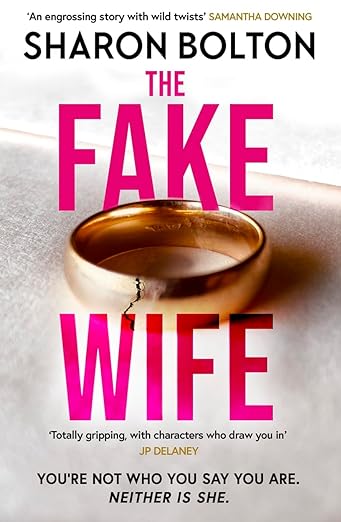
The Fake Wife was not my favorite Sharon J. Bolton thriller, but at this point Bolton is almost an automatic read for me. The book is certainly full of twists and turns, some expected and some definitely not. It’s complex and intriguing, but you really have to pay attention to know what’s happening at any given moment. There are multiple flashbacks from several characters to follow, and we get threads of the story from all directions—the victims, the perpetrators, the cops—that all weave together to gradually reveal what’s going on.
As the book opens, Olive Anderson is having dinner on her own in her hotel dining room in Hexham. A beautiful stranger walks up and seats herself at Olive’s table as if she belongs there, and then starts an elaborate game of pretense, engaging the waiter in banter and implying she is Olive’s wife. Olive is intrigued and decides to play along—it’s a lot more fun than sitting there by herself mulling over her marriage to Labour MP Michael Anderson. But as the evening goes on, the lighthearted pretense morphs into something else, and soon Michael is reporting Olive as missing and DS Lexy Thomas and traffic cop PC Garry Mizon are teaming up to try to solve what becomes an increasingly complex and bewildering situation.
This is an immersive domestic puzzle combined with a police procedural, adding more characters into the mix as the plot continues, with back stories that completely change what you were thinking at the beginning. It’s almost impossible to figure out who is telling the truth—if anyone is. The characterizations are excellent, and as for the setting, the beautiful but frigid winter scenery in the north of England provides both background and an extra sense of menace. If you like reading books that are set at the same time of year and in the same climate you are currently inhabiting, this is definitely a winter tale!
I’m kind of hoping Bolton decides to bring back the odd police couple in another book—their relationship provides both depth and humor in a story that is otherwise kind of dark. But if you enjoy dark (and confusing and exciting and suspenseful), this book might be a good one for your reading list.
Another old faithful
I first discovered the books of Robert Crais when I picked up one of his stand-alones at a library sale, and that one—Demolition Angel—remains a favorite; I think I have read it three or four times over the years. I found and read his other stand-alone novels, and liked them all quite a lot (my next favorite being The Two Minute Rule), so then I went on to his series, based on a private detective named Elvis Cole and (after book #10) his enigmatic pal, Joe Pike. The first Elvis Cole book is The Monkey’s Raincoat, and he’s pretty much on his own until The Watchman, which is Cole’s 11th outing and Pike’s debut.
I have an up-and-down relationship with these, because I find them to be somewhat uneven. Elvis is kind of a goofy guy, always joking around (although he takes his work seriously), and sometimes there’s just too much tongue-in-cheek banter. Joe Pike is the ultimate wordless action hero, and sometimes there’s too little personality there to make you care. And the mysteries are sometimes compelling, sometimes weird, and occasionally implausible. So although I think I have read most of the series (which is long—10 books for Cole, nine with Cole and Pike, and another seven with just Pike), I never know whether I will finish up the current book with a sense of satisfaction or feel vaguely let down.
In general, however, this is a reliable series and, like Michael Connelly’s Bosch, Elvis lives in the Hollywood Hills, so all the terrain is familiar to this Los Angeles resident, which is always a bonus. Who doesn’t like to be able to know exactly where the characters are and what things look, feel, smell, and taste like while reading a book? Or maybe that’s just me? Crais is particularly adept at both scene-setting and dialogue, having been (before his career as a novelist) a screenwriter for the TV shows Hill Street Blues, Cagney & Lacey, and Miami Vice. These, coupled with his love for such writers as Raymond Chandler and Dashiell Hammett, gave him the basis for his mysteries.
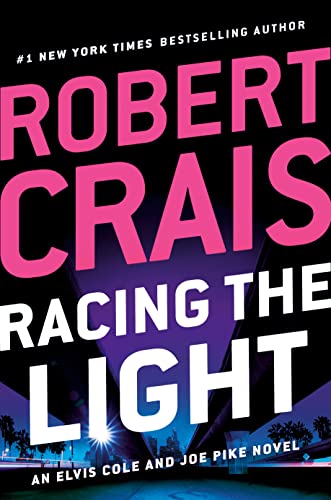
Anyway, I just finished the latest offering in the Cole+Pike batch, called Racing the Light, and it definitely didn’t disappoint. Although it starts out with everyone (i.e., the reader and Elvis himself) thinking that Adele Schumacher may be paranoid and possibly crazy when she asks Elvis to find her son, plunks down a bag full of cash, and starts talking about aliens and government conspiracies, it soon becomes clear that there is something going on with “Josh Shoe,” a controversial though small-time podcaster.
It seems that Elvis isn’t the only person looking for him, and the others are a few steps ahead in their search. Elvis needs to figure things out fast, before these guys with their sophisticated resources and extra knowledge do something permanent to keep Josh from telling what he knows. What starts out as humoring a mother about her maybe-missing adult son (who could just be ducking her calls because he’s trying to live his life) turns into a deadly race to save him from himself before he gets caught and dealt with by some people with a lot to lose if he exposes them.
Joe Pike is enlisted in the search and he, in turn, calls on Jon Stone, a former government “spook” with both connections and equipment a private eye can’t access, but this one will strain all their resources to figure out the magnitude and complexity of the government corruption over which Josh has stumbled.
Elvis’s private life also expands a bit in this one, with the return of his sometime girlfriend Lucy Chenier, who retreated to Baton Rouge a few books back after it became clear to her that the lifestyle of a private eye was too precarious for her to want it affecting her young son, Ben. But it’s been a few years; things have changed. Ben has grown up into a self-reliant teenager, and Lucy has realized that her overprotectiveness may have masked personal doubts, so she’s back to explore options, to Elvis’s simultaneous delight and dismay.
This was a solid offering, and I read it with quite a bit of breathless anticipation, particularly in the second half when the action starts to heat up and the players begin to come into focus. I don’t want to downplay the series too much; Crais won the Anthony and Macavity Awards for The Monkey’s Raincoat, and was nominated for the Edgar Award; and a later title, L.A. Requiem, was a New York Times and Los Angeles Times bestseller. So if you’re looking for a “new” series that has been around for a while and will therefore give you many hours of reading pleasure as you catch up, then check out the first Elvis Cole book, and also look into his non-series novels. (One of them, Hostage, is also a Bruce Willis movie….)
Writer of the dark
I have been a longtime fan of Sharon J. Bolton‘s books, variously characterized as mystery, suspense, or thriller. I defined the difference between those in a previous post; let me recap here:
First of all, neither a suspense novel nor a thriller is about solving a crime, they are about stopping a killer or a crime. So they are not necessarily a whodunit as is a mystery; we may know who the villain is from page one.
In a thriller, the protagonist is in danger from the outset, and action is a required element. Pacing is the key ingredient. In suspense, danger is more important than action, and the protagonist becomes aware of danger only gradually. Setting and mood are key. There must be terror, confusion, upset, and conflict.
A thriller has to start off with a bang, and have a clearly defined hero and villain, because the thriller is all about the push and pull between the two. By contrast, the only real requirement of a suspense story is that it build, and that it keep the reader on edge with a series of reveals or surprises until the final one. Suspense can be present in any genre; a suspense novel is simply one where the reader is uncertain about the outcome. It’s not so much about what is happening as what may happen. It’s about anticipation.

Bolton is a nuanced writer, with examples of all of these in her repertoire, sometimes putting the characteristics of all three into one volume. I would call Daisy in Chains a psychological thriller, and perhaps The Craftsman as well, while Dead Woman Walking would probably fall more into the suspense line. And then there is her ongoing mystery series, featuring Detective Constable Lacey Flint, from which I just read #5, The Dark. I am always thrilled when a new book in this series is published, because they are so involving, so ingenious, and so suspenseful—they leave me breathless. This one was no exception.
Lacey is, first of all, such an intriguing character. She comes out of nowhere, makes a name for herself by exhibiting “derring do,” aka extreme recklessness in solving cases for the London police by any means necessary (including dangerous undercover work), and then takes a baffling sidestep from advancement up the ladder to instead become part of the Marine Policing Unit, working on the Thames river. She’s aloof, almost secretive, even with her best friends and occasional love interests, and as the series progresses you learn that her secrets are not garden variety and she has a good reason (several, actually) for maintaining her solo status; but at the same time, you wish for her that she could let it all go and simply be happy! In short, it’s hard not to get involved with her life story.

Then there are the mysteries, and this latest is a doozy. It relates to what’s been happening in the world during the past few years as women’s rights have begun to be rescinded and certain men scheme to steal even more freedoms in their attempt to turn the world back to when they ran things without dispute and the women stayed home and had babies. In The Dark, there is an underground movement lurking on the dark web that is stirring up the “incels”—men who are involuntarily celibate and therefore harbor a deep dislike of the women who deny them—as well as any other guy who has felt overlooked in favor of a woman, for whatever reason. They target women who (they claim) have benefitted from affirmative action, those who they perceive as having favored the rights of women over men, and pretty much all women who choose more successful, more attractive men (or other women) over them.
And they aren’t just talking—they are inciting men to violence, staging actions such as harassment of women walking alone on the street after 10 p.m., intensive catfishing on dating sites, and the like. The women are both terrified and outraged, and the police are using every traditional and cyber tool at their disposal to figure out who are the ringleaders. And Lacey is, of course, smack dab in the middle of all of it, having been in the right place at the right time to foil their opening act, when a baby is stolen from its carriage and tossed into the Thames on a pool float and Lacey is in the area in her kayak to pull off an audacious rescue.
The scariest part of the story is when one of the incel leaders figures out that he has a past connection with Lacey, and she suddenly becomes the focus of everything he hates in women. All of the regulars from previous books—Dana, Helen, Victoria, Mark Joesbury—are present, along with some new characters from Joesbury’s team, plus Emma Boston, a reporter who plays a pivotal role. The book is as dark as its title, and scarily believable, given recent activities by the religion-obsessed right wing active in many countries today.
The suspense throughout is riveting, and I will confess I lost some sleep sitting up to read this. It’s been a while since Bolton wrote a Lacey Flint, and I was so glad she was back. Bolton has a new book (not in this series) coming out on November 9th, and I already have a pre-order destined for my Kindle the minute it’s 12:01 a.m. on that date! If you’re not familiar with Bolton’s books and you crave more thrillers and mysteries, start reading!
Riches
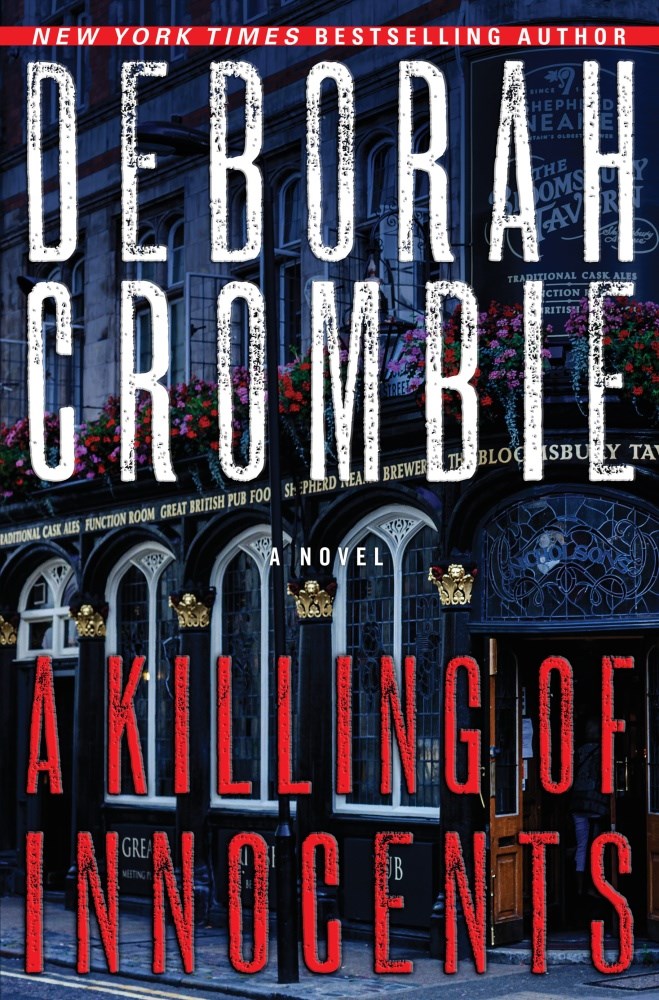
Sometimes forgetfulness or inattention is a gift. I was so busy for a while there trying out new authors and new titles garnered from various Facebook reading groups that I quit paying attention to the yield of some of my favorite mystery writers, with the result that I built up a backlog and got to enjoy three of them in succession: First I read the two Bosch/Ballard books by Connelly, then I followed up with the latest Cormoran Strike; when I finished that (which took some time, since it was 960 pages!), I remembered that I hadn’t checked on Deborah Crombie’s output in a while (I don’t check her too often because she’s an exceedingly slow writer, with as much as four years between books), and discovered she’d published a new one in February! This was a case of gulping down a dessert and then wishing retroactively that I’d made it last a little longer. I was still reading at the intense pace necessary to peruse a Cormoran Strike, but the latest Crombie book in the Kincaid/James series was only 368 pages, and I got through it in under 48 hours, reading at mealtimes and in the middle of the night when histamines from a recent prescription drug reaction kept me awake, and before I knew it, it was over.
I really enjoyed this one although, again, contrasting with the Strike tome with all its wealth of detail made me wish Crombie went a little more in depth into some of her subplots and red herrings to stretch out my experience! Still, we got a nice dose of the main protagonists, the secondaries, the friend circle, and a bunch of new and intriguing characters, and they sucked me into their messy, complex lives and made me want to figure out both the mystery and the relationships.
If you’re not familiar, Crombie’s series is about two detectives who are married to one another—Detective Superintendent Duncan Kincaid, and Detective Inspector Gemma James—although they didn’t start out that way at the beginning of the series (so this is a spoiler for those who haven’t read any of it yet, sorry!). They share a house and a life in London with children from separate previous relationships plus a recently added foster they acquired while together, and some dogs and cats. The books are populated with several significant co-workers and some old family friends from both sides who are ongoing, and then introduce one-off relationships related to the various cases in which they find themselves embroiled. I particularly like this literary pairing because Crombie alternates the lead detective in each book, so one will have Kincaid as the primary while the next will feature James, keeping things both fresh and non-sexist!
In this instance, Gemma has just taken a new position heading a task force on knife crime that places her primarily at a desk rather than in the field, so it’s Duncan who is called out to the scene when a young woman is murdered while walking through the well-populated Russell Square. But Gemma is rapidly involved as well when it turns out that Sasha Johnson, a young trainee doctor at a local hospital, has been stabbed. Is it part of the gang activity that Gemma and colleague Melody Talbot are investigating? It seems to have no connection; but another stabbing in a public park just days later seems to indicate a disturbing trend that will keep everyone looking for associations as they try to solve both cases.
This was well thought out and compelling, and I enjoyed the variety of characters and situations brought into the investigation as all involved look for clues to who might have wanted these people dead and why. Crombie is great at building suspense by switching POV, finding one fact, then changing again, letting each isolated realization begin to form a picture for the team. This was multi-layered with many threads, but they were and remained interesting right through an exciting climax and a satisfying wrap-up.
This series is now 19 books long, and it’s well worth your time if you haven’t tried it yet. I’m envious of those who haven’t, because once you’re caught up, it’s a long time to wait for the next! I keep threatening to start over at the beginning for a massive re-read, and I may well resort to that in the interim before #20.
Re-invested!
I just finished #7 in the Cormoran Strike/Robin Ellacott series by J. K. Rowling, and my complaints from the previous book are all forgotten in the sheer pleasure of reading this one. The Running Grave (named for a line from a Dylan Thomas poem that I find quite frankly incomprehensible) is likewise long, clocking in at 960 pages, although that still makes it 400+ pages shorter than #6; and the lack of those 400 pages may be one thing that improves this book to no end. But what caught me up in it was the subject matter (the culture and operation of a religious cult) and the resulting changes in the protagonists from their pursuit of this case.
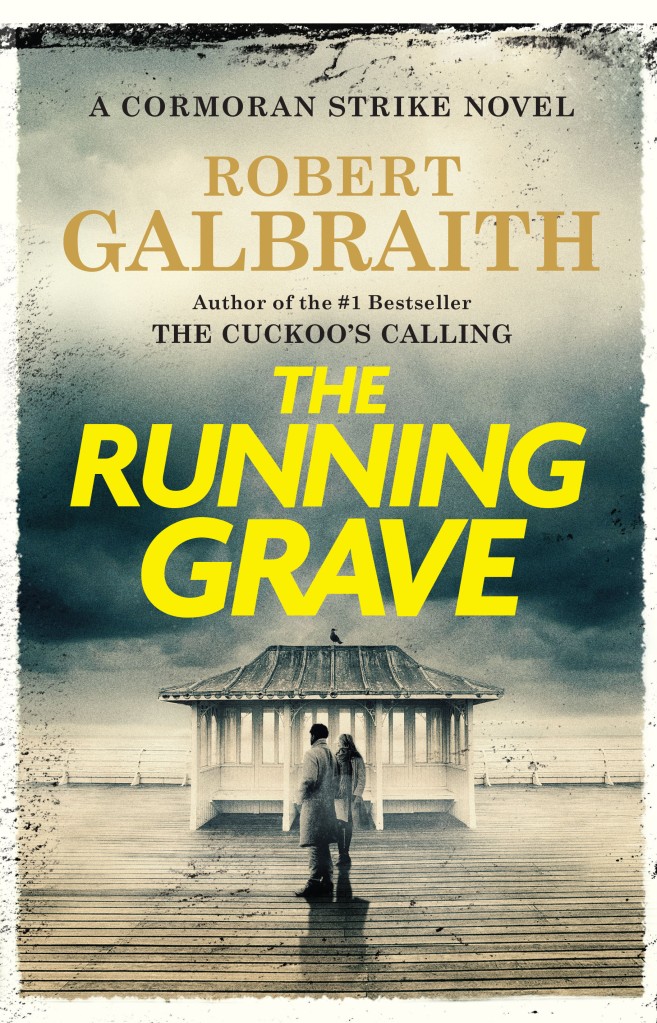
Rowling was so clever in the staging and pacing of this story: Cormoran and Robin are hired by a frantic father to try to extricate his son, Will, from the Universal Humanitarian Church, on the surface a seemingly innocuous organization focused on a general sense of spirituality in service of creating a better world. But after hearing the father’s concerns about how they have prevented all contact between his son and anyone outside the bounds of the cult and then reading up on such rumors as unexplained deaths, compulsory sex, and severe punishments for the slightest infractions, Robin decides to infiltrate the cult. Strike is reluctant to let her be the one, but he is too well known himself to be able to create and maintain an alias, so Robin attends a public meeting of the church designed to recruit new members, and allows herself to be absorbed into their midst and transported to their “farm” in Norfolk for an undetermined length of time, her goal being to contact Will Edensor and see if he is amenable to leaving with her.
This is the genius of the book, creating the world of the cult members living at the farm for Robin to inhabit while keeping Cormoran outside following up on all their other cases, essentially unaware of what’s happening with Robin. They have a tenuous connection: She sneaks out of her dormitory every Thursday night and leaves him a note detailing her week’s experience, putting it in a hollow plastic rock situated in a blind spot near the fence to the outside world; but this weekly check-in is her only fall-back position to get out of what is turning into a seriously sticky situation. Being Robin, she is determined to stay until she achieves results, no matter how precarious things become; and being Cormoran, he is constantly worrying whether he needs to storm the front gate and pull her out of there for her own good. The back-and-forth detailing of the mundane running of the agency (and some rather amusing case work for Cormoran and the gang) with the surreal situation at the farm kept me turning pages every night long after I should have turned out my light and sought sleep.

(female saint in water, painter unknown, 1894)
There is also, of course, the ongoing situation between these two business partners who treat each other like best friends while dating other people because they’re afraid of ruining what they have professionally and are also both a bit cowardly about stating their feelings in the absence of certain knowledge about the reaction that revelation would receive. Robin is currently seeing Detective Inspector Ryan Murphy, while Cormoran uses typical bad judgment in his effort to find sex with no ties by getting involved with someone wholly inappropriate and potentially damaging to his (and the agency’s) reputation. But the longer Robin is sequestered in the cult, the more clear Cormoran becomes about what he really wants, and although nothing definitive happens in the relationship arena for most of the book, it’s not the frustrating experience we have endured for far too long, because we can feel something coming, and the cliff-hanger at the end of this one doesn’t disappoint.
What I am telling you is, if your loyalty has floundered in the face of weird plots on the mystery side and stalled emotions in the romantic sub-plot, I think based on this book that Rowling has hit the tipping point and things are going to get increasingly interesting in future tomes. Read The Running Grave and see if you agree!

 The Book Adept