Another old faithful
I first discovered the books of Robert Crais when I picked up one of his stand-alones at a library sale, and that one—Demolition Angel—remains a favorite; I think I have read it three or four times over the years. I found and read his other stand-alone novels, and liked them all quite a lot (my next favorite being The Two Minute Rule), so then I went on to his series, based on a private detective named Elvis Cole and (after book #10) his enigmatic pal, Joe Pike. The first Elvis Cole book is The Monkey’s Raincoat, and he’s pretty much on his own until The Watchman, which is Cole’s 11th outing and Pike’s debut.
I have an up-and-down relationship with these, because I find them to be somewhat uneven. Elvis is kind of a goofy guy, always joking around (although he takes his work seriously), and sometimes there’s just too much tongue-in-cheek banter. Joe Pike is the ultimate wordless action hero, and sometimes there’s too little personality there to make you care. And the mysteries are sometimes compelling, sometimes weird, and occasionally implausible. So although I think I have read most of the series (which is long—10 books for Cole, nine with Cole and Pike, and another seven with just Pike), I never know whether I will finish up the current book with a sense of satisfaction or feel vaguely let down.
In general, however, this is a reliable series and, like Michael Connelly’s Bosch, Elvis lives in the Hollywood Hills, so all the terrain is familiar to this Los Angeles resident, which is always a bonus. Who doesn’t like to be able to know exactly where the characters are and what things look, feel, smell, and taste like while reading a book? Or maybe that’s just me? Crais is particularly adept at both scene-setting and dialogue, having been (before his career as a novelist) a screenwriter for the TV shows Hill Street Blues, Cagney & Lacey, and Miami Vice. These, coupled with his love for such writers as Raymond Chandler and Dashiell Hammett, gave him the basis for his mysteries.
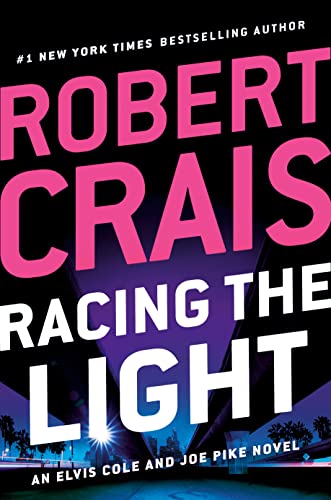
Anyway, I just finished the latest offering in the Cole+Pike batch, called Racing the Light, and it definitely didn’t disappoint. Although it starts out with everyone (i.e., the reader and Elvis himself) thinking that Adele Schumacher may be paranoid and possibly crazy when she asks Elvis to find her son, plunks down a bag full of cash, and starts talking about aliens and government conspiracies, it soon becomes clear that there is something going on with “Josh Shoe,” a controversial though small-time podcaster.
It seems that Elvis isn’t the only person looking for him, and the others are a few steps ahead in their search. Elvis needs to figure things out fast, before these guys with their sophisticated resources and extra knowledge do something permanent to keep Josh from telling what he knows. What starts out as humoring a mother about her maybe-missing adult son (who could just be ducking her calls because he’s trying to live his life) turns into a deadly race to save him from himself before he gets caught and dealt with by some people with a lot to lose if he exposes them.
Joe Pike is enlisted in the search and he, in turn, calls on Jon Stone, a former government “spook” with both connections and equipment a private eye can’t access, but this one will strain all their resources to figure out the magnitude and complexity of the government corruption over which Josh has stumbled.
Elvis’s private life also expands a bit in this one, with the return of his sometime girlfriend Lucy Chenier, who retreated to Baton Rouge a few books back after it became clear to her that the lifestyle of a private eye was too precarious for her to want it affecting her young son, Ben. But it’s been a few years; things have changed. Ben has grown up into a self-reliant teenager, and Lucy has realized that her overprotectiveness may have masked personal doubts, so she’s back to explore options, to Elvis’s simultaneous delight and dismay.
This was a solid offering, and I read it with quite a bit of breathless anticipation, particularly in the second half when the action starts to heat up and the players begin to come into focus. I don’t want to downplay the series too much; Crais won the Anthony and Macavity Awards for The Monkey’s Raincoat, and was nominated for the Edgar Award; and a later title, L.A. Requiem, was a New York Times and Los Angeles Times bestseller. So if you’re looking for a “new” series that has been around for a while and will therefore give you many hours of reading pleasure as you catch up, then check out the first Elvis Cole book, and also look into his non-series novels. (One of them, Hostage, is also a Bruce Willis movie….)
Writer of the dark
I have been a longtime fan of Sharon J. Bolton‘s books, variously characterized as mystery, suspense, or thriller. I defined the difference between those in a previous post; let me recap here:
First of all, neither a suspense novel nor a thriller is about solving a crime, they are about stopping a killer or a crime. So they are not necessarily a whodunit as is a mystery; we may know who the villain is from page one.
In a thriller, the protagonist is in danger from the outset, and action is a required element. Pacing is the key ingredient. In suspense, danger is more important than action, and the protagonist becomes aware of danger only gradually. Setting and mood are key. There must be terror, confusion, upset, and conflict.
A thriller has to start off with a bang, and have a clearly defined hero and villain, because the thriller is all about the push and pull between the two. By contrast, the only real requirement of a suspense story is that it build, and that it keep the reader on edge with a series of reveals or surprises until the final one. Suspense can be present in any genre; a suspense novel is simply one where the reader is uncertain about the outcome. It’s not so much about what is happening as what may happen. It’s about anticipation.

Bolton is a nuanced writer, with examples of all of these in her repertoire, sometimes putting the characteristics of all three into one volume. I would call Daisy in Chains a psychological thriller, and perhaps The Craftsman as well, while Dead Woman Walking would probably fall more into the suspense line. And then there is her ongoing mystery series, featuring Detective Constable Lacey Flint, from which I just read #5, The Dark. I am always thrilled when a new book in this series is published, because they are so involving, so ingenious, and so suspenseful—they leave me breathless. This one was no exception.
Lacey is, first of all, such an intriguing character. She comes out of nowhere, makes a name for herself by exhibiting “derring do,” aka extreme recklessness in solving cases for the London police by any means necessary (including dangerous undercover work), and then takes a baffling sidestep from advancement up the ladder to instead become part of the Marine Policing Unit, working on the Thames river. She’s aloof, almost secretive, even with her best friends and occasional love interests, and as the series progresses you learn that her secrets are not garden variety and she has a good reason (several, actually) for maintaining her solo status; but at the same time, you wish for her that she could let it all go and simply be happy! In short, it’s hard not to get involved with her life story.

Then there are the mysteries, and this latest is a doozy. It relates to what’s been happening in the world during the past few years as women’s rights have begun to be rescinded and certain men scheme to steal even more freedoms in their attempt to turn the world back to when they ran things without dispute and the women stayed home and had babies. In The Dark, there is an underground movement lurking on the dark web that is stirring up the “incels”—men who are involuntarily celibate and therefore harbor a deep dislike of the women who deny them—as well as any other guy who has felt overlooked in favor of a woman, for whatever reason. They target women who (they claim) have benefitted from affirmative action, those who they perceive as having favored the rights of women over men, and pretty much all women who choose more successful, more attractive men (or other women) over them.
And they aren’t just talking—they are inciting men to violence, staging actions such as harassment of women walking alone on the street after 10 p.m., intensive catfishing on dating sites, and the like. The women are both terrified and outraged, and the police are using every traditional and cyber tool at their disposal to figure out who are the ringleaders. And Lacey is, of course, smack dab in the middle of all of it, having been in the right place at the right time to foil their opening act, when a baby is stolen from its carriage and tossed into the Thames on a pool float and Lacey is in the area in her kayak to pull off an audacious rescue.
The scariest part of the story is when one of the incel leaders figures out that he has a past connection with Lacey, and she suddenly becomes the focus of everything he hates in women. All of the regulars from previous books—Dana, Helen, Victoria, Mark Joesbury—are present, along with some new characters from Joesbury’s team, plus Emma Boston, a reporter who plays a pivotal role. The book is as dark as its title, and scarily believable, given recent activities by the religion-obsessed right wing active in many countries today.
The suspense throughout is riveting, and I will confess I lost some sleep sitting up to read this. It’s been a while since Bolton wrote a Lacey Flint, and I was so glad she was back. Bolton has a new book (not in this series) coming out on November 9th, and I already have a pre-order destined for my Kindle the minute it’s 12:01 a.m. on that date! If you’re not familiar with Bolton’s books and you crave more thrillers and mysteries, start reading!
Riches
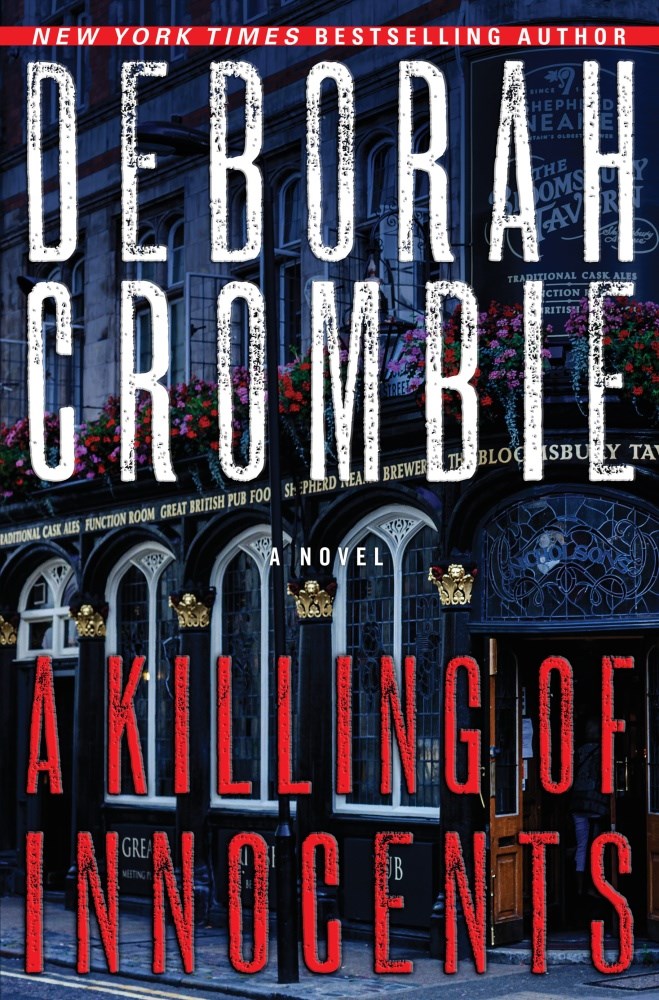
Sometimes forgetfulness or inattention is a gift. I was so busy for a while there trying out new authors and new titles garnered from various Facebook reading groups that I quit paying attention to the yield of some of my favorite mystery writers, with the result that I built up a backlog and got to enjoy three of them in succession: First I read the two Bosch/Ballard books by Connelly, then I followed up with the latest Cormoran Strike; when I finished that (which took some time, since it was 960 pages!), I remembered that I hadn’t checked on Deborah Crombie’s output in a while (I don’t check her too often because she’s an exceedingly slow writer, with as much as four years between books), and discovered she’d published a new one in February! This was a case of gulping down a dessert and then wishing retroactively that I’d made it last a little longer. I was still reading at the intense pace necessary to peruse a Cormoran Strike, but the latest Crombie book in the Kincaid/James series was only 368 pages, and I got through it in under 48 hours, reading at mealtimes and in the middle of the night when histamines from a recent prescription drug reaction kept me awake, and before I knew it, it was over.
I really enjoyed this one although, again, contrasting with the Strike tome with all its wealth of detail made me wish Crombie went a little more in depth into some of her subplots and red herrings to stretch out my experience! Still, we got a nice dose of the main protagonists, the secondaries, the friend circle, and a bunch of new and intriguing characters, and they sucked me into their messy, complex lives and made me want to figure out both the mystery and the relationships.
If you’re not familiar, Crombie’s series is about two detectives who are married to one another—Detective Superintendent Duncan Kincaid, and Detective Inspector Gemma James—although they didn’t start out that way at the beginning of the series (so this is a spoiler for those who haven’t read any of it yet, sorry!). They share a house and a life in London with children from separate previous relationships plus a recently added foster they acquired while together, and some dogs and cats. The books are populated with several significant co-workers and some old family friends from both sides who are ongoing, and then introduce one-off relationships related to the various cases in which they find themselves embroiled. I particularly like this literary pairing because Crombie alternates the lead detective in each book, so one will have Kincaid as the primary while the next will feature James, keeping things both fresh and non-sexist!
In this instance, Gemma has just taken a new position heading a task force on knife crime that places her primarily at a desk rather than in the field, so it’s Duncan who is called out to the scene when a young woman is murdered while walking through the well-populated Russell Square. But Gemma is rapidly involved as well when it turns out that Sasha Johnson, a young trainee doctor at a local hospital, has been stabbed. Is it part of the gang activity that Gemma and colleague Melody Talbot are investigating? It seems to have no connection; but another stabbing in a public park just days later seems to indicate a disturbing trend that will keep everyone looking for associations as they try to solve both cases.
This was well thought out and compelling, and I enjoyed the variety of characters and situations brought into the investigation as all involved look for clues to who might have wanted these people dead and why. Crombie is great at building suspense by switching POV, finding one fact, then changing again, letting each isolated realization begin to form a picture for the team. This was multi-layered with many threads, but they were and remained interesting right through an exciting climax and a satisfying wrap-up.
This series is now 19 books long, and it’s well worth your time if you haven’t tried it yet. I’m envious of those who haven’t, because once you’re caught up, it’s a long time to wait for the next! I keep threatening to start over at the beginning for a massive re-read, and I may well resort to that in the interim before #20.
Re-invested!
I just finished #7 in the Cormoran Strike/Robin Ellacott series by J. K. Rowling, and my complaints from the previous book are all forgotten in the sheer pleasure of reading this one. The Running Grave (named for a line from a Dylan Thomas poem that I find quite frankly incomprehensible) is likewise long, clocking in at 960 pages, although that still makes it 400+ pages shorter than #6; and the lack of those 400 pages may be one thing that improves this book to no end. But what caught me up in it was the subject matter (the culture and operation of a religious cult) and the resulting changes in the protagonists from their pursuit of this case.
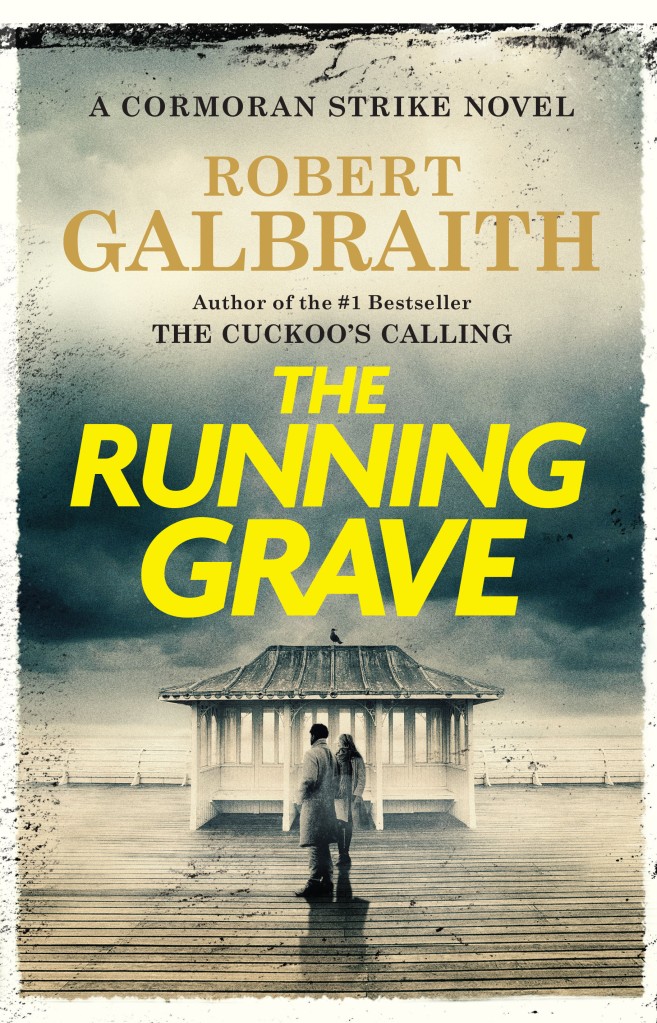
Rowling was so clever in the staging and pacing of this story: Cormoran and Robin are hired by a frantic father to try to extricate his son, Will, from the Universal Humanitarian Church, on the surface a seemingly innocuous organization focused on a general sense of spirituality in service of creating a better world. But after hearing the father’s concerns about how they have prevented all contact between his son and anyone outside the bounds of the cult and then reading up on such rumors as unexplained deaths, compulsory sex, and severe punishments for the slightest infractions, Robin decides to infiltrate the cult. Strike is reluctant to let her be the one, but he is too well known himself to be able to create and maintain an alias, so Robin attends a public meeting of the church designed to recruit new members, and allows herself to be absorbed into their midst and transported to their “farm” in Norfolk for an undetermined length of time, her goal being to contact Will Edensor and see if he is amenable to leaving with her.
This is the genius of the book, creating the world of the cult members living at the farm for Robin to inhabit while keeping Cormoran outside following up on all their other cases, essentially unaware of what’s happening with Robin. They have a tenuous connection: She sneaks out of her dormitory every Thursday night and leaves him a note detailing her week’s experience, putting it in a hollow plastic rock situated in a blind spot near the fence to the outside world; but this weekly check-in is her only fall-back position to get out of what is turning into a seriously sticky situation. Being Robin, she is determined to stay until she achieves results, no matter how precarious things become; and being Cormoran, he is constantly worrying whether he needs to storm the front gate and pull her out of there for her own good. The back-and-forth detailing of the mundane running of the agency (and some rather amusing case work for Cormoran and the gang) with the surreal situation at the farm kept me turning pages every night long after I should have turned out my light and sought sleep.

(female saint in water, painter unknown, 1894)
There is also, of course, the ongoing situation between these two business partners who treat each other like best friends while dating other people because they’re afraid of ruining what they have professionally and are also both a bit cowardly about stating their feelings in the absence of certain knowledge about the reaction that revelation would receive. Robin is currently seeing Detective Inspector Ryan Murphy, while Cormoran uses typical bad judgment in his effort to find sex with no ties by getting involved with someone wholly inappropriate and potentially damaging to his (and the agency’s) reputation. But the longer Robin is sequestered in the cult, the more clear Cormoran becomes about what he really wants, and although nothing definitive happens in the relationship arena for most of the book, it’s not the frustrating experience we have endured for far too long, because we can feel something coming, and the cliff-hanger at the end of this one doesn’t disappoint.
What I am telling you is, if your loyalty has floundered in the face of weird plots on the mystery side and stalled emotions in the romantic sub-plot, I think based on this book that Rowling has hit the tipping point and things are going to get increasingly interesting in future tomes. Read The Running Grave and see if you agree!

Harry Bosch is 70
Speaking of a Golden Bachelor…it had to come sometime. Has there ever been another police officer who has joined and left the LAPD and joined up again so many times? and had a career that spanned three or four departments and several separate locations and even a different police department or two? Not to mention a brief foray as a private eye. Yep, Harry’s getting up there, and I don’t want to say that Connelly is phasing him out just yet, but the fact that he has, in each of the past five books, shared star billing with Renée Ballard says “transition” to me. Seventy isn’t so old these days, but after being exposed to cesium during a previous case, Harry’s mortality is apparently something to contemplate more immediately.
I’m not real happy about that; although I liked Renee well enough in her debut novel, when she appeared to be an outsider to rival Bosch—sleeping in a tent on the beach with her dog, and dividing her time between the police force and surfing—I have mainly read the Renée Ballard books because she always appears in conjunction with Harry, and when he’s no longer with us, I’m not sure she has the moxie to carry a series alone. While I would definitely call the Bosch books police procedurals, the focus has always been squarely on Harry, and his personality defines and permeates every story; but Renée doesn’t have the same spark, and I fear that once Bosch is no longer even an outlier, I won’t find enough pizzazz left to keep reading.

I read the latest Harry/Renée book, and then realized that I had missed the one just before that, so I went back and read that one. In The Dark Hours, Renée is still working “the late show” (the overnight shift) without a partner, but when she gets in too deep or needs some backup, she doesn’t call on a fellow officer, most of whom seem to be phoning it in since the twin discouragements of the “defund the police” movement and the Covid epidemic, but rather on the retired Harry Bosch, at home and at loose ends. This could ultimately get her in a lot of trouble with the department, but she’s a risk-taker and knows what she needs to get a solve on her cases; what she needs is Bosch. In this book the two have an almost instinctual camaraderie that is fun to watch.

There’s a big contrast between that book and the next one, Desert Star. In this latest Bosch/Ballard pair-up, Ballard has become almost unrecognizable as the junior-grade maverick following in her mentor’s footsteps. Towards the end of The Dark Hours, a disgraced Ballard had quit the force and was considering teaming with Bosch in a private detective firm, but at the beginning of this one she is back in the LAPD, and has been made head of her own department, examining cold/unsolved cases for the Robbery/Homicide division, and reopening ones that are viable for moving ahead, due to DNA evidence or other new information. This promotion seems to have turned her into a cautious, uptight, stuffy version of herself, and it takes practically the whole book for her to unwind back into the Ballard we’ve met before.
The inclusion of Harry is made legitimate this time, since Ballard is empowered to recruit him as a volunteer and he is more than willing to fill his time focusing on a multiple murder he was never able to solve. He’s supposed to be working on a case that is important to the city councilman sponsoring the new unit, but as usual Harry prioritizes what he believes to be more essential, and in so doing gets both himself and Ballard in hot water more than once. Most of it is believable, but when he takes off for Florida without telling either Ballard or his daughter that he’s going, it was one step too far into uncharacteristic behavior for me. I ultimately enjoyed most of this book, but it certainly didn’t make me warm up to Ballard or cease to dread the retirement of one of the best detectives any mystery novelist ever created.
Resolution

I just finished reading the last two books in Elly Griffiths’s Ruth Galloway mystery series: The Locked Room, and The Last Remains. For those who aren’t familiar, Ruth is (now) a 40-something archaeologist/professor at the University of North Norfolk, and lives in a cottage overlooking the Fens (marshlands) and the ocean. Norfolk was settled in pre-Roman times and then taken over by the Romans; during the Middle Ages it was a center for the wool trade, resulting in the building of many churches. Since it has remained a largely rural county, this makes the area a rich archaeological source of artifacts and, as Ruth discovers in her role as a forensic consultant to the police, bodies both ancient and modern.
I don’t want to get too spoiler-y in this post, but the arc of the books is partly professional and partly personal, and it is the personal for which all we fans and readers have been waiting resolution for many years and volumes. In her role as a consultant, Ruth is thrown into the company of Detective Chief Inspector (DCI) Harry Nelson, a married man with a couple of children, and an impulsive one-night stand results in a pregnancy for Ruth. She doesn’t ask for anything to change, knowing how deeply dug into married life is Nelson, and although she has doubts about her own abilities to raise a child effectively by herself, her love for her daughter, Kate, conquers all.
Kate is born at the end of book #2, and there are 13 books that follow after. In each one, the discovery of a body or bodies draws Ruth into the subsequent police investigations, regularly renewing questions about her relationship to Nelson. There are at least two books that constitute partial departures from proximity: In one, Ruth and Kate travel to Italy without Nelson, while in another they actually move away from Norfolk to Cambridge and in with a “boyfriend” of Ruth’s for a period of time. But if you are a long-term reader of this blog, you will perhaps remember how many times I have complained about the on-again, off-again nature of their interactions, the glacial slowness with which things have moved, and the constant wondering: Will they ever get together? Will Nelson get up the courage to leave his wife for Ruth? Will Ruth ever let her growing exasperation prompt her to kick Nelson to the curb for good? This speculation has overshadowed the mysteries in more than one book in this series and has caused me to swear off reading them on several occasions, but there’s something appealing about the awkward archaeologist that I have found hard to resist, and I have always come back to get caught up.
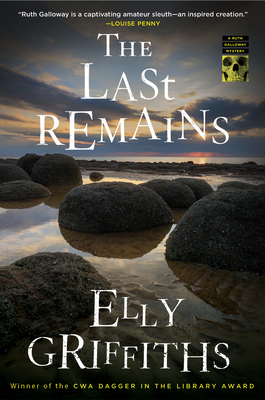
At last, however, that is at an end: Book #15 is the last in the series, and finally we have resolution to the decade-long question: Will they or won’t they? But first we have to participate in the perpetual angst throughout Book #14 and part of the last.
I’m not going to reveal anything else here, so let’s take a look at the mysteries detailed in these two books. As I have commented before, the books have seemed to alternate, throughout the series, between one that is compelling and one that phones it in, to the point where there were at least two books I recommended that readers skip, going instead to a synopsis to find out the details about the personal relationships while avoiding the somewhat boring plots. That has held true to the end; The Locked Room‘s mystery is both confusing and slight, while The Last Remains has a tight, interesting story line that includes several characters both new and old and nicely ties up some dangling questions by taking us back to the very first mystery on which Ruth and Nelson collaborated. The one thing that does distinguish The Locked Room is that Griffiths set it during the recent pandemic and imbued her story with all the inconveniences and tragedies we experienced during that time period, which was both refreshingly real and disturbingly uncomfortable, a reminder of all that we did and didn’t do and all that we lost.
I still struggle a bit with the idea that Ruth and Harry have taken 15 years to confront their feelings, but I congratulate Elly Griffiths on a largely successful and mostly involving mystery series. I hope with her Harbinder Kaur books that she draws us into many more murderous adventures.
Day for cats
A friend’s post on Facebook reminded me that today is International Cat Day, which I dare not let go by unremarked, lest Gidget do some big-time scolding (at which she is quite proficient!). So here are some titles guaranteed to appeal to readers of various types who are also cat lovers.

MISCELLANEOUS STUFF YOU WON’T WANT TO MISS
The Dalai Lama’s Cat, by David Michie, in which the Tibetan Buddhist leader’s cat offers insights on happiness and meaning.
The Rabbi’s Cat, by Joann Sfar, a graphic novel about a cat who eats the family parrot, gains the ability to speak, and demands a Bar Mitzvah, by a celebrated French comic artist.
James Herriot’s Cat Stories, by, you guessed it, James Herriot! Celebrating his feline friends…
On Cats, by Charles Bukowski, the irreverent and profane poet whose primary subjects of women and booze also apparently expand to include his take on cats.
The Travelling Cat Chronicles, by Hiro Arikawa, in which Nana the cat and her person, Satoru, go on a road trip, for what purpose Nana isn’t quite sure. Be prepared to cry.
The Cat Who Went to Paris, by Peter Gethers, the story of how a Scottish Fold kitten named Norton turned a curmudgeonly cat hater into a compassionate human.
A Street Cat Named Bob: How One Man and His Cat Found Hope on the Streets, by James Bowen. It’s all there in the very long title.
I Could Pee On This, and Other Poems by Cats, by Francesco Marciuliano. From the singular minds of housecats.
Old Possum’s Book of Practical Cats, by T. S. Eliot, in which the author describes cats each by their distinct personality.
The Tribe of Tiger: Cats and Their Culture, by Elizabeth Marshall Thomas, a naturalist and anthropologist who explores the worlds of lions, tigers, pumas, and housecats.

MYSTERIES
The Cat Who… mysteries, by Lilian Jackson Braun, in which a reporter and his cat solve mysteries. First book: The Cat Who Could Read Backwards.
The Mrs. Murphy mysteries, by Rita Mae Brown & Sneaky Pie Brown, in which Mrs. Murphy and her human companion solve mysteries. First book: Wish You Were Here.
The Joe Grey mysteries, by Shirley Rousseau Murphy, in which there are talking cats and also a human who discovers an ability to morph into a cat. First book: Cat on the Edge.
SCIENCE FICTION/HORROR
Catfantastic: Nine Lives and Fifteen Tales, by Andre Norton, editor, in which sci fi and fantasy writers tell tall tales about furry felines. (Short stories.)
The Chanur novels, by C. J. Cherryh, in which a leonine species—the Chanur—take in a human refugee and by so doing threaten the interspecies Compact. First book: The Pride of Chanur.
The Cinder Spires books, by Jim Butcher, in which there are also cat clans and some naval airship action. First book: The Aeronaut’s Windlass.
The Cult of the Cat books, by Zoe Kalo, in which Trinity is left with a dead grandmother and a thousand grieving cats. A sort of Egyptian urban fantasy. First book: Daughter of the Sun.
Pet Sematary, by Stephen King. I always have trouble with the spelling of this one, seeing as how it’s spelled “cemetery.” Hm. But if you like to be scared by revenants, this one’s for you.
FOR SMALL, MEDIUM, AND LARGE CHILDREN:
Millions of Cats, by Wanda Gág, in which a lonely old couple acquires companions. This is known as the original picture book for children.
The Owl and the Pussycat, by Edward Lear. A classic.
Time Cat, by Lloyd Alexander. He can talk, he can time travel…what’s not to like? By the wonderful author of The Prydain Chronicles.
The Fur Person, by May Sarton. Yes, that May Sarton. A charming tale about a Cat About Town who decides to become a Fur Person instead. It could be read as either a children’s book or a novelty book for adults.
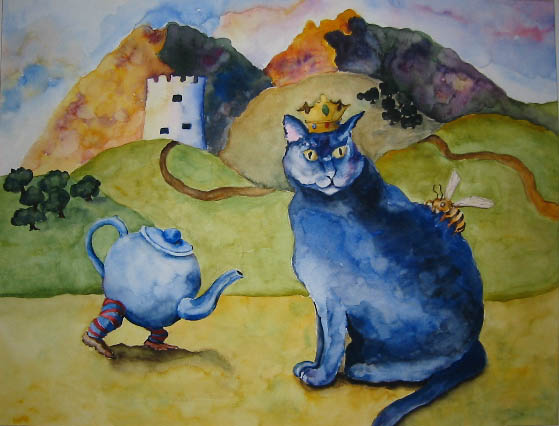
The Warriors books, by Erin Hunter, in which a house cat discovers clans of cats living in the wild in the forest…. First book: Into the Wild.
The Wildings books, by Nilanjana Roy, in which a small band of cats lives in the alleys and ruins of Nizamuddin, an old neighborhood in Delhi, India.
The Feline Wizards series, by Diane Duane, in which feline wizards time travel to avert disasters. First book: The Book of Night with Moon.
Tales of the Barque Cats, by Anne McCaffrey, in which cats are essential members of the crews of space vessels…until an epidemic threatens their extinction.

For many, many more books with or about cats, hit up this gargantuan list on Goodreads of Great Cat Books (1,511).
Invested

How to weigh the investment
I have made in the ongoing relationship that is still not a “relationship” between Cormoran Strike and Robin Ellacott against the increasingly lengthy tomes that, while well written and intriguing, still need the hand of a ruthless editor to bring them in under a thousand pages? It’s a toughie. I refer to the latest by “Robert Galbraith,” aka J. K. Rowling, The Ink Black Heart, #6 in this series, each book anticipated with both excitement and dread.
On the positive side, I love the effortless way she paints a picture of the inner workings of each character, lets us in on what each is thinking, and then shows us how they choose to respond on the outside regardless of their inner conclusions. The understanding of the misunderstandings inherent in human relations is masterful, and never on better display than in the interplay between Cormoran and Robin. This skill carries over to the rest of the characters that inhabit this somewhat sordid world observed by London’s private detectives, and it’s hard not to get caught up in the drama Rowling, er, Galbraith provides.
This particular book assays some formidable subjects. The seamy side of social media is on full display as people in chat rooms and on Twitter grab rumor and turn it into accusations and abuse. Some sincerely believe what they have read and are addressing it, while others are just meanly happy for the drama or are using it to manipulate situations for their own purposes. It’s also a political book, showcasing as it does the use extremists make of naive folk online, and the determined denigration of women by incels and just about everyone else.
The negative side is, well, the page count. The book is more than a thousand pages and, while I am not opposed to a lengthy story, there is something to be said for not turning over every single rock on the beach. This book could have been about 25-30 percent shorter and still been just as (or perhaps more) effective. I also simultaneously applaud the ingenuity of including the chatroom interchanges to thoroughly explore the largely anonymous characters in the game, any one of whom could be a murderer, while also bemoaning how repetitive and lengthy is that back-and-forth documentation. Sheesh!
The basic plot: Two people, Edie and Josh, have created a popular online cartoon, The Ink Black Heart. Two other anonymous parties came along afterwards and made a game (Drek’s Game) to accompany that cartoon, which features all the characters from the cartoon and also hosts chat rooms. There has been hostility between one of the creators of the game (and from his minions who play and enjoy it) and the people who made the original cartoon ever since the female creator, Edie Ledwell, expressed dislike for the game. The trolls have been out in full force, and the level of abuse is toxic. Edie is desperate to find out the identity of the creator, Anomie, who is out to get her, especially because now that the cartoon has gained interest from Netflix and will be made into a film, new rumors and abuse are flying. Edie approaches Robin to try to hire the agency to discover her nemesis, but Cormoran, Robin, and their subcontractors are already overwhelmed with work and Robin turns her away. A few days later, Edie turns up stabbed to death in Highgate Cemetery, the setting where the cartoon takes place. Through another client, Robin and Cormoran are drawn into the investigation to uncover Anomie’s identity, but considering the number of suspects with both motive and affiliation to the dead creators, it will be a long, tedious, and ultimately dangerous search.
Both the suspense and the level of frustration are doubled in this book because not only are they trying to unmask a villain, but—before they are able to do so—they must also unmask all the anonymous online personae.

And speaking of levels of frustration, the growing consciousness between Robin and Cormoran that there is something more to their partnership than friendship and work is definitely still present and ongoing, but I felt like it stalled out significantly in this book. I am beginning to fear that Rowling will drag this out for as long as Elly Griffiths has milked the connection between Ruth Galloway and DCI Harry Nelson in her series, and if Rowling and Griffiths don’t get on with it, their fans are going to start dropping off.
This book won’t cause me to do so, but I would love to say to Rowling, empower both your editor and your romance next time!
Catching up
I have read so very many series that I can’t keep track any more when a new book from one of them comes out, particularly if it’s a writer who is irregular in their production. With Louise Penny, you can always plan on a new Gamache hitting the bookstores somewhere between August and November each and every year, but others (such as Deborah Crombie) produce one so seldom that it’s depressing to go check up on what’s (not) happening.

Cynthia Harrod-Eagles is a fairly prolific writer, especially when one considers she has at least three different series going, and in different genres to boot. I discovered her first as a writer of police procedurals in the Bill Slider mystery series, but she’s more well known for her Morland Dynasty saga, and is now writing a new historical fiction series as well. I found out via my Kindle membership that there was a new Bill Slider, so this week I embarked on a read of #24, Before I Sleep.
The past few Sliders of late have been somewhat uneven, so I was pleased to discover that this was a particularly good one. Slider is tasked by the bumbling but good-natured Detective Superintendent Porson with a missing persons case, even though it’s not in his district and that’s not what he does (he generally solves murders), because word has come down from “on high” that this is a case that needs solving pronto. A woman has disappeared, and her husband is old school chums with the big boss, so Slider, who has an impressive solve rate and is also sometimes tiresome enough for the politicos to want to be rid of him, gets stuck with it. If he solves it, the glory redounds, and if he doesn’t, maybe he loses his job, so there’s a lot on the line.
Felicity Holland is a settled middle-aged woman married to a successful author, with an active social schedule and lots of hobbies and charities. One Tuesday after breakfast, when the husband has gone upstairs to begin his day of writing, she heads out for her weekly pottery class, but according to her husband she didn’t come home that night and hasn’t been heard from since. Being a vague, self-centered guy, he doesn’t remember the name of where she takes the class, has no idea who her after-class lunching friends are, and is basically unable to provide any useful information to the police, but expects immediate results nonetheless. His rather hysterical theory that she has been snatched up by a serial killer is causing him to make himself a nuisance, while Slider and his team have to buckle down to do the plodding police work that will ultimately trace her movements—check the CCTV cameras, the bus passes, the taxi services, talk to her relatives, find her friends, maybe delve a little into her past.
I liked how this evolved from a nuisance case into a legitimate “misspers” and from there to a probable murder mystery. The usual team is on duty, with a few new people added; Porson continues with his malapropisms, now enabled by Slider, who somewhat ironically inserts his own into the conversation to enjoy watching Porson struggle with the thought that what he said just isn’t right. Atherton is quick with the puns, and also has a new, possibly more permanent love interest at last. There’s not a whole lot about Joanna and the family in this one, but enough to keep things going. I figured out a key plot point quite a while before it was revealed, but it didn’t spoil my enjoyment of its revelation at the end. All in all, a satisfying read. Keep them coming, Ms. Harrod-Eagles!
Miscellaneous reads
In general, I try to blog about every book I read, but sometimes either there’s not much to say, or there’s something to be said that isn’t positive, either of which can stop me. But in the interest of an even flow of content…

I read the next book in Dana Stabenow’s Kate Shugak mysteries set in Alaska, and liked it quite as well as the first two, if not more. In Dead in the Water, Kate has to join up as a crew member of a fishing boat in search of expensive and difficult to harvest crabs in the Bering Sea in order to get a handle on a missing persons case she inherited from her former employer, the Anchorage District Attorney. The author’s own youthful experiences on an Alaskan fishing boat inform this volume with a real feel for what the life is like, and taking Kate out of her normal setting and putting her at a disadvantage among strangers ups both the tension and the quality of the storytelling. I will continue with this series anon.

I then picked up a young adult novel, in an attempt to get some new titles onto my “read” list; I will be teaching Young Adult Literature again at UCLA’s library school next spring, and since I retired from my job as a teen librarian I have fallen woefully behind with my reading. Unfortunately, I won’t be recommending The Upside of Falling Down, by Rebekah Crane to anyone. It had an interesting premise—Clementine Haas is the sole survivor of a plane crash, and wakes in a hospital in Ireland with trauma-induced amnesia that stubbornly hangs on for weeks. Her father’s imminent arrival from Chicago to take her home provokes a panicked response as she worries that she won’t recognize him or any part of her life in America, and she runs away, falling in with a kind young man who takes her back to his small Irish village and gives her license to stay there for as long as she needs. And then, of course, stuff happens…
I thought the book was only okay. The characters were all suspect—untrustworthy, and not particularly likeable. The best character in the book was, ironically, neither of the main protagonists; the “mean girl” sister stole every scene in which she appeared. And the events of the last third of the book were just too pat to be either believable or entertaining. Give it a miss. There’s a multitude of better YA novels out there, some of which I will hopefully be reading and reviewing soon.
 The Book Adept