Missing Francis
I am a huge fan of Dick Francis mysteries. When he passed away and his son took up his mantle, I decided to reserve judgment until I had read a few. (I had been burned once before by this dynamic when the brilliant and innovative Frank Herbert died and his son Brian started writing decidedly inferior sequels to his Dune series.) It was noted that Felix had helped Dick with the massive research required to deliver his books, and since I was cognizant of what that involved (Dick’s books were chock full of interesting details about all sorts of things), and since it was also noted that Felix had co-written the last few, I believed that Felix might just have the master’s touch.
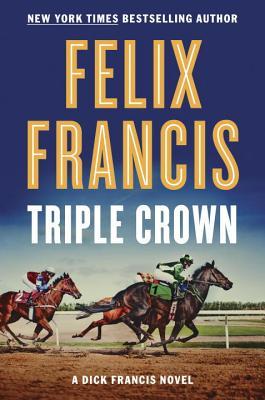
I have read several of Felix’s books since he began writing on his own, and while they weren’t quite Dick Francis, they weren’t bad. I enjoyed both Bloodline and Damage, and when I saw that Triple Crown was another book featuring Jeff Hinkley (the protagonist of Damage), I was somewhat enthusiastic about picking it up.
I think it will be my last authored by Felix.
I am not an apologist for such American quirks as overly armed police officers, or the animal cruelty that is present in the branding of cattle and horses, or the convoluted groups of associated government departments that nonetheless refuse to work together. Quite the contrary, in fact: Based on my experience working as a librarian who was constantly called upon to be a social worker for certain of our patrons, I applaud the recent movement towards scaling back police influence to do the things they are actually trained to do. I am a vegetarian and deplore all forms of deliberate injury to animals; and I think the level of jockeying for power in Washington is ludicrous. But that doesn’t mean I want to read about all those things and, if I did, it certainly wouldn’t be in the pages of what is supposed to be an entertaining mystery novel.
The plot seems like a reasonably good one: Jeff Hinkley, who works as a covert investigator for the British Horseracing Authority (BHA), is requested to come to America to help their Federal Anti-Corruption in Sports Agency (FACSA) find out who in their organization is passing on confidential information that will help horse trainers and owners evade arrest when they get up to such things as drugging rival horses. After consulting with the agency’s Deputy Director, by whom he was invited to come, Hinkley sets up a sting operation in which he goes undercover as a groom for a trainer believed to cut corners to win races, hoping that, as an insider, he will be able to find information on the mole. As he discovers some horrifying steps this trainer is taking to win the Triple Crown, his added motive becomes to root out this corruption before more horses die.
The execution of the story turns into a vehicle for Francis, disguised as Hinkley, to exhibit a condescending supercilious attitude toward American horse-racing when compared with the British, and this attitude constitutes almost the only defining trait of the protagonist—he is otherwise so unmemorable that near the end of the novel, when he decides to dye his hair and beard dark as a disguise, I was utterly surprised that he had been a blond previous to the dye job, because his physicality was left so vague throughout the book. Hinkley is completely lacking in the charm, intelligence, or wit of a Dick Francis hero. He is a fatal combination of bland and pompous that endears him to no one, including his fellow characters or the reader.
In addition to the rather overbearing anti-American themes is the pedantic tone of his explanatory passages, which constantly trip you up and shove you out of the story. The dialogue is likewise stilted and formal, and the character development is rudimentary at best, and laden with offensive clichés. Hinkley’s attitude toward his co-worker, Maria, the Puerto Rican hot walker for the stable, basically consists of his observation that she’s a hot mama; his Mexican roommate is a drunkard and a simpleton; he seems surprised that a female federal agent could be such a crack shot; and another female agent becomes a stereotype of a whiny mistress to her colleague’s married man. Dick Francis’s gentle misogyny was both understandable (due to his age and upbringing) and predictable; but what is Felix’s problem with women in particular? It seems that, along with not respecting them, he doesn’t particularly admire them either. At least his father had a healthy appreciation and understanding of relationships and knew how to write them.
My constant feeling during the reading of this novel was that I was trudging through a quicksand of expository prequel while hoping the actual story would pick up at some point and become involving, but it never did. By the time the book reached the intended climactic scenes, I simply didn’t care—and the lackluster way in which they were written confirmed those feelings.
Next time I’m feeling nostalgic for an exciting mystery with a horse racing theme, I’ll go back and re-read the real thing. And perhaps, at this point, this Francis should quit putting “A Dick Francis Novel” on his covers.
Undeniably not done
In between other more serious fare, I checked out the Kindle copies of the next three books in the Lucy Valentine psychic matchmaking series. I had enjoyed the first two, and thought I’d like to find out what happened to all the engaging characters (pardon the pun), most of all Lucy and her beau, Sean.
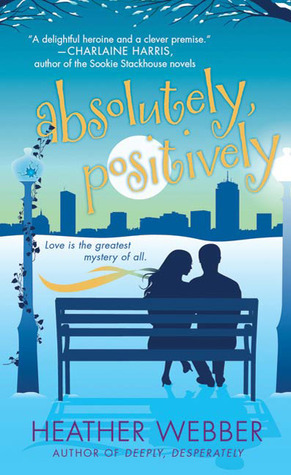
First was Absolutely, Positively, in which Lucy’s psychic ability to find things is finally unmasked to the public and she has to deal with the fallout, while discovering a new method to find “lost loves” with it that expands her father’s matchmaking business to a new department that includes Lucy plus private eyes Sean and his brother.
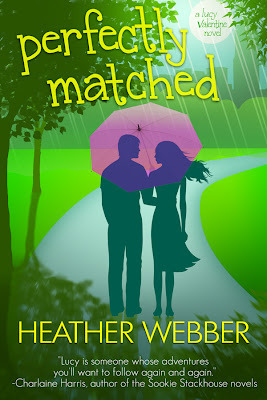
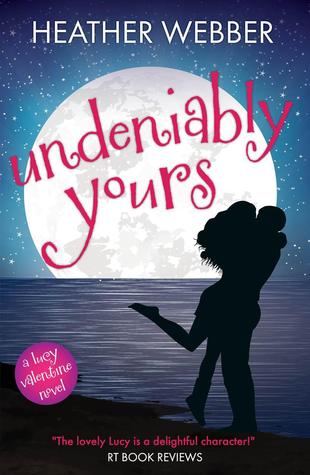
Then came Perfectly Matched, in which she hooks up with a bunch of other psychics to try to bring out more abilities and hone the one she has. Meanwhile, someone is targeting her boyfriend and his brother by setting fires at all the places where they grew up, and Lucy becomes increasingly desperate to discover why and, more important, who, before something bad happens. Lastly was Undeniably Yours, in which her policeman friend, Aiden, seeks her help finding a lost reporter, who also happens to be the mother of his (previously unknown) child.
I still liked the series after going through the next three books; the author is great at reminding you what has happened, adding to it by expanding knowledge and relationships in the next volume, and still drawing out the suspense in various pairings as well as various themes so you want to go on to the next.
What made me crazy was finding out that this isn’t the end of the series! If you picked up a book called Undeniably Yours with the couple in question in a clinch on the cover, wouldn’t you assume that this is the book in which the drawn-out relationship that started in book #1 would finally reach its HEA (happily ever after)? Well, I did, and I was mistaken! There are still things for the main couple (and other secondaries) to do, places to go, states to achieve (as in matrimony or whatever), and we leave them in the midst of a massive home remodeling project! So there will be more Lucy Valentine tales in my future after all. I don’t know whether I’m mad or glad.
I’m struggling a little with where to put these books in terms of genre. Is it magical realism if people have psychic abilities, or is it just paranormal fiction? Is it a romance if half the characters belong to a family of matchmakers and keep putting people together, or does it just have romantic elements? And is it relationship fiction, or is it a mystery cozy? There IS a mystery of some kind in each one…
Whatever. I enjoyed these books, and felt like each one improved upon the last, so that’s something.
All the Devils
If it’s September, it must be time for Louise Penny’s yearly addition to the chronicles of Armand Gamache, always a highly anticipated treat. I am happy to say that this year’s offering renewed my faith in her continued skill to deliver a nuanced, perplexing, utterly enjoyable mystery. (I wasn’t so happy with last year’s book.)

All the Devils Are Here disrupts tradition by setting the entire story in France, rather than centering it in the mysterious town of Three Pines (outside of Montreal) where the Gamaches currently live. Armand and Reine-Marie have traveled to Paris to be in at the birth of their daughter Annie’s and son-in-law Jean-Guy Beauvoir’s second child. The Gamaches’ son, Daniel, and his wife and two daughters have lived in Paris for some time, but the Beauvoirs have only recently moved there, after Jean-Guy chose to leave the Sûreté du Québec for the private sector, an engineering firm in Paris, so this trip reunites everyone in the family.
Paris is also a home to Armand’s beloved godfather, Stephen Horowitz, who raised Armand from about age nine. Although his godfather remains hale and hearty, the man is 93 years old, so there may not be many more encounters in their future, and the occasion of the birth of Armand’s granddaughter is a particularly joyful one to share with Stephen, who serves in the capacity of great-grandfather.
Horowitz is a billionaire with diverse interests, and it becomes apparent to Armand that he is in Paris for more than just the birth. His cryptic statement (taken from Shakespeare’s The Tempest) that “Hell is empty and all the devils are here” reverberates in Armand’s mind throughout this trip. Stephen’s specialty in business has always been to root out corruption and bad dealings within and amongst companies and to reveal or thwart them somehow before they can do more harm but, contrary to his usual practice with Armand, he is silent about whatever issue is pending.
After a dinner en famille at their favorite restaurant, Armand and Reine-Marie watch in horror as a van barrels towards and runs down Stephen, who is crossing the street while looking at his telephone and pauses at the sight of the Eiffel Tower lighting up for the evening. But this was no accident; the hit-and-run was deliberate, and starts the story rolling as the family begins to ponder who would want to harm or kill Stephen and why. It soon becomes apparent that the Paris police, possibly at the very highest levels, are involved/not to be trusted, and Armand, his wife, and his two sons are soon playing a game of cat and mouse, hoping to avoid bad consequences while ferreting out the mystery Horowitz (now in a coma from which he is not expected to recover) has left behind for them to handle.

Paris is not a city about which I can be objective. It enthralls me whenever I am there, whether that’s literally (only twice and that briefly) or within the pages of a book. Penny makes the city one of the chief characters in the novel, especially as she weaves the histories of Horowitz and the various Gamache family members into its environs—Stephen’s presence in the Resistance, Armand’s marriage proposal to Reine-Marie, their current wanderings amongst its landmarks and personal favorite haunts. I thought, as so many others have said, that I would miss the critical element of Three Pines in this book, but I actually think it was brilliant to extract all of the characters from their regular venue—it made the story much more about their interactions and relationships when not constrained by the familiarity of background, especially set against the magnificence of Paris.
Armand’s family is front and center in this book, and we get to know some previously less prominent characters much better, including Reine-Marie and especially Daniel. There has been an estrangement between Armand and his son since Daniel’s adolescence, and this relationship is finally put under the microscope as the two men have to deal with the reality of mutual dependence to save them all from disaster. The scenes between them are among the most emotionally charged we have seen in this series, and that is saying something, considering Penny doesn’t shy away from interpersonal angst or joy.
The mystery, murder, and mayhem are likewise intricate, puzzling, exciting, and ultimately satisfying, involving as they do the past and present of all the characters and drawing in the movers and shakers of society and business and their contracted mercenaries. Penny really makes the reader stay on his or her toes along with the principals in her novels, in order to understand and solve this kind of puzzle.
I would like to say that I do still feel Penny has changed her narrative writing style for the worse, using as she does so many strung-together incomplete sentences punctuated by periods where there should be commas and semicolons: “The cracked and faded picture showed a young woman. Smiling. But her eyes were grave. And beside her was a young man. Arm across her shoulder.”
But…with a triumph this big under her belt, I’m not going to quibble overmuch. I can think of only one or two other entries in this series that I found so compelling. After my comparative disappointment with last year’s book, to say I am relieved is a big understatement.

True love, mispers
Although I have a bunch of books lined up to read, including the latest Inspector Gamache mystery from Louise Penny and a new Jo Walton, whom I adore but who is always a challenging author, I decided to take a different kind of a break and read some light, bright, silly fiction for a couple of days. I’ve been working hard on getting ready for my Readers’ Advisory class at UCLA, which starts on September 29th, and also suffering some setbacks with recent art projects as I struggled with a new technique (not to mention the news, which is always fraught these days), so the last thing I need is something else that is too taxing. A reader on Facebook recommended the Lucy Valentine books by Heather Webber as good escapist fare, so I launched into Truly Madly and followed up with Deeply Desperately.

The premise is that Lucy Valentine comes from a long line of matchmakers blest by Cupid himself with a secret ability: They can see people’s auras, and thus match them up according to color, giving the Valentines a 97 percent success rate and making them renowned and also wealthy. Lucy, however, has renounced her trust fund and has been trying to make it on her own, because she doesn’t possess the family talent: She suffered an electrical shock at age 14 that killed her ability to read auras and replaced it with a talent for finding lost objects, which makes her terrible at the family business but handy to have around if your car keys are missing.
The issue the Valentines have that confounds their talent and sometimes their happiness is their own inability to sustain a relationship: Lucy’s parents have been broken up for 20-some years, but maintain a façade of happily married life in order not to ruin their rep as matchmakers; her grandmother, Dovie, got divorced from her beloved Henry a scant year after they got together; and Lucy herself has never had a long-term relationship. They call it “Cupid’s Curse,” and it’s almost as big a secret as their ability to read auras: After all, will people trust a matchmaker who can’t him- or herself keep a relationship going?

But many things are about to change for Lucy: After a scandal (her father was caught in a public display of “affection” with a woman not his wife on a night-time beach) and a subsequent heart attack (brought on by the stress?), Lucy’s parents have gone away to St. Lucia together to let him recover and also to escape the press, leaving Lucy in charge of the agency, to her combined pride and dismay. Sam, the private investigator who rents the top floor in the Valentine building, has just taken on his younger brother, Sean, to help him with the business, and when Lucy gets a vision of a missing wedding ring that shows it gracing the finger of a dead woman, she asks Sean to assist her in solving the mystery. There is a spark between Sean and Lucy that threatens her equilibrium and is obviously reciprocated,
but Lucy, wary of “the curse,” tries to avoid entanglement—at least for now. Meanwhile, Lucy is beginning to see that her gift of finding lost objects just might be able to translate to finding lost people as well, as long as she can get all the factors to work together…
The touch of magical realism (the reading of auras and the finding of lost things) gives the cozy mystery format a charming aspect. Webber knows how to write effective, likeable characters and likewise how to set scenes and describe surroundings, and there is a tiny bit of steam in Lucy’s relationship without its getting either sappy or overly explicit, plus a grace note of humor that lifts them above the common cozy. The author seems to be able to hit just the right combination of whimsy, mystery, and romance, without getting too heavy-handed in any of those areas, rendering the books delightfully engaging. They aren’t anything I would normally seek out, but they have definitely provided the necessary antidote to the seriousness all around me, and I may continue with the series (there are three more so far) to prolong my respite.
Expectations
One thing you have to do as a reader, if you are not to be eternally disgruntled with life, is to try not to have outsize expectations of authors. That’s tough sometimes, particularly if an author has never disappointed you with a single one of her books until the one you are reading right now, which you cannot believe came from the same person’s formerly fertile brain. Sometimes it’s not a matter of your icon having written a bad book, simply that she has written one that doesn’t resonate with you, or is directed to a different age group than you expected, or was written earlier in her career before she developed the amazing story-telling abilities that hooked you later on.
There are several authors I have run across who have surprised me in this way: One of them is Elizabeth George, whose masterful mysteries featuring the unlikely detective team of Thomas Lynley, son of the peerage, and Barbara Havers, woman of the people, cause me much excitement whenever they emerge. When I found out she was also trying her hand at young adult books, I was excited to see what she would produce, particularly because, as a teen librarian, I was always looking for a gifted “new” author to pitch to my YA book clubs. I read the first one the minute it hit the library shelf, and was both amazed and dismayed; where was the intricate plotting of her adult mysteries? This pseudo-paranormal mish-mash couldn’t be a product of the same sharp, incisive wit! I’m told that they did improve as she wrote more of them, but I never found out, I stopped at number one. I am still a dedicated fan of Lynley/Havers, and steadfastly ignore the rest.

Author V. E. Schwab
Another author where the contrast isn’t so wide but nonetheless exists is V. E. (Victoria) Schwab. Her book Vicious is among my top 10 favorite books of all time, and I tout her Shades of Magic series to all and sundry, from 12-year-olds to the elderly. But her two series for young adults—The Archived and Monsters of Verity—left me feeling not exactly disappointed but certainly underwhelmed. I did enjoy the first of her Cassidy Blake books (City of Ghosts) for slightly younger readers, and I am looking forward to reading her new, long-awaited The Invisible Life of Addie LaRue, which Schwab has spent 10 years bringing forth and of which she says, “I’ve put my heart and soul, my teeth and blood and bones into this one.” I’m really hoping that it falls into the “I want a copy so I can reread it multiple times” category and not into the “I’m wishing I had read something else this weekend” pile.
 Anyway…that’s a long preface to say that I have experienced something similar this week with the book I chose. A few years back I read Code Name Verity, by Elizabeth Wein, an historical fiction novel of World War II, set in Nazi-occupied France, with an American and a British protagonist, both women, one a pilot and the other a spy. To say the book captured my imagination as thoroughly as one of its protagonists is held hostage by the Germans is an understatement. I read it straight through in one sitting, and wept profusely several times, the first occasion on which a book has caused tears since I was a teenager. The story, and the specific way it was recounted, simply bowled me over, and I actually couldn’t read anything else for a couple of days while I thought about and recovered from the book.
I remember, when I read it, thinking, “I do not understand why this has been marketed and sold as a YA book. Will some teens love this book? Definitely. Is it a teen book? Not in the least.” I followed up by telling blog readers, “I find myself sad that [CNV] has been marginalized in any way from finding its full audience, because this book deserves to be widely read. Adults out there, recommend this to your teens, and then read it yourselves, and give it to your mother and your friends and to strangers on the bus.”
As you can imagine, this set up high expectations for all the rest of Wein’s oeuvre, and when I saw one of them for a discounted price from bookoutlet.com, I snapped it up and prepared to be wowed.
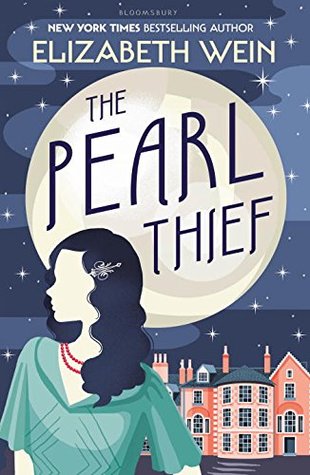 The book is The Pearl Thief, and it is as different as night and day or, to be specifically British about it, as chalk and cheese, to her previous work, even though its protagonist is one of the women from CNV, at age 15. And it is definitely written for a younger teenage audience. Before you expect me to pan it, let me say that it was a completely enjoyable read. But I was unconsciously expecting a level of drama and pathos, based on Code Name Verity, that simply didn’t manifest in this story.
If I hadn’t had specific expectations of this author, I still think I would have been intrigued by the book and its subject matter. It takes place in Scotland in 1938, and drops in at the end of an era for one family whose “perfect little Scottish estate, with a ruined castle and a baronial manor, nestled in woodland just where the River Fearn meets the River Tay” will no longer belong to the family, now that the death of Julia Beaufort-Stuart’s grandfather has triggered a reckoning. Lord Streathfern did all he could to save the house and the land for his heirs, but the combination of a lingering illness and a downturn in the economy made it necessary to sell up to a boys’ school, and the family are now inhabiting a small section of the house while the school administrators oversee the renovations and conversions necessary to turn it into the institution it will become. This will be Julie’s last summer on her grandfather’s land, with her brothers, her mother and grandmother, and the few servants left, and then they will move back to their own Craig Castle near Aberdeen, taking her widowed grandmother with them.
By broad contrast with Julie’s sheltered and privileged upbringing, the other vital characters in this story are the two teenagers, Ellen and Euan, in a family of Travelers who have spent seasons on Streathfern land time out of mind, helping harvest “tatties,” beating the bushes and collecting the downed birds during shooting holidays and, in between, collecting tin from the townsfolk and weaving baskets from the withies in the marshy land near the river. This land was ceded to them by right for the past 300 years in exchange for a small fortune in river pearls (which play a vital role in the story), but now the changing fortunes of the laird will mean change for them all.
As the story begins, Julie has just arrived home for the summer three days before she is expected. When no one is around up at the house, she changes out of her traveling outfit into a T-shirt and an old kilt and goes out hiking around the estate, reacquainting herself with her favorite haunts. One moment she is lying on the bank of the river with one arm immersed, tickling for trout in the deep, cold water, and the next she is awaking in a hospital ward with a splitting headache from a lump on her head, being treated with disrespect and disdain as the “tinker” girl they believe her to be. She discovers that she was found, unconscious, on a path in the woods, and brought into the hospital by two of the Travelers; once her mistaken identity is resolved, her mother is called, and she returns home, feeling battered and wondering about how it all happened.
It soon becomes clear that the thump on her head was no accident, and that it is probably directly related to a missing employee of the estate, who disappeared on the same day she landed in the hospital. Along with the two travelers, Euan and Ellen, she seeks out the reason why anyone would have sought to hurt her or the missing man and, in the process, must stand up for her Traveller friends as local bias against them starts framing Euan up for murder.
This book is a delightful combination of murder mystery, coming of age story, and a serious depiction of prejudice, as exhibited by many of the “regular” people towards the Travelers they hold in suspicion and distrust for their alternate lifestyle. Although it wasn’t quite what I expected in terms of drama and emotional engagement, it surprised me (in a good way) with its exposition of the themes Wein did choose to explore. I think adults could enjoy the book, but it is definitely written with teens in mind, and is one of those books one could recommend that promotes empathy to its young readers. The book would be appropriate for anyone 12 and up, although probably a lower age of 14 would find it more relateable.
This review is also to say, placing expectations on your favorite authors and holding them to some rigid ideal may make you miss out on books they wrote that are different but nonetheless effective and providing of considerable enjoyment.
ADDENDUM: Today (according to a post on Facebook) is National Book Lovers Day. I’m not making a special post like for the cats, because EVERY day is book lovers’ day here @TheBookAdept!
Results
In my previous post, I posed the question, “Can the setting of a story (a particular place or atmosphere) be a sufficiently appealing element to carry a book?” (Or something like that.) To research the experiment,
I read books by three of the authors recommended to the woman on the “What Should I Read Next?” Facebook page who requested “books that take place at the beach.”
Author #1 was Karen White, and I read her book The Sound of Glass. The title comes from the wind chimes constructed from pieces of polished beach glass that the original owner of the house depicted in the novel made and hung from the rafters all around.
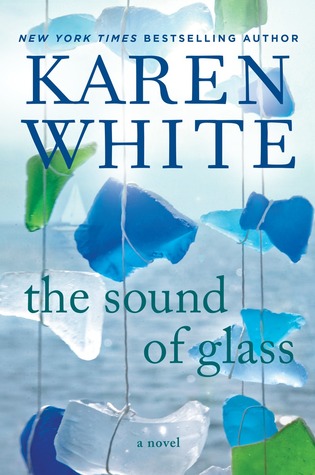 The book is set in Beaufort, South Carolina, which the author classifies as part of the “Outer Banks” (although Wikipedia says those are “a string of peninsulas and barrier islands separating the Atlantic Ocean from mainland North Carolina”). Suffice it to say, the setting is one of open beaches and also of protected swamplands characterized by flat-bottomed boats cruising above pluff mud, and trees covered in Spanish moss. Although there is a minor plot detail involving one of the protagonists’ fear of water, the setting doesn’t have a lot to do with the book, beyond providing evocative sound effects and scents unfamiliar to the one protagonist, who hails from Maine. Scene-setting mostly came down to that character, Merritt, complaining about the stifling heat. A lot.
The story in brief: Merritt’s husband died two years ago. She has recently discovered that his grandmother left him a house in South Carolina, and since he is dead, she inherits. She decides to upend her stagnant life in Maine to go live in it. Shortly after she arrives, so does her stepmother, who is a scant five years older than she is and has a 10-year-old son. The stepmother pleads poverty and asks to stay and Merritt reluctantly agrees, although her father’s marriage to this woman was the reason for her 12-year estrangement from him (he is also now deceased). The two begin to work out their relationship with one another, but it’s complicated by rather large secrets on both sides.
Someone on Goodreads described this book as “relationship melodrama,” and that about sums it up. The thing is, the bones of a good story are here: estranged family who find each other amidst personal crises. But Merritt (the buttoned-up Maine girl), and her counterpart, Loralee (the brash Southern blonde with the pancake makeup), are both such stereotypes that I found it hard to relate to them. Better than the two protagonists, I liked Loralee’s kid, Owen, and Merritt’s doctor/brother-in-law, Gibbes. They were less prone to both drama and cliché, and I think their characters show of what this author is capable if she would quit dropping into the easy channels dug by predecessors.
The secret Loralee is keeping is obvious to everyone but Merritt, but the way she goes about ingratiating herself and her son with her stepdaughter is pretty ingenious. If the story consisted solely of this plot, I think I would have liked it better. Instead, we had to do a whole convoluted study of Merritt’s damaged psyche and how it got that way, and although exposing some of the issues was a worthy goal, her protracted whinging was exhausting. And her ultimate secret, the one that connects grandmother with grandsons with widow, is patently ridiculous.
A comment on writing: When I am reading a book, I subconsciously give the reading the same tests that I give my own writing, one of which is not to use the same descriptive word twice on the same page (let alone in the same sentence), and yet that happens over and over again in this book. The author has the potential for good story-telling, with evocative images and powerful characters, but sloppy writing (uncorrected by her inattentive editors) and tendency to drop into cliché operated for me against enjoyment. I probably will not read any other books by Karen White.
The second author whose work I sought out was that of Elin Hilderbrand, a perennially popular name associated with “beach read” in the Facebook group. I scanned her list of offerings on Goodreads and selected a book that had uniformly higher marks, since some of the others swung wildly between two stars and five. The one I ended up reading was The Identicals.
 I was immediately captivated by the slightly tongue-in-cheek comparison between Nantucket and Martha’s Vineyard in the prologue, citing the benefits of each and the detriments of the other from the residents’ point of view. It was a great set-up for the story: While Nantucket and Martha’s Vineyard may look to the rest of the world like similar places, to the natives they are worlds apart, even though that distance is a scant 11 miles. Similarly, while twins Tabitha and Harper are identical enough to fool others even at age 39, they are completely different in their life choices and affects.
The story in brief: Twins Tabitha and Harper have been estranged for many years, for various reasons. Harper lives on Nantucket near their father, Billy, while Tabitha assists in their mother’s previously successful but now waning design business/dress shop. Things suddenly get stirred up: Billy dies; Harper’s affair with his doctor becomes a common topic of island gossip; and Eleanor (their mother) falls and breaks her hip. Add to that mix Tabitha’s precocious and trouble-making 16-year-old daughter, Ainsley. Harper needs to cultivate a low profile, Tabitha needs to care for their mother in her recuperation but is at her wits’ end with both her teenager and her dress shop, and something needs to be done about Billy’s ramshackle house on Nantucket. All these circumstances combine to make the twins grudgingly reach out to one another for assistance (facilitated by Ainsley, who is dying of curiosity about their lack of relationship) for the first time in decades.
Part of the reason why this plot line works is that the author herself (in the guise of her various narrators) initially sets it up for derision by comparing the separation of the twins at age 17—one going with “Mommy” and one with “Billy” when their parents divorced—to the Hayley Mills/Lindsay Lohan Parent Trap plot. She then uses their wholly different upbringings—Harper’s on Nantucket as a laid-back, casual evolution into an underachieving adulthood, and Tabitha’s on Martha’s Vineyard (and in Boston) as an uptight, socially restrictive one with high expectations of her performance—as a parallel for the respective towns. It was cunningly written.
I also liked that although there were important elements of mistaken identity “hijinks” and romance in the book, the story was by no means restricted to those plot lines and in fact was much more about the obstacles to familial love and how to overcome them. The back stories were also credible, and gave the story depth. Based on this book, I would read another by Hilderbrand.
As far as the influence of setting, in addition to paralleling elements of the story it also made me wish for sea wind in my hair and a big bowl of clam chowder in front of me on the table. The atmosphere definitely both contributed to and influenced the plot.
For my third book, I chose Sunset Beach, by Mary Kay Andrews, an author appearing on the Facebook page and also mentioned to me as one fitting into the category by my friend Patrice.
The story in brief: Drue Campbell has just gone through her mother’s protracted illness and death when her estranged father, who left them 20 years ago, turns up with a proposition: Drue has inherited her grandparents’ ocean-front cottage in the same town where Brice Campbell has his lucrative personal injury law practice, and Brice thinks she should move into the cottage and take a job at his firm. Complicating the issue is his new wife and office manager, Wendy, who also happens to be Drue’s 8th-grade frenemy. Drue is down on her luck and can’t afford to say no, but she agrees with an ill grace and initially resents both the job and her father and “stepmother.” Then, she is arrested by the plight of one of Brice’s former clients, whose lawsuit over a suspicious death didn’t receive the attention it deserved, and decides to investigate.
 In this book, Drue’s former hobby (kite-boarding) and her nightly walks on the beach and swims in the ocean from the venue of her derelict cottage do give a beachy atmosphere to the book. But I would definitely not call this one “just” a beach read. Although the opening scenes paint this as “relationship fiction” with the reuniting of Drue with her absentee father, the scenes between them are sometimes shallow, with Drue coming across like a snarky teenager. Brice himself is a bit of a cardboard cutout—bland and not particularly compelling—while Wendy (the new wife) is a cliché of a shrew. But the rest of the book—in which Drue starts out working as an information-taker over the phone for her father’s legal practice and ends up (after taking an interest in an old case with an unsatisfactory resolution) as a bull-headed private investigator—is much more compelling. While there are bits of romance and reconciliation here, the main story is the mystery and this is how I would recommend the book if I were to suggest it to someone. Based on this book, I would read another of Andrews’s, although it could have done with a little more depth in the relationships before switching to the mystery.
Of the three books, I would say that only Hilderbrand’s reinforced the theory that setting can be powerful enough to carry a story. Although the beach hotel culture does become fairly important in Andrews’s tale of betrayal and murder, both the other books could probably have been set anywhere without it feeling like something essential was removed from the plot. In Hilderbrand’s, plot and setting were intertwined, which is the ideal when setting is an issue.
As for my other premise, that people who like a “slow build” in pacing in one genre will enjoy the same in others, that will have to wait for another day and some reporting back from other readers!
Kate Racculia
In 2015, I picked up Bellweather Rhapsody, by Kate Racculia, to check it out for my high school book club. It had just won an Alex Award, which is given to 10 books each year that are written for adults but that have appeal for teens. My high school club had become sophisticated readers, and that year we were going almost exclusively for Alex Award books, since 18 out of our 23 members were seniors and the rest were juniors.
 I never persuaded the club to choose the book; it always got high votes, but never made it to the final pick, and I always regretted that.
Recently, I was reminded of how much I liked it when I saw on the “What Should I Read Next?” Facebook page that Racculia had published a new book, Tuesday Mooney Talks to Ghosts, in 2019. I put it on reserve for my Kindle at the library and awaited its arrival.
While I waited, I went back to Goodreads to review what I had thought of that first book. A brief description: Every year the Bellweather Hotel in upstate New York hosts a high school musical competition called “Statewide,” where music and performance students gather to display their skills. In 1997, twin high school seniors Alice and Bertram “Rabbit” Hatmaker have both qualified to attend. Rabbit plays bassoon in the orchestra, while his sister, an aspiring actress and singer, is in the chorus. Meanwhile (unrelated to the competition), Minnie Graves, who was a child attending a wedding in 1982 when she discovered the groom shot dead and the bride hanging from the light fixture in room 712, has returned for the weekend with her support dog, Augie, to attempt to face down her demons.
Alice is paired as a roommate (in that same room, of course!) with flute prodigy Jill, who also happens to be the daughter of the hated and feared Viola Fabian, sarcastic head of Statewide. Alice discovers Jill’s hanging body in their room on the first evening, but while she runs to get help, the body disappears. Viola dismisses it as an attention-seeking prank, but…if so, where is Jill? All in attendance will have plenty of time to find out, as the Bellweather is enveloped by the biggest snowstorm of the season, and no one is able to leave.
This book started out feeling like a cliché, if an enjoyable one:
The set-up was like a combination of The Shining (Stephen King) and Christie’s And Then There Were None, and I had resigned myself to enjoying it for those familiarities, with perhaps a few modern twists. But there’s a whole lot more going on in this book than just a murder mystery. It’s a coming of age story, for both children and adults, compressed into a wild weekend in which the adults must re-examine what they’ve been told, what they’ve experienced, and what they remember longing for, and the children go through profound changes due to the catalysts provided by this weird music festival in a moldering old resort, while everyone (well, almost everyone—it is a murder mystery, after all!) comes out the other side changed. Parts are hilarious, parts are incredibly touching, and I loved the resolution for all the characters, who were sharp and quirky, and all of them unique.
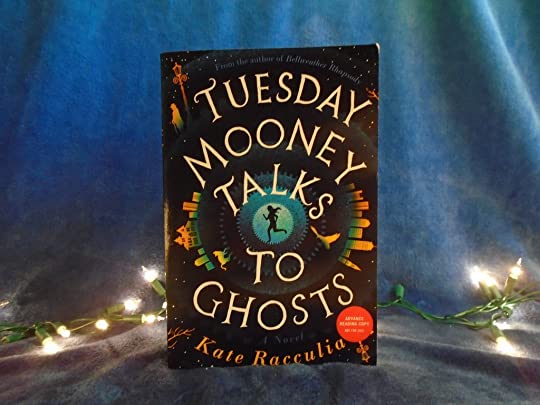
Tuesday Mooney Talks to Ghosts has a lot of the same things going for it. Racculia’s real gift is for creating memorable characters and making you care what happens to them, and in this book it’s Tuesday, Dex, and Dorry (and well, maybe Archie).
Tuesday Mooney has an unconventional job: She is what’s called a prospect researcher, which means she profiles wealthy people (for a Boston hospital) to see who best for the office fundraisers to hit up for donations. She has the skills of a private detective, but goes beyond those to assess property, analyze gossip, and also rely on her finely honed instincts to find information and connections. She is uniquely suited to this work, being a loner who prefers to be on the outside, noticing what the insiders will miss. She is a guarded person, whose best friend of 10 years has never even been to her apartment. Her austere reserve rises from a genuine and justified fear of having her heart broken.
She is among a dozen employees who have volunteered to work at the hospital’s “Auction for Hope,” to staff the sign-in tables, keep track of auction bids, and make herself generally useful. Tuesday always volunteers, because after learning absolutely everything she can about her subjects, these events are her only opportunity to interact with them in person. But she’s no fan-girl: She simply wants to weigh her assessment of their facts and figures against the reality of a first impression.
At this particular event, Tuesday manages to finagle a place on the guest list for her best friend, Dex Howard, a gay financier who longed to be in musical theater but settled for a large paycheck. Dex looks around for someone interesting to sit with, and meets eccentric billionaire Vincent Pryce, a collector of Edgar Allan Poe memorabilia, and his much younger wife, Lila. In the course of the evening, Pryce is outbid, stands up dramatically as if to challenge the person doing the bidding, and drops dead of a stroke. The Boston Herald headline the next day read PRYCE BIDS FAREWELL.
But his death is not the big news: Pryce has created an epic treasure hunt throughout Boston—clues inspired by Edgar Allan Poe—whose winner will inherit a share of Pryce’s wealth. Tuesday’s curiosity combined with her skills lead her and her oddball crew—Dex, her teenage neighbor Dorry, and the handsome heir to the Arches fortune she met at the benefit—into a complicated game that will make them face past tragedies, present shortcomings, and future hopes.
As I initially underestimated Bellweather Rhapsody, so did I have lesser expectations for this book. First of all, both the title and the cover art strongly suggested a middle-school novel, especially since many reviewers were comparing it to that old chestnut The Westing Game, by Ellen Raskin. Although it was reminiscent, in some ways, of that book, the one it reminded me of more was The Extraordinary Education of Nicholas Benedict, the prequel to the Benedict Society series by Trenton Lee Stewart. I immediately thought of Tuesday as a more mature version of Nicholas—clever, introverted, and innovative. Her selection of her friends was likewise unexpected but key.

The supernatural element doesn’t actually merit the implications of the name of the book: Tuesday talks to only one ghost, that of her dead teenage friend Abby, and it’s a toss-up whether this is a real spirit contact or just a trauma reaction to her loss. (Her young friend Dorry longs to talk to ghosts, notably that of her deceased mother, and covets Pryce’s possession of Edgar Allan Poe’s goggles, said to allow one to see them.) But the plot is engaging, not just because of the mystery or the potential for ghosts but also as a result of what pursuing the treasure hunt reveals in each of the four main characters. The book shows what it’s like to be haunted, not by a spirit but by longings to express the person you have squashed down inside of you in the interests of practicality. It deals with the ethics, pleasures, and responsibilities of money, and what it’s like to have it/not have it. It enters in depth into the theme of friendship. It’s a great mix of mystery, introspection, campy humor, and cultural references that shouldn’t work but does. I couldn’t put it down.
I see from Goodreads that Racculia wrote another book, her debut, back before Bellweather. It’s on my list.
Appeals: Eccentric, captivating, substantial characters; evocative world-building with some attention to detail (in both cases); a nice genre mix of mystery, ghosts, and human drama; and an engaging writing style.
Laudable series
As I mentioned in my previous post, I recently spent some time re-reading the four books and two novellas Sharon Bolton wrote about Detective Constable Lacey Flint, who works for the London police, sometimes with a murder team, other times undercover and, in one book, as part of the River Police who patrol the Thames.
Lacey is an iconoclast, part of that subgenre of mystery characters known as loners. She attempts to be colorless and matter-of-fact, to keep her head down and fit into the team; but she has so many secrets of her own to keep that it’s a relief to be able to focus instead on the secrets of others, on the methods and madnesses of the serial killers she hunts. As a young, new, and inexperienced detective, Lacey is extraordinarily unlucky about attracting the attention of these criminals to herself. There is some sort of affinity between Lacey and her prey that causes some among her fellow officers to be over-whelmed by the suspicion that she herself is the criminal they are seeking.
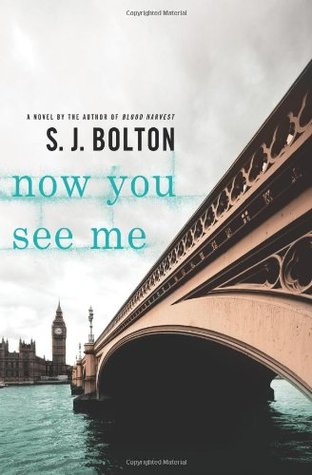 In the first book, Now You See Me, Lacey serves as a source for “her” team on the history of the Jack the Ripper killer, whose scenarios, methods, and exploits the murderer they are now seeking seems to be mimicking. What becomes clear as the team follows this killer further into the labyrinthine twists and turns of serial murder, however, is that the Ripper similarities are camouflage for something much more sinister, and that Lacey is at the center of the story. The rarity of this and the other books in the Lacey Flint series is that the mystery keeps unfolding in each, all the way to the last page.
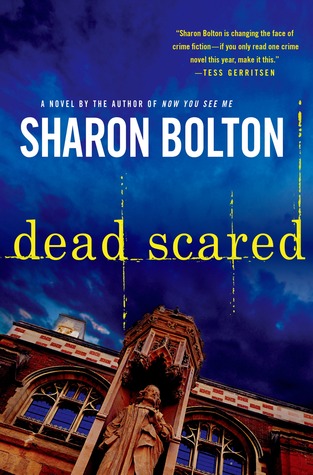 In Dead Scared, Lacey’s sometime mentor and reluctant crush, Detective Inspector Mark Joesbury, asks her to go undercover as a student at Cambridge University to explore the inexplicable uptick of bizarre suicides on that campus. Given her fragility since the recent end of their last case, her boss, Dana Tulloch, and other members of the team are concerned that Lacey will be overwhelmed by the necessity of playing this vulnerable part. But Joesbury thinks she’s up to it, and she’s the obvious choice, given her youthful appearance, so she immerses herself in campus life and tries to discover more about the raft of lonely and insecure students who chose such unconventional methods of death. It’s an insane plot, fascinating (and misleading) to the last page, and full of peril for more than just Lacey.
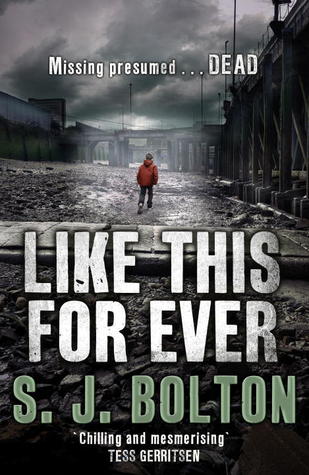 In Like This, For Ever, titled Lost in the United States, Lacey is on leave from her job, and considering not returning to it. She hasn’t been able to process the jumble in her head created by her last case, and is spending most of her time obsessively working out and taking long late-night walks to exhaust her enough for sleep. I can’t say too much about the plot of this one, because it takes an unusual twist at about 85 percent that I don’t want to reveal, but it’s written with Bolton’s usual skill and panache. Because Lacey is on leave, she is not directly involved in most of the police investigation of a serial killer who is targeting young boys. But the usual crowd (Stenning, Anderson, Mizon, Tulloch, Joesbury) are all on hand, and Lacey inevitably gets drawn in by an unexpected personal involvement with a seemingly peripheral character, the boy next door. There’s lots of suspense, with multiple red herrings and a great resolution.
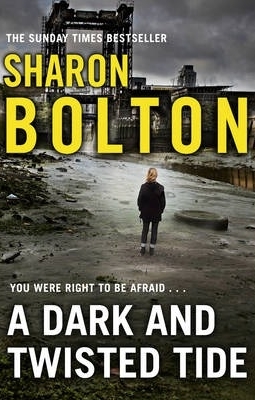 A Dark and Twisted Tide once again involves Lacey Flint in spite of herself. After her leave of absence, instead of working as a detective she has gone back to uniform as part of the river police, hoping to return gradually to the force, but quiet time is not in the cards. Only Lacey could be out swimming at high tide in the Thames River (a hobby she has taken up since moving onto a houseboat) and discover a body floating in the river wrapped carefully in white burial cloths. Soon it becomes obvious that she didn’t find it by accident, that once again someone is focused on her, trying to draw her in. Being Lacey, she lets herself be drawn. This one, I have to say, was a little weird in spots even for me—but I enjoyed it. I had two problems: First, I think it’s time for Bolton to take up a new story line with regard to Lacey—not every case can relate specifically to her! Second, the long-drawn-out non-courtship of Lacey and Detective Mark Joesbury can’t be prolonged beyond a point, and I think we just hit that barrier as readers. To quote my British friends, at least give us a little snogging!
The two novellas that Bolton wrote for this series exclusively as
e-books are equally compelling and mysterious. In the first, If Snow Hadn’t Fallen, something happens in Lacey’s neighborhood that weighs on her mind, because none of the explanations for it add up to what the killers attempted to convey. The second, Here Be Dragons, which falls at the end of the series, is a long-needed exposition of Mark Joesbury, detailing one of his undercover cases and leaving us, finally, with a cliffhanger regarding his relationship with Lacy. There have been two stand-alone books written and published since the #4.5 novella with the tease at the end; when, oh when, will we discover the outcome?
One of the things I like about this series is that Bolton has nicely combined two separate mystery subgenres. Her protagonist is a lone-wolf type, and we get all the fun that goes along with that; but the books are also pretty comprehensive police procedurals, detailing all the myriad ways in which the police go about solving a murder. This gives the lone-wolf concept a nice, solid background on which to rest.
These books are beautifully written, with a wealth of detailed description of the characters, the neighborhoods of London, and the beauties of the natural world that make themselves known even
along the dreariest parts of the river Thames. Both the characters
and the mysteries are sufficiently unique and well developed that
I would venture to say if you are a Tana French fan you would love these books.
They also remind me of Carol O’Connell’s series featuring Kathleen Mallory: Lacey Flint is likewise a damaged, somewhat amoral police detective who does everything according to her own instincts regardless of policy and logic, and gets “up people’s noses” even though she has no desire or intention to do so. I think Bolton has been wise, however, to vary her oeuvre with completely unrelated stand-alones; O’Connell’s Mallory has a distressing sameness from book to book as her series unfolds, and Bolton could fall into that trap with Lacey if she focused solely on her as a protagonist. That’s not to say I don’t want more of Lacy, because I do! But I will wait at the pleasure of Ms. Bolton and meanwhile enjoy everything else she has written, which is considerable.
Dystopian fantasy
I just finished the first two books in what I hope will be a longer series by Charlaine Harris, the author best known for her Sookie Stackhouse vampire books later immortalized as the TV show True Blood.
Harris has had a checquered history for me, with some of her books striking a major chord while others just struck out. I hated her cozy mystery series featuring Aurora Teagarden—I don’t know why, but I found the protagonist irritating and the plots excessively weird. I liked the vampire novels a lot for about the first five, and then they became increasingly silly and kind of desperate. I liked the Lily Bard mysteries that take place in Shakespeare, Arkansas, but they are grim and dark for recreational reading. The Midnight, Texas books are only okay, although I have a soft spot for the protagonist, psychic Manfred Bernardo. I tried a couple of her stand-alone novels from her early writing days but couldn’t get through them.
My favorites up until now have been a four-book series about Harper Connelly, a young woman who was struck by lightning as a teenager and survived it, only to discover that it had given her the power to know how people had died. She couldn’t see who killed them, but she could stand on her grave and reliably tell you if your wife accidentally drowned in the bathtub or if someone had pulled her under. Having no other skills that would earn her a living, she and her step-brother, Tolliver, team up (he acts as her manager) and hire her out to police departments and individuals who want or need to know cause of death. It’s an interesting lifestyle, to say the least, and the most enjoyable part of it is the sheer banality of their daily existence contrasted with the use of Harper’s particular gift. I have read the series three times.
 I say they are my favorites up until now because they may have just been aced out by some “new” books I didn’t even know she was writing. The first Gunnie Rose book, An Easy Death, was published in October of 2018, and the second, A Longer Fall, came out this past January. There is a Goodreads note for a third one on the way, no date indicated.
Although I shouldn’t be surprised at the extent of Harris’s imagination (especially after the cast she developed for the Sookie Stackhouse novels), I was so taken with the concept for this book. Perhaps it is conditioning from all the dystopian teen fiction I have read during my 10-year career as a teen librarian, but I do love an alternate history, and this one really delivers.
The setting is the former United States, but one event—the assassination of Franklin Delano Roosevelt—has significantly altered the history of the country. Without Roosevelt’s guiding hand during the Great Depression, the crippled country fractures, and various states were either absorbed into surrounding countries, taken over by former rulers, or banded together to form small nations. The original 13 Colonies pledged fealty to the British Empire; a few of the “top” border states became part of Canada; the south-eastern states are now “Dixie” while Texas and Oklahoma and a few others formed “Texoma”; the “flyover” states remained “New” American territory; the rest of the southwest was annexed by Mexico; and the biggest surprise was California/the Pacific Northwest, which was taken over—by a combination of invitation, treaty, advantageous marriages, and magic—by the tsar Nicholas and the remains of the Holy Russian Empire, which is now its new name.
 Yes, magic is what I said: This dystopia is not only an alternate history, but also includes wizardry, mastered primarily by the Russians, who value it, and the British, who don’t, so many British wizards have migrated to the new HRE on the Pacific coast, inter-
mingling with their Russian counterparts to maintain the rule of the Romanovs. Readers of history will remember that the Romanovs had a fatal flaw in the male bloodline—hemophilia—and it is this flaw around which Harris has built this first story about Gunnie Rose.
It seems that only the blood of Rasputin (and his descendents) can keep Nicolai’s heir, Alexei, alive, and now that Rasputin is deceased, the hunt is on to find the descendents who can help the Russians maintain their hold. Two wizards travel to Lizbeth “Gunnie” Rose’s home in Texoma, seeking an illegitimate granddaughter rumored to live in the state, and hire Gunnie to protect them while they make their search. Gunnie Rose is between jobs and desperate for cash, so she packs up her arsenal and takes them up on their offer, despite her distrust of Russia and wizardry. But Gunnie is nothing if not brave, and she has ample opportunities to prove this as people intent on preventing the wizards’ mission keep trying to take them out.
 This series is pure delight, from the elaborate world-building to the laconic Western flavor of Texoma, and the characters are so alive they could step off the page. Harris has written this with just the amount of detail you crave, without drowning you in either description or explanation, and the pace of this mystery/adventure story is perfect. The minute I finished the first book, I jumped without hesitation into the second one.
The second book takes Gunnie Rose and the reader on a train trip into Dixie with a crew new to her, guarding a crate with mysterious contents and not even knowing its ultimate recipient. The mission is quite literally derailed, along with the train, and Gunnie is left, once again, with most of her crew dead or disabled, wondering what could be so important that the people who wanted the crate’s contents would kill that many people by blowing up the train to get it. When her former partner and lover, Eli the grigori wizard, shows up, she begins to winkle out some answers, but the truth is stranger than anyone could imagine.
What a fun and imaginative read. I hope she doesn’t take too long to produce the third volume.
(I loved the cover on this one, showing Gunnie Rose basically sulking because in Dixie she has to appear ladylike by wearing blouses and skirts and petticoats and stockings—and foregoing her gunbelt—in order to fit in. I greatly sympathized with her sigh of relief when she could finally resume the jeans and boots of her everyday wear.)
Journalism & crime
 On May 26th, a surprise arrived via my Kindle. I had completely forgotten that I had pre-purchased Michael Connelly’s new novel, Fair Warning, to be delivered as soon as it was published, and suddenly there it was! I had another book mid-read, so I have just finished it.
Connelly leaves the world of Harry Bosch to hark back to gonzo journalist Jack McEvoy, the protagonist of two of his former books, The Poet and The Scarecrow. Although I read both of those books when they came out (I have to date read 34 of Connelly’s books!), it’s been such a long time that I toyed with the idea of revisiting them first before proceeding with the new one, but chose to forge ahead. Although there were a few references to the previous cases in this one, it essentially read like a stand-alone for those who hadn’t read them, so that was fine.
As well as being the title of the book, Fair Warning is the name of a non-profit consumer protection news website run by Myron Levin (which actually exists in real life). Jack is a reporter for this website, which feels like something of a come-down from his former hard-hitting crime beat for the L.A. Times (and his authorship of two best-selling books), but he is quick to point out that consumer reporting is a vital service to the public, especially in this age of accelerating scientific discovery, and that many major papers (the L.A. Times and others) pick up and run with his stories. Maybe he protests too much?
The beginning of this story, however, isn’t professional, it’s personal: Two homicide detectives show up at McEvoy’s door with the news that Tina Portrero, a woman with whom he had a fun, slightly drunken one-night stand (a year previous) has been brutally murdered, and he is a suspect. Jack cooperates to the extent that he provides a DNA sample in order to eliminate himself from their list of “people of interest”; but then, because of a curious mind and an eye for the anomalous detail, McEvoy gets ahead of the detectives on this crime and a bunch of related ones.
The method of the murder (which I won’t mention here) is so dramatic and so extreme that McEvoy researches it, and discovers that this method appears in widespread cases; then he notices that the murderer may have been using personal data shared by the victims themselves in a particular way, to select and hunt his targets.
At this point, McEvoy has ceased to think of himself as an accused murderer and started to see the potential for a really big story that involves solving the murders of a bunch of women, zeroing in on a serial killer, and even calling the government to account for lax practices in data protection. So he decides to reach out to his former lover, Rachel Walling, whose FBI profiling career he burned the last time they collaborated, to see if she can pull some strings for him.
Instead, Rachel jumps into the middle of his quest, perhaps to curry favor with and return to the FBI fold, helping Jack’s information stream but also setting up all kinds of conflicts of interest.
A big part of the story here is the moral quandaries in which the various characters find themselves. McEvoy does want to identify the killer and facilitate his capture; but he also wants to break his story, which means he can’t hand over all his information to the police until he “gets the scoop.” He and Rachel Walling have a chemistry between them that didn’t disappear with their falling-out years ago, so there is a motivation to perhaps rekindle that. In addition, Walling has been pursuing a necessary but boring job since she left the FBI, so the prospect of handing them a serial killer ignites her with the ambition to prove them wrong for firing her. A colleague of Jack’s at the website, who is added to the story by his editor, wants to make a name for herself without treading on Jack’s toes too much to do so; and Jack realizes that although he is the better researcher, she is the better writer, so he reluctantly acquiesces in her involvement but then keeps throwing her under the bus. And of course the police want to be the first, last, and final arbiters of what happens with this case, story scoop be damned. It makes for an interesting level of tension throughout the story.
Connelly has pulled off a gripping, fast-paced tale whose interest level is enhanced by having a reporter, rather than a detective, at the helm. Some of the true-to-life details of data collection and (the lack of) government regulation are chilling, and he also fills in the reader on some aspects of operating on the dark web, as well as providing the usual details of his Los Angeles setting that are fun for those of us who live here and recognize them. I enjoyed this book, and it was a nice change from the Bosch litany.
And no, I have no idea why there is a black bird (a crow? a raven?) on the cover.
 The Book Adept